


 |
市場調查報告書
商品編碼
2100003
航太與國防領域被動電子元件:市場佔有率分析、產業趨勢與統計及成長預測(2026-2031)Passive Electronic Components in Aerospace And Defense Industry - Market Share Analysis, Industry Trends & Statistics, Growth Forecasts (2026 - 2031) |
||||||

※ 本網頁內容可能與最新版本有所差異。詳細情況請與我們聯繫。
據 Mordor Intelligence 稱,2025 年航太和國防被動電子元件的市場規模為 41 億美元,預計到 2031 年將從 2026 年的 43.4 億美元成長到 57.7 億美元,預測期(2026-2031 年)的複合年成長率為 5.87%。
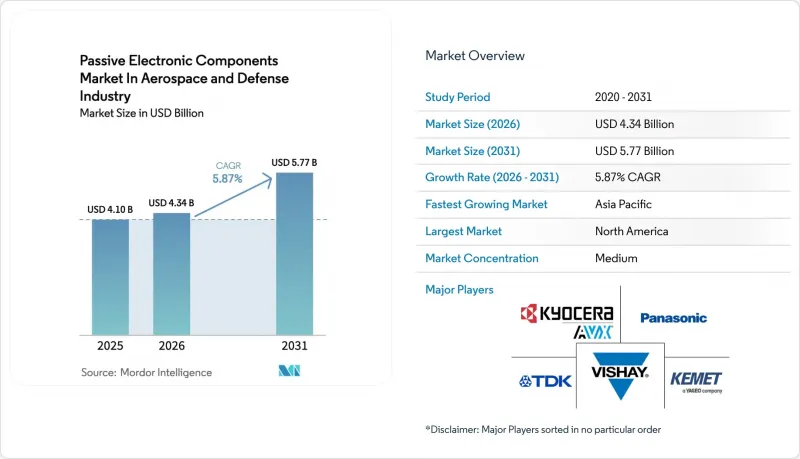
本報告按產品類型(電容器、電感器等)、平台(固定翼飛機、旋翼飛機等)、最終用途(航空電子設備、通訊設備、配電設備等)和地區(北美、南美、歐洲、亞太地區等)進行細分。市場預測以美元計價。
航太和國防領域被動電子元件市場的趨勢和發展。
擴大「更電動化」飛機架構的應用
飛機製造商正以電氣子系統取代液壓和氣壓系統,這項轉變提高了下一代平台的功率密度和熱負荷。作為其「清潔航空轉型計畫」(Clean Aviation Switch program)的一部分,柯林斯太空公司(Collins Aerospace)對兆瓦級配電原型進行了現場測試,檢驗了組件在史無前例的電應力水平下的運作情況。通用電氣宇航公司(GE Aerospace)的碳化矽功率級相比傳統矽元件,功率密度提高了約三倍,效率提高了3%,從而推動了電容器、電阻器和磁性元件的類似進步。空中巴士和東芝正在合作開發一種2兆瓦級超導性推進系統概念,顯示未來對低溫被動元件的需求將持續成長。隨著額定電壓提升至千伏特級,具有低損耗角正切和最小寄生電感的介電材料正變得具有戰略意義。擁有自主陶瓷複合材料技術和獨特箔材技術的供應商,在民用和軍用飛機製造領域新興的設計訂單中佔據了有利地位。
增加國防電子設備現代化預算
美國陸軍已在2025財政年度累計86億美元用於通訊和電子設備採購。這項預算將間接增加無線電、感測器和火控子系統對被動元件的需求。歐洲也出現了類似的投資趨勢,重點是無人機的雷達升級和電子戰系統。英國航空航太系統公司(BAE Systems)已訂單一份價值超過4.4億美元的契約,用於對布雷德利A4戰車進行數位化電子設備現代化改造,這推動了對符合MIL-PRF和DO-160認證的高可靠性被動元件的需求。國防領域的領先製造商正在將人工智慧(AI)整合到訊號處理鏈中,這反過來又要求電容器和電感器具有更嚴格的電壓容差和更寬的動作溫度範圍。由於專案進度通常會超過商業產品的生命週期,因此提供長期供應合約和過時管理服務的供應商保持優勢。隨著開放系統結構的日益普及,不斷提高的相容性要求凸顯了符合多種標準且具有封裝相容性的被動元件的重要性。
鉭和鈀價格波動
鉭和鈀的供應仍集中在少數幾個礦產國,這使得航太產業的供應鏈極易受到價格上漲和出口限制的影響。根據美國政府責任署 (GAO) 的報告顯示,美國國防部 100% 依賴進口來滿足其鉭需求,這進一步加劇了關鍵任務電容器的脆弱性。現貨市場價格高企正在擠壓零件製造商的利潤空間,而他們必須履行多年前簽訂的固定價格合約。雖然人們正在考慮使用鈮氧化物和高壓多層陶瓷等替代介質,但由於認證過程漫長,這些材料的廣泛應用進展緩慢。製造商正在透過確保策略儲備和建立跨洲雙重採購安排來應對這項挑戰。儘管金融對沖產品可以提供一定的緩解措施,但如果出口禁令在幾乎沒有或根本沒有事先通知的情況下實施,這些產品也無法降低交付風險。
細分市場分析
預計到2025年,電容器將佔據被動電子市場57.34%的佔有率,複合年成長率(CAGR)為7.68%。這反映了電容器在儲能、電源調節和電磁干擾(EMI)抑制方面的核心作用。鉭電容器和高容量多層陶瓷電容器有助於滿足MIL-STD-704F標準規定的保持時間要求,即使在發電機瞬態過程中也能維持航空電子設備的供電。隨著更多電氣化飛機引入兆瓦級電壓軌,此類產品類型受益匪淺;採用聚丙烯和氟化介質的薄膜設計即使在高溫下也能實現低損耗。電感器和電阻器的需求曲線趨於成熟,但隨著射頻前端向高頻率發展,它們仍保持中等個位數的成長率。小型化努力正在將元件尺寸縮小到0402或更小,同時保持其在寬溫度範圍內的可靠性。
被動電子市場對公差要求越來越高,耐壓能力也越來越強,促使供應商加強對薄膜沉積、微影和自主光學檢測技術的投資。垂直整合粉末冶金霧化和陶瓷流延製程的供應商即使在原料短缺的情況下也能確保穩定的供應。同時,直接成型於印刷電路基板的嵌入式被動元件也越來越受到關注,這有助於減輕衛星和無人機(UAV)的重量。這些元件能否被廣泛採用,取決於它們能否滿足IPC-6012認證週期和電路基板組裝過程中的返工要求。為了滿足這些嚴苛的需求,供應商目前提供結合薄膜和陶瓷元件的混合電容器模組,以最佳化紋波容差和體積效率。
區域分析
憑藉雄厚的國防預算和成熟的商用航太供應鏈,預計北美將在2025年佔據被動電子市場33.05%的佔有率。根據《晶片與科學法案》資助的政府計畫旨在促進鎵和稀土元素的國內加工,但美國政府責任署(GAO)警告稱,在2030年之前,大規模產能難以實現。波音、洛克希德·馬丁和雷神索爾等主要承包商優先考慮供應商的韌性,並與在北美設有冗餘製造地的零件製造商簽訂多年期合約。政策獎勵正在推動晶圓級電容器製造回歸美國,但高資本密集度阻礙了新工廠的建設。出口合規機制,包括《國際武器貿易條例》(ITAR)和《國防聯邦採購條例補充條款》(DFARS)中的網路安全條款,增加了行政負擔,並有利於熟悉國防合約的現有公司。
亞太地區預計將維持最高成長率,到2031年年均複合成長率將達到7.86%,主要受飛機保有量增加和國防項目推進的推動。中國、日本、韓國和印度正在大力投資低地球軌道(LEO)和地球靜止軌道(GEO)衛星星系,這大大增加了對抗輻射被動元件的需求。遍布東南亞的電子製造群為多層陶瓷電容器和繞線電感器提供具有成本競爭力的組裝服務。然而,該地區對鈷、鉭和鈀等金屬進口的結構性依賴使得價格容易受到外部衝擊的影響。原始設備製造商(OEM)正在透過擴大本地研發中心和客製化設計來應對這項挑戰,以滿足區域適航法規的要求。戰略儲備和材料替代方案正在減輕地緣政治因素造成的短期供應中斷的影響。
憑藉先進的民用航太計畫和北約成員國的國防現代化建設,歐洲在被動電子市場保持強大的影響力。環境法規正在加速以符合RoHS標準的替代品取代傳統化學品,從而推動無鉛焊料合金和無鹵層壓板的創新。 「清潔航空聯合計畫」下的合作框架實現了電氣化演示驗證機的風險分擔。法國、德國和英國的衛星主承包商透過合約強制要求在航太應用中使用歐洲製造的被動元件,從而保護了當地的供應鏈。儘管中東和非洲的需求仍處於起步階段,但各國國防採購方案中日益增多的技術轉移條款,正為願意投資本地組裝和測試業務的合格供應商創造長期機會。
其他好處:
- Excel格式的市場預測(ME)表
- 3個月的分析師支持
目錄
第1章:引言
- 研究假設和市場定義
- 調查範圍
第2章:調查方法
第3章執行摘要
第4章 市場狀況
- 市場概覽
- 市場促進因素
- 擴大「更電動化」飛機架構的應用
- 增加國防電子設備現代化預算
- 低衛星星系擴展
- 向寬能隙(GaN/SiC)功率電子裝置過渡
- 客製化射頻被動元件的積層製造
- 強制遵守北約STANAG 4736標準中類似RoHS的有害物質法規
- 市場限制因素
- 鉭和鈀價格波動
- 地緣政治因素導致供應鏈中斷
- 客製化射頻被動元件的積層製造(3D列印)技術的普及
- 對立方衛星聚合物薄膜的氣體釋放實施更嚴格的限制
- 產業供應鏈分析
- 宏觀經濟因素的影響
- 技術展望
- 波特五力分析
第5章 市場規模與成長預測
- 依產品類型
- 電容器
- 電感器
- 電阻器
- 其他被動元件產品類型(變壓器、晶體等)
- 按平台
- 固定翼飛機
- 旋翼飛機
- 無人駕駛飛行器(UAV)
- 太空船和衛星
- 飛彈和導引武器
- 按最終用途
- 航空電子設備
- 通訊與導航
- 電力分配與調節
- 電子戰和雷達
- 溫度控管
- 按地區
- 北美洲
- 美國
- 加拿大
- 墨西哥
- 南美洲
- 巴西
- 阿根廷
- 其他南美國家
- 歐洲
- 德國
- 英國
- 法國
- 義大利
- 西班牙
- 俄羅斯
- 其他歐洲國家
- 亞太地區
- 中國
- 日本
- 印度
- 韓國
- 東南亞
- 其他亞太國家
- 中東和非洲
- 中東
- 沙烏地阿拉伯
- 阿拉伯聯合大公國
- 其他中東國家
- 非洲
- 南非
- 埃及
- 其他非洲國家
- 中東
- 北美洲
第6章 競爭情勢
- 市場集中度
- 策略趨勢
- 市佔率分析
- 公司簡介
- TDK Corporation
- Vishay Intertechnology Inc.
- KYOCERA AVX Components Corporation
- KEMET Corporation(Yageo Group)
- Panasonic Holdings Corporation
- Murata Manufacturing Co., Ltd.
- Samsung Electro-Mechanics Co., Ltd.
- Taiyo Yuden Co., Ltd.
- WIMA GmbH & Co. KG
- Cornell Dubilier Electronics, Inc.
- API Delevan Inc.(Regal Rexnord)
- Bourns, Inc.
- TE Connectivity Ltd.
- Eaton Corporation plc
- TT Electronics plc
- Ohmite Manufacturing Company, LLC
- Honeywell International Inc.
- Exxelia Group SAS
- Smiths Interconnect Inc.
- Littelfuse, Inc.
- Johanson Dielectrics, Inc.
- NIC Components Corp.
- Delta Electronics, Inc.
- Lelon Electronics Corporation
- Knowles Precision Devices(Knowles Corp.)
第7章 市場機會與未來展望
According to Mordor Intelligence, the passive electronic components market size in the aerospace and defense industry was valued at USD 4.1 billion in 2025 and estimated to grow from USD 4.34 billion in 2026 to reach USD 5.77 billion by 2031, at a CAGR of 5.87% during the forecast period (2026-2031).
This report is Segmented by Product Type (Capacitors, Inductors, and More), Platform (Fixed-Wing Aircraft, Rotary-Wing Aircraft, and More), End-Use Application (Avionics, Communications, Power Distribution, and More), and Geography (North America, South America, Europe, Asia-Pacific, and More). The Market Forecasts are Provided in Terms of Value (USD).
Insights and Trends of Passive Electronic Components Market in Aerospace And Defense Industry
Increasing Adoption of More-Electric Aircraft Architectures
Airframe primes are replacing hydraulics and pneumatics with electrically driven subsystems, a shift that intensifies power densities and thermal loads across next-generation platforms. Collins Aerospace has field-tested megawatt-class distribution prototypes under the Clean Aviation SWITCH program, validating component operation at unprecedented electrical stress levels.Silicon carbide-based power stages developed by GE Aerospace deliver roughly 3 X higher power density and 3% efficiency gains versus legacy silicon devices, prompting matching advances in capacitors, resistors, and magnetic components. Airbus and Toshiba have partnered on superconducting 2 MW propulsion concepts, signaling future demand for cryogenic-compatible passives. As voltage ratings rise toward the kV class, dielectric materials with low loss tangents and minimal parasitic inductance gain strategic importance. Suppliers with in-house ceramic formulation and proprietary foil technologies position themselves to capture emerging design slots across commercial and military aircraft builds.
Rising Defense Electronics Modernization Budgets
The U.S. Army earmarked USD 8.6 billion in FY 2025 for communications and electronics procurement, a budget line that indirectly scales passive component volumes across radio, sensor, and fire-control subsystems. Similar investment patterns in Europe focus on radar upgrades and counter-drone electronic warfare suites. BAE Systems received contracts exceeding USD 440 million to modernize Bradley A4 vehicles with digitized electronics, driving demand for high-reliability passives that meet MIL-PRF and DO-160 qualifications. Defense primes are layering artificial intelligence into signal-processing chains, prompting tighter voltage tolerances and wider operating temperature windows for supporting capacitors and inductors. Program schedules often outlast commercial product life cycles, so vendors with long-term supply agreements and obsolescence management services maintain an edge. As open-systems architectures proliferate, interchangeability requirements elevate the importance of footprint-compatible passive devices qualified to multiple standards.
Volatility in Tantalum and Palladium Prices
Tantalum and palladium supply remains concentrated in a handful of mining nations, exposing aerospace supply chains to price spikes and export restrictions. The U.S. Government Accountability Office reported that the Department of Defense relies on imports for 100% of its tantalum needs, amplifying vulnerability for mission-critical capacitors. Spot market surges compress margins for component makers that must honor fixed-price contracts awarded years earlier. Alternate dielectrics such as niobium oxide and high-voltage multilayer ceramic variants are under evaluation, yet qualification timelines delay their broad rollout. Manufacturers have responded by stockpiling strategic reserves and establishing dual-sourcing frameworks across continents. Financial hedging products provide partial relief but cannot mitigate delivery risk when export bans take effect with minimal notice.
Other drivers and restraints analyzed in the detailed report include:
- Expansion of LEO Satellite Constellations
- Shift to Wide-Bandgap (GaN/SiC) Power Electronics
- Geopolitical Supply-Chain Disruptions
For complete list of drivers and restraints, kindly check the Table Of Contents.
Segment Analysis
Capacitors held a 57.34% share of the passive electronic components market in 2025 and are on track for an 7.68% CAGR, reflecting their central role in energy storage, power conditioning, and electromagnetic interference suppression. Tantalum and high-capacitance multilayer ceramics help satisfy hold-up times dictated by MIL-STD-704F, ensuring avionics remain powered during generator transients. This product class benefits from megawatt-class voltage rails introduced in more-electric aircraft, where film designs with polypropylene or fluorinated dielectrics deliver low dissipation factors at elevated temperatures. Inductors and resistors follow with mature demand curves but still post mid-single-digit growth as RF front-ends migrate toward higher frequencies. Miniaturization efforts push component footprints below 0402 sizes while maintaining reliability under wide temperature swings.
The passive electronic components market demands tighter tolerance and higher voltage ratings, prompting investments in thin-film deposition, photo-lithography, and autonomous optical inspection. Suppliers that vertically integrate powdered metal atomization and ceramic tape casting gain supply assurance during raw-material shortages. Meanwhile, interest in embedded passives fabricated directly into printed circuit boards offers weight savings for satellites and UAVs. Adoption hinges on IPC-6012 qualification cycles and the ability to meet rework requirements during board assembly. Addressing both ends of the spectrum, vendors now offer hybrid capacitor modules that combine film and ceramic elements to optimize ripple handling and volumetric efficiency.
Complete Report Scope:
- By Product Type
- Capacitors
- Inductors
- Resistors
- Other Passive Component Product Types (Transformers, Crystals)
- By Platform
- Fixed-wing Aircraft
- Rotary-wing Aircraft
- Unmanned Aerial Vehicles (UAVs)
- Spacecraft and Satellites
- Missiles and Guided Weapons
- By End-Use Application
- Avionics
- Communications and Navigation
- Power Distribution and Conditioning
- Electronic Warfare and Radar
- Thermal Management
- By Geography
- North America
- United States
- Canada
- Mexico
- South America
- Brazil
- Argentina
- Rest of South America
- Europe
- Germany
- United Kingdom
- France
- Italy
- Spain
- Russia
- Rest of Europe
- Asia-Pacific
- China
- Japan
- India
- South Korea
- South-East Asia
- Rest of Asia-Pacific
- Middle East and Africa
- Middle East
- Saudi Arabia
- United Arab Emirates
- Rest of Middle East
- Africa
- South Africa
- Egypt
- Rest of Africa
- Middle East
- North America
Geography Analysis
North America commanded a 33.05% share of the passive electronic components market in 2025, buoyed by strong defense budgets and a mature commercial aerospace supply chain. Government programs funded under the CHIPS and Science Act target domestic processing of gallium and rare earths, yet the GAO cautions that meaningful capacity will not arrive before 2030. Leading primes such as Boeing, Lockheed Martin, and Raytheon emphasize supplier resilience, awarding multiyear agreements to component makers that maintain redundant North American manufacturing sites. Policy incentives encourage the reshoring of wafer-level capacitor fabrication, though high capital intensity slows greenfield progress. Export compliance regimes, including ITAR and DFARS cybersecurity clauses, introduce administrative overhead, favoring incumbents versed in defense contracting.
Asia-Pacific is forecast to log the highest 7.86% CAGR through 2031, propelled by rising aircraft fleet counts and indigenous defense projects. China, Japan, South Korea, and India invest heavily in LEO and GEO satellite constellations, multiplying demand for radiation-hardened passives. Electronics manufacturing clusters across Southeast Asia provide cost-competitive assembly for multilayer ceramic capacitors and wire-wound inductors. However, the region's structural reliance on imported cobalt, tantalum, and palladium exposes pricing to external shocks. OEMs respond by expanding local research and development centers to customize designs for regional airworthiness regulations. Strategic stockpiling and material substitution programs mitigate near-term exposure to geopolitical supply disruptions.
Europe maintains solid participation in the passive electronic components market thanks to advanced civil aerospace programs and defense modernization across NATO members. Environmental legislation accelerates the replacement of legacy chemistries with RoHS-compliant alternatives, fostering innovation in lead-free solder alloys and halogen-free laminates. Collaborative frameworks under the Clean Aviation Joint Undertaking allow shared risk on electrification demonstrators. Satellite prime contractors in France, Germany, and the United Kingdom contractually mandate European content for space-grade passives, safeguarding local supply chains. While the Middle East and Africa show nascent volumes, sovereign defense procurement packages increasingly stipulate technology-transfer clauses, presenting long-term opportunities for qualified suppliers willing to invest in local assembly and test operations.
- TDK Corporation
- Vishay Intertechnology Inc.
- KYOCERA AVX Components Corporation
- KEMET Corporation (Yageo Group)
- Panasonic Holdings Corporation
- Murata Manufacturing Co., Ltd.
- Samsung Electro-Mechanics Co., Ltd.
- Taiyo Yuden Co., Ltd.
- WIMA GmbH & Co. KG
- Cornell Dubilier Electronics, Inc.
- API Delevan Inc. (Regal Rexnord)
- Bourns, Inc.
- TE Connectivity Ltd.
- Eaton Corporation plc
- TT Electronics plc
- Ohmite Manufacturing Company, LLC
- Honeywell International Inc.
- Exxelia Group SAS
- Smiths Interconnect Inc.
- Littelfuse, Inc.
- Johanson Dielectrics, Inc.
- NIC Components Corp.
- Delta Electronics, Inc.
- Lelon Electronics Corporation
- Knowles Precision Devices (Knowles Corp.)
Additional Benefits:
- The market estimate (ME) sheet in Excel format
- 3 months of analyst support
TABLE OF CONTENTS
1 INTRODUCTION
- 1.1 Study Assumptions and Market Definition
- 1.2 Scope of the Study
2 RESEARCH METHODOLOGY
3 EXECUTIVE SUMMARY
4 MARKET LANDSCAPE
- 4.1 Market Overview
- 4.2 Market Drivers
- 4.2.1 Increasing adoption of "More-Electric" aircraft architectures
- 4.2.2 Rising defense electronics modernization budgets
- 4.2.3 Expansion of LEO satellite constellations
- 4.2.4 Shift to wide-bandgap (GaN/SiC) power electronics
- 4.2.5 Additive manufacturing of custom RF passives
- 4.2.6 NATO STANAG-4736 RoHS-like mandates
- 4.3 Market Restraints
- 4.3.1 Volatility in tantalum and palladium prices
- 4.3.2 Geopolitical supply-chain disruptions
- 4.3.3 Qualification bottlenecks for 3-D-printed passives
- 4.3.4 Stricter cube-sat out-gassing limits on polymer films
- 4.4 Industry Supply Chain Analysis
- 4.5 Impact of Macroeconomic Factors
- 4.6 Technological Outlook
- 4.7 Porter's Five Forces Analysis
- 4.7.1 Threat of New Entrants
- 4.7.2 Bargaining Power of Buyers
- 4.7.3 Bargaining Power of Suppliers
- 4.7.4 Threat of Substitute Products
- 4.7.5 Intensity of Competitive Rivalry
5 MARKET SIZE AND GROWTH FORECASTS (VALUE)
- 5.1 By Product Type
- 5.1.1 Capacitors
- 5.1.2 Inductors
- 5.1.3 Resistors
- 5.1.4 Other Passive Component Product Types (Transformers, Crystals)
- 5.2 By Platform
- 5.2.1 Fixed-wing Aircraft
- 5.2.2 Rotary-wing Aircraft
- 5.2.3 Unmanned Aerial Vehicles (UAVs)
- 5.2.4 Spacecraft and Satellites
- 5.2.5 Missiles and Guided Weapons
- 5.3 By End-Use Application
- 5.3.1 Avionics
- 5.3.2 Communications and Navigation
- 5.3.3 Power Distribution and Conditioning
- 5.3.4 Electronic Warfare and Radar
- 5.3.5 Thermal Management
- 5.4 By Geography
- 5.4.1 North America
- 5.4.1.1 United States
- 5.4.1.2 Canada
- 5.4.1.3 Mexico
- 5.4.2 South America
- 5.4.2.1 Brazil
- 5.4.2.2 Argentina
- 5.4.2.3 Rest of South America
- 5.4.3 Europe
- 5.4.3.1 Germany
- 5.4.3.2 United Kingdom
- 5.4.3.3 France
- 5.4.3.4 Italy
- 5.4.3.5 Spain
- 5.4.3.6 Russia
- 5.4.3.7 Rest of Europe
- 5.4.4 Asia-Pacific
- 5.4.4.1 China
- 5.4.4.2 Japan
- 5.4.4.3 India
- 5.4.4.4 South Korea
- 5.4.4.5 South-East Asia
- 5.4.4.6 Rest of Asia-Pacific
- 5.4.5 Middle East and Africa
- 5.4.5.1 Middle East
- 5.4.5.1.1 Saudi Arabia
- 5.4.5.1.2 United Arab Emirates
- 5.4.5.1.3 Rest of Middle East
- 5.4.5.2 Africa
- 5.4.5.2.1 South Africa
- 5.4.5.2.2 Egypt
- 5.4.5.2.3 Rest of Africa
- 5.4.5.1 Middle East
- 5.4.1 North America
6 COMPETITIVE LANDSCAPE
- 6.1 Market Concentration
- 6.2 Strategic Moves
- 6.3 Market Share Analysis
- 6.4 Company Profiles (includes Global level Overview, Market level overview, Core Segments, Financials as available, Strategic Information, Market Rank/Share for key companies, Products and Services, and Recent Developments)
- 6.4.1 TDK Corporation
- 6.4.2 Vishay Intertechnology Inc.
- 6.4.3 KYOCERA AVX Components Corporation
- 6.4.4 KEMET Corporation (Yageo Group)
- 6.4.5 Panasonic Holdings Corporation
- 6.4.6 Murata Manufacturing Co., Ltd.
- 6.4.7 Samsung Electro-Mechanics Co., Ltd.
- 6.4.8 Taiyo Yuden Co., Ltd.
- 6.4.9 WIMA GmbH & Co. KG
- 6.4.10 Cornell Dubilier Electronics, Inc.
- 6.4.11 API Delevan Inc. (Regal Rexnord)
- 6.4.12 Bourns, Inc.
- 6.4.13 TE Connectivity Ltd.
- 6.4.14 Eaton Corporation plc
- 6.4.15 TT Electronics plc
- 6.4.16 Ohmite Manufacturing Company, LLC
- 6.4.17 Honeywell International Inc.
- 6.4.18 Exxelia Group SAS
- 6.4.19 Smiths Interconnect Inc.
- 6.4.20 Littelfuse, Inc.
- 6.4.21 Johanson Dielectrics, Inc.
- 6.4.22 NIC Components Corp.
- 6.4.23 Delta Electronics, Inc.
- 6.4.24 Lelon Electronics Corporation
- 6.4.25 Knowles Precision Devices (Knowles Corp.)
7 MARKET OPPORTUNITIES AND FUTURE OUTLOOK
- 7.1 White-space and Unmet-Need Assessment

 表面黏著技術被動元件市場:全球市場預測,2026-2032年
 被動電子元件:市場佔有率分析、產業趨勢與統計、成長預測(2026-2031)
 被動電子元件市場預測至2034年-按元件類型、材料、封裝技術、應用、終端用戶產業和地區分類的全球分析被動和互連電子元件市場:2026-2032年全球市場預測(按元件類別、安裝方式、介質材料、頻段、分銷管道、應用領域和最終用戶行業分類)
 2026年全球電阻墊市場報告
 全球被動電子元件市場:市場展望(2026-2031年)
 被動電子元件市場:按類型、最終用戶和地區分類
 被動電子元件市場規模、佔有率、趨勢及預測(按類型、最終用途產業及地區分類),2026-2034年歐洲航太與國防領域被動電子元件:市場佔有率分析、產業趨勢、統計數據和成長預測(2026-2031 年)
 被動電子元件市場-2025-2030年預測