


 |
市場調查報告書
商品編碼
2099943
DDR5 DRAM可靠性技術:市場佔有率分析、產業趨勢與統計數據、成長預測(2026-2031年)DDR5 DRAM Reliability Technology - Market Share Analysis, Industry Trends & Statistics, Growth Forecasts (2026 - 2031) |
||||||

※ 本網頁內容可能與最新版本有所差異。詳細情況請與我們聯繫。
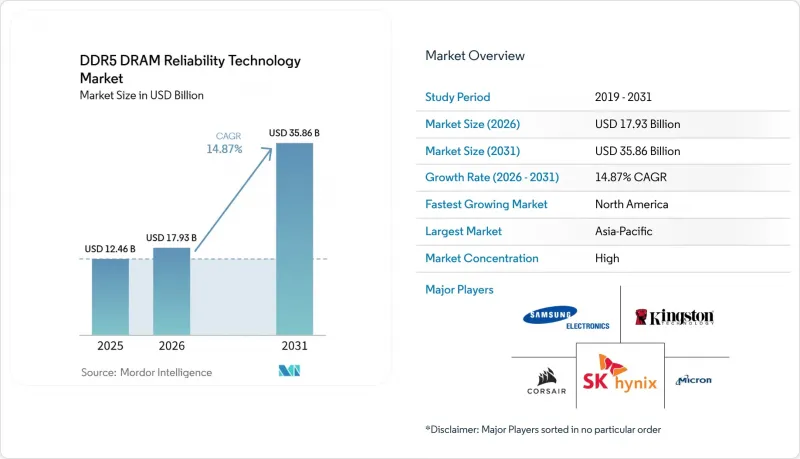
根據 Mordor Intelligence 預測,DDR5 DRAM 可靠性技術的市場規模預計將在 2025 年達到 124.6 億美元,在 2026 年達到 179.3 億美元,在 2031 年達到 358.6 億美元,從 2026 年到 2031 年的複合年成長率為 14.87%。
本報告依技術(片上ECC DDR5、系統級ECC DDR5模組等)、模組類型(RDIMM、LRDIMM、MRDIMM等)、容量(最高32 GB、32 GB至64 GB等)、資料速率(最高5,600 MT/s等)、應用(超大規模和雲端資料中心、企業區級工作站等)以及地區進行區隔(超大規模和雲端資料中心、企業區。市場預測以美元(USD)計價。
全球DDR5 DRAM可靠性技術市場趨勢及洞察
AI伺服器記憶體可靠性需求
人工智慧伺服器對記憶體的需求不斷提高,對整個DDR5 DRAM可靠性技術市場提出了更高的要求。在大規模語言模型推理系統中,單一未糾正的多位元故障就可能導致難以察覺的輸出損壞。因此,記憶體容錯能力已成為一項直接的運行要求,而非次要功能。 2025年IEEE DSN現場調查發現,DDR5的糾錯率低於DDR4,但調查也指出,片上ECC的不透明性可能會降低供應商和營運商的診斷可見度。開放運算專案(OCP)針對GPU和加速器的2025年可靠度應用標準(RAS)要求明確指出,人工智慧伺服器的記憶體子系統應支援DDR5 x10晶片級故障修復功能,這推動了對更強大的系統級糾錯和復原層的需求。因此,DDR5 DRAM可靠性技術市場越來越依賴認證的深度、遙測處理和叢集級故障管理,而不僅僅是處理速度本身。
伺服器和工作站向DDR5平台遷移
伺服器平台的轉型正在加速DDR4的淘汰週期,並推動整個市場採用DDR5 DRAM可靠性技術。隨著以DDR5為核心的全新英特爾至強6和AMD EPYC Turin平台的推出,建構新伺服器叢集的買家不再依賴DDR4支援來規避採購風險。 2024年4月,JEDEC更新了JESD79-5C DDR5標準,將時序參數擴展至8800 MT/s,並增加了逐行啟動計數功能,以解決低階故障問題。這將使許多平台遷移過程中可靠性和頻寬同時得到提升,從而改變企業負責人對刷新時序和檢驗優先順序的考量。過渡期的縮短使那些已在處理器、主機板、韌體堆疊以及整個伺服器OEM生態系統中擁有認證覆蓋範圍的供應商更具優勢。
DRAM供應集中度與分配風險
DDR5 DRAM可靠性技術市場的供應集中度仍然是一個明顯的阻礙因素。三星、SK海力士和美光主導上游DRAM晶片層,限制了模組供應商的採購柔軟性,而這些供應商需要一致的晶片特性和檢驗的韌體運作。當配額緊張時,那些未納入長期供應鏈的採購公司在價格穩定、生產計畫和準時交貨方面將面臨更大的困難。這在DDR5 DRAM可靠性技術市場中尤其關鍵,因為不同可靠性等級的模組並非完全相容,它們依賴於經過認證的晶片、介面邏輯、維修能力和系統級檢驗的協同工作。即使終端需求強勁且新設計應用不斷增加,除非解決上游認證供應的瓶頸問題,否則市場成長可能會放緩。
細分市場分析
2025年,高可靠性DDR5記憶體模組在「技術」細分市場中佔據58.65%的佔有率。這顯示DDR5 DRAM可靠性技術市場中最有價值的需求集中在哪些領域。這些模組將片上糾錯(ECC)與更強大的系統級糾錯、巡檢和修復功能相結合,使其能夠處理記憶體路徑多個層面的故障。開放運算專案(OCP)在2025年指出,人工智慧伺服器的記憶體子系統應支援DDR5 x10晶片級故障修復功能。這進一步提升了對超越基本糾錯功能的模組的需求。這項要求實際上提高了面向加速器密集型伺服器叢集的供應商的最低可接受設計水準。因此,在DDR5 DRAM可靠性技術市場中,能夠在單一檢驗的封裝中證明晶片、模組和系統級容錯能力的供應商備受青睞。
在成本控制較為嚴格、平台需求相對寬鬆的工作站和中階企業系統中,片上ECC DDR5和系統級ECC DDR5模組仍扮演重要角色。它們仍然是DDR5 DRAM可靠性技術市場的重要組成部分,因為許多買家需要可靠的錯誤錯誤功能,即使是最複雜的晶片級架構,也不願為此增加額外成本。 2025年10月,JEDEC宣布更新JESD400-5D SPD,增強了MRDIMM的錯誤日誌記錄功能。這為企業團隊提供了更強大的韌體基礎,以便在生產過程中進行故障監控。此外,在2026年4月,JEDEC宣布MRDIMM Gen2的開發已即將完工,速度達到12,800 MT/s,Gen3的開發也已啟動。這表明,隨著時間的推移,技術棧的頂層正逐漸遠離標準DDR5。這意味著技術配置將繼續傾向於兼顧速度、可修復性和遙測功能的模組,而不僅僅是追求頻寬。
從模組類型來看,RDIMM 將在 2025 年佔據 DDR5 DRAM 可靠性技術市場規模的 44.21%,這反映了其在英特爾至強和 AMD EPYC 伺服器平台上的滲透率。 RDIMM 仍然是主流生產速度下運作的通用企業級和超大規模工作負載中最廣泛檢驗的規格。 MRDIMM 目前的角色並非取代所有伺服器中的 RDIMM,而是將 DDR5 DRAM 可靠性技術市場擴展到記憶體頻寬成為瓶頸的工作負載。根據 2026 年 5 月的學術分析,MRDIMM 將透過實現雙列交錯,在不犧牲訊號完整性的前提下,為 AI 和資料密集型工作負載帶來效能和能源效率優勢,而訊號完整性先前限制了其擴展路徑。這將使 MRDIMM 在高階市場佔有一席之地,而 RDIMM 仍將是該領域量產的核心。
2026年4月,JEDEC宣布MRDIMM Gen2標準即將完工,目標速度為12,800 MT/s。這將為MRDIMM這項尺寸規格奠定更堅實的標準基礎,使其在伺服器領域得到更廣泛的應用。 2026年7月,Rambus發布了面向DDR5 9600伺服器的RDIMM晶片組,進一步推動了這一趨勢。此晶片組包含第六代RCD,支援高速伺服器模組所需的介面層。 LRDIMM在大容量記憶體配置中仍扮演著重要角色。 2026年5月,HPE宣布其「Compute Scale-up Server 3250」伺服器將支援高達64 TB的DDR5內存,並提供16個記憶體插槽,以滿足關鍵業務的記憶體內工作負載需求。小型化記憶體的目標市場也不斷擴大。 2025年8月,Innodisk宣布其DDR5和LPDDR5X CAMM2記憶體模組相比SODIMM模組體積縮小60%,並採用螺絲固定式連接器,適用於嚴苛環境。這為DDR5 DRAM可靠性技術市場創造了更廣泛的模組配置,RDIMM仍將主導大規模生產,而未來的差異化將集中在MRDIMM和專用小尺寸設計。
區域分析
到2025年,亞太地區將佔據DDR5 DRAM可靠性技術市場49.39%的佔有率,並繼續保持其在供需兩端的核心地位。韓國為該地區奠定了堅實的基礎,三星和SK海力士在先進DRAM生產及相關認證流程中仍扮演著至關重要的角色。台灣地區透過模組組裝、介面邏輯開發以及協調圍繞伺服器記憶體平台的廣泛生態系統,為DDR5 DRAM可靠性技術市場提供支援。日本正透過封裝材料和製程設備不斷擴大其市場佔有率,而中國則憑藉其國內雲端基礎設施持續採用更先進的伺服器內存,繼續保持關鍵終端市場的地位。這些因素共同作用,使得亞太地區在製造、生態系統支援和大規模部署方面擁有深厚的根基。
預計到2031年,北美將成為成長最快的地區,而這一成長與伺服器、加速器和記憶體子系統等人工智慧基礎設施的快速擴張密切相關。美光將於2026年5月提供256GB DDR5 RDIMM記憶體樣品,其讀寫速度高達9200 MT/s,顯示北美在下一代高密度伺服器記憶體的開發中仍然佔據核心地位。 Marvell將於2026年3月推出用於機架級DDR5記憶體池的CXL交換機,這表明記憶體擴展和分配也正在成為該地區架構發展的重要組成部分。 HPE將於2026年5月發表64TB可擴充伺服器,戴爾將於2026年6月推出人工智慧基礎設施,這些都進一步支援了北美廠商推動採用更先進DDR5配置的平台。
歐洲在DDR5 DRAM可靠性技術市場中佔據著雖小但戰略地位獨特的地位。該市場優先考慮資料完整性、符合行業標準以及更長的檢驗週期,而非單純追求產量擴張。隨著傳統伺服器叢集達到更新換代週期,企業負責人更加重視故障遙測和認證文檔,歐洲市場正從中受益。 JEDEC 2025和2026版SPD日誌記錄更新以及MRDIMM藍圖的進展正在推動這一趨勢,為歐洲負責人的高可靠性部署計劃提供了更強大的標準基礎。儘管世界其他地區的貢獻仍然較小,但檢驗的DDR5可靠性模組的部署基礎正在透過通訊業者、政府資料中心專案和工業用戶不斷擴大。因此,儘管成長最快的地區仍集中在人工智慧和伺服器投資中心,但DDR5 DRAM可靠性技術市場的全球範圍依然廣闊,遠不止於超大規模市場。
其他好處:
- Excel格式的市場預測(ME)表
- 3個月的分析師支持
目錄
第1章:引言
- 研究假設和市場定義
- 調查範圍
第2章:調查方法
第3章執行摘要
第4章 市場狀況
- 市場概覽
- 市場促進因素
- AI伺服器記憶體的可靠性要求
- 伺服器和工作站向DDR5平台遷移
- 每個插槽的記憶體密度和頻寬均有所提高
- 在受監管和安全關鍵系統中以合規主導的實施
- CXL相容的記憶體擴充和池化
- 現場層級記憶體故障分析和艦隊 RAS 自動化
- 市場限制因素
- DRAM供應集中度與分配風險
- 新型DDR5外型尺寸的認證複雜性
- DDR5 ECC 和高可靠性模組的溢價很高。
- 廠商特定故障診斷缺乏透明度
- 價值鏈分析
- 監理情勢
- 技術展望
- 波特五力分析
第5章 市場規模與成長預測
- 透過技術
- 片上ECC DDR5
- 系統級 ECC DDR5 模組
- 高可靠性DDR5模組
- 按模組類型
- RDIMM
- LRDIMM
- MRDIMM
- UDIMM 和 CUDIMM
- SODIMM 和 CSODIMM
- CAMM2
- 工業與嵌入式DDR5模組
- 按產能
- 32 GB 或更少
- 32 GB~64 GB
- 64 GB~128 GB
- 128 GB~256 GB
- 256 GB 或更多
- 按數據速率
- 最高可達 5,600 噸/秒
- 5,600 MT/s~6,400 MT/s
- 6,400 MT/s~7,200 MT/s
- 7,200 噸/秒或以上
- 透過使用
- 超大規模和雲端資料中心
- 企業伺服器和資料中心
- 人工智慧伺服器和高效能運算系統
- 企業工作站
- 通訊和網路基礎設施
- 工業和邊緣運算系統
- 消費性桌上型電腦和筆記型電腦
- 政府、國防和研究系統
- 按地區
- 北美洲
- 歐洲
- 亞太地區
- 中國
- 日本
- 韓國
- 台灣
- 其他亞太國家
- 世界其他地區
第6章 競爭情勢
- 市場集中度
- 策略趨勢
- 市佔率分析
- 公司簡介
- Samsung Electronics Co., Ltd.
- SK hynix Inc.
- Micron Technology, Inc.
- Kingston Technology Company, Inc.
- Corsair Gaming, Inc.
- ADATA Technology Co., Ltd.
- Transcend Information, Inc.
- Apacer Technology Inc.
- SMART Modular Technologies, Inc.
- Innodisk Corporation
- Lenovo Group Limited
- Dell Technologies Inc.
- Hewlett Packard Enterprise Company
- Super Micro Computer, Inc.
- IBM Corporation
- Nanya Technology Corporation
- Winbond Electronics Corporation
- TEAMGROUP Inc.
- Patriot Memory, LLC
- Viking Technology
第7章 市場機會與未來展望
According to Mordor Intelligence, the DDR5 DRAM reliability technology market size is projected to be USD 12.46 billion in 2025, USD 17.93 billion in 2026, and reach USD 35.86 billion by 2031, growing at a CAGR of 14.87% from 2026 to 2031.
This report is Segmented by Technology (On-Die ECC DDR5, System-Level ECC DDR5 Modules, and More), Module Type (RDIMM, LRDIMM, MRDIMM, and More), Capacity (Up To 32 GB, 32 GB To 64 GB, and More), Data Rate (Up To 5, 600 MT/S, and More), Application (Hyperscale and Cloud Data Centers, Enterprise Workstations, and More), and Geography. The Market Forecasts are Provided in Terms of Value (USD).
Global DDR5 DRAM Reliability Technology Market Trends and Insights
AI Server Memory Reliability Requirements
AI server memory requirements are raising the minimum reliability threshold across the DDR5 DRAM reliability technology market. Large language model inference systems can turn a single uncorrected multi-bit fault into silent output corruption, which makes memory resilience a direct operating requirement rather than a secondary feature. A 2025 IEEE DSN field study found that DDR5 showed lower corrected error rates than DDR4, but it also noted that the opacity of on-die ECC can reduce diagnostic visibility for vendors and operators. The Open Compute Project stated in its 2025 GPU and Accelerator RAS requirements that AI server memory subsystems should support DDR5 x10 chip-kill capability, which pushes demand toward stronger system-level correction and recovery layers. This leaves the DDR5 DRAM reliability technology market more dependent on qualification depth, telemetry handling, and fleet-level fault management than on raw speed alone.
DDR5 Platform Transition in Servers and Workstations
The server platform transition is compressing the DDR4 phase-out cycle and accelerating adoption across the DDR5 DRAM reliability technology market. New Intel Xeon 6 and AMD EPYC Turin platforms center on DDR5, so buyers building fresh server fleets no longer use DDR4 support as a procurement hedge. JEDEC updated the JESD79-5C DDR5 standard in April 2024 and extended timing parameters to 8,800 MT/s while adding per-row activation counting to address rowhammer-class fault behavior. This means many platform migrations now deliver a reliability upgrade and a bandwidth upgrade at the same time, which changes how enterprise buyers think about refresh timing and validation priorities. The shorter transition window favors vendors that already have qualification coverage across processors, boards, firmware stacks, and server OEM ecosystems.
DRAM Supply Concentration and Allocation Risk
Supply concentration remains a clear restraint on the DDR5 DRAM reliability technology market. Samsung, SK hynix, and Micron dominate the upstream DRAM die layer, which limits sourcing flexibility for module vendors that need consistent die characteristics and validated firmware behavior. When allocation tightens, buyers outside long-term supply structures face a harder path to stable pricing, production planning, and delivery timing. This is especially important in the DDR5 DRAM reliability technology market because reliability-tier modules are not interchangeable commodities, since they depend on qualified die, interface logic, repair features, and system-level validation working together. Even when end-demand is strong, growth can slow because new design wins do not remove bottlenecks in qualified upstream supply.
Other drivers and restraints analyzed in the detailed report include:
- Higher Memory Density and Bandwidth per Socket
- Compliance-Driven Adoption in Regulated and Safety-Critical Systems
- Qualification Complexity Across New DDR5 Form Factors
For complete list of drivers and restraints, kindly check the Table Of Contents.
Segment Analysis
Advanced Reliability DDR5 Modules held 58.65% share of the By Technology segmentation in 2025, which shows where the DDR5 DRAM reliability technology market is concentrating its highest-value demand. These modules combine on-die ECC with stronger system-level correction, patrol scrub, and repair features, so they address faults across more than one layer of the memory path. The Open Compute Project stated in 2025 that AI server memory subsystems should support DDR5 x10 chip-kill capability, which reinforced demand for modules that go beyond baseline error correction. That requirement effectively raises the minimum acceptable design level for suppliers targeting accelerator-heavy server fleets. As a result, the DDR5 DRAM reliability technology market is rewarding vendors that can prove resilience at the die, module, and system levels in one validated package.
On-Die ECC DDR5 and System-Level ECC DDR5 Modules remain relevant in workstations and mid-range enterprise systems where cost discipline is stronger, and platform demands are less severe. They still serve an important part of the DDR5 DRAM reliability technology market because many buyers need dependable correction without paying for the most complex chipkill-class architectures. JEDEC stated in October 2025 that the JESD400-5D SPD update added expanded MRDIMM error logging, which gives enterprise teams a stronger firmware basis for production fault monitoring. JEDEC also said in April 2026 that MRDIMM Gen2 was nearing completion at 12,800 MT/s and that Gen3 development had started, which shows that the top end of the technology stack will keep moving away from standard DDR5 over time. This keeps the technology mix tilted toward modules that pair speed with repairability and telemetry rather than pursuing bandwidth alone.
In module type terms, RDIMM represented 44.21% of the DDR5 DRAM reliability technology market size in 2025, which reflects its incumbency across Intel Xeon and AMD EPYC server platforms. RDIMM remains the most broadly validated form factor for general-purpose enterprise and hyperscale workloads that run at mainstream production speeds. The current role of MRDIMM is not to replace RDIMM in every server, but to expand the DDR5 DRAM reliability technology market into workloads where memory bandwidth has become the limiting factor. A May 2026 academic analysis found that MRDIMMs delivered performance and energy benefits in AI and data-intensive workloads by enabling dual-rank interleaving without the signal integrity tradeoffs that limited earlier scaling paths. That keeps RDIMM in the volume center of the segment while giving MRDIMM a clear path in the premium tier.
JEDEC stated in April 2026 that MRDIMM Gen2 was nearing completion and targeting 12,800 MT/s, which gives the form factor a stronger standards base for broader server adoption. Rambus added to that momentum in July 2026 when it launched its DDR5 9600 server RDIMM chipset, including a sixth-generation RCD, which supports the interface layer needed for higher-speed server modules. LRDIMM still has a role in large memory footprints, and HPE said in May 2026 that its Compute Scale-up Server 3250 supported up to 64 TB of DDR5 across 16 sockets for business-critical in-memory workloads. Smaller form factors are also expanding the addressable base, since Innodisk said in August 2025 that its DDR5 and LPDDR5X CAMM2 modules cut space use by 60% compared to SODIMMs and added screw-lock mounting for rugged deployments. This leaves the DDR5 DRAM reliability technology market with a broad module map, where volume remains with RDIMM, while future differentiation centers on MRDIMM and specialized small-form-factor designs.
Complete Report Scope:
- By Technology
- On-Die ECC DDR5
- System-Level ECC DDR5 Modules
- Advanced Reliability DDR5 Modules
- By Module Type
- RDIMM
- LRDIMM
- MRDIMM
- UDIMM and CUDIMM
- SODIMM and CSODIMM
- CAMM2
- Industrial and Embedded DDR5 Modules
- By Capacity
- Up to 32 GB
- 32 GB to 64 GB
- 64 GB to 128 GB
- 128 GB to 256 GB
- Above 256 GB
- By Data Rate
- Up to 5,600 MT/s
- 5,600 MT/s to 6,400 MT/s
- 6,400 MT/s to 7,200 MT/s
- Above 7,200 MT/s
- By Application
- Hyperscale and Cloud Data Centers
- Enterprise Servers and Data Centers
- AI Servers and HPC Systems
- Enterprise Workstations
- Telecom and Networking Infrastructure
- Industrial and Edge Computing Systems
- Consumer PCs and Notebooks
- Government, Defense, and Research Systems
- By Geography
- North America
- Europe
- Asia-Pacific
- China
- Japan
- South Korea
- Taiwan
- Rest of Asia-Pacific
- Rest of the World
Geography Analysis
Asia-Pacific held 49.39% of the DDR5 DRAM reliability technology market share in 2025, which kept the region at the center of both supply and demand. South Korea anchors the regional base because Samsung and SK Hynix remain critical to advanced DRAM output and related qualification flows. Taiwan supports the DDR5 DRAM reliability technology market through module assembly, interface logic development, and broader ecosystem coordination around server memory platforms. Japan adds weight through packaging materials and process equipment, while China remains an important end-market as domestic cloud infrastructure continues to absorb more advanced server memory. This combination keeps Asia-Pacific deeply embedded in manufacturing, ecosystem support, and large-scale deployment.
North America is the fastest-growing region through 2031, and its growth is tied to rapid AI infrastructure buildout across server, accelerator, and memory subsystems. Micron's May 2026 sampling of a 256 GB DDR5 RDIMM at up to 9,200 MT/s showed that North America remains central to the next wave of high-density server memory development. Marvell's March 2026 launch of a CXL switch for rack-level DDR5 memory pooling showed that memory expansion and disaggregation are also becoming part of the regional architecture path. HPE's May 2026 64 TB scale-up server announcement and Dell's June 2026 AI infrastructure launch further show that North American system vendors are pushing platforms that absorb more advanced DDR5 configurations.
Europe holds a moderate but strategically distinct position in the DDR5 DRAM reliability technology market, where data integrity, industrial compliance, and longer validation cycles matter more than pure volume expansion. The region benefits as older server fleets move through replacement cycles and as enterprise buyers place more weight on fault telemetry and documented qualification. JEDEC's 2025 and 2026 updates on SPD logging and the MRDIMM roadmap progression support this trend, as they provide European buyers with a stronger standards base for high-reliability deployment planning. The Rest of the World remains a smaller contributor, but telecom operators, government data center programs, and industrial users are expanding the installed base of validated DDR5 reliability modules. That keeps the global footprint of the DDR5 DRAM reliability technology market wider than hyperscale alone, even though the highest growth still clusters around the main AI and server investment centers.
- Samsung Electronics Co., Ltd.
- SK hynix Inc.
- Micron Technology, Inc.
- Kingston Technology Company, Inc.
- Corsair Gaming, Inc.
- ADATA Technology Co., Ltd.
- Transcend Information, Inc.
- Apacer Technology Inc.
- SMART Modular Technologies, Inc.
- Innodisk Corporation
- Lenovo Group Limited
- Dell Technologies Inc.
- Hewlett Packard Enterprise Company
- Super Micro Computer, Inc.
- IBM Corporation
- Nanya Technology Corporation
- Winbond Electronics Corporation
- TEAMGROUP Inc.
- Patriot Memory, LLC
- Viking Technology
Additional Benefits:
- The market estimate (ME) sheet in Excel format
- 3 months of analyst support
TABLE OF CONTENTS
1 INTRODUCTION
- 1.1 Study Assumptions and Market Definition
- 1.2 Scope of the Study
2 RESEARCH METHODOLOGY
3 EXECUTIVE SUMMARY
4 MARKET LANDSCAPE
- 4.1 Market Overview
- 4.2 Market Drivers
- 4.2.1 AI Server Memory Reliability Requirements
- 4.2.2 DDR5 Platform Transition in Servers and Workstations
- 4.2.3 Higher Memory Density and Bandwidth per Socket
- 4.2.4 Compliance-Driven Adoption in Regulated and Safety-Critical Systems
- 4.2.5 CXL-Enabled Memory Expansion and Pooling
- 4.2.6 Field-Level Memory Fault Analytics and Fleet RAS Automation
- 4.3 Market Restraints
- 4.3.1 DRAM Supply Concentration and Allocation Risk
- 4.3.2 Qualification Complexity Across New DDR5 Form Factors
- 4.3.3 High Price Premium for DDR5 ECC and High-Reliability Modules
- 4.3.4 Limited Transparency in Vendor-Specific Fault Diagnostics
- 4.4 Value Chain Analysis
- 4.5 Regulatory Landscape
- 4.6 Technological Outlook
- 4.7 Porter's Five Forces Analysis
- 4.7.1 Bargaining Power of Suppliers
- 4.7.2 Bargaining Power of Buyers
- 4.7.3 Threat of New Entrants
- 4.7.4 Threat of Substitutes
- 4.7.5 Competitive Rivalry
5 MARKET SIZE AND GROWTH FORECASTS (VALUE)
- 5.1 By Technology
- 5.1.1 On-Die ECC DDR5
- 5.1.2 System-Level ECC DDR5 Modules
- 5.1.3 Advanced Reliability DDR5 Modules
- 5.2 By Module Type
- 5.2.1 RDIMM
- 5.2.2 LRDIMM
- 5.2.3 MRDIMM
- 5.2.4 UDIMM and CUDIMM
- 5.2.5 SODIMM and CSODIMM
- 5.2.6 CAMM2
- 5.2.7 Industrial and Embedded DDR5 Modules
- 5.3 By Capacity
- 5.3.1 Up to 32 GB
- 5.3.2 32 GB to 64 GB
- 5.3.3 64 GB to 128 GB
- 5.3.4 128 GB to 256 GB
- 5.3.5 Above 256 GB
- 5.4 By Data Rate
- 5.4.1 Up to 5,600 MT/s
- 5.4.2 5,600 MT/s to 6,400 MT/s
- 5.4.3 6,400 MT/s to 7,200 MT/s
- 5.4.4 Above 7,200 MT/s
- 5.5 By Application
- 5.5.1 Hyperscale and Cloud Data Centers
- 5.5.2 Enterprise Servers and Data Centers
- 5.5.3 AI Servers and HPC Systems
- 5.5.4 Enterprise Workstations
- 5.5.5 Telecom and Networking Infrastructure
- 5.5.6 Industrial and Edge Computing Systems
- 5.5.7 Consumer PCs and Notebooks
- 5.5.8 Government, Defense, and Research Systems
- 5.6 By Geography
- 5.6.1 North America
- 5.6.2 Europe
- 5.6.3 Asia-Pacific
- 5.6.3.1 China
- 5.6.3.2 Japan
- 5.6.3.3 South Korea
- 5.6.3.4 Taiwan
- 5.6.3.5 Rest of Asia-Pacific
- 5.6.4 Rest of the World
6 COMPETITIVE LANDSCAPE
- 6.1 Market Concentration
- 6.2 Strategic Moves
- 6.3 Market Share Analysis
- 6.4 Company Profiles (includes Global Level Overview, Market Level Overview, Core Segments, Financials as available, Strategic Information, Market Rank/Share, Products and Services, Recent Developments)
- 6.4.1 Samsung Electronics Co., Ltd.
- 6.4.2 SK hynix Inc.
- 6.4.3 Micron Technology, Inc.
- 6.4.4 Kingston Technology Company, Inc.
- 6.4.5 Corsair Gaming, Inc.
- 6.4.6 ADATA Technology Co., Ltd.
- 6.4.7 Transcend Information, Inc.
- 6.4.8 Apacer Technology Inc.
- 6.4.9 SMART Modular Technologies, Inc.
- 6.4.10 Innodisk Corporation
- 6.4.11 Lenovo Group Limited
- 6.4.12 Dell Technologies Inc.
- 6.4.13 Hewlett Packard Enterprise Company
- 6.4.14 Super Micro Computer, Inc.
- 6.4.15 IBM Corporation
- 6.4.16 Nanya Technology Corporation
- 6.4.17 Winbond Electronics Corporation
- 6.4.18 TEAMGROUP Inc.
- 6.4.19 Patriot Memory, LLC
- 6.4.20 Viking Technology
7 MARKET OPPORTUNITIES AND FUTURE OUTLOOK
- 7.1 White-Space and Unmet-Need Assessment


