


 |
市場調查報告書
商品編碼
2099790
高速DDR5 DRAM模組:市佔率分析、產業趨勢與統計及成長預測(2026-2031年)High Speed DDR5 DRAM Module - Market Share Analysis, Industry Trends & Statistics, Growth Forecasts (2026 - 2031) |
||||||

※ 本網頁內容可能與最新版本有所差異。詳細情況請與我們聯繫。
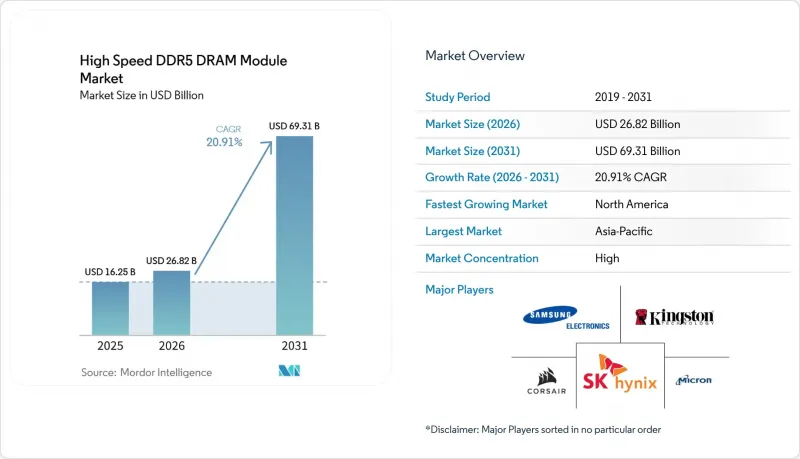
根據 Mordor Intelligence 預測,高速 DDR5 DRAM 模組的市場規模預計將從 2025 年的 162.5 億美元成長到 2026 年的 268.2 億美元,到 2031 年將達到 693.1 億美元,2026 年至 2031 年的複合年成長率為 20.9%。
本報告按模組類型(UDIMM、CUDIMM、SODIMM 等)、容量(最高 16 GB、24 GB 至 48 GB 等)、資料速率(5,600 至 6,400 MT/s、6,800 至 7,200 MT/s 等)、最終用途(超大規模和北美地區資料中心、美國地區市場(美國地區細分、歐洲地區)、美國地區市場(超大規模區和全球地區)。市場預測以美元 (USD) 為單位。
全球高速DDR5 DRAM模組市場趨勢及洞察
人工智慧伺服器和高效能運算對記憶體密度的需求日益成長。
高速DDR5 DRAM模組市場最大的驅動力在於人工智慧開發從早期階段轉向大規模推理叢集的轉變,後者需要海量主內存,且更靠近計算處理單元。這些伺服器環境依賴大規模DDR5 RDIMM和MRDIMM記憶體池來支援模型參數、更長的上下文視窗以及加速器周圍更廣泛的記憶體佔用。隨著每台伺服器記憶體容量的增加,即使出貨量成長未能跟上,這種轉變也會改變市場需求模式。此外,由於營運商需要更大的容量,同時又要避免機架數量和功耗的急劇增加,因此對高密度模組的需求也日益成長。美光256GB DDR5 RDIMM模組於2026年5月開始提供樣品,其速度高達9200 MT/s,與使用兩個128GB模組相比,功耗降低了40%以上。這表明,高速DDR5 DRAM模組市場正在向人工智慧基礎設施的高密度配置轉型。
遷移到更快的客戶端和伺服器記憶體平台
高速DDR5 DRAM模組市場也受益於新型伺服器和客戶端平台檢驗的最低運行速度的穩定提升。隨著系統藍圖向高階機型發展,低速DDR5模組的佔有率正在下降,銷售量重心轉向具有更高訊號完整性和更嚴格檢驗要求的優質模組。這使得伺服器和客戶端通路的需求保持活躍,儘管短期內伺服器平台的需求更為強勁。產品組合也在變化,供應商有更多空間來增強模組級功能並銷售更高效能定位的模組。 JEDEC的2026年MRDIMM藍圖,從新發布的DDR5MDB02標準過渡到目標速度為12,800 MT/s的Gen2模組,再到目標速度高達17,600 MT/s的Gen3設計,正在推動高速DDR5 DRAM模組市場中高速產品的長期成長。
與傳統DDR4產品相比,每位元成本更高
高速DDR5 DRAM模組市場的主要商業性限制因素是其與傳統DDR4產品相比的成本差距。由於DDR5模組的元件數量更多,電氣要求也更嚴格,即使使用者並未充分利用頻寬優勢,其低階產品的成本也高於DDR4。這對於那些仍在運行性能有限、無法充分發揮高階DDR5速度優勢的應用的中型企業和對價格敏感的組織而言,構成了尤為嚴峻的挑戰。在這些情況下,如果現有DDR4平台仍在支援期內,則可能是更實際的選擇。因此,高速DDR5 DRAM模組市場在對效能需求迫切的領域成長最為迅速,而注重成本績效的客戶往往會延後升級到高階DDR5配置。
細分市場分析
到2025年,RDIMM將佔據高速DDR5 DRAM模組市場39.54%的佔有率,這反映了其在企業和雲端環境標準雙路伺服器部署中的穩固地位。由於採購部門已將RDIMM視為大規模部署中最成熟的DDR5伺服器模組類型,其地位仍然穩固。憑藉廣泛的兼容性、成熟的供應鏈和熟悉的操作特性,RDIMM在目前的伺服器升級中繼續佔據核心地位。 LRDIMM則繼續應用於高密度記憶體配置,透過降低負載,支援在更專業的伺服器配置中實現更大的記憶體容量。
儘管 UDIMM 和 SODIMM 仍能滿足主流桌上型電腦和筆記型電腦的需求,但隨著高階系統用戶端速度的提升,CUDIMM 和 CSODIMM 的重要性日益凸顯。 DDR5 CAMM2 在 2025 年仍將保持小尺寸規格,但在空間利用率至關重要的輕薄工作站和高階筆記型電腦領域,其應用正日益普及。 MRDIMM/MCR DIMM 是高速 DDR5 DRAM 模組市場中成長最快的模組類型,旨在解決標準暫存器模組在人工智慧和高效能伺服器環境中最終將面臨的頻寬限制問題。美光提供的 256 GB DDR5 伺服器模組樣品以及 JEDEC 的 MRDIMM 標準藍圖表明,隨著高階伺服器平台向更高持續頻寬和更大記憶體密度發展,MRDIMM 設計的應用範圍將進一步擴大。
在2025年的高速DDR5 DRAM模組市場中,64GB至96GB頻寬將佔30.33%的佔有率,使其成為目前最適合標準雙路伺服器部署的容量範圍。此頻寬在通道數、記憶體佔用和系統成本之間取得了良好的平衡,使其適用於各種伺服器部署。 24GB至48GB範圍持續滿足記憶體負載相對較低的中階企業伺服器和工作站的需求。 128GB等級介於主流伺服器配置和要求更高的AI應用配置之間,使其成為一個重要的過渡類別。
在高速DDR5 DRAM記憶體模組市場中,容量超過128GB的模組是成長最快的容量等級。這主要是由於大規模推理環境中系統記憶體中儲存的模型資料量不斷增加。這種需求促使人們對高密度模組產生了濃厚的興趣,這些模組無需逐一增加插槽數量即可擴展容量。美光(Micron)的256GB DDR5 RDIMM記憶體條於2026年5月開始分發樣品,它透過結合3D堆疊晶片架構、高達9200 MT/s的讀寫速度以及比兩個128GB模組低40%以上的功耗,證明了這一容量等級的技術可行性。 SK海力士(SK hynix)的256GB DDR5 RDIMM記憶體條於2025年12月獲得英特爾資料中心認證,也進一步推動了高密度伺服器記憶體的發展。據該公司稱,與上一代 256 GB 產品相比,推理性能提高了 16%,功耗降低了約 18%。
區域分析
到2025年,亞太地區將佔據全球高速DDR5 DRAM模組市場53.29%的佔有率,這反映了該地區在上游生產和下游需求方面的整體優勢。韓國繼續保持其在製造領域的核心地位,主要記憶體供應商憑藉其先進的製造地,持續影響全球DRAM供應。中國是該地區的主要需求中心,這得歸功於大規模雲端運算和人工智慧基礎設施的擴張。台灣透過模組組裝及其深厚的電子產業生態系統做出貢獻,而日本則在先進材料和封裝產業鏈中扮演著至關重要的角色。新加坡作為東南亞的資料中心樞紐,也透過支援跨境技術基礎設施的需求,增強了該地區的影響力。
在預測期內,北美將是高速DDR5 DRAM模組市場成長最快的地區。該地區受益於超大規模人工智慧投資的集中、高階伺服器升級以及新建資料中心對高密度記憶體配置的強勁需求。此外,北美本土製造業的努力也為其長期供應的穩定性提供了保障。美光公司計劃於2026年5月在維吉尼亞馬納薩斯擴建製造地,投資額超過20億美元,並配合其到2035年在美國投入2500億美元的製造和研發資金,這將進一步鞏固北美在內存供應和技術發展領域的戰略地位。
儘管歐洲的市佔率落後於亞太和北美,但企業資料中心升級、通訊基礎設施和汽車運算平台的需求仍然穩定。世界其他地區雖然規模較小,但隨著各國主導的人工智慧專案、現代化改造計畫和企業更新換代活動推動多個地區對記憶體的需求,市場仍在持續成長。中東和非洲受益於區域資料中心樞紐降低了本地數位服務的延遲,而南美洲的需求則主要來自銀行、能源和政府機構的更新換代。從長遠觀點,印度仍然是一個重要的市場,因為進口替代措施可能會逐漸影響高速DDR5 DRAM模組市場的採購和本地生態系統決策。
其他好處:
- Excel格式的市場預測(ME)表
- 3個月的分析師支持
目錄
第1章:引言
- 研究假設和市場定義
- 調查範圍
第2章:調查方法
第3章執行摘要
第4章 市場狀況
- 市場概覽
- 市場促進因素
- 客戶端和伺服器向更快的記憶體平台過渡
- 人工智慧伺服器和高效能運算對記憶體密度的需求日益成長。
- 在主流PC和伺服器更新周期中向DDR4過渡。
- 加快採用模組上電源管理和訊號完整性改進技術。
- 對高階遊戲系統和內容創作系統的需求不斷成長
- 新一代平台 8,800 MT/s 級模組的認證。
- 市場限制因素
- 與傳統的DDR4替代產品相比,每位元成本增加。
- 超高速資料速率模組平台認證的複雜性
- 由於速度提高,散熱設計和基板佈線受到限制。
- 對供應有限的先進DRAM和組件生態系統的依賴
- 價值鏈分析
- 監理情勢
- 技術展望
- 波特五力分析
第5章 市場規模與成長預測
- 按模組類型
- UDIMM
- CUDIMM
- SODIMM
- CSODIMM
- DDR5 CAMM2
- RDIMM
- LRDIMM
- MRDIMM/MCR DIMM
- 按產能
- 16 GB 或更少
- 24 GB~48 GB
- 64 GB~96 GB
- 128 GB
- 128 GB 或更多
- 按數據速率
- 5,600~6,400 MT/s
- 6,800~7,200 MT/s
- 7,600~8,000 MT/s
- 8,400~8,800 MT/s
- 按最終用途
- 超大規模和雲端資料中心
- 企業資料中心
- 工作站和專業系統
- 遊戲電腦
- 消費級和商用PC/筆記型電腦
- 工業、嵌入式和邊緣系統
- 通訊和網路基礎設施
- 按地區
- 北美洲
- 歐洲
- 亞太地區
- 中國
- 日本
- 韓國
- 台灣
- 其他亞太國家
- 世界其他地區
第6章 競爭情勢
- 市場集中度
- 策略趨勢
- 市佔率分析
- 公司簡介
- Samsung Electronics Co., Ltd.
- SK hynix Inc.
- Micron Technology, Inc.
- Kingston Technology Company, Inc.
- Corsair Gaming, Inc.
- G.SKILL International Enterprise Co., Ltd.
- ADATA Technology Co., Ltd.
- Team Group Inc.
- Transcend Information, Inc.
- Apacer Technology Inc.
- PNY Technologies, Inc.
- Patriot Memory, LLC
- Silicon Power Computer and Communications Inc.
- Mushkin Enhanced MFG LLC
- SMART Modular Technologies, Inc.
- Nanya Technology Corporation
- Winbond Electronics Corporation
- KLEVV Co., Ltd.
- Lexar Media, Inc.
- GIGABYTE Technology Co., Ltd.
第7章 市場機會與未來展望
According to Mordor Intelligence, the high speed DDR5 DRAM module market size is expected to increase from USD 16.25 billion in 2025 to USD 26.82 billion in 2026 and reach USD 69.31 billion by 2031, growing at a CAGR of 20.91% over 2026-2031.
This report is Segmented by Module Type (UDIMM, CUDIMM, SODIMM, and More), Capacity (Up To 16 GB, 24 GB To 48 GB, and More), Data Rate (5, 600-6, 400 MT/S, 6, 800-7, 200 MT/S, and More), End-Use Application (Hyperscale and Cloud Data Centers, Enterprise Data Centers, and More), and Geography (North America, Europe, Asia-Pacific, and More). The Market Forecasts are Provided in Terms of Value (USD).
Global High Speed DDR5 DRAM Module Market Trends and Insights
Rising AI Server and High-Performance Computing Memory Density Requirements
The largest demand driver in the high speed DDR5 DRAM module market is the shift from earlier AI build phases toward larger inference clusters that need more main memory close to compute. These server environments depend on large DDR5 RDIMM and MRDIMM pools to support model parameters, longer context windows, and broader memory footprints around accelerators. This changes the demand pattern because memory content per server rises even when shipment growth does not move at the same pace. It also lifts interest in higher-density modules, since operators need more capacity without expanding rack count or power use too quickly. Micron's May 2026 sampling of 256 GB DDR5 RDIMM modules at speeds up to 9,200 MT/s and with more than 40% lower operating power than two 128 GB modules shows how the high speed DDR5 DRAM module market is moving toward denser configurations for AI infrastructure.
Shift Toward Higher-Speed Client and Server Memory Platforms
The high speed DDR5 DRAM module market is also benefiting from a steady rise in the validated speed floor across new server and client platforms. As system roadmaps move upward, slower DDR5 bins lose share and more volume shifts into premium modules with stronger signal integrity and tighter validation requirements. This keeps demand active across both server and client channels, even though the near-term pull is stronger in server platforms. It also changes product mix, because suppliers gain more room to sell modules with richer module-level functionality and higher performance positioning. JEDEC's 2026 MRDIMM roadmap, which extends from the newly published DDR5MDB02 standard toward Gen2 modules targeting 12,800 MT/s and Gen3 designs targeting up to 17,600 MT/s, supports the long runway for higher-speed products in the high speed DDR5 DRAM module market.
Higher Cost Per Bit Versus Legacy DDR4 Alternatives
The main commercial restraint in the high speed DDR5 DRAM module market is the cost gap against legacy DDR4 alternatives. DDR5 modules carry more component content and stricter electrical requirements, which keeps the cost floor above DDR4 even when buyers are not using the full bandwidth advantage. This is especially challenging for mid-tier enterprises and price-sensitive organizations that still run applications with limited performance benefit from premium DDR5 speeds. In these cases, existing DDR4 platforms can remain the more practical option while support life is still available. The result is that the high speed DDR5 DRAM module market grows fastest where performance demands are urgent, while value-focused customers often delay the move to premium DDR5 configurations.
Other drivers and restraints analyzed in the detailed report include:
- DDR4 Replacement Across Mainstream PC and Server Refresh Cycles
- Faster Adoption of On-Module Power Management and Signal Integrity Improvements
- Platform Qualification Complexity for Very High Data Rate Modules
For complete list of drivers and restraints, kindly check the Table Of Contents.
Segment Analysis
RDIMM held 39.54% of the high speed DDR5 DRAM module market share in 2025, reflecting its deep position in standard two-socket server deployments across enterprise and cloud environments. Its role remains strong because procurement teams already view it as the most established DDR5 server module type for scale deployments. Broad compatibility, mature supply chains, and familiar operational behavior keep RDIMM at the center of current server refresh programs. LRDIMM continues to serve dense memory configurations where load reduction supports larger memory footprints in more specialized server builds.
UDIMM and SODIMM still serve mainstream desktop and notebook needs, while CUDIMM and CSODIMM are becoming more relevant as higher client speeds gain traction across premium systems. DDR5 CAMM2 remained a smaller form factor in 2025, but it is attracting attention in thin workstations and premium laptops where space efficiency matters. MRDIMM / MCR DIMM is the fastest-growing module type in the high speed DDR5 DRAM module market because it addresses the bandwidth limits that standard registered modules eventually face in AI and high-performance server environments. Micron's 256 GB DDR5 server module sampling and JEDEC's MRDIMM standards roadmap both point to a broader role for MRDIMM designs as premium server platforms move toward higher sustained bandwidth and denser memory footprints.
The 64 GB to 96 GB tier accounted for 30.33% of the high speed DDR5 DRAM module market size in 2025, making it the current density sweet spot for standard two-socket server deployments. This tier balances channel population, memory footprint, and system cost in a way that works well for broad server rollouts. The 24 GB to 48 GB range still serves mid-range enterprise servers and workstation needs where memory intensity is lower. The 128 GB tier sits between mainstream server builds and heavier AI-oriented configurations, which makes it an important bridge category.
Above-128 GB modules are the fastest-growing capacity tier in the high speed DDR5 DRAM module market because larger inference environments increasingly need more model data to remain resident in system memory. That requirement raises interest in denser modules that can scale capacity without a one-for-one rise in slot usage. Micron's May 2026 256 GB DDR5 RDIMM sampling validated the technical path for this tier, combining 3D-stacked die architecture, speeds up to 9,200 MT/s, and more than 40% lower operating power than two 128 GB modules. SK hynix's December 2025 Intel Data Center Certification for its 256 GB DDR5 RDIMM also supports the move toward dense server memory, with the company reporting up to 16% higher inference performance and approximately 18% lower power consumption than its previous-generation 256 GB product.
Complete Report Scope:
- By Module Type
- UDIMM
- CUDIMM
- SODIMM
- CSODIMM
- DDR5 CAMM2
- RDIMM
- LRDIMM
- MRDIMM / MCR DIMM
- By Capacity
- Up to 16 GB
- 24 GB to 48 GB
- 64 GB to 96 GB
- 128 GB
- Above 128 GB
- By Data Rate
- 5,600-6,400 MT/s
- 6,800-7,200 MT/s
- 7,600-8,000 MT/s
- 8,400-8,800 MT/s
- By End-Use Application
- Hyperscale and Cloud Data Centers
- Enterprise Data Centers
- Workstations and Professional Systems
- Gaming PCs
- Consumer and Commercial PCs/Notebooks
- Industrial, Embedded, and Edge Systems
- Telecom and Networking Infrastructure
- By Geography
- North America
- Europe
- Asia-Pacific
- China
- Japan
- South Korea
- Taiwan
- Rest of Asia-Pacific
- Rest of the World
Geography Analysis
Asia-Pacific held 53.29% of the global high speed DDR5 DRAM module market in 2025, which reflects the region's combined strength in both upstream production and downstream demand. South Korea remains the anchor at the manufacturing layer because leading memory suppliers continue to shape global DRAM availability from their advanced fabrication base. China is a major demand center within the region, supported by large-scale cloud and AI infrastructure expansion. Taiwan contributes through module assembly and electronics ecosystem depth, while Japan supports critical parts of the advanced materials and packaging chain. Singapore also strengthens the regional profile because it serves as a data center hub for Southeast Asia and supports cross-border technology infrastructure demand.
North America is the fastest-growing geography in the high speed DDR5 DRAM module market during the forecast period. The region benefits from a high concentration of hyperscale AI spending, premium server refresh programs, and strong demand for dense memory configurations in new data center builds. It also gains from domestic manufacturing commitments that can support supply resilience over time. Micron's May 2026 manufacturing expansion in Manassas, Virginia, backed by more than USD 2 billion in investment and tied to a broader USD 250 billion U.S. manufacturing and R&D commitment through 2035, reinforces North America's strategic position in memory supply and technology development.
Europe trails Asia Pacific and North America in share, but it continues to generate steady demand from enterprise data center refresh programs, telecommunications infrastructure, and automotive compute platforms. The rest of the World is smaller, but it is expanding as sovereign AI projects, modernization programs, and enterprise refresh activity support new memory demand across multiple regions. The Middle East and Africa are benefiting from regional data center nodes that reduce latency for local digital services, while South America is seeing demand from banking, energy, and government refresh cycles. India also remains relevant over the longer horizon because import substitution efforts could gradually influence sourcing and local ecosystem decisions in the high speed DDR5 DRAM module market.
- Samsung Electronics Co., Ltd.
- SK hynix Inc.
- Micron Technology, Inc.
- Kingston Technology Company, Inc.
- Corsair Gaming, Inc.
- G.SKILL International Enterprise Co., Ltd.
- ADATA Technology Co., Ltd.
- Team Group Inc.
- Transcend Information, Inc.
- Apacer Technology Inc.
- PNY Technologies, Inc.
- Patriot Memory, LLC
- Silicon Power Computer and Communications Inc.
- Mushkin Enhanced MFG LLC
- SMART Modular Technologies, Inc.
- Nanya Technology Corporation
- Winbond Electronics Corporation
- KLEVV Co., Ltd.
- Lexar Media, Inc.
- GIGABYTE Technology Co., Ltd.
Additional Benefits:
- The market estimate (ME) sheet in Excel format
- 3 months of analyst support
TABLE OF CONTENTS
1 INTRODUCTION
- 1.1 Study Assumptions and Market Definition
- 1.2 Scope of the Study
2 RESEARCH METHODOLOGY
3 EXECUTIVE SUMMARY
4 MARKET LANDSCAPE
- 4.1 Market Overview
- 4.2 Market Drivers
- 4.2.1 Shift Toward Higher-Speed Client and Server Memory Platforms
- 4.2.2 Rising AI Server and High-Performance Computing Memory Density Requirements
- 4.2.3 DDR4 Replacement Across Mainstream PC and Server Refresh Cycles
- 4.2.4 Faster Adoption of On-Module Power Management and Signal Integrity Improvements
- 4.2.5 Growing Demand for Premium Gaming and Creator Systems
- 4.2.6 Qualification of 8,800 MT/s-Class Modules for Next-Generation Platforms
- 4.3 Market Restraints
- 4.3.1 Higher Cost Per Bit Versus Legacy DDR4 Alternatives
- 4.3.2 Platform Qualification Complexity for Very High Data Rate Modules
- 4.3.3 Thermal Design and Board Routing Constraints at Higher Speeds
- 4.3.4 Dependence on Limited Advanced DRAM Supply and Component Ecosystem
- 4.4 Value Chain Analysis
- 4.5 Regulatory Landscape
- 4.6 Technological Outlook
- 4.7 Porter's Five Forces Analysis
- 4.7.1 Bargaining Power of Suppliers
- 4.7.2 Bargaining Power of Buyers
- 4.7.3 Threat of New Entrants
- 4.7.4 Threat of Substitutes
- 4.7.5 Competitive Rivalry
5 MARKET SIZE AND GROWTH FORECASTS (VALUE)
- 5.1 By Module Type
- 5.1.1 UDIMM
- 5.1.2 CUDIMM
- 5.1.3 SODIMM
- 5.1.4 CSODIMM
- 5.1.5 DDR5 CAMM2
- 5.1.6 RDIMM
- 5.1.7 LRDIMM
- 5.1.8 MRDIMM / MCR DIMM
- 5.2 By Capacity
- 5.2.1 Up to 16 GB
- 5.2.2 24 GB to 48 GB
- 5.2.3 64 GB to 96 GB
- 5.2.4 128 GB
- 5.2.5 Above 128 GB
- 5.3 By Data Rate
- 5.3.1 5,600-6,400 MT/s
- 5.3.2 6,800-7,200 MT/s
- 5.3.3 7,600-8,000 MT/s
- 5.3.4 8,400-8,800 MT/s
- 5.4 By End-Use Application
- 5.4.1 Hyperscale and Cloud Data Centers
- 5.4.2 Enterprise Data Centers
- 5.4.3 Workstations and Professional Systems
- 5.4.4 Gaming PCs
- 5.4.5 Consumer and Commercial PCs/Notebooks
- 5.4.6 Industrial, Embedded, and Edge Systems
- 5.4.7 Telecom and Networking Infrastructure
- 5.5 By Geography
- 5.5.1 North America
- 5.5.2 Europe
- 5.5.3 Asia-Pacific
- 5.5.3.1 China
- 5.5.3.2 Japan
- 5.5.3.3 South Korea
- 5.5.3.4 Taiwan
- 5.5.3.5 Rest of Asia-Pacific
- 5.5.4 Rest of the World
6 COMPETITIVE LANDSCAPE
- 6.1 Market Concentration
- 6.2 Strategic Moves
- 6.3 Market Share Analysis
- 6.4 Company Profiles (includes Global Level Overview, Market Level Overview, Core Segments, Financials as available, Strategic Information, Market Rank/Share, Products and Services, Recent Developments)
- 6.4.1 Samsung Electronics Co., Ltd.
- 6.4.2 SK hynix Inc.
- 6.4.3 Micron Technology, Inc.
- 6.4.4 Kingston Technology Company, Inc.
- 6.4.5 Corsair Gaming, Inc.
- 6.4.6 G.SKILL International Enterprise Co., Ltd.
- 6.4.7 ADATA Technology Co., Ltd.
- 6.4.8 Team Group Inc.
- 6.4.9 Transcend Information, Inc.
- 6.4.10 Apacer Technology Inc.
- 6.4.11 PNY Technologies, Inc.
- 6.4.12 Patriot Memory, LLC
- 6.4.13 Silicon Power Computer and Communications Inc.
- 6.4.14 Mushkin Enhanced MFG LLC
- 6.4.15 SMART Modular Technologies, Inc.
- 6.4.16 Nanya Technology Corporation
- 6.4.17 Winbond Electronics Corporation
- 6.4.18 KLEVV Co., Ltd.
- 6.4.19 Lexar Media, Inc.
- 6.4.20 GIGABYTE Technology Co., Ltd.
7 MARKET OPPORTUNITIES AND FUTURE OUTLOOK
- 7.1 White-Space and Unmet-Need Assessment


