


 |
市場調查報告書
商品編碼
2097469
DDR5 DRAM:市場佔有率分析、產業趨勢與統計、成長預測(2026-2031)DDR5 DRAM - Market Share Analysis, Industry Trends & Statistics, Growth Forecasts (2026 - 2031) |
||||||

※ 本網頁內容可能與最新版本有所差異。詳細情況請與我們聯繫。
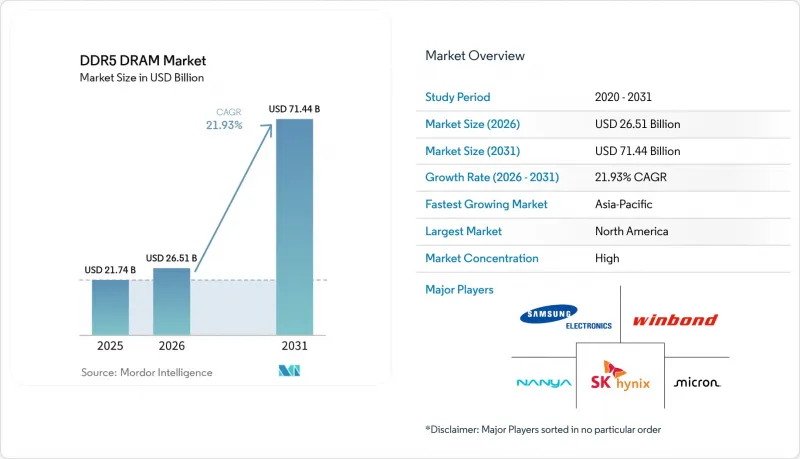
根據 Mordor Intelligence 預測,DDR5 DRAM 市場規模預計在 2025 年達到 217.4 億美元,2026 年達到 265.1 億美元,到 2031 年達到 714.4 億美元,2026 年至 2031 年的複合年成長率為 21.9%。
本報告按模組類型(無緩衝客戶端模組 [DDR5 UDIMM、CUDIMM]、小型模組 [DDR5 SODIMM、CSODIMM、CAMM2、LPCAM2 等])、容量(最高 16 GB、24-128 GB 等)、資料速率(4800 MT/s 等)、最終用途(企業區和超大規模站台)、區域化資料中心進行區域分類市場預測以美元 (USD) 為單位。
全球DDR5 DRAM市場趨勢與洞察
擴大人工智慧伺服器的記憶體密度
人工智慧訓練和推理平台需要比傳統伺服器設計能夠有效支援的更高的單插槽記憶體密度,這項需求正在改變整個DDR5 DRAM市場的採購趨勢。美光錶示,其1Y DRAM節點相比上一代1B節點,每片晶圓的比特數提高了30%以上,從而實現了高密度DDR5藍圖,而無需僅依賴產量的增加。每個DIMM插槽密度的提高減少了人工智慧工作負載所需的插槽數量。因此,DDR5 DRAM市場仍與加速器主導的基礎設施發展緊密相關,而非傳統的伺服器更新周期。美光也將其1Y系列產品定位為符合未來運算需求,進一步印證了基於密度的差異化正在成為DDR5 DRAM市場更永續的收入促進因素的觀點。正因如此,96GB以上容量的DDR5 DRAM比通用配置更能吸引投資並獲得價格支撐。
向DDR5專用伺服器CPU遷移
伺服器CPU的升級推動DDR5 DRAM市場擺脫了DDR4作為高階部署標準這一階段。 AMD已宣布EPYC 9005將支援多達12通道的DDR5-6000 ECC內存,而JEDEC也在持續開發MRDIMM標準,這將提升下一代伺服器內存的頻寬上限。隨著AMD JEDEC伺服器平台原生支援DDR5,模組檢驗不再是簡單的量產任務,因為在DDR5 DRAM市場,時序、韌體和平台特定認證比以往任何時候都更重要。 JEDEC的MRDIMM Gen2和Gen3藍圖也表明,未來效能提升的路徑將圍繞DDR5展開,而非過渡性相容解決方案。這將提高小規模供應商的進入門檻,並進一步促使伺服器記憶體採購轉向能夠提供DDR5 DRAM市場廣泛跨平台認證的供應商。
對 HBM 的需求增加限制了傳統 DDR5 的供應。
DDR5 DRAM市場的主要供應限制因素在於,儘管DDR5伺服器的需求不斷成長,但先進製程節點的晶圓產能卻被轉移到了利潤更高的HBM專案上。 SK海力士正加速投資龍仁Fab 1工廠,總投資額達31兆韓元(約215億美元),顯示供應商們正積極為持續成長的先進記憶體需求做好準備,而不僅僅是應對短期的市場正常化。美光科技的1年藍圖也清楚地表明,尖端製程的性能提升對於未來的運算產品至關重要,這意味著對相同先進製造資源的競爭將持續下去。只要最佳製程視窗仍然稀缺,DDR5 DRAM市場中伺服器用DDR5的供應量就可能比終端用戶需求所顯示的更為緊張。這將有力地支撐低階價格,並有利於大規模一體化製造商,而不是依賴上游配額的品牌模組供應商。
細分市場分析
2025年,暫存器和緩衝式記憶體模組佔DDR5 DRAM市場佔有率的41.8%,使其成為平台過渡早期階段最大的模組類別。 DDR5 DRAM市場需求偏向RDIMM、LRDIMM和MRDIMM,因為超大規模和企業級伺服器的升級速度領先了消費級市場的普遍更換。 2026年4月,JEDEC制定了DDR5 MRDIMM Gen2標準,目標吞吐量為12,800 MT/s,並開始著手製定Gen3標準,目標吞吐量為17,600 MT/s。這將擴展緩衝式記憶體的長期效能藍圖。此標準的製定至關重要,因為MRDIMM的普及取決於平台支持,而在DDR5 DRAM市場,認證的深度比產品可用性更為重要。因此,緩衝式記憶體模組的競爭格局正在從純粹的價格主導轉向夥伴關係主導。
在人工智慧筆記型電腦、緊湊型工作站和加固型邊緣系統的推動下,小型記憶體模組是DDR5 DRAM市場中成長最快的模組類型,預計2026年至2031年將以25.0%的複合年成長率成長。 2026年2月,JEDEC發布了CUDIMM和CQDIMM的更新通用標準,正式定義了時脈高達9600 MT/s的客戶端模組,並強化了更小、更快尺寸模組的設計基礎。 2026年5月,Rhambus發布了完整的DDR5 9600客戶記憶體模組晶片組,支援CUDIMM、CQDIMM和CSODIMM模組,進一步鞏固了這一趨勢。因此,DDR5 DRAM產業在尺寸頻譜的邊緣地帶正經歷著更加迅猛的成長,這些邊緣地帶的輕薄系統和本地人工智慧工作負載需要更高的頻寬,但又不需要伺服器層級的面積。專用和工業級模組也持續保持較高的利潤率。這是因為,在這些小規模規模部署領域,認證、溫度範圍和可靠性支援仍然比表面價格更重要。
至2025年,24GB至32GB容量的DDR5 DRAM市場將佔總市場佔有率的34.2%,並將繼續成為主流伺服器和工作站部署的主要銷售量驅動力。此容量範圍在DDR5 DRAM市場中仍然極具吸引力,因為它在每個插槽的成本效益和足夠的頻寬及容量之間取得了平衡,足以應對各種企業級工作負載。 128GB以上的容量類別將在2026年至2031年間實現最快成長,複合年成長率(CAGR)將達到25.2%。這是因為人工智慧推理系統需要更大的單插槽記憶體容量,以避免因系統解耦而導致的效能下降和系統複雜性增加。美光科技的1年製程藍圖顯示,與上一代產品相比,每片晶圓的位元數將增加30%以上,這將推動向更高容量DDR5模組的過渡,並加速向128GB及以上的高密度伺服器配置過渡。這是DDR5 DRAM市場從「銷售主導成長」轉變為「產品配置主導成長」的最明顯例子之一。
此外,48GB-64GB 和 96GB-128GB的頻寬在 DDR5 DRAM 市場正迅速發展。這是因為在企業更新周期中,每工作負載的成本比低廉的初始系統成本更為重要。據 Astera Labs 稱,其 Leo 系列 CXL 2.0 智慧記憶體控制器透過多個 DDR5-5600 通道支援每個模組高達 2TB 的容量,這意味著高密度 DIMM 和 CXL 擴充卡現在正在爭奪相同的工作負載預算。這種重疊使得 96GB-128GB 的容量區間成為 DDR5 DRAM 市場的策略決策點,因為買家必須在高容量 DIMM 和記憶體擴充卡之間做出選擇。同時,隨著筆記型電腦和桌上型電腦的標準配置容量不斷增大,DDR5 DRAM 產業中 16GB 以下容量層級的重要性正在下降。與以往以客戶端主導的記憶體週期相比,容量決策現在對架構決策的影響更為直接。
區域分析
到2025年,亞太地區將佔據DDR5 DRAM市場規模的47.4%,預計到2031年將以22.9%的複合年成長率持續成長。這將使該地區成為規模最大、成長最快的市場。韓國是亞太DDR5 DRAM市場的核心,三星電子和SK海力士繼續成為先進DRAM製造供應鏈的主要支柱。 SK海力士正在其龍仁半導體叢集的Fab 1工廠投資31兆韓元(約215億美元),加速建造其首個無塵室,預計於2027年2月投入運作。這顯示該地區的生產力計畫與未來對先進記憶體的需求高度契合。中國也積極建構更本地化的記憶體供應鏈,這為DDR5 DRAM市場的籌資策略和區域市場細分增添了新的維度。台灣和日本繼續透過模組組裝和先進封裝來支援區域價值鏈,而印度正逐步崛起為消費市場和組裝中心。
北美是DDR5 DRAM市場最集中的地區,超大規模資料中心業者對AI伺服器的投資使得伺服器記憶體採購需求異常強勁。此外,該地區基礎設施投資與平台檢驗之間聯繫更加緊密,也推動了市場成長,使得認證供應商能夠獲得比以往記憶體需求成長更可預測的訂單預測。在北美DDR5 DRAM市場,長期合約和確保穩定的國內供應變得日益重要,因為主要買家希望降低現貨價格波動和上游工程分配不確定性帶來的風險。這種需求結構比以往DRAM轉型中以客戶主導的周期性波動更為穩定。
儘管歐洲在DDR5 DRAM市場中所佔佔有率較小,但其細分市場更為多元化,企業、工業和汽車領域的需求佔比高於大批量超大規模資料中心的需求。 IEA-4E EDNA研究以及SK海力士和英特爾的案例研究均支持DDR5在節能伺服器環境中的價值,這與歐洲對能源效率和合規性的更高重視不謀而合。德國、英國和法國仍然是需求的主要支柱,而其他歐洲國家則透過企業記憶體升級活動實現了較為溫和的成長。世界其他地區在DDR5 DRAM市場中所佔佔有率仍然相對較小,但透過進口品牌模組和建造專用託管設施,中東、非洲和南美洲的基本客群正在持續擴大。
其他好處:
- Excel格式的市場預測(ME)表
- 3個月的分析師支持
目錄
第1章:引言
- 研究假設和市場定義
- 調查範圍
第2章:調查方法
第3章執行摘要
第4章 市場狀況
- 市場概覽
- 市場促進因素
- 擴大人工智慧伺服器的記憶體密度
- 遷移到 DDR5 專用伺服器 CPU
- DDR5和DDR4之間的價格差距正在縮小。
- 提高電力受限資料中心每瓦頻寬
- CXL連接的記憶體擴展
- 採用 CAMM2 和 Rugged Edge DDR5
- 市場限制因素
- HBM產能的擴張限制了傳統DDR5的供應。
- EUV微影製程在高密度DDR5晶片的良率和大規模生產方面面臨挑戰
- 中國出口限制與本土化差異
- CUDIMM、MRDIMM 和 CAMM2 認證的複雜性
- 產業價值鏈分析
- 技術展望
- 監理情勢
- 波特五力分析
- 宏觀經濟因素對市場的影響
第5章 市場規模與成長預測
- 按模組類型
- 無緩衝客戶端模組(DDR5 UDIMM 和 CUDIMM)
- 小型模組(DDR5 SODIMM、CSODIMM、CAMM2 和 LPCAMM2)
- 暫存器和緩衝式記憶體模組(DDR5 RDIMM、LRDIMM、MRDIMM 和其他緩衝伺服器記憶體模組)
- 特殊及工業級模組(耐環境DDR5模組、工業級溫域模組、嵌入式/板載DDR5模組)
- 按產能
- 最高可達 16GB
- 24 GB~32 GB
- 48 GB~64 GB
- 96 GB~128 GB
- 128 GB 或更多
- 按數據速率
- 4800 MT/s
- 5200 MT/s
- 5600 MT/s
- 6400 MT/s
- 7200噸/秒或以上
- 按最終用途
- 伺服器和超大規模資料中心
- 企業和工作站
- 消費性桌上型電腦
- 筆記型電腦和行動電腦
- 邊緣和工業系統
- 通訊和網路基礎設施
- 汽車運算平台
- 其他最終用途
- 按地區
- 北美洲
- 美國
- 加拿大
- 墨西哥
- 歐洲
- 德國
- 英國
- 法國
- 義大利
- 其他歐洲國家
- 亞太地區
- 中國
- 日本
- 韓國
- 台灣
- 印度
- 其他亞太國家
- 世界其他地區
- 北美洲
第6章 競爭情勢
- 市場集中度
- 策略趨勢
- 市佔率分析
- 公司簡介
- Samsung Electronics Co., Ltd.
- SK hynix Inc.
- Micron Technology, Inc.
- Nanya Technology Corporation
- ChangXin Memory Technologies, Inc.(CXMT)
- Kingston Technology Company, Inc.
- ADATA Technology Co., Ltd.
- Corsair Gaming, Inc.
- G.SKILL International Enterprise Co., Ltd.
- TEAMGROUP Inc.
- Innodisk Corporation
- SMART Modular Technologies, Inc.
- Apacer Technology Inc.
- Transcend Information, Inc.
- Patriot Memory, Inc.
- PNY Technologies, Inc.
- Silicon Power Computer & Communications Inc.
- Biwin Storage Technology Co., Ltd.
- Essencore Limited(KLEVV)
- Lexar Co., Ltd.
第7章 市場機會與未來展望
According to Mordor Intelligence, the DDR5 DRAM market size is projected to be USD 21.74 billion in 2025, USD 26.51 billion in 2026, and reach USD 71.44 billion by 2031, growing at a CAGR of 21.9% from 2026 to 2031.
This report is Segmented by Module Type (Unbuffered Client Modules [DDR5 UDIMM, and CUDIMM], Small-Form Modules [DDR5 SODIMM, CSODIMM, CAMM2, and LPCAMM2], and More), Capacity (Up To 16 GB, 24-128 GB, and More), Data Rate (4800 MT/S, and More), End-Use Application (Servers and Hyperscale Data Centers, Enterprise and Workstations, and More), and Geography. The Market Forecasts are Provided in Terms of Value (USD).
Global DDR5 DRAM Market Trends and Insights
AI Server Memory Density Scaling
AI training and inference platforms need more memory density per socket than earlier server designs could support efficiently, and that requirement is changing procurement behavior across the DDR5 DRAM market. Micron stated that its 1Y DRAM node delivers over 30% more bits per wafer than the prior 1B generation, which supports higher-density DDR5 roadmaps without relying only on volume expansion. Higher density per DIMM slot lowers the number of sockets needed for AI workloads, which keeps the DDR5 DRAM market tied closely to accelerator-led infrastructure builds rather than normal server replacement cycles. Micron also framed its 1Y generation around future compute needs, which supports the view that density-tier differentiation is becoming a more durable revenue lever inside the DDR5 DRAM market. This is why capacity bands from 96 GB upward are attracting stronger investment and pricing support than commodity configurations in the DDR5 DRAM market.
DDR5-Only Server CPU Transition
The server CPU transition has moved the DDR5 DRAM market past the stage where DDR4 could remain a practical default for new high-end deployments. AMD documented that EPYC 9005 supports up to 12 channels of DDR5-6000 ECC, while JEDEC continued to advance MRDIMM standards that raise the ceiling for next-generation server memory bandwidth. AMD JEDEC As server platforms become DDR5-native, module validation is no longer a simple volume exercise, because timing, firmware, and platform-specific qualification now matter more in the DDR5 DRAM market. JEDEC's MRDIMM Gen2 and Gen3 roadmap also shows that the performance path ahead is centered on DDR5 rather than transitional compatibility solutions. This raises the barrier for smaller vendors and shifts more server memory purchasing toward suppliers that can support broad cross-platform qualification inside the DDR5 DRAM market.
HBM Capacity Pull Constraining Conventional DDR5 Supply
The main supply-side restraint in the DDR5 DRAM market is that advanced-node wafer capacity is being pulled toward higher-margin HBM programs at the same time that DDR5 server demand is rising. SK hynix accelerated investment in Yongin Fab 1, with total project commitment of KRW 31 trillion, or USD 21.5 billion, which shows how strongly suppliers are preparing for sustained advanced memory demand rather than short-cycle normalization. Micron's 1Y roadmap also makes clear that leading-edge process gains are central to future compute products, which implies continued competition for the same advanced manufacturing resources. As long as the best process windows remain scarce, server DDR5 output is likely to stay tighter than end demand would suggest in the DDR5 DRAM market. That supports a firmer pricing floor and tends to favor large integrated manufacturers over branded module vendors that depend on upstream allocation.
Other drivers and restraints analyzed in the detailed report include:
- Narrowing DDR5-To-DDR4 Price Gap
- Bandwidth-Per-Watt Gains For Power-Constrained Data Centers
- EUV Yield And Ramp Challenges On High-Density DDR5 Dies
For complete list of drivers and restraints, kindly check the Table Of Contents.
Segment Analysis
Registered and Buffered Modules held 41.8% share of the DDR5 DRAM market size in 2025, which made them the largest module category during the first stage of platform migration. The DDR5 DRAM market has leaned toward RDIMM, LRDIMM, and MRDIMM demand because hyperscale and enterprise server upgrades came earlier than broad consumer replacement. JEDEC advanced the DDR5 MRDIMM Gen2 standard in April 2026 with a target of 12,800 MT/s and also began work on Gen3 with a 17,600 MT/s direction, which extends the long-range performance roadmap for buffered memory. That standards path matters because MRDIMM adoption is tied to specific platform support, which makes qualification depth more important than simple unit availability in the DDR5 DRAM market. As a result, buffered module competition is becoming more relationship-driven and less purely price-led.
Small-Form Modules are the fastest-growing module type in the DDR5 DRAM market, with a 25.0% CAGR from 2026 to 2031, supported by AI-capable notebooks, compact workstations, and rugged edge systems. JEDEC published the updated CUDIMM and CQDIMM common standard in February 2026, which formalized clocked client modules up to 9,600 MT/s and improved the design base for smaller high-speed form factors. Rambus reinforced that direction in May 2026 by releasing a complete DDR5 9600 client memory module chipset for CUDIMM, CQDIMM, and CSODIMM modules. The DDR5 DRAM industry is therefore seeing faster growth at the edge of the form-factor spectrum, where thinner systems and local AI workloads need more bandwidth without a server-sized footprint. Specialty and industrial modules also keep premium margins because certification, thermal range, and reliability support still matter more than headline pricing in these smaller deployment niches.
The 24 GB-32 GB segment held 34.2% of the DDR5 DRAM market size in 2025, which kept it as the volume backbone for mainstream server and workstation installs. In the DDR5 DRAM market, this range remains attractive because it balances per-slot cost discipline with enough bandwidth and capacity for broad enterprise workloads. The above 128 GB category is expanding the fastest, at 25.2% CAGR from 2026 to 2031, because AI inference systems need more memory per socket to avoid disaggregation penalties and system complexity. Micron's 1Y node roadmap, with over 30% more bits per wafer than the prior generation, supports the push toward larger DDR5 modules and a shorter cycle between 128 GB and higher-density server configurations. This is one of the clearest places where the DDR5 DRAM market is moving from volume-led growth to mix-led growth.
The 48 GB-64 GB and 96 GB-128 GB bands are also gaining traction in the DDR5 DRAM market because enterprise refresh cycles now focus more on cost per workload than on the lowest upfront system cost. Astera Labs said its Leo-series CXL 2.0 smart memory controllers support up to 2 TB per card across multiple DDR5-5600 channels, which shows that high-density DIMMs and CXL expansion are now competing for the same workload budgets. That overlap means the 96 GB to 128 GB boundary has become a strategic decision point inside the DDR5 DRAM market, because buyers must choose between larger DIMMs and memory expansion cards. The DDR5 DRAM industry is also seeing the up to 16 GB tier lose relevance as default notebook and desktop configurations move higher. Capacity decisions now shape architecture decisions more directly than in prior client-led memory cycles.
Complete Report Scope:
- By Module Type
- Unbuffered Client Modules (DDR5 UDIMM, and CUDIMM)
- Small-Form Modules (DDR5 SODIMM, CSODIMM, CAMM2, and LPCAMM2)
- Registered and Buffered Modules (DDR5 RDIMM, LRDIMM, MRDIMM, and Other Buffered Server Memory Modules)
- Specialty and Industrial Modules (Ruggedized DDR5 Modules, Industrial-temperature Modules, Embedded/on-board DDR5 Modules)
- By Capacity
- Up to 16 GB
- 24 GB - 32 GB
- 48 GB - 64 GB
- 96 GB - 128 GB
- Above 128 GB
- By Data Rate
- 4800 MT/s
- 5200 MT/s
- 5600 MT/s
- 6400 MT/s
- 7200 MT/s and Above
- By End-Use Application
- Servers and Hyperscale Data Centers
- Enterprise and Workstations
- Consumer Desktops
- Notebooks and Mobile PCs
- Edge and Industrial Systems
- Telecom and Networking Infrastructure
- Automotive Compute Platforms
- Other End-Use Applications
- By Geography
- North America
- United States
- Canada
- Mexico
- Europe
- Germany
- United Kingdom
- France
- Italy
- Rest of Europe
- Asia-Pacific
- China
- Japan
- South Korea
- Taiwan
- India
- Rest of Asia-Pacific
- Rest of the World
- North America
Geography Analysis
Asia-Pacific accounted for 47.4% of the DDR5 DRAM market size in 2025 and is projected to expand at 22.9% CAGR through 2031, which makes it both the largest and fastest-growing region. The DDR5 DRAM market in Asia-Pacific is anchored by South Korea, where Samsung Electronics and SK hynix remain the core supply-side pillars for advanced DRAM manufacturing. SK hynix committed KRW 31 trillion, or USD 21.5 billion, to Yongin Semiconductor Cluster Fab 1 and accelerated the first cleanroom toward February 2027 operations, which shows how strongly regional capacity planning is aligned with future advanced memory demand. China is also pushing a more localized memory supply chain, which is adding another layer to procurement strategy and regional segmentation inside the DDR5 DRAM market. Taiwan and Japan continue to support the regional value chain through module assembly and advanced packaging, while India is emerging more gradually as a consumer and assembly destination.
North America is the most concentrated demand center in the DDR5 DRAM market because hyperscaler spending on AI servers has kept server memory procurement unusually strong. The region also benefits from a tighter link between infrastructure spending and platform validation, which gives qualified suppliers more predictable order visibility than in past memory upcycles. Long-term agreements and domestic supply security goals are becoming more important in the DDR5 DRAM market here, because large buyers want less exposure to spot-price volatility and less uncertainty around upstream allocation. This demand structure is more stable than the client-led cycles that shaped earlier DRAM transitions.
Europe represents a smaller but more differentiated part of the DDR5 DRAM market, with enterprise, industrial, and automotive-adjacent demand carrying more weight than hyperscale volume. The IEA-4E EDNA study and the SK hynix-Intel case study both support DDR5's value in energy-sensitive server environments, which fits well with Europe's stronger emphasis on power efficiency and compliance. Germany, the United Kingdom, and France remain the main demand anchors, while the rest of Europe adds volume more gradually through enterprise refresh activity. Rest of the World remains smaller in the DDR5 DRAM market, but imported branded modules and selected colocation builds are still widening the customer base across the Middle East, Africa, and South America.
- Samsung Electronics Co., Ltd.
- SK hynix Inc.
- Micron Technology, Inc.
- Nanya Technology Corporation
- ChangXin Memory Technologies, Inc. (CXMT)
- Kingston Technology Company, Inc.
- ADATA Technology Co., Ltd.
- Corsair Gaming, Inc.
- G.SKILL International Enterprise Co., Ltd.
- TEAMGROUP Inc.
- Innodisk Corporation
- SMART Modular Technologies, Inc.
- Apacer Technology Inc.
- Transcend Information, Inc.
- Patriot Memory, Inc.
- PNY Technologies, Inc.
- Silicon Power Computer & Communications Inc.
- Biwin Storage Technology Co., Ltd.
- Essencore Limited (KLEVV)
- Lexar Co., Ltd.
Additional Benefits:
- The market estimate (ME) sheet in Excel format
- 3 months of analyst support
TABLE OF CONTENTS
1 INTRODUCTION
- 1.1 Study Assumptions and Market Definition
- 1.2 Scope of the Study
2 RESEARCH METHODOLOGY
3 EXECUTIVE SUMMARY
4 MARKET LANDSCAPE
- 4.1 Market Overview
- 4.2 Market Drivers
- 4.2.1 AI Server Memory Density Scaling
- 4.2.2 DDR5-Only Server CPU Transition
- 4.2.3 Narrowing DDR5-to-DDR4 Price Gap
- 4.2.4 Bandwidth-per-Watt Gains for Power-Constrained Data Centers
- 4.2.5 CXL-Attached Memory Expansion
- 4.2.6 CAMM2 and Rugged Edge DDR5 Adoption
- 4.3 Market Restraints
- 4.3.1 HBM Capacity Pull Constraining Conventional DDR5 Supply
- 4.3.2 EUV Yield and Ramp Challenges on High-Density DDR5 Dies
- 4.3.3 Export-Control and China-Localization Bifurcation
- 4.3.4 Qualification Complexity Across CUDIMM, MRDIMM, and CAMM2
- 4.4 Industry Value Chain Analysis
- 4.5 Technological Outlook
- 4.6 Regulatory Landscape
- 4.7 Porter's Five Forces Analysis
- 4.7.1 Bargaining Power of Suppliers
- 4.7.2 Bargaining Power of Buyers
- 4.7.3 Threat of New Entrants
- 4.7.4 Threat of Substitute Products
- 4.7.5 Intensity of Competitive Rivalry
- 4.8 Impact of Macroeconomic Factors on the Market
5 MARKET SIZE AND GROWTH FORECASTS (VALUE)
- 5.1 By Module Type
- 5.1.1 Unbuffered Client Modules (DDR5 UDIMM, and CUDIMM)
- 5.1.2 Small-Form Modules (DDR5 SODIMM, CSODIMM, CAMM2, and LPCAMM2)
- 5.1.3 Registered and Buffered Modules (DDR5 RDIMM, LRDIMM, MRDIMM, and Other Buffered Server Memory Modules)
- 5.1.4 Specialty and Industrial Modules (Ruggedized DDR5 Modules, Industrial-temperature Modules, Embedded/on-board DDR5 Modules)
- 5.2 By Capacity
- 5.2.1 Up to 16 GB
- 5.2.2 24 GB - 32 GB
- 5.2.3 48 GB - 64 GB
- 5.2.4 96 GB - 128 GB
- 5.2.5 Above 128 GB
- 5.3 By Data Rate
- 5.3.1 4800 MT/s
- 5.3.2 5200 MT/s
- 5.3.3 5600 MT/s
- 5.3.4 6400 MT/s
- 5.3.5 7200 MT/s and Above
- 5.4 By End-Use Application
- 5.4.1 Servers and Hyperscale Data Centers
- 5.4.2 Enterprise and Workstations
- 5.4.3 Consumer Desktops
- 5.4.4 Notebooks and Mobile PCs
- 5.4.5 Edge and Industrial Systems
- 5.4.6 Telecom and Networking Infrastructure
- 5.4.7 Automotive Compute Platforms
- 5.4.8 Other End-Use Applications
- 5.5 By Geography
- 5.5.1 North America
- 5.5.1.1 United States
- 5.5.1.2 Canada
- 5.5.1.3 Mexico
- 5.5.2 Europe
- 5.5.2.1 Germany
- 5.5.2.2 United Kingdom
- 5.5.2.3 France
- 5.5.2.4 Italy
- 5.5.2.5 Rest of Europe
- 5.5.3 Asia-Pacific
- 5.5.3.1 China
- 5.5.3.2 Japan
- 5.5.3.3 South Korea
- 5.5.3.4 Taiwan
- 5.5.3.5 India
- 5.5.3.6 Rest of Asia-Pacific
- 5.5.4 Rest of the World
- 5.5.1 North America
6 COMPETITIVE LANDSCAPE
- 6.1 Market Concentration
- 6.2 Strategic Moves
- 6.3 Market Share Analysis
- 6.4 Company Profiles (includes Global level Overview, Market level Overview, Core Segments, Financials as available, Strategic Information, Market Rank/Share for Key Companies, Products and Services, and Recent Developments)
- 6.4.1 Samsung Electronics Co., Ltd.
- 6.4.2 SK hynix Inc.
- 6.4.3 Micron Technology, Inc.
- 6.4.4 Nanya Technology Corporation
- 6.4.5 ChangXin Memory Technologies, Inc. (CXMT)
- 6.4.6 Kingston Technology Company, Inc.
- 6.4.7 ADATA Technology Co., Ltd.
- 6.4.8 Corsair Gaming, Inc.
- 6.4.9 G.SKILL International Enterprise Co., Ltd.
- 6.4.10 TEAMGROUP Inc.
- 6.4.11 Innodisk Corporation
- 6.4.12 SMART Modular Technologies, Inc.
- 6.4.13 Apacer Technology Inc.
- 6.4.14 Transcend Information, Inc.
- 6.4.15 Patriot Memory, Inc.
- 6.4.16 PNY Technologies, Inc.
- 6.4.17 Silicon Power Computer & Communications Inc.
- 6.4.18 Biwin Storage Technology Co., Ltd.
- 6.4.19 Essencore Limited (KLEVV)
- 6.4.20 Lexar Co., Ltd.
7 MARKET OPPORTUNITIES AND FUTURE OUTLOOK
- 7.1 White-Space and Unmet-Need Assessment


