


 |
市場調查報告書
商品編碼
2099932
中東飼料用植物源添加劑:市場佔有率分析、產業趨勢與統計及成長預測(2026-2031 年)Middle East Feed Phytogenics - Market Share Analysis, Industry Trends & Statistics, Growth Forecasts (2026 - 2031) |
||||||

※ 本網頁內容可能與最新版本有所差異。詳細情況請與我們聯繫。
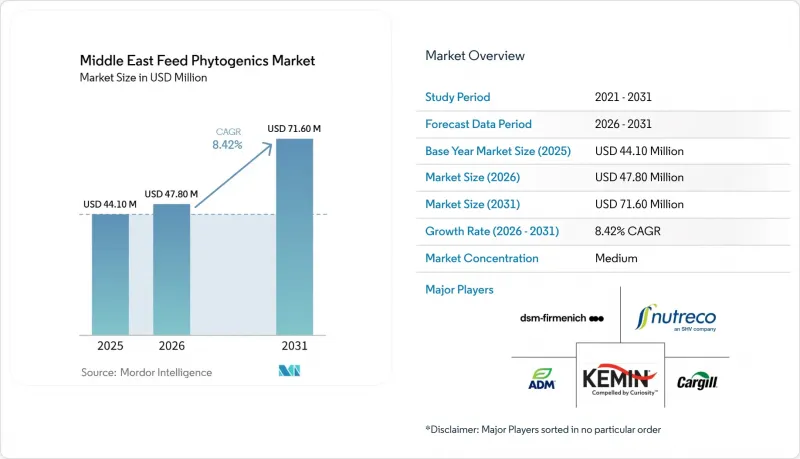
根據 Mordor Intelligence 預測,中東飼料植物源市場規模將從 2025 年的 4,410 萬美元和 2026 年的 4,780 萬美元成長到 2031 年的 7,160 萬美元,2026 年至 2031 年的複合年成長率為 8.42%。
本報告按添加劑(精油、油樹脂等)、目標動物(家禽、反芻動物等)和地區(沙烏地阿拉伯、土耳其等)進行細分。市場預測以價值(美元)和數量(公噸)表示。
中東植物性飼料添加劑市場趨勢與洞察。
從抗生素類生長促進劑轉向天然性能增強添加劑。
沙烏地阿拉伯和阿拉伯聯合大公國分別於2024年和2025年收緊了對抗生素生長促進劑的監管。這加速了集約化家禽和反芻動物養殖系統向植物來源和其他天然飼料添加劑的轉變。沙烏地阿拉伯的《2022-2025年國家抗菌素抗藥性行動計畫》為減少肉類畜牧業抗生素的使用提供了明確的方向,這項政策在中東飼料添加劑市場催生了對符合監管要求的替代方案的需求。這項轉變具有重要的商業性意義,因為對於先前依賴低成本抗生素方案的中小型企業而言,傳統方案與植物性解決方案之間的經濟差距正在縮小。中東飼料添加劑市場也從中受益,因為買家越來越將這些產品視為應對監管壓力的實際可行的解決方案,而不僅僅是隨意提高生產力的工具。 2025 年發表在《動物科學前沿》雜誌上的一項系統性綜述報告稱,植物來源飼料添加劑可使肉雞增重提高 5% 至 13%,而濃度為 125 ppm 的特定精油混合物可在 42 天內使總增重提高 12.9%,並將飼料轉化率從 1.71 提高到 1.600。
在食品安全計畫下擴大工業化家禽生產
在糧食安全政策的推動下,海灣國家家禽業的大規模投資正在穩步推進,為服務中東飼料添加劑市場的添加劑供應商創造了穩定的銷售基礎。沙烏地阿拉伯的「2030願景」框架大力支持農業自給自足,而家禽業在這過程中繼續發揮核心作用。隨著新的飼料廠和綜合養雞場投入運作,採購趨勢正轉向能夠證明其在大規模養殖和多個飼料週期中有效性的標準化添加劑方案。這一趨勢對現有供應商有利,因為大型綜合養雞場往往更傾向於選擇能夠提供穩定技術服務、清晰文件和長期採購合約的產品。因此,家禽業的擴張不僅為中東飼料植物來源市場帶來了銷售量,也提升了供應商與該地區其他供應商的合作關係和績效價值。
與傳統積層製造方案相比,成本較高
高昂的價格仍然是中東植物性飼料添加劑市場面臨的最大障礙。在對成本高度敏感的家禽養殖系統中,這一點尤其明顯,因為養殖戶主要根據短期飼料成本來比較添加劑。伊拉克和伊朗的情況最為突出,因為這兩個國家家禽養殖的虧損降低了養殖戶為注重性能和合規性的解決方案支付溢價的意願。海灣合作理事會標準化組織 (GSO) 的標準「GSO 2141:2023」對飼料添加劑的品質和安全合規性提出了新的要求。這可能會增加小批量產品的文件編制和進口成本。具備混合能力的本地供應商則更具優勢,因為他們可以將這些成本分攤到更廣泛的產品系列中。因此,除非獨立植物性添加劑供應商能夠清楚證明其產品性能的提升足以抵消最初的價格溢價,否則他們將面臨更大的壓力。
細分市場分析
到2025年,精油將佔中東飼料添加劑市場銷售額的38.0%,成為該市場最大的產品類型。此外,預計2026年至2031年間,精油的複合年成長率將達到8.9%,成為成長最快的產品類型。這一地位反映了香芹酚、百里香酚和肉桂醛等化合物在全部區域肉雞和蛋雞養殖項目中的廣泛商業性認可。這些化合物具有抗菌、抗氧化和提高飼料轉換率的特性,為營養學家製定配方提供了明確的依據。油樹脂佔據第二大產品佔有率,非常適合水性給藥策略和針對熱應激家禽的實用農場方案。其他植物來源成分雖然在整體產品組合中所佔比例仍然較小,但在反芻動物和特定健康應用領域持續受到關注。
2025年發表於《科學報告》(Scientific Reports)的一篇論文指出,奈米封裝精油配方在肉雞增重和飼料轉化率方面優於遊離配方,進一步鞏固了該領域高級產品的技術基礎。這項發現意義重大,因為中東飼料添加劑市場越來越重視那些在飼料製作流程中保持活性並能在動物體內實現可預測釋放的產品。擁有精油計畫的供應商更具優勢,因為中東飼料添加劑產業的大部分企業已經與成長最快的產品類型建立了合作關係。 2025年精油在中東飼料添加劑市場的佔有率也表明,買家不再將該類別視為試水產品。相反,精油現在已成為許多家禽植物添加劑計畫的核心產品平台。
其他好處:
- Excel格式的市場預測(ME)表
- 3個月的分析師支持
目錄
第1章:引言
- 研究假設和市場定義
- 調查範圍
第2章:調查方法
第3章執行摘要
第4章 市場狀況
- 市場概覽
- 市場促進因素
- 從抗生素類生長促進劑過渡到天然來源的增產添加劑
- 在食品安全計畫下擴大工業化家禽生產
- 隨著飼料成本的上漲,人們越來越關注飼料轉換率。
- 紅海和波斯灣水產養殖業的擴張
- 出口型家禽價值鏈的清真認證植物來源原料
- 乾旱地區生產系統對緩解熱應激的需求
- 市場限制因素
- 與傳統積層製造方案相比,成本較高
- 植物來源活性成分的功效差異及劑量標準化問題
- 紅海和霍爾木茲海峽的物流中斷
- 核准流程分散以及缺乏市場測試基礎設施
- 監理情勢
- 技術展望
- 波特五力分析
第5章 市場規模與成長預測
- 添加劑
- 精油
- 香草和香辛料
- 其他植物源性物質
- 動物
- 水產養殖
- 魚
- 蝦
- 其他養殖物種
- 家禽
- 肉雞
- 產蛋母雞
- 其他家禽
- 反芻動物
- 肉牛
- 乳牛
- 其他反芻動物
- 豬
- 其他動物
- 水產養殖
- 按地區
- 沙烏地阿拉伯
- 土耳其
- 伊朗
- 阿拉伯聯合大公國
- 伊拉克
- 其他中東國家
第6章 競爭情勢
- 市場集中度
- 策略趨勢
- 市佔率分析
- 公司簡介
- Cargill, Incorporated
- DSM-Firmenich AG
- Kemin Industries, Inc.
- Nutreco NV(SHV Holdings NV)
- Archer Daniels Midland Company
- Adisseo
- Alltech, Inc.
- Phytobiotics Futterzusatzstoffe GmbH
- DOSTOFARM GmbH
- Orffa Additives BV
- MIAVIT GmbH
- Anpario plc
- Nutrex
- Natural Remedies
- Himalaya Wellness Company
第7章 市場機會與未來展望
According to Mordor Intelligence, the Middle East phytogenics market for feed is projected to expand from USD 44.1 million in 2025 and USD 47.8 million in 2026 to USD 71.6 million by 2031, registering a CAGR of 8.42% between 2026 and 2031.
This report is Segmented by Sub Additive (Essential Oils, Oleoresins, and More), by Animal (Poultry, Ruminants, and More), and by Geography (Saudi Arabia, Turkey, and More). The Market Forecasts are Provided in Terms of Value (USD) and Volume (Metric Tons).
Middle East Feed Phytogenics Market Trends and Insights
Shift from Antibiotic Growth Promoters to Natural Performance Additives
Saudi Arabia and the United Arab Emirates tightened restrictions on antibiotic growth promoters in 2024 and 2025, which accelerated the shift toward phytogenics and other natural feed additives in intensive poultry and ruminant systems. Saudi Arabia's National Action Plan on Antimicrobial Resistance 2022-2025 set a clear direction toward reducing antimicrobial use in food animals, and that policy direction created a compliance-led demand base for alternatives in the Middle East feed phytogenics market. This shift matters commercially because smaller integrators that once relied on lower-cost antibiotic programs now face a narrower economic gap between conventional programs and phytogenic solutions. The Middle East feed phytogenics market also benefits, as buyers increasingly evaluate these products as a practical response to regulatory pressure rather than as a discretionary performance input. A 2025 systematic review in Frontiers in Animal Science reported that phytogenic feed additives improved broiler body weight gain by 5% to 13%, while one essential oil blend at 125 parts per million lifted total weight gain by 12.9% and improved feed conversion ratio from 1.71 to 1.60 over 42 days.
Expansion of Industrial Poultry Production Under Food-Security Programs
Food security policy is driving large poultry investments across the Gulf, creating a stable volume base for additive suppliers serving the Middle East feed phytogenics market. Saudi Arabia's Vision 2030 framework includes strong support for agricultural self-sufficiency, and the poultry segment remains central to that effort. As new feed mills and integrated farms come online, purchasing shifts toward standardized additive programs that can be validated across larger flocks and multiple feed cycles. This pattern supports established suppliers because large integrators tend to favor consistent technical service, clear documentation, and products that fit into long-term procurement contracts. The result is that poultry expansion not only adds volume to the Middle East feed phytogenics market but also raises the value of supplier relationships and performance evidence in the region.
Higher Cost versus Conventional Additive Programs
Higher pricing remains the clearest barrier to the Middle East feed phytogenics market, especially in cost-sensitive farming systems where producers primarily compare additives based on near-term feed costs. This issue is most visible in Iraq and Iran, where tighter farm economics reduce the willingness to pay a premium for performance or compliance-led solutions. The Gulf Cooperation Council Standardization Organization standard GSO 2141:2023 added quality and safety compliance requirements for feed additives, which can increase documentation and import costs for smaller product lots. Regional suppliers with local blending capacity are in a stronger position because they can spread those costs over broader product portfolios. That leaves standalone phytogenic suppliers under greater pressure unless they can clearly demonstrate performance gains that offset the initial price premium.
Other drivers and restraints analyzed in the detailed report include:
- Rising Feed-Efficiency Focus Amid High Feed Input Costs
- Red Sea and Gulf Aquaculture Build-Out
- Inconsistent Efficacy and Dosage Standardization Across Botanical Actives
For complete list of drivers and restraints, kindly check the Table Of Contents.
Segment Analysis
Essential oils accounted for 38.0% of revenue in 2025, which made them the largest product type in the Middle East feed phytogenics market, and they are also projected to be the fastest-growing product category at an 8.9% CAGR during 2026-2031. Their position reflects the strong commercial acceptance of compounds such as carvacrol, thymol, and cinnamaldehyde in broiler and layer programs across the region. These compounds provide nutritionists with a clear inclusion case because they are linked to antimicrobial activity, antioxidant support, and improved feed efficiency. Oleoresins accounted for the second-largest product block because they align well with water-based delivery strategies and practical farm programs for heat-stressed birds. Other phytogenics remained smaller parts of the portfolio mix, but they continued to gain attention in ruminant and niche health applications.
A 2025 paper in Scientific Reports showed that nanoencapsulated essential oil formulations outperformed free-form formulations in terms of body weight gain and feed conversion ratio in broilers, strengthening the technical case for premium products in this segment. That finding matters because the Middle East feed phytogenics market is increasingly rewarding products that hold activity through feed processing and deliver a predictable release in the animal. Suppliers with established essential oil programs are in a stronger position because the largest part of the Middle East feed phytogenics industry is already aligned with the fastest-expanding product class. The Middle East feed phytogenics market share held by essential oils in 2025 also shows that buyers are no longer treating the category as a trial segment. Instead, essential oils now form the core product platform for many poultry-focused phytogenic programs.
Complete Report Scope:
- By Sub Additive
- Essential Oil
- Herbs and Spices
- Other Phytogenics
- By Animal
- Aquaculture
- Fish
- Shrimp
- Other Aquaculture Species
- Poultry
- Broiler
- Layer
- Other Poultry Birds
- Ruminants
- Beef Cattle
- Dairy Cattle
- Other Ruminants
- Swine
- Other Animals
- Aquaculture
- By Geography
- Saudi Arabia
- Turkey
- Iran
- United Arab Emirates
- Iraq
- Rest of Middle East
List of Companies Covered in this Report:
- Cargill, Incorporated
- DSM-Firmenich AG
- Kemin Industries, Inc.
- Nutreco N.V. (SHV Holdings N.V.)
- Archer Daniels Midland Company
- Adisseo
- Alltech, Inc.
- Phytobiotics Futterzusatzstoffe GmbH
- DOSTOFARM GmbH
- Orffa Additives B.V.
- MIAVIT GmbH
- Anpario plc
- Nutrex
- Natural Remedies
- Himalaya Wellness Company
Additional Benefits:
- The market estimate (ME) sheet in Excel format
- 3 months of analyst support
TABLE OF CONTENTS
1 INTRODUCTION
- 1.1 Study Assumptions and Market Definition
- 1.2 Scope of the Study
2 RESEARCH METHODOLOGY
3 EXECUTIVE SUMMARY
4 MARKET LANDSCAPE
- 4.1 Market Overview
- 4.2 Market Drivers
- 4.2.1 Shift from Antibiotic Growth Promoters to Natural Performance Additives
- 4.2.2 Expansion of Industrial Poultry Production Under Food-Security Programs
- 4.2.3 Rising Feed-Efficiency Focus Amid High Feed Input Costs
- 4.2.4 Red Sea and Gulf Aquaculture Build-Out
- 4.2.5 Halal-Certified Phytogenics for Export-Oriented Poultry Value Chains
- 4.2.6 Heat-Stress Mitigation Demand in Arid Production Systems
- 4.3 Market Restraints
- 4.3.1 Higher Cost Versus Conventional Additive Programs
- 4.3.2 Inconsistent Efficacy and Dosage Standardization Across Botanical Actives
- 4.3.3 Red Sea and Strait of Hormuz Logistics Disruptions
- 4.3.4 Fragmented Approvals and Limited in-Market Testing Infrastructure
- 4.4 Regulatory Landscape
- 4.5 Technological Outlook
- 4.6 Porter's Five Forces Analysis
- 4.6.1 Threat of New Entrants
- 4.6.2 Bargaining Power of Suppliers
- 4.6.3 Bargaining Power of Buyers
- 4.6.4 Threat of Substitutes
- 4.6.5 Intensity of Competitive Rivalry
5 MARKET SIZE AND GROWTH FORECASTS (VALUE AND VOLUME)
- 5.1 By Sub Additive
- 5.1.1 Essential Oil
- 5.1.2 Herbs and Spices
- 5.1.3 Other Phytogenics
- 5.2 By Animal
- 5.2.1 Aquaculture
- 5.2.1.1 Fish
- 5.2.1.2 Shrimp
- 5.2.1.3 Other Aquaculture Species
- 5.2.2 Poultry
- 5.2.2.1 Broiler
- 5.2.2.2 Layer
- 5.2.2.3 Other Poultry Birds
- 5.2.3 Ruminants
- 5.2.3.1 Beef Cattle
- 5.2.3.2 Dairy Cattle
- 5.2.3.3 Other Ruminants
- 5.2.4 Swine
- 5.2.5 Other Animals
- 5.2.1 Aquaculture
- 5.3 By Geography
- 5.3.1 Saudi Arabia
- 5.3.2 Turkey
- 5.3.3 Iran
- 5.3.4 United Arab Emirates
- 5.3.5 Iraq
- 5.3.6 Rest of Middle East
6 COMPETITIVE LANDSCAPE
- 6.1 Market Concentration
- 6.2 Strategic Moves
- 6.3 Market Share Analysis
- 6.4 Company Profiles (Includes Global Level Overview, Market Level Overview, Core Segments, Financials as Available, Strategic Information, Market Rank/Share for Key Companies, Products and Services, and Recent Developments)
- 6.4.1 Cargill, Incorporated
- 6.4.2 DSM-Firmenich AG
- 6.4.3 Kemin Industries, Inc.
- 6.4.4 Nutreco N.V. (SHV Holdings N.V.)
- 6.4.5 Archer Daniels Midland Company
- 6.4.6 Adisseo
- 6.4.7 Alltech, Inc.
- 6.4.8 Phytobiotics Futterzusatzstoffe GmbH
- 6.4.9 DOSTOFARM GmbH
- 6.4.10 Orffa Additives B.V.
- 6.4.11 MIAVIT GmbH
- 6.4.12 Anpario plc
- 6.4.13 Nutrex
- 6.4.14 Natural Remedies
- 6.4.15 Himalaya Wellness Company
7 MARKET OPPORTUNITIES AND FUTURE OUTLOOK

 飼料用植物源添加劑市場:按類型、功能、形態、畜種、應用和分銷管道分類-2026-2032年全球市場預測
 非洲飼料用植物源添加劑:市場佔有率分析、產業趨勢與統計及成長預測(2026-2031 年)植物來源飼料添加劑:市場佔有率分析、行業趨勢和統計數據以及成長預測(2026-2031 年)
 飼料植物原料市場規模、佔有率及成長分析(按類型、畜種、來源、功能、形態和地區分類)-2026-2033年產業預測
 飼料植物源性市場-全球產業規模、佔有率、趨勢、機會和預測,按添加劑細分(精油、草藥和香料等)、按動物細分(水產養殖、家禽、反芻動物、豬等)、按地區和競爭細分,2020 年至 2030 年預測
 飼料植物性物質市場規模、佔有率和成長分析(按類型、牲畜、來源、功能、形式和地區)- 產業預測 2025-2032
 全球飼料植物源市場預測(-2030):按類型、來源、形式、功能、應用、最終用戶和地區進行分析