


 |
市場調查報告書
商品編碼
2073423
植物來源飼料添加劑:市場佔有率分析、行業趨勢和統計數據以及成長預測(2026-2031 年)Feed Phytogenics - Market Share Analysis, Industry Trends & Statistics, Growth Forecasts (2026 - 2031) |
||||||

※ 本網頁內容可能與最新版本有所差異。詳細情況請與我們聯繫。
根據 Mordor Intelligence 預測,飼料植物來源添加劑的市場規模預計將從 2025 年的 9.6 億美元成長到 2026 年的 10 億美元,到 2031 年達到 12.3 億美元,2026 年至 2031 年的複合年成長率為 4.23%。
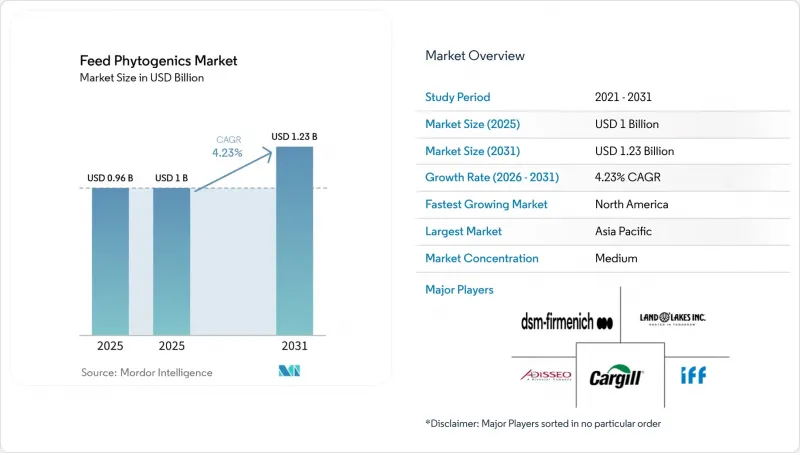
本報告按添加劑子類別(精油、草藥和香辛料以及其他植物性添加劑)、動物種類(水產養殖、家禽、反芻動物、豬和其他動物)以及地區(北美、南美、歐洲、亞太地區以及中東和非洲)進行細分。市場預測以價值(美元)和數量(公噸)表示。
全球植物來源飼料添加劑市場趨勢及洞察。
透過監管逐步淘汰抗生素類生長促進劑。
政府對獸用抗生素使用的監管正在推動人們對飼料植物來源添加劑的興趣,而這種興趣也正持續轉化為市場上的實際商業性需求。根據歐洲藥品管理局 (EMA) 的報告,歐盟委員會已設定目標,到 2030 年將歐盟畜牧業和水產養殖用抗生素的銷售量減少 50%,以此作為其應對抗生素抗藥性努力的一部分。印度也在推動 2025 年 4 月生效的法規,這將進一步促進這個全球最大的肉雞和水產養殖生產國之一的發展。由於各國法規的推進速度不盡相同,跨國飼料公司開始意識到,管理廣譜植物來源添加劑的配方比應對各個司法管轄區不同的抗生素核准程序要容易得多。
對無殘留蛋白質的需求
植物來源飼料添加劑市場也受到零售商和餐飲服務業對無殘留肉類、雞蛋、乳製品和水產品的需求所驅動。到2025年,北美和歐洲的主流採購標準將進一步滲透到無抗生素採購要求中,迫使供應商在飼料層面兌現其承諾。 2025年發表在《獸醫學前沿》(Frontiers in Veterinary Science)上的一項研究表明,植物來源添加劑能夠調節商業家禽的腸道菌群和免疫功能,支持將其用於與無殘留生產相關的生產力提升計劃。願意承擔添加劑成本的生產商通常可以透過設定溢價以及在無抗生素分銷管道中獲得買家的高接受度來收回這些成本。這使得需求比短期替代週期更具永續性,因為採購訊號越來越多來自飼料添加劑供應商以及下游蛋白質採購環節。
原物料價格波動和成本溢價
原料價格波動仍是限制飼料植物來源添加劑廣泛應用的最明顯因素之一。與合成添加劑不同,精油和植物萃取物的價格受制於作物生長週期、天氣狀況、產量以及農業地區的供應中斷。在對成本高度敏感的畜牧業系統中,即使植物性原料價格略有上漲,也可能導致買家轉而選擇更便宜的合成替代品。在東南亞和拉丁美洲,飼料已佔總生產成本的很大一部分,因此這個問題更為嚴重。由於大多數芳香植物並未透過標準化期貨合約進行主動避險,買家在長期採購週期中管理價格風險的手段仍然非常有限。
細分市場分析
到2025年,飼料植物來源添加劑市場中,精油類精油將佔55.6%的佔有率,成為最大的細分市場。其主導地位源自於其悠久的商業應用歷史以及抗菌、抗氧化和促進消化等公認的特性。百里香酚和牛至酚分別提取自百里香和牛至,目前仍佔據市售精油配方的大部分佔有率。這些成分在單胃動物飼料中最具吸引力,因為有大量經驗數據證明其有效性,且與生產結果密切相關。基於這些證據,即使新型產品不斷湧現,精油添加劑仍已在飼料植物來源添加劑市場中佔據核心地位。
香草和香辛料是成長最快的細分市場,預計2026年至2031年將以4.1%的複合年成長率成長。這一市場成長主要得益於成本優勢以及不斷深入的研究證實了這些產品的生物活性。牛至油因其已被證實的抗菌功效,在精油應用領域佔據主導地位。同時,百里香油和迷迭香油在獲得歐洲食品安全局(EFSA)2024年的批准後,在歐洲市場越來越受歡迎。油樹脂用於需要高濃度生物活性物質的特殊應用,尤其是在水產養殖飼料中,在水中的穩定性至關重要。
區域分析
亞太地區是最大的市場,預計到2025年將佔據植物來源飼料添加劑23.8%的市場。中國、印度、越南和泰國雖然家禽和生豬產量龐大,但也面臨更嚴格的飼料使用監管。中國大力推動農業現代化,而印度於2024年宣布並於2025年4月生效的抗生素禁令,正從不同的政策層面推動這些產品的普及。 2025年發表在《獸醫科學》雜誌上的一項研究報告稱,中國商業白羽肉雞飼餵植物性複合飼料後,日均增重提高了21%,這為該地區推廣植物來源飼料添加劑提供了更有力的證據。亞太地區在水產養殖業也扮演著重要角色,供應商正在開發適用於蝦類和魚類養殖系統的產品,這些系統需要更精準的劑量控制和生物安全保障。
北美是成長最快的地區,預計2026年至2031年將以3.5%的複合年成長率成長。美國食品藥物管理局(FDA)的獸用飼料指令和加州的州級法規正在為天然替代品提供監管支援。此外,主要食品零售商對無抗生素採購的要求也促使生產商採用植物來源解決方案,從而獲得市場溢價,抵消不斷上漲的原料成本。在加拿大,有機畜牧業正在推動對經認證的天然飼料添加劑的需求,而墨西哥以出口為導向的家禽業也在採用植物來源飼料添加劑,以滿足國際買家的需求。
在南美洲,巴西和阿根廷的重要性日益凸顯,因為兩國將大規模畜牧業生產與永續性飼料解決方案(尤其是反芻動物飼料解決方案)日益成長的需求相結合。儘管預計到2025年,中東和非洲仍將是貢獻最小的地區,但對國內糧食安全和垂直整合家禽生產的投資正在為植物植物來源飼料添加劑市場的中期成長奠定基礎。
其他好處:
- Excel格式的市場預測(ME)表
- 3個月的分析師支持
目錄
第1章:引言
- 研究假設和市場定義
- 調查範圍
- 調查方法
第2章:本報告的內容
第3章:執行摘要和主要發現
第4章:主要產業趨勢
- 飼養的動物數量
- 家禽
- 反芻動物
- 豬
- 飼料生產
- 水產養殖
- 家禽
- 反芻動物
- 豬
- 法律規範
- 阿根廷
- 澳洲
- 巴西
- 加拿大
- 智利
- 中國
- 埃及
- 法國
- 德國
- 印度
- 印尼
- 伊朗
- 義大利
- 日本
- 肯亞
- 墨西哥
- 荷蘭
- 菲律賓
- 俄羅斯
- 沙烏地阿拉伯
- 南非
- 韓國
- 西班牙
- 泰國
- 土耳其
- 英國
- 美國
- 越南
- 價值鍊和通路分析
- 市場促進因素
- 透過監管逐步淘汰抗生素類生長促進劑。
- 對無殘留蛋白質的需求
- 關注家禽業的飼料轉換率和腸道健康
- 療效檢驗和藥物科學
- 微囊化和精準給藥
- 反芻動物甲烷排放計劃
- 市場限制因素
- 原物料價格波動和成本溢價
- 監管碎片化
- 缺乏封裝和合約製造能力
- 植物性原料供應波動和可追溯性壓力
第5章 市場規模與成長預測
- 次要添加劑
- 精油
- 香草和香辛料
- 其他植物來源成分
- 動物
- 水產養殖
- 魚
- 蝦
- 其他養殖物種
- 家禽
- 肉雞
- 產蛋母雞
- 其他家禽
- 反芻動物
- 牛
- 牛
- 其他反芻動物
- 豬
- 其他動物
- 水產養殖
- 地區
- 非洲
- 埃及
- 肯亞
- 南非
- 其他非洲國家
- 亞太地區
- 澳洲
- 中國
- 印度
- 印尼
- 日本
- 菲律賓
- 韓國
- 泰國
- 越南
- 其他亞太國家
- 歐洲
- 法國
- 德國
- 義大利
- 荷蘭
- 俄羅斯
- 西班牙
- 土耳其
- 英國
- 其他歐洲國家
- 中東
- 伊朗
- 沙烏地阿拉伯
- 其他中東國家
- 北美洲
- 加拿大
- 墨西哥
- 美國
- 其他北美國家
- 南美洲
- 阿根廷
- 巴西
- 智利
- 其他南美國家
- 非洲
第6章 競爭情勢
- 關鍵策略趨勢
- 市佔率分析
- 企業狀況
- 公司簡介
- Cargill, Incorporated
- DSM-Firmenich AG
- Kemin Industries, Inc
- Adisseo
- Alltech
- IFF(Danisco Animal Nutrition)
- Borregaard
- Land O'Lakes, Inc
- Orffa International
- Prinova Group
- Phytobiotics Futterzusatzstoffe
- Nor-Feed
- Silvateam
- Amax NutraSource
- Nutrex NV
第7章:執行長面臨的關鍵策略問題
According to Mordor Intelligence, the feed phytogenics market size is projected to increase from USD 0.96 billion in 2025 to USD 1.00 billion in 2026 and reach USD 1.23 billion by 2031, growing at a CAGR of 4.23% over 2026 to 2031.
This report is Segmented by Sub-Additive (Essential Oils, Herbs and Spices, and Other Phytogenics), by Animal (Aquaculture, Poultry, Ruminants, Swine, and Other Animals), and by Geography (North America, South America, Europe, Asia-Pacific, Middle East, and Africa). The Market Forecasts are Provided in Terms of Value (USD) and Volume (metric Tons).
Global Feed Phytogenics Market Trends and Insights
Regulatory Phaseout of Antibiotic Growth Promoters
Government restrictions on veterinary antibiotic use continue to turn interest in botanical additives into real commercial demand across the feed phytogenics market. The European Medicines Agency reported that the European Commission has set targets as part of its efforts to address antimicrobial resistance, including an aspirational goal to reduce overall European Union sales of antimicrobials for farmed animals and in aquaculture by 50% by 2030. India also moved ahead with restrictions that took effect in April 2025, adding momentum to one of the world's largest broiler and aquaculture production bases. As these national rules expand at different speeds, multinational feed companies are finding that broad-spectrum phytogenic formulations are easier to manage than antibiotic approvals that vary by jurisdiction.
Residue-Free Protein Demand
The feed phytogenics market is also being pulled forward by retailer and foodservice demand for residue-free meat, eggs, dairy, and aquaculture products. By 2025, antibiotic-free sourcing requirements had moved further into mainstream procurement standards in North America and Europe, pushing suppliers to support the claim at the feed level. A 2025 study in Frontiers in Veterinary Science found that phytogenics modulate gut microbiota and immune function in commercial poultry, which supports their use in performance programs tied to residue-free production. Producers that accept the additive cost can often recover it through premium pricing or stronger buyer acceptance in antibiotic-free channels. That makes demand more durable than a short replacement cycle because the buying signal is increasingly coming from downstream protein procurement rather than only from feed additive suppliers.
Raw-Material Price Volatility and Cost Premium
Raw-material price volatility remains one of the clearest limits on broader adoption in the feed phytogenics market. Unlike synthetic additives, essential oils and botanical extracts depend on crop cycles, weather conditions, harvest volumes, and supply disruptions in agricultural regions. In cost-sensitive livestock systems, even a moderate rise in botanical input prices can push buyers back toward cheaper synthetic alternatives. The problem is sharper in Southeast Asia and Latin America, where feed already accounts for a large share of total production cost. Because most aromatic plants are not actively hedged through standardized futures contracts, buyers still have few tools to manage price risk over longer procurement cycles.
Other drivers and restraints analyzed in the detailed report include:
- Poultry Focus on Feed Efficiency and Gut Health
- Efficacy Validation and Formulation Science
- Regulatory Fragmentation
For complete list of drivers and restraints, kindly check the Table Of Contents.
Segment Analysis
Sub-additive essential oils accounted for 55.6% of the feed phytogenics market in 2025, making them the largest segment. This dominance is attributed to their long-standing commercial use and well-established antimicrobial, antioxidant, and digestive-support properties. Thymol and carvacrol, derived from thyme and oregano, still anchor a large share of essential-oil-based commercial formulations. Their appeal remains strongest in monogastric diets, where the response is better documented and easier to link to production outcomes. This evidence base helps establish essential oils in a central position in the feed phytogenics market, even as newer product types gain attention.
Herbs and spices are the fastest-growing segment, projected to grow at a 4.1% CAGR from 2026 to 2031. The market is driven by cost advantages and expanding research supporting the bioactive properties of these products. Oregano oil dominates essential oil applications due to its proven antimicrobial efficacy, while thyme and rosemary oils are gaining popularity in European markets following European Food Safety Authority (EFSA) approvals in 2024. Oleoresins are used in specialized applications that require concentrated bioactive compounds, particularly in aquaculture feeds, where water stability is a critical factor.
Complete Report Scope:
- Sub Additive
- Essential Oil
- Herbs & Spices
- Other Phytogenics
- Animal
- Aquaculture
- Fish
- Shrimp
- Other Aquaculture Species
- Poultry
- Broiler
- Layer
- Other Poultry Birds
- Ruminants
- Beef Cattle
- Dairy Cattle
- Other Ruminants
- Swine
- Other Animals
- Aquaculture
- Geography
- Africa
- Egypt
- Kenya
- South Africa
- Rest of Africa
- Asia-Pacific
- Australia
- China
- India
- Indonesia
- Japan
- Philippines
- South Korea
- Thailand
- Vietnam
- Rest of Asia-Pacific
- Europe
- France
- Germany
- Italy
- Netherlands
- Russia
- Spain
- Turkey
- United Kingdom
- Rest of Europe
- Middle East
- Iran
- Saudi Arabia
- Rest of Middle East
- North America
- Canada
- Mexico
- United States
- Rest of North America
- South America
- Argentina
- Brazil
- Chile
- Rest of South America
- Africa
Geography Analysis
Asia-Pacific is the largest region, accounting for 23.8% of the feed phytogenics market share in 2025. China, India, Vietnam, and Thailand combine large poultry and swine output with stricter expectations for antibiotic use. China's broad push toward agricultural modernization and India's 2024 antibiotic ban, effective from April 2025, are reinforcing adoption from different policy angles. A 2025 study in Veterinary Sciences reported a 21% improvement in average daily gain in Chinese commercial white-feathered broilers fed a phytogenic formula, providing the region with stronger local evidence for adoption. Asia-Pacific is also important for aquaculture, where suppliers are building products for shrimp and fish systems that need more targeted delivery and biosecurity support.
North America is the fastest-growing region, forecast to expand at a 3.5% CAGR through 2026 to 2031. The United States Food and Drug Administration (FDA) Veterinary Feed Directive and state-level restrictions in California have generated regulatory support for natural alternatives. Additionally, major food retailers' antibiotic-free sourcing requirements are encouraging producers to implement phytogenic solutions, enabling market premiums that offset higher ingredient costs. In Canada, the organic livestock sector is driving demand for certified natural feed additives, while Mexico's export-focused poultry industry is adopting phytogenics to comply with international buyer requirements.
South America is becoming more relevant as Brazil and Argentina connect large-scale livestock output with rising interest in sustainability-linked feed solutions, especially for ruminants. The Middle East and Africa remained the smallest regional contributor in 2025, but investments in domestic food security and vertically integrated poultry production are building a base for medium-term growth in the feed phytogenics market.
- Cargill, Incorporated
- DSM-Firmenich AG
- Kemin Industries, Inc
- Adisseo
- Alltech
- IFF (Danisco Animal Nutrition)
- Borregaard
- Land O'Lakes, Inc
- Orffa International
- Prinova Group
- Phytobiotics Futterzusatzstoffe
- Nor-Feed
- Silvateam
- Amax NutraSource
- Nutrex NV
Additional Benefits:
- The market estimate (ME) sheet in Excel format
- 3 months of analyst support
TABLE OF CONTENTS
1 Introduction
- 1.1 Study Assumptions & Market Definition
- 1.2 Scope of the Study
- 1.3 Research Methodology
2 Report Offers
3 Executive Summary and Key Findings
4 Key Industry Trends
- 4.1 Animal Headcount
- 4.1.1 Poultry
- 4.1.2 Ruminants
- 4.1.3 Swine
- 4.2 Feed Production
- 4.2.1 Aquaculture
- 4.2.2 Poultry
- 4.2.3 Ruminants
- 4.2.4 Swine
- 4.3 Regulatory Framework
- 4.3.1 Argentina
- 4.3.2 Australia
- 4.3.3 Brazil
- 4.3.4 Canada
- 4.3.5 Chile
- 4.3.6 China
- 4.3.7 Egypt
- 4.3.8 France
- 4.3.9 Germany
- 4.3.10 India
- 4.3.11 Indonesia
- 4.3.12 Iran
- 4.3.13 Italy
- 4.3.14 Japan
- 4.3.15 Kenya
- 4.3.16 Mexico
- 4.3.17 Netherlands
- 4.3.18 Philippines
- 4.3.19 Russia
- 4.3.20 Saudi Arabia
- 4.3.21 South Africa
- 4.3.22 South Korea
- 4.3.23 Spain
- 4.3.24 Thailand
- 4.3.25 Turkey
- 4.3.26 United Kingdom
- 4.3.27 United States
- 4.3.28 Vietnam
- 4.4 Value Chain & Distribution Channel Analysis
- 4.5 Market Drivers
- 4.5.1 Regulatory phaseout of antibiotic growth promoters
- 4.5.2 Residue-free protein demand
- 4.5.3 Poultry focus on feed efficiency and gut health
- 4.5.4 Efficacy validation and formulation science
- 4.5.5 Microencapsulation and precision dosing
- 4.5.6 Ruminant methane programs
- 4.6 Market Restraints
- 4.6.1 Raw-material price volatility and cost premium
- 4.6.2 Regulatory fragmentation
- 4.6.3 Limited encapsulation and toll-processing capacity
- 4.6.4 Botanical supply variability and traceability pressure
5 Market Size and Growth Forecasts (Value and Volume)
- 5.1 Sub Additive
- 5.1.1 Essential Oil
- 5.1.2 Herbs & Spices
- 5.1.3 Other Phytogenics
- 5.2 Animal
- 5.2.1 Aquaculture
- 5.2.1.1 Fish
- 5.2.1.2 Shrimp
- 5.2.1.3 Other Aquaculture Species
- 5.2.2 Poultry
- 5.2.2.1 Broiler
- 5.2.2.2 Layer
- 5.2.2.3 Other Poultry Birds
- 5.2.3 Ruminants
- 5.2.3.1 Beef Cattle
- 5.2.3.2 Dairy Cattle
- 5.2.3.3 Other Ruminants
- 5.2.4 Swine
- 5.2.5 Other Animals
- 5.2.1 Aquaculture
- 5.3 Geography
- 5.3.1 Africa
- 5.3.1.1 Egypt
- 5.3.1.2 Kenya
- 5.3.1.3 South Africa
- 5.3.1.4 Rest of Africa
- 5.3.2 Asia-Pacific
- 5.3.2.1 Australia
- 5.3.2.2 China
- 5.3.2.3 India
- 5.3.2.4 Indonesia
- 5.3.2.5 Japan
- 5.3.2.6 Philippines
- 5.3.2.7 South Korea
- 5.3.2.8 Thailand
- 5.3.2.9 Vietnam
- 5.3.2.10 Rest of Asia-Pacific
- 5.3.3 Europe
- 5.3.3.1 France
- 5.3.3.2 Germany
- 5.3.3.3 Italy
- 5.3.3.4 Netherlands
- 5.3.3.5 Russia
- 5.3.3.6 Spain
- 5.3.3.7 Turkey
- 5.3.3.8 United Kingdom
- 5.3.3.9 Rest of Europe
- 5.3.4 Middle East
- 5.3.4.1 Iran
- 5.3.4.2 Saudi Arabia
- 5.3.4.3 Rest of Middle East
- 5.3.5 North America
- 5.3.5.1 Canada
- 5.3.5.2 Mexico
- 5.3.5.3 United States
- 5.3.5.4 Rest of North America
- 5.3.6 South America
- 5.3.6.1 Argentina
- 5.3.6.2 Brazil
- 5.3.6.3 Chile
- 5.3.6.4 Rest of South America
- 5.3.1 Africa
6 Competitive Landscape
- 6.1 Key Strategic Moves
- 6.2 Market Share Analysis
- 6.3 Company Landscape
- 6.4 Company Profiles (includes Global Level Overview, Market Level Overview, Core Business Segments, Financials, Headcount, Key Information, Market Rank, Market Share, Products and Services, and Analysis of Recent Developments).
- 6.4.1 Cargill, Incorporated
- 6.4.2 DSM-Firmenich AG
- 6.4.3 Kemin Industries, Inc
- 6.4.4 Adisseo
- 6.4.5 Alltech
- 6.4.6 IFF (Danisco Animal Nutrition)
- 6.4.7 Borregaard
- 6.4.8 Land O'Lakes, Inc
- 6.4.9 Orffa International
- 6.4.10 Prinova Group
- 6.4.11 Phytobiotics Futterzusatzstoffe
- 6.4.12 Nor-Feed
- 6.4.13 Silvateam
- 6.4.14 Amax NutraSource
- 6.4.15 Nutrex NV
7 Key Strategic Questions for Feed Additive CEOS

 中東飼料用植物源添加劑:市場佔有率分析、產業趨勢與統計及成長預測(2026-2031 年)
 飼料用植物源添加劑市場:按類型、功能、形態、畜種、應用和分銷管道分類-2026-2032年全球市場預測非洲飼料用植物源添加劑:市場佔有率分析、產業趨勢與統計及成長預測(2026-2031 年)
 飼料植物原料市場規模、佔有率及成長分析(按類型、畜種、來源、功能、形態和地區分類)-2026-2033年產業預測
 飼料植物源性市場-全球產業規模、佔有率、趨勢、機會和預測,按添加劑細分(精油、草藥和香料等)、按動物細分(水產養殖、家禽、反芻動物、豬等)、按地區和競爭細分,2020 年至 2030 年預測
 飼料植物性物質市場規模、佔有率和成長分析(按類型、牲畜、來源、功能、形式和地區)- 產業預測 2025-2032
 全球飼料植物源市場預測(-2030):按類型、來源、形式、功能、應用、最終用戶和地區進行分析