


 |
市場調查報告書
商品編碼
2073176
非洲飼料用植物源添加劑:市場佔有率分析、產業趨勢與統計及成長預測(2026-2031 年)Africa Feed Phytogenics - Market Share Analysis, Industry Trends & Statistics, Growth Forecasts (2026 - 2031) |
||||||

※ 本網頁內容可能與最新版本有所差異。詳細情況請與我們聯繫。
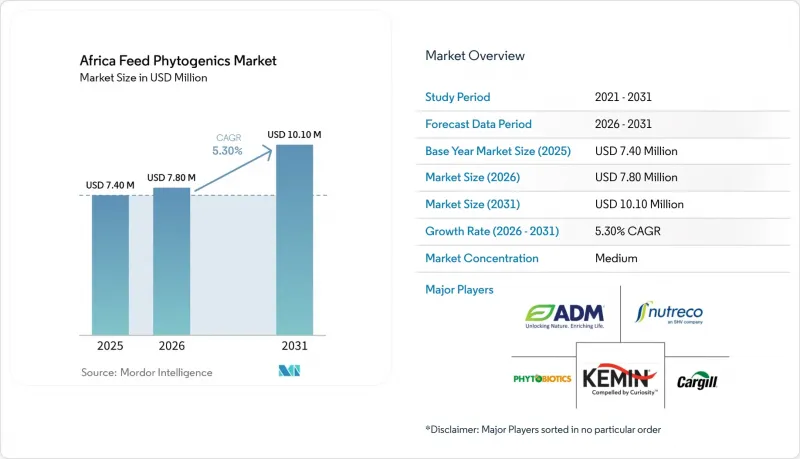
根據 Mordor Intelligence 預測,非洲飼料植物性物質市場規模將從 2025 年的 740 萬美元成長到 2026 年的 780 萬美元,然後在 2031 年達到 1,010 萬美元,2026 年至 2031 年的複合年成長率為 5.3%。
本報告依產品種類(精油等)、動物種類(家禽、反芻動物、豬、水產養殖及其他動物)及地區(南非、埃及、摩洛哥、奈及利亞、肯亞及非洲其他地區)進行細分。市場預測以價值(美元)和數量(公噸)呈現。
非洲飼料源添加劑市場的趨勢與洞察。
無抗生素家禽和水產養殖計劃
非洲商業家禽和水產養殖系統正邁入對抗抗生素抗藥性的更嚴格階段,這直接推動了非洲飼料植物源添加劑市場的發展。奈及利亞於2024年10月發布了“同一健康國家行動計劃2.0”,埃塞俄比亞於2025年12月發布了第四個國家行動計劃。這表明,各國政府對畜牧業系統施加了越來越大的壓力,要求其減少不必要的抗生素使用。 2025年6月,聯合國糧食及農業組織(糧農組織)報告了RENOFARM在津巴布韋肉雞養殖方面的舉措,該舉措透過改善畜牧管理和生物安全措施,減少了抗生素的過度使用。這表明,系統性的替代方案在非洲的生產環境中同樣有效。在產品層面,家禽研究表明,植物來源混合物和精油能夠抑制病原體,改善腸道健康,並提高飼料轉換率,符合現代飼料方案的合規性和性能目標。
在糧食價格飆升的壓力下,提高飼料轉換率面臨挑戰
在奈及利亞、肯亞和南非,提高飼料轉換率仍然是採用植物來源添加劑最顯而易見的商業性原因之一。隨著飼料投入成本的上升,生產者面臨維持利潤率的壓力,因此,能夠提高消化率和飼料轉換率的添加劑在採購決策中扮演著越來越重要的角色。 2025年發表在《免疫學前沿》(Frontiers in Immunology)上的一項研究表明,添加150毫克/公斤的百里香油可以提高肉雞的增重、飼料轉換率、消化酶活性和經濟效益。 2025年發表在《科學報告》(Scientific Reports)上的另一項研究表明,在所測試的精油中,400毫克/公斤的胡蘆巴油對肉雞的增重和飼料轉化率的改善效果最為穩定。此外,2025年發表在《反芻動物》(Ruminants)雜誌上的一篇系統綜述證實,薑黃素類產品和精油混合物可以提高撒哈拉以南非洲地區反芻動物養殖系統的平均每日增重和飼料轉換率。這些結果鞏固了非洲飼料源添加劑市場的地位,因為即使在飼料成本高昂的環境中,輕微的性能提升也能幫助抵消添加植物性添加劑的額外成本。
植物源活性成分的批次間差異
植物活性成分批次間的差異仍是限制植物性產品在非洲飼料市場廣泛應用的主要阻礙因素之一。在技術支援有限的市場,這個問題尤其突出,因為飼料廠買家在決定是否繼續採購之前,需要獲得可預測的結果。 2025年發表在《獸醫學前沿》(Frontiers in Veterinary Science)上的一篇綜述指出,收穫時間、植物種類差異、種植地點、提取方法和儲存條件是導致百里酚、香芹酚、肉桂醛和芹菜素等活性成分差異的主要因素。在其他非洲市場,這項挑戰更為嚴峻,因為購買本地植物原料可以降低成本,但往往缺乏確保性能一致性所需的品質標準化。提供微膠囊化、活性成分含量標準化和分析證書的供應商在正式競標過程中具有優勢,但這些措施也會導致產品成本增加。這造成了明顯的兩極化:一方面是能夠承受價格溢價的市場,例如南非、埃及和摩洛哥;另一方面是價格敏感度仍然限制其普及的市場。
細分市場分析
到2025年,精油將佔據非洲飼料添加劑市場55%的佔有率,成為該全部區域產品組合中佔比最大的產品類型,也是成長最快的細分市場,預計在預測期內將以5.8%的複合年成長率成長。 2024年發表在《國際家禽科學雜誌》(International Journal of Poultry Science)上的一項研究表明,每公斤體重飼餵40-60微升生薑根莖精油,可將肉雞的平均日增重從56.09克提高到64.83克。這些可衡量的性能結果有助於解釋為什麼精油將在2025年繼續保持非洲飼料源添加劑市場領先地位。百里酚、香芹酚、丁香酚和肉桂醛等關鍵活性成分具有抗菌、抗發炎和促進消化等功效,滿足了非洲商業家禽、反芻動物和水產飼料系統的主要需求。由於可透過國際供應商輕鬆取得,且與南非、埃及和奈及利亞的顆粒飼料和預混合料系統相容,這些植物性添加劑已成為飼料廠常規採購中最成熟的產品。 Trouw Nutrition 的「Fytera Perform」是一種微膠囊化的丁香、肉桂和牛至精油混合物,其功效已在六項獨立的商業試驗中得到驗證。該產品表明,此類產品正從單純的植物來源標籤轉向活性成分含量標準化和性能驗證。其他植物來源成分,如油樹脂、皂素、單寧和類黃酮,構成了該產品的其餘成分,這些成分的重要性日益凸顯,尤其是在埃及和新興東非市場的特色水產養殖應用和反芻動物養殖項目中。
就香草和香辛料而言,百里香、大蒜、迷迭香和檸檬草等植物性原料在東非和西非的廣泛應用反映了這一趨勢。肯亞一家研究機構發表了一篇經過同行評審的研究報告,探討了大蒜素作為肉雞抗生素替代品的潛力。同時,針對西非胡椒和月桂葉的區域性研究表明,它們對肉雞的血液和免疫反應有積極作用,且不影響肉質。 NOR-FEED(現為Adiseo旗下公司)於2025年也發表了相關證據,顯示Nor-Spice AB(一種含有檸檬黃酮和果膠寡糖的標準化柑橘萃取物)能夠改善肉雞的生長性能、腸道健康和胴體品質。這意義重大,因為許多用於香草和香辛料衍生植物萃取物的植物性原料已經在肯亞、衣索比亞、坦尚尼亞和奈及利亞等地種植,這為制定區域性定價策略提供了可能。此外,這一成長也反映出,此類產品與奈及利亞和埃塞俄比亞等國應對抗生素抗藥性的政策重點高度契合。在這些國家,草藥活性成分作為可靠的抗生素替代品,正日益受到關注。
其他好處:
- Excel格式的市場預測(ME)表
- 3個月的分析師支持
目錄
第1章:引言
- 研究假設和市場定義
- 調查範圍
第2章:調查方法
第3章執行摘要
第4章 市場狀況
- 市場概覽
- 市場促進因素
- 無抗生素家禽和水產養殖計劃
- 在糧食價格飆升的壓力下,提高飼料轉換率面臨挑戰
- 商業飼料中對天然抗菌和腸道健康解決方案的需求
- 包埋技術提高了植物來源成分在高溫高濕飼料供應鏈中的穩定性。
- 熱帶地區畜牧系統中緩解熱應激的必要性
- 標準化的植物源活性成分,有助於產生更可重複的現場效果。
- 市場限制因素
- 植物源活性成分的批次間差異
- 與傳統飼料添加劑相比,複合成本較高
- 缺乏針對非洲不同物種和生產系統的實地檢驗。
- 主要牲畜收集和分銷中心以外的地區在分銷和技術服務方面存在差距。
- 監理情勢
- 技術展望
- 波特五力分析
第5章 市場規模與成長預測
- 依產品類型
- 精油
- 香草和香辛料
- 其他植物來源成分
- 依動物類型
- 水產養殖
- 魚
- 蝦
- 其他養殖物種
- 家禽
- 肉雞
- 產蛋母雞
- 其他家禽
- 反芻動物
- 牛
- 牛
- 其他反芻動物
- 豬
- 其他動物
- 水產養殖
- 按地區
- 南非
- 埃及
- 摩洛哥
- 奈及利亞
- 肯亞
- 其他非洲國家
第6章 競爭情勢
- 市場集中度
- 策略趨勢
- 市佔率分析
- 公司簡介
- Cargill, Incorporated
- Kemin Industries, Inc.
- Adisseo
- Natural Remedies Pvt. Ltd.
- Phode Animal Care(Phode Group)
- Nutrex NV
- Phytosynthese
- DOSTOFARM GmbH
- Archer-Daniels-Midland Company
- CCPA Group
- EW Nutrition GmbH
- Phytobiotics Futterzusatzstoffe GmbH
- Trouw Nutrition(Nutreco NV)
- Orffa International Holding BV
- Norel SA
第7章 市場機會與未來展望
According to Mordor Intelligence, the africa feed phytogenics market size is projected to grow from USD 7.4 million in 2025 to USD 7.8 million in 2026 and is forecast to reach USD 10.1 million by 2031 at 5.3% CAGR over 2026-2031.
This report is Segmented by Product Type (Essential Oils, and More), by Animal Type (Poultry, Ruminants, Swine, Aquaculture, and Other Animals), and by Geography (South Africa, Egypt, Morocco, Nigeria, Kenya, and Rest of Africa). The Market Forecasts are Provided in Terms of Value (USD) and Volume (Metric Tons).
Africa Feed Phytogenics Market Trends and Insights
Antibiotic-Free Poultry and Aquaculture Programs
Commercial poultry and aquaculture systems in Africa are moving into a stricter phase of antimicrobial resistance control, which directly supports the Africa feed phytogenics market. Nigeria launched its One Health Antimicrobial Resistance National Action Plan 2.0 in October 2024, and Ethiopia launched its fourth national action plan in December 2025, which signals stronger policy pressure on animal production systems to reduce unnecessary antibiotic use. The Food and Agriculture Organization of the United Nations documented in June 2025 that Zimbabwe's RENOFARM work on broilers reduced antimicrobial overuse through improved husbandry and biosecurity, demonstrating that structured alternatives can work in African production settings. At the product level, poultry research shows that phytogenic blends and essential oil actives can suppress pathogens, improve gut integrity, and support feed efficiency, which fits the compliance and performance goals of modern feed programs.
Feed Efficiency Improvement Under High Grain-Cost Pressure
Feed efficiency remains one of the clearest commercial reasons for phytogenic adoption across Nigeria, Kenya, and South Africa. Producers are under pressure to protect margins when feed input costs rise, so additives that support digestibility and conversion become more relevant to buying decisions. A 2025 study published in Frontiers in Immunology found that thyme oil at 150 mg/kg improved body weight gain, feed conversion ratio, digestive enzyme activity, and economic return in broilers. A separate 2025 study published in Scientific Reports showed that fenugreek oil at 400 mg/kg delivered the most consistent body weight gain and feed conversion improvement among the tested essential oils in broilers. A 2025 systematic review published in Ruminants also confirmed that curcumin-based products and essential oil blends improved average daily gain and feed conversion performance in ruminant systems across sub-Saharan Africa. These results strengthen the case for the Africa feed phytogenics market because even modest performance gains can help offset the added cost of phytogenic inclusion in high-cost feeding environments.
Batch-to-Batch Variability in Botanical Active Content
Batch variability in botanical actives remains one of the main constraints to wider adoption of phytogenic products in African feed markets. This issue matters because feed mill buyers need predictable results before they commit to repeat purchasing, especially in markets with limited technical support. A 2025 review published in Frontiers in Veterinary Science identified harvest timing, differences in plant species, growing location, extraction method, and storage conditions as major factors contributing to variation in actives such as thymol, carvacrol, cinnamaldehyde, and apigenin. The challenge is more severe in the rest of Africa markets, where local botanical sourcing may reduce cost but often lacks the quality standardization needed for consistent performance. Suppliers that offer microencapsulation, active-level standardization, and certificate-of-analysis support are better positioned in formal tender processes, but these steps also raise product cost. This creates a clear split between markets that can absorb the premium, such as South Africa, Egypt, and Morocco, and those where price sensitivity still limits adoption.
Other drivers and restraints analyzed in the detailed report include:
- Demand for Natural Antimicrobial and Gut-Health Solutions in Commercial Feed
- Encapsulation Improving Phytogenic Stability in Hot and Humid Feed Chains
- Higher Formulation Cost Versus Conventional Feed Additives
For complete list of drivers and restraints, kindly check the Table Of Contents.
Segment Analysis
Essential oils held 55% of the Africa feed phytogenics market share in 2025, making them the largest product type across the regional portfolio and also the fastest growing segment with 5.8% CAGR during the forecast period. A 2024 study in the International Journal of Poultry Science showed that ginger rhizome essential oil at 40-60 µL/kg body weight improved average daily broiler weight gain from 56.09 to 64.83 g/day. This kind of measurable performance outcome helps explain why Essential oils remained the leading product type in the Africa feed phytogenics market in 2025. Key active molecules such as thymol, carvacrol, eugenol, and cinnamaldehyde offer antimicrobial, anti-inflammatory, and digestive-support effects that match the main needs of commercial poultry, ruminant, and aquaculture feed systems in Africa. Their strong availability through international suppliers and their compatibility with pelleted feed and premix systems across South Africa, Egypt, and Nigeria have made them the most established phytogenic format in formal feed mill procurement. Trouw Nutrition's Fytera Perform, a microencapsulated blend of clove, cinnamon, and oregano essential oils validated across 6 independent commercial trials, also shows how the category is moving toward stronger active-level standardization and performance documentation rather than simple botanical labeling. Other phytogenics, including oleoresins, saponins, tannins, and flavonoids, account for the rest of the product mix and are gaining more relevance in niche aquaculture uses and in ruminant feeding programs, especially in Egypt and emerging East African markets.
Herbs and spices reflects the wide local availability of botanicals such as thyme, garlic, rosemary, and lemongrass across East and West Africa. Kenyan research institutions have published peer-reviewed findings on garlic allicin as an antibiotic alternative in broilers, while regional studies on West African pepper and bay leaf have shown positive blood and immune responses in broiler production without reducing meat quality. NOR-FEED, now part of Adisseo, also published evidence in 2025 showing that Nor-Spice AB, a standardized citrus extract containing citroflavonoids and pectic oligosaccharides, improved broiler growth performance, gut health, and carcass quality. This matters because many of the botanical raw materials used in Herbs and spices phytogenics are already cultivated in Kenya, Ethiopia, Tanzania, and Nigeria, which opens the possibility for more region-specific pricing strategies. The growth also reflects how closely this category lines up with antimicrobial resistance policy priorities in countries such as Nigeria and Ethiopia, where herb-derived actives are increasingly seen as credible antibiotic alternatives.
Complete Report Scope:
- By Product Type
- Essential Oils
- Herbs & Spices
- Other Phytogenics
- By Animal Type
- Aquaculture
- Fish
- Shrimp
- Other Aquaculture Species
- Poultry
- Broiler
- Layer
- Other Poultry Birds
- Ruminants
- Beef Cattle
- Dairy Cattle
- Other Ruminants
- Swine
- Other Animals
- Aquaculture
- By Geography
- South Africa
- Egypt
- Morocco
- Nigeria
- Kenya
- Rest of Africa
List of Companies Covered in this Report:
- Cargill, Incorporated
- Kemin Industries, Inc.
- Adisseo
- Natural Remedies Pvt. Ltd.
- Phode Animal Care (Phode Group)
- Nutrex NV
- Phytosynthese
- DOSTOFARM GmbH
- Archer-Daniels-Midland Company
- CCPA Group
- EW Nutrition GmbH
- Phytobiotics Futterzusatzstoffe GmbH
- Trouw Nutrition (Nutreco N.V.)
- Orffa International Holding B.V.
- Norel S.A.
Additional Benefits:
- The market estimate (ME) sheet in Excel format
- 3 months of analyst support
TABLE OF CONTENTS
1 INTRODUCTION
- 1.1 Study Assumptions and Market Definition
- 1.2 Scope of the Study
2 RESEARCH METHODOLOGY
3 EXECUTIVE SUMMARY
4 MARKET LANDSCAPE
- 4.1 Market Overview
- 4.2 Market Drivers
- 4.2.1 Antibiotic-Free Poultry and Aquaculture Programs
- 4.2.2 Feed Efficiency Improvement Under High Grain-Cost Pressure
- 4.2.3 Demand for Natural Antimicrobial and Gut-Health Solutions in Commercial Feed
- 4.2.4 Encapsulation Improving Phytogenic Stability in Hot and Humid Feed Chains
- 4.2.5 Heat-stress mitigation needs in tropical livestock systems
- 4.2.6 Standardized Botanical Actives Supporting More Repeatable Field Performance
- 4.3 Market Restraints
- 4.3.1 Batch-to-Batch Variability in Botanical Active Content
- 4.3.2 Higher Formulation Cost Versus Conventional Feed Additives
- 4.3.3 Limited Africa-Specific Field Validation Across Species and Production Systems
- 4.3.4 Distributor and Technical-Service Gaps Outside Major Livestock Hubs
- 4.4 Regulatory Landscape
- 4.5 Technological Outlook
- 4.6 Porter's Five Forces Analysis
- 4.6.1 Threat of New Entrants
- 4.6.2 Bargaining Power of Suppliers
- 4.6.3 Bargaining Power of Buyers
- 4.6.4 Threat of Substitutes
- 4.6.5 Intensity of Competitive Rivalry
5 MARKET SIZE AND GROWTH FORECASTS (VALUE AND VOLUME)
- 5.1 By Product Type
- 5.1.1 Essential Oils
- 5.1.2 Herbs & Spices
- 5.1.3 Other Phytogenics
- 5.2 By Animal Type
- 5.2.1 Aquaculture
- 5.2.1.1 Fish
- 5.2.1.2 Shrimp
- 5.2.1.3 Other Aquaculture Species
- 5.2.2 Poultry
- 5.2.2.1 Broiler
- 5.2.2.2 Layer
- 5.2.2.3 Other Poultry Birds
- 5.2.3 Ruminants
- 5.2.3.1 Beef Cattle
- 5.2.3.2 Dairy Cattle
- 5.2.3.3 Other Ruminants
- 5.2.4 Swine
- 5.2.5 Other Animals
- 5.2.1 Aquaculture
- 5.3 By Geography
- 5.3.1 South Africa
- 5.3.2 Egypt
- 5.3.3 Morocco
- 5.3.4 Nigeria
- 5.3.5 Kenya
- 5.3.6 Rest of Africa
6 COMPETITIVE LANDSCAPE
- 6.1 Market Concentration
- 6.2 Strategic Moves
- 6.3 Market Share Analysis
- 6.4 Company Profiles (includes Global Level Overview, Market Level Overview, Core Segments, Financials as Available, Strategic Information, Market Rank/Share for Key Companies, Products and Services, and Recent Developments)
- 6.4.1 Cargill, Incorporated
- 6.4.2 Kemin Industries, Inc.
- 6.4.3 Adisseo
- 6.4.4 Natural Remedies Pvt. Ltd.
- 6.4.5 Phode Animal Care (Phode Group)
- 6.4.6 Nutrex NV
- 6.4.7 Phytosynthese
- 6.4.8 DOSTOFARM GmbH
- 6.4.9 Archer-Daniels-Midland Company
- 6.4.10 CCPA Group
- 6.4.11 EW Nutrition GmbH
- 6.4.12 Phytobiotics Futterzusatzstoffe GmbH
- 6.4.13 Trouw Nutrition (Nutreco N.V.)
- 6.4.14 Orffa International Holding B.V.
- 6.4.15 Norel S.A.
7 MARKET OPPORTUNITIES AND FUTURE OUTLOOK

 中東飼料用植物源添加劑:市場佔有率分析、產業趨勢與統計及成長預測(2026-2031 年)
 飼料用植物源添加劑市場:按類型、功能、形態、畜種、應用和分銷管道分類-2026-2032年全球市場預測植物來源飼料添加劑:市場佔有率分析、行業趨勢和統計數據以及成長預測(2026-2031 年)
 飼料植物原料市場規模、佔有率及成長分析(按類型、畜種、來源、功能、形態和地區分類)-2026-2033年產業預測
 飼料植物源性市場-全球產業規模、佔有率、趨勢、機會和預測,按添加劑細分(精油、草藥和香料等)、按動物細分(水產養殖、家禽、反芻動物、豬等)、按地區和競爭細分,2020 年至 2030 年預測
 飼料植物性物質市場規模、佔有率和成長分析(按類型、牲畜、來源、功能、形式和地區)- 產業預測 2025-2032
 全球飼料植物源市場預測(-2030):按類型、來源、形式、功能、應用、最終用戶和地區進行分析