

 |
市場調查報告書
商品編碼
2099865
北美人工智慧副駕駛市場:市場佔有率分析、產業趨勢與統計及成長預測(2026-2031 年)North America AI Copilot - Market Share Analysis, Industry Trends & Statistics, Growth Forecasts (2026 - 2031) |
||||||

※ 本網頁內容可能與最新版本有所差異。詳細情況請與我們聯繫。
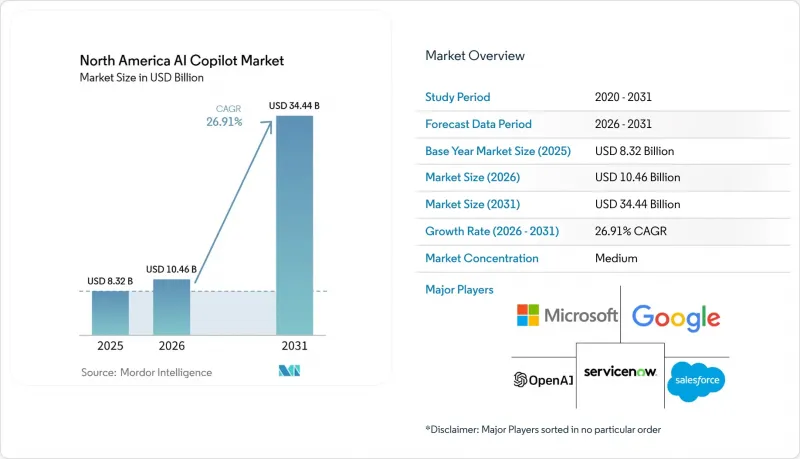
根據 Mordor Intelligence 預測,北美 AI 副駕駛市場規模將從 2025 年的 83.2 億美元和 2026 年的 104.6 億美元成長到 2031 年的 344.4 億美元,2026 年至 2031 年的年複合成長率(CAGR)%為 26.91%。
本報告按副駕駛類型(通用生產力副駕駛、特定功能工作流程副駕駛等)、部署模式(雲端部署等)、組織規模(大型企業、中小企業)、應用領域(知識工作和生產力支援等)、最終用戶產業(銀行、金融服務和保險等)以及地區進行細分。市場預測以美元計價。
北美人工智慧副駕駛市場趨勢與洞察
透過副駕駛工作流程提高企業生產力
北美人工智慧輔助駕駛市場需求的核心驅動力在於,由輔助駕駛主導的工作流程能夠顯著提升企業生產力。 OpenAI 在 2025 年 12 月發布的報告顯示,75% 的受訪員工認為工作速度和交付成果的品質均有所提升。企業用戶也表示,借助人工智慧輔助,他們每天可以節省 40 到 60 分鐘的工作時間,而資料科學家和工程師每天節省的時間甚至高達 80 分鐘。對於需要大量溝通的職位而言,這些時間節省尤其重要,因為撰寫、總結、審核和搜尋等工作往往佔據了很大一部分時間。此外,企業也看到了員工快速上手的價值,因為他們可以利用輔助駕駛來獲取內部知識,而無需等待資深員工的手動支援。這減輕了在複雜工作環境中進行培訓的負擔,並使團隊能夠在入職後更快地取得穩定的成果。正因如此,財務領導者們越來越傾向於將輔助駕駛視為一種提升工作效率的工具,而不僅僅是一項軟體實驗。
Microsoft 365 在知識工作的整體被採用的程度。
微軟在日常知識工作領域的滲透優勢持續影響北美人工智慧助理市場。其龐大的商業 Microsoft 365 用戶群為企業提供了直接的管道,這些企業已經在日常營運中使用 Word、Excel、Outlook、Teams 及相關資料層。微軟新聞在 2026 年 6 月報道稱,Infosys、TCS 和 Wipro 在不到六個月的時間內,已向超過 30 萬名員工部署了 Microsoft 365 Copilot。這表明,當採用門檻較低時,大型企業可以迅速採取行動。這種策略優勢源自於向現有用戶銷售產品,而不是說服企業採用另一個需要全新習慣和管理結構的「待開發區」工具。由於企業資料已存在於與微軟整合的系統中,這縮短了評估週期,但也增加了轉換成本。隨著越來越多的工作流程基於這些內部數據構建,即使在個別測試中輸出品質看起來很高,其他生產力助手進入市場的空間也越來越小。
人們擔心企業資料儲存位置以及資料外洩的風險。
企業資料儲存位置和提示資訊外洩的擔憂仍然是大規模部署的主要限制因素。法律、金融、醫療保健和公共部門的採購負責人通常需要證明高度敏感的提示資訊、記錄和衍生輸出處於可接受的控制之下。當單一工作流程涉及多個雲端服務、第三方模型和內部儲存庫時,滿足這些要求就變得更加困難。緩解這個問題需要建立專用環境、採用零資料保存合約條款、加強預防資料外泄措施並更嚴格地執行策略,但這些措施通常會增加審查的時間和成本。中型企業承受的負擔最大,它們通常缺乏大型企業那樣的採購能力,卻要求同等程度的安全保護。因此,即使商業案例看起來很充分,引進週期也可能比基於預期的 Copilot 更長。
細分市場分析
到2025年,通用生產力輔助工具將佔據北美人工智慧輔助工具市場42.18%的佔有率。它們的領先地位源於其在常用生產力套件中的廣泛應用,包括電子郵件處理、文件創建、會議記錄、電子表格操作和日常搜尋任務。許多公司在部署輔助工具之前就已經具備了必要的授權、身分管理和資料結構,從而降低了採用門檻。功能性工作流程輔助工具也正在蓬勃發展,這得益於人工智慧在人力資源、財務和銷售平台等各個流程特定任務中的整合能力不斷增強,而不僅限於提供聊天支援。雖然技術和工程輔助工具的目標使用者群體更為細分,但由於它們能夠輕鬆地在編碼、測試和事件回應環境中評估輸出質量,因此仍然十分重要。
預計2026年至2031年間,產業專用的人工智慧輔助駕駛軟體的複合年成長率將達29.24%。這一成長速度反映出,在高度監管和專業化的環境中,針對特定產業量身定做的工具比通用生產力輔助駕駛軟體能夠提供更清晰的成果。醫療文件、法律調查支援以及專有的數據驅動型財務分析都為高價定價和降低客戶流失率提供了強力的理由。 2026年5月,SAP宣布Anthropic的「Claude」將作為SAP商業人工智慧平台的主要基於代理的推理層,為SAP企業基礎架構中的「Joule」代理提供支援。此舉表明,領先的軟體供應商正在從通用模型轉向與企業系統整合的業務特定介面。在北美人工智慧輔助駕駛軟體市場,隨著市場採用率的提高,將強大的模型與專有的垂直行業數據相結合的供應商有望佔據最有利的地位。
到2025年,基於雲端的部署將佔北美AI Copilot市場規模的75.41%。這項領先優勢反映了Microsoft 365、Salesforce、Google Workspace及相關企業軟體等SaaS產品的主導地位。雲端交付使供應商能夠快速發布功能、無需本地升級即可更新模型,並減輕客戶的基礎設施負擔。本地部署在國防、情報機構和關鍵基礎設施等領域仍然發揮著重要作用,在這些領域,空氣間隙和高度隔離的環境仍然至關重要。 2026年6月,GitHub推出了AI管治的企業管理設置,為組織提供了一種集中執行Copilot客戶端標準的手段,並縮小了雲端部署和本地部署之間的管治差距。
預計到 2031 年,混合部署將以 28.83% 的複合年成長率 (CAGR) 成長。推動這一成長的主要是那些既需要雲端創新速度,又需要對敏感工作負載進行更強控制的企業。金融服務、醫療保健和政府機構的負責人通常無法在不引發合規性問題的情況下,將所有提示和文件都路由到公共端點。混合架構提供了一種利用公共雲端容量處理低風險任務,同時將特定工作負載保留在私有環境中的方法。 AWS 在 2026 年 4 月的一篇關於跨混合雲端服務和本地基礎架構的分散式代理 AI 工作負載的討論中強調了這種模式。雖然這種分區模型增加了編配的複雜性,但它比純雲端或純本地部署方法更適合大型企業的營運實際情況。
其他好處:
- Excel格式的市場預測(ME)表
- 3個月的分析師支持
目錄
第1章:引言
- 研究假設和市場定義
- 調查範圍
第2章:調查方法
第3章執行摘要
第4章 市場狀況
- 市場概覽
- 市場促進因素
- 透過協同工作流程提高公司整體生產力
- 在知識工作的整體採用 Microsoft 365 的優勢。
- 透過無摩擦的 SaaS 採購流程加速內部採用。
- 在北美雲端基礎架構中擴展安全的企業級人工智慧堆疊
- 受監管企業對程式碼、內容和知識自動化的需求日益成長。
- 圍繞原生 Copilot 軟體包的供應商整合
- 市場限制因素
- 企業資料儲存位置及相關的資料外洩問題。
- 高風險商業工作流程中模式幻覺的風險
- 副駕駛執照累積及預算審查
- 由於舊有應用程式和資料孤島,導致整合碎片化。
- 宏觀經濟因素對市場的影響
- 產業價值鏈分析
- 科技趨勢
- 監理情勢
- 波特五力分析
第5章 市場規模與成長預測
- 副駕駛的類型
- 通用生產力副駕駛
- 功能性工作流程副駕駛
- 技術/工程副駕駛
- 產業專用的副駕駛
- 不同的發展
- 基於雲端的
- 混合
- 現場
- 按組織規模
- 大公司
- 小型企業
- 透過使用
- 知識工作和生產力支持
- 軟體工程和技術運營
- 客戶和員工服務營運
- 銷售、行銷和產生收入
- 業務流程和公司運營
- 受監管行業工作流程
- 按最終用戶行業分類
- 資訊科技/通訊
- BFSI
- 醫療保健和生命科學
- 零售與電子商務
- 工業製造
- 教育和研究機構
- 媒體與娛樂
- 政府/行政部門
- 能源公用事業
- 其他終端用戶產業
- 按地區
- 美國
- 加拿大
- 墨西哥
第6章 競爭情勢
- 市場集中度
- 策略趨勢
- 市佔率分析
- 公司簡介
- Microsoft Corporation
- Google LLC
- Salesforce, Inc.
- OpenAI, Inc.
- ServiceNow, Inc.
- Anthropic PBC
- Amazon Web Services, Inc.
- Adobe Inc.
- IBM Corporation
- Oracle Corporation
- SAP SE
- Workday, Inc.
- Atlassian Corporation Plc
- GitHub, Inc.
- Notion Labs, Inc.
- Replit, Inc.
- Tabnine Ltd.
- Sourcegraph, Inc.
- Glean Technologies, Inc.
- Cohere Inc.
第7章 市場機會與未來展望
According to Mordor Intelligence, the North America AI copilot market size is projected to expand from USD 8.32 billion in 2025 and USD 10.46 billion in 2026 to USD 34.44 billion by 2031, registering a CAGR of 26.91% between 2026 and 2031.
This report is Segmented by Copilot Type (Horizontal Productivity Copilots, Functional Workflow Copilots, and More), Deployment (Cloud-Based, and More), Organization Size (Large Enterprises, and Small and Medium Enterprises), Application (Knowledge Work and Productivity Assistance, and More), End-User Industry (BFSI, and More), and Geography. The Market Forecasts are Provided in Terms of Value (USD).
North America AI Copilot Market Trends and Insights
Enterprise Productivity Gains From Copilot Workflows
Enterprise productivity gains from copilot-led workflows are a central demand driver for the North America AI copilot market. OpenAI reported in December 2025 that 75% of surveyed workers saw better speed or output quality, while enterprise users linked AI support to 40 to 60 minutes saved in an active workday, and data scientists and engineers reported up to 80 minutes saved daily. Those time savings matter most in communications-heavy roles where drafting, summarizing, reviewing, and searching take a large share of the workday. Companies are also seeing value in faster onboarding because employees can use copilots to surface internal knowledge without waiting for manual support from senior staff. That effect reduces training friction in complex operating environments and helps teams reach stable output sooner after hiring. It also explains why finance leaders are paying closer attention to copilots as labor-efficiency tools rather than as isolated software experiments.
Microsoft 365 Distribution Reach Across Knowledge Work
Microsoft's distribution advantage across everyday knowledge work continues to shape the North America AI copilot market. The company's commercial Microsoft 365 base gives it a direct path into organizations that already rely on Word, Excel, Outlook, Teams, and related data layers for daily work. Microsoft News reported in June 2026 that Infosys, TCS, and Wipro scaled Microsoft 365 Copilot to more than 300,000 employees in under 6 months, which showed how quickly large organizations can move once deployment barriers are low. The strategic advantage comes from selling into existing tenancy, not from convincing enterprises to adopt a separate greenfield tool with new habits and new controls. This shortens evaluation cycles and increases switching costs because enterprise data already resides in Microsoft-connected systems. As more workflows are grounded in that internal data, competing productivity copilots have a narrower opening even when output quality appears strong in isolated tests.
Enterprise Data Residency and Prompt Leakage Concerns
Enterprise data residency and prompt leakage concerns remain significant constraints on adoption at scale. Buyers in legal, financial, healthcare, and public sector settings often need proof that sensitive prompts, records, and derived outputs remain under acceptable control. Those requirements become harder when multiple cloud services, third-party models, and internal repositories are involved in a single workflow. The mitigation path involves dedicated environments, zero-retention terms, stronger data loss prevention, and closer policy enforcement, but these steps usually add review time and cost. Mid-sized organizations bear this burden most, as they often seek the same protections as large enterprises but lack the same procurement capacity. This keeps rollout cycles longer than the excitement around copilots might suggest, even when the business case looks strong.
Other drivers and restraints analyzed in the detailed report include:
- Demand For Code, Content, and Knowledge Automation in Regulated Enterprises
- Secure Enterprise AI Stack Expansion on North America Cloud Infrastructure
- Hallucination Risk in High-Stakes Business Workflows
For complete list of drivers and restraints, kindly check the Table Of Contents.
Segment Analysis
Horizontal Productivity Copilots accounted for 42.18% of the North America AI copilot market in 2025. Their lead came from broad use across email handling, document drafting, meeting summaries, spreadsheet work, and everyday search tasks inside common productivity suites. Many enterprises already had the necessary licenses, identity controls, and data structures in place before Copilot activation, reducing friction at deployment time. Functional Workflow Copilots are also gaining ground because platforms in HR, finance, and sales are becoming better at embedding AI into process-specific tasks rather than simple chat assistance. Technical and Engineering Copilots serve a narrower user base, but they remain important because output quality is easier to judge in code, testing, and incident response environments.
Industry-Specific Copilots are projected to grow at a 29.24% CAGR from 2026 to 2031. That pace reflects the fact that domain-adapted tools can show clearer returns in regulated or specialized environments than broad productivity copilots usually can. Healthcare documentation, legal research support, and financial analysis grounded in proprietary data each create a strong case for premium pricing and lower churn. SAP announced in May 2026 that Anthropic's Claude would serve as the primary agentic reasoning layer within the SAP Business AI Platform and support Joule agents across SAP's enterprise base. This move showed how large software vendors are turning general-purpose models into business-specific interfaces tied to enterprise systems. In the North America AI copilot market, vendors that combine strong models with proprietary vertical data are likely to hold the most defensible positions as adoption deepens.
Cloud-based deployment accounted for 75.41% of the North America AI copilot market size in 2025. This lead reflected the dominance of SaaS delivery via Microsoft 365, Salesforce, Google Workspace, and related enterprise software. Cloud delivery helped vendors release features faster, update models without local upgrades, and lower the infrastructure burden placed on customers. On-premises deployment still mattered in defense, intelligence, and critical infrastructure settings where air-gapped or tightly isolated environments remained essential. GitHub introduced enterprise-managed settings for AI governance in June 2026, giving organizations a way to enforce standards centrally across Copilot clients and narrowing a part of the governance gap between cloud and local deployments.
Hybrid deployment is projected to expand at a 28.83% CAGR through 2031. Its growth is being driven by enterprises that need both cloud innovation speed and stronger control over highly sensitive workloads. Financial services, healthcare, and government buyers often cannot route every prompt and every document through public endpoints without raising compliance questions. Hybrid architectures give them a path to keep selected workloads in private environments while still using public cloud capacity for lower-risk tasks. AWS highlighted this pattern in April 2026 through its discussion of distributed agentic AI workloads across hybrid cloud services and localized infrastructure. This split model adds orchestration complexity, but it better aligns with the operational realities of large enterprises than a purely cloud-only or purely on-premises approach.
Complete Report Scope:
- By Copilot Type
- Horizontal Productivity Copilots
- Functional Workflow Copilots
- Technical and Engineering Copilots
- Industry-Specific Copilots
- By Deployment
- Cloud-Based
- Hybrid
- On-Premises
- By Organization Size
- Large Enterprises
- Small and Medium Enterprises
- By Application
- Knowledge Work and Productivity Assistance
- Software Engineering and Technical Operations
- Customer and Employee Service Operations
- Sales, Marketing and Revenue Enablement
- Business Process and Enterprise Operations
- Regulated Industry Workflows
- By End-User Industry
- IT and Telecommunication
- BFSI
- Healthcare and Life Sciences
- Retail and E-Commerce
- Industrial Manufacturing
- Education and Research Institutions
- Media and Entertainment
- Government and administration
- Energy and Utilities
- Other end-user industries
- By Geography
- United States
- Canada
- Mexico
List of Companies Covered in this Report:
- Microsoft Corporation
- Google LLC
- Salesforce, Inc.
- OpenAI, Inc.
- ServiceNow, Inc.
- Anthropic PBC
- Amazon Web Services, Inc.
- Adobe Inc.
- IBM Corporation
- Oracle Corporation
- SAP SE
- Workday, Inc.
- Atlassian Corporation Plc
- GitHub, Inc.
- Notion Labs, Inc.
- Replit, Inc.
- Tabnine Ltd.
- Sourcegraph, Inc.
- Glean Technologies, Inc.
- Cohere Inc.
Additional Benefits:
- The market estimate (ME) sheet in Excel format
- 3 months of analyst support
TABLE OF CONTENTS
1 INTRODUCTION
- 1.1 Study Assumptions and Market Definition
- 1.2 Scope of the Study
2 RESEARCH METHODOLOGY
3 EXECUTIVE SUMMARY
4 MARKET LANDSCAPE
- 4.1 Market Overview
- 4.2 Market Drivers
- 4.2.1 Enterprise-Wide Productivity Gains From Copilotized Workflows
- 4.2.2 Microsoft 365 Distribution Advantage Across Knowledge Work
- 4.2.3 Faster Internal Adoption Through Low-Friction SaaS Procurement
- 4.2.4 Expansion of Secure Enterprise AI Stack on North America Cloud Infrastructure
- 4.2.5 Rising Demand for Code, Content, and Knowledge Automation in Regulated Enterprises
- 4.2.6 Vendor Consolidation Around Native Copilot Bundles
- 4.3 Market Restraints
- 4.3.1 Enterprise Data Residency and Prompt Leakage Concerns
- 4.3.2 Model Hallucination Risk in High-Stakes Business Workflows
- 4.3.3 Copilot License Stacking and Budget Scrutiny
- 4.3.4 Fragmented Integration Across Legacy Applications and Data Silos
- 4.4 Impact of Macroeconomic Factors on the Market
- 4.5 Industry Value Chain Analysis
- 4.6 Technology Outlook
- 4.7 Regulatory Landscape
- 4.8 Porter's Five Forces Analysis
- 4.8.1 Threat of New Entrants
- 4.8.2 Bargaining Power of Suppliers
- 4.8.3 Bargaining Power of Buyers
- 4.8.4 Threat of Substitutes
- 4.8.5 Intensity of Competitive Rivalry
5 MARKET SIZE AND GROWTH FORECASTS (VALUE)
- 5.1 By Copilot Type
- 5.1.1 Horizontal Productivity Copilots
- 5.1.2 Functional Workflow Copilots
- 5.1.3 Technical and Engineering Copilots
- 5.1.4 Industry-Specific Copilots
- 5.2 By Deployment
- 5.2.1 Cloud-Based
- 5.2.2 Hybrid
- 5.2.3 On-Premises
- 5.3 By Organization Size
- 5.3.1 Large Enterprises
- 5.3.2 Small and Medium Enterprises
- 5.4 By Application
- 5.4.1 Knowledge Work and Productivity Assistance
- 5.4.2 Software Engineering and Technical Operations
- 5.4.3 Customer and Employee Service Operations
- 5.4.4 Sales, Marketing and Revenue Enablement
- 5.4.5 Business Process and Enterprise Operations
- 5.4.6 Regulated Industry Workflows
- 5.5 By End-User Industry
- 5.5.1 IT and Telecommunication
- 5.5.2 BFSI
- 5.5.3 Healthcare and Life Sciences
- 5.5.4 Retail and E-Commerce
- 5.5.5 Industrial Manufacturing
- 5.5.6 Education and Research Institutions
- 5.5.7 Media and Entertainment
- 5.5.8 Government and administration
- 5.5.9 Energy and Utilities
- 5.5.10 Other end-user industries
- 5.6 By Geography
- 5.6.1 United States
- 5.6.2 Canada
- 5.6.3 Mexico
6 COMPETITIVE LANDSCAPE
- 6.1 Market Concentration
- 6.2 Strategic Moves
- 6.3 Market Share Analysis
- 6.4 Company Profiles (includes Global Level Overview, Market Level Overview, Core Segments, Financials as available, Strategic Information, Market Rank/Share, Products and Services, Recent Developments)
- 6.4.1 Microsoft Corporation
- 6.4.2 Google LLC
- 6.4.3 Salesforce, Inc.
- 6.4.4 OpenAI, Inc.
- 6.4.5 ServiceNow, Inc.
- 6.4.6 Anthropic PBC
- 6.4.7 Amazon Web Services, Inc.
- 6.4.8 Adobe Inc.
- 6.4.9 IBM Corporation
- 6.4.10 Oracle Corporation
- 6.4.11 SAP SE
- 6.4.12 Workday, Inc.
- 6.4.13 Atlassian Corporation Plc
- 6.4.14 GitHub, Inc.
- 6.4.15 Notion Labs, Inc.
- 6.4.16 Replit, Inc.
- 6.4.17 Tabnine Ltd.
- 6.4.18 Sourcegraph, Inc.
- 6.4.19 Glean Technologies, Inc.
- 6.4.20 Cohere Inc.
7 MARKET OPPORTUNITIES AND FUTURE OUTLOOK
- 7.1 White-Space and Unmet-Need Assessment

 人工智慧副駕駛:市場佔有率分析、產業趨勢與統計、成長預測(2026-2031)歐洲人工智慧副駕駛:市場佔有率分析、產業趨勢與統計及成長預測(2026-2031 年)
 LocalSphere 智慧市場預測至 2034 年—按智慧類型、部署模式、技術、應用程式、最終使用者和地區分類的全球分析人工智慧個人電腦處理器市場預測至2034年——全球處理器類型、架構、處理能力、製造技術、應用、最終用戶和區域分析執行功能最佳化市場預測至2034年—按解決方案類型、技術、應用、最終用戶和地區分類的全球分析智慧城區智慧市場預測(2034 年)-按組件、部署模式、技術、永續性舉措、最終用戶和地區分類的全球分析本地行動智慧市場預測至2034年-按解決方案、部署模式、技術、最終用戶和區域分類的全球分析
 全球人工智慧女友應用市場:2035 年的機會與策略
 人工智慧(AI)市場:按組件、技術、最終用途、部署模式和組織規模分類-2026-2032年全球市場預測高階GPU封裝:市佔率分析、產業趨勢與統計及成長預測(2026-2031年)