

 |
市場調查報告書
商品編碼
2099851
人工智慧副駕駛:市場佔有率分析、產業趨勢與統計、成長預測(2026-2031)AI Copilot - Market Share Analysis, Industry Trends & Statistics, Growth Forecasts (2026 - 2031) |
||||||

※ 本網頁內容可能與最新版本有所差異。詳細情況請與我們聯繫。
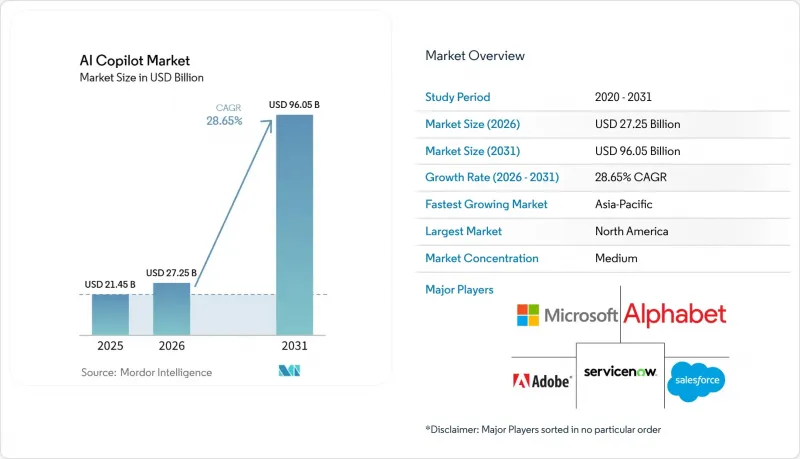
據 Mordor Intelligence 稱,2025 年人工智慧副駕駛市場價值 214.5 億美元,2026 年價值 272.5 億美元,預計從 2026 年到 2031 年將以 28.65% 的複合年成長率成長,到 2031 年達到 960.5 億美元。
本報告按副駕駛類型(例如,通用生產力副駕駛)、部署模式(雲端、混合、本地部署)、組織規模(大型企業、中小企業)、應用領域(例如,知識工作和生產力支援)、最終用戶產業(例如,IT和電信、銀行、金融服務和保險)以及地區進行細分。市場預測以價值(美元)表示。
全球人工智慧副駕駛市場趨勢與洞察
人工智慧原生生產力基準正在改變企業的授權成本結構。
企業負責人現在不再將自動駕駛軟體視為無限期的實驗,而是基於可衡量的生產力基準來評估其效能。微軟透露,截至2026年4月,付費版Microsoft 365 Copilot的授權用戶將超過2,000萬。該公司還報告稱,Accenture、拜耳、強生、梅賽德斯-奔馳和羅氏等大型企業已大規模部署了該軟體。這些部署意義重大,因為它們表明人工智慧自動駕駛軟體市場不再局限於試點項目,而是正在以企業級授權部署的規模進行評估。當大型企業宣布這些措施時,競爭對手將面臨更大的內部壓力,需要解釋其部署延遲或縮減部署範圍的原因。 GitHub Copilot預計到2026會計年度第三季也將部署在約14萬家企業組織中,這顯示同樣的基準評估理念不僅影響著普通生產力用戶,也影響著技術團隊。這使得整個 AI 副駕駛市場的授權經濟狀況更加清晰,鼓勵了更廣泛的部署決策,從而可以從營運角度討論降低人事費用。
內建的副駕駛工作流程降低了整個 SaaS 套件的切換成本。
當輔助駕駛工具整合到員工已經使用且花費大量工作時間的軟體中時,它們的普及速度將會更快。 2026年4月,ServiceNow宣布所有客戶無需額外購買即可獲得完整的AI軟體包,即Otto——一種整合了對話式AI、工作流程和企業搜尋的AI體驗。這減少了單獨購買的需求,縮短了銷售週期,並降低了採用門檻。因此,在AI輔助駕駛市場,能夠將輔助駕駛深度整合到生產力、服務和工作流程平台中的供應商越來越受歡迎,而不是銷售獨立助理。當輔助駕駛能夠與主軟體堆疊中已有的資料、權限和工作流程協同工作時,買家的轉換成本也會降低。這一趨勢正在推動平台採用率的提高,並對無法實現大型套件提供者那樣深度整合的獨立解決方案構成壓力。
幻覺的風險和檢驗輸出的成本會延遲高風險部署。
在法律、金融、醫療和行政營運中使用人工智慧輔助駕駛系統時,輸出結果的可靠性仍然是一個核心挑戰。歐盟人工智慧法律特別強調在高風險情況下進行人工監督和受控使用,這反映了敏感工作流程中對可追溯和檢驗輸出結果的需求。簡而言之,阻礙人工智慧輔助駕駛系統市場廣泛應用的並非好奇心或進入許可權問題,而是在使用前檢驗輸出結果的成本,尤其是在後果重大的情況下。檢驗工作會削弱買家期望從部署中節省時間的優勢,尤其是在所有回應都必須根據政策、法律法規或已通過核准的記錄進行驗證的情況下。這個問題在成長最快的受監管工作流程案例中尤其關鍵,因為這些應用依賴於資訊來源、合理的推理和有記錄的控制措施。除非有更多供應商能夠在管治和可靠的治理之間取得平衡,否則人工智慧輔助駕駛系統市場在那些一次失誤就可能抵消顯著生產力提升的營運中,將繼續面臨緩慢的普及。
細分市場分析
到 2025 年,通用生產力輔助駕駛工具將佔據 AI 輔助駕駛工具市場 40.12% 的佔有率,成為收入最高的輔助駕駛工具類別。這項領先優勢反映了直接整合到 Microsoft 365、Google Workspace 和類似工作環境中的工具的強大實力,使用者大部分的時間都已在這些環境中度過。這種整合方式縮短了引進週期,因為企業不再需要引入完全獨立的工作環境或採購類別。這也使得主要供應商更容易將輔助駕駛工具的存取權限捆綁到現有的商業合約中,一旦首批團隊開始使用產品,部署就會變得更加便捷。在 AI 輔助駕駛工具市場,這形成了一種自我強化的模式:可見度、整合性和採購便利性都有利於橫向平台的發展。
功能性工作流程助理仍然是至關重要的第二層級,支援人力資源、財務、法務和供應鏈等特定業務流程。它們的價值在於整合了任務庫和工作流程,從而與 SAP SE 和 Oracle 等供應商提供的企業系統更加緊密地連結。技術和工程助理也在快速發展,這得益於到 2026 會計年度第三季將有約 14 萬家企業組織採用 GitHub Copilot 的強勁勢頭。這一趨勢表明,工程團隊正在成為 AI 助理市場的第二大成長引擎,尤其是在它允許在受控環境中自動化編碼、測試和文件編寫任務的情況下。預計到 2031 年,產業專用的助手將以 30.84% 的複合年成長率成長。這是因為醫療保健、金融服務、製造業和法律行業的買家需要經過領域訓練的工具,以滿足通用助理無法滿足的更嚴格的精確性和合規性要求。
到2025年,基於雲端的部署將佔據人工智慧副駕駛市場71.24%的佔有率,成為最大的部署方式,遠遠超過其他部署類型。這種主導地位源自於部署便利性、能夠快速取得更新模型,以及許多公司已與主要雲端服務供應商建立了業務合作關係。雲端交付也降低了技術門檻,因為供應商負責管理推理基礎架構、更新和服務可用性。從實際角度來看,這促進了人工智慧副駕駛市場在那些優先考慮速度並希望最大限度地減少部署摩擦的組織中的快速擴張。它也與各種提高生產力的應用場景高度契合,這些應用情境對保密要求相對較低,旨在快速部署到辦公室工作流程中。
在國防、情報和中央銀行等資料外洩限制更為嚴格的領域,本地部署仍然至關重要。然而,混合部署預計到2031年將以31.16%的複合年成長率成長,因為它能夠幫助企業在便利性和控制力之間取得平衡。谷歌的「分散式雲端」以客戶主導的推理為核心,而Teradata則推出了面向私有AI部署的“AI工廠”,該部署需要完整的資料管理。這些服務表明,混合設計不再是權宜之計,而是企業在需要基於雲端的介面和對受監管任務進行更嚴格管治時所採用的實用架構。因此,AI輔助駕駛市場正在超越純粹的SaaS產品,基礎設施控制在採購決策中扮演越來越重要的角色。
區域分析
預計到2025年,亞太地區將成為最大的區域市場,佔據人工智慧副駕駛市場佔有率的23.64%。該地區受益於政府對數位基礎設施的支持、大規模的技術服務人才儲備以及語言模型開發領域的激烈國內競爭。儘管亞太地區各國的發展趨勢有所不同,但日本大型企業的採用案例表明,如果實施方案與現有業務實踐相契合,以提高生產力為導向的先導計畫可以從測試階段發展到廣泛應用。微軟的客戶案例研究顯示,日本製鐵公司從最初的試點階段擴展到11,000個企業許可證,而三井物產在近5,000名用戶中保持了非常高的每月活躍使用率。這些案例表明,亞太地區人工智慧副駕駛市場的發展動力源於其龐大的勞動力規模以及將副駕駛技術融入核心辦公和工業工作流程的日益成長的意願。
預計到2031年,北美市場將以31.38%的複合年成長率成長,成為成長最快的區域市場。這主要歸功於人工智慧軟體的應用模式從部門試點計畫轉向與更廣泛的IT支出掛鉤的多年期商業合約。微軟宣布2026會計年度第三季新商業訂單激增,顯示對未來人工智慧和雲端支出的承諾將更加堅定。北美人工智慧輔助駕駛市場也正獲得州級公共部門採購的支持,例如與加州Anthropic公司簽訂的合約。
在歐洲和中東及非洲,人工智慧副駕駛市場呈現不同的需求趨勢。在歐洲,歐盟人工智慧法案重新定義了供應商的合格要求,提高了合規性、人工監督以及選擇適用於受監管用例的基礎設施的重要性。這使得那些已經擁有滿足資料居住要求的基礎設施和完善的管治流程的供應商更具優勢。在中東和非洲,公共部門的數位轉型計畫和國家層面的人工智慧優先事項正在推動需求成長,吸引了供應商的注意。南美洲仍處於人工智慧成熟週期的早期階段,其應用仍集中在能夠利用全球平台服務的技術和金融服務用戶群體。
其他好處:
- Excel格式的市場預測(ME)表
- 3個月的分析師支持
目錄
第1章:引言
- 研究假設和市場定義
- 調查範圍
第2章:調查方法
第3章執行摘要
第4章 市場狀況
- 市場概覽
- 市場促進因素
- AI原生生產力基準正在重新定義企業授權的經濟模式。
- Copilot嵌入式工作流程可降低您整個SaaS套件的切換成本。
- 對私有託管模式的需求正在加速受監管企業的採用。
- 「基於代理的任務執行」將 Copilot 的應用範圍擴展到了文字產生之外。
- 多模態副駕駛正在為更高價值的知識工作開闢新的應用場景。
- 用於部署人工智慧副駕駛的預算正在從試點預算轉移到核心 IT 和轉型預算。
- 市場限制因素
- 幻覺的風險和檢驗輸出的成本正在延緩高風險應用情境的採用。
- 資料居住要求和對資料外洩的擔憂限制了「雲端優先」方法的採用。
- 副駕駛人數的增加導致座位安排重疊和管治摩擦。
- 更短的車型更新周期使得產品差異化變得困難,並給價格帶來壓力。
- 宏觀經濟因素對市場的影響
- 產業價值鏈分析
- 科技趨勢
- 監理情勢
- 波特五力分析
第5章 市場規模與成長預測
- 副駕駛的類型
- 通用生產力副駕駛
- 功能性工作流程副駕駛
- 技術/工程副駕駛
- 產業專用的副駕駛
- 不同的發展
- 基於雲端的
- 混合
- 現場
- 按組織規模
- 大公司
- 小型企業
- 透過使用
- 知識工作和生產力支持
- 軟體工程和技術運營
- 客戶和員工服務營運
- 銷售、行銷和產生收入
- 業務流程和公司運營
- 受監管行業工作流程
- 按最終用戶行業分類
- 資訊科技/通訊
- BFSI
- 醫療保健和生命科學
- 零售與電子商務
- 工業製造
- 教育和研究機構
- 媒體與娛樂
- 政府/行政部門
- 能源公用事業
- 其他終端用戶產業
- 按地區
- 北美洲
- 美國
- 加拿大
- 墨西哥
- 南美洲
- 巴西
- 阿根廷
- 其他南美國家
- 歐洲
- 德國
- 英國
- 法國
- 俄羅斯
- 西班牙
- 其他歐洲國家
- 亞太地區
- 中國
- 日本
- 印度
- 韓國
- 東南亞
- 其他亞太國家
- 中東和非洲
- 中東
- 沙烏地阿拉伯
- 阿拉伯聯合大公國
- 土耳其
- 其他中東國家
- 非洲
- 南非
- 奈及利亞
- 埃及
- 其他非洲國家
- 中東
- 北美洲
第6章 競爭情勢
- 市場集中度
- 策略趨勢
- 市佔率分析
- 公司簡介
- Alphabet Inc.
- Salesforce, Inc.
- ServiceNow, Inc.
- Adobe Inc.
- GitHub, Inc.
- OpenAI, LLC
- Anthropic PBC
- Amazon Web Services, Inc.
- Oracle Corporation
- SAP SE
- IBM Corporation
- Notion Labs, Inc.
- Writer, Inc.
- Glean Technologies, Inc.
- Moveworks, Inc.
- Aisera, Inc.
- Replit, Inc.
- Tabnine Ltd.
- Anysphere, Inc.
- Aisera, Inc.
第7章 市場機會與未來展望
According to Mordor Intelligence, the AI copilot market size was valued at USD 21.45 billion in 2025, USD 27.25 billion in 2026, and is forecast to reach USD 96.05 billion by 2031 at a CAGR of 28.65% over 2026-2031.
This report is Segmented by Copilot Type (Horizontal Productivity Copilots, and More), Deployment (Cloud-Based, Hybrid, and On-Premises), Organization Size (Large Enterprises, and Small and Medium Enterprises), Application (Knowledge Work and Productivity Assistance, and More), End-User Industry (IT and Telecommunication, BFSI, and More), and Geography. The Market Forecasts are Provided in Terms of Value (USD).
Global AI Copilot Market Trends and Insights
AI Native Productivity Benchmarks Reset Enterprise Seat Economics
Enterprise buyers are now evaluating Copilot software against measurable productivity benchmarks rather than treating it as an open-ended experiment. Microsoft disclosed that more than 20 million paid Microsoft 365 Copilot seats were in use by April 2026, and the company also reported very large enterprise deployments from Accenture, Bayer, Johnson and Johnson, Mercedes-Benz, and Roche. These deployments matter because they show that the AI Copilot Market is now being measured in enterprise-wide seat rollouts, not in narrow pilot groups. Once large employers make these commitments public, peer organizations face stronger internal pressure to justify slower adoption or smaller scope. GitHub Copilot also reached nearly 140,000 enterprise organizations by Q3 FY2026, which shows that the same benchmark logic is shaping technical teams as well as general productivity users. This is making seat economics more visible across the AI Copilot Market and supporting wider rollout decisions in which labor savings can be discussed in operational terms.
Embedded Copilot Workflows Reduce Switching Costs Across Saas Suites
Copilot tools gain traction faster when they are added to software that employees already use for much of the workday. ServiceNow announced in April 2026 that all customers would receive a complete AI package without an additional purchase and introduced Otto, a unified AI experience combining conversational AI, workflows, and enterprise search. This reduces the need for a separate purchase case, thereby shortening sales cycles and lowering adoption friction. The result is that the AI Copilot Market is increasingly rewarding vendors that can embed copilots deeply into productivity, service, and workflow platforms rather than selling a standalone assistant. Buyers also face lower switching costs when the copilot is tied to data, permissions, and workflows already in place within the main software stack. That dynamic increases platform stickiness and puts more pressure on point solutions that cannot match the integration depth of large-suite providers.
Hallucination Risk and Output Verification Costs Slow High-Stakes Adoption
Output reliability remains a core issue when copilots are used in legal, financial, healthcare, and public administration work. The EU AI Act places particular emphasis on human oversight and controlled use in higher-risk contexts, reflecting the need for traceable, reviewable outputs in sensitive workflows. This means the AI Copilot Market is not held back by curiosity or access, but by the cost of validating output before it can be used in high-consequence settings. Verification work reduces the time savings that buyers expect from deployment, especially where every response must be checked against policy, legal rules, or approved records. The issue is especially important for the fastest-growing regulated workflow use cases, because those applications depend on source attribution, defensible reasoning, and documented control. Until more vendors can combine speed with dependable governance, the AI Copilot Market will continue to face slower adoption in work where a single mistake can outweigh a large productivity gain.
Other drivers and restraints analyzed in the detailed report include:
- Agentic Task Execution Expands Copilot Use Beyond Text Generation
- Private Model Hosting Accelerates Regulated Enterprise Adoption
- Data Residency and Prompt Leakage Concerns Restrict Cloud-First Rollouts
For complete list of drivers and restraints, kindly check the Table Of Contents.
Segment Analysis
Horizontal Productivity Copilots held 40.12% of the AI Copilot Market share in 2025, which made them the largest copilot category by revenue. Their lead reflects the strength of tools that sit directly inside Microsoft 365, Google Workspace, and similar work environments, where users already spend a large part of the day. This placement shortens adoption cycles because organizations do not need to introduce a completely separate work surface or procurement category. It also helps large vendors bundle Copilot access into existing commercial agreements, making expansion easier once the first teams begin using the product. In the AI Copilot Market, this creates a self-reinforcing pattern where attention, integration, and procurement convenience all favor horizontal platforms.
Functional Workflow Copilots remained an important second tier because they support specific business processes in HR, finance, legal, and supply chain functions. Their value comes from task libraries and workflow alignment that connect more tightly with enterprise systems from providers such as SAP SE and Oracle. Technical and Engineering Copilots also advanced quickly, supported by GitHub Copilot momentum across nearly 140,000 enterprise organizations by Q3 FY2026. That trend suggests that engineering teams are becoming a second-scale engine for the AI Copilot Market, especially when coding, testing, and documentation tasks can be automated in controlled environments. Industry-Specific Copilots are projected to expand at a 30.84% CAGR through 2031 because healthcare, financial services, manufacturing, and legal buyers need domain-trained tools that can meet narrower accuracy and compliance expectations than a general assistant can support.
Cloud-Based deployment accounted for 71.24% of the AI Copilot Market size in 2025, making it the largest deployment mode by a wide margin. The lead came from ease of activation, faster access to updated models, and the fact that many enterprises already had working relationships with major cloud providers. Cloud delivery also lowers the technical barrier by having the vendor manage the inference infrastructure, updates, and service availability. In practical terms, this allowed the AI Copilot Market to scale rapidly across organizations that wanted speed and limited implementation friction. It also aligned well with broad productivity use cases where sensitivity levels were lower, and the goal was quick activation across office workflows.
On-Premises deployment remained relevant in defense, intelligence, and central banking environments where data egress limits were much stricter. Hybrid deployment is projected to grow at a 31.16% CAGR through 2031 because it enables organizations to balance convenience and control. Google positioned Distributed Cloud around customer-controlled inference, and Teradata introduced AI Factory for private AI deployment with full data custody needs. These offerings show that hybrid design is no longer a temporary compromise, but a practical architecture for enterprises that need cloud-based interfaces and tighter governance for regulated tasks. As a result, the AI Copilot Market is broadening beyond pure SaaS delivery and giving infrastructure control a stronger role in buying decisions.
Complete Report Scope:
- By Copilot Type
- Horizontal Productivity Copilots
- Functional Workflow Copilots
- Technical and Engineering Copilots
- Industry-Specific Copilots
- By Deployment
- Cloud-Based
- Hybrid
- On-Premises
- By Organization Size
- Large Enterprises
- Small and Medium Enterprises
- By Application
- Knowledge Work and Productivity Assistance
- Software Engineering and Technical Operations
- Customer and Employee Service Operations
- Sales, Marketing and Revenue Enablement
- Business Process and Enterprise Operations
- Regulated Industry Workflows
- By End-User Industry
- IT and Telecommunication
- BFSI
- Healthcare and Life Sciences
- Retail and E-Commerce
- Industrial Manufacturing
- Education and Research Institutions
- Media and Entertainment
- Government and administration
- Energy and Utilities
- Other End-User Industries
- By Geography
- North America
- United States
- Canada
- Mexico
- South America
- Brazil
- Argentina
- Rest of South America
- Europe
- Germany
- United Kingdom
- France
- Russia
- Spain
- Rest of Europe
- Asia-Pacific
- China
- Japan
- India
- South Korea
- Southeast Asia
- Rest of Asia-Pacific
- Middle East and Africa
- Middle East
- Saudi Arabia
- United Arab Emirates
- Turkey
- Rest of Middle East
- Africa
- South Africa
- Nigeria
- Egypt
- Rest of Africa
- Middle East
- North America
Geography Analysis
Asia-Pacific held 23.64% of the AI Copilot Market share in 2025, making it the largest regional market. The region benefited from public support for digital infrastructure, a large technology services workforce, and strong domestic competition in language model development. Country patterns within Asia-Pacific were not uniform, but large enterprise adoption in Japan showed that productivity pilots could move from the pilot stage to broad use when the deployment fit existing work habits. Microsoft customer stories showed that Nippon Steel expanded from an initial pilot to 11,000 enterprise licenses, while Mitsui and Co. maintained a very high monthly active utilization rate across nearly 5,000 users. These examples indicate that the AI Copilot Market in Asia-Pacific is supported by both workforce scale and a growing willingness to integrate copilots into core office and industrial workflows.
North America is projected to expand at a 31.38% CAGR through 2031, making it the fastest-growing regional market. The main reason is that procurement is shifting from departmental trials to multi-year commercial commitments that connect AI software with broader IT spending. Microsoft stated that new commercial bookings rose sharply in Q3 FY2026, suggesting a deeper pipeline of committed future AI and cloud expenditure. The AI Copilot Market in North America is also gaining support from state-level public-sector buying, as evidenced by California's statewide Anthropic agreement.
Europe, the Middle East, and Africa followed different demand paths in the AI Copilot Market. In Europe, the EU AI Act is reshaping supplier qualification by increasing the importance of compliance, human oversight, and infrastructure choices that fit regulated use cases. This favors vendors that already have data-residency-ready infrastructure and documented governance processes. In the Middle East and Africa, demand is building through public digital transformation programs and sovereign AI priorities, attracting greater vendor attention. South America remained earlier in the maturity cycle, with adoption still more concentrated in technology and financial services users who can access global platform offerings.
- Alphabet Inc.
- Salesforce, Inc.
- ServiceNow, Inc.
- Adobe Inc.
- GitHub, Inc.
- OpenAI, L.L.C.
- Anthropic PBC
- Amazon Web Services, Inc.
- Oracle Corporation
- SAP SE
- IBM Corporation
- Notion Labs, Inc.
- Writer, Inc.
- Glean Technologies, Inc.
- Moveworks, Inc.
- Aisera, Inc.
- Replit, Inc.
- Tabnine Ltd.
- Anysphere, Inc.
- Aisera, Inc.
Additional Benefits:
- The market estimate (ME) sheet in Excel format
- 3 months of analyst support
TABLE OF CONTENTS
1 INTRODUCTION
- 1.1 Study Assumptions and Market Definition
- 1.2 Scope of the Study
2 RESEARCH METHODOLOGY
3 EXECUTIVE SUMMARY
4 MARKET LANDSCAPE
- 4.1 Market Overview
- 4.2 Market Drivers
- 4.2.1 AI Native Productivity Benchmarks are Resetting Enterprise Seat Economics
- 4.2.2 Copilot Embedded Workflows are Reducing Switching Costs Across SaaS Suites
- 4.2.3 Private Model Hosting Demand is Accelerating Regulated Enterprise Adoption
- 4.2.4 Agentic Task Execution is Expanding Copilot Use Beyond Text Generation
- 4.2.5 Multi-Modal Copilots are Unlocking Higher-Value Knowledge Work Use Cases
- 4.2.6 AI Copilot Procurement is Moving From Pilot Budgets to Core IT and Transformation Budgets
- 4.3 Market Restraints
- 4.3.1 Hallucination Risk and Output Verification Costs Slow High-Stakes Adoption
- 4.3.2 Data Residency and Prompt Leakage Concerns Restrict Cloud-First Rollouts
- 4.3.3 Copilot Sprawl Is Creating Seat Overlap and Governance Friction
- 4.3.4 Model Refresh Cycles Are Compressing Differentiation and Pressuring Pricing
- 4.4 Impact of Macroeconomic Factors on the Market
- 4.5 Industry Value Chain Analysis
- 4.6 Technology Outlook
- 4.7 Regulatory Landscape
- 4.8 Porter's Five Forces Analysis
- 4.8.1 Threat of New Entrants
- 4.8.2 Bargaining Power of Suppliers
- 4.8.3 Bargaining Power of Buyers
- 4.8.4 Threat of Substitutes
- 4.8.5 Intensity of Competitive Rivalry
5 MARKET SIZE AND GROWTH FORECASTS (VALUE)
- 5.1 By Copilot Type
- 5.1.1 Horizontal Productivity Copilots
- 5.1.2 Functional Workflow Copilots
- 5.1.3 Technical and Engineering Copilots
- 5.1.4 Industry-Specific Copilots
- 5.2 By Deployment
- 5.2.1 Cloud-Based
- 5.2.2 Hybrid
- 5.2.3 On-Premises
- 5.3 By Organization Size
- 5.3.1 Large Enterprises
- 5.3.2 Small and Medium Enterprises
- 5.4 By Application
- 5.4.1 Knowledge Work and Productivity Assistance
- 5.4.2 Software Engineering and Technical Operations
- 5.4.3 Customer and Employee Service Operations
- 5.4.4 Sales, Marketing and Revenue Enablement
- 5.4.5 Business Process and Enterprise Operations
- 5.4.6 Regulated Industry Workflows
- 5.5 By End-User Industry
- 5.5.1 IT and Telecommunication
- 5.5.2 BFSI
- 5.5.3 Healthcare and Life Sciences
- 5.5.4 Retail and E-Commerce
- 5.5.5 Industrial Manufacturing
- 5.5.6 Education and Research Institutions
- 5.5.7 Media and Entertainment
- 5.5.8 Government and administration
- 5.5.9 Energy and Utilities
- 5.5.10 Other End-User Industries
- 5.6 By Geography
- 5.6.1 North America
- 5.6.1.1 United States
- 5.6.1.2 Canada
- 5.6.1.3 Mexico
- 5.6.2 South America
- 5.6.2.1 Brazil
- 5.6.2.2 Argentina
- 5.6.2.3 Rest of South America
- 5.6.3 Europe
- 5.6.3.1 Germany
- 5.6.3.2 United Kingdom
- 5.6.3.3 France
- 5.6.3.4 Russia
- 5.6.3.5 Spain
- 5.6.3.6 Rest of Europe
- 5.6.4 Asia-Pacific
- 5.6.4.1 China
- 5.6.4.2 Japan
- 5.6.4.3 India
- 5.6.4.4 South Korea
- 5.6.4.5 Southeast Asia
- 5.6.4.6 Rest of Asia-Pacific
- 5.6.5 Middle East and Africa
- 5.6.5.1 Middle East
- 5.6.5.1.1 Saudi Arabia
- 5.6.5.1.2 United Arab Emirates
- 5.6.5.1.3 Turkey
- 5.6.5.1.4 Rest of Middle East
- 5.6.5.2 Africa
- 5.6.5.2.1 South Africa
- 5.6.5.2.2 Nigeria
- 5.6.5.2.3 Egypt
- 5.6.5.2.4 Rest of Africa
- 5.6.5.1 Middle East
- 5.6.1 North America
6 COMPETITIVE LANDSCAPE
- 6.1 Market Concentration
- 6.2 Strategic Moves
- 6.3 Market Share Analysis
- 6.4 Company Profiles (includes Global Level Overview, Market Level Overview, Core Segments, Financials as available, Strategic Information, Market Rank/Share, Products and Services, Recent Developments)
- 6.4.1 Alphabet Inc.
- 6.4.2 Salesforce, Inc.
- 6.4.3 ServiceNow, Inc.
- 6.4.4 Adobe Inc.
- 6.4.5 GitHub, Inc.
- 6.4.6 OpenAI, L.L.C.
- 6.4.7 Anthropic PBC
- 6.4.8 Amazon Web Services, Inc.
- 6.4.9 Oracle Corporation
- 6.4.10 SAP SE
- 6.4.11 IBM Corporation
- 6.4.12 Notion Labs, Inc.
- 6.4.13 Writer, Inc.
- 6.4.14 Glean Technologies, Inc.
- 6.4.15 Moveworks, Inc.
- 6.4.16 Aisera, Inc.
- 6.4.17 Replit, Inc.
- 6.4.18 Tabnine Ltd.
- 6.4.19 Anysphere, Inc.
- 6.4.20 Aisera, Inc.
7 MARKET OPPORTUNITIES AND FUTURE OUTLOOK
- 7.1 White-Space and Unmet-Need Assessment

 北美人工智慧副駕駛市場:市場佔有率分析、產業趨勢與統計及成長預測(2026-2031 年)歐洲人工智慧副駕駛:市場佔有率分析、產業趨勢與統計及成長預測(2026-2031 年)
 LocalSphere 智慧市場預測至 2034 年—按智慧類型、部署模式、技術、應用程式、最終使用者和地區分類的全球分析人工智慧個人電腦處理器市場預測至2034年——全球處理器類型、架構、處理能力、製造技術、應用、最終用戶和區域分析執行功能最佳化市場預測至2034年—按解決方案類型、技術、應用、最終用戶和地區分類的全球分析智慧城區智慧市場預測(2034 年)-按組件、部署模式、技術、永續性舉措、最終用戶和地區分類的全球分析本地行動智慧市場預測至2034年-按解決方案、部署模式、技術、最終用戶和區域分類的全球分析
 全球人工智慧女友應用市場:2035 年的機會與策略
 人工智慧(AI)市場:按組件、技術、最終用途、部署模式和組織規模分類-2026-2032年全球市場預測高階GPU封裝:市佔率分析、產業趨勢與統計及成長預測(2026-2031年)