


 |
市場調查報告書
商品編碼
2099749
無人機系統用相機:市場佔有率分析、產業趨勢與統計及成長預測(2026-2031)Unmanned Aerial Systems Camera - Market Share Analysis, Industry Trends & Statistics, Growth Forecasts (2026 - 2031) |
||||||

※ 本網頁內容可能與最新版本有所差異。詳細情況請與我們聯繫。
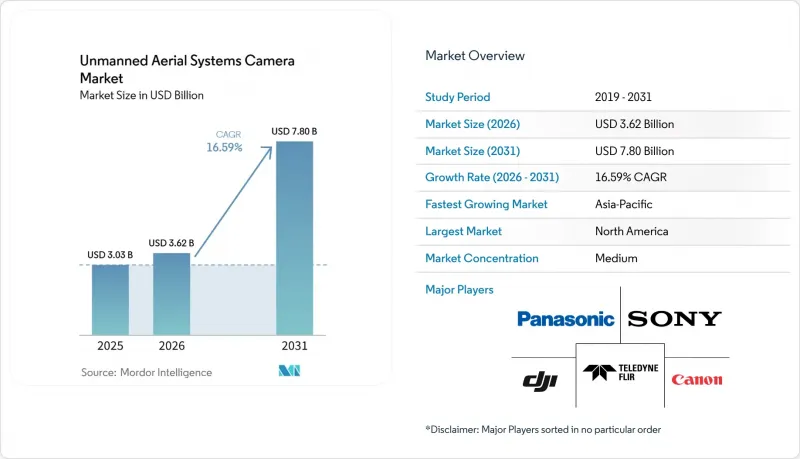
據 Mordor Intelligence 稱,2025 年無人機系統用相機的市值為 30.3 億美元,預計到 2031 年將從 2026 年的 36.2 億美元成長到 78 億美元,在預測期(2026-2031 年)內的複合年成長率為 16.59%。
本報告按攝影機類型(高畫質攝影機、熱成像攝影機及其他)、應用領域(攝影/影片、熱成像、監控等)、解析度(低於1,200萬像素、1,200萬像素至低於2,000萬像素及其他)、最終用戶(民用、軍用、國防安全保障)和地區(北美、歐洲及其他)進行細分。市場預測以美元計價。
無人機系統用相機的全球市場趨勢與洞察。
人工智慧驅動的機載影像處理系統的進展
有效載荷中的人工智慧處理能力正在改變買家對無人機(UAV)相機市場的需求。這種變化減少了對地面站的依賴,並實現了飛行過程中的即時物體識別、目標追蹤和場景判讀。在OEM廠商Teledyne FLIR的支援下,Gremsy於2025年10月推出了「ORUS-L」酬載。此有效載荷整合了熱成像和光電感測器以及NVIDIA Jetson Orin NX模組,可在無人機專用封裝中提供100 TOPS的人工智慧運算能力。此類整合正在將無人機相機市場的有效載荷從單純的攝影配件轉變為自主型情境察覺系統。 IEEE於2026年發表的一項研究也表明,基於FPGA的無人機集群邊緣人工智慧流水線無需雲端連接即可實現即時語義推理,這將有助於在野外環境中更廣泛地應用機載分析技術。
政府支持措施促進無人機系統在精密農業的應用
公共支援計畫正在降低配備攝影機的農業無人機的准入門檻。印度的「2025年農民無人機計畫」為用於作物評估、噴灑農藥和土壤分析的無人機提供高達90%的補貼。此外,該計劃還為婦女主導的農業組織和特定種姓/特定部落(SC/ST)農業組織的試點計畫提供100%的資金支持。中央邦的「2025年無人機推廣和利用政策」為新的製造投資提供高達3000萬印度盧比(約340萬美元)的40%資本投資補貼。該邦的目標是在五年內實現37,000萬印度盧比(約4,220萬美元)的產業投資,並創造8,000個就業機會。這些項目正在推動對頻譜和近紅外線有效載荷的需求,因為作物監測和疾病檢測需要超越標準可見光成像的能力。隨著補貼資金的增加,無人機系統用相機的市場正在獲得更穩定的商業性基礎,尤其是在中等解析度和農業成像系統方面。
與加強網路安全和認證合規相關的成本增加。
認證成本正逐漸成為無人機(UAV)相機市場進入的一大障礙。目前,AUVSI 的「綠色無人機系統」(Green UAS)框架被用作獲得美國國防部(DoD)「藍色無人機系統」(Blue UAS)認證的途徑,該框架要求對企業的網路安全管理、產品和設備安全、遠端操作和連接以及供應鏈風險管理進行評估。這些要求增加了無人機相機市場中飛機製造商和有效載荷供應商的文件編制、測試和審計工作量。此外,製造商在更新酬載型號或在已認證的設備組合中更換供應商時,也會產生持續的成本。中小型專業公司面臨的負擔尤其沉重,因為它們必須先承擔工程和合規成本,才能完全滿足政府相關要求。
細分市場分析
到2025年,高清攝影機將佔據53.67%的市場佔有率,這主要得益於其在電影製作、測繪和建築工地巡檢等領域的廣泛應用。高畫質攝影機的市場主導地位依然穩固,因為商用無人機機隊已基本採用可見光成像技術,許多用戶無需先進的飛行運算能力即可有效處理這些數據。大疆創新(DJI)於2025年9月發布的Mini 5 Pro無人機,展現了高階成像能力在更輕、更容易取得的無人機產品中的日益普及,進一步拓展了高清攝影機系統的應用範圍。同時,包括頻譜、高光譜遙測和雷射雷達整合載荷在內的其他類別,也繼續為精密農業和可再生能源巡檢等小規模但高價值的應用場景做出貢獻。
預計到2031年,熱成像相機將以18.65%的複合年成長率成長,成為相機類別中成長最快的細分市場。這一成長主要得益於更小巧、更輕、更符合監管要求的長波紅外線(LWIR)模組,這些模組目前已可用於緊湊型商用平台。 Teledyne FLIR於2026年6月發布的Boson SX8,在專為尺寸和功耗受限的無人機系統(UAS)設計的封裝中實現了更高的熱解析度,從而促進了先進熱成像功能的大規模應用。 Thermal by FLIR與Gremsy的合作也展示了感測器供應商和有效載荷整合商如何透過協作加速產品發布,並減輕整個價值鏈的認證負擔。在美國,遵守《國防授權法案》(NDAA)正日益影響熱成像相機的設計,從早期階段就開始發揮作用,這吸引了歐洲供應商的關注,他們也希望獲得類似的市場地位。
構成比,攝影和影片位居榜首,佔34.40%的市場。這一領域持續受益於商業內容創作、房地產、現場製作和社交媒體相關營運的強勁需求。大疆創新(DJI)的Mini 5 Pro進一步推動了這一趨勢,它將1吋感測器整合到重量不足250克的無人機中,縮小了消費級無人機和專業級無人機在影像性能方面的差距。雖然監控應用仍然重要,但在某些市場,合法監控正變得越來越突出。 2025年7月,奧勒岡州上訴法院裁定,當高級空中監控被用作搜索令的依據時,必須有其他證據支持,這凸顯了加強對執法機關和商業無人機影像項目監管的必要性。
預計到2031年,熱成像技術將在應用領域實現最快成長,複合年成長率將達到19.10%。基礎設施巡檢、無人機緊急應變項目以及依賴類似感測器和處理能力的軍事情報、監視與偵察(ISR)任務對熱成像技術的需求正在不斷成長。高解析度熱成像有效載荷目前正進入量產階段,這也推動了相關應用場景中對高性能可見光成像系統的需求。SONY在2026年阿姆斯特丹無人機週上展示的ILX-LR1,體現了攝影測量和精密測繪領域向高解析度有效載荷標準的轉變。 「其他」類別在環境監測、搜救和走廊巡檢等領域仍然發揮著重要作用,在這些領域,操作人員通常需要在同一任務中同時使用熱成像和可見光成像技術。
區域分析
到2025年,北美將佔據無人機系統攝影機市場32.88%的佔有率,成為銷售額最高的區域市場。該地區受益於國防和國防安全保障領域大規模的需求基礎、成熟的商業運營商生態系統以及比其他許多市場更完善的認證體系。這些因素支撐了市場對符合標準的熱成像、光電成像和多感測器有效載荷的穩定需求,而不僅僅是簡單的低成本攝影機單元。此外,公共安全和巡檢應用場景在北美日益普及,推動了無人機系統攝影機市場的重複購買和升級週期。因此,該地區不僅在銷售方面,而且在高價值有效載荷配置方面,都繼續保持著重要的地位。
預計到2031年,亞太地區將以17.65%的複合年成長率成長,成為無人機系統攝影機市場成長最快的區域市場。該地區擁有大規模的製造能力,農業領域的應用日益廣泛,並且對長時間監控和巡檢應用的需求不斷成長。印度的「農民無人機計畫2025」(Kisan Drone Yojana 2025)補貼政策和中央邦的投資支持政策,為該地區配備攝影機的農業無人機提供了清晰的商業性基礎。此外,Gremsy和Aerosense於2026年6月完成了LYNX EO/IR有效載荷與Aerobo Wing垂直起降無人機的整合,這表明該地區正在從小型商用系統轉向更長時間的監控和巡檢任務。
歐洲是無人機系統(UAS)相機市場第二大區域叢集,這主要得益於國防需求以及日益支持超視距(BVLOS)作業的法規環境。歐洲太空總署(ESA)的Iris RPAS飛行測試於2026年4月完成,結果表明,可靠的衛星和地面指揮通訊鏈路能夠支援遠端任務的實際運作條件。這對歐洲的巡檢和民用基礎設施項目具有重要意義,因為符合監管規定的遠端作業將刺激無人機相機市場對專用影像擷取負荷的需求。南美洲、中東和非洲雖然目前規模較小,但對用於農業成像、能源巡檢、公共安全和邊境監控的有效載荷的需求仍然存在。
其他好處:
- Excel格式的市場預測(ME)表
- 3個月的分析師支持
目錄
第1章:引言
- 研究假設和市場定義
- 調查範圍
第2章:調查方法
第3章執行摘要
第4章 市場狀況
- 市場概覽
- 市場促進因素
- 人工智慧驅動的車載影像處理系統的進展
- 適用於公共安全無人機的SWaP最佳化型熱成像核心現已上市。
- 降低高解析度CMOS成像感測器的成本
- 政府支持措施促進無人機系統在精密農業的應用
- FPV無人機在商業影像製作的應用正在加速。
- 衛星與無人機之間光子技術的進步,使得超視距飛行成為可能。
- 市場限制因素
- 加強網路安全和遵守認證標準帶來的成本增加。
- 加強對兩用光電和紅外線(EO/IR)負荷的出口管制
- 關鍵成像感測器組件的供應鏈持續中斷。
- 飛機收集生物識別數據引發的法律挑戰日益增加。
- 價值鏈分析
- 監理情勢
- 技術展望
- 波特五力分析
第5章 市場規模與成長預測
- 按相機類型
- 高畫質攝影機
- 熱像儀
- 其他
- 透過使用
- 照片和影像
- 熱成像
- 監視
- 測量和地圖繪製
- 檢查和維護
- 其他用途
- 通過決議
- 小於1200萬像素
- 12-20 MP
- 20-32百萬畫素
- 3200萬像素或以上
- 最終用戶
- 商業
- 軍隊
- 國防安全保障
- 按地區
- 北美洲
- 美國
- 加拿大
- 墨西哥
- 歐洲
- 英國
- 法國
- 德國
- 義大利
- 其他歐洲國家
- 亞太地區
- 中國
- 日本
- 印度
- 韓國
- 澳洲
- 其他亞太國家
- 南美洲
- 巴西
- 其他南美國家
- 中東和非洲
- 中東
- 阿拉伯聯合大公國
- 沙烏地阿拉伯
- 土耳其
- 其他中東國家
- 非洲
- 南非
- 其他非洲國家
- 中東
- 北美洲
第6章 競爭情勢
- 市場集中度
- 策略趨勢
- 市佔率分析
- 公司簡介
- SZ DJI Technology Co., Ltd.
- Sony Corporation
- Canon Inc.
- Panasonic Corporation
- Teledyne FLIR LLC
- Controp Precision Technologies Ltd.
- Yuneec(ATL Drone)
- Autel Robotics Co., Ltd.
- Parrot Drone SAS
- Victor Hasselblad AB
- PHASE ONE A/S
- Shenzhen Viewpro Technology Co., Ltd.
- GoPro, Inc.
- Garmin Ltd.
第7章 市場機會與未來展望
According to Mordor Intelligence, the unmanned aerial systems camera market size was valued at USD 3.03 billion in 2025 and estimated to grow from USD 3.62 billion in 2026 to reach USD 7.80 billion by 2031, at a CAGR of 16.59% during the forecast period (2026-2031).
This report is Segmented by Camera Type (HD Cameras, Thermal Cameras, and Others), Application (Photography and Videography, Thermal Imaging, Surveillance, and More), Resolution (Less Than 12 MP, 12 To Less Than 20 MP, and More), End-User (Commercial, Military, and Homeland Security), and Geography (North America, Europe, and More). The Market Forecasts are Provided in Terms of Value (USD).
Global Unmanned Aerial Systems Camera Market Trends and Insights
Advancements in AI-Enabled Onboard Image Processing Systems
AI processing inside the payload is changing what buyers expect from the unmanned aerial systems camera market. The shift reduces dependence on ground stations and supports real-time object recognition, target tracking, and scene interpretation during flight. Gremsy launched the ORUS-L payload in October 2025 with Teledyne FLIR OEM support, combining thermal and EO sensors with an NVIDIA Jetson Orin NX module that delivers 100 TOPS of AI compute in a drone-ready package. That kind of integration shifts the payload from a capture accessory to a self-contained situational-awareness system in the unmanned aerial systems camera market. IEEE research published in 2026 also showed that FPGA-based edge AI pipelines on drone swarms can deliver real-time semantic reasoning without cloud connectivity, thereby supporting the broader use of onboard analytics in field conditions.
Government Incentives Driving Precision Agriculture UAS Applications
Public support programs are lowering the barrier to entry for camera-equipped agricultural drones in the unmanned aerial systems camera market. India's Kisan Drone Yojana 2025 offered subsidies of up to 90% for drones used in crop assessment, spraying, and soil analysis. It provided 100% funding for demonstrations with women-led and SC/ST farmer organizations. Madhya Pradesh's Drone Promotion and Utilization Policy 2025 added a 40% capital investment subsidy, capped at INR 30 crore (USD 3.40 million), for new manufacturing investments. They targeted INR 370 crore (USD 42.20 million) in sector investment over 5 years, along with 8,000 jobs. These programs favor demand for multispectral and near-infrared payloads because crop monitoring and disease detection require more than standard visual capture. As subsidy-backed procurement expands, the unmanned aerial systems camera market gains a steadier commercial base for mid-resolution and specialized agricultural imaging systems
Rising Costs Associated with Cyber-Hardening and Certification Compliance
Certification costs are becoming a real filter in the unmanned aerial systems camera market. AUVSI's Green UAS framework, now used as a pathway toward DoD Blue UAS Cleared status, requires review of corporate cyber hygiene, product and device security, remote operations and connectivity, and supply chain risk management. Those requirements increase documentation, testing, and audit work for both aircraft makers and payload suppliers in the unmanned aerial systems camera market. They also incur recurring costs when manufacturers update payload variants or switch suppliers within a certified stack. The burden is heaviest on smaller specialists because they must absorb engineering and compliance costs before they can fully meet government-linked demand.
Other drivers and restraints analyzed in the detailed report include:
- Emergence of SWaP-Optimized Thermal Imaging Cores for Public Safety UAS
- Progress in Satellite-to-UAS Optical Communications Enabling BVLOS Operations
- Stricter Export Controls on Dual-Use Electro-Optical and Infrared Payloads
For complete list of drivers and restraints, kindly check the Table Of Contents.
Segment Analysis
HD cameras accounted for 53.67% of the market in 2025, supported by their widespread use in cinematography, mapping, and construction inspection. Their lead remains strong because commercial drone fleets are already built around visible-light imaging, and many users can process this data effectively without needing advanced onboard computing. DJI's Mini 5 Pro, launched in September 2025, showed how premium imaging features are moving into lighter, more accessible drone classes, helping extend the reach of HD camera systems. The other category, which includes multispectral, hyperspectral, and LiDAR-linked payloads, continues to serve smaller but higher-value use cases such as precision agriculture and renewable energy inspection.
Thermal cameras are projected to grow at a CAGR of 18.65% through 2031, making them the fastest-growing camera type segment. This growth is being supported by smaller, lighter, and more compliant LWIR modules that can now be used on compact commercial platforms. Teledyne FLIR's Boson SX8, introduced in June 2026, brought higher thermal resolution into a package designed for size- and power-constrained UAS, making advanced thermal capability more accessible at production scale. The Thermal by FLIR collaboration with Gremsy also showed how sensor providers and payload integrators are working together to speed up product launches and reduce certification pressure across the value chain. In the US, NDAA compliance is increasingly shaping thermal camera design from the start, and this is also drawing attention from European suppliers seeking similar positioning.
Photography and videography led the application mix in 2025 with a 34.40% share. This segment continues to benefit from strong demand across commercial content creation, real estate, live production, and social media work. DJI's Mini 5 Pro helped reinforce this trend by bringing a 1-inch sensor to the sub-250g drone class, narrowing the gap between consumer and professional imaging performance. Surveillance remains an important use case, although legal scrutiny is becoming more visible in some markets. In July 2025, the Oregon Court of Appeals ruled that enhanced aerial surveillance required separate evidentiary support when used as the basis for a warrant, underscoring the need for tighter oversight of law enforcement and commercial drone imaging programs.
Thermal imaging is expected to record the fastest application growth, with a CAGR of 19.10% through 2031. Demand is rising across infrastructure inspection, drone-as-first-responder programs, and military ISR missions that rely on similar sensor and processing capabilities. Higher-resolution thermal payloads are now entering volume production, and that is also lifting demand for stronger visible-light imaging systems in connected use cases. Sony's ILX-LR1, showcased at Amsterdam Drone Week 2026, reflected this move toward higher-resolution payload standards in photogrammetry and precision mapping. The others category still has a role in environmental monitoring, search and rescue, and corridor inspection, where operators often need a mix of thermal and visible-light imaging in the same mission.
Complete Report Scope:
- By Camera Type
- HD Cameras
- Thermal Cameras
- Others
- By Application
- Photography and Videography
- Thermal Imaging
- Surveillance
- Mapping and Surveying
- Inspection and Maintenance
- Other Applications
- By Resolution
- Less than 12 MP
- 12 to Less than 20 MP
- 20 to Less than 32 MP
- More than 32 MP
- By End-user
- Commercial
- Military
- Homeland Security
- By Geography
- North America
- United States
- Canada
- Mexico
- Europe
- United Kingdom
- France
- Germany
- Italy
- Rest of Europe
- Asia-Pacific
- China
- Japan
- India
- South Korea
- Australia
- Rest of Asia-Pacific
- South America
- Brazil
- Rest of South America
- Middle East and Africa
- Middle East
- United Arab Emirates
- Saudi Arabia
- Turkey
- Rest of Middle East
- Africa
- South Africa
- Rest of Africa
- Middle East
- North America
Geography Analysis
North America accounted for 32.88% of the unmanned aerial systems camera market share in 2025, which made it the leading regional contributor by revenue. The region benefits from a large defense and homeland security demand base, a mature commercial operator ecosystem, and a stronger certification culture than many other markets. Those factors support steady demand for compliant thermal, EO, and multi-sensor payloads rather than simple low-cost camera units. Public safety and inspection use cases are also more established in North America, which improves repeat purchasing and upgrade cycles in the unmanned aerial systems camera market. This keeps the region important not only for volume, but also for higher-value payload configurations.
Asia-Pacific is projected to grow at a 17.65% CAGR through 2031, making it the fastest-growing regional segment in the unmanned aerial systems camera market. The region combines large manufacturing capacity, expanding agricultural deployment, and rising interest in long-endurance surveillance and inspection applications. India's subsidy-backed Kisan Drone Yojana 2025 and Madhya Pradesh's investment support policy provide the region with a clear commercial basis for camera-equipped agricultural drones. Gremsy and Aerosense also completed integration of the LYNX EO/IR payload onto the Aerobo Wing VTOL in June 2026, showing that the region is moving beyond small commercial systems toward longer-endurance surveillance and inspection roles.
Europe represents the second-largest geographic cluster in the unmanned aerial systems camera market, supported by defense demand and a regulatory environment that is increasingly supportive of BVLOS operations. The ESA Iris RPAS flight trials completed in April 2026 provided evidence that resilient satellite and terrestrial command links can support real operating conditions for long-range missions. That matters for European inspection and civil infrastructure work, where compliant long-range operations can unlock demand for purpose-built imaging payloads in the unmanned aerial systems camera market. South America, the Middle East, and Africa remain smaller in current scale, but they continue to present demand for agricultural imaging, energy inspection, public safety, and border surveillance payloads.
- SZ DJI Technology Co., Ltd.
- Sony Corporation
- Canon Inc.
- Panasonic Corporation
- Teledyne FLIR LLC
- Controp Precision Technologies Ltd.
- Yuneec (ATL Drone)
- Autel Robotics Co., Ltd.
- Parrot Drone SAS
- Victor Hasselblad AB
- PHASE ONE A/S
- Shenzhen Viewpro Technology Co., Ltd.
- GoPro, Inc.
- Garmin Ltd.
Additional Benefits:
- The market estimate (ME) sheet in Excel format
- 3 months of analyst support
TABLE OF CONTENTS
1 INTRODUCTION
- 1.1 Study Assumptions and Market Definition
- 1.2 Scope of the Study
2 RESEARCH METHODOLOGY
3 EXECUTIVE SUMMARY
4 MARKET LANDSCAPE
- 4.1 Market Overview
- 4.2 Market Drivers
- 4.2.1 Advancements in AI-enabled onboard image processing systems
- 4.2.2 Emergence of SWaP-optimized thermal imaging cores for public safety UAS
- 4.2.3 Declining cost of high-resolution CMOS imaging sensors
- 4.2.4 Government incentives driving precision agriculture UAS applications
- 4.2.5 Accelerated adoption of FPV drones in commercial cinematography
- 4.2.6 Progress in satellite-to-UAS optical communications enabling BVLOS operations
- 4.3 Market Restraints
- 4.3.1 Rising costs associated with cyber-hardening and certification compliance
- 4.3.2 Stricter export controls on dual-use electro-optical and infrared (EO/IR) payloads
- 4.3.3 Ongoing supply chain disruptions in critical imaging sensor components
- 4.3.4 Increasing legal challenges related to aerial biometric data collection
- 4.4 Value Chain Analysis
- 4.5 Regulatory Landscape
- 4.6 Technological Outlook
- 4.7 Porter's Five Forces Analysis
- 4.7.1 Bargaining Power of Buyers
- 4.7.2 Bargaining Power of Suppliers
- 4.7.3 Threat of New Entrants
- 4.7.4 Threat of Substitute Products
- 4.7.5 Intensity of Competitive Rivalry
5 MARKET SIZE AND GROWTH FORECASTS (VALUE)
- 5.1 By Camera Type
- 5.1.1 HD Cameras
- 5.1.2 Thermal Cameras
- 5.1.3 Others
- 5.2 By Application
- 5.2.1 Photography and Videography
- 5.2.2 Thermal Imaging
- 5.2.3 Surveillance
- 5.2.4 Mapping and Surveying
- 5.2.5 Inspection and Maintenance
- 5.2.6 Other Applications
- 5.3 By Resolution
- 5.3.1 Less than 12 MP
- 5.3.2 12 to Less than 20 MP
- 5.3.3 20 to Less than 32 MP
- 5.3.4 More than 32 MP
- 5.4 By End-user
- 5.4.1 Commercial
- 5.4.2 Military
- 5.4.3 Homeland Security
- 5.5 By Geography
- 5.5.1 North America
- 5.5.1.1 United States
- 5.5.1.2 Canada
- 5.5.1.3 Mexico
- 5.5.2 Europe
- 5.5.2.1 United Kingdom
- 5.5.2.2 France
- 5.5.2.3 Germany
- 5.5.2.4 Italy
- 5.5.2.5 Rest of Europe
- 5.5.3 Asia-Pacific
- 5.5.3.1 China
- 5.5.3.2 Japan
- 5.5.3.3 India
- 5.5.3.4 South Korea
- 5.5.3.5 Australia
- 5.5.3.6 Rest of Asia-Pacific
- 5.5.4 South America
- 5.5.4.1 Brazil
- 5.5.4.2 Rest of South America
- 5.5.5 Middle East and Africa
- 5.5.5.1 Middle East
- 5.5.5.1.1 United Arab Emirates
- 5.5.5.1.2 Saudi Arabia
- 5.5.5.1.3 Turkey
- 5.5.5.1.4 Rest of Middle East
- 5.5.5.2 Africa
- 5.5.5.2.1 South Africa
- 5.5.5.2.2 Rest of Africa
- 5.5.5.1 Middle East
- 5.5.1 North America
6 COMPETITIVE LANDSCAPE
- 6.1 Market Concentration
- 6.2 Strategic Moves
- 6.3 Market Share Analysis
- 6.4 Company Profiles (includes Global level Overview, Market level Overview, Core Segments, Financials as available, Strategic Information, Market Rank/Share for key companies, Products and Services, and Recent Developments)
- 6.4.1 SZ DJI Technology Co., Ltd.
- 6.4.2 Sony Corporation
- 6.4.3 Canon Inc.
- 6.4.4 Panasonic Corporation
- 6.4.5 Teledyne FLIR LLC
- 6.4.6 Controp Precision Technologies Ltd.
- 6.4.7 Yuneec (ATL Drone)
- 6.4.8 Autel Robotics Co., Ltd.
- 6.4.9 Parrot Drone SAS
- 6.4.10 Victor Hasselblad AB
- 6.4.11 PHASE ONE A/S
- 6.4.12 Shenzhen Viewpro Technology Co., Ltd.
- 6.4.13 GoPro, Inc.
- 6.4.14 Garmin Ltd.
7 MARKET OPPORTUNITIES AND FUTURE OUTLOOK
- 7.1 White-space and Unmet-Need Assessment

 工業相機市場規模:按類型、感測器類型、應用、地區和預測分類
 工業相機市場機會、成長要素、產業趨勢分析及2026-2035年預測
 建築攝影機:市場佔有率分析、行業趨勢和統計數據、成長預測(2026-2031)
 機器人相機支架市場預測—按類型、應用、最終用戶和地區分類的全球分析—2034年滑軌機器人相機市場預測至2034年—按類型、分銷管道、運動範圍、應用和地區分類的全球分析
 攝影系統市場:依產品類型、技術和地區分類
 2026年全球建築攝影解決方案市場報告
 凸輪端面加工系統市場規模、佔有率和成長分析:按操作技術、系統整合、葉片配置、車輛類型、銷售管道和地區分類 - 產業預測,2026-2033 年
 建築攝影解決方案市場:全球市場按產品類型、連接方式、應用和部署模式分類的預測 - 2026-2032 年全球建築攝影機市場規模、佔有率、趨勢和成長分析報告(2026-2034)