


 |
市場調查報告書
商品編碼
2099477
DRAM製造工廠專用氣體:市佔率分析、產業趨勢與統計及成長預測(2026-2031年)Specialty Gases For DRAM Fabs - Market Share Analysis, Industry Trends & Statistics, Growth Forecasts (2026 - 2031) |
||||||

※ 本網頁內容可能與最新版本有所差異。詳細情況請與我們聯繫。
根據 Mordor Intelligence 預測,DRAM 製造工廠的特種氣體市場規模預計將在 2025 年達到 12.4 億美元,在 2026 年成長至 13.7 億美元,並在 2031 年達到 20.7 億美元,在預測期(2026-2031 年)內複合至 20.7 億美元,在預測期(2026-2031 年)內複合至 20.61%。
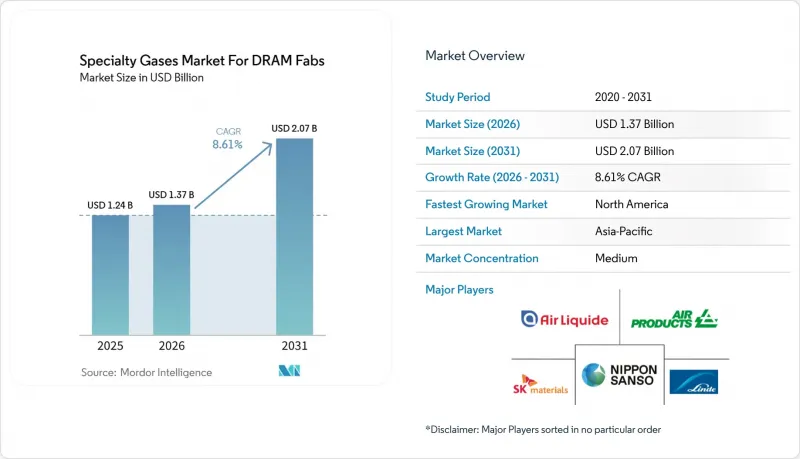
本報告按氣體類型(氟化氣體、矽前驅體和氫化物、稀有氣體等)、工藝應用(腔室清洗、電漿蝕刻/反應離子刻蝕 (RIE)、薄膜沉積 (CVD/ALD/外延等)、DRAM 產品類型(標準 DRAM、移動 DRAM (LPDDR) 等市場)和地區進行細分市場價值(美元)。
DRAM製造工廠特種氣體市場洞察與趨勢
DRAM節點的日益複雜和多重圖形化化的日益精細。
DRAM製造廠的特種氣體市場正因1z到1b和1c世代的過渡而直接成長。這是因為,隨著微型化過程的推進,完成每片晶圓製造所需的沉積、間隔層形成、圖案轉移和清洗過程的數量不斷增加。具體而言,隨著線尺寸的縮小,晶圓廠需要使用更多的氟化蝕刻氣體和矽基材料,並更嚴格地控制供應條件,以保持圖案的保真度。這從根本上增加了每位元製造所需的氣體消耗量,而隨著向先進DRAM節點的過渡,這比單純的晶圓產量更為重要。此外,Lam Research的研究表明,主要記憶體製造商在2025年將EUV乾式光阻劑技術應用於生產,可能會導致流程中某個環節的製程整合,進而可能在其他環節產生新的氣相材料和新的純度要求。因此,即使微影術配置因製程藍圖的變化而改變,DRAM製造廠的特種氣體市場仍將繼續受益。這是因為控制圖案轉移、缺陷密度和薄膜質量的壓力始終存在。因此,製程進步仍然是推動韓國、台灣和日本DRAM晶圓廠需求成長的最強勁動力之一。
增加 HBM 層數可以增加沉積和蝕刻循環次數。
HBM技術也推動了DRAM製造廠特種氣體市場的發展。隨著堆疊晶片數量的增加,穿透矽通孔(TSV)的形成、更均勻的隔離層的沉積以及單元級填充製程的工序也隨之增加。這至關重要,因為HBM的大規模生產不僅意味著產量的提升,還意味著製程密度的提升。隨著堆疊高度的增加,每個封裝成品都需要整合大量氣體密集型製程。堆疊高度的增加對蝕刻深度和精度、製程均勻性以及ALD和CVD循環重複性的要求也隨之提高,因此,穩定供應氟化氣體和沈積前驅體的重要性也日益凸顯。 HBM的擴張已經帶動了封裝和測試等相關領域的氣體需求,例如,液化空氣集團於2026年6月與SK海力士清州P&T7工廠達成協議,將為其建造並運營一套氮氣生產裝置。 DRAM製造工廠的特種氣體市場不僅服務於晶圓生產,也服務於周邊先進記憶體生態系統,使得HBM成為需求倍增的因素,而非小眾產品。因此,供應商將HBM相關的產能、認證和在地化決策視為核心策略重點,而非標準DRAM需求的次要延伸。
由於對含氟氣體排放的監管更加嚴格,成本增加。
由於含氟溫室氣體的排放法規日益嚴格,DRAM製造廠的特種氣體市場正面臨明顯的成本限制。這是因為在蝕刻和腔室清洗過程中扮演核心角色的化學物質正是排放量最大的化學物質。歐盟透過(EU) 2024/573號法規強化了這一方向,而歐盟委員會的(EU) 2026/286號實施條例僅規定半導體冷卻器可獲得臨時豁免至2029年,而非永久豁免。這項政策訊號的影響遠不止於歐洲,因為隨著更嚴格的標準開始影響長期成本和合規計劃,記憶體製造商通常傾向於在其全球各地實現設備和化學品選擇的標準化。隨著DRAM蝕刻深度的增加和HBM層數的增加,氣體密集型製程在減排、報告和製程最佳化方面面臨更大的壓力,即使實際需求依然強勁,也會導致實際總擁有成本(TCO)的上升。這不會抑制DRAM製造廠特種氣體市場的成長,但會壓縮晶圓廠和供應商的利潤空間,並提升符合認證標準的低全球暖化潛勢(GWP)替代氣體的商業性價值。未來,合規成本不僅會影響氣體的採購,還會影響哪些供應商能夠支援晶圓廠層級的整合監控、可追溯性和減排措施。
細分市場分析
2025年,氟化氣體在DRAM製造廠的特種氣體市場中仍佔40.61%的佔有率。這反映了這些氣體在所有主要DRAM製程的電漿蝕刻和腔室清洗環節中所扮演的核心角色。 NF3、CF4、C2F6、CHF3和C4F8仍然難以取代,因為它們支援高頻步驟,而這些步驟直接影響腔室狀態、特性轉移和產能穩定性。這一地位在DRAM製造廠的特種氣體市場中尤其重要,因為清洗和蝕刻製程經常重複進行,這意味著即使是微小的製程變化也會改變晶圓廠的總氣體需求。同時,競爭壓力也不斷加劇。 2026年IOP Science的一項研究表明,COF2(包括添加了N2O的COF2)在氮化矽腔室清洗方面具有良好的性能,同時其全球暖化潛能值(GWP)顯著低於傳統氣體。
在DRAM製造廠的特種氣體市場中,矽前驅體和氫化物是成長最快的氣體類別,預計2026年至2031年將以9.38%的複合年成長率成長,這主要得益於高深長寬比記憶體結構中保形沉積技術的普及。隨著對電容器和勢壘結構的要求日益嚴格,晶圓廠需要更精確的薄膜厚度控制和更潔淨的表面特性,這使得原子層沉積(ALD)前驅體的化學成分和供應穩定性變得愈發重要。雖然稀有氣體和稀缺氣體的直接處理量仍然較低,但它們佔據著至關重要的戰略地位,因為供應短缺會影響微影術支撐、蝕刻穩定性和吹掃性能。其他氣體,例如N₂O、CO₂和H₂,繼續發揮氧化劑、載體和調節劑的作用,滿足整個製程的廣泛需求,即使它們在價值上並非氣體混合物的主要成分。在DRAM製造工廠的特種氣體市場,這造成了供應商和仍只依賴一兩條傳統產品線的供應商之間的明顯分歧。
區域分析
2025年,亞太地區佔據DRAM製造廠特種氣體市場87.58%的佔有率。這反映了該地區先進DRAM製造技術的集中度極高,以及氣體生產設施在這些晶圓廠周邊高度集中。韓國仍然是DRAM製造廠特種氣體市場最重要的樞紐,三星平澤工廠以及SK海力士現有和規劃中的設施將繼續為長期氣體基礎設施建設奠定基礎。 2026年4月,空氣產品公司決定在三星位於平澤的新型先進半導體晶圓廠建造、擁有並營運多個氣體生產設施,顯示其供應基礎與韓國記憶體擴張計畫的深度融合。 2026年2月,SK海力士決定投資龍仁,也印證了類似的市場需求趨勢。如此規模的大型晶圓廠項目,一旦設備安裝和認證完成,將確保未來多年的氣體需求。台灣憑藉著在記憶體和材料領域的活動,進一步鞏固了在DRAM製造工廠特種氣體市場的地位。 2026年3月,液化空氣集團在台中市開設了其首個大規模先進材料工廠,用於生產薄膜沉積和蝕刻產品,這進一步推動了台灣在該市場的發展。
日本仍是DRAM製造廠特種氣體市場的重要參與者,這並非主要得益於其DRAM晶圓產量,而是憑藉其強大的上游供應能力,尤其是在超高純度大氣氣體、蝕刻化學品和前驅體的供應方面。液化空氣集團於2026年4月宣佈在廣島投資2億歐元(約2.26億美元)建造兩座超高純度氣體生產設施,顯示日本對長期投資者的持續吸引力,因為尖端半導體生產需要高度可靠的氣體供應。在中國,本土記憶體相關業務的擴張以及國內供應商在獲得先進製程氣體認證方面取得的進展,正使其成為DRAM製造廠特種氣體市場日益重要的需求中心。此趨勢體現在CXMT的2026年IPO招股說明書及其更廣泛的記憶體生產設施擴建計畫。儘管亞太地區在DRAM晶圓製造規模方面仍然相對較小,但隨著對先進封裝的支援以及區域供應鏈的整合,其重要性正在不斷提升。
北美是DRAM製造廠特種氣體市場成長最快的地區,預計2026年至2031年複合年成長率將達到9.38%。這主要得益於美國國內半導體投資的成長,從而催生了對本地氣體基礎設施、供應系統和特殊材料支援的新需求。 Entegris於2025年8月宣布投資7億美元用於國內研發和資本支出,並於2024年12月同意根據《晶片工業與生產法案》(CHIPS Act)獲得津貼,這些都顯示美國先進半導體材料和純度解決方案的供應基礎正在不斷擴大。歐洲和世界其他地區在DRAM製造廠特種氣體市場中的直接佔有率要小得多,因為這些地區的DRAM生產規模遠不及北美。儘管如此,歐洲仍然對全球化學品的選擇有重要影響,因為歐洲的氟化氣體法規正迫使晶圓廠和供應商為更嚴格的長期排放法規做好準備。
其他好處:
- Excel格式的市場預測(ME)表
- 3個月的分析師支持
目錄
第1章:引言
- 研究假設和市場定義
- 調查範圍
第2章:調查方法
第3章執行摘要
第4章 市場狀況
- 市場概覽
- 市場促進因素
- DRAM 節點的日益複雜和多重圖形化化的日益精細。
- 隨著 HBM 層數的增加,沉積和蝕刻循環的次數也會增加。
- 加強亞太地區記憶體製造廠的生產能力
- 半導體氣體供應鏈的地緣政治定位
- 過渡到超高純度在線氣體供應和監測
- 對缺陷更少的腔室清潔劑的需求日益成長
- 市場限制因素
- 與更嚴格的氟化氣體排放法規相關的合規成本
- 記憶體製造工廠對氣體配方有很高的認證要求
- 稀有氣體原料來源集中風險
- 採購週期過長和供應商轉換的惰性
- 產業價值鏈分析
- 監理情勢
- 技術展望
- 宏觀經濟因素對市場的影響
- 波特五力分析
第5章 市場規模與成長預測
- 依氣體類型
- 含氟氣體
- 矽前驅體和氫化物
- 稀有氣體
- 其他氣體類型
- 透過流程申請
- 腔室清潔
- 電漿蝕刻/反應離子蝕刻(RIE)
- 薄膜沉積(CVD/ALD/外延)
- 摻雜/離子布植
- 其他工藝應用
- DRAM產品類型
- 標準DRAM
- 行動DRAM(LPDDR)
- 圖形顯存(GDDR)
- 高頻寬體(HBM)
- 伺服器DRAM
- 其他DRAM產品類型
- 按地區
- 北美洲
- 歐洲
- 亞太地區
- 中國
- 日本
- 韓國
- 台灣
- 其他亞太國家
- 世界其他地區
第6章 競爭情勢
- 市場集中度
- 策略趨勢
- 市佔率分析
- 公司簡介
- Linde plc
- Air Liquide SA
- Air Products and Chemicals, Inc.
- Nippon Sanso Corporation
- SK Materials Co., Ltd.
- Merck KGaA
- Kanto Denka Kogyo Co., Ltd.
- Showa Denko KK
- Chengdu Taiyu Industrial Gases Co., Ltd.
- Linde Korea Ltd.
- Dongwoo Fine-Chem Co., Ltd.
- Solvay SA
- Iwatani Corporation
- Matheson Tri-Gas, Inc.
- Guangdong Huate Gas Co., Ltd.
- China Mengfei Group Limited
- REC Silicon ASA
- Entegris, Inc.
第7章 市場機會與未來展望
According to Mordor Intelligence, the specialty gases market for DRAM Fabs was valued at USD 1.24 billion in 2025 and is estimated to grow from USD 1.37 billion in 2026 to USD 2.07 billion by 2031, at a CAGR of 8.61% during the forecast period (2026-2031).
This report is Segmented by Gas Family (Fluorinated Gases, Silicon Precursors and Hydrides, Noble / Rare Gases, and More), Process Application (Chamber Cleaning, Plasma Etching/Reactive Ion Etching (RIE), Thin-Film Deposition (CVD/ALD/Epitaxy), and More), DRAM Product Type (Standard DRAM, Mobile DRAM (LPDDR), and More), and Geography. The Market Forecasts are Provided in Terms of Value (USD).
Insights and Trends of Specialty Gases Market For DRAM Fabs
Rising DRAM Node Complexity and Multi-Patterning Intensity
The specialty gases market for DRAM fabs industry are gaining direct support from the move from 1z toward 1b and 1c process generations, because finer structures raise the number of deposition, spacer, pattern transfer, and clean steps needed to complete each wafer. In practical terms, fabs are using more fluorinated etch gases, more silicon-based materials, and more tightly controlled delivery conditions simply to preserve pattern fidelity as line dimensions narrow. That creates a structural rise in gas consumption per bit manufactured, which is more important than wafer output alone when advanced DRAM node migration is underway. Lam Research's 2025 production adoption of EUV dry photoresist technology by a leading memory manufacturer also showed that step consolidation in one part of the flow can still introduce new gas-phase materials and new purity requirements in another part of the flow. The result is that specialty gases market for DRAM fabs industry continue to benefit even as the process roadmap changes its lithography mix, because the pressure to control pattern transfer, defect density, and film quality remains unchanged. This is why process escalation remains one of the strongest supports for demand growth across South Korean, Taiwanese, and Japanese DRAM fabs.
HBM Stack Count Expansion Increasing Deposition and Etch Cycles
The specialty gases market for DRAM fabs industry are also being boosted by HBM, where each additional die in the stack increases through-silicon via formation, more conformal barrier deposition, and more fill activity at the unit level. This matters because the HBM ramp is not only a volume story, it is also a process-density story, with more gas-intensive steps embedded into every finished package as stack heights rise. Taller stacks need deeper and cleaner etch performance, stronger process uniformity, and more repeatable ALD and CVD cycles, which raises the importance of stable fluorinated and deposition precursor supply. The HBM build-out is already feeding adjacent gas demand in packaging and testing as well, illustrated by Air Liquide's June 2026 agreement to build and operate a nitrogen production unit for SK Hynix's Cheongju P&T7 HBM site in South Korea. Because the specialty gases market for the DRAM fabs sector serve both wafer fabrication and the advanced memory ecosystem around it, HBM has become a demand multiplier rather than a narrow product niche. That is why suppliers are treating HBM-linked capacity, qualification, and localization decisions as core strategic priorities rather than as a side extension of standard DRAM demand.
Tighter Fluorinated Gas Emissions Compliance Costs
Specialty gases market for DRAM fabs industry face clear cost constraints due to tighter controls on fluorinated greenhouse gases, because the same chemistries that remain central to etch and chamber cleaning also carry the greatest emissions burden. The European Union strengthened this direction under Regulation (EU) 2024/573, and the European Commission's Implementing Regulation (EU) 2026/286 provided only a temporary semiconductor chiller exemption through 2029, rather than a permanent carve-out. That policy signal matters well beyond Europe because memory manufacturers often harmonize tool and chemistry decisions across global sites once a tighter standard begins to shape long-term cost and compliance planning. As DRAM etch depth increases and HBM layers rise, gas-intensive steps entail a larger abatement, reporting, and process-optimization burden, which raises the delivered cost of ownership even if physical demand remains firm. This does not stop the specialty gases market for DRAM fabs industry from growing, but it does narrow margin room for both fabs and suppliers and raises the commercial value of lower-GWP alternatives that can pass qualification. Over time, compliance costs will influence not only which gas is purchased, but also which supplier can support monitoring, traceability, and abatement integration at the fab level.
Other drivers and restraints analyzed in the detailed report include:
- Fab Capacity Additions in Asia-Pacific Memory Hubs
- Geopolitical Localization of Semiconductor Gas Supply Chains
- High Qualification Burden for Memory Fab Gas Recipes
For complete list of drivers and restraints, kindly check the Table Of Contents.
Segment Analysis
Fluorinated gases retained a 40.61% share of the specialty gases market for DRAM fabs industry in 2025, reflecting their central role in plasma etch and chamber cleaning across every major DRAM process flow. NF3, CF4, C2F6, CHF3, and C4F8 remained difficult to displace because they support high-frequency steps that directly influence chamber condition, feature transfer, and throughput stability. That position is especially important in the specialty-gas market for DRAM fabs because cleaning and etch processes are repeated so often that even small process changes can alter total gas demand at the fab level. At the same time, competitive pressure is emerging, as IOP Science studies in 2026 showed that COF2, including COF2 with N2O addition, can deliver promising silicon nitride chamber-cleaning performance with a much lower GWP profile than legacy options.
Silicon precursors and hydrides are the fastest-growing gas family in the specialty gases market for DRAM fabs industry at a 9.38% CAGR from 2026 to 2031, driven by the shift toward more conformal deposition in higher-aspect-ratio memory structures. As capacitor and barrier architectures become more demanding, fabs need tighter thickness control and cleaner surface behavior, which lifts the importance of ALD-oriented precursor chemistries and delivery stability. Noble and rare gases remain smaller in direct volume terms, but they carry outsize strategic importance because lithography support, etch stability, and purge performance can all be affected when sourcing becomes tight. Other gases such as N2O, CO2, and H2 continue to serve oxidation, carrier, and conditioning roles that keep demand broad-based across the process flow even when they do not lead the mix by value. Within the specialty gases market for DRAM fabs industry, that creates a clear divide between suppliers that can support a broad chemistry basket and those that remain dependent on only 1 or 2 legacy product lines.
Complete Report Scope:
- By Gas Type
- Fluorinated Gases
- Silicon Precursors and Hydrides
- Noble / Rare Gases
- Other Gas Types
- By Process Application
- Chamber Cleaning
- Plasma Etching / Reactive Ion Etching (RIE)
- Thin-Film Deposition (CVD / ALD / Epitaxy)
- Doping / Ion Implantation
- Others Process Applications
- By DRAM Product Type
- Standard DRAM
- Mobile DRAM (LPDDR)
- Graphics DRAM (GDDR)
- High Bandwidth Memory (HBM)
- Server DRAM
- Others DRAM Product Types
- By Geography
- North America
- Europe
- Asia-Pacific
- China
- Japan
- South Korea
- Taiwan
- Rest of Asia-Pacific
- Rest of the World
Geography Analysis
Asia-Pacific commanded 87.58% of the specialty gases market size for DRAM fabs industry in 2025, reflecting the region's overwhelming concentration of advanced DRAM manufacturing and the clustering of gas production assets around those fabs. South Korea remained the single most important national center within the sspecialty gases market for DRAM fabs industry, with Samsung's Pyeongtaek complex and SK Hynix's established and planned sites continuing to anchor long-term gas infrastructure commitments. Air Products' April 2026 selection to build, own, and operate multiple gas production facilities at Samsung's new advanced semiconductor fab in Pyeongtaek showed how deeply the supply base is being embedded into Korean memory expansion plans. SK Hynix's February 2026 Yongin investment decision reinforced the same demand direction, as major fab projects of this scale lock in gas demand for many years once tool installation and qualification progress. Taiwan also strengthened its role in the specialty gases market for DRAM fabs industry through memory and materials activity, supported by Air Liquide's March 2026 inauguration of its first large-scale advanced materials plant in Taichung for deposition and etching products.
Japan remained critical to the specialty gases market for DRAM fabs industry through upstream supply strength rather than sheer DRAM wafer volume, particularly in ultra-pure atmospheric gases, etching chemistries, and precursor support. Air Liquide's April 2026 commitment of EUR 200 million (USD 226 million) for 2 ultra-pure gas production units in Hiroshima showed that Japan continues to attract long-horizon investment where advanced chip output requires extremely reliable gas supply. China is becoming a more important demand center in the specialty gases market for DRAM fabs industry as local memory activity scales and domestic suppliers try to qualify more process gases for advanced use, a direction reflected in CXMT's 2026 IPO prospectus and broader memory build-out plans. The rest of Asia-Pacific remains smaller in DRAM wafer fabrication, but it is becoming more relevant through advanced packaging support and regional supply-chain integration.
North America is the fastest-growing geography in the specialty gases market for DRAM fabs industry at a 9.38% CAGR from 2026 to 2031, because onshore semiconductor investment is creating new demand for local gas infrastructure, delivery systems, and specialty materials support. Entegris' August 2025 plan for USD 700 million in domestic R&D and capital investment, together with its December 2024 CHIPS Act award agreement, showed how the U.S. supply base is expanding around advanced semiconductor materials and purity solutions. Europe and the rest of the world held a much smaller direct share of the specialty gases market for DRAM fabs industry because they do not host the same scale of volume DRAM fabrication. Even so, Europe still influences chemistry decisions globally, since its F-gas rules are pushing fabs and suppliers to prepare for stricter long-term emissions compliance.
- Linde plc
- Air Liquide S.A.
- Air Products and Chemicals, Inc.
- Nippon Sanso Corporation
- SK Materials Co., Ltd.
- Merck KGaA
- Kanto Denka Kogyo Co., Ltd.
- Showa Denko K.K.
- Chengdu Taiyu Industrial Gases Co., Ltd.
- Linde Korea Ltd.
- Dongwoo Fine-Chem Co., Ltd.
- Solvay S.A.
- Iwatani Corporation
- Matheson Tri-Gas, Inc.
- Guangdong Huate Gas Co., Ltd.
- China Mengfei Group Limited
- REC Silicon ASA
- Entegris, Inc.
Additional Benefits:
- The market estimate (ME) sheet in Excel format
- 3 months of analyst support
TABLE OF CONTENTS
1 INTRODUCTION
- 1.1 Study Assumptions and Market Definition
- 1.2 Scope of the Study
2 RESEARCH METHODOLOGY
3 EXECUTIVE SUMMARY
4 MARKET LANDSCAPE
- 4.1 Market Overview
- 4.2 Market Drivers
- 4.2.1 Rising DRAM Node Complexity and Multi-Patterning Intensity
- 4.2.2 HBM Stack Count Expansion Increasing Deposition and Etch Cycles
- 4.2.3 Fab Capacity Additions in Asia-Pacific Memory Hubs
- 4.2.4 Geopolitical Localization of Semiconductor Gas Supply Chains
- 4.2.5 Shift Toward Ultra-High-Purity In-Line Gas Delivery and Monitoring
- 4.2.6 Increased Demand for Low-Defect Chamber Cleaning Chemistry
- 4.3 Market Restraints
- 4.3.1 Tighter Fluorinated Gas Emissions Compliance Costs
- 4.3.2 High Qualification Burden for Memory Fab Gas Recipes
- 4.3.3 Feedstock Concentration Risk for Rare Gases
- 4.3.4 Long Procurement Cycles and Supplier Switching Inertia
- 4.4 Industry Value Chain Analysis
- 4.5 Regulatory Landscape
- 4.6 Technological Outlook
- 4.7 Impact of Macroeconomic Factors on the Market
- 4.8 Porter's Five Forces Analysis
- 4.8.1 Threat of New Entrants
- 4.8.2 Bargaining Power of Buyers
- 4.8.3 Bargaining Power of Suppliers
- 4.8.4 Threat of Substitutes
- 4.8.5 Industry Rivalry
5 MARKET SIZE AND GROWTH FORECASTS (VALUE)
- 5.1 By Gas Type
- 5.1.1 Fluorinated Gases
- 5.1.2 Silicon Precursors and Hydrides
- 5.1.3 Noble / Rare Gases
- 5.1.4 Other Gas Types
- 5.2 By Process Application
- 5.2.1 Chamber Cleaning
- 5.2.2 Plasma Etching / Reactive Ion Etching (RIE)
- 5.2.3 Thin-Film Deposition (CVD / ALD / Epitaxy)
- 5.2.4 Doping / Ion Implantation
- 5.2.5 Others Process Applications
- 5.3 By DRAM Product Type
- 5.3.1 Standard DRAM
- 5.3.2 Mobile DRAM (LPDDR)
- 5.3.3 Graphics DRAM (GDDR)
- 5.3.4 High Bandwidth Memory (HBM)
- 5.3.5 Server DRAM
- 5.3.6 Others DRAM Product Types
- 5.4 By Geography
- 5.4.1 North America
- 5.4.2 Europe
- 5.4.3 Asia-Pacific
- 5.4.3.1 China
- 5.4.3.2 Japan
- 5.4.3.3 South Korea
- 5.4.3.4 Taiwan
- 5.4.3.5 Rest of Asia-Pacific
- 5.4.4 Rest of the World
6 COMPETITIVE LANDSCAPE
- 6.1 Market Concentration
- 6.2 Strategic Moves
- 6.3 Market Share Analysis
- 6.4 Company Profiles (includes Global Level Overview, Market Level Overview, Core Segments, Financials as available, Strategic Information, Market Rank/Share, Products and Services, Recent Developments)
- 6.4.1 Linde plc
- 6.4.2 Air Liquide S.A.
- 6.4.3 Air Products and Chemicals, Inc.
- 6.4.4 Nippon Sanso Corporation
- 6.4.5 SK Materials Co., Ltd.
- 6.4.6 Merck KGaA
- 6.4.7 Kanto Denka Kogyo Co., Ltd.
- 6.4.8 Showa Denko K.K.
- 6.4.9 Chengdu Taiyu Industrial Gases Co., Ltd.
- 6.4.10 Linde Korea Ltd.
- 6.4.11 Dongwoo Fine-Chem Co., Ltd.
- 6.4.12 Solvay S.A.
- 6.4.13 Iwatani Corporation
- 6.4.14 Matheson Tri-Gas, Inc.
- 6.4.15 Guangdong Huate Gas Co., Ltd.
- 6.4.16 China Mengfei Group Limited
- 6.4.17 REC Silicon ASA
- 6.4.18 Entegris, Inc.
7 MARKET OPPORTUNITIES AND FUTURE OUTLOOK
- 7.1 White-Space and Unmet-Need Assessment

 特種氣體:市場佔有率分析、產業趨勢與統計、成長預測(2026-2031 年)
 電子特種氣體市場預測至2034年—按氣體類型、應用、最終用戶、銷售管道和地區分類的全球分析
 高純度特種氣體市場機會、成長促進因素、產業趨勢分析及2026-2035年預測
 特種氣體市場:2026-2032年全球市場預測(依氣體類型、純度等級、供應形式、包裝形式、應用及最終用戶產業分類)
 特種電子氣體市場-全球產業規模、佔有率、趨勢、機會、預測:按類型、應用、最終用途、分銷方式、地區和競爭格局分類,2021-2031年
 特種氣體市場規模、佔有率、趨勢和預測:按類型、元素、應用、包裝類型、銷售形式和地區分類,2026-2034年
 散裝特殊氣體系統 (BSGS) 市場規模、佔有率和成長分析:按系統組件、氣體類型、產業、企業規模和地區分類-2026 年至 2033 年產業預測
 特種氣體市場規模、佔有率、成長及全球產業分析:按類型、應用和地區分類,並預測至2026-2034年全球半導體製造特種氣體市場預測至2034年:依氣體類型、純度等級、形態、應用、最終用戶及地區分類
 2026年全球特種氣體市場報告