


 |
市場調查報告書
商品編碼
2114647
特種氣體:市場佔有率分析、產業趨勢與統計、成長預測(2026-2031 年)Specialty Gas - Market Share Analysis, Industry Trends & Statistics, Growth Forecasts (2026 - 2031) |
||||||

※ 本網頁內容可能與最新版本有所差異。詳細情況請與我們聯繫。
特種氣體市場預計到 2026 年將達到 1,565 萬美元,高於 2025 年的 1,492 萬美元,預計到 2031 年將達到 1,991 萬美元。
預計從 2026 年到 2031 年,其複合年成長率將達到 4.92%。
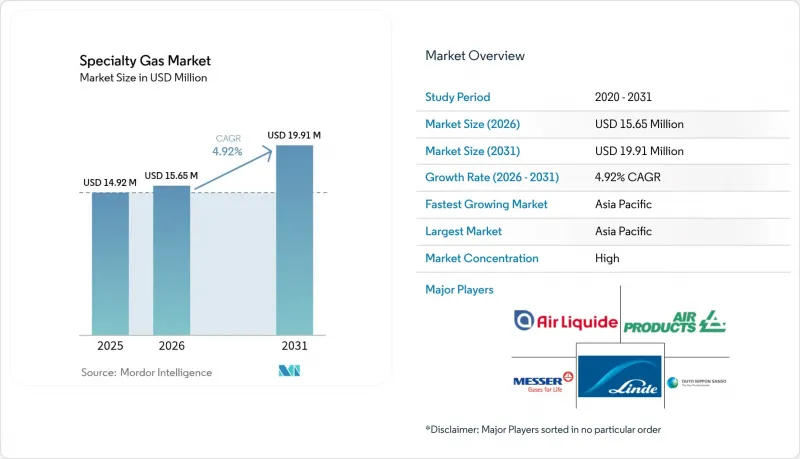
本報告按「類型」(高純度氣體、稀有氣體、碳基氣體、鹵基氣體及其他)、「終端用戶產業」(電子、醫療保健、汽車、食品飲料、石油天然氣及其他產業)及「地區」(亞太、北美、歐洲、南美、中東和非洲)對產業進行分類。市場預測以美元計價。
全球特種氣體市場趨勢及洞察
半導體晶圓製造業的蓬勃發展正在推動對特種氣體的需求。
半導體製造領域前所未有的投資正推動超高純度氮氣、氬氣和氟化化合物的需求成長。以林德公司SPECTRA工廠為三星平澤園區供氣為例,目前化學氣相沉積(CVD)、蝕刻和離子布植製程均指定使用6N純度(99.9999%)的氣體。美國《晶片與科學法案》正在刺激90個項目的4,500億美元私人投資,預計到2032年將使美國國內晶圓產量增加兩倍。包括台灣、韓國和中國當地在內的亞太地區晶圓廠也在擴張,並與全球氣體供應商簽訂了更多長期合約。這些趨勢支撐了精製撬裝設備、微型儲槽和電子級氣體填充設備的強勁訂單前景。因此,特種氣體市場受益於可預測的銷售量和與純度保證掛鉤的溢價。
石油化工產業特種氣體用途的擴展
在石化聯合裝置的加氫處理、裂解和催化劑再生過程中,氫氣、一氧化碳和客製化烴類混合物仍然至關重要。中東和德州德克薩斯州墨西哥灣沿岸地區的營運商接入了空氣產品公司(Air Products)的氫氣管道,該管道總長超過1,600公里。即時氣體分析提高了產品產率,減少了燃燒排放,並有助於採購用於氧化製程的校準氣體和高純度氧氣。隨著煉油廠轉向低硫燃料,氣體消耗量進一步增加。因此,特種氣體市場存在穩定的基本負載需求,同時對包含氣體、設備和製程控制軟體的承包供應方案的需求也在不斷成長。
對特種氣體的生產和品管有嚴格的環境法規和限制。
《AIM法案》規定,到2036年,氫氟碳化合物(HFC)的消耗量必須減少85%,這將促進特種冷媒混合物的重組以及對減排系統的投資。美國油氣產業的甲烷排放企業將於2024年面臨每噸900美元的廢棄物排放附加稅,預計2026年將增加至每噸1,500美元。歐洲工廠目前在《工業排放指令》和碳定價機制的限制下運營,這增加了合規成本。雖然這些法規推動了低全球暖化潛勢(GWP)氣體的創新,但它們可能會減緩產能擴張速度並導致短期供應緊張,對特種氣體市場的成長率造成輕微的下行壓力。
細分市場分析
預計到2025年,高純度氣體銷售額將佔總銷售額的37.79%,因為半導體製造廠將雜質標準提高到兆分之一等級。宇部興產株式會社(UBE)宇部工廠高純度硝酸產能提升30%,凸顯了半導體需求的持續性。儘管稀有氣體供應曾因地緣政治緊張局勢和液化工廠的維護停產而出現零星中斷,但針對加強回收能力和升級液化工廠的專案投資正在穩定供應。電子氣體和製程氣體是成長最快的細分市場,受益於3D NAND和環柵(GAA)電晶體所需的先進蝕刻化學技術,其複合年成長率(CAGR)達到5.48%。
超高純度 (UHP) 氫氣和氟化化合物正為快速發展的極紫外線 (EUV) 光刻生產線提供支持,因為在這些生產線中,金屬和水分污染超過個位數 ppt 的閾值是不可接受的。同時,精細化工和顯示器製造業對碳基特種氣體(包括用於 OLED 前驅體合成的高純度一氧化碳)的需求仍然強勁。這些多樣化的應用場景增強了特種氣體市場抵禦特定產業短期波動的能力。
區域分析
預計到2025年,亞太地區將佔全球銷售額的47.85%,並在2031年之前以6.55%的複合年成長率成長。在中國當地,消耗大量氮氣和電子級氟化氣體的記憶體和邏輯晶片大型晶圓廠仍在持續運作。韓國平澤和中國西安的生產線正在推動對超高純度氬氣(UHP)的運作。台灣的半導體產業叢集仍然是氖氣的主要買家,其氖氣來源廣泛,來自不同的精煉廠,以降低來自烏克蘭的供應風險。日本原始設備製造商(OEM)正在投資簽訂長期氦氣契約,以保障國內半導體製造設備的生產,並在全球供不應求的情況下維持進口。東南亞國協,特別是馬來西亞和越南,正在吸引需要大量成型氣體混合物的先進封裝工廠,這使得區域分銷商更貼近終端用戶。這些投資的協同效應使亞太地區得以繼續保持其在特種氣體市場的長期領先地位。
北美地區受惠於《晶片技術創新法案》(CHIPS Act)帶來的4,500億美元私人半導體投資,促進了晶圓產量的成長,並帶動了前驅體氣體、高純氨氣和腔室清洗氣體混合物的銷售。預計到2025年,頁岩氣日產量將達到1,050億立方英尺,這將降低氮氣和氫氣原料的成本。該地區綠色氫氣電解和二氧化碳捕集系統的安裝量也在增加,這兩者都依賴校準參考物質,從而推動了特種氣體的採購。醫院維修的增加,以及國家國防衛生計畫的預算,都在加速對醫用級氣體的需求。因此,美國和加拿大的特種氣體市場正處於多年穩定上升的趨勢中。
在歐洲,由於嚴格的工業排放法規,成長速度相對緩慢,但對綠氫的強烈需求以及先進研究機構的存在確保了穩定的消費。德國計劃將其電解產能翻番,這支撐了對氫氣、氧氣和一氧化碳等校準氣體的需求;而作為歐洲最大的液化天然氣進口國,法國則推動了對船用燃料轉化氣體和船用級氮氣的需求。專注於碳化矽和氮化鎵元件的斯堪地那維亞半導體製造商正在訂購高純度矽烷和二氯矽烷,從而擴大了其在特種氣體市場的佔有率。東歐的製藥叢集也透過採購用於其冷凍乾燥生產線的無菌級二氧化碳,進一步增加了對特種氣體的需求。
南美洲特種氣體市場規模雖小,但正蓬勃發展。巴西石化聯合企業在生產聚合物級產品時使用氫氣和氮氣,阿根廷煉油廠則投資升級硫磺回收裝置,這些裝置需要使用特殊混合氣體。在中東和非洲地區,沙烏地阿拉伯的大規模煉油和天然氣製化學品轉換計畫正在推動氫氣和二氧化硫(用於去除微量元素)的大量訂單。同時,南非醫療產業的氧氣供應網路正在各省醫院不斷擴展。這些措施共同推動了特種氣體市場在全球的覆蓋範圍擴大。
其他好處:
- Excel格式的市場預測(ME)表
- 3個月的分析師支持
目錄
第1章:引言
- 研究假設和市場定義
- 調查範圍
第2章:調查方法
第3章執行摘要
第4章 市場狀況
- 市場概覽
- 市場促進因素
- 半導體晶圓製造業的蓬勃發展催生了對特殊氣體的需求。
- 石油化工產業特種氣體用途的擴展
- 綠色氫氣試點計畫快速擴張,需要校準氣體
- 來自醫療領域的需求增加
- 擴大應用範圍,以提高太陽能發電領域的能量吸收和運作效率。
- 市場限制因素
- 對特種氣體的生產和品管有嚴格的環境法規和限制。
- 擔憂供應鏈會影響特定地區的運轉率
- 某些氣體的生產和提煉成本高昂
- 價值鏈分析
- 波特五力模型
第5章 市場規模與成長預測
- 按類型
- 高純度氣體
- 稀有氣體
- 二氧化碳
- 鹵素氣體
- 其他類型(電子氣體和製程氣體等)
- 按最終用戶行業分類
- 電子設備
- 醫療保健
- 車
- 食品/飲料
- 石油和天然氣
- 其他行業(製造業和冶金業等)
- 按地區
- 亞太地區
- 中國
- 日本
- 印度
- 韓國
- 其他亞太國家
- 北美洲
- 美國
- 加拿大
- 墨西哥
- 歐洲
- 德國
- 英國
- 法國
- 義大利
- 其他歐洲國家
- 南美洲
- 巴西
- 阿根廷
- 其他南美國家
- 中東和非洲
- 沙烏地阿拉伯
- 南非
- 其他中東和非洲地區
- 亞太地區
第6章 競爭情勢
- 市場集中度
- 策略趨勢
- 市佔率和排名分析
- 公司簡介
- Air Liquide
- Air Products and Chemicals Inc.
- Coregas
- ILMO Products Company
- Linde plc
- Matheson Tri-Gas Inc.
- Matheson Tri-Gas, Inc.
- Messer SE & Co. KGaA
- Mitsui Chemicals Inc.
- Norco Inc.
- Resonac Holdings Corporation
- SK Materials Co. Ltd.
- TAIYO NIPPON SANSO CORPORATION
- Yingde Gases Group
- Yueyang Kaimeite Electronic Specialty Rare Gases CO., Ltd
第7章 市場機會與未來展望
According to Mordor Intelligence, the specialty gas market size in 2026 is estimated at USD 15.65 million, growing from 2025 value of USD 14.92 million with 2031 projections showing USD 19.91 million, growing at 4.92% CAGR over 2026-2031.
This report Segments the Industry by Type (High-Purity Gases, Noble Gases, Carbon Gases, Halogen Gases, and Other Types), End-User Industry (Electronics, Medical and Healthcare, Automotive, Food and Beverage, Oil and Gas, and Other Industries), Geography (Asia-Pacific, North America, Europe, South America, and Middle East and Africa). The Market Forecasts are Provided in Terms of Value (USD).
Global Specialty Gas Market Trends and Insights
Semiconductor-grade wafer fabrication boom creating demand for specialty gas
Unprecedented chip-fabrication investment is elevating consumption of ultra-high-purity nitrogen, argon, and fluorinated compounds. Plants now specify 6 N purity (99.9999%) for chemical vapor deposition, etching, and ion implantation, as shown by Linde's SPECTRA plants that supply Samsung's Pyeongtaek campus. The U.S. CHIPS and Science Act has catalyzed USD 450 billion in private spending across 90 projects, expected to triple national wafer output by 2032. Asia-Pacific fabs in Taiwan, South Korea, and mainland China are also scaling, fueling long-term contracts with global gas suppliers. These dynamics underpin a robust pipeline of purification skids, micro-bulk tanks, and electronic-grade fill plants. The specialty gas market therefore benefits from predictable volume off-take and premium pricing tied to purity guarantees.
Increasing utilization for specialty gases from petrochemical industry
Hydrogen, carbon monoxide, and bespoke hydrocarbon blends remain critical for hydrotreating, cracking, and catalyst regeneration within petrochemical complexes. Operators in the Middle East and Texas Gulf Coast are connecting to Air Products' hydrogen pipelines that exceed 1,600 km in length. Real-time gas analytics enhance product yields while reducing flaring, driving procurement of calibration mixes and high-purity oxygen for oxidative processes. Refineries shifting toward low-sulfur fuels intensify consumption further. As a result, the specialty gas market sees stable base-load volumes and rising demand for turnkey supply schemes that bundle gas, equipment, and process control software.
Stringent environmental regulations and restrictions on specialty gas production and quality control
The AIM Act compels an 85% phase-down of HFC consumption by 2036, prompting reformulation of specialty refrigerant blends and investment in abatement systems. Methane emitters in the U.S. oil and gas sector face a Waste Emissions Charge of USD 900 per ton in 2024, rising to USD 1,500 by 2026. European plants operate under the Industrial Emissions Directive and carbon pricing, which elevate compliance costs. Although these rules drive innovation in low-GWP gases, they can slow capacity additions and tighten short-term supply, putting minor downward pressure on the specialty gas market's growth rate.
Other drivers and restraints analyzed in the detailed report include:
- Rapid expansion of green hydrogen pilots requiring calibration gases
- Increasing demand from the healthcare sector
- Supply chain vulnerabilities impacting utilization in certain geographies
For complete list of drivers and restraints, kindly check the Table Of Contents.
Segment Analysis
High-purity gases accounted for a 37.79% revenue share in 2025 as fabs tightened impurity specifications to parts-per-trillion levels. UBE's 30% capacity increase for high-purity nitric acid at its Ube facility underlines sustained semiconductor demand. Noble gases face sporadic supply disruptions following geopolitical tensions and maintenance outages at liquefaction plants, but targeted investments in recovery and liquefier upgrades are stabilizing availability. Electronic and process gases make up the fastest-growing sub-segment at 5.48% CAGR, benefiting from advanced etch chemistries needed in 3-D NAND and gate-all-around transistors.
Ultra-high-purity (UHP) hydrogen and fluorinated compounds support aggressively scaled EUV lithography lines that cannot tolerate metallic or moisture contamination beyond single-digit ppt thresholds. Meanwhile, demand for carbon-based specialty gases-including high-purity carbon monoxide for OLED precursor synthesis-remains strong across fine-chemical and display manufacturing. These diverse use cases reinforce the specialty gas market's resilience to short-cycle swings in any one sector.
Complete Report Scope:
- By Type
- High-Purity Gases
- Noble Gases
- Carbon Gases
- Halogen Gases
- Other Types (Electronic and Process Gases, etc.)
- By End-User Industry
- Electronics
- Medical and Healthcare
- Automotive
- Food and Beverage
- Oil and Gas
- Other Industries (Manufacturing and Metallurgy, etc.)
- By Geography
- Asia-Pacific
- China
- Japan
- India
- South Korea
- Rest of Asia-Pacific
- North America
- United States
- Canada
- Mexico
- Europe
- Germany
- United Kingdom
- France
- Italy
- Rest of Europe
- South America
- Brazil
- Argentina
- Rest of South America
- Middle East and Africa
- Saudi Arabia
- South Africa
- Rest of Middle East Africa
- Asia-Pacific
Geography Analysis
Asia-Pacific generated 47.85% of global revenue in 2025 and is on course to grow at a 6.55% CAGR through 2031. Mainland China continues to commission memory and logic megafabs that consume bulk nitrogen and electronic-grade fluorinated gases. South Korea's Pyeongtaek and Xi'an lines bolster demand for UHP argon. Taiwan's cluster remains a heavy purchaser of neon sourced from diversified purification hubs to mitigate Ukrainian supply risk. Japanese OEMs invest in long-term helium contracts to shield domestic chip tool production, sustaining imports despite global shortages. ASEAN nations, led by Malaysia and Vietnam, have attracted advanced-packaging plants that require large volumes of forming-gas mixtures, drawing regional distributors closer to end-users. These combined investments secure Asia-Pacific's long-running leadership in the specialty gas market.
North America benefits from USD 450 billion in private semiconductor investment sparked by the CHIPS Act, expanding wafer output and stimulating sales of precursor gases, high-purity ammonia, and chamber-clean blends. Shale gas production is set to hit 105 Bcf/d in 2025, improving feedstock economics for nitrogen and hydrogen. The region is also witnessing brisk installation of green-hydrogen electrolyzers and CO2 capture units, each reliant on calibration standards that spur specialty gas procurement. Rising hospital refurbishment, coupled with the Defense Health Program budget, accelerates medical-grade demand. Consequently, the specialty gas market in the United States and Canada is on a firm, multi-year upswing.
Europe shows more measured growth due to stringent industrial-emission directives, yet its strong green-hydrogen ambitions and advanced research laboratories ensure steady consumption. Germany's plan to double electrolyzer capacity underpins demand for H2, O2, and CO calibration gases, while France's role as Europe's largest LNG importer drives marine-fuel transition gases and bunker-grade nitrogen. Scandinavian fabs focusing on silicon carbide and gallium nitride devices order high-purity silane and dichlorosilane, expanding the specialty gas market's niche segments. Eastern European pharmaceutical clusters add another layer of volume, purchasing sterile-grade CO2 for lyophilization lines.
South America's specialty gas market is smaller but rising, with Brazilian petrochemical complexes using hydrogen and nitrogen for polymer grade output, and Argentine refineries investing in sulfur-recovery upgrades that require specialty blends. In the Middle East & Africa, mega-refining and gas-to-chemicals projects in Saudi Arabia drive ordering of bulk hydrogen and SO2 for trace-element removal, while South Africa's healthcare sector expands bulk oxygen networks across provincial hospitals. These initiatives collectively widen the specialty gas market's global footprint.
- Air Liquide
- Air Products and Chemicals Inc.
- Coregas
- ILMO Products Company
- Linde plc
- Matheson Tri-Gas Inc.
- Matheson Tri-Gas, Inc.
- Messer SE & Co. KGaA
- Mitsui Chemicals Inc.
- Norco Inc.
- Resonac Holdings Corporation
- SK Materials Co. Ltd.
- TAIYO NIPPON SANSO CORPORATION
- Yingde Gases Group
- Yueyang Kaimeite Electronic Specialty Rare Gases CO., Ltd
Additional Benefits:
- The market estimate (ME) sheet in Excel format
- 3 months of analyst support
TABLE OF CONTENTS
1 Introduction
- 1.1 Study Assumptions and Market Definition
- 1.2 Scope of the Study
2 Research Methodology
3 Executive Summary
4 Market Landscape
- 4.1 Market Overview
- 4.2 Market Drivers
- 4.2.1 Semiconductor-grade Wafer Fabrication Boom Creating Demand for Specialty Gas
- 4.2.2 Increasing Utilization for Specialty Gased from Petrochemcial Industry
- 4.2.3 Rapid Expansion of Green Hydrogen Pilots Requiring Calibration Gases
- 4.2.4 Increasing Demand from the Healthcare Sector
- 4.2.5 Increasing Usage in the Solar Power Sector for Energy Absorption and Operational Efficiency
- 4.3 Market Restraints
- 4.3.1 Stringent Environmental Regulations and Restrictions on Specialty Gas Production and Quality Control
- 4.3.2 Supply Chain Concerns Impacting Utilization in Certain Geographies
- 4.3.3 High Production and Purification Cost for Certain Gases
- 4.4 Value Chain Analysis
- 4.5 Porter's Five Forces
- 4.5.1 Bargaining Power of Suppliers
- 4.5.2 Bargaining Power of Buyers
- 4.5.3 Threat of New Entrants
- 4.5.4 Threat of Substitutes
- 4.5.5 Degree of Competition
5 Market Size and Growth Forecasts (Value)
- 5.1 By Type
- 5.1.1 High-Purity Gases
- 5.1.2 Noble Gases
- 5.1.3 Carbon Gases
- 5.1.4 Halogen Gases
- 5.1.5 Other Types (Electronic and Process Gases, etc.)
- 5.2 By End-User Industry
- 5.2.1 Electronics
- 5.2.2 Medical and Healthcare
- 5.2.3 Automotive
- 5.2.4 Food and Beverage
- 5.2.5 Oil and Gas
- 5.2.6 Other Industries (Manufacturing and Metallurgy, etc.)
- 5.3 By Geography
- 5.3.1 Asia-Pacific
- 5.3.1.1 China
- 5.3.1.2 Japan
- 5.3.1.3 India
- 5.3.1.4 South Korea
- 5.3.1.5 Rest of Asia-Pacific
- 5.3.2 North America
- 5.3.2.1 United States
- 5.3.2.2 Canada
- 5.3.2.3 Mexico
- 5.3.3 Europe
- 5.3.3.1 Germany
- 5.3.3.2 United Kingdom
- 5.3.3.3 France
- 5.3.3.4 Italy
- 5.3.3.5 Rest of Europe
- 5.3.4 South America
- 5.3.4.1 Brazil
- 5.3.4.2 Argentina
- 5.3.4.3 Rest of South America
- 5.3.5 Middle East and Africa
- 5.3.5.1 Saudi Arabia
- 5.3.5.2 South Africa
- 5.3.5.3 Rest of Middle East Africa
- 5.3.1 Asia-Pacific
6 Competitive Landscape
- 6.1 Market Concentration
- 6.2 Strategic Moves
- 6.3 Market Share(%)/Ranking Analysis
- 6.4 Company Profiles {(includes Global-level Overview, Market-level Overview, Core Segments, Financials, Strategic Information, Market Rank/Share, Products and Services, Recent Developments)}
- 6.4.1 Air Liquide
- 6.4.2 Air Products and Chemicals Inc.
- 6.4.3 Coregas
- 6.4.4 ILMO Products Company
- 6.4.5 Linde plc
- 6.4.6 Matheson Tri-Gas Inc.
- 6.4.7 Matheson Tri-Gas, Inc.
- 6.4.8 Messer SE & Co. KGaA
- 6.4.9 Mitsui Chemicals Inc.
- 6.4.10 Norco Inc.
- 6.4.11 Resonac Holdings Corporation
- 6.4.12 SK Materials Co. Ltd.
- 6.4.13 TAIYO NIPPON SANSO CORPORATION
- 6.4.14 Yingde Gases Group
- 6.4.15 Yueyang Kaimeite Electronic Specialty Rare Gases CO., Ltd
7 Market Opportunities and Future Outlook
- 7.1 White-Space and Unmet-Need Assessment
- 7.2 Use in the Pharmaceutical or Biotechnology Sector

 電子特種氣體市場預測至2034年—按氣體類型、應用、最終用戶、銷售管道和地區分類的全球分析
 高純度特種氣體市場機會、成長促進因素、產業趨勢分析及2026-2035年預測
 DRAM製造工廠專用氣體:市佔率分析、產業趨勢與統計及成長預測(2026-2031年)
 特種氣體市場:2026-2032年全球市場預測(依氣體類型、純度等級、供應形式、包裝形式、應用及最終用戶產業分類)
 特種電子氣體市場-全球產業規模、佔有率、趨勢、機會、預測:按類型、應用、最終用途、分銷方式、地區和競爭格局分類,2021-2031年
 特種氣體市場規模、佔有率、趨勢和預測:按類型、元素、應用、包裝類型、銷售形式和地區分類,2026-2034年
 散裝特殊氣體系統 (BSGS) 市場規模、佔有率和成長分析:按系統組件、氣體類型、產業、企業規模和地區分類-2026 年至 2033 年產業預測
 特種氣體市場規模、佔有率、成長及全球產業分析:按類型、應用和地區分類,並預測至2026-2034年全球半導體製造特種氣體市場預測至2034年:依氣體類型、純度等級、形態、應用、最終用戶及地區分類
 2026年全球特種氣體市場報告