


 |
市場調查報告書
商品編碼
2099461
中東和非洲5G光纖骨幹網路傳輸:市場佔有率分析、產業趨勢和統計數據以及成長預測(2026-2031年)Middle East and Africa 5G Fiber Backbone Transport - Market Share Analysis, Industry Trends & Statistics, Growth Forecasts (2026 - 2031) |
||||||

※ 本網頁內容可能與最新版本有所差異。詳細情況請與我們聯繫。
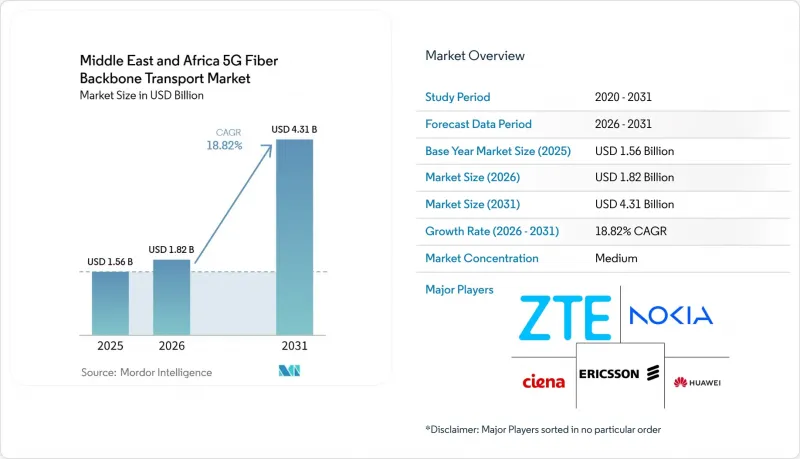
據 Mordor Intelligence 稱,2025 年中東和非洲地區的 5G 光纖骨幹傳輸市場價值為 15.6 億美元,預計到 2031 年將從 2026 年的 18.2 億美元成長至 43.1 億美元,2026 年至 2031 年的複合年成長率為 18.82%。
本報告按組件(硬體、軟體、網路管理等)、容量(最高 10 Gbps、10–100 Gbps、超過 100 Gbps)、應用程式(行動網路回程傳輸、資料中心互連等)、終端用戶產業(行動網路營運商、網際服務供應商等)及地區進行細分。市場預測以美元計價。
中東和非洲地區 5G 光纖骨幹傳輸市場的趨勢和洞察。
雲端和資料中心互連對 400G 和 800G 骨幹網路的需求
隨著海灣合作理事會(GCC)成員國通訊業者已從測試階段過渡到全面運營,並推進高容量部署,雲端和資料中心流量成為中東和非洲地區5G光纖骨幹網路傳輸市場短期成長要素。 2025年1月,諾基亞和stc集團在沙烏地阿拉伯完成了該地區首個1Tbps長距離現場測試,測試距離達850公里,證明了超高容量骨幹網路的性能已具備商業實用化。隨後,在2025年2月,阿拉伯聯合大公國e&UAE部署了Ciena的WaveLogic 6 Extreme,在其現有服務區域內實現了單波長1.6Tbps的傳輸速率。這進一步凸顯了圍繞人工智慧和雲端集線器快速擴展光纖通訊基礎架構的必要性。 2025年7月,MTN奈及利亞和華為推出了奈及利亞首個混合400G-800G自動交換光纖網路。這其中也包括該國首個單波長 800G 光通道,顯示類似的容量升級正在向非洲新興市場擴展。此外,e&UAE 於 2025 年 11 月展示了基於 DWDM 的雙 800GE 可以降低延遲並降低每位元成本。這進一步增強了在用戶流量完全成熟之前對骨幹網路進行早期投資的商業合理性。
5G小型基地台和都市區廣域基地台密度更高
中東和非洲的5G光纖骨幹傳輸市場也受惠於5G基地台的高密度部署。這是因為小型基地台和先進的巨集架構比傳統的行動通訊佈局需要更多的光纖。 Safaricom在內羅畢的5G部署採用了小型基地台和分散式天線系統(DAS),在人口密集的商業區通常可實現400至700 Mbit/s的傳輸速度。這凸顯了無線層面直接光纖連接的必要性。阿爾及利亞是另一個鮮明的例子。 2025年2月,果凍電信和華為將涵蓋全國58個省份的國家光纖骨幹網路升級至400G WDM,隨後Ooredoo、Djezzy和Mobilis於2025年12月正式推出商用5G服務。根據eCPRI 7.2x選項啟動的每個5G小型基地台,都會將對延遲敏感的處理環節更靠近無線單元,從而將端到端延遲容差限制在100-150微秒,並顯著提高傳輸要求。諾基亞的《2025年中東和非洲行動寬頻指數》也指出,5G投資正在加速成長。通訊業者正在部署5G-Advanced功能、工業應用場景和網路切片,所有這些都需要比標準消費寬頻服務更高的傳輸精度。
高昂的土木工程成本和土地徵用延誤
土木工程成本和授權延誤仍然是中東和非洲5G光纖骨幹傳輸市場面臨的最緊迫障礙。在撒哈拉以南非洲和農村地區,核准流程進展緩慢,這影響尤其顯著。根據《2024年非洲寬頻展望》,非洲陸地光纖總長度超過210萬公里,其中130萬公里已投入運作中,截至2024年6月的12個月內新增5.8萬公里。然而,這一速度距離大規模部署5G網路所需的密度仍相去甚遠。主要問題不僅僅是資金短缺。奈及利亞和沙烏地阿拉伯農村地區的專案面臨電信監管機構、規劃機構和道路管理部門的重疊核准流程,耗時18至24個月。在2025年非洲通訊展(AfricaCom 2025)上,Ciena指出,一些最重要的傳輸線路仍面臨漫長的建設週期,而人工智慧基礎設施的建設正在增加資料中心的整體資料量。這就是為什麼共用線路和開放式光纖模式日益普及的原因之一。換句話說,單一特許經營業者可以透過單一許可流程將容量租賃給多家通訊業者。
細分市場分析
預計到2025年,硬體將佔據62.12%的市場佔有率,顯示中東和非洲的5G光纖骨幹網路傳輸市場仍處於建設階段,通訊業者優先投資於實體光纖通訊層。光纖傳輸系統、DWDM和ROADM平台以及分組光纖設備仍然是海灣合作理事會(GCC)骨幹網路線路和非洲長途走廊採購週期中的關鍵組件。這一趨勢反映出通訊業者在增加軟體層投入之前,更專注於擴大網路覆蓋範圍和提升傳輸容量。此外,隨著非洲新興市場通訊業者通常依賴供應商進行規劃、部署、整合和營運管理,服務的重要性日益凸顯。預計2026年至2031年,軟體和網路管理將以24.57%的複合年成長率成長,成為中東和非洲5G光纖骨幹網路傳輸市場中成長最快的組件類別。
該軟體領域的快速成長反映了中東和非洲地區5G光纖骨幹傳輸產業競爭格局的更廣泛轉變。這是因為價值正從單純的硬體轉向網路控制、編配和最佳化。 2025年1月,諾基亞以23億美元完成了Infinera的收購,將連貫光電與雲端原生網路管理結合。這顯示主要供應商正在同時加強這兩個層面。此外,Omatel與Ciena於2025年聯合推出的「託管光纖網路」表明,通訊業者購買的不僅僅是光容量,還包括即時服務等級協定(SLA)監控、按需頻寬以及在網路即服務(NaaS)模式下的自動化配置。此外,隨著營運商尋求在其不斷擴展的傳輸基礎設施中實現互通性,諸如ITU-T G.709光纖傳輸網路幀格式和IETF YANG資料模型等標準正在影響競標通訊業者軟體架構的選擇。因此,儘管硬體在中東和非洲的 5G 光纖骨幹傳輸市場中仍然主導主導地位,但未來的差異化因素正日益轉向軟體定義的管理層。
預計到2025年,中東和非洲5G光纖骨幹網路傳輸市場中,10-100 Gbps頻寬將佔50.59%,這反映了在4G向5G過渡期間建構的龐大的100G連貫系統部署基礎。由於該地區許多通訊業者仍在接近其容量極限的情況下運行這些系統,因此該頻寬仍然是商業運營的基礎。同時,受海灣合作理事會(GCC)國家資料中心連接流量成長以及非洲主要都會區5G傳輸負載上升的推動,預計2026年至2031年間,超過100 Gbps的頻寬將以20.20%的複合年成長率成長。在非洲新興市場,由於流量密度尚未達到升級到更高容量平台的程度,10 Gbps以下的頻寬仍然在遠端地面鏈路和早期回程傳輸鏈路中發揮作用。這種格局意味著中東和非洲5G光纖骨幹網路傳輸市場既擁有大規模的傳統基礎設施,又面臨快速的升級週期。
2025 年和 2026 年的商業部署表明,向高容量傳輸的過渡不再只是一個計劃,而是已經在運作網路中逐步展開。 2025 年 12 月,e&UAE 與思科合作,將其 EMIX IP Transit 骨幹網路升級至 400G,從而將高容量服務擴展到國際目的地點 (PoP)。這顯示通訊業者的需求已經超過了最初的試點階段。隨後,Nokia、e&UAE 和 NPS 在 2026 年進行了一項 153 Tbps 規模的試驗,採用了中空光纖,這表明未來 100 Gbps 以上的傳輸速度也將涵蓋多 Tbps 的單纖性能。因此,中東和非洲 5G 光纖骨幹網路傳輸市場的採購團隊在規劃新的光纖線路時,需要考慮到比傳統 100G 規劃模型所假設的更廣泛的未來性能範圍。這意味著容量決策需要更加謹慎,因為當前升級週期鋪設的光纖需要在預測期的剩餘時間內支援大規模的工作負載。
其他好處:
- Excel格式的市場預測(ME)表
- 3個月的分析師支持
目錄
第1章:引言
- 研究假設和市場定義
- 調查範圍
第2章:調查方法
第3章執行摘要
第4章 市場狀況
- 市場概覽
- 市場促進因素
- 都市區的5G小型基地台和高密度廣域基地台
- 使用 Open RAN 和 eCPRI 實現傳輸層隔離
- 雲端和資料中心連接對 400G 和 800G 骨幹網路的需求。
- 海灣合作理事會和北非國家數位基礎設施計劃
- 港口、工業園區和能源走廊的公用事業級光纖。
- 將路由設計轉型為多租戶批發光纖骨幹網
- 市場限制因素
- 高昂的土木工程成本和土地徵用延誤
- 非洲偏遠市場電力、冷凍和場地准入的限制
- 多段光層和資料包層的互通性挑戰
- 連貫光學和線系統中的FX壓力和導入依賴性
- 產業價值鏈分析
- 監理情勢
- 技術展望
- 波特五力分析
- 宏觀經濟因素對市場的影響
第5章 市場規模與成長預測
- 按組件
- 硬體
- 軟體和網路管理
- 服務
- 按產能
- 10 Gbps 或更低
- 10~100 Gbps
- 100 Gbps 或更高
- 透過使用
- 行動網路回程傳輸
- 行動網路的去程傳輸與中傳
- 資料中心之間的互連
- 企業與私有 5G 傳輸
- 其他用途(例如潛水艇登陸站的回程傳輸)
- 按最終用戶行業分類
- 行動通訊業者
- 網際服務供應商
- 雲端和超大規模提供者
- 企業及私人網路
- 其他終端使用者產業(政府、公共安全等)
- 按地區
- 中東
- 沙烏地阿拉伯
- 阿拉伯聯合大公國
- 卡達
- 科威特
- 土耳其
- 其他中東國家
- 非洲
- 南非
- 奈及利亞
- 埃及
- 肯亞
- 其他非洲國家
- 中東
第6章 競爭情勢
- 市場集中度
- 策略趨勢
- 市佔率分析
- 公司簡介
- Huawei Technologies Co., Ltd.
- Nokia Corporation
- Ciena Corporation
- ZTE Corporation
- Telefonaktiebolaget LM Ericsson
- Cisco Systems, Inc.
- Infinera Corporation
- ADTRAN Holdings, Inc.
- Ribbon Communications Inc.
- Juniper Networks, Inc.
- NEC Corporation
- Fujitsu Limited
- CommScope Holding Company, Inc.
- Sterlite Technologies Limited
- Prysmian SpA
- Corning Incorporated
- Tejas Networks Limited
- FiberHome Telecommunication Technologies Co., Ltd.
- Coherent Corp.
- Aviat Networks Inc.
- Ekinops SA
第7章 市場機會與未來展望
According to Mordor Intelligence, the Middle East and Africa 5G Fiber Backbone Transport Market size was valued at USD 1.56 billion in 2025 and is estimated to grow from USD 1.82 billion in 2026 to reach USD 4.31 billion by 2031, at a CAGR of 18.82% during the forecast period (2026-2031).
This report is Segmented by Component (Hardware, Software and Network Management, and More), Capacity (Up To 10 Gbps, 10 To 100 Gbps, and Above 100 Gbps), Application (Mobile Network Backhaul, Data Center Interconnect, and More), End User Industry (Mobile Network Operators, Internet Service Providers, and More), and Geography. The Market Forecasts are Provided in Value (USD).
Middle East and Africa 5G Fiber Backbone Transport Market Trends and Insights
Cloud and Data Center Interconnect Demand for 400G and 800G Backbones
Cloud and data center traffic is a major near-term support factor for the Middle East and Africa 5G fiber backbone transport market, as GCC operators are already moving beyond trial conditions into live, high-capacity deployments. Nokia and stc Group completed the region's first 1Tbps long-haul field trial in January 2025 over 850 km, which showed that very high-capacity backbone performance is already practical for commercial use in Saudi Arabia. e& UAE then deployed Ciena's WaveLogic 6 Extreme in February 2025 and reached 1.6Tbps per wavelength within its existing footprint, which strengthened the case for rapid optical scaling around AI and cloud hubs. MTN Nigeria and Huawei also launched Nigeria's first hybrid 400G-800G Automatically Switched Optical Network in July 2025, including the country's first single-wavelength 800G optical channel, which showed that the same capacity shift is now reaching frontier African markets as well. e& UAE further demonstrated in November 2025 that dual-800GE over DWDM can reduce latency and lower cost per bit, which improves the business case for early backbone investment before subscriber traffic fully matures.
5G Small-Cell and Urban Macro Densification
The Middle East and Africa 5G fiber backbone transport market is also benefiting from dense 5G site rollouts, because small-cell and advanced macro architectures require much more fiber than legacy mobile layouts. Safaricom's 5G deployment in Nairobi has been supported by small-cell and DAS installations that delivered typical speeds of 400 Mbit/s to 700 Mbit/s in dense commercial areas, underscoring the need for direct fiber support at the radio level. Algeria added another clear example when Ooredoo, Djezzy, and Mobilis launched commercial 5G in December 2025 after Algerie Telecom and Huawei had upgraded the national optical backbone to 400G WDM across all 58 wilayas in February 2025. The transport requirement rises sharply because each 5G small-cell activation under eCPRI option 7.2x shifts latency-sensitive processing closer to the radio unit, tightening the end-to-end latency budget to 100-150 microseconds. Nokia's MEA Mobile Broadband Index 2025 also pointed to accelerating 5G investment, with operators adding 5G-Advanced capabilities, industrial use cases, and network slicing, all of which require tighter transport precision than standard consumer broadband services.
High Civil Works Cost and Right-Of-Way Delays
Civil works costs and permitting delays remain the most immediate brake on the Middle East and Africa 5G fiber backbone transport market, especially across sub-Saharan Africa and secondary cities, where approvals move slowly. Africa's terrestrial fiber footprint passed 2.1 million km, with 1.3 million km active as of the Africa Broadband Outlook 2024, and 58,000 km entered service in the 12 months to June 2024, yet this pace still falls short of the density required for full 5G transport readiness at scale. The main issue is not a lack of capital alone, because projects in Nigeria and secondary Saudi cities can still face overlapping approvals from telecom regulators, planning bodies, and road authorities that stretch for 18-24 months. Ciena stated at AfricaCom 2025 that AI infrastructure is increasing data volumes across data centers, even as some of the most important transport routes still face long delivery schedules. This is one reason shared trench and open-access fiber models are gaining support: a single concessionaire can move through a single permitting process and lease capacity to several operators.
Other drivers and restraints analyzed in the detailed report include:
- Sovereign Digital Infrastructure Programs in GCC And North Africa
- Open RAN and eCPRI Disaggregation of Transport Layers
- Power, Cooling, And Site Access Constraints In Remote African Markets
For complete list of drivers and restraints, kindly check the Table Of Contents.
Segment Analysis
Hardware held a 62.12% share in 2025, indicating that the Middle East and Africa 5G fiber backbone transport market is still in a build phase, with operators spending first on physical optical layers. Optical transport systems, DWDM and ROADM platforms, and packet-optical equipment remain the main items in procurement cycles across GCC backbone routes and African long-haul corridors. This pattern reflects the fact that carriers are still expanding network reach and raw transport capacity before they shift a larger share of spending toward software layers. Services are also gaining relevance because operators in frontier African markets often rely on vendors for planning, deployment, integration, and managed operations. Software and network management is projected to expand at a 24.57% CAGR from 2026 to 2031, which makes it the fastest-growing component category in the Middle East and Africa 5G fiber backbone transport market.
That faster software growth reflects a broader change in how the Middle East and Africa 5G fiber backbone transport industry is competing, because value is moving toward network control, orchestration, and optimization rather than hardware alone. Nokia completed its acquisition of Infinera for USD 2.3 billion in January 2025, combining coherent photonics with cloud-native network management and demonstrating that major vendors are strengthening both layers simultaneously. Omantel's 2025 launch of its Managed Optical Fiber Network with Ciena also showed that operators are buying real-time SLA monitoring, bandwidth-on-demand, and automated provisioning under a network-as-a-service model, not just raw optical capacity. Standards such as ITU-T G.709 optical transport network framing and IETF YANG data models are also shaping software architecture choices in regional tenders, as operators seek interoperability across expanding transport estates. As a result, the component mix in the Middle East and Africa 5G fiber backbone transport market is still led by hardware, but future differentiation is increasingly moving toward software-defined management layers.
The 10 to 100 Gbps segment accounted for 50.59% of the Middle East and Africa 5G fiber backbone transport market in 2025, reflecting the large installed base of coherent 100G systems built during the 4G-to-5G transition. Many carriers across the region are still running these systems near capacity, so this tier remains the present backbone of commercial operations. At the same time, above 100 Gbps is projected to expand at a 20.20% CAGR from 2026 to 2031 as data center interconnect traffic rises in the GCC and 5G transport loads increase in major African metros. The up to 10 Gbps tier still has a role in remote terrestrial links and early-stage backhaul routes in frontier African markets where traffic density has not yet justified a move to higher-capacity platforms. This mix means the Middle East and Africa 5G fiber backbone transport market has both a large legacy installed base and a fast upgrade cycle.
Commercial moves in 2025 and 2026 show that the shift toward higher-capacity transport is already happening in live networks rather than remaining a plan. e& UAE upgraded its EMIX IP transit backbone to 400G in partnership with Cisco in December 2025, extending higher-capacity services to international points of presence and demonstrating that operator demand has moved beyond early pilots. Nokia, e& UAE, and NPS then used hollow-core fiber in a 2026 trial at 153 Tbps, pointing to a future where the above 100 Gbps category will also include multi-Tbps single-fiber performance. Procurement teams in the Middle East and Africa 5G fiber backbone transport market, therefore, need to plan new fiber routes against a much wider future performance range than older 100G planning models assumed. This makes capacity decisions more sensitive because fiber laid for today's upgrade cycle will need to support much larger workloads over the rest of the forecast window.
Complete Report Scope:
- By Component
- Hardware (Includes Optical Transport Systems, DWDM and ROADM Platforms, Packet-Optical Transport Platforms, Routers and Switches, Fiber Optic Cables, Optical Transceivers, Amplifiers, and OTN Equipment)
- Software and Network Management (Includes Network Management Systems, SDN Controllers, Transport Orchestration Software, Analytics and Assurance Tools, Automation Platforms, and Inventory Management Software)
- Services (Includes Network Planning and Design, Deployment and Installation, Integration and Commissioning, Managed Services, Maintenance and Support, Optimization, Consulting, and Training)
- By Capacity
- Up to 10 Gbps
- 10 to 100 Gbps
- Above 100 Gbps
- By Application
- Mobile Network Backhaul
- Mobile Network Fronthaul and Midhaul
- Data Center Interconnect
- Enterprise and Private 5G Transport
- Other Applications (Submarine Landing Station Backhaul, etc.)
- By End User Industry
- Mobile Network Operators
- Internet Service Providers
- Cloud and Hyperscale Providers
- Enterprises and Private Networks
- Other End User Industry (Government and Public Safety, etc.)
- By Geography
- Middle East
- Saudi Arabia
- United Arab Emirates
- Qatar
- Kuwait
- Turkey
- Rest of Middle East
- Africa
- South Africa
- Nigeria
- Egypt
- Kenya
- Rest of Africa
- Middle East
List of Companies Covered in this Report:
- Huawei Technologies Co., Ltd.
- Nokia Corporation
- Ciena Corporation
- ZTE Corporation
- Telefonaktiebolaget LM Ericsson
- Cisco Systems, Inc.
- Infinera Corporation
- ADTRAN Holdings, Inc.
- Ribbon Communications Inc.
- Juniper Networks, Inc.
- NEC Corporation
- Fujitsu Limited
- CommScope Holding Company, Inc.
- Sterlite Technologies Limited
- Prysmian S.p.A.
- Corning Incorporated
- Tejas Networks Limited
- FiberHome Telecommunication Technologies Co., Ltd.
- Coherent Corp.
- Aviat Networks Inc.
- Ekinops S.A.
Additional Benefits:
- The market estimate (ME) sheet in Excel format
- 3 months of analyst support
TABLE OF CONTENTS
1 INTRODUCTION
- 1.1 Study Assumptions and Market Definition
- 1.2 Scope of the Study
2 RESEARCH METHODOLOGY
3 EXECUTIVE SUMMARY
4 MARKET LANDSCAPE
- 4.1 Market Overview
- 4.2 Market Drivers
- 4.2.1 5G Small-Cell and Urban Macro Densification
- 4.2.2 Open RAN and eCPRI Disaggregation of Transport Layers
- 4.2.3 Cloud and Data Center Interconnect Demand for 400G and 800G Backbones
- 4.2.4 Sovereign Digital Infrastructure Programs in GCC and North Africa
- 4.2.5 Utility-Grade Fiberization of Ports, Industrial Zones, and Energy Corridors
- 4.2.6 Route Design Shift Toward Multi-Tenant Wholesale Fiber Backbones
- 4.3 Market Restraints
- 4.3.1 High Civil Works Cost and Right-of-Way Delays
- 4.3.2 Power, Cooling, and Site Access Constraints in Remote African Markets
- 4.3.3 Interoperability Friction Across Multi-Vendor Optical and Packet Layers
- 4.3.4 FX Pressure and Import Dependency for Coherent Optics and Line Systems
- 4.4 Industry Value Chain Analysis
- 4.5 Regulatory Landscape
- 4.6 Technological Outlook
- 4.7 Porter's Five Forces Analysis
- 4.7.1 Threat of New Entrants
- 4.7.2 Bargaining Power of Suppliers
- 4.7.3 Bargaining Power of Buyers
- 4.7.4 Threat of Substitutes
- 4.7.5 Competitive Rivalry
- 4.8 Impact of Macroeconomic Factors on the Market
5 MARKET SIZE AND GROWTH FORECASTS (VALUE)
- 5.1 By Component
- 5.1.1 Hardware (Includes Optical Transport Systems, DWDM and ROADM Platforms, Packet-Optical Transport Platforms, Routers and Switches, Fiber Optic Cables, Optical Transceivers, Amplifiers, and OTN Equipment)
- 5.1.2 Software and Network Management (Includes Network Management Systems, SDN Controllers, Transport Orchestration Software, Analytics and Assurance Tools, Automation Platforms, and Inventory Management Software)
- 5.1.3 Services (Includes Network Planning and Design, Deployment and Installation, Integration and Commissioning, Managed Services, Maintenance and Support, Optimization, Consulting, and Training)
- 5.2 By Capacity
- 5.2.1 Up to 10 Gbps
- 5.2.2 10 to 100 Gbps
- 5.2.3 Above 100 Gbps
- 5.3 By Application
- 5.3.1 Mobile Network Backhaul
- 5.3.2 Mobile Network Fronthaul and Midhaul
- 5.3.3 Data Center Interconnect
- 5.3.4 Enterprise and Private 5G Transport
- 5.3.5 Other Applications (Submarine Landing Station Backhaul, etc.)
- 5.4 By End User Industry
- 5.4.1 Mobile Network Operators
- 5.4.2 Internet Service Providers
- 5.4.3 Cloud and Hyperscale Providers
- 5.4.4 Enterprises and Private Networks
- 5.4.5 Other End User Industry (Government and Public Safety, etc.)
- 5.5 By Geography
- 5.5.1 Middle East
- 5.5.1.1 Saudi Arabia
- 5.5.1.2 United Arab Emirates
- 5.5.1.3 Qatar
- 5.5.1.4 Kuwait
- 5.5.1.5 Turkey
- 5.5.1.6 Rest of Middle East
- 5.5.2 Africa
- 5.5.2.1 South Africa
- 5.5.2.2 Nigeria
- 5.5.2.3 Egypt
- 5.5.2.4 Kenya
- 5.5.2.5 Rest of Africa
- 5.5.1 Middle East
6 COMPETITIVE LANDSCAPE
- 6.1 Market Concentration
- 6.2 Strategic Moves
- 6.3 Market Share Analysis
- 6.4 Company Profiles (includes Global Level Overview, Market Level Overview, Core Segments, Financials as available, Strategic Information, Market Rank/Share, Products and Services, Recent Developments)
- 6.4.1 Huawei Technologies Co., Ltd.
- 6.4.2 Nokia Corporation
- 6.4.3 Ciena Corporation
- 6.4.4 ZTE Corporation
- 6.4.5 Telefonaktiebolaget LM Ericsson
- 6.4.6 Cisco Systems, Inc.
- 6.4.7 Infinera Corporation
- 6.4.8 ADTRAN Holdings, Inc.
- 6.4.9 Ribbon Communications Inc.
- 6.4.10 Juniper Networks, Inc.
- 6.4.11 NEC Corporation
- 6.4.12 Fujitsu Limited
- 6.4.13 CommScope Holding Company, Inc.
- 6.4.14 Sterlite Technologies Limited
- 6.4.15 Prysmian S.p.A.
- 6.4.16 Corning Incorporated
- 6.4.17 Tejas Networks Limited
- 6.4.18 FiberHome Telecommunication Technologies Co., Ltd.
- 6.4.19 Coherent Corp.
- 6.4.20 Aviat Networks Inc.
- 6.4.21 Ekinops S.A.
7 MARKET OPPORTUNITIES AND FUTURE OUTLOOK
- 7.1 White-Space and Unmet-Need Assessment

 全球跨境勞動力和移民解決方案市場規模、佔有率、趨勢和成長分析報告(2026-2034)Frost Radar™:下一代人工智慧基礎設施和智慧資料中心,2026 年
 5G連結:市場佔有率分析、產業趨勢與統計、成長預測(2026-2031年)
 5G非地面網路市場:全球市場預測,2026-2032年4G 和 5G 市場:按組件、網路技術、頻段、頻段所有權、網路架構、部署類型、部署模式和最終用戶分類——2026-2032 年全球市場預測
 跨國勞動力和移民解決方案市場:市場機會、成長要素、產業趨勢分析以及 2026-2035 年預測。
 智慧網路容量最佳化市場預測至2034年—按組件、部署模式、技術、應用、最終用戶和地區分類的全球分析
 5G無線生態系統市場規模、佔有率和成長分析:按組件基礎設施、網路頻段、終端用戶產業和地區分類-產業預測,2026-2033年
 5G獨立組網的商業化:早期應用案例
 5G非地面網路市場-全球產業規模、佔有率、趨勢、機會、預測:按組件類型、平台、應用、位置、最終用戶、地區和競爭格局分類,2021-2031年