

 |
市場調查報告書
商品編碼
2101982
跨國勞動力和移民解決方案市場:市場機會、成長要素、產業趨勢分析以及 2026-2035 年預測。Cross-border Workforce and Migration Solution Market Opportunity, Growth Drivers, Industry Trend Analysis, and Forecast 2026 - 2035 |
||||||

全球跨境勞動力和移民解決方案市場預計到 2025 年將達到 46 億美元,年複合成長率為 11.2%,到 2035 年將達到 132 億美元。
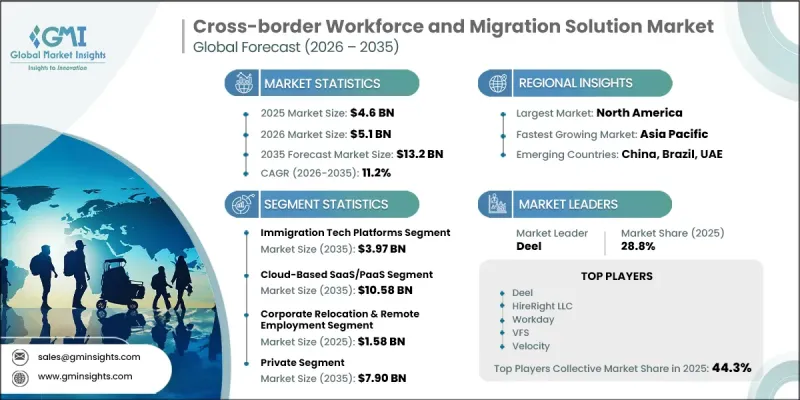
隨著企業不斷拓展國際招聘策略以應對技術工人短缺並建立地理多元化的員工隊伍,跨境勞動力和移民解決方案市場正在蓬勃發展。日益成長的全球人才需求正促使雇主採用數位化行動辦公平台,以簡化員工調動、移民管理和跨國僱傭管理。企業正摒棄分散的手動流程,轉而採用整合式雲端解決方案,從而提高營運效率並支援跨國勞動力管理。移民和勞動合規相關法規的日益複雜化,進一步推動了自動化平台的應用,這些平台能夠大規模地管理文件、就業核實和合規義務。隨著跨國招募從偶爾的人才活動轉變為日常營運職能,企業越來越重視集中式人才管理解決方案,這些方案能夠提供即時可見性、標準化工作流程和更完善的監管。國際招聘的成長和持續的數位轉型舉措,不斷為跨境人才管理和移民解決方案市場的供應商創造巨大的商機。
| 市場範圍 | |
|---|---|
| 開始年份 | 2025 |
| 預測期 | 2026-2035 |
| 初始市場規模 | 46億美元 |
| 預測金額 | 132億美元 |
| 複合年成長率 | 11.2% |
預計2025年,移民管理技術平台市場規模將達到12.7億美元,市佔率27.9%。隨著企業需要一個集中化的平台,以便在統一的營運環境中管理移民流程、僱用文件、人才管理、薪資核算調整、員工福利和合規性監控,該行業將繼續保持主導地位。對能夠簡化國際僱用流程並提高企業透明度的數位化人才流動解決方案的需求不斷成長,預計將推動該行業在預測期內持續擴張。
預計到2025年,基於雲端的SaaS/PaaS市場收入將達到31億美元,佔68%的市場。雲端模式仍然是首選的交付模式,因為它能夠在多個司法管轄區持續更新移民政策、就業法規、薪資要求和員工相關文件。越來越多的組織傾向於選擇雲端平台,這些平台能夠提供即時處理能力、可擴展的基礎設施、集中式人才管理以及增強的審計應對力,同時也能透過單一技術環境支援全球分散式營運。
2025年,北美跨境勞動力和移民解決方案市場規模將達16億美元,市佔率將達38.4%。推動區域市場成長的主要因素是市場對簡化工作移民管理、勞動力合規和國際招聘流程的數位化解決方案的需求不斷成長。北美各地的組織機構持續投資於整合式勞動力管理平台,將移民管理、薪資核算運營、員工身份驗證和合規活動整合到一個集中式系統中,從而促進了區域市場的持續擴張。
目錄
第1章:調查方法和範圍
第2章執行摘要
第3章 行業洞察
- 產業生態系分析
- 供應商情況
- 原物料供應商
- 零件供應商
- 製造商
- 服務供應商
- 分銷管道
- 最終用途
- 成本結構
- 利潤率
- 每個階段增加的價值
- 垂直整合趨勢
- 顛覆者
- 供應商情況
- 影響產業的因素
- 促進因素
- 全球勞動力短缺問題日益惡化。
- 擴大遠距和海外招聘
- 移民和勞工法規日益複雜
- 政府對數位移民和邊境控制系統的投資
- 市場限制因素
- 資料隱私和網路安全問題
- 各國移民和勞動法規各不相同
- 市場機遇
- 移民案件管理中的人工智慧和自動化
- 擴展雇主記錄 (EoR) 平台
- 實施基於雲端的員工行動辦公
- 數位身分和生物識別的融合
- 促進因素
- 成長潛力分析
- 價格分析
- 對過去價格趨勢的分析
- 依球員類型分類的定價策略(高級球員、超值球員、成本加成球員)
- 監理情勢
- 北美洲
- 根據美墨加協定,商務相關人員可臨時入境。
- H-1B簽證計劃
- TN非移民分類
- 美國移民與國籍法(INA)
- 加拿大臨時外籍勞工計畫(TFWP)
- 歐洲
- 歐盟藍卡指令
- 單一授權指令
- 派遣工人指令
- 申根簽證規定
- 歐洲勞工機構(ELA)框架
- 公司內部調任指示
- 亞太地區
- 東協自然人流動協定(MNP)
- 《全面與進步跨太平洋夥伴關係關係協定》(CPTPP)-關於臨時入境的條款
- 澳洲臨時低技能簽證(482子類)
- 新加坡就業證制度
- 日本的特定技能工人(SSW)制度
- 拉丁美洲
- 國際勞工組織《移徙工人公約》
- 南方共同居住協議
- 太平洋聯盟的流動性框架
- 巴西移民法(2017 年第 13,445 號法律)
- 中東和非洲
- 海灣合作理事會統一簽證和勞動力流動框架
- 沙烏地阿拉伯勞動法
- 阿拉伯聯合大公國勞動法(2021年第33號聯邦法規)
- 非洲自由貿易區(AfCFTA)人員流動議定書
- 北美洲
- 技術與創新展望
- 最新技術
- 新興技術
- 波特的分析
- PESTLE分析
- 專利分析
- 人工智慧和生成式人工智慧對市場的影響
- 利用人工智慧改造現有經營模式
- 設計自動化最佳化
- 用於需求預測的供應鏈人工智慧
- 按細分市場分類的生成式人工智慧用例和部署藍圖
- 風險、限制和監管考量
- 永續性和環境方面
- 永續計劃
- 減少廢棄物策略
- 生產中的能源效率
- 具有環保意識的舉措
- 考慮碳足跡
- 預測假設和情境分析
- 基本案例:驅動複合年成長率的關鍵宏觀經濟與產業變量
- 樂觀情境:宏觀經濟與產業的順風
- 悲觀情景:宏觀經濟放緩或產業逆風
第4章 競爭情勢
- 介紹
- 企業市佔率分析
- 北美洲
- 歐洲
- 亞太地區
- 拉丁美洲
- 中東和非洲
- 競爭定位矩陣
- 主要進展
- 併購
- 夥伴關係和聯盟
- 新產品發布
- 業務拓展計劃及資金籌措
- 按公司規模進行基準測試
- 排名分類標準與遴選標準
- 按銷售額、地區和創新能力分類的層級定位矩陣。
第5章 市場估計與預測:依解法分類,2022-2035年
- 移民相關技術平台
- 員工集中管理系統
- 流動性和搬遷管理
- 勞動合規和檢驗工具
- 數位身分和身分驗證平台
- 其他
第6章 市場估算與預測:依部署模式分類,2022-2035年
- 基於雲端(SaaS/PaaS)
- 現場
- 混合
第7章 市場估計與預測:依應用領域分類,2022-2035年
- 企業搬遷與遠距辦公
- 技術純熟勞工遷移
- 季節性和技術純熟勞工的流動
- 國際學生流動
- 醫護人員流動
第8章 市場估算與預測:依最終用戶分類,2022-2035年
- 私人公司雇主
- 政府機構和監管機構
- 招募及勞務移民機構
- 醫療機構
- 教育機構
第9章 市場估計與預測:依地區分類,2022-2035年
- 北美洲
- 美國
- 加拿大
- 歐洲
- 英國
- 德國
- 法國
- 義大利
- 西班牙
- 比利時
- 荷蘭
- 瑞典
- 俄羅斯
- 亞太地區
- 中國
- 印度
- 日本
- 澳洲
- 新加坡
- 韓國
- 越南
- 印尼
- 泰國
- 拉丁美洲
- 巴西
- 墨西哥
- 阿根廷
- 中東和非洲
- 南非
- 沙烏地阿拉伯
- UAE
第10章:公司簡介
- 世界公司
- Deel
- Remote
- Velocity
- Papaya
- GP(Globalization Partners)
- Rippling
- Oyster HR
- Atlas HXM
- ADP GlobalView+Streamline
- Workday
- 當地公司
- Multiplier
- WorkMotion
- Acclime
- Remofirst
- Lano
- VFS
- Equus Software
- HireRight
- Payoneer
- Emerald
The Global Cross-Border Workforce and Migration Solution Market was valued at USD 4.6 billion in 2025 and is estimated to grow at a CAGR of 11.2% to reach USD 13.2 billion by 2035.
The cross-border workforce and migration solution market is experiencing growth as organizations increasingly expand their international hiring strategies to address skilled labor shortages and build geographically diverse workforces. Rising demand for global talent is encouraging employers to adopt digital workforce mobility platforms that simplify employee relocation, immigration management, and cross-border employment administration. Businesses are moving away from fragmented manual processes in favor of integrated cloud-based solutions that improve operational efficiency and support workforce management across multiple countries. Growing regulatory complexity surrounding immigration and labor compliance is further driving the adoption of automated platforms capable of managing documentation, employment verification, and compliance obligations at scale. As cross-border employment becomes a routine business function rather than an occasional workforce activity, organizations are placing greater emphasis on centralized workforce management solutions that provide real-time visibility, standardized workflows, and enhanced regulatory oversight. Increasing international recruitment activity, combined with ongoing digital transformation initiatives, continues to create significant opportunities for providers operating in the cross-border workforce and migration solution market.
| Market Scope | |
|---|---|
| Start Year | 2025 |
| Forecast Year | 2026-2035 |
| Start Value | $4.6 Billion |
| Forecast Value | $13.2 Billion |
| CAGR | 11.2% |
The immigration technology platforms segment generated USD 1.27 billion in 2025, accounting for 27.9% share. This segment continues to maintain a leading position because organizations require centralized platforms capable of managing immigration processes, employment documentation, workforce administration, payroll coordination, employee benefits, and compliance monitoring through a unified operating environment. Growing demand for digital workforce mobility solutions that streamline international employment procedures and improve organizational visibility is expected to support continued expansion of this segment throughout the forecast period.
The cloud-based SaaS/PaaS segment generated USD 3.10 billion holding a 68% share in 2025. Cloud deployment remains the preferred delivery model because it enables continuous updates to immigration policies, employment regulations, payroll requirements, and workforce documentation across multiple jurisdictions. Organizations increasingly favor cloud platforms that provide real-time processing capabilities, scalable infrastructure, centralized workforce management, and enhanced audit readiness while supporting globally distributed operations through a single technology environment.
North America Cross-Border Workforce and Migration Solution Market accounted for USD 1.6 billion in 2025, representing 38.4% share. Regional market growth is supported by rising demand for employment-based immigration management, workforce compliance, and digital solutions that simplify international hiring processes. Organizations across North America continue to invest in integrated workforce management platforms that consolidate immigration administration, payroll operations, employee verification, and compliance activities into centralized systems, contributing to sustained regional market expansion.
Leading companies operating in the global cross-border workforce and migration solution market include Deel, Workday, Papaya, VFS, Velocity, Equus Software, HireRight, G-P (Globalization Partners), Rippling, and Oyster HR. Companies operating in the cross-border workforce and migration solution market are strengthening their market position by expanding cloud-based platform capabilities and developing integrated solutions that simplify international workforce management. Providers continue to invest in automation, artificial intelligence, and advanced analytics to improve compliance monitoring, document processing, workflow efficiency, and workforce visibility. Businesses are also enhancing platform scalability to support multinational organizations managing employees across multiple jurisdictions. Strategic partnerships, product enhancements, and geographic expansion remain key priorities for increasing customer reach and strengthening service portfolios.
Table of Contents
Chapter 1 Methodology & Scope
- 1.1 Research approach
- 1.2 Quality Commitments
- 1.2.1 GMI AI policy & data integrity commitment
- 1.2.1.1 Source consistency protocol
- 1.2.1 GMI AI policy & data integrity commitment
- 1.3 Research Trail & Confidence Scoring
- 1.3.1 Research Trail Components
- 1.3.2 Scoring Components
- 1.4 Data Collection
- 1.4.1 Partial list of primary sources
- 1.5 Data mining sources
- 1.5.1 Paid sources
- 1.5.1.1 Sources, by region
- 1.5.1 Paid sources
- 1.6 Base estimates and calculations
- 1.6.1 Base year calculation
- 1.7 Forecast
- 1.7.1 Quantified market impact analysis
- 1.7.1.1 Mathematical impact of growth parameters on forecast
- 1.7.1 Quantified market impact analysis
- 1.8 Research transparency addendum
- 1.8.1 Source attribution framework
- 1.8.2 Quality assurance metrics
- 1.8.3 Our commitment to trust
Chapter 2 Executive Summary
- 2.1 Industry 360° synopsis
- 2.2 Key market trends
- 2.2.1 Regional
- 2.2.2 Solution
- 2.2.3 Deployment Model
- 2.2.4 Application
- 2.2.5 End User
- 2.3 TAM Analysis, 2026-2035
- 2.4 CXO perspectives: Strategic imperatives
Chapter 3 Industry Insights
- 3.1 Industry ecosystem analysis
- 3.1.1 Supplier landscape
- 3.1.1.1 Raw material suppliers
- 3.1.1.2 Component suppliers
- 3.1.1.3 Manufacturers
- 3.1.1.4 Service providers
- 3.1.1.5 Distribution channel
- 3.1.1.6 End Use
- 3.1.2 Cost structure
- 3.1.3 Profit margin
- 3.1.4 Value addition at each stage
- 3.1.5 Vertical integration trends
- 3.1.6 Disruptors
- 3.1.1 Supplier landscape
- 3.2 Industry impact forces
- 3.2.1 Growth drivers
- 3.2.1.1 Rising global talent shortages
- 3.2.1.2 Growth in remote and international hiring
- 3.2.1.3 Increasing complexity of immigration and labor regulations
- 3.2.1.4 Government investments in digital immigration and border management systems
- 3.2.2 Market Restraints
- 3.2.2.1 Data privacy and cybersecurity concerns
- 3.2.2.2 Diverse immigration and labor regulations across countries
- 3.2.3 Market Opportunities
- 3.2.3.1 AI and automation in immigration case management
- 3.2.3.2 Employer of Record platform expansion
- 3.2.3.3 Cloud-based workforce mobility deployment
- 3.2.3.4 Digital identity and biometric verification integration
- 3.2.1 Growth drivers
- 3.3 Growth potential analysis
- 3.4 Pricing Analysis (Driven by Primary Research)
- 3.4.1 Historical Price Trend Analysis
- 3.4.2 Pricing Strategy by Player Type (Premium / Value / Cost-plus)
- 3.5 Regulatory landscape
- 3.5.1 North America
- 3.5.1.1 USMCA Temporary Entry for Business Persons
- 3.5.1.2 H-1B Visa Program
- 3.5.1.3 TN Nonimmigrant Classification
- 3.5.1.4 U.S. Immigration and Nationality Act (INA)
- 3.5.1.5 Canada's Temporary Foreign Worker Program (TFWP)
- 3.5.2 Europe
- 3.5.2.1 EU Blue Card Directive
- 3.5.2.2 Single Permit Directive
- 3.5.2.3 Posted Workers Directive
- 3.5.2.4 Schengen Visa Code
- 3.5.2.5 European Labour Authority (ELA) Framework
- 3.5.2.6 Intra-Corporate Transferees (ICT) Directive
- 3.5.3 Asia-Pacific
- 3.5.3.1 ASEAN Agreement on the Movement of Natural Persons (MNP)
- 3.5.3.2 Comprehensive and Progressive Agreement for Trans-Pacific Partnership (CPTPP) - Temporary Entry Provisions
- 3.5.3.3 Australia Temporary Skill Shortage (Subclass 482) Visa
- 3.5.3.4 Singapore Employment Pass Framework
- 3.5.3.5 Japan Specified Skilled Worker (SSW) Program
- 3.5.4 Latin America
- 3.5.4.1 ILO Migrant Workers Convention
- 3.5.4.2 MERCOSUR Residence Agreement
- 3.5.4.3 Pacific Alliance Mobility Framework
- 3.5.4.4 Brazil Migration Law (Law No. 13,445/2017)
- 3.5.5 Middle East & Africa
- 3.5.5.1 GCC Unified Visa and Labor Mobility Framework
- 3.5.5.2 Saudi Arabia Labor Law
- 3.5.5.3 UAE Labour Law (Federal Decree-Law No. 33 of 2021)
- 3.5.5.4 African Continental Free Trade Area (AfCFTA) Protocol on Movement of Persons
- 3.5.1 North America
- 3.6 Technology and Innovation landscape
- 3.6.1 Current technologies
- 3.6.2 Emerging technologies
- 3.7 Porter's analysis
- 3.8 PESTEL analysis
- 3.9 Patent analysis (Driven by Primary Research)
- 3.10 Impact of AI & generative AI on the market
- 3.10.1 AI-Driven Disruption of Existing Business Models
- 3.10.2 Automated design optimization
- 3.10.3 Supply chain AI for demand forecasting
- 3.10.4 GenAI use cases & adoption roadmap by segment
- 3.10.5 Risks, Limitations & Regulatory Considerations
- 3.11 Sustainability and environmental aspects
- 3.11.1 Sustainable practices
- 3.11.2 Waste reduction strategies
- 3.11.3 Energy efficiency in production
- 3.11.4 Eco-friendly Initiatives
- 3.11.5 Carbon footprint considerations
- 3.12 Forecast assumptions & scenario analysis (Driven by Primary Research)
- 3.12.1 Base Case - key macro & industry variables driving CAGR
- 3.12.2 Optimistic Scenarios - Favorable Macro and Industry Tailwinds
- 3.12.3 Pessimistic Scenario - Macroeconomic slowdown or industry headwinds
Chapter 4 Competitive Landscape, 2025
- 4.1 Introduction
- 4.2 Company market share analysis
- 4.2.1 North America
- 4.2.2 Europe
- 4.2.3 Asia-Pacific
- 4.2.4 Latin America
- 4.2.5 Middle East & Africa
- 4.3 Competitive positioning matrix
- 4.4 Key developments
- 4.4.1 Mergers & acquisitions
- 4.4.2 Partnerships & collaborations
- 4.4.3 New product launches
- 4.4.4 Expansion plans and funding
- 4.5 Company tier benchmarking
- 4.5.1 Tier classification criteria & qualifying thresholds
- 4.5.2 Tier positioning matrix by revenue, geography & innovation
Chapter 5 Market Estimates & Forecast, By Solution, 2022 - 2035 ($Mn)
- 5.1 Key trends
- 5.2 Immigration Tech Platforms
- 5.3 Workforce Centralized Management Systems
- 5.4 Mobility & Relocation Management
- 5.5 Labor Compliance & Verification Tools
- 5.6 Digital Identity & Background Screening Platforms
- 5.7 Others
Chapter 6 Market Estimates & Forecast, By Deployment Model, 2022 - 2035 ($Mn)
- 6.1 Key trends
- 6.2 Cloud-Based (SaaS/PaaS)
- 6.3 On-Premise
- 6.4 Hybrid
Chapter 7 Market Estimates & Forecast, By Application, 2022 - 2035 ($Mn)
- 7.1 Key trends
- 7.2 Corporate Relocation & Remote Employment
- 7.3 Skilled Labor Migration
- 7.4 Seasonal & Low-Skilled Workforce Mobility
- 7.5 International Student Migration
- 7.6 Medical & Healthcare Workforce Mobility
Chapter 8 Market Estimates & Forecast, By End User, 2022 - 2035 ($Mn)
- 8.1 Key trends
- 8.2 Private Sector Employers
- 8.3 Government Agencies & Regulatory Bodies
- 8.4 Recruitment & Labor Migration Agencies
- 8.5 Healthcare Institutions
- 8.6 Educational Institutions
Chapter 9 Market Estimates & Forecast, By Region, 2022 - 2035 ($Mn)
- 9.1 North America
- 9.1.1 US
- 9.1.2 Canada
- 9.2 Europe
- 9.2.1 UK
- 9.2.2 Germany
- 9.2.3 France
- 9.2.4 Italy
- 9.2.5 Spain
- 9.2.6 Belgium
- 9.2.7 Netherlands
- 9.2.8 Sweden
- 9.2.9 Russia
- 9.3 Asia Pacific
- 9.3.1 China
- 9.3.2 India
- 9.3.3 Japan
- 9.3.4 Australia
- 9.3.5 Singapore
- 9.3.6 South Korea
- 9.3.7 Vietnam
- 9.3.8 Indonesia
- 9.3.9 Thailand
- 9.4 Latin America
- 9.4.1 Brazil
- 9.4.2 Mexico
- 9.4.3 Argentina
- 9.5 MEA
- 9.5.1 South Africa
- 9.5.2 Saudi Arabia
- 9.5.3 UAE
Chapter 10 Company Profiles
- 10.1 Global Players
- 10.1.1 Deel
- 10.1.2 Remote
- 10.1.3 Velocity
- 10.1.4 Papaya
- 10.1.5 G-P (Globalization Partners)
- 10.1.6 Rippling
- 10.1.7 Oyster HR
- 10.1.8 Atlas HXM
- 10.1.9 ADP GlobalView + Streamline
- 10.1.10 Workday
- 10.2 Regional Players
- 10.2.1 Multiplier
- 10.2.2 WorkMotion
- 10.2.3 Acclime
- 10.2.4 Remofirst
- 10.2.5 Lano
- 10.2.6 VFS
- 10.2.7 Equus Software
- 10.2.8 HireRight
- 10.2.9 Payoneer
- 10.2.10 Emerald

 全球跨境勞動力和移民解決方案市場規模、佔有率、趨勢和成長分析報告(2026-2034)Frost Radar™:下一代人工智慧基礎設施和智慧資料中心,2026 年
 5G連結:市場佔有率分析、產業趨勢與統計、成長預測(2026-2031年)
 5G非地面網路市場:全球市場預測,2026-2032年中東和非洲5G光纖骨幹網路傳輸:市場佔有率分析、產業趨勢和統計數據以及成長預測(2026-2031年)4G 和 5G 市場:按組件、網路技術、頻段、頻段所有權、網路架構、部署類型、部署模式和最終用戶分類——2026-2032 年全球市場預測
 智慧網路容量最佳化市場預測至2034年—按組件、部署模式、技術、應用、最終用戶和地區分類的全球分析
 5G無線生態系統市場規模、佔有率和成長分析:按組件基礎設施、網路頻段、終端用戶產業和地區分類-產業預測,2026-2033年
 5G獨立組網的商業化:早期應用案例
 5G非地面網路市場-全球產業規模、佔有率、趨勢、機會、預測:按組件類型、平台、應用、位置、最終用戶、地區和競爭格局分類,2021-2031年