


 |
市場調查報告書
商品編碼
2099453
中國冷藏倉庫:市場佔有率分析、產業趨勢與統計及成長預測(2026-2031年)China Cold Storage - Market Share Analysis, Industry Trends & Statistics, Growth Forecasts (2026 - 2031) |
||||||

※ 本網頁內容可能與最新版本有所差異。詳細情況請與我們聯繫。
根據 Mordor Intelligence 估計,2025 年中國冷藏倉庫市場規模為 477.8 億美元,預計 2026 年將擴大至 519.8 億美元,到 2031 年將達到 776.6 億美元。
預計從 2026 年到 2031 年,其複合年成長率將達到 8.36%。
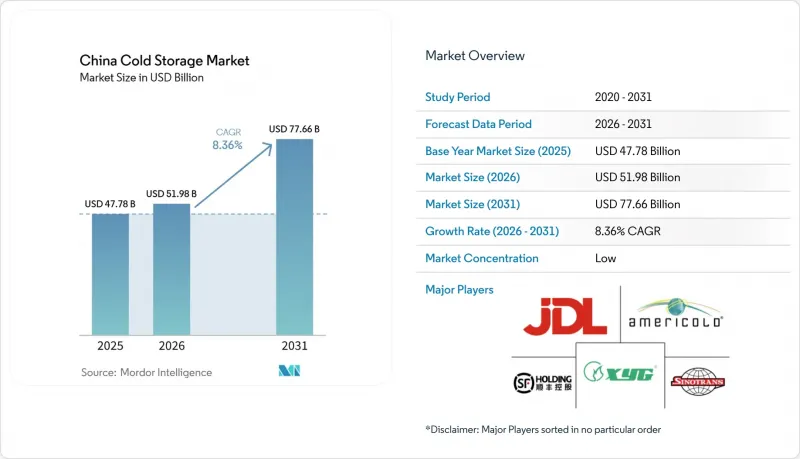
目前,中國冷藏倉庫市場的需求主要來自食品零售、生物製藥、高階簡便食品和都市區末端物流等多個行業。這意味著高規格冷藏倉庫的價值已超越了單純的儲存容量需求。本報告按溫度類型(冷藏、冷凍、常溫等)、自動化程度(傳統設施和自動化冷藏倉庫)、應用領域(果蔬、肉類和禽類、魚貝類、乳製品和冷凍甜點、即食食品等)以及地區(北方、東北、南方等)進行細分。市場預測以美元(USD)計價。
中國冷庫市場趨勢與洞察
線上雜貨和生鮮食品電子商務的擴張
2025年,生鮮食品電商滲透率將達48.6%,中國都市化將達67.2%。這將使中國冷庫市場在人口密集的城市配送網路覆蓋範圍內保持大規模的消費群。類似的趨勢正迫使企業在人口密集的住宅區內或附近部署更多冷庫庫存,因為在許多食品類別中,快速配送與大容量儲存同樣重要。分散式微型倉配中心(面積500-2000平方公尺)正在改變中國冷庫市場的規模格局,因為它們比單純依賴大型遠距離設施更能有效率地滿足都市區需求。這種轉變給位於郊區工業園區的標準規格冷庫帶來了壓力,因為這些設施雖然可以輕鬆提升供給能力,但卻難以快速回應都市區需求。此外,城市低溫運輸績效現在不僅與托盤負載容量密切相關,還與響應速度和位置品質密切相關,這推動了對基於軟體的庫存可視性、配送路線最佳化和補貨系統的更多投資。
藥品和生物製藥對低溫運輸的需求日益成長
在中國冷藏倉儲市場,醫藥和生物製藥客戶的需求日益成長,他們需要比傳統食品級倉儲設施更嚴格的驗證、更高的可追溯性和更嚴格的溫度控制。隨著國家標準GB/T 46204-2025於2025年10月實施,可追溯性的要求將進一步提高,這將進一步鞏固已採用驗證流程和數位化溫度監控系統的營運商的優勢。此外,生物製藥、mRNA處理和先進療法物流的需求也正轉向超低溫運輸,這縮小了能夠承接高價值合約的供應商的選擇範圍。因此,中國冷藏倉儲市場正朝著為醫療保健客戶提供更高品質的收入來源的方向發展,相關設施需具備規範的倉儲、驗證處理和可靠的末端配送服務。
主要物流走廊地價及電力成本高昂
由於冷藏設施比普通倉庫電力消耗量,能源和土地成本仍然是中國冷藏倉庫市場的主要成本因素。此外,主要物流走廊沿線的工業用地價格持續上漲。在上海、廣州和深圳周邊地區,這個問題特別突出,如果業者不投資環保冷媒、太陽能發電系統或改善能源管理,老舊設施的經濟效益就會下降。小規模營運商面臨更大的壓力,因為他們往往缺乏必要的資金進行維修,以降低持續的公用事業成本並避免未來的合規風險。因此,開發商正在將一些新計畫轉移到地價較低的衛星城和二環工業區,儘管這意味著更長的運輸距離。因此,中國冷藏倉庫市場的盈利越來越取決於位置、能源效率和客戶群體,而不是儲存容量本身。
細分市場分析
至2025年,冷藏(0-5度C)倉儲將佔中國冷藏市場佔有率的46.51%,成為以金額為準最高的溫度細分市場。這一地位的形成主要得益於中國東部和南部地區透過分銷網路銷售的大量生鮮食品、乳製品、冷藏肉類和已調理食品。雖然冷藏設施在處理能力和網路密度方面至關重要,但與更專業的低溫應用相比,它們通常服務於利潤率較低的食品零售合約。冷凍倉庫在加工肉品、進口食品和中央廚房的供應中仍然發揮著核心作用。這是因為冷凍倉庫更長的儲存時間和可預測的處理量,使其在中國冷藏倉庫市場擁有更穩定的營運模式。
預計到2031年,超低溫(-20 度C及以下)儲存將以13.62%的複合年成長率成長,成為中國冷藏市場成長最快的溫度細分領域。這項需求源自於生物製藥的處理以及高階水產品和冰淇淋的進口,這些產品需要比傳統食品儲存更穩定的低溫環境。由於超低溫儲存設施比標準冷庫需要更高的資本投入、更嚴格的監控和更先進的技術,因此,早期進入該領域的企業將擁有顯著優勢。由此,中國冷藏倉儲產業呈現兩極化趨勢,高容量冷藏基礎設施和盈利強的超低溫資產服務於規模較小但要求更高的客戶群。
其他好處:
- Excel格式的市場預測(ME)表
- 3個月的分析師支持
目錄
第1章:引言
- 研究假設和市場定義
- 調查範圍
第2章:調查方法
第3章執行摘要
第4章 市場狀況
- 市場概況及冷藏倉庫在物流中的作用
- 市場促進因素
- 線上雜貨和生鮮食品電子商務的擴張
- 藥品和生技藥品低溫運輸需求日益成長
- 政府主導的低溫運輸基礎建設投資
- 高階冷凍食品和即食食品的需求不斷成長
- 在高密度城市物流樞紐引進自動化
- 水產品及加工食品出口合規性
- 市場限制因素
- 主要物流走廊地價及電力成本高昂
- 商業基礎設施碎片化和低溫運輸標準化程度不均
- 自動化、維護和品質保證領域技術純熟勞工短缺。
- 電網的可靠性以及碳排放法規對高耗能設施的壓力。
- 法律規範
- 價值鍊和分銷管道的結構分析
- 技術創新前景
- 波特五力分析
- 冷藏倉庫產業的變化
- 冷藏倉庫裝置容量及擴大趨勢分析
- 公共部門和私營部門之間的能力分配
- 重大基礎建設項目
- 永續性和ESG評估
- 地緣政治事件對供應鏈變化的影響
第5章 市場規模及成長預測(價值,2026-2031 年)
- 按溫度類型
- 冷藏(0-5 度C)
- 冷凍(-18~0 度C)
- 環境的
- 超低溫(低於-20 度C)
- 自動化等級(儲存)
- 傳統設施
- 自動化倉庫(AS/RS、機器人)
- 透過使用
- 水果和蔬菜
- 肉類/家禽
- 魚貝類
- 乳製品和冷凍甜點
- 麵包糖果甜點
- 即食餐
- 藥品和生技藥品
- 疫苗和臨床試驗樣本
- 化學品和特殊材料
- 其他生鮮食品
- 按地區
- 北
- 東北
- 東
- 中部
- 南
- 西南
- 西北
第6章 競爭情勢
- 市場集中度
- 關鍵策略趨勢
- 市佔率分析
- 公司簡介
- China Merchants Americold Holdings Co., Ltd.
- JD Logistics, Inc.
- SF Cold Chain(SF Holding)
- Sinotrans Ltd.
- Xianyi Holdings Group
- Swire Cold Chain Logistics
- YH Global(Yuan Hong Holdings)
- COFCO Cold Chain Logistics
- Beijing Shounong Food Group Co., Ltd.
- CJ Rokin Logistics and Supply Chain Co., Ltd.
- China Logistics Group Cold Chain
- China Railway Special Cargo Logistics
- Shenzhen Agricultural Products Group(SZAP)
- Shandong Gaishi International Logistics Group
- Zhengming Logistics(ZM Logistics)
- Rongqing Logistics
- Wanwei Logistics
- Shanghai Speed Fresh Logistics Co. Ltd.
- Qingdao Port International Co. Ltd.
- Nichirei Logistics Group
- Henan Fresh Easy Supply Chain Co. Ltd.
- Hunan Hongxing Frozen Food Co. Ltd.
第7章 市場機會與未來展望
According to Mordor Intelligence, the China cold storage market size was valued at USD 47.78 billion in 2025 and is projected to grow to USD 51.98 billion in 2026 and reach USD 77.66 billion by 2031, growing at a CAGR of 8.36% from 2026 to 2031.
Demand in the China cold storage market is now coming from a broader mix of food retail, biologics, premium convenience foods, and last-mile urban fulfillment, lifting the value of higher-specification storage beyond its capacity needs. This report is Segmented by Temperature Type (Chilled, Frozen, Ambient, and More), by Automation Level (Conventional Facilities and Automated Cold Stores), by Application (Fruits and Vegetables, Meat and Poultry, Fish and Seafood, Dairy and Frozen Desserts, Ready-To-Eat Meals, and More), and by Region (North, Northeast, South, and More). The Market Forecasts are Provided in Terms of Value USD.
China Cold Storage Market Trends and Insights
Expansion Of Online Grocery And Fresh E-Commerce
Fresh e-commerce penetration reached 48.6% in 2025, while China's urbanization rate reached 67.2%, which kept a large consumer base within reach of dense urban delivery networks in the China cold storage market. The same pattern is pushing operators to place more chilled inventory inside or near residential clusters because short delivery windows now matter as much as bulk storage capacity for many food categories. Micro-fulfillment hubs are changing the sizing logic of the China cold storage market because distributed 500- to 2,000-m2 nodes can serve urban demand more efficiently than relying solely on distant mega sites. This shift is creating pressure on standard-specification assets in outer industrial parks, where supply is easier to add but access to fast urban demand is weaker. It also supports greater investment in software-enabled inventory visibility, routing, and replenishment, as city-level cold chain performance is now closely tied to response speed and location quality, not just pallet volume.
Rising Pharmaceutical And Biologics Cold Chain Demand
The China cold storage market is seeing stronger demand from pharmaceutical and biologics customers that need tighter validation, higher traceability, and better temperature discipline than conventional food-grade storage usually provides. The national standard GB/T 46204-2025 increased the traceability burden upon its October 2025 implementation, strengthening the position of operators that already run validated processes and digital temperature monitoring systems. Demand is also shifting toward ultra-low-temperature lanes for biologics, mRNA-related handling, and advanced therapy logistics, which is narrowing the field of providers able to serve premium contracts. As a result, the China cold storage market is moving toward higher-quality revenue by facilities that combine compliant storage, validated handling, and dependable last-mile service for healthcare customers.
High Land And Electricity Costs In Core Logistics Corridors
Energy and land remain major cost limits in the China cold storage market because refrigerated facilities are more power-intensive than standard warehouses, and core logistics corridors continue to see pricing pressure on industrial sites. This issue is most visible around Shanghai, Guangzhou, and Shenzhen, where the economics of older facilities are weaker if operators have not invested in green refrigerants, solar support, or better energy management. Smaller operators are under the most pressure because they often lack the capital needed for retrofits that could lower recurring utility exposure and reduce future compliance risk. Developers are therefore moving some new projects toward satellite cities and second-ring industrial zones, where land is cheaper even if transport distances become longer. The result is that profitability in the China cold storage market depends more on site selection, energy efficiency, and customer mix than on storage scale alone.
Other drivers and restraints analyzed in the detailed report include:
- Government-Led Cold Chain Infrastructure Investment
- Automation Adoption In High-Density Urban Logistics Hubs
- Fragmented Operator Base And Uneven Cold Chain Standardization
For complete list of drivers and restraints, kindly check the Table Of Contents.
Segment Analysis
Chilled (0-5 °C) storage accounted for 46.51% of China cold storage market share in 2025, making it the largest temperature segment by value. That position came from the large flow of fresh produce, dairy, chilled meat, and ready-to-sell food items moving through East and South China distribution networks. Chilled assets are important for throughput and network density, but they often serve food retail contracts with lower margins than more specialized low-temperature applications. Frozen storage remains central for processed meat, imports, and central kitchen supply because longer dwell times and more predictable throughput support steadier operating patterns in the China cold storage market.
Deep-frozen/ultra-low (-20 °C or lower) storage is projected to grow at a 13.62% CAGR through 2031, making it the fastest-expanding temperature segment in the China cold storage market. This demand is coming from both biologics handling and premium seafood or ice cream imports, which require more stable sub-zero performance than conventional food storage. Operators that entered this segment earlier are better placed because ultra-low chambers require more capex, tighter monitoring, and stronger engineering discipline than standard frozen rooms. The China cold storage industry is therefore seeing a clearer divide between volume-heavy chilled infrastructure and higher-yield ultra-low assets that serve fewer but more demanding customers.
Complete Report Scope:
- By Temperature Type
- Chilled (0-5 °C)
- Frozen (-18-0 °C)
- Ambient
- Deep-Frozen / Ultra-Low (Less than -20 °C)
- By Automation Level (Storage)
- Conventional Facilities
- Automated Cold Stores (AS/RS, Robotics)
- By Application
- Fruits and Vegetables
- Meat and Poultry
- Fish and Seafood
- Dairy and Frozen Desserts
- Bakery and Confectionery
- Ready-to-Eat Meals
- Pharmaceuticals and Biologics
- Vaccines and Clinical Trial Materials
- Chemicals and Specialty Materials
- Other Perishables
- By Region
- North
- Northeast
- East
- Central
- South
- Southwest
- Northwest
List of Companies Covered in this Report:
- China Merchants Americold Holdings Co., Ltd.
- JD Logistics, Inc.
- SF Cold Chain (SF Holding)
- Sinotrans Ltd.
- Xianyi Holdings Group
- Swire Cold Chain Logistics
- YH Global (Yuan Hong Holdings)
- COFCO Cold Chain Logistics
- Beijing Shounong Food Group Co., Ltd.
- CJ Rokin Logistics and Supply Chain Co., Ltd.
- China Logistics Group Cold Chain
- China Railway Special Cargo Logistics
- Shenzhen Agricultural Products Group (SZAP)
- Shandong Gaishi International Logistics Group
- Zhengming Logistics (ZM Logistics)
- Rongqing Logistics
- Wanwei Logistics
- Shanghai Speed Fresh Logistics Co. Ltd.
- Qingdao Port International Co. Ltd.
- Nichirei Logistics Group
- Henan Fresh Easy Supply Chain Co. Ltd.
- Hunan Hongxing Frozen Food Co. Ltd.
Additional Benefits:
- The market estimate (ME) sheet in Excel format
- 3 months of analyst support
TABLE OF CONTENTS
1 Introduction
- 1.1 Study Assumptions and Market Definition
- 1.2 Scope of the Study
2 Research Methodology
3 Executive Summary
4 Market Landscape
- 4.1 Market Overview and Role of Cold Storage in Logistics
- 4.2 Market Drivers
- 4.2.1 Expansion of Online Grocery and Fresh E-Commerce
- 4.2.2 Rising Pharmaceutical and Biologics Cold Chain Demand
- 4.2.3 Government-Led Cold Chain Infrastructure Investment
- 4.2.4 Rising Demand for Premium Frozen and Ready-To-Eat Foods
- 4.2.5 Automation Adoption in High-Density Urban Logistics Hubs
- 4.2.6 Export-Oriented Compliance for Seafood and Processed Food
- 4.3 Market Restraints
- 4.3.1 High Land and Electricity Costs in Core Logistics Corridors
- 4.3.2 Fragmented Operator Base and Uneven Cold Chain Standardization
- 4.3.3 Skilled Labor Shortages for Automation, Maintenance, and QA
- 4.3.4 Grid Reliability and Carbon Compliance Pressure on Energy-Intensive Facilities
- 4.4 Regulatory Framework
- 4.5 Value Chain and Distribution Channel Architecture Analysis
- 4.6 Technology Innovations Outlook
- 4.7 Porter's Five Forces Analysis
- 4.7.1 Threat of New Entrants
- 4.7.2 Bargaining Power of Suppliers
- 4.7.3 Bargaining Power of Buyers
- 4.7.4 Threat of Substitutes
- 4.7.5 Rivalry Among Competitors
- 4.8 Evolution of the Cold Storage Industry
- 4.9 Cold Storage Installed Capacity and Expansion Trend Analysis
- 4.10 Public vs Private Capacity Split
- 4.11 Key Infrastructure Projects
- 4.12 Sustainability and ESG Assessment
- 4.13 Impact of Geo-Political Events on Supply Chain Shifts
5 Market Size & Growth Forecasts (Value, 2026-2031)
- 5.1 By Temperature Type
- 5.1.1 Chilled (0-5 °C)
- 5.1.2 Frozen (-18-0 °C)
- 5.1.3 Ambient
- 5.1.4 Deep-Frozen / Ultra-Low (Less than -20 °C)
- 5.2 By Automation Level (Storage)
- 5.2.1 Conventional Facilities
- 5.2.2 Automated Cold Stores (AS/RS, Robotics)
- 5.3 By Application
- 5.3.1 Fruits and Vegetables
- 5.3.2 Meat and Poultry
- 5.3.3 Fish and Seafood
- 5.3.4 Dairy and Frozen Desserts
- 5.3.5 Bakery and Confectionery
- 5.3.6 Ready-to-Eat Meals
- 5.3.7 Pharmaceuticals and Biologics
- 5.3.8 Vaccines and Clinical Trial Materials
- 5.3.9 Chemicals and Specialty Materials
- 5.3.10 Other Perishables
- 5.4 By Region
- 5.4.1 North
- 5.4.2 Northeast
- 5.4.3 East
- 5.4.4 Central
- 5.4.5 South
- 5.4.6 Southwest
- 5.4.7 Northwest
6 Competitive Landscape
- 6.1 Market Concentration
- 6.2 Key Strategic Moves
- 6.3 Market Share Analysis
- 6.4 Company Profiles (includes Global level Overview, Market level overview, Core Segments, Financials as available, Strategic Information, Market Rank/Share for key companies, Products & Services, and Recent Developments)
- 6.4.1 China Merchants Americold Holdings Co., Ltd.
- 6.4.2 JD Logistics, Inc.
- 6.4.3 SF Cold Chain (SF Holding)
- 6.4.4 Sinotrans Ltd.
- 6.4.5 Xianyi Holdings Group
- 6.4.6 Swire Cold Chain Logistics
- 6.4.7 YH Global (Yuan Hong Holdings)
- 6.4.8 COFCO Cold Chain Logistics
- 6.4.9 Beijing Shounong Food Group Co., Ltd.
- 6.4.10 CJ Rokin Logistics and Supply Chain Co., Ltd.
- 6.4.11 China Logistics Group Cold Chain
- 6.4.12 China Railway Special Cargo Logistics
- 6.4.13 Shenzhen Agricultural Products Group (SZAP)
- 6.4.14 Shandong Gaishi International Logistics Group
- 6.4.15 Zhengming Logistics (ZM Logistics)
- 6.4.16 Rongqing Logistics
- 6.4.17 Wanwei Logistics
- 6.4.18 Shanghai Speed Fresh Logistics Co. Ltd.
- 6.4.19 Qingdao Port International Co. Ltd.
- 6.4.20 Nichirei Logistics Group
- 6.4.21 Henan Fresh Easy Supply Chain Co. Ltd.
- 6.4.22 Hunan Hongxing Frozen Food Co. Ltd.
7 Market Opportunities and Future Outlook
- 7.1 White-space and Unmet-Need Assessment

 冷藏保管市場:全球預測,2026-2032年
 印度冷藏倉庫:市場佔有率分析、產業趨勢與統計及成長預測(2026-2031)美國冷藏倉庫:市場佔有率分析、產業趨勢與統計及成長預測(2026-2031 年)
 全球冷庫市場規模、佔有率、趨勢及成長分析報告(2026-2034)
 冷資料儲存市場規模、佔有率和成長分析:按類型、溫度類型、儲存方法、應用和地區分類-2026-2033年產業預測
 2026年全球冷資料儲存市場報告2026年全球分散式冷資料儲存市場報告
 2026-2030年全球冷藏冷凍倉庫市場
 冷庫市場分析及預測(至2035年):依類型、產品類型、服務、技術、組件、應用、形式、材質、部署類型及最終用戶分類水產品冷資料儲存市場按儲存類型、產品類型、技術和最終用途分類-2026-2032年全球預測