


 |
市場調查報告書
商品編碼
2099238
印度冷藏倉庫:市場佔有率分析、產業趨勢與統計及成長預測(2026-2031)India Cold Storage - Market Share Analysis, Industry Trends & Statistics, Growth Forecasts (2026 - 2031) |
||||||

※ 本網頁內容可能與最新版本有所差異。詳細情況請與我們聯繫。
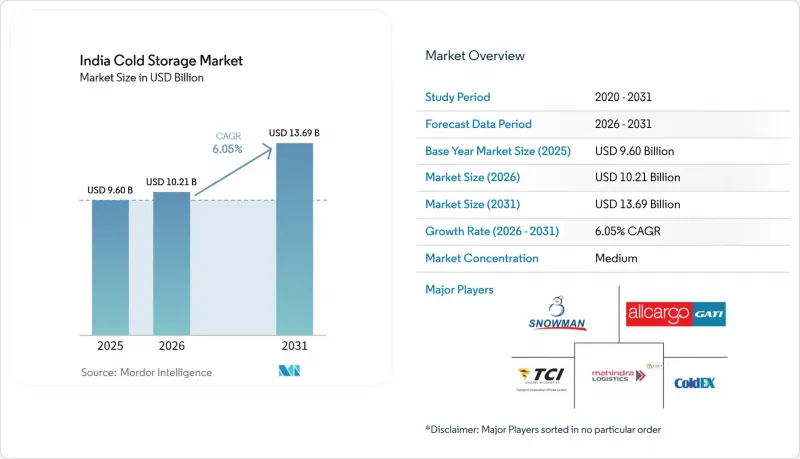
根據 Mordor Intelligence 預測,印度冷庫市場規模將從 2025 年的 96 億美元成長到 2026 年的 102.1 億美元,到 2031 年達到 136.9 億美元,2026 年至 2031 年的複合年成長率為 6.05%。
印度冷庫市場目前受三大平行需求趨勢的影響:食品零售現代化、醫藥低溫運輸擴張以及快速交易所需的暗庫數量激增。本報告按溫度類型(冷藏、冷凍、常溫、超低溫)、自動化程度(傳統設施和自動化冷庫)、應用領域(水果蔬菜、肉類和家禽、魚貝類、乳製品和冷凍甜點、即食食品等)以及地區(北部、中部、西部、東部和南部)進行細分。市場預測以美元計價。
印度冷庫市場趨勢及洞察。
對多溫區倉庫的需求日益成長
印度冷藏倉庫市場的需求不再侷限於單一溫區。零售連鎖店、快餐店和製藥公司越來越需要在同一設施內整合冷藏、冷凍和常溫區域。這種轉變迫使營運商重新設計倉庫,因為為單一產品或溫區建造的倉庫難以容納多樣化的庫存。電商平台預測,到2025年夏季,冷凍和冷藏產品的需求將增加30%,這將進一步增加暗店業者的壓力,他們必須在嚴格的交貨時限內管理多個冷藏區域。在印度冷藏倉庫市場,這種設計上的不匹配導致投資週期超出新建範圍,因為維修舊設施通常與新建設施同等重要。因此,現代化改造的路徑往往更長,尤其是在基礎設施品質跟不上消費成長的城市。
有組織的食品零售和快餐業的擴張
有組織的食品零售商和快速電商正在改變印度冷藏倉庫市場的營運模式。預計到2025年,印度快速電商的商品總值將達到113億美元,光是Zepto一家公司就已在2027年至2030年間撥款16.29億印度盧比(約1.9億美元)用於暗店擴張。 Blinkit也宣布計劃在2027年3月將其暗店網路擴展至3000個地點,預計這將進一步提高都市區(需要冷藏設施的地區)的庫存密度。由於生鮮食品目前在這些平台上佔據了訂單的大部分,需求正從用於長期存放的倉庫轉向靠近住宅的高周轉率微型倉配中心。因此,印度冷藏倉庫市場對都市區多區域設施以及大規模區域和郊區散裝設施的需求正在增加。由於大多數主要大都會圈的供不應求仍然十分嚴重,郊區冷藏基礎設施顯然是擴張最明顯的領域之一。
現代低溫運輸設施屬於高資本密集產業。
高昂的專案成本仍然是限制印度冷庫市場成長速度的最主要因素之一。冷凍級冷庫的建造成本約為每平方英尺3200至4000印度盧比(約33.80至43.60美元),而醫藥級冷庫的建設成本則高達每噸25000至40000印度盧比(約合267至462美元)。多溫區佈局、自動化系統、倉庫管理軟體和緊急電源等都會進一步增加所需的投資。這導致投資回收期延長,尤其是對於那些無法透過長期重要客戶或補貼來抵消資本投資的企業而言。這造成了印度冷庫市場的兩極化:大型、組織完善的企業正在快速擴張,而小規模企業則難以資金籌措來滿足客戶日益成長的設備升級需求。這種壓力不僅限於資金層面。食品和醫療保健行業日益嚴格的合規要求也正在削弱低規格冷庫的競爭優勢。
細分市場分析
到2025年,「冷藏(0-5°C)」將佔印度冷藏市場佔有率的52.40%,這反映出水果、蔬菜和乳製品在總處理量中仍佔據主導地位。 「冷凍」和「常溫」冷藏形式在加工食品、糖果甜點和乾藥材領域仍將發揮重要作用。然而,變化最快的領域是超低溫和低溫存儲,預計到2031年將以11.31%的複合年成長率成長。這一成長率表明,印度冷藏市場正從以傳統農產品儲存為主的階段轉向更專業的溫度範圍。隨著藥品應用範圍從標準產品擴展到生物製藥、疫苗和其他對溫度敏感的治療藥物,對-20 度C至-80 度C範圍的需求也在不斷成長。
這種轉變如今已體現在專案的進展中。 2024年,Indicold在古吉拉特邦多霍古吉拉突邦推出了印度首個全自動高層冷凍ASRS倉庫,隨後於2025年4月在底特律開設了其第二個倉庫,該倉庫的容量超過1萬個托盤,溫度保持在-25 度C。因此,印度的冷鏈產業正經歷一個分階段的投資週期:冷藏容量作為現有基礎得以維持,而冷凍容量則在為有組織的食品分銷而擴張,超低溫基礎設施的商業性重要性日益凸顯。對於快速貿易企業而言,確保冷凍貨物在中央倉庫、微型倉配點和最終目的地之間更順暢的運輸至關重要。因此,在印度的冷藏和冷凍倉庫市場,溫度等級不再只是技術分類,而是正在成為新資本投資方向的直接指標。
其他好處:
- Excel格式的市場預測(ME)表
- 3個月的分析師支持
目錄
第1章:引言
- 研究假設和市場定義
- 調查範圍
第2章:調查方法
第3章執行摘要
第4章 市場狀況
- 市場概況及冷藏倉庫在物流中的作用
- 市場促進因素
- 對多溫區倉儲的需求日益成長
- 有組織的食品零售和快餐業的擴張
- 藥品、疫苗和生技藥品對低溫運輸的需求日益成長
- 透過現場可再生能源備用電源提高能源韌性
- 出口合規性數字溫度追溯
- 擴大加工基地周邊叢集級生產能力
- 市場限制因素
- 現代低溫運輸設施屬於高資本密集產業。
- 電力可靠性和營運成本方面的壓力
- 熟練的冷凍和自動化技術人員短缺
- 需求多元化導致資產運轉率下降。
- 法律規範
- 價值鍊和分銷管道的結構分析
- 技術創新的前景
- 波特五力分析
- 冷藏倉庫產業的變化
- 冷藏倉庫裝置容量及擴大趨勢分析
- 公共部門和私營部門之間的能力分配
- 重大基礎建設項目
- 永續性和ESG評估
- 地緣政治事件對供應鏈變化的影響
第5章 市場規模及成長預測(價值,2026-2031 年)
- 按溫度類型
- 冷藏(0-5 度C)
- 冷凍(-18~0 度C)
- 環境的
- 超低溫(低於-20 度C)
- 自動化等級(儲存)
- 傳統設施
- 自動化倉庫(AS/RS、機器人)
- 透過使用
- 水果和蔬菜
- 肉類/家禽
- 魚貝類
- 乳製品和冷凍甜點
- 麵包糖果甜點
- 即食餐
- 藥品和生物製藥
- 疫苗和臨床試驗樣本
- 化學品/特殊材料
- 其他生鮮食品
- 按地區
- 北方
- 中部
- 西
- 東
- 南部
第6章 競爭情勢
- 市場集中度
- 關鍵策略趨勢
- 市佔率分析
- 公司簡介
- Snowman Logistics Ltd.
- ColdEX Logistics Pvt. Ltd.
- Allcargo Gati
- Mahindra Logistics Limited
- TCI Cold Chain Solutions
- Coldman Logistics Pvt. Ltd.
- DHL Supply Chain India Private Limited
- Reefer Logistics Pvt. Ltd.
- CEVA Logistics(CMA CGM Group)
- Kuehne+Nagel Private Limited
- CMR Cold Storage
- Indicold Pvt. Ltd.
- Coldrush Logistics Pvt. Ltd.
- Gubba Cold Storage Pvt. Ltd.
- Cold Care Group
- GK Cold Chain Solutions Pvt. Ltd.
- Siddhi Cold Chain
- Vasani Cold Chains
- SBP Cold Storage Pvt. Ltd.
- C5 Cold Chain India Pvt. Ltd.
- Arihant Cold Storage
- Hindustan Ice & Cold Storage Co.
第7章 市場機會與未來展望
According to Mordor Intelligence, the India cold storage market size is expected to increase from USD 9.60 billion in 2025 to USD 10.21 billion in 2026 and reach USD 13.69 billion by 2031, growing at a CAGR of 6.05% over 2026-2031.
The India cold storage market is being shaped by 3 demand streams that now move in parallel, food retail modernization, pharmaceutical cold chain expansion, and the spread of quick commerce dark stores. This report is Segmented by Temperature Type (Chilled, Frozen, Ambient, and Deep-Frozen), by Automation Level (Conventional Facilities and Automated Cold Stores), by Application (Fruits and Vegetables, Meat and Poultry, Fish and Seafood, Dairy and Frozen Desserts, Ready-To-Eat Meals, and More), and by Region (North, Central, West, East, and South). The Market Forecasts are Provided in Terms of Value (USD).
India Cold Storage Market Trends and Insights
Rising Demand for Multi-Temperature Warehousing
Demand in the India cold storage market is no longer centered on a single temperature band. Retail chains, quick-service restaurants, and pharmaceutical companies increasingly need chilled, frozen, and ambient zones on the same site. That change is pushing operators to rethink warehouse design, as facilities built for a single commodity or temperature cannot easily accommodate mixed inventory. Quick commerce platforms recorded a 30% rise in summer demand for frozen and chilled products in 2025, further increasing pressure on dark-store operators to manage multiple cold zones within tight delivery windows. In the India cold storage market, this design mismatch is extending the investment cycle beyond new builds alone, because retrofitting older sites is often as important as building fresh capacity. The result is a longer modernization runway, especially in cities where consumption is broadening faster than infrastructure quality.
Expansion of Organized Food Retail and Quick Commerce
Organized food retail and quick commerce are changing the operating logic of the India cold storage market. India's quick commerce gross merchandise value reached USD 11.3 billion in 2025, and Zepto alone earmarked INR 1,629 crores (USD 190 million) for dark-store expansion across FY 27-FY 30. Blinkit has also stated plans to expand its dark-store network to 3,000 stores by March 2027, adding to the density of cold-sensitive urban inventory. Perishables now account for a large share of orders on these platforms, so demand is shifting from long-dwell repository storage to fast-turn micro-fulfillment capacity near residential clusters. This is why the India cold storage market is seeing stronger demand for urban multi-zone sites rather than only large rural or peri-urban bulk facilities. The supply gap remains wide in most major metros, making near-city cold infrastructure one of the clearest expansion pockets.
High Capital Intensity for Modern Cold Chain Facilities
High project cost remains one of the clearest limits on the pace of the India cold storage market. Construction costs for frozen cold storage range from INR 3,200 to INR 4,000 (USD 33.80 to USD 43.60 ) per ft2, while pharmaceutical-grade cold rooms cost INR 25,000-40,000 (USD 267 to USD 462) per metric ton of capacity. Multi-temperature layouts, automation systems, warehouse management software, and backup power all further increase the required investment. This stretches payback periods, especially for operators that cannot offset capex with long-term anchor clients or subsidy support. In the Indian cold storage market, this is creating a split: larger, organized players are expanding faster, while smaller operators struggle to finance upgrades that customers increasingly expect. The pressure is not only financial, because rising compliance expectations in food and healthcare also reduce the room for low-spec capacity to remain competitive.
Other drivers and restraints analyzed in the detailed report include:
- Rising Pharma, Vaccine, and Biologics Cold Chain Needs
- Energy Resilience Through On-Site Renewable Backup
- Power Reliability and Operating Cost Pressure
For complete list of drivers and restraints, kindly check the Table Of Contents.
Segment Analysis
Chilled (0-5 °C) accounted for 52.40% of the India cold storage market share in 2025, reflecting the continued dominance of fruits, vegetables, and dairy in total throughput. Frozen and ambient formats still play important roles across processed foods, confectionery, and dry pharmaceuticals. The fastest shift, however, is in deep-freeze / ultra-low storage, which is projected to grow at a 11.31% CAGR through 2031. That growth rate shows how the India cold storage market is moving beyond its older focus on conventional produce storage and into more specialized temperature bands. The need for handling at -20 °C to -80 °C is rising as pharmaceutical use cases broaden from standard products to biologics, vaccines, and other temperature-sensitive therapies.
That shift is now visible in project execution. Indicold deployed India's first fully automated high-bay frozen ASRS warehouse in Dholasan, Gujarat, in 2024, and followed it with a second Detroj facility in April 2025 with more than 10,000 pallet capacity at -25 °C. The India cold storage industry is therefore moving through a staggered capex cycle, where chilled capacity remains the installed base, frozen capacity is being scaled for organized food distribution, and ultra-low infrastructure is entering commercial relevance. Operators serving quick commerce also need better frozen continuity between the central warehouse, the micro-fulfillment point, and the final delivery. That is why temperature segmentation in the India cold storage market is no longer just a technical classification; it is becoming a direct indicator of where new capital is being deployed.
Complete Report Scope:
- By Temperature Type
- Chilled (0-5 °C)
- Frozen (-18-0 °C)
- Ambient
- Deep-Frozen / Ultra-Low (Less than -20 °C)
- By Automation Level (Storage)
- Conventional Facilities
- Automated Cold Stores (AS/RS, Robotics)
- By Application
- Fruits & Vegetables
- Meat & Poultry
- Fish & Seafood
- Dairy & Frozen Desserts
- Bakery & Confectionery
- Ready-to-Eat Meals
- Pharmaceuticals & Biologics
- Vaccines & Clinical Trial Materials
- Chemicals & Specialty Materials
- Other Perishables
- By Region
- North
- Central
- West
- East
- South
List of Companies Covered in this Report:
- Snowman Logistics Ltd.
- ColdEX Logistics Pvt. Ltd.
- Allcargo Gati
- Mahindra Logistics Limited
- TCI Cold Chain Solutions
- Coldman Logistics Pvt. Ltd.
- DHL Supply Chain India Private Limited
- Reefer Logistics Pvt. Ltd.
- CEVA Logistics (CMA CGM Group)
- Kuehne+Nagel Private Limited
- CMR Cold Storage
- Indicold Pvt. Ltd.
- Coldrush Logistics Pvt. Ltd.
- Gubba Cold Storage Pvt. Ltd.
- Cold Care Group
- GK Cold Chain Solutions Pvt. Ltd.
- Siddhi Cold Chain
- Vasani Cold Chains
- SBP Cold Storage Pvt. Ltd.
- C5 Cold Chain India Pvt. Ltd.
- Arihant Cold Storage
- Hindustan Ice & Cold Storage Co.
Additional Benefits:
- The market estimate (ME) sheet in Excel format
- 3 months of analyst support
TABLE OF CONTENTS
1 Introduction
- 1.1 Study Assumptions & Market Definition
- 1.2 Scope of the Study
2 Research Methodology
3 Executive Summary
4 Market Landscape
- 4.1 Market Overview and Role of Cold Storage in Logistics
- 4.2 Market Drivers
- 4.2.1 Rising Demand for Multi-Temperature Warehousing
- 4.2.2 Expansion of Organized Food Retail and Quick Commerce
- 4.2.3 Rising Pharma, Vaccine, and Biologics Cold Chain Needs
- 4.2.4 Energy Resilience Through On-Site Renewable Backup
- 4.2.5 Digital Temperature Traceability for Export Compliance
- 4.2.6 Cluster-Level Capacity Buildout Near Processing Hubs
- 4.3 Market Restraints
- 4.3.1 High Capital Intensity for Modern Cold Chain Facilities
- 4.3.2 Power Reliability and Operating Cost Pressure
- 4.3.3 Shortage of Skilled Refrigeration and Automation Technicians
- 4.3.4 Fragmented Demand Reduces Asset Utilization
- 4.4 Regulatory Framework
- 4.5 Value Chain and Distribution Channel Architecture Analysis
- 4.6 Technology Innovations Outlook
- 4.7 Porter's Five Forces Analysis
- 4.7.1 Threat of New Entrants
- 4.7.2 Bargaining Power of Suppliers
- 4.7.3 Bargaining Power of Buyers
- 4.7.4 Threat of Substitutes
- 4.7.5 Rivalry Among Competitors
- 4.8 Evolution of the Cold Storage Industry
- 4.9 Cold Storage Installed Capacity and Expansion Trend Analysis
- 4.10 Public vs Private Capacity Split
- 4.11 Key Infrastructure Projects
- 4.12 Sustainability and ESG Assessment
- 4.13 Impact of Geo-Political Events on Supply Chain Shifts
5 Market Size & Growth Forecasts (Value, 2026-2031)
- 5.1 By Temperature Type
- 5.1.1 Chilled (0-5 °C)
- 5.1.2 Frozen (-18-0 °C)
- 5.1.3 Ambient
- 5.1.4 Deep-Frozen / Ultra-Low (Less than -20 °C)
- 5.2 By Automation Level (Storage)
- 5.2.1 Conventional Facilities
- 5.2.2 Automated Cold Stores (AS/RS, Robotics)
- 5.3 By Application
- 5.3.1 Fruits & Vegetables
- 5.3.2 Meat & Poultry
- 5.3.3 Fish & Seafood
- 5.3.4 Dairy & Frozen Desserts
- 5.3.5 Bakery & Confectionery
- 5.3.6 Ready-to-Eat Meals
- 5.3.7 Pharmaceuticals & Biologics
- 5.3.8 Vaccines & Clinical Trial Materials
- 5.3.9 Chemicals & Specialty Materials
- 5.3.10 Other Perishables
- 5.4 By Region
- 5.4.1 North
- 5.4.2 Central
- 5.4.3 West
- 5.4.4 East
- 5.4.5 South
6 Competitive Landscape
- 6.1 Market Concentration
- 6.2 Key Strategic Moves
- 6.3 Market Share Analysis
- 6.4 Company Profiles (includes Global level Overview, Market level overview, Core Segments, Financials as available, Strategic Information, Market Rank/Share for key companies, Products & Services, and Recent Developments)
- 6.4.1 Snowman Logistics Ltd.
- 6.4.2 ColdEX Logistics Pvt. Ltd.
- 6.4.3 Allcargo Gati
- 6.4.4 Mahindra Logistics Limited
- 6.4.5 TCI Cold Chain Solutions
- 6.4.6 Coldman Logistics Pvt. Ltd.
- 6.4.7 DHL Supply Chain India Private Limited
- 6.4.8 Reefer Logistics Pvt. Ltd.
- 6.4.9 CEVA Logistics (CMA CGM Group)
- 6.4.10 Kuehne+Nagel Private Limited
- 6.4.11 CMR Cold Storage
- 6.4.12 Indicold Pvt. Ltd.
- 6.4.13 Coldrush Logistics Pvt. Ltd.
- 6.4.14 Gubba Cold Storage Pvt. Ltd.
- 6.4.15 Cold Care Group
- 6.4.16 GK Cold Chain Solutions Pvt. Ltd.
- 6.4.17 Siddhi Cold Chain
- 6.4.18 Vasani Cold Chains
- 6.4.19 SBP Cold Storage Pvt. Ltd.
- 6.4.20 C5 Cold Chain India Pvt. Ltd.
- 6.4.21 Arihant Cold Storage
- 6.4.22 Hindustan Ice & Cold Storage Co.
7 Market Opportunities & Future Outlook
- 7.1 White-space & Unmet-Need Assessment

 冷藏保管市場:全球預測,2026-2032年
 中國冷藏倉庫:市場佔有率分析、產業趨勢與統計及成長預測(2026-2031年)美國冷藏倉庫:市場佔有率分析、產業趨勢與統計及成長預測(2026-2031 年)
 全球冷庫市場規模、佔有率、趨勢及成長分析報告(2026-2034)
 冷資料儲存市場規模、佔有率和成長分析:按類型、溫度類型、儲存方法、應用和地區分類-2026-2033年產業預測
 2026年全球冷資料儲存市場報告2026年全球分散式冷資料儲存市場報告
 2026-2030年全球冷藏冷凍倉庫市場
 冷庫市場分析及預測(至2035年):依類型、產品類型、服務、技術、組件、應用、形式、材質、部署類型及最終用戶分類水產品冷資料儲存市場按儲存類型、產品類型、技術和最終用途分類-2026-2032年全球預測