


 |
市場調查報告書
商品編碼
2099452
骨幹網路服務:市場佔有率分析、產業趨勢與統計、成長預測(2026-2031)Backbone Network Services - Market Share Analysis, Industry Trends & Statistics, Growth Forecasts (2026 - 2031) |
||||||

※ 本網頁內容可能與最新版本有所差異。詳細情況請與我們聯繫。
根據 Mordor Intelligence 預測,骨幹網路服務市場預計將在 2025 年達到 1,052.1 億美元,並將在 2026 年至 2031 年以 9.57% 的複合年成長率成長,到 2031 年達到 1821.2 億美元。
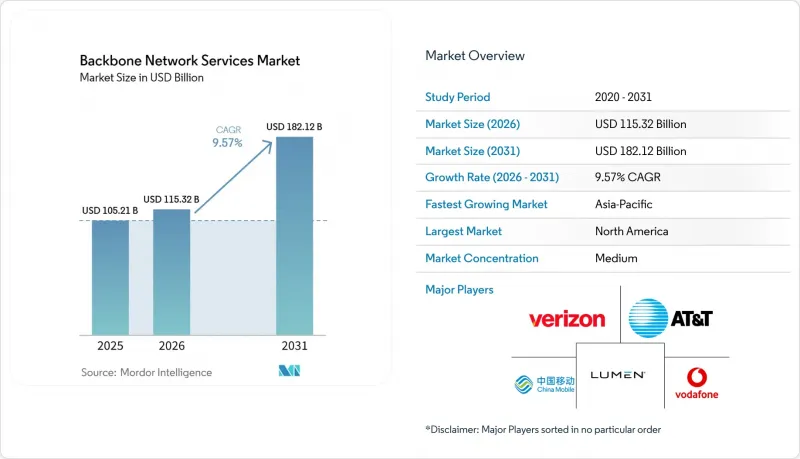
本報告按網路類型(有線、無線)、服務類型(網際網路骨幹網路、企業內部網路等)、連接模式(點對點、營運商間批發、波長管理等)、最終用戶(電信、企業、政府、教育、醫療保健等)和地區(北美、南美、歐洲等)進行細分。市場預測以美元計價。
全球骨幹網路服務市場趨勢及洞察
不斷成長的跨雲端和資料中心互連流量
在骨幹網路服務市場,跨雲端流量正逐漸成為驅動核心網路容量成長的主要動力,取代傳統的企業廣域網路需求。預計到2025年,全球網際網路頻寬將顯著成長,其中很大一部分流量將由與分散式人工智慧工作負載和廣泛採用的多重雲端環境相關的資料中心間和雲間通訊驅動。這種轉變迫使通訊業者縮短骨幹網路設計的更新周期,因為傳統的核心網路佈局是為了適應不同的流量模式而建造的。 2026年3月,中國行動發布了「GSE-DCI」解決方案,其路由器原型擁有115.2T的交換容量和144個800GE長途端口,展示了人工智慧傳輸需求如何快速融入商業骨幹網路規劃。因此,採用資料中心叢集中心路由的通訊業者比仍依賴傳統城際樞紐模式的營運商更具優勢。這種路由方式的轉變正在骨幹網路服務市場中催生一個更鮮明的優質層級,其核心在於容量密度、低延遲和快速擴展。
5G、物聯網和低延遲回程傳輸的擴展
骨幹網路服務市場也受益於5G回程傳輸、機器連接以及對延遲控制要求更高的服務的普及。新型5G小型基地台叢集需要可靠的路由連接到區域或國家骨幹網節點,這促使光纖網路更深入地滲透到以前僅依賴微波的地區。諾基亞為沃達豐Idea提供的2025年部署案例表明,通訊業者正在對其傳輸網路進行現代化改造,以建立更強大的IP/MPLS骨幹網,從而支援更高密度的4G和5G流量。物聯網流量又增加了一個新的層面,因為工業、農業和智慧城市等應用情境會產生非對稱流量,需要比典型消費者流量更嚴格的流量處理。這些營運現實迫使通訊業者在整個骨幹網路路由上更謹慎地設計服務質量,尤其是在針對包含專用5G元素的企業合約時。實際上,骨幹網路服務市場正受益於目前行動網路的高密度以及通訊業者正在規劃的下一步企業傳輸捆綁服務。
核心傳輸和光纖資產資本密集度高
巨額升級投資仍是骨幹網路服務市場最大的結構性阻力。 AT&T 預計 2025 年的資本支出將達到 220 億美元,並預測到 2028 年每年將達到 230 億至 240 億美元,這凸顯了即使是最大的通訊業者,同時擴展光纖和核心傳輸網路也需要耗資巨資。光元件、路由平台和較長的前置作業時間等因素越來越有利於大型買家,使得規模較小的區域性通訊業者難以跟上如此高的投資水準。因此,能夠快速更新路由的大型通訊業者與被迫延長資產使用壽命或推遲升級的小型營運商之間的差距正在擴大。一些通訊業者正在透過延長設備使用壽命或在新部署成本最低時尋求採購二手硬體來應對這一問題。然而,由於路由擴展、遷移到二手以及對客戶服務的承諾都需要同時投入資金,骨幹網路服務市場仍然光纖通訊脆弱。當向 400G 和 800G 過渡與新網路段的建設同時發生時,這種壓力尤其明顯。
細分市場分析
2025年,有線骨幹網路服務收入佔比高達71.23%,穩居骨幹網路服務市場基石地位。光纖仍然是高容量、低延遲城際傳輸的最佳選擇,尤其適用於流量密度和訊號穩定性至關重要的場景。此外,國內和跨境線路持續部署400G和800G波長也為該領域帶來了正面影響。諾基亞計畫在2025年將荷蘭KPN的國內骨幹網路升級至216Tbps以上,顯示通訊業者正在利用新型光纖系統實現規模化擴展,同時又不改變光纖的核心作用。在有線服務領域,VPN骨幹網路、內網骨幹網路和專用波長服務仍然是主要的收入來源,而暗纖租賃業務也越來越受到尋求增強路由管理的買家的關注。
儘管如此,無線骨幹網路服務預計到2031年將以11.32%的複合年成長率成長,成為市場中成長最快的細分領域。此成長動能源自於5G小型基地台回程傳輸、固定無線接入線路以及光纖全面部署中城際二級鏈路的部署速度低於預期或經濟效益不佳。 Seragon公司於2025年推出的IP-50EXP表明,毫米波系統正在縮小部分性能差距,在以前只能使用E波段的路由上,採用2+0配置即可實現高達20Gbps的傳輸速率。這進一步提高了混合骨幹網路設計的可行性,尤其是在新興市場,通訊業者希望在不犧牲服務品質的前提下降低部署成本。因此,骨幹網路服務市場正朝著更平衡的模式轉變,光纖仍然是核心,而無線回程傳輸在某些路由上成為更強大的輔助主備選擇。
到2025年,網際網路骨幹網路服務將佔據49.12%的市場佔有率,使其成為骨幹網路服務市場中最大的服務層級。這一地位反映了一級IP傳輸在為通訊業者、企業和數位平台傳輸全球網際網路流量方面持續發揮至關重要的作用。到2025年,GTT將成為全球第三大一級骨幹網,總網路容量超過700Terabit,顯示儘管每比特價格面臨壓力,但規模競爭依然激烈。企業和政府客戶需要流量隔離、維運管理以及普通傳輸無法提供的更強大的服務保障,因此,企業繼續提供內部網路骨幹網路服務。即使標準傳輸的利潤空間日益收窄,這種需求也維持了對加值服務的需求。
預計到2031年,VPN骨幹網路服務將以10.87%的複合年成長率成長,成為本研究中成長最快的服務類型。軟體定義廣域網路(SD-WAN)的普及性推動了這個細分市場的發展,因為許多企業仍需要在策略層和應用層進行下游骨幹網路傳輸的管理。 2026年1月,Lumen宣布,自2025年第三季以來,其網路即服務(NaaS)基本客群已擴展至2,000多家,這主要得益於以人工智慧驅動和多重雲端工作負載的可程式設計連接。這些變化正促使骨幹網路服務產業將VPN骨幹網路視為軟體編配的傳輸架構,而不僅僅是專用線路的傳統替代方案。 VPN服務的功能也不斷擴展,涵蓋了互連人工智慧訓練、支援即時推理以及其他對延遲和流量可預測性要求極高的工作負載。
區域分析
2025年,北美佔據骨幹網路服務市場佔有率的28.95%,持續維持其全球需求中心的地位。北美骨幹網路服務市場持續受益於超大規模資料中心業者中心園區、一級營運商網路以及企業連接投資的集中。 2026年,AT&T承諾在五年內投資2,500億美元用於基礎建設。這其中包括預計到2028年每年230億至240億美元的資本支出,以及2026年底每年新增400萬個光纖接入點的計畫。 Lumen也計劃在2026年開發其「NorthLine」線路,連接西雅圖和明尼阿波利斯,沿著北部資料中心走廊建設,用於傳輸人工智慧資料。這些投資表明,該地區的成長不僅僅是傳統批發業務的擴張,而是正在向人工智慧相關的長途走廊和專用連接基礎設施轉型。
由於龐大的企業流量、國家基礎設施建設的優先地位以及日益成長的合規要求,歐洲仍然是一個具有重要戰略意義的地區。歐洲骨幹網路服務市場正經歷重組,包括路由重組、強化國家彈性計畫以及快速向高容量光纖系統過渡。諾基亞計畫於2025年將KPN的傳輸和核心網路升級到支援800G的架構,實現超過216Tbps的容量,這體現了向更高密度、自動化基礎設施的轉型。 GEANT計劃於2026年2月遷移到800G IP骨幹網,也顯示了類似的趨勢,因為歐洲各地的科學研究和教育流量也需要大規模的容量。商業性需求和政策主導的容錯能力相結合,正在推動全部區域更有計劃的升級週期。
亞太地區骨幹網路服務市場預計到2031年將以11.33%的複合年成長率成長,成為成長最快的區域市場。這一成長率反映了中國、印度和東南亞地區大規模的網路擴張,這些地區的人工智慧叢集、雲端運算發展和5G網路擴張正在推動對更強大的國內和區域骨幹網路的需求。中國移動在香港的投資及其運算網路整合計畫顯示了該地區對雲端路由的預期需求規模。在印度,諾基亞與沃達豐Idea的合作部署凸顯了主要通訊業者如何加強IP/MPLS傳輸以應對更高密度的4G和5G流量。中東和非洲地區也透過路由多元化和新建的東西向海底光纜專案而日益重要,而南美洲地區則在人工智慧、雲端運算和近岸外包需求的驅動下,對長距離光纖專案的關注度不斷提高。這些趨勢共同導致骨幹網路服務市場在亞太地區持續快速擴張,而其他新興地區則正在發展以容錯和資料中心成長為中心的特定通道。
其他好處:
- Excel格式的市場預測(ME)表
- 3個月的分析師支持
目錄
第1章:引言
- 研究假設和市場定義
- 調查範圍
第2章:調查方法
第3章執行摘要
第4章 市場狀況
- 市場概覽
- 市場促進因素
- 跨雲端和跨資料中心連線流量增加
- 5G、物聯網和低延遲回程傳輸的擴展
- SDN、NFV 和自動化交通工程的實施
- 保障區域間通訊需求,包括抵禦 DDoS 攻擊的能力。
- 海底電纜鋪設和線路多樣化的要求
- 人工智慧驅動的網路最佳化和預測容量規劃
- 市場限制因素
- 核心交通和光纖資產屬於高資本密集產業。
- 跨境監管碎片化和數據主權限制
- 專用光纖通訊和路由設備供不應求
- 衛星路線的替代方案和特定交通等級的替代路線
- 供應鏈分析
- 監理情勢
- 技術展望
- 波特五力分析
第5章 市場規模與成長預測
- 依網路類型
- 有線骨幹網路服務
- 無線骨幹網路服務
- 按服務類型
- 網際網路骨幹網路服務
- 內網骨幹服務
- VPN骨幹服務
- 按連接模型
- 專用點對點連接
- 通訊業者間批發連接
- 託管波長服務
- 其他連接方式
- 按最終用途
- 電訊
- 公司
- 政府
- 教育
- 衛生保健
- 內容和數位平台
- 雲端服務供應商
- 按地區
- 北美洲
- 美國
- 加拿大
- 墨西哥
- 南美洲
- 巴西
- 阿根廷
- 其他南美國家
- 歐洲
- 德國
- 英國
- 法國
- 義大利
- 西班牙
- 俄羅斯
- 其他歐洲國家
- 亞太地區
- 中國
- 印度
- 日本
- 韓國
- 澳洲
- 其他亞太國家
- 中東
- 沙烏地阿拉伯
- 阿拉伯聯合大公國
- 以色列
- 土耳其
- 其他中東國家
- 非洲
- 南非
- 奈及利亞
- 其他非洲國家
- 北美洲
第6章 競爭情勢
- 市場集中度
- 策略趨勢
- 市佔率分析
- 公司簡介
- Verizon Communications Inc.
- AT&T Inc.
- China Mobile Limited
- Deutsche Telekom AG
- China Telecom Corporation Limited
- Bharti Airtel Limited
- British Telecommunications plc
- China Unicom(Hong Kong)Limited
- Tata Communications Limited
- Lumen Technologies, Inc.
- Cogent Communications Holdings, Inc.
- Vodafone Group Plc
- Orange SA
- NTT Communications Corporation
- Telstra Group Limited
- Arelion
- Equinix, Inc.
- Digital Realty Trust, Inc.
- GTT Communications, Inc.
- Colt Technology Services Group Limited
- KDDI Corporation
第7章 市場機會與未來展望
According to Mordor Intelligence, the backbone network services market size stood at USD 105.21 billion in 2025 and is forecast to reach USD 182.12 billion by 2031 at a CAGR of 9.57% over 2026-2031.
This report is Segmented by Network Type (Wired, and Wireless), Service Type (Internet Backbone, Intranet, and More), Connectivity Model (P2P, Carrier-To-Carrier Wholesale, Managed Wavelength, and More), End Use (Telecom, Enterprise, Government, Education, Healthcare, and More), and Geography (North America, South America, Europe, and More). The Market Forecasts are Provided in Terms of Value (USD).
Global Backbone Network Services Market Trends and Insights
Rising Cross-Cloud and Data Center Interconnect Traffic
Cross-cloud traffic is replacing traditional enterprise WAN demand as the primary driver of new core capacity in the backbone network services market. Global internet bandwidth grew significantly in 2025, and a larger share of that traffic came from inter-data-center and cloud-to-cloud flows tied to distributed AI workloads and broader multi-cloud use. That shift is pushing operators to shorten refresh cycles for backbone design because older core layouts were built for different traffic patterns. In March 2026, China Mobile presented its GSE-DCI solution, featuring a router prototype with 115.2T switching capacity and 144 long-haul 800GE ports, demonstrating how quickly AI transport needs are moving into commercial backbone planning. The practical result is that carriers with routes centered on data center clusters are better placed than operators still relying on older city-to-city hub patterns. That routing shift is giving the backbone network services market a clearer premium layer built around capacity density, low latency, and faster scaling.
5G, IoT, And Low-Latency Backhaul Expansion
The backbone network services market is also being lifted by the spread of 5G backhaul, machine connectivity, and services that require tighter latency control. Each new 5G small-cell cluster needs a dependable path to regional or national backbone nodes, which is forcing fiber deeper into areas that previously relied solely on microwave. Nokia's 2025 deployment for Vodafone Idea demonstrated how operators are modernizing transport networks to build a stronger IP/MPLS backbone to support denser 4G and 5G traffic. IoT traffic adds another layer, as industrial, agricultural, and smart-city use cases generate asymmetric flows that require stricter traffic handling than ordinary consumer traffic. That operating reality is pushing carriers to engineer service quality more carefully across backbone routes, especially when they target enterprise contracts with private 5G elements. In effect, the backbone network services market is gaining from mobile densification today and from enterprise transport bundling that carriers are positioning for next.
High Capital Intensity of Core Transport and Fiber Assets
High upgrade spending remains the largest structural brake on the backbone network services market. AT&T reported USD 22 billion in capital investment in 2025 and guided to USD 23 billion to USD 24 billion annually through 2028, underscoring how expensive concurrent fiber and core transport buildouts have become, even for the biggest operators. Those spending levels are harder for smaller regional carriers to match because optical components, routing platforms, and long lead times increasingly favor buyers with scale. The result is a wider gap between large carriers that can refresh routes quickly and smaller operators that must stretch asset life or delay upgrades. Some operators are responding by extending equipment life cycles and turning to secondary hardware channels when new-build pricing is least favorable. Even so, the backbone network services market remains exposed when route expansion, optical migration, and customer service commitments all demand capital simultaneously. This pressure is especially evident where 400G and 800G migrations overlap with new corridor builds.
Other drivers and restraints analyzed in the detailed report include:
- SDN, NFV, And Automated Traffic Engineering Adoption
- Secure Inter-Regional Transport Demand, Including DDoS Resilience
- Cross-Border Regulatory Fragmentation and Data Sovereignty Constraints
For complete list of drivers and restraints, kindly check the Table Of Contents.
Segment Analysis
Wired backbone network services commanded 71.23% of revenue in 2025, which kept this segment as the clear base of the backbone network services market. Fiber still offers the best fit for high-capacity, low-latency inter-city transport where traffic density and signal stability matter most. The segment also benefits from the continued deployment of 400G and 800G wavelengths on national and cross-border routes. Nokia's 2025 upgrade of KPN's Dutch backbone to more than 216Tbps showed how operators are using new optical systems to expand scale without changing the core role of fiber. Within wired services, VPN backbone, intranet backbone, and dedicated wavelength offerings remain the main revenue pillars, while dark fiber leasing is gaining traction among buyers seeking greater route control.
That said, wireless backbone network services are forecast to grow at a 11.32% CAGR through 2031, making it the fastest-growing segment of this market. Its momentum comes from 5G small-cell backhaul, fixed wireless access corridors, and secondary inter-city links where full fiber deployment is slower or less economical. Ceragon's IP-50EXP launch in 2025 demonstrated how millimeter-wave systems are closing part of the performance gap, reaching up to 20Gbps in a 2+0 configuration over routes that previously required exclusive E-band use. That strengthens the case for a mixed backbone design, especially in emerging markets where carriers want to lower deployment costs without sacrificing service quality. As a result, the backbone network services market is moving toward a more balanced model in which fiber remains central, while wireless backhaul becomes a stronger co-primary option on selected routes.
Internet backbone services held a 49.12% share in 2025, making this segment the largest service layer in the backbone network services market. That position reflects the continuing role of Tier 1 IP transit in carrying global internet traffic for carriers, enterprises, and digital platforms. GTT's recognition in 2025 as the world's third-largest global backbone by Tier 1 capacity, with more than 700 terabits across its network, showed that scale competition remains active despite pressure on price per bit. Intranet backbone services continue to serve enterprise and government buyers that need traffic separation, managed operations, and stronger service guarantees than commodity transit can provide. That keeps premium demand present even when standard transit margins remain tight.
VPN backbone services are expected to grow at a 10.87% CAGR through 2031, making it the fastest-growing service type in this review. The segment is benefiting from software-defined WAN adoption because many enterprises still need managed backbone transport beneath their policy and application layers. Lumen said in January 2026 that its Network-as-a-Service customer base had grown to more than 2,000 businesses since the third quarter of 2025, driven by programmable connectivity for AI-driven and multi-cloud workloads. That shift is pushing the backbone network services industry to treat VPN backbone less as a legacy substitute for leased lines and more as a software-orchestrated transport fabric. It also broadens the role of VPN services into AI training interconnect, real-time inference support, and other workloads where latency and traffic predictability remain critical.
Complete Report Scope:
- By Network Type
- Wired Backbone Network Services
- Wireless Backbone Network Services
- By Service Type
- Internet Backbone Services
- Intranet Backbone Services
- VPN Backbone Services
- By Connectivity Model
- Dedicated Point-to-Point Connectivity
- Carrier-to-Carrier Wholesale Connectivity
- Managed Wavelength Services
- Other Connectivity Model
- By End Use
- Telecommunication
- Enterprise
- Government
- Education
- Healthcare
- Content and Digital Platforms
- Cloud Service Providers
- By Geography
- North America
- United States
- Canada
- Mexico
- South America
- Brazil
- Argentina
- Rest of South America
- Europe
- Germany
- United Kingdom
- France
- Italy
- Spain
- Russia
- Rest of Europe
- Asia-Pacific
- China
- India
- Japan
- South Korea
- Australia
- Rest of Asia-Pacific
- Middle East
- Saudi Arabia
- United Arab Emirates
- Israel
- Turkey
- Rest of Middle East
- Africa
- South Africa
- Nigeria
- Rest of Africa
- North America
Geography Analysis
North America held 28.95% of the backbone network services market share in 2025, which kept the region as the anchor of global demand. The backbone network services market in North America continues to benefit from a dense base of hyperscaler campuses, Tier 1 carrier networks, and enterprise connectivity spending. AT&T announced a USD 250 billion five-year infrastructure commitment in 2026, with annual capital expenditure guidance of USD 23 billion to USD 24 billion through 2028 and a fiber deployment run rate targeting 4 million new locations per year by the end of 2026. Lumen also advanced its NorthLine route in 2026 to connect Seattle and Minneapolis along northern data center corridors built for AI data movement. These investments show that regional growth is moving toward AI-linked long-haul corridors and private connectivity fabrics rather than solely toward standard wholesale expansion.
Europe remains strategically important because the region combines heavy enterprise traffic, sovereign infrastructure priorities, and rising compliance demands. The backbone network services market in Europe is being reshaped by route realignment, stronger domestic resilience planning, and faster migration toward high-capacity optical systems. Nokia's 2025 upgrade of KPN's transport and core network to an 800G-ready architecture, with more than 216Tbps of capacity, reflected this move toward denser, more automated infrastructure. GEANT's 800G IP backbone migration in February 2026 pointed in the same direction, as research and education traffic also required a much larger capacity base across Europe. This combination of commercial demand and policy-led resilience is supporting a more disciplined upgrade cycle across the region.
The Asia Pacific backbone network services market is projected to expand at a 11.33% CAGR through 2031, making it the fastest-growing geographic segment. The region's pace reflects major buildouts across China, India, and Southeast Asia, where AI clusters, cloud growth, and 5G expansion are increasing demand for stronger national and regional backbones. China Mobile's Hong Kong investment and computing-network integration plans signaled the scale at which cloud-linked routing demand is now being planned in the region. In India, Nokia's deployment for Vodafone Idea showed how large operators are strengthening IP/MPLS transport to support denser 4G and 5G traffic. The Middle East and Africa are also gaining importance through route diversification and new east-west cable projects, while South America is attracting attention from long-haul fiber projects tied to AI, cloud, and nearshoring demand. Together, these patterns keep the backbone network services market tilted toward Asia Pacific for the fastest expansion, while other emerging regions build selective corridors around resilience and data center growth.
- Verizon Communications Inc.
- AT&T Inc.
- China Mobile Limited
- Deutsche Telekom AG
- China Telecom Corporation Limited
- Bharti Airtel Limited
- British Telecommunications plc
- China Unicom (Hong Kong) Limited
- Tata Communications Limited
- Lumen Technologies, Inc.
- Cogent Communications Holdings, Inc.
- Vodafone Group Plc
- Orange S.A.
- NTT Communications Corporation
- Telstra Group Limited
- Arelion
- Equinix, Inc.
- Digital Realty Trust, Inc.
- GTT Communications, Inc.
- Colt Technology Services Group Limited
- KDDI Corporation
Additional Benefits:
- The market estimate (ME) sheet in Excel format
- 3 months of analyst support
TABLE OF CONTENTS
1 INTRODUCTION
- 1.1 Study Assumptions and Market Definition
- 1.2 Scope of the Study
2 RESEARCH METHODOLOGY
3 EXECUTIVE SUMMARY
4 MARKET LANDSCAPE
- 4.1 Market Overview
- 4.2 Market Drivers
- 4.2.1 Rising Cross-Cloud and Data Center Interconnect Traffic
- 4.2.2 5G, IoT, and Low-Latency Backhaul Expansion
- 4.2.3 SDN, NFV, and Automated Traffic Engineering Adoption
- 4.2.4 Secure Inter-Regional Transport Demand, Including DDoS Resilience
- 4.2.5 Subsea Cable Buildouts and Route Diversity Requirements
- 4.2.6 AI-Driven Network Optimization and Predictive Capacity Planning
- 4.3 Market Restraints
- 4.3.1 High Capital Intensity of Core Transport and Fiber Assets
- 4.3.2 Cross-Border Regulatory Fragmentation and Data Sovereignty Constraints
- 4.3.3 Scarcity of Specialized Optical and Routing Equipment Supply
- 4.3.4 Satellite and Alternative Path Substitution for Certain Traffic Classes
- 4.4 Supply Chain Analysis
- 4.5 Regulatory Landscape
- 4.6 Technological Outlook
- 4.7 Porter's Five Forces Analysis
- 4.7.1 Bargaining Power of Suppliers
- 4.7.2 Bargaining Power of Buyers
- 4.7.3 Threat of New Entrants
- 4.7.4 Threat of Substitutes
- 4.7.5 Industry Rivalry
5 MARKET SIZE AND GROWTH FORECASTS (VALUE)
- 5.1 By Network Type
- 5.1.1 Wired Backbone Network Services
- 5.1.2 Wireless Backbone Network Services
- 5.2 By Service Type
- 5.2.1 Internet Backbone Services
- 5.2.2 Intranet Backbone Services
- 5.2.3 VPN Backbone Services
- 5.3 By Connectivity Model
- 5.3.1 Dedicated Point-to-Point Connectivity
- 5.3.2 Carrier-to-Carrier Wholesale Connectivity
- 5.3.3 Managed Wavelength Services
- 5.3.4 Other Connectivity Model
- 5.4 By End Use
- 5.4.1 Telecommunication
- 5.4.2 Enterprise
- 5.4.3 Government
- 5.4.4 Education
- 5.4.5 Healthcare
- 5.4.6 Content and Digital Platforms
- 5.4.7 Cloud Service Providers
- 5.5 By Geography
- 5.5.1 North America
- 5.5.1.1 United States
- 5.5.1.2 Canada
- 5.5.1.3 Mexico
- 5.5.2 South America
- 5.5.2.1 Brazil
- 5.5.2.2 Argentina
- 5.5.2.3 Rest of South America
- 5.5.3 Europe
- 5.5.3.1 Germany
- 5.5.3.2 United Kingdom
- 5.5.3.3 France
- 5.5.3.4 Italy
- 5.5.3.5 Spain
- 5.5.3.6 Russia
- 5.5.3.7 Rest of Europe
- 5.5.4 Asia-Pacific
- 5.5.4.1 China
- 5.5.4.2 India
- 5.5.4.3 Japan
- 5.5.4.4 South Korea
- 5.5.4.5 Australia
- 5.5.4.6 Rest of Asia-Pacific
- 5.5.5 Middle East
- 5.5.5.1 Saudi Arabia
- 5.5.5.2 United Arab Emirates
- 5.5.5.3 Israel
- 5.5.5.4 Turkey
- 5.5.5.5 Rest of Middle East
- 5.5.6 Africa
- 5.5.6.1 South Africa
- 5.5.6.2 Nigeria
- 5.5.6.3 Rest of Africa
- 5.5.1 North America
6 COMPETITIVE LANDSCAPE
- 6.1 Market Concentration
- 6.2 Strategic Moves
- 6.3 Market Share Analysis
- 6.4 Company Profiles (includes Global Level Overview, Market Level Overview, Core Segments, Financials as available, Strategic Information, Market Rank/Share, Products and Services, Recent Developments)
- 6.4.1 Verizon Communications Inc.
- 6.4.2 AT&T Inc.
- 6.4.3 China Mobile Limited
- 6.4.4 Deutsche Telekom AG
- 6.4.5 China Telecom Corporation Limited
- 6.4.6 Bharti Airtel Limited
- 6.4.7 British Telecommunications plc
- 6.4.8 China Unicom (Hong Kong) Limited
- 6.4.9 Tata Communications Limited
- 6.4.10 Lumen Technologies, Inc.
- 6.4.11 Cogent Communications Holdings, Inc.
- 6.4.12 Vodafone Group Plc
- 6.4.13 Orange S.A.
- 6.4.14 NTT Communications Corporation
- 6.4.15 Telstra Group Limited
- 6.4.16 Arelion
- 6.4.17 Equinix, Inc.
- 6.4.18 Digital Realty Trust, Inc.
- 6.4.19 GTT Communications, Inc.
- 6.4.20 Colt Technology Services Group Limited
- 6.4.21 KDDI Corporation
7 MARKET OPPORTUNITIES AND FUTURE OUTLOOK
- 7.1 White Space and Unmet Need Assessment
- 7.1.1 Hyperscale-to-Edge Backbone Orchestration
- 7.1.2 Sovereign Regional Transport Corridors
- 7.1.3 AI-Aware Capacity Reservation and Traffic Forecasting
- 7.1.4 Carrier-Neutral Interconnect Expansion in Secondary Cities
- 7.1.5 Secure Backbone for Critical Infrastructure and Public Sector Networks

 託管網路服務市場-2026-2032年全球市場預測
 骨幹網路服務市場:按網路類型、網路拓撲、服務類型、最終用戶產業、資料速度/容量、網路供應商和地區分類
 託管式區域網路/廣域網路服務市場預測至2034年-按服務類型、部署類型、組織規模、最終用戶和地區分類的全球分析
 全球託管網路服務市場規模、佔有率、趨勢和成長分析報告(2026-2034年)
 2026年全球託管網路服務市場報告
 託管網路服務市場分析及預測(至 2035 年):按類型、產品類型、服務、技術、組件、應用、部署類型、最終用戶和解決方案分類
 託管網路服務市場規模、佔有率和成長分析(按類型、託管網路安全、垂直產業和地區分類)-2026-2033年產業預測
 託管網路服務市場-全球產業規模、佔有率、趨勢、機會及預測(按類型、組織規模(中小企業和大型企業)、最終用戶、地區和競爭格局分類,2020-2030 年預測)
 全球託管網路服務市場(至2030年)按類型(託管區域網路、託管Wi-Fi、託管廣域網路、託管VPN、網路監控、託管NFV、託管網路安全)、產業(銀行、金融服務和保險、IT與通訊、製造業)和地區分類
 網路營運中心(NOC)即服務市場機會、成長促進因素、產業趨勢分析及預測(2025-2034年)