

 |
市場調查報告書
商品編碼
2099394
北美現場作業人員技術:市場佔有率分析、產業趨勢與統計及成長預測(2026-2031 年)North America Frontline Worker Technology - Market Share Analysis, Industry Trends & Statistics, Growth Forecasts (2026 - 2031) |
||||||

※ 本網頁內容可能與最新版本有所差異。詳細情況請與我們聯繫。
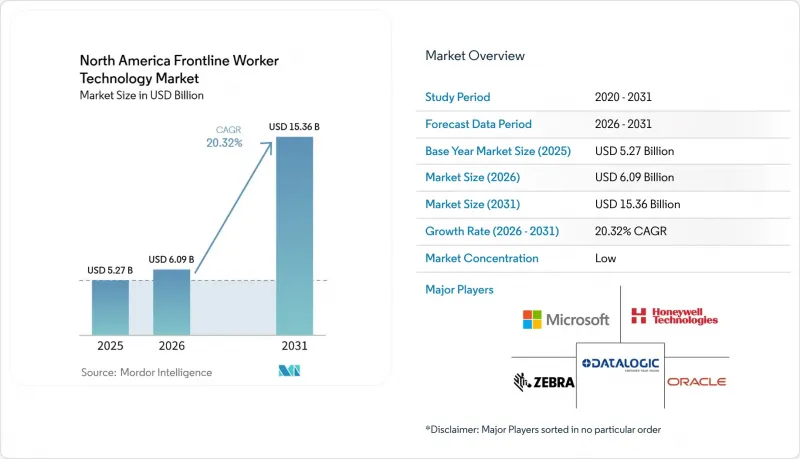
根據 Mordor Intelligence 預測,北美現場作業人員技術市場規模將從 2025 年的 52.7 億美元和 2026 年的 60.9 億美元成長到 2031 年的 153.6 億美元,2026 年至 2031 年的年複合成長率(CAGR)為 20.32%。
本報告按組件(軟體和服務)、部署方式(雲端、混合、本地部署)、組織規模(大型企業和中小企業)、應用領域(學習和知識利用等)、最終用戶行業(零售和電子商務、酒店等)以及地區進行細分。市場預測以美元計價。
北美現場作業人員技術市場趨勢及洞察。
受監管營運中合規相關數位化工作流程的增加
在北美現場工作人員技術市場,合規要求正從單純的背景條件轉變為直接的採購驅動力。對電子記錄管理的需求迫使雇主在現場收集安全和工作流程數據,而不是依賴延遲的人工報告。此外,美國國家勞工關係委員會 (NLRB) 關於電子監控的指導意見提高了組織記錄和證明員工監控合理性的標準,促進了可審計工作流程平台的使用,而非非正式的追蹤工具。這正在改變供應商的選擇標準,因為內建的管治控制與現場易用性同等重要。在製藥和醫療保健行業,預先配置的審計追蹤的重要性日益凸顯。買家要求系統在合規審計期間易於檢驗和證明其合理性。記錄和證明合規主導的快速採購週期的能力也在推動北美現場工作人員技術市場的發展,因為與可自由支配的軟體支出相比,這些項目不太可能被延誤。
輪班工作和現場作業人手不足
勞動力短缺仍然是北美現場作業人員技術市場的主要成長要素,因為許多採用輪班制的雇主仍然難以獲得足夠的員工。 2025年第一季,卡車運輸業的薪資年增16%,倉儲業的薪資較去年同期成長15%,凸顯了現場勞動力競爭的加劇。在運輸、物流和汽車產業,74%的美國雇主表示到2025年將面臨人才短缺問題,凸顯了利用數位化工具提高生產力而非僅僅逐步增加員工人數的迫切需求。製造業也面臨類似的挑戰,近75%的製造業企業表示缺乏熟練人員而難以招募。因此,企業正在採用數位化工單、任務路由和分析工具,以直接提高北美現場作業人員技術市場的勞動生產力。此外,由於雇主需要新進員工更快投入工作,入職培訓的時間也正在縮短。
碎片化的舊有系統會減緩企業採用新技術的速度。
舊有系統碎片化持續阻礙北美現場作業人員技術市場的發展,尤其是在複雜的工業環境中。許多公司仍在運行ERP系統、製造執行系統(MES)、SCADA平台、無線工具和紙本工作流程,這些系統並非為便利的資料共用設計。因此,測試週期延長,整合負擔加重,在部署到生產環境之前,對專家顧問的依賴也隨之增強。這個問題在公共產業和製藥行業更為嚴重,因為工作流程的變更通常需要經過書面檢驗才能獲得實際應用的批准。研究引述Gartner的觀點,指出「整合複雜性」是商用採用人工智慧的最大障礙,這一趨勢在整個現場技術應用領域普遍存在。簡而言之,即使是一些數位化程度最高的公司,在北美現場作業人員技術市場仍然落後。這是因為舊有系統基礎越深,依賴關係就越多,而不是越少。
細分市場分析
預計到2025年,北美現場作業人員技術市場中,軟體將佔組件類產品的80.21%,反映出自疫情以來,企業平台採用規模的快速成長。服務領域的成長率預計將更高,2026年至2031年的複合年成長率將達到26.72%。這一轉變表明,買家更加關注成功的實施,而非僅僅購買基礎許可。因此,北美現場作業人員技術市場對整合、培訓、託管支援和實施服務的需求日益成長。這種需求與將現場平台連接到ERP、MES和營運技術(OT)環境的複雜性直接相關。
早期採用者通常會嘗試利用內部 IT 資源管理部署,但許多組織隨後轉而依賴供應商和合作夥伴提供更結構化的部署支援。隨著企業尋求減少延遲和提升部署效果,這一趨勢正在推動業務收益的成長。基於結果的合約也在促進服務結構化,因為一些買家現在不僅根據用戶數量支付訂閱費,還根據更高的運作、更完善的入職流程或達到的生產力目標付費。麥肯錫 2026 年 1 月的一份報告指出,領先的營運公司每在技術上投入 2 美元,就會有 3 美元用於流程現代化,5 美元用於擴展和加速部署。這表明部署的成功在很大程度上取決於實施支援。因此,北美現場工作人員技術產業正逐步轉向一種新的收入結構,在這種結構中,部署能力與軟體的廣度同等重要。
到2025年,基於雲端的部署將佔北美現場工作人員技術市場78.05%的佔有率,預計到2031年,此模式將以25.58%的複合年成長率成長。如此龐大的規模和成長速度表明,企業目前對集中式平台的青睞程度非常高。雲端基礎架構支援自動更新、多站點視覺性、集中式設備管理以及更便捷地跨分散式員工進行資料聚合。這些優勢在北美現場工作人員技術市場尤其重要,因為許多雇主需要管理分佈在門市、倉庫、工廠和服務點的大規模現場工作人員。此外,雲端基礎設施還支援人工智慧驅動的應用場景的激增,這些場景需要存取共用資料和模型。
然而,現場作業並非完全依賴雲端連線。在工作場所、裝卸碼頭、堆場和偏遠地區,連接中斷仍然頻繁發生,這意味著許多工作環境仍然需要邊緣處理和本地快取。支援「離線優先」效能並與雲端後端同步的供應商能夠更好地應對這些挑戰。混合模式部署和本地部署模式在醫療保健、製藥和政府部門仍然至關重要,因為這些部門對資料居住和檢驗的要求仍然嚴格。因此,北美現場作業技術產業正在將邊緣運算功能整合到雲端管理架構中,而不是放棄它們。
其他好處:
- Excel格式的市場預測(ME)表
- 3個月的分析師支持
目錄
第1章:引言
- 研究假設和市場定義
- 調查範圍
第2章:調查方法
第3章執行摘要
第4章 市場狀況
- 市場概覽
- 市場促進因素
- 受監管營運中合規相關數位化工作流程的增加
- 輪班工作和現場作業人手不足
- 為了提高投資報酬率,需要減少停機時間並快速完成任務。
- 擴大人工智慧驅動的工作指令在現場的應用。
- 堅固耐用的穿戴式設備和行動優先的企業應用的普及。
- 從資深員工即時獲取知識的需求日益成長。
- 市場限制因素
- 碎片化的舊有系統正在減緩企業採用新技術的速度。
- 工作場所中對改變的疲勞和對實施的抗拒情緒
- 設備的衛生、耐用性和支撐結構的複雜性。
- 對資料隱私和員工監控的擔憂
- 產業價值鏈分析
- 監理情勢
- 技術展望
- 宏觀經濟因素對市場的影響
- 波特五力分析
第5章 市場規模與成長預測
- 按組件
- 軟體
- 服務
- 不同的發展
- 基於雲端的
- 混合
- 現場
- 按組織規模
- 大公司
- 小型企業
- 透過使用
- 員工溝通與參與
- 勞動力執行與任務管理
- 人員排班和協調
- 學習與知識應用
- 勞動分析與績效管理
- 安全與合規管理
- 其他用途
- 按最終用戶行業分類
- 零售與電子商務
- 工業製造
- 醫療保健和生命科學
- 運輸/物流
- 飯店業
- 建造
- 政府/公共行政
- 其他終端用戶產業
- 按地區
- 美國
- 加拿大
- 墨西哥
第6章 競爭情勢
- 市場集中度
- 策略趨勢
- 市佔率分析
- 公司簡介
- Zebra Technologies Corporation
- Honeywell International Inc.
- Microsoft Corporation
- ServiceNow, Inc.
- SAP SE
- Oracle Corporation
- WorkJam, Inc.
- Beekeeper AG
- TeamViewer SE
- RealWear, Inc.
- Vuzix Corporation
- ProGlove GmbH
- Datalogic SpA
- Panasonic Holdings Corporation
- Motorola Solutions, Inc.
- AWS, Inc.
- Logility Supply Chain Solutions, Inc.
- Samsara Inc.
- Augmentir, Inc.
- Frontline Education, Inc.
第7章 市場機會與未來展望
According to Mordor Intelligence, the North America frontline worker technology market size is projected to expand from USD 5.27 billion in 2025 and USD 6.09 billion in 2026 to USD 15.36 billion by 2031, registering a CAGR of 20.32% between 2026 and 2031.
This report is Segmented by Component (Software, and Services), Deployment (Cloud-Based, Hybrid, and On-Premises), Organization Size (Large Enterprises, and Small and Medium Enterprises), Application (Learning and Knowledge Enablement, and More), End-User Industry (Retail and E-Commerce, Hospitality, and More), and Geography. The Market Forecasts are Provided in Terms of Value (USD).
North America Frontline Worker Technology Market Trends and Insights
Rising Compliance-Linked Digital Workflows in Regulated Operations
Compliance requirements have moved from a background condition to a direct purchase trigger in the North America frontline worker technology market. Electronic recordkeeping needs are pushing employers to capture safety and workflow data at the point of work rather than rely on delayed manual reporting. The NLRB guidance on electronic surveillance has also raised the standard for how organizations document and justify worker monitoring, encouraging the use of auditable workflow platforms rather than informal tracking tools. This is changing vendor selection because built-in governance controls now matter as much as frontline usability. In pharmaceutical manufacturing and healthcare, pre-configured audit trails are becoming more important. Buyers want systems that are easier to validate and defend during compliance reviews. Documenting and justifying faster compliance-led buying cycles are also helping the North America frontline worker technology market, as these projects are less likely to be delayed than discretionary software spending.
Labor Scarcity Across Shift-Based and Field Operations
Labor scarcity remains a core growth driver for the North America frontline worker technology market, as many shift-based employers still struggle to fill operational roles. Trucking wages rose 16%, and warehousing pay increased 15% year over year in Q1 2025, underscoring how intense the competition for frontline labor had become. In transportation, logistics, and automotive, 74% of US employers reported difficulty filling roles in 2025, reinforcing the pressure to improve output with digital tools rather than incremental hiring. Manufacturing sites faced the same issue, with nearly 75% reporting difficulty hiring due to a shortage of skilled candidates. As a result, companies are buying digital work instructions, task routing, and analytics tools as direct labor productivity solutions in the North America frontline worker technology market. That same pressure is also shortening onboarding expectations because employers need new hires to become effective faster.
Fragmented Legacy Systems Slow Enterprise Rollouts
Legacy system fragmentation continues to slow the North America frontline worker technology market, especially in complex industrial settings. Many enterprises still operate with ERP systems, manufacturing execution systems, SCADA platforms, radio tools, and paper workflows that were never designed to easily share data. That creates longer testing cycles, heavier integration work, and added dependence on specialized consultants before a rollout can move into production. The issue is more severe in utilities and pharmaceutical operations because workflow changes often need documented validation before they can be approved for live use. Gartner was cited in the input as identifying integration complexity as the top barrier to operational AI deployment, which supports the same pattern seen across frontline rollouts. This means some of the most digitally invested enterprises still move slowly in the North America frontline worker technology market because deeper legacy estates create more dependencies, not fewer.
Other drivers and restraints analyzed in the detailed report include:
- ROI Pressure on Reduced Downtime and Faster Task Completion
- Expansion of AI-Guided Work Instructions at the Point of Use
- Frontline Change Fatigue and Adoption Resistance
For complete list of drivers and restraints, kindly check the Table Of Contents.
Segment Analysis
Software held 80.21% of the North America frontline worker technology market share in 2025 within the component mix, reflecting how quickly enterprises expanded platform deployments after the pandemic. Services are forecast to record the faster growth rate at a 26.72% CAGR through 2026-2031. This shift shows that buyers are moving beyond basic license purchases and paying more attention to implementation success. The North America frontline worker technology market is therefore seeing stronger demand for integration, training, managed support, and deployment services. That demand is directly tied to the complexity of connecting frontline platforms to ERP, MES, and operational technology environments.
Earlier adopters often tried to manage deployments with internal IT resources, but many organizations later returned to vendors and partners for structured rollout support. That pattern is increasing service revenue because enterprises want fewer delays and better adoption outcomes. Outcome-based contracting also supports the services mix because some buyers now pay for uptime gains, onboarding improvements, or productivity targets rather than only per-seat subscriptions. McKinsey reported in January 2026 that leading operations companies invested USD 3 in process revamping and USD 5 in scaling and adoption for every USD 2 spent on technology, which shows how heavily successful deployments depend on execution support. As a result, the North America frontline worker technology industry is gradually moving toward a revenue mix where deployment capability matters almost as much as software breadth.
Cloud-based deployment accounted for 78.05% of the North America frontline worker technology market size in 2025, and the same model is projected to expand at a 25.58% CAGR through 2031. This combination of scale and growth shows how strongly enterprises now prefer centrally managed platforms. Cloud infrastructure supports automatic updates, multi-site visibility, centralized device management, and easier data aggregation across distributed workforces. Those benefits are especially important in the North America frontline worker technology market because many employers need to manage large frontline populations across stores, warehouses, plants, and service sites. It also supports the spread of AI-enabled use cases that need shared data and model access.
Even so, frontline execution does not depend solely on cloud connectivity. Many work environments still need edge processing and local caching because connectivity gaps remain common on shop floors, docks, yards, and remote sites. Vendors that support offline-first performance while synchronizing with cloud back ends are better placed to serve these conditions. Hybrid and on-premises models remain relevant in healthcare, pharmaceuticals, and government settings, where data residency and validation requirements remain high. The North America frontline worker technology industry is therefore not moving away from edge capabilities, but is organizing them around a cloud-managed architecture.
Complete Report Scope:
- By Component
- Software
- Services
- By Deployment
- Cloud-Based
- Hybrid
- On-Premises
- By Organization Size
- Large Enterprises
- Small and Medium Enterprises
- By Application
- Employee Communication and Engagement
- Workforce Execution and Task Management
- Workforce Scheduling and Coordination
- Learning and Knowledge Enablement
- Workforce Analytics and Performance Management
- Safety and Compliance Management
- Other Applications
- By End-User Industry
- Retail and E-Commerce
- Industrial Manufacturing
- Healthcare and Life Sciences
- Transportation and Logistics
- Hospitality
- Construction
- Government and Public Administration
- Other End-User Industries
- By Geography
- United States
- Canada
- Mexico
List of Companies Covered in this Report:
- Zebra Technologies Corporation
- Honeywell International Inc.
- Microsoft Corporation
- ServiceNow, Inc.
- SAP SE
- Oracle Corporation
- WorkJam, Inc.
- Beekeeper AG
- TeamViewer SE
- RealWear, Inc.
- Vuzix Corporation
- ProGlove GmbH
- Datalogic S.p.A.
- Panasonic Holdings Corporation
- Motorola Solutions, Inc.
- AWS, Inc.
- Logility Supply Chain Solutions, Inc.
- Samsara Inc.
- Augmentir, Inc.
- Frontline Education, Inc.
Additional Benefits:
- The market estimate (ME) sheet in Excel format
- 3 months of analyst support
TABLE OF CONTENTS
1 INTRODUCTION
- 1.1 Study Assumptions and Market Definition
- 1.2 Scope of the Study
2 RESEARCH METHODOLOGY
3 EXECUTIVE SUMMARY
4 MARKET LANDSCAPE
- 4.1 Market Overview
- 4.2 Market Drivers
- 4.2.1 Rising Compliance-Linked Digital Workflows in Regulated Operations
- 4.2.2 Labor Scarcity Across Shift-Based and Field Operations
- 4.2.3 ROI Pressure on Reduced Downtime and Faster Task Completion
- 4.2.4 Expansion of AI-Guided Work Instructions at the Point of Use
- 4.2.5 Proliferation of Ruggedized Wearables and Mobile-First Enterprise Apps
- 4.2.6 Growing Demand for Real-Time Knowledge Capture from Senior Workers
- 4.3 Market Restraints
- 4.3.1 Fragmented Legacy Systems Slow Enterprise Rollouts
- 4.3.2 Frontline Change Fatigue and Adoption Resistance
- 4.3.3 Device Hygiene, Durability, and Support Complexity
- 4.3.4 Data Privacy and Worker Monitoring Concerns
- 4.4 Industry Value Chain Analysis
- 4.5 Regulatory Landscape
- 4.6 Technological Outlook
- 4.7 Impact of Macroeconomic Factors on the Market
- 4.8 Porter's Five Forces Analysis
- 4.8.1 Threat of New Entrants
- 4.8.2 Bargaining Power of Suppliers
- 4.8.3 Bargaining Power of Buyers
- 4.8.4 Threat of Substitutes
- 4.8.5 Competitive Rivalry
5 MARKET SIZE AND GROWTH FORECASTS (VALUE)
- 5.1 By Component
- 5.1.1 Software
- 5.1.2 Services
- 5.2 By Deployment
- 5.2.1 Cloud-Based
- 5.2.2 Hybrid
- 5.2.3 On-Premises
- 5.3 By Organization Size
- 5.3.1 Large Enterprises
- 5.3.2 Small and Medium Enterprises
- 5.4 By Application
- 5.4.1 Employee Communication and Engagement
- 5.4.2 Workforce Execution and Task Management
- 5.4.3 Workforce Scheduling and Coordination
- 5.4.4 Learning and Knowledge Enablement
- 5.4.5 Workforce Analytics and Performance Management
- 5.4.6 Safety and Compliance Management
- 5.4.7 Other Applications
- 5.5 By End-User Industry
- 5.5.1 Retail and E-Commerce
- 5.5.2 Industrial Manufacturing
- 5.5.3 Healthcare and Life Sciences
- 5.5.4 Transportation and Logistics
- 5.5.5 Hospitality
- 5.5.6 Construction
- 5.5.7 Government and Public Administration
- 5.5.8 Other End-User Industries
- 5.6 By Geography
- 5.6.1 United States
- 5.6.2 Canada
- 5.6.3 Mexico
6 COMPETITIVE LANDSCAPE
- 6.1 Market Concentration
- 6.2 Strategic Moves
- 6.3 Market Share Analysis
- 6.4 Company Profiles (includes Global Level Overview, Market Level Overview, Core Segments, Financials as available, Strategic Information, Market Rank/Share, Products and Services, Recent Developments)
- 6.4.1 Zebra Technologies Corporation
- 6.4.2 Honeywell International Inc.
- 6.4.3 Microsoft Corporation
- 6.4.4 ServiceNow, Inc.
- 6.4.5 SAP SE
- 6.4.6 Oracle Corporation
- 6.4.7 WorkJam, Inc.
- 6.4.8 Beekeeper AG
- 6.4.9 TeamViewer SE
- 6.4.10 RealWear, Inc.
- 6.4.11 Vuzix Corporation
- 6.4.12 ProGlove GmbH
- 6.4.13 Datalogic S.p.A.
- 6.4.14 Panasonic Holdings Corporation
- 6.4.15 Motorola Solutions, Inc.
- 6.4.16 AWS, Inc.
- 6.4.17 Logility Supply Chain Solutions, Inc.
- 6.4.18 Samsara Inc.
- 6.4.19 Augmentir, Inc.
- 6.4.20 Frontline Education, Inc.
7 MARKET OPPORTUNITIES AND FUTURE OUTLOOK
- 7.1 White-Space and Unmet-Need Assessment

 中國現場作業人員技術:市場佔有率分析、產業趨勢與統計及成長預測(2026-2031)印度現場工作人員技術:市場佔有率分析、產業趨勢與統計及成長預測(2026-2031 年)日本現場工作人員技術:市場佔有率分析、產業趨勢與統計及成長預測(2026-2031)法國田間作業人員技術:市場佔有率分析、產業趨勢與統計及成長預測(2026-2031 年)
 雲端解決方案市場:按服務模式、組織規模、部署模式、應用程式和產業分類-2026-2032年全球市場預測亞太地區現場工作人員技術:市場佔有率分析、產業趨勢與統計及成長預測(2026-2031 年)南美洲現場工作人員技術:市場佔有率分析、行業趨勢和統計數據以及成長預測(2026-2031 年)德國現場工作人員技術:市場佔有率分析、產業趨勢與統計及成長預測(2026-2031 年)東協地區現場工作人員技術:市場佔有率分析、產業趨勢與統計及成長預測(2026-2031 年)現場作業人員技術:市場佔有率分析、產業趨勢與統計及成長預測(2026-2031 年)