


 |
市場調查報告書
商品編碼
2099398
亞太地區現場工作人員技術:市場佔有率分析、產業趨勢與統計及成長預測(2026-2031 年)Asia-Pacific Frontline Worker Technology - Market Share Analysis, Industry Trends & Statistics, Growth Forecasts (2026 - 2031) |
||||||

※ 本網頁內容可能與最新版本有所差異。詳細情況請與我們聯繫。
根據 Mordor Intelligence 預測,亞太地區現場工作人員技術市場規模將從 2025 年的 33.6 億美元成長到 2026 年的 40.2 億美元,然後在 2031 年達到 125.9 億美元,2026 年至 2031 年的複合年成長率為 25.63%。
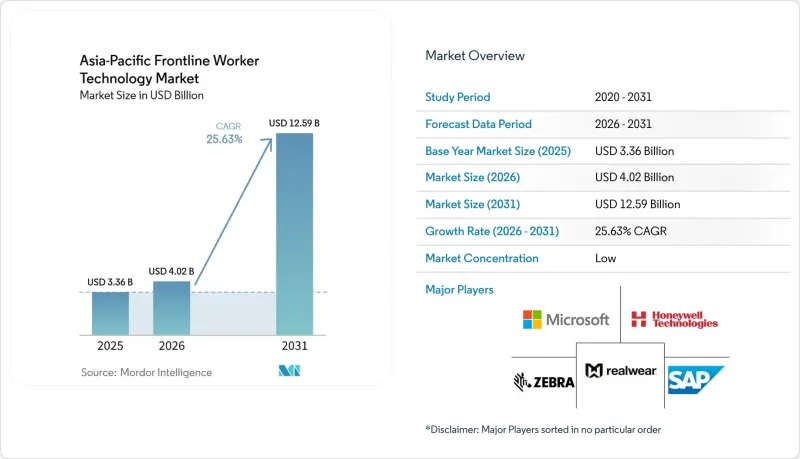
本報告按元件(軟體和服務)、部署方式(雲端、混合和本地部署)、組織規模(大型企業和中小企業)、應用領域(例如,勞動力分析和績效管理)、最終用戶行業(例如,零售和電子商務)以及地區進行細分。市場預測以美元計價。
亞太地區現場工作人員技術市場的趨勢與洞察。
受監管工作場所的安全文件記錄要求有所提高
在全部區域,安全文件正逐漸成為受監管工作場所的核心營運要求,推動亞太地區現場工作人員技術市場向更廣泛的數位轉型。由於合規記錄要求及時性、搜尋和易於檢驗,維護紙本現場工作流程變得越來越困難。用於安全檢查的行動介面還可以處理交接、檢查清單和事故記錄,從而將技術的應用範圍擴展到合規功能之外。這些趨勢推動了對能夠輕鬆部署到分散的工作人員群體和多個班次的平台的需求。此外,缺乏無縫的系統整合會在報告和課責方面造成不必要的漏洞,進一步凸顯了整合通訊和工作流程工具的重要性。新加坡的《職場安全框架》體現了這一監管方向,推動了向更結構化的現場風險管理工作流程的轉變。
勞動力短缺導致企業越來越依賴工作流程自動化。
持續的勞動力短缺為亞太地區的現場工作人員技術市場創造了強勁的成長動力,尤其是在輪班制和現場作業行業。企業不僅尋求減少人員空缺,還希望提高每個班次中每位員工的生產力。因此,市場需求正從簡單的排班工具轉向引導式工作流程、數位化標準作業程序和人工智慧驅動的輔導。隨著經驗豐富的員工退休,這些系統的價值日益凸顯,因為雇主需要快速將知識傳授給新員工。日立於2025年7月推出的「前線協調員Naivy」就體現了供應商如何透過將專家指導整合到操作工作流程中來滿足這一需求。隨著這一趨勢的蔓延,買家將越來越重視能夠幫助保護組織專有技術的平台,而不是僅僅提供考勤管理和通訊功能的工具。
員工監控相關的資料隱私問題
在亞太地區,資料隱私仍然是現場工作人員技術市場面臨的一大障礙,因為許多現場系統會收集員工的位置資料、工作行為、通訊活動或設備使用模式。雖然這些工具可以改善協作,但也引發了關於同意、儲存、揭露和跨境傳輸等方面的問題。對於在亞太地區多個司法管轄區運作的雇主而言,這項挑戰更為嚴峻,因為通常需要遵循特定國家/地區的資料處理規範。這導致缺乏大規模合規團隊或成熟管治流程的買家面臨更高的部署成本。相較於那些僅以功能取勝的供應商,提供內建隱私控制、清晰的管理設定和靈活的資料策略的供應商更具優勢。雖然這種限制不會阻止部署,但它會延長評估期,並引導買家選擇能夠降低法律和營運不確定性的供應商。
細分市場分析
預計到2025年,軟體仍將是最大的組成部分,佔銷售額的77.21%。同時,服務預計將以28.41%的複合年成長率成長至2031年。這一構成比反映了亞太地區現場工作人員技術市場對平台在通訊、調度、分析和大規模引導式作業管理方面的持續依賴。軟體的優勢在於其高度可複製性,尤其是在不同買家群體中,供應商能夠跨製造、物流、醫療保健和服務等不同環境交付相同的核心產品時。基於雲端的交付也在加速軟體的普及,使買家能夠更早開始部署,並減輕本地IT團隊的負擔。隨著越來越多的公司將其核心現場工作流程遷移到數位化平台,軟體將繼續成為用戶互動、資料收集和流程標準化的基礎。
服務業的加速成長源自於這樣一個事實:隨著市場日趨成熟,實施難度反而增加。買家越來越期望獲得能夠支援在地化、工作流程重組、員工培訓、整合支援以及持續部署後使用的管理服務。在亞太地區的現場工作人員技術產業,語言多樣性、監管差異以及各地數位化成熟度的差異進一步加劇了這些需求。即使平台在技術上從一開始就可用,效能提升往往取決於供應商能否將工具很好地適應到各個地區的營運流程中。因此,諮詢和營運支援在合約總價值中所佔比例越來越大。從長遠來看,即使軟體仍然是最大的收入來源,服務也應該成為更重要的差異化因素。
預計到2025年,基於雲端的部署將佔總收入的70.23%,這表明全部區域買家明顯傾向於更便捷的交付模式。這一趨勢反映了雇主在快速部署、降低前期成本和簡化多地點管理方面的務實決策。基於雲端的交付也符合現場應用場景的需求,因為它通常無需大規模的基礎設施建設即可完成部署,即使是對於新地點、承包商或季節性員工也是如此。在亞太地區的現場工作人員技術市場,這一優勢對於那些業務遍及廣闊地域和擁有多元化員工的公司尤其重要。因此,一種新的採購模式正在形成,即行動友善且易於管理的平台備受青睞。
混合部署和本地部署模式仍然佔據一定的市場佔有率。這是因為並非所有買家都能完全遷移到雲端。工業企業通常存在資料管理需求、站點間連接受限或架構陳舊等問題,使得短期內完全遷移並不現實。政府機構、公共產業和重工業用戶也傾向於對營運資訊進行更嚴格的控制。儘管如此,雲端產品所佔的市場佔有率表明,市場重心已經發生轉移。此外,採用雲端技術可以縮短實施時間,這對於無法承擔長期企業級部署成本的中型買家來說至關重要。這種平衡表明,雖然雲端技術將繼續佔據主導地位,但在監管嚴格或技術受限的環境中,混合部署和本地部署方案仍然非常重要。
其他好處:
- Excel格式的市場預測(ME)表
- 3個月的分析師支持
目錄
第1章:引言
- 研究假設和市場定義
- 調查範圍
第2章:調查方法
第3章執行摘要
第4章 市場狀況
- 市場概覽
- 市場促進因素
- 加強受監管工作場所的安全文件記錄要求
- 由於人手不足,人們越來越依賴工作流程自動化。
- 利用專用 5G 技術擴展邊緣工業連接。
- 人工智慧驅動的任務分配和輔導技術正在加速普及。
- 對現場營運整體的數位化可追溯性的需求日益成長。
- 服務業人才離職率。
- 市場限制因素
- 員工監控相關的資料隱私問題
- 與傳統OT系統和ERP系統整合的複雜性。
- 設備在惡劣工業環境中的耐用性存在差異
- 中小企業的預算敏感性
- 產業價值鏈分析
- 監理情勢
- 技術展望
- 宏觀經濟因素對市場的影響
- 波特五力分析
第5章 市場規模與成長預測
- 按組件
- 軟體
- 服務
- 不同的發展
- 基於雲端的
- 混合
- 現場
- 按組織規模
- 大公司
- 小型企業
- 透過使用
- 員工溝通與參與
- 勞動力執行與任務管理
- 人員排班和協調
- 學習與知識應用
- 勞動分析與績效管理
- 安全與合規管理
- 其他用途
- 按最終用戶行業分類
- 零售與電子商務
- 工業製造
- 醫療保健和生命科學
- 運輸/物流
- 飯店業
- 建造
- 政府/公共行政
- 其他終端用戶產業
- 按地區
- 中國
- 日本
- 印度
- 韓國
- 東南亞
- 其他亞太國家
第6章 競爭情勢
- 市場集中度
- 策略趨勢
- 市佔率分析
- 公司簡介
- Microsoft Corporation
- Honeywell International Inc.
- Zebra Technologies Corporation
- PTC Inc.
- Siemens AG
- Schneider Electric SE
- Oracle Corporation
- SAP SE
- ServiceNow, Inc.
- Fujitsu Limited
- Accenture plc
- Tata Consultancy Services Limited
- RealWear, Inc.
- Vuzix Corporation
- WorkJam, Inc.
- Beekeeper AG
- Crew AI, Inc.
- Quinyx AB
- UKG Inc.
- IFS AB
- Poka Inc.
- SymphonyAI
第7章 市場機會與未來展望
According to Mordor Intelligence, the Asia-Pacific frontline worker technology market size is expected to grow from USD 3.36 billion in 2025 to USD 4.02 billion in 2026 and is forecast to reach USD 12.59 billion by 2031 at 25.63% CAGR over 2026-2031.
This report is Segmented by Component (Software, and Services), Deployment (Cloud-Based, Hybrid, and On-Premises), Organization Size (Large Enterprises, and Small and Medium Enterprises), Application (Workforce Analytics and Performance Management, and More), End-User Industry (Retail and E-Commerce, and More), and Geography. The Market Forecasts are Provided in Terms of Value (USD).
Asia-Pacific Frontline Worker Technology Market Trends and Insights
Rising Safety Documentation Requirements in Regulated Worksites
Safety documentation is becoming a core operating requirement on regulated worksites across the region, driving the Asia-Pacific frontline worker technology market toward broader digital adoption. When compliance records must be timely, searchable, and easy to verify, paper-based frontline processes become harder to sustain. The same mobile interface used for safety checks can also support task handovers, checklists, and incident logging, extending technology use beyond a single compliance function. This dynamic raises demand for platforms that are easy to deploy across dispersed worker groups and multiple shifts. It also strengthens the case for integrated communication and workflow tools, because disconnected systems create avoidable gaps in reporting and accountability. Singapore's workplace safety framework reflects this regulatory direction and reinforces the shift toward more structured frontline risk management workflows.
Labor Shortages Increasing Reliance on Workflow Automation
Persistent labor pressure is creating a durable growth base for the Asia-Pacific frontline worker technology market, especially in sectors that depend on shift-based and field-based labor. Companies are not only trying to reduce vacancies but also to make each available worker more productive during every shift. That is why demand is moving beyond simple scheduling tools and toward guided workflows, digital standard operating procedures, and AI-supported coaching. The value of these systems increases when experienced workers retire, because employers then need faster ways to transfer knowledge to newer staff. Hitachi's July 2025 launch of its Frontline Coordinator, Naivy, shows how vendors are addressing this need by embedding expert guidance into operational workflows. As this pattern spreads, buyers are likely to place more value on platforms that help protect institutional knowledge than on tools that only manage attendance or messaging.
Data Privacy Concerns around Worker Monitoring
Data privacy remains a meaningful brake on the Asia-Pacific frontline worker technology market because many frontline systems collect worker location, task behavior, communication activity, or device usage patterns. These tools can improve coordination, but they also raise questions around consent, retention, disclosure, and cross-border transfer. The challenge becomes harder for employers that operate across multiple APAC jurisdictions, as they often need different data-handling practices in different countries. That makes implementation more expensive for buyers without large compliance teams or mature governance processes. Vendors that offer built-in privacy controls, clear administrative settings, and flexible data policies are in a stronger position than those that compete solely on functionality. This restraint does not stop adoption, but it does lengthen review cycles and pushes buyers toward vendors that can reduce legal and operational uncertainty.
Other drivers and restraints analyzed in the detailed report include:
- Expansion of Private 5G and Industrial Connectivity at the Edge
- Faster Adoption of AI-Enabled Task Routing and Coaching
- Integration Complexity with Legacy OT and ERP Systems
For complete list of drivers and restraints, kindly check the Table Of Contents.
Segment Analysis
Software remained the largest component in 2025, with 77.21% of revenue, while services are projected to expand at a 28.41% CAGR through 2031. This mix shows that the Asia-Pacific frontline worker technology market still leans heavily toward platforms that manage communication, scheduling, analytics, and guided work at scale. Software benefits from strong repeatability across buyer groups, especially when vendors can deliver the same core product across manufacturing, logistics, healthcare, and service environments. Cloud delivery has also helped accelerate software adoption, enabling buyers to get started sooner and reducing the burden on local IT teams. As more companies move core frontline workflows onto digital platforms, software remains the anchor for user engagement, data capture, and process standardization.
Services are growing faster because implementation is becoming harder, not easier, as the market matures. Buyers increasingly expect localization, workflow redesign, worker training, integration support, and managed services that can help adoption continue after launch. In the Asia-Pacific frontline worker technology industry, those needs are intensified by language diversity, regulatory variation, and uneven digital maturity across sites. A platform may be technically ready on day 1, but performance gains often depend on how well the vendor aligns the tool with site-specific work routines. That creates a larger role for advisory and operational support inside total contract value. Over time, this should make services a more meaningful differentiator even when software remains the largest revenue pool.
Cloud-based deployment accounted for 70.23% of revenue in 2025, indicating that buyers have clearly favored lower-friction delivery models across the region. This lead reflects a practical decision by employers who want faster setup, lower upfront spending, and easier multi-site management. Cloud delivery also matches the needs of frontline use cases, because new locations, contractors, or seasonal labor can often be onboarded without major infrastructure work. In the Asia-Pacific frontline worker technology market, that advantage is especially relevant where companies operate across wide geographies and varied labor pools. The result is a buying pattern that rewards platforms with strong mobile usability and straightforward administration.
Hybrid and on-premises models still hold a place in the market because not every buyer can shift fully to the cloud. Industrial operators often have data control requirements, site connectivity limits, or legacy architectures that make a full migration less practical in the near term. Government-linked, utility, and heavy-industry users may also prefer tighter control over operational information. Even so, the share held by cloud-based delivery shows that the center of gravity has already shifted. Cloud deployments also shorten implementation timelines, which matters for mid-sized buyers that cannot support long enterprise rollouts. This balance suggests that cloud will remain dominant, while hybrid and on-premises options will remain relevant in more regulated or technically constrained environments.
Complete Report Scope:
- By Component
- Software
- Services
- By Deployment
- Cloud-Based
- Hybrid
- On-Premises
- By Organization Size
- Large Enterprises
- Small and Medium Enterprises
- By Application
- Employee Communication and Engagement
- Workforce Execution and Task Management
- Workforce Scheduling and Coordination
- Learning and Knowledge Enablement
- Workforce Analytics and Performance Management
- Safety and Compliance Management
- Other Applications
- By End-User Industry
- Retail and E-Commerce
- Industrial Manufacturing
- Healthcare and Life Sciences
- Transportation and Logistics
- Hospitality
- Construction
- Government and Public Administration
- Other End-User Industries
- By Geography
- China
- Japan
- India
- South Korea
- Southeast Asia
- Rest of Asia-Pacific
List of Companies Covered in this Report:
- Microsoft Corporation
- Honeywell International Inc.
- Zebra Technologies Corporation
- PTC Inc.
- Siemens AG
- Schneider Electric SE
- Oracle Corporation
- SAP SE
- ServiceNow, Inc.
- Fujitsu Limited
- Accenture plc
- Tata Consultancy Services Limited
- RealWear, Inc.
- Vuzix Corporation
- WorkJam, Inc.
- Beekeeper AG
- Crew AI, Inc.
- Quinyx AB
- UKG Inc.
- IFS AB
- Poka Inc.
- SymphonyAI
Additional Benefits:
- The market estimate (ME) sheet in Excel format
- 3 months of analyst support
TABLE OF CONTENTS
1 INTRODUCTION
- 1.1 Study Assumptions and Market Definition
- 1.2 Scope of the Study
2 RESEARCH METHODOLOGY
3 EXECUTIVE SUMMARY
4 MARKET LANDSCAPE
- 4.1 Market Overview
- 4.2 Market Drivers
- 4.2.1 Rising Safety Documentation Requirements in Regulated Worksites
- 4.2.2 Labor Shortages Increasing Reliance on Workflow Automation
- 4.2.3 Expansion of Private 5G and Industrial Connectivity at the Edge
- 4.2.4 Faster Adoption of AI-Enabled Task Routing and Coaching
- 4.2.5 Digital Traceability Demands Across Frontline Operations
- 4.2.6 Workforce Retention Pressure in High-Turnover Service Industries
- 4.3 Market Restraints
- 4.3.1 Data Privacy Concerns Around Worker Monitoring
- 4.3.2 Integration Complexity With Legacy OT and ERP Systems
- 4.3.3 Uneven Device Durability in Harsh Industrial Environments
- 4.3.4 Budget Sensitivity Among Small and Medium Enterprises
- 4.4 Industry Value Chain Analysis
- 4.5 Regulatory Landscape
- 4.6 Technological Outlook
- 4.7 Impact of Macroeconomic Factors on the Market
- 4.8 Porter's Five Forces Analysis
- 4.8.1 Threat of New Entrants
- 4.8.2 Bargaining Power of Suppliers
- 4.8.3 Bargaining Power of Buyers
- 4.8.4 Threat of Substitutes
- 4.8.5 Competitive Rivalry
5 MARKET SIZE AND GROWTH FORECASTS (VALUE)
- 5.1 By Component
- 5.1.1 Software
- 5.1.2 Services
- 5.2 By Deployment
- 5.2.1 Cloud-Based
- 5.2.2 Hybrid
- 5.2.3 On-Premises
- 5.3 By Organization Size
- 5.3.1 Large Enterprises
- 5.3.2 Small and Medium Enterprises
- 5.4 By Application
- 5.4.1 Employee Communication and Engagement
- 5.4.2 Workforce Execution and Task Management
- 5.4.3 Workforce Scheduling and Coordination
- 5.4.4 Learning and Knowledge Enablement
- 5.4.5 Workforce Analytics and Performance Management
- 5.4.6 Safety and Compliance Management
- 5.4.7 Other Applications
- 5.5 By End-User Industry
- 5.5.1 Retail and E-Commerce
- 5.5.2 Industrial Manufacturing
- 5.5.3 Healthcare and Life Sciences
- 5.5.4 Transportation and Logistics
- 5.5.5 Hospitality
- 5.5.6 Construction
- 5.5.7 Government and Public Administration
- 5.5.8 Other End-User Industries
- 5.6 By Geography
- 5.6.1 China
- 5.6.2 Japan
- 5.6.3 India
- 5.6.4 South Korea
- 5.6.5 Southeast Asia
- 5.6.6 Rest of Asia-Pacific
6 COMPETITIVE LANDSCAPE
- 6.1 Market Concentration
- 6.2 Strategic Moves
- 6.3 Market Share Analysis
- 6.4 Company Profiles (includes Global Level Overview, Market Level Overview, Core Segments, Financials as available, Strategic Information, Market Rank/Share, Products and Services, Recent Developments)
- 6.4.1 Microsoft Corporation
- 6.4.2 Honeywell International Inc.
- 6.4.3 Zebra Technologies Corporation
- 6.4.4 PTC Inc.
- 6.4.5 Siemens AG
- 6.4.6 Schneider Electric SE
- 6.4.7 Oracle Corporation
- 6.4.8 SAP SE
- 6.4.9 ServiceNow, Inc.
- 6.4.10 Fujitsu Limited
- 6.4.11 Accenture plc
- 6.4.12 Tata Consultancy Services Limited
- 6.4.13 RealWear, Inc.
- 6.4.14 Vuzix Corporation
- 6.4.15 WorkJam, Inc.
- 6.4.16 Beekeeper AG
- 6.4.17 Crew AI, Inc.
- 6.4.18 Quinyx AB
- 6.4.19 UKG Inc.
- 6.4.20 IFS AB
- 6.4.21 Poka Inc.
- 6.4.22 SymphonyAI
7 MARKET OPPORTUNITIES AND FUTURE OUTLOOK
- 7.1 White-Space and Unmet-Need Assessment

 2026年全球人工智慧(AI)雲端解決方案市場報告2026年全球數位圖書館市場報告
 Travelport GDS系統市場規模、佔有率和成長分析:按組件、部署類型、應用、最終用戶、企業規模和地區分類-2026-2033年產業預測
 時間序列資料庫市場預測至2034年-按部署模式、資料庫類型、資料來源、元件、應用、最終使用者和地區分類的全球分析
 數位發送服務市場:按組件、按組織規模、按行業、按地區分類
 中國現場作業人員技術:市場佔有率分析、產業趨勢與統計及成長預測(2026-2031)印度現場工作人員技術:市場佔有率分析、產業趨勢與統計及成長預測(2026-2031 年)日本現場工作人員技術:市場佔有率分析、產業趨勢與統計及成長預測(2026-2031)法國田間作業人員技術:市場佔有率分析、產業趨勢與統計及成長預測(2026-2031 年)
 雲端解決方案市場:按服務模式、組織規模、部署模式、應用程式和產業分類-2026-2032年全球市場預測