


 |
市場調查報告書
商品編碼
2099396
南美洲現場工作人員技術:市場佔有率分析、行業趨勢和統計數據以及成長預測(2026-2031 年)South America Frontline Worker Technology - Market Share Analysis, Industry Trends & Statistics, Growth Forecasts (2026 - 2031) |
||||||

※ 本網頁內容可能與最新版本有所差異。詳細情況請與我們聯繫。
據 Mordor Intelligence 稱,2025 年南美洲現場工作人員技術市場價值為 6.2 億美元,預計到 2031 年將從 2026 年的 7.3 億美元成長到 21.5 億美元,預測期(2026-2031 年)的複合年成長率為 24.01%。
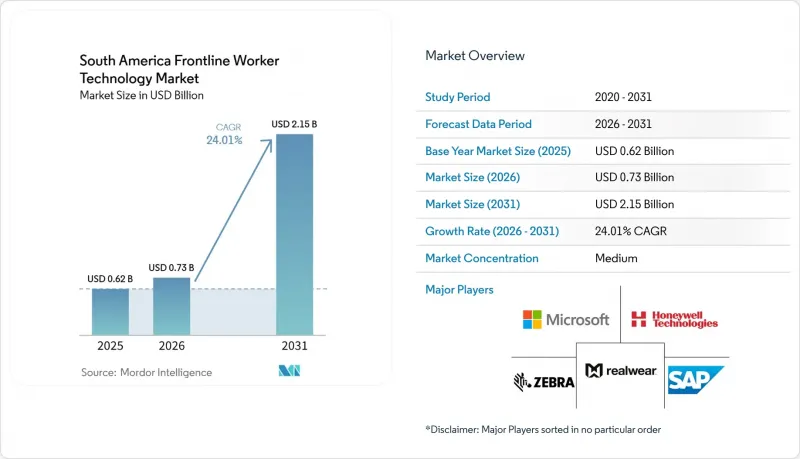
本報告按元件(軟體和服務)、部署方式(雲端、混合和本地部署)、組織規模(大型企業和中小企業)、應用領域(例如,勞動力分析和績效管理)、最終用戶行業(例如,零售和電子商務)以及地區進行細分。市場預測以美元計價。
南美現場工作人員技術市場的趨勢與見解。
在危險工作環境中,對免手持作業指導的需求日益成長
南美洲的現場作業人員技術市場正獲得雇主的青睞,他們希望員工能夠在不中斷體力勞動或摘下防護裝備的情況下遵循數位化指示。採礦、冶金、能源和加工產業對此類需求特別強烈,因為這些產業的工人必須在同一工作週期內頻繁地移動、檢查、溝通和驗證作業流程。語音控制的智慧眼鏡和頭戴式工具減少了對紙質指令、行動裝置或重複無線電通訊的依賴,使工作流程在嘈雜和高風險環境中更加實用。這些設備還能持續記錄任務完成情況、時間戳記和工作狀態,為安全性、品質和維護團隊提供無法透過傳統方法持續收集的資料。隨著企業開始利用這些記錄進行事故檢驗和培訓,類似的部署將滿足南美洲現場作業人員技術市場更廣泛的合規性和性能需求。此外,產品設計也日益在地化,以滿足危險環境和隱私期望的需求,例如專為嘈雜環境設計的本質安全型智慧眼鏡和符合巴西資料隱私要求的智慧徽章系統。
工業環境中專用 5G 和 Wi-Fi 6 網路的擴展
南美洲的現場作業人員技術市場正受益於礦山、工廠、港口和現場資產中共用且不可靠的通訊層被專用連接所取代。在複雜的工作環境中,當工作人員能夠即時接收指令、發送影片、確認任務並共用狀態數據,且無需像在公共網路中那樣經歷延遲時,現場工具的效用將顯著提升。這一點至關重要,因為如果通訊範圍不穩定或延遲在輪班期間波動,許多現場應用場景(例如遠端指導、安全警報、位置追蹤和數位化巡檢)的價值將大打折扣。改進的現場連接使雇主能夠將各個試點工具整合到全面的營運平台中,從而降低部署成本並使長期訂閱費用更具合理性。隨著網路變得更加專用和易於管理,平台供應商可以承諾為整個南美洲現場作業人員技術市場提供更穩定的用戶體驗和更高的運轉率。巴西聯邦機構關鍵任務通訊系統的部署表明,專用寬頻和整合通訊基礎設施正在向長期營運架構轉型,從而支持在該地區更廣泛地建立高度可靠的勞動力連接。
高性能設備和平台整合相關的高昂初始成本
南美洲的現場作業人員技術市場仍面臨巨大的普及障礙。這是因為加固型設備的價格遠高於消費級硬體,通常需要單獨進行投資。這個問題在大型企業以外的地區尤其突出,即使企業認知到現場軟體的價值,也往往會推遲購買,因為初始部署涉及設備、配件、配置、培訓和支援。此外,整合也是一大難題。許多買家要求將平台與企業資源計劃 (ERP)、維護、勞動力或安全系統整合,才能將其融入日常營運。這些整合專案並不簡單,通常需要數月的專家工作,使用者才能充分體驗其優勢。因此,南美洲現場作業人員技術市場的中小型企業往往更傾向於「行動優先」或「無代碼」方案,以避免一些硬體和系統方面的負擔。在資金籌措模式、設備租賃或更便利的部署方式普及之前,成本問題可能會使部分需求停留在考慮階段,而無法實現全面應用。
細分市場分析
到2025年,軟體將佔據南美現場工作人員技術市場76.25%的佔有率。這表明買家正在優先考慮能夠連接通訊、任務、分析和合規記錄的控制層。這項轉變意義重大,因為雇主不再需要為每個現場職能配備單獨的工具,而真正的營運價值在於連結工作人員、設備和企業系統的單一介面。平台主導的架構也拓寬了硬體選擇範圍,使企業能夠添加和修改穿戴式裝置、智慧型手機、平板電腦、掃描器等,而無需每次都重新設計核心工作流程邏輯。這提高了軟體投資的永續性,因為平台不再是一次性應用程式,而是一個執行框架。因此,在南美現場工作人員技術市場,如果軟體供應商能夠整合多種工作流程並滿足大型企業的現場報告和管理需求,則可以進一步提高其預算佔有率。
預計到2031年,服務業將以27.02%的複合年成長率成長,這表明軟體的興起正在增加而非減少對服務的需求。隨著現場平台的功能從基本通訊擴展到工作流程設計、分析和合規性文件編制,買家通常需要實施支援、整合工作、流程映射和使用者培訓。尤其是在實施過程中需要與企業系統堆疊中的現有ERP、MES、CMMS、身分管理系統或安全記錄系統整合時,這一點更為重要。隨著人工智慧輔助功能在南美現場工作人員技術市場日益普及,專家設置和持續最佳化的工作量可能會進一步增加。 TeamViewer在2026年6月推出的「Assist AR」更新增加了對Microsoft Windows AI API的支持,即使在網路不穩定的情況下也能實現清晰的遠端影像。這表明現場平台的複雜性日益增加,因此對專業實施和支援服務的依賴性也越來越高。
預計到2025年,基於雲端的部署將佔據66.45%的市場。南美現場工作人員技術市場的這一細分領域正受益於一種營運模式,該模式允許雇主擴展用戶規模、更新工作流程並添加功能,而無需重複購買基礎設施。雲端交付也適用於在多個地點運作的組織,因為它能夠比在每個地點進行本地部署更快地啟動新使用者、地點和流程更新。對許多雇主而言,這種模式更符合預算規劃,因為成本以訂閱形式分攤,而不是以經常性資本項目的形式分攤。它也減少了對稀缺的本地IT人才的依賴,這在先進基礎設施支援仍然集中在少數都市區的地區尤其重要。因此,在南美現場工作人員技術市場,雲端已成為許多主流現場應用程式的預設架構,即使買家仍然傾向於對某些工作負載進行本地控制。
在某些重工業領域,混合部署仍然至關重要,因為它們既需要基於雲端的分析和集中式管理,也需要本地容錯、低延遲以及在網路故障期間的業務連續性。在政府和受監管的公共產業環境中,本地部署環境仍然非常重要,因為管理權限、主權或傳統的採購結構等因素仍然優先考慮本地基礎設施。儘管如此,基於雲端的採用也是成長最快的領域,預計到 2031 年將以 26.34% 的複合年成長率成長,這表明集中式軟體管理的經濟效益持續改善。南美現場工作人員技術市場的發展方向表明,其長期結構將以「雲端主導」而非「純雲端」為主導,並根據需要整合邊緣運算功能。 TeamViewer 利用設備內建人工智慧技術在「Assist AR」中提升影像質量,印證了這一趨勢,顯示雲端平台和本地處理技術的融合日益增強,即使在低頻寬環境下也能保持可用性。
其他好處:
- Excel格式的市場預測(ME)表
- 3個月的分析師支持
目錄
第1章:引言
- 研究假設和市場定義
- 調查範圍
第2章:調查方法
第3章執行摘要
第4章 市場狀況
- 市場概覽
- 市場促進因素
- 在危險作業中,對免手持作業指導的需求日益成長。
- 工業設施中專用 5G 和 Wi-Fi 6 網路的擴展
- 擴大堅固耐用的穿戴裝置的應用範圍,以確保符合工人安全標準。
- 需要對勞動力進行即時可見性和可追溯性。
- 擴大對採礦和油田作業的遠端專家支持
- 維護、檢查和培訓工作流程的數位化
- 市場限制因素
- 堅固耐用的設備和平台整合需要較高的初始成本。
- 現場部署的穿戴式設備的電池續航時間限制
- 持續員工監控引發了人們對資料隱私的擔憂
- 與傳統OT系統和企業系統的互通性差。
- 產業價值鏈分析
- 監理情勢
- 技術展望
- 宏觀經濟因素對市場的影響
- 波特五力分析
第5章 市場規模與成長預測
- 按組件
- 軟體
- 服務
- 不同的發展
- 基於雲端的
- 混合
- 現場
- 按組織規模
- 大公司
- 小型企業
- 透過使用
- 員工溝通與參與
- 勞動力執行與任務管理
- 人員排班和協調
- 學習與知識應用
- 勞動分析與績效管理
- 安全與合規管理
- 其他用途
- 按最終用戶行業分類
- 零售與電子商務
- 工業製造
- 醫療保健和生命科學
- 運輸/物流
- 飯店業
- 建造
- 政府和公共行政
- 其他終端用戶產業
- 按地區
- 巴西
- 阿根廷
- 智利
- 其他南美國家
第6章 競爭情勢
- 市場集中度
- 策略趨勢
- 市佔率分析
- 公司簡介
- RealWear, Inc.
- Vuzix Corporation
- Zebra Technologies Corporation
- Honeywell International Inc.
- Datalogic SpA
- ProGlove Holding GmbH
- Motorola Solutions, Inc.
- TrueContext Corporation
- TeamViewer SE
- PTC Inc.
- Ubimax GmbH
- Microsoft Corporation
- SAP SE
- Qualcomm Technologies, Inc.
- Augmedics Ltd.
- Atheer, Inc.
- Lenovo Group Limited
- Aegex Technologies, LLC
- KORE Wireless Group, Inc.
- Ecom Instruments GmbH
第7章 市場機會與未來展望
According to Mordor Intelligence, the South America frontline worker technology market size was valued at USD 0.62 billion in 2025 and estimated to grow from USD 0.73 billion in 2026 to reach USD 2.15 billion by 2031, at a CAGR of 24.01% during the forecast period (2026-2031).
This report is Segmented by Component (Software, and Services), Deployment (Cloud-Based, Hybrid, and On-Premises), Organization Size (Large Enterprises, and Small and Medium Enterprises), Application (Workforce Analytics and Performance Management, and More), End-User Industry (Retail and E-Commerce, and More), and Geography. The Market Forecasts are Provided in Terms of Value (USD).
South America Frontline Worker Technology Market Trends and Insights
Rising Demand for Hands-Free Task Guidance in Hazardous Operations
The South America frontline worker technology market is gaining support from employers that need workers to follow digital instructions without pausing manual tasks or removing protective equipment. This need is strongest in mining, metals, energy, and process industries, where a worker often must move, inspect, communicate, and confirm steps in the same operating cycle. Voice-controlled smart glasses and head-mounted tools reduce reliance on paper sheets, handheld devices, or repeated radio calls, making the workflow more practical in high-noise, high-risk settings. These deployments also create a continuous record of task completion, timestamps, and operating context, which gives safety, quality, and maintenance teams a data layer they could not consistently capture with analog methods. Once companies begin using this record for incident review and training, the same deployment starts supporting broader compliance and performance needs inside the South America frontline worker technology market. Product design is also becoming more localized for hazardous environments and privacy expectations, as shown by intrinsically safe smart glasses for noisy field use and smart badge systems aligned with Brazilian data privacy needs.
Expansion of Private 5G and Wi-Fi 6 Networks in Industrial Sites
The South America frontline worker technology market benefits when dedicated connectivity replaces shared and unstable communication layers in mines, plants, ports, and field assets. Frontline tools become far more useful when workers can receive live instructions, send video, confirm tasks, and share status data without the delays that often affect public networks in complex operating environments. This matters because many frontline use cases, including remote guidance, safety alerts, location tracking, and digital inspections, lose much of their value if coverage is inconsistent or latency varies during a shift. Better site connectivity also helps employers consolidate separate pilot tools into a single, broader operating platform, improving the economics of rollout and strengthening the case for long-term subscription spending. As networks become more dedicated and easier to govern, platform vendors can promise a more stable user experience and higher uptime across the South America frontline worker technology market. Brazil's mission-critical communications rollout for federal agencies shows that dedicated broadband and unified communications infrastructure are moving into a long-term operational architecture, supporting the broader normalization of high-reliability workforce connectivity in the region.
High Upfront Cost of Rugged Devices and Platform Integration
The South America frontline worker technology market still faces a clear adoption barrier because rugged devices cost far more than consumer hardware and usually require a separate investment case. This issue is most visible outside the large-enterprise tier, where a company may accept the value of frontline software but still delay purchases because the first deployment includes devices, accessories, configuration, training, and support. Integration adds another burden, since many buyers need the platform to connect with ERP, maintenance, workforce, or safety systems before it can become part of daily operations. Those integration projects are not simple, and they often consume months of specialist work before users see a full return. Smaller employers in the South America frontline worker technology market, therefore, tend to favor mobile-first or no-code options that can avoid part of the hardware and systems burden. Until financing models, device leasing, or lighter implementation methods become more common, cost will continue to keep a portion of demand in evaluation mode rather than full deployment.
Other drivers and restraints analyzed in the detailed report include:
- Increasing Adoption of Rugged Wearables for Worker Safety Compliance
- Need for Real-Time Workforce Visibility and Traceability
- Limited Battery Life in Field-Deployed Wearables
For complete list of drivers and restraints, kindly check the Table Of Contents.
Segment Analysis
Software held a 76.25% share of the South America frontline worker technology market in 2025, indicating that buyers are prioritizing the control layer that connects communication, tasks, analytics, and compliance records. The shift is important because employers no longer want separate tools for each frontline function when the real operational value lies in a single interface that links workers, devices, and enterprise systems. A platform-led architecture also supports hardware choice, since companies can add or change wearables, phones, tablets, or scanners without redesigning the core workflow logic each time. This makes software spending more durable because the platform becomes the execution framework rather than a single-use application. The South America frontline worker technology market, therefore, gives software vendors a stronger share of the budget when they can unify multiple workflows and support the local reporting and control needs of large employers.
The services segment is projected to expand at a 27.02% CAGR through 2031, indicating that software dominance is increasing service demand rather than reducing it. Once a frontline platform moves beyond basic messaging into workflow design, analytics, and compliance documentation, the buyer usually needs implementation support, integration work, process mapping, and user training. This is especially true when deployments must integrate with ERP, MES, CMMS, identity systems, or safety records that already reside within the enterprise stack. As the South America frontline worker technology market adds more AI-assisted features, the amount of specialist setup and ongoing optimization tends to rise further. TeamViewer's June 2026 update to Assist AR, which added Microsoft Windows AI API support for clearer remote video under weak connectivity, shows how frontline platforms are becoming more advanced and, as a result, more dependent on skilled deployment and support services.
Cloud-based deployment held 66.45% share in 2025, and this part of the South America frontline worker technology market benefits from the operating model that lets employers scale users, update workflows, and add features without repeated infrastructure purchases. Cloud delivery also suits organizations that run multiple sites because new users, locations, and process updates can be activated faster than they could through site-by-site local installations. For many employers, this model better aligns with budget planning because costs are spread across subscriptions rather than irregular capital projects. It also reduces dependence on scarce local IT talent, which is particularly useful in regions where advanced infrastructure support remains concentrated in a few urban centers. The South America frontline worker technology market has therefore treated cloud as the default architecture for many mainstream frontline applications, even where buyers still want local control over selected workloads.
Hybrid deployment remains relevant because some heavy industrial operations need local resilience, low latency, or continuity during network interruptions while still wanting cloud analytics and centralized administration. On-premises setups continue to matter in government and regulated utility environments where control, sovereignty, or legacy procurement structures still favor local infrastructure. Even so, cloud-based deployment is also the fastest-growing segment, with a 26.34% CAGR through 2031, indicating that the economics of centralized software management continue to improve. The direction of the South America frontline worker technology market suggests that the long-term structure will not be cloud-only, but cloud-led with edge capabilities layered in where field conditions require them. TeamViewer's use of on-device AI for video enhancement in Assist AR supports this pattern by showing that cloud platforms are increasingly paired with local processing to preserve usability in low-bandwidth environments.
Complete Report Scope:
- By Component
- Software
- Services
- By Deployment
- Cloud-Based
- Hybrid
- On-Premises
- By Organization Size
- Large Enterprises
- Small and Medium Enterprises
- By Application
- Employee Communication and Engagement
- Workforce Execution and Task Management
- Workforce Scheduling and Coordination
- Learning and Knowledge Enablement
- Workforce Analytics and Performance Management
- Safety and Compliance Management
- Other Applications
- By End-User Industry
- Retail and E-Commerce
- Industrial Manufacturing
- Healthcare and Life Sciences
- Transportation and Logistics
- Hospitality
- Construction
- Government and Public Administration
- Other End-User Industries
- By Geography
- Brazil
- Argentina
- Chile
- Rest of South America
List of Companies Covered in this Report:
- RealWear, Inc.
- Vuzix Corporation
- Zebra Technologies Corporation
- Honeywell International Inc.
- Datalogic S.p.A.
- ProGlove Holding GmbH
- Motorola Solutions, Inc.
- TrueContext Corporation
- TeamViewer SE
- PTC Inc.
- Ubimax GmbH
- Microsoft Corporation
- SAP SE
- Qualcomm Technologies, Inc.
- Augmedics Ltd.
- Atheer, Inc.
- Lenovo Group Limited
- Aegex Technologies, LLC
- KORE Wireless Group, Inc.
- Ecom Instruments GmbH
Additional Benefits:
- The market estimate (ME) sheet in Excel format
- 3 months of analyst support
TABLE OF CONTENTS
1 INTRODUCTION
- 1.1 Study Assumptions and Market Definition
- 1.2 Scope of the Study
2 RESEARCH METHODOLOGY
3 EXECUTIVE SUMMARY
4 MARKET LANDSCAPE
- 4.1 Market Overview
- 4.2 Market Drivers
- 4.2.1 Rising Demand for Hands-Free Task Guidance in Hazardous Operations
- 4.2.2 Expansion of Private 5G and Wi-Fi 6 Networks in Industrial Sites
- 4.2.3 Increasing Adoption of Rugged Wearables for Worker Safety Compliance
- 4.2.4 Need for Real-Time Workforce Visibility and Traceability
- 4.2.5 Growth of Remote Expert Assistance in Mining and Oilfield Operations
- 4.2.6 Digitalization of Maintenance, Inspection, and Training Workflows
- 4.3 Market Restraints
- 4.3.1 High Upfront Cost of Rugged Devices and Platform Integration
- 4.3.2 Limited Battery Life in Field-Deployed Wearables
- 4.3.3 Data Privacy Concerns From Persistent Worker Monitoring
- 4.3.4 Weak Interoperability With Legacy OT and Enterprise Systems
- 4.4 Industry Value Chain Analysis
- 4.5 Regulatory Landscape
- 4.6 Technological Outlook
- 4.7 Impact of Macroeconomic Factors on the Market
- 4.8 Porter's Five Forces Analysis
- 4.8.1 Threat of New Entrants
- 4.8.2 Bargaining Power of Suppliers
- 4.8.3 Bargaining Power of Buyers
- 4.8.4 Threat of Substitutes
- 4.8.5 Competitive Rivalry
5 MARKET SIZE AND GROWTH FORECASTS (VALUE)
- 5.1 By Component
- 5.1.1 Software
- 5.1.2 Services
- 5.2 By Deployment
- 5.2.1 Cloud-Based
- 5.2.2 Hybrid
- 5.2.3 On-Premises
- 5.3 By Organization Size
- 5.3.1 Large Enterprises
- 5.3.2 Small and Medium Enterprises
- 5.4 By Application
- 5.4.1 Employee Communication and Engagement
- 5.4.2 Workforce Execution and Task Management
- 5.4.3 Workforce Scheduling and Coordination
- 5.4.4 Learning and Knowledge Enablement
- 5.4.5 Workforce Analytics and Performance Management
- 5.4.6 Safety and Compliance Management
- 5.4.7 Other Applications
- 5.5 By End-User Industry
- 5.5.1 Retail and E-Commerce
- 5.5.2 Industrial Manufacturing
- 5.5.3 Healthcare and Life Sciences
- 5.5.4 Transportation and Logistics
- 5.5.5 Hospitality
- 5.5.6 Construction
- 5.5.7 Government and Public Administration
- 5.5.8 Other End-User Industries
- 5.6 By Geography
- 5.6.1 Brazil
- 5.6.2 Argentina
- 5.6.3 Chile
- 5.6.4 Rest of South America
6 COMPETITIVE LANDSCAPE
- 6.1 Market Concentration
- 6.2 Strategic Moves
- 6.3 Market Share Analysis
- 6.4 Company Profiles (includes Global Level Overview, Market Level Overview, Core Segments, Financials as available, Strategic Information, Market Rank/Share, Products and Services, Recent Developments)
- 6.4.1 RealWear, Inc.
- 6.4.2 Vuzix Corporation
- 6.4.3 Zebra Technologies Corporation
- 6.4.4 Honeywell International Inc.
- 6.4.5 Datalogic S.p.A.
- 6.4.6 ProGlove Holding GmbH
- 6.4.7 Motorola Solutions, Inc.
- 6.4.8 TrueContext Corporation
- 6.4.9 TeamViewer SE
- 6.4.10 PTC Inc.
- 6.4.11 Ubimax GmbH
- 6.4.12 Microsoft Corporation
- 6.4.13 SAP SE
- 6.4.14 Qualcomm Technologies, Inc.
- 6.4.15 Augmedics Ltd.
- 6.4.16 Atheer, Inc.
- 6.4.17 Lenovo Group Limited
- 6.4.18 Aegex Technologies, LLC
- 6.4.19 KORE Wireless Group, Inc.
- 6.4.20 Ecom Instruments GmbH
7 MARKET OPPORTUNITIES AND FUTURE OUTLOOK
- 7.1 White-Space and Unmet-Need Assessment

 2026年全球人工智慧(AI)雲端解決方案市場報告2026年全球數位圖書館市場報告
 Travelport GDS系統市場規模、佔有率和成長分析:按組件、部署類型、應用、最終用戶、企業規模和地區分類-2026-2033年產業預測
 時間序列資料庫市場預測至2034年-按部署模式、資料庫類型、資料來源、元件、應用、最終使用者和地區分類的全球分析
 數位發送服務市場:按組件、按組織規模、按行業、按地區分類
 中國現場作業人員技術:市場佔有率分析、產業趨勢與統計及成長預測(2026-2031)印度現場工作人員技術:市場佔有率分析、產業趨勢與統計及成長預測(2026-2031 年)日本現場工作人員技術:市場佔有率分析、產業趨勢與統計及成長預測(2026-2031)法國田間作業人員技術:市場佔有率分析、產業趨勢與統計及成長預測(2026-2031 年)
 雲端解決方案市場:按服務模式、組織規模、部署模式、應用程式和產業分類-2026-2032年全球市場預測