


 |
市場調查報告書
商品編碼
2099346
英國現場作業人員技術:市場佔有率分析、產業趨勢與統計及成長預測(2026-2031 年)UK Frontline Worker Technology - Market Share Analysis, Industry Trends & Statistics, Growth Forecasts (2026 - 2031) |
||||||

※ 本網頁內容可能與最新版本有所差異。詳細情況請與我們聯繫。
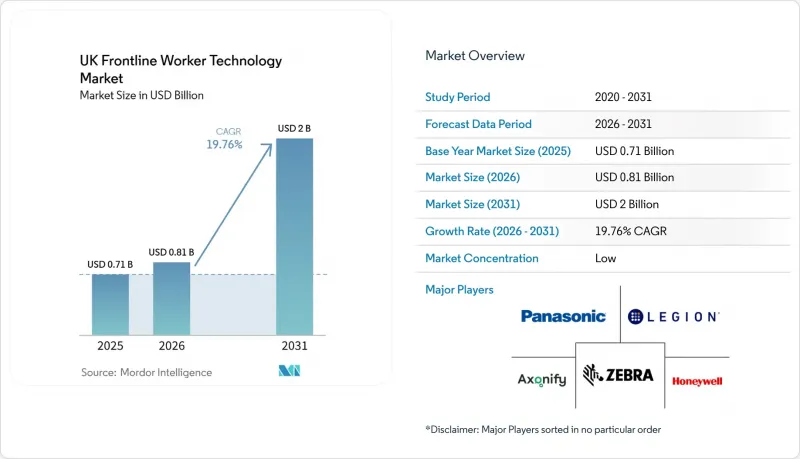
據 Mordor Intelligence 稱,2025 年英國現場工作人員技術市場價值為 7.1 億美元,預計到 2031 年將達到 20 億美元,而 2026 年為 8.1 億美元,預測期(2026-2031 年)的複合年成長率為 19.76%。
本報告按組件(軟體和服務)、部署方式(雲端、混合等)、組織規模(大型企業和中小企業)、應用領域(員工溝通與互動等)以及最終用戶行業(零售和電子商務、工業製造等)進行細分。市場預測以美元計價。
英國現場工作人員技術市場的趨勢與洞察。
輪班工作中對即時任務協調的需求日益成長。
在英國外勤人員技術市場,輪班工作需要更快速的調整,因為電子商務的履約、醫療保健行業的人員配備限制以及分佈式門市和位置網路都減少了人工操作的空間。雇主們正逐漸從使用獨立的應用程式進行排班、溝通和學習,轉向使用單一的面向外勤人員的系統,該系統可以管理跨多個地點的活動。 WorkJam 與 Rotageek 於 2025 年 3 月的合作清晰地展現了這一發展方向,它將需求主導的排班和任務管理、溝通、自助排班和培訓整合到一個單一的工作流程平台中。 Deputy 和 Geografia 在 2026 年對英國外勤人員進行的一項調查發現,雖然 88% 的受訪者表示人工智慧使他們的工作更輕鬆,但只有 42% 的受訪者表示人工智慧減輕了與輪班相關的壓力。這表明,僅僅提高工作效率並不能自動消除工作負擔。這種差距意義重大,因為雇主現在需要的不僅僅是一個分配任務的平台;他們需要的是一個能夠讓主管及早發現瓶頸並即時調整人員配置的系統。因此,英國現場工作人員技術市場更青睞那些能夠將任務級活動轉化為可操作的管理指南,而無需現場團隊添加新工具的供應商。
人手不足日益嚴重,關鍵領域人才面臨留任壓力。
長期人手不足仍然是英國現場工作人員技術市場最強勁的需求促進因素之一,因為雇主需要在勞動力萎縮的情況下維持生產力。英國政府發布的《2025年職業需求分析》顯示,510萬名工人(佔總就業人數的15.4%)將從事高需求職業,另有1,090萬名工人也將從事高需求職業。光是在成人社會照護領域,2024-2025年就將出現11.1萬個職缺,預計到2040年,還需要額外47萬名工人來滿足老齡化人口日益成長的需求。這些勞動力短缺使得人工智慧驅動的排班、數位入職和技能匹配工具更具吸引力,因為它們減少了人工調整所需的時間。此外,雇主正在利用現場系統來提高現有團隊的生產力,這使得採用這些系統的理由從單純的數位化轉變為增強勞動力韌性。在此背景下,英國現場工作人員技術市場中,能夠減輕管理負擔和提高員工留任率的醫療保健、物流和酒店業的供應商獲得了競爭優勢。
碎片化的舊有系統會增加整合成本和部署複雜性。
整合仍然是英國現場工作人員技術市場的主要限制因素,因為許多雇主仍在使用混合部署的系統,包括本地ERP系統、獨立的HR工具、薪資核算平台和過時的阻礙因素軟體。這種分散的系統配置推高了實施成本,延長了部署週期,尤其是在內部IT團隊無法同時支援跨多個地點的複雜介面操作的情況下。英國科學、創新和技術部在2026年6月發布的《技術採納評估報告》中指出,API互通性和整合複雜性是企業採用數位化技術的主要障礙,這個議題在倫敦以外的地區更為突出。這種情況會減緩投資回報,因為排班、溝通和分析的價值取決於與員工和薪資數據的精確整合。因此,擁有與SAP SuccessFactors、Workday、ADP和Sage等常用系統預先建置連接器的供應商在縮短實施週期和減少買家猶豫方面具有優勢。儘管英國市場對現場工作人員技術的需求仍然強勁,但整合帶來的摩擦可能會延遲購買決策,即使人手不足已經顯現。
細分市場分析
到2025年,軟體將佔據82.28%的市場佔有率,成為英國現場工作人員技術市場的主要收入來源。這一主導地位反映了市場正經歷著從硬體主導的單一功能工具向雲端平台的廣泛轉變,後者能夠將溝通、日程安排、任務、學習和分析整合到一個統一的管理層中。由於每個工作流程分散在不同的應用程式中,跨多個地點的營運管理變得異常困難,因此雇主越來越傾向於使用單一的管理環境。 WorkJam與Rotageek於2025年3月達成的合作凸顯了這一趨勢,該合作將基於需求的日程安排與溝通、培訓和任務執行整合在一個統一的平台中。因此,在英國現場工作人員技術市場,那些能夠在不增加現場使用複雜性的前提下擴展功能範圍的供應商備受青睞。
服務業是成長最快的領域,預計到2031年複合年成長率將達到22.31%。這是因為複雜的部署仍然需要整合、培訓、配置和部署後支援。隨著平台增加分析和人工智慧功能,每次部署相關的管治和變更管理負擔也隨之增加。這意味著,即使透過SaaS模式購買軟體變得便捷,服務的重要性依然存在。供應商投資於認證合作夥伴網路和特定產業模板,可以透過最佳化和支援來減輕部署負擔,同時維持業務收益。這種平衡至關重要,因為英國現場工作人員技術產業仍有許多大型公司在使用過時的系統,這些公司在擴展部署規模之前需要強大的服務基礎設施。
到2025年,基於雲端的部署將佔英國現場工作人員技術市場80.41%的佔有率,並且是成長最快的部署模式,到2031年複合年成長率將達到20.38%。這反映了零售、物流和醫療保健行業企業的需求,他們尋求集中管理、快速更新以及減少對各地點本地基礎設施的依賴。分散的現場團隊無法容忍換班期間的系統停機,因此可靠性和遠端支援仍然是選擇雲端的主要原因。英國現場工作人員技術市場也受益於強大的企業雲端基礎設施,這降低了已在使用其他託管業務系統的買家的准入門檻。因此,當雇主希望在多個地點快速部署時,雲端平台正成為首選。
對於那些既想享受雲端技術的便利性,又想嚴格控制特定員工記錄的雇主而言,混合部署仍然佔據著重要地位。在英國國家醫療服務體系(NHS)信託機構、公共機構和大規模金融服務機構等資料處理決策高度敏感的環境中,這一點尤其突出。此外,在大規模工業設施中,由於遷移成本超過了短期收益,本地部署模式仍然佔據主導地位。英國數位資訊技術部(DSIT)的一份研究報告指出,雲端技術專業知識在英國的分佈並不均衡,這意味著在主要數位中心之外,對混合部署和本地部署解決方案的需求在短期內不會消失。
其他好處:
- Excel格式的市場預測(ME)表
- 3個月的分析師支持
目錄
第1章:引言
- 研究假設和市場定義
- 調查範圍
第2章:調查方法
第3章執行摘要
第4章 市場狀況
- 市場概覽
- 市場促進因素
- 在整個輪班工作環境中,對即時任務編配的需求日益成長。
- 關鍵第一線部門勞動力短缺日益嚴重,以及確保人才供應的壓力。
- 行動優先的商用應用和穿戴式裝置的廣泛應用。
- 在安全性、可審計性和培訓可追溯性方面面臨的合規壓力。
- 將數位化工單整合到傳統業務流程中
- 管理人員和現場團隊對非結構化變革感到疲憊。
- 市場限制因素
- 碎片化的舊有系統會增加整合成本和部署複雜性。
- 對資料隱私、員工監控和員工信任的擔憂。
- 多個地點業務運作中連接環境的不統一以及設備標準化程度的差異
- 中小終端用戶的預算敏感性
- 產業價值鏈分析
- 宏觀經濟因素對市場的影響
- 監理情勢
- 技術展望
- 波特五力分析
第5章 市場規模與成長預測
- 按組件
- 軟體
- 服務
- 不同的發展
- 基於雲端的
- 混合
- 現場
- 按組織規模
- 大公司
- 小型企業
- 透過使用
- 員工溝通與參與
- 勞動力執行與任務管理
- 人員排班和協調
- 學習與知識應用
- 勞動分析與績效管理
- 安全與合規管理
- 其他用途
- 按最終用戶行業分類
- 零售與電子商務
- 工業製造
- 醫療保健和生命科學
- 運輸/物流
- 飯店業
- 建造
- 政府和公共行政
- 其他行業
第6章 競爭情勢
- 市場集中度
- 策略趨勢
- 市佔率分析
- 公司簡介
- Zebra Technologies Corporation
- Honeywell International Inc.
- Axonify Inc.
- Legion Technologies Inc.
- Panasonic Holdings Corporation
- Toshiba Tec Corporation
- Staffbase GmbH
- Rotageek Ltd.
- Beekeeper AG
- WorkJam, Inc.
- YOOBIC SAS
- Microsoft Corporation
- SAP SE
- ServiceNow, Inc.
- Oracle Corporation
- Salesforce, Inc.
- Infor Holdings LLC
- UKG Inc.
- Zaptic Limited
- Quinyx AB
第7章 市場機會與未來展望
According to Mordor Intelligence, the UK frontline worker technology market size was valued at USD 0.71 billion in 2025 and estimated to grow from USD 0.81 billion in 2026 to reach USD 2.00 billion by 2031, at a CAGR of 19.76% during the forecast period (2026-2031).
This report is Segmented by Component (Software, and Services), Deployment Mode (Cloud-Based, Hybrid, and More), Organization Size (Large Enterprises, and Small and Medium Enterprises), Application (Employee Communication and Engagement, and More), and End-User Industry (Retail and E-Commerce, Industrial Manufacturing, and More). The Market Forecasts are Provided in Terms of Value (USD).
UK Frontline Worker Technology Market Trends and Insights
Rising Need for Real-Time Task Orchestration Across Shift-Based Operations
Shift-based operations in the United Kingdom frontline worker technology market now require faster coordination because e-commerce fulfillment, healthcare staffing pressure, and distributed store and site networks leave less room for manual task flow. Employers are increasingly moving away from separate apps for scheduling, communication, and learning, and toward a single frontline system that can manage activity across many locations. WorkJam's March 2025 partnership with Rotageek showed this direction clearly by linking demand-driven scheduling with task management, communication, schedule self-service, and training in one workflow stack. Deputy and Geografia's 2026 UK frontline study found that 88% of workers said AI made their jobs easier, yet only 42% said it reduced shift-related stress, which shows that speed gains do not automatically remove operational strain. That gap matters because employers now want platforms that do more than push tasks; they want systems that help supervisors see bottlenecks early and adjust labor in real time. The United Kingdom frontline worker technology market, therefore, favors vendors that can turn task-level activity into usable managerial guidance without adding another tool for site teams.
Escalating Labor Shortages and Retention Pressure in Essential Frontline Sectors
Persistent labor shortages remain one of the strongest demand drivers in the United Kingdom frontline worker technology market because employers need to protect output with fewer available workers. The UK government's 2025 occupational demand analysis identified 5.1 million workers, or 15.4% of total employment, in critical-demand occupations, while another 10.9 million workers were in elevated-demand roles. Adult social care alone had 111,000 vacant posts in 2024-25, and the sector is projected to need 470,000 additional workers by 2040 to meet rising demand from an aging population. These shortages increase the appeal of AI-assisted rostering, digital onboarding, and skills-matching tools because each of them reduces time spent on manual coordination. Employers are also using frontline systems to make existing teams more productive, which changes the buying case from basic digitization to workforce resilience. In this setting, the United Kingdom frontline worker technology market gives an edge to vendors that can show lower administrative burden and stronger retention support in healthcare, logistics, and hospitality.
Fragmented Legacy Systems Increase Integration Cost and Deployment Complexity
Integration remains one of the main restraints on the United Kingdom frontline worker technology market because many employers still run a mix of on-premises ERP systems, separate HR tools, payroll platforms, and older scheduling software. This fragmented stack raises implementation cost and extends rollout timelines, especially when internal IT teams cannot support complex interface work across several sites at once. The UK Department for Science, Innovation and Technology stated in its Technology Adoption Review, published in June 2026, that API interoperability and integration complexity were among the leading barriers to enterprise digital technology adoption, with the problem more pronounced outside London. These conditions slow down return on investment because value from scheduling, communication, and analytics depends on clean links to workforce and payroll data. Vendors with pre-built connectors into widely used systems such as SAP SuccessFactors, Workday, ADP, and Sage are therefore better positioned to shorten deployment time and reduce buyer hesitation. The United Kingdom frontline worker technology market still has strong demand, but integration friction can delay purchase decisions even where the labor need is already clear.
Other drivers and restraints analyzed in the detailed report include:
- Broader Adoption of Mobile-First Workforce Applications and Wearable Devices
- Compliance Pressure for Safety, Auditability, and Training Traceability
- Data Privacy, Worker Monitoring, and Employee Trust Concerns
For complete list of drivers and restraints, kindly check the Table Of Contents.
Segment Analysis
Software captured 82.28% share in 2025, which made it the dominant revenue base across the United Kingdom frontline worker technology market. That lead reflects a broad shift away from hardware-led point tools and toward cloud-based platforms that can coordinate communication, scheduling, tasks, learning, and analytics from a single control layer. Employers increasingly prefer one administrative environment because multi-site operations are harder to manage when each workflow sits in a different application. WorkJam's March 2025 partnership with Rotageek supports this pattern because it joined demand-based scheduling with communication, training, and task execution inside one stack. The United Kingdom frontline worker technology market is, therefore, rewarding software vendors that can widen their functional reach without making site-level use more complex.
Services is the fastest-growing component, with a 22.31% CAGR through 2031, because complex deployments still need integration, training, configuration, and post-launch support. As platforms add more analytics and AI functions, the amount of governance and change management around each rollout also increases. This keeps services relevant even when software becomes easier to buy through SaaS models. Vendors that invest in certified partner networks and industry-specific templates can reduce implementation strain while preserving service revenue from optimization and support. That balance matters because the United Kingdom frontline worker technology industry still includes many large employers with older systems, and those employers need service depth before they can scale adoption across sites.
Cloud-based deployment accounted for 80.41% of the United Kingdom frontline worker technology market size in 2025 and is also the fastest-growing deployment model with a 20.38% CAGR through 2031. This position reflects the needs of retail, logistics, and healthcare operators that want centralized administration, faster updates, and less dependence on local infrastructure at each location. Distributed frontline teams cannot absorb downtime during shift changes, so reliability and remote support remain core reasons for cloud preference. The United Kingdom frontline worker technology market also benefits from a strong enterprise cloud base, which lowers the barrier for buyers who already use other hosted business systems. Cloud platforms are therefore becoming the default option when employers want quick expansion across multiple sites.
Hybrid deployment still keeps a place where employers want cloud usability, but retain tighter control over selected workforce records. This is especially relevant in environments such as NHS trusts, public bodies, and large financial services organizations where data handling choices remain sensitive. On-premises models also persist in large industrial sites where migration cost is still higher than the short-term gain from change. The DSIT review noted that cloud-technology expertise is less evenly distributed across UK regions, which suggests hybrid and on-premises demand will not disappear quickly outside the main digital hubs.
Complete Report Scope:
- By Component
- Software
- Services
- By Deployment
- Cloud-Based
- Hybrid
- On-Premises
- By Organization Size
- Large Enterprises
- Small and Medium Enterprises
- By Application
- Employee Communication and Engagement
- Workforce Execution and Task Management
- Workforce Scheduling and Coordination
- Learning and Knowledge Enablement
- Workforce Analytics and Performance Management
- Safety and Compliance Management
- Other Applications
- By End-User Industry
- Retail and E-Commerce
- Industrial Manufacturing
- Healthcare and Life Sciences
- Transportation and Logistics
- Hospitality
- Construction
- Government and Public Administration
- Other Industries
List of Companies Covered in this Report:
- Zebra Technologies Corporation
- Honeywell International Inc.
- Axonify Inc.
- Legion Technologies Inc.
- Panasonic Holdings Corporation
- Toshiba Tec Corporation
- Staffbase GmbH
- Rotageek Ltd.
- Beekeeper AG
- WorkJam, Inc.
- YOOBIC SAS
- Microsoft Corporation
- SAP SE
- ServiceNow, Inc.
- Oracle Corporation
- Salesforce, Inc.
- Infor Holdings LLC
- UKG Inc.
- Zaptic Limited
- Quinyx AB
Additional Benefits:
- The market estimate (ME) sheet in Excel format
- 3 months of analyst support
TABLE OF CONTENTS
1 INTRODUCTION
- 1.1 Study Assumptions and Market Definition
- 1.2 Scope of the Study
2 RESEARCH METHODOLOGY
3 EXECUTIVE SUMMARY
4 MARKET LANDSCAPE
- 4.1 Market Overview
- 4.2 Market Drivers
- 4.2.1 Rising Need for Real-Time Task Orchestration Across Shift-Based Operations
- 4.2.2 Escalating Labor Shortages and Retention Pressure in Essential Frontline Sectors
- 4.2.3 Broader Adoption of Mobile-First Workforce Applications and Wearable Devices
- 4.2.4 Compliance Pressure for Safety, Auditability, and Training Traceability
- 4.2.5 Integration of Digital Work Instructions Into Legacy Operational Workflows
- 4.2.6 Unstructured Change Fatigue Among Supervisors and Frontline Teams
- 4.3 Market Restraints
- 4.3.1 Fragmented Legacy Systems Increase Integration Cost and Deployment Complexity
- 4.3.2 Data Privacy, Worker Monitoring, and Employee Trust Concerns
- 4.3.3 Uneven Connectivity and Device Standardization Across Multi-Site Operations
- 4.3.4 Budget Sensitivity Among Small and Mid-Sized End Users
- 4.4 Industry Value Chain Analysis
- 4.5 Impact of Macroeconomic Factors on the Market
- 4.6 Regulatory Landscape
- 4.7 Technological Outlook
- 4.8 Porter's Five Forces Analysis
- 4.8.1 Bargaining Power of Buyers
- 4.8.2 Bargaining Power of Suppliers
- 4.8.3 Threat of New Entrants
- 4.8.4 Threat of Substitutes
- 4.8.5 Intensity of Competitive Rivalry
5 MARKET SIZE AND GROWTH FORECASTS (VALUE)
- 5.1 By Component
- 5.1.1 Software
- 5.1.2 Services
- 5.2 By Deployment
- 5.2.1 Cloud-Based
- 5.2.2 Hybrid
- 5.2.3 On-Premises
- 5.3 By Organization Size
- 5.3.1 Large Enterprises
- 5.3.2 Small and Medium Enterprises
- 5.4 By Application
- 5.4.1 Employee Communication and Engagement
- 5.4.2 Workforce Execution and Task Management
- 5.4.3 Workforce Scheduling and Coordination
- 5.4.4 Learning and Knowledge Enablement
- 5.4.5 Workforce Analytics and Performance Management
- 5.4.6 Safety and Compliance Management
- 5.4.7 Other Applications
- 5.5 By End-User Industry
- 5.5.1 Retail and E-Commerce
- 5.5.2 Industrial Manufacturing
- 5.5.3 Healthcare and Life Sciences
- 5.5.4 Transportation and Logistics
- 5.5.5 Hospitality
- 5.5.6 Construction
- 5.5.7 Government and Public Administration
- 5.5.8 Other Industries
6 COMPETITIVE LANDSCAPE
- 6.1 Market Concentration
- 6.2 Strategic Moves
- 6.3 Market Share Analysis
- 6.4 Company Profiles (includes Global Level Overview, Market Level Overview, Core Segments, Financials as available, Strategic Information, Market Rank/Share, Products and Services, Recent Developments)
- 6.4.1 Zebra Technologies Corporation
- 6.4.2 Honeywell International Inc.
- 6.4.3 Axonify Inc.
- 6.4.4 Legion Technologies Inc.
- 6.4.5 Panasonic Holdings Corporation
- 6.4.6 Toshiba Tec Corporation
- 6.4.7 Staffbase GmbH
- 6.4.8 Rotageek Ltd.
- 6.4.9 Beekeeper AG
- 6.4.10 WorkJam, Inc.
- 6.4.11 YOOBIC SAS
- 6.4.12 Microsoft Corporation
- 6.4.13 SAP SE
- 6.4.14 ServiceNow, Inc.
- 6.4.15 Oracle Corporation
- 6.4.16 Salesforce, Inc.
- 6.4.17 Infor Holdings LLC
- 6.4.18 UKG Inc.
- 6.4.19 Zaptic Limited
- 6.4.20 Quinyx AB
7 MARKET OPPORTUNITIES AND FUTURE OUTLOOK
- 7.1 White Space and Unmet Need Assessment

 2026年全球數位圖書館市場報告
 時間序列資料庫市場預測至2034年-按部署模式、資料庫類型、資料來源、元件、應用、最終使用者和地區分類的全球分析
 數位發送服務市場:按組件、按組織規模、按行業、按地區分類
 中國現場作業人員技術:市場佔有率分析、產業趨勢與統計及成長預測(2026-2031)印度現場工作人員技術:市場佔有率分析、產業趨勢與統計及成長預測(2026-2031 年)日本現場工作人員技術:市場佔有率分析、產業趨勢與統計及成長預測(2026-2031)法國田間作業人員技術:市場佔有率分析、產業趨勢與統計及成長預測(2026-2031 年)
 雲端解決方案市場:按服務模式、組織規模、部署模式、應用程式和產業分類-2026-2032年全球市場預測亞太地區現場工作人員技術:市場佔有率分析、產業趨勢與統計及成長預測(2026-2031 年)北美現場作業人員技術:市場佔有率分析、產業趨勢與統計及成長預測(2026-2031 年)