


 |
市場調查報告書
商品編碼
2099306
海底光纖骨幹:市場佔有率分析、產業趨勢與統計、成長預測(2026-2031)Subsea Fiber Backbone Network - Market Share Analysis, Industry Trends & Statistics, Growth Forecasts (2026 - 2031) |
||||||

※ 本網頁內容可能與最新版本有所差異。詳細情況請與我們聯繫。
據 Mordor Intelligence 稱,2025 年海底光纖骨幹網路市場規模為 77.5 億美元,預計到 2031 年將從 2026 年的 82.1 億美元成長至 123 億美元,預測期(2026-2031 年)複合年成長率為 8.42%。
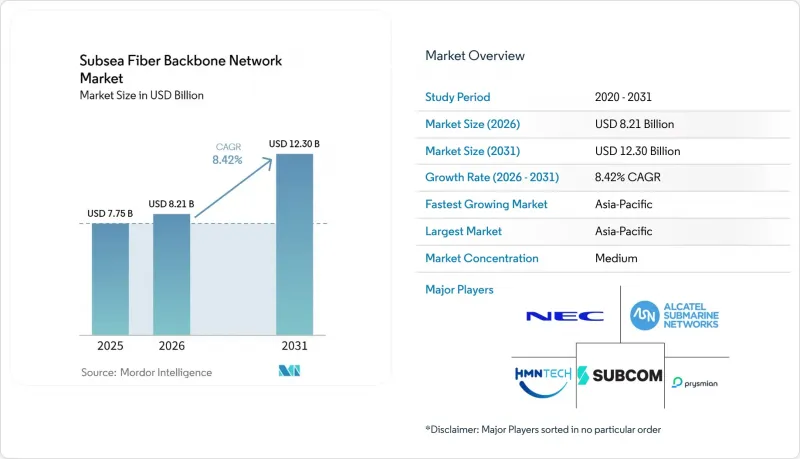
本報告按組件(濕式設備、乾式設備等)、光纜類型(單模光纖和多模光纖)、客戶類型(通訊業者、超大規模資料中心業者、海洋能源企業等)、所有權結構(財團所有、獨資所有等)和地區(北美、南美、歐洲、亞太等)進行細分。市場預測以美元計價。
全球海底光纖骨幹網路市場趨勢及洞察
由於雲端運算和人工智慧流量,國際頻寬需求不斷成長
人工智慧訓練和推理使得大規模資料集能夠在遠端資料中心之間而非單一區域內傳輸,從而在海底光纖骨幹網路市場催生了一種新的流量模式。根據IEEE預測,到2026年1月,超過570條運作中中的海底光纜將承載超過99%的國際網路流量,凸顯了工作負載設計的轉變為何會導致骨幹網路需求顯著成長。然而,這種需求分佈並不均衡,因為伴隨亞洲數位化快速發展的線路所承載的新增流量遠遠超過那些已具備充足裝置容量的成熟線路。在海底光纖骨幹網路市場,這種負載不均衡促使企業對服務不足的線路進行資本投資,並認為線路多樣性比逐步升級現有線路更有價值。
超大規模資料中心業者的根所有權和容量租賃
海底光纖骨幹網路市場正從眾多通訊業者共用所有權的傳統模式轉向雲端平台和內容平台的直接投資。 2026年6月,IEEE報告稱,到2026年中期,超大規模資料中心業者將擁有75%的頻寬容量,並參與全球超過三分之二的海底光纜鋪設計劃。單一所有權模式將光纖轉換為效能資產,因為延遲、路由控制和實體安全都成為企業和雲端用戶服務保障的一部分。這種轉變正在縮小通訊業者主導的聯盟結構在最繁忙的海底走廊所能瞄準的批發市場機會。在海底光纖骨幹網路市場,能夠提供承包系統並滿足安全檢查要求的供應商正透過與少數幾家大型買家簽訂長期合約獲利。
高資本密集度及長投資回收期
由於鋪設洲際光纜需要巨額初始投資和漫長的投資回收期,海底光纜骨幹網路市場仍面臨巨大的資金籌措障礙。研究數據顯示,即使是一條洲際線路也需要2億至5億美元的初始投資,投資回收期長達8至15年,這限制了只有大規模贊助商和財團才能參與。不斷上漲的船舶補貼、勘測成本以及對鎧裝光纜的要求進一步加劇了資金籌措短缺的困境。此外,儘管光通訊技術不斷進步,但資金與需要多年才能收回價值的資產掛鉤,造成了時間上的難題。雖然混合公私合營資金籌措正在海底光纜骨幹網路市場興起,但尚未能緩解整個計畫流程中的這些限制因素。
細分市場分析
到2025年,「濕式設備」將構成比最大,達到28.82%。這反映出海底光纜、中繼器和分支設備佔據了新建設預算的大部分。乾式設備位居第二,因為登陸站、海底線路終端設備和供電系統都需要對新建線路和升級改造進行投資。開放式光纜設計使這些升級改造更加可行,因為營運商無需更換整條線路即可更新終端設備。在海底光纖骨幹網路市場,這筆支出分配在光纜本身和提取其商業性價值的陸上系統之間。
預計2026年至2031年間,「輔助及海上服務」細分市場將以9.41%的複合年成長率成長,超過海底光纜骨幹網市場的整體成長速度。全球僅有不到70艘維修船維護600多條海底光纜系統,預計約65%的維修船隊將在15年內達到使用壽命終點。隨著各地區光纜部署的不斷擴展,供應商正透過增加船舶作業能力、測量能力和維護能力來應對這一需求。因此,海底光纜骨幹網市場不僅依賴海上服務來實現成長,而且在調度和災難復原方面也發揮著重要作用。
預計到2025年,單模光纖將佔光纜總銷量的67.33%,並將維持最高的成長率,到2031年複合年成長率將達到8.78%。遠距離海上傳輸需要數千公里的傳輸距離和容量,這是多模光纖無法實現的,因此單模光纖佔據了市場主導地位。 2026年,Google宣布了「Sol」跨大西洋光纖項目,該項目將連接美國、百慕達、亞速爾群島和西班牙。這表明,線路所有者持續投資於高容量、遠距離傳輸系統,並著眼於未來的升級。在海底光纖骨幹網路市場,單模光纖已成為希望在其資產使用壽命內擴展流量的營運商的標準選擇。
多模光纖仍適用於在登陸站附近和淺海沿岸區域鋪設短距離海底線路。雖然它們不適用於骨幹網,但其較大的纖芯直徑使其能夠在這些局部環境中保持耦合效率。此外,具有高光纖對數的單模系統為用戶提供了備用容量,這些容量可以透過後續的連貫光技術升級來利用,而無需進行物理延遲重建。這種設計概念使得海底光纖骨幹網路市場能夠在不提前重建整個線路的情況下滿足未來的需求。
區域分析
預計到2025年,亞太地區將佔據最大的區域市場佔有率,達到30.12%,並在2031年之前保持最高的複合年成長率(CAGR),達到9.13%。 2026年6月,IEEE通訊技術協會宣布,隨著多個新系統接近完工,預計2025年,印度的海底光纜登陸能力將成長四倍。據同一資訊來源稱,Google的「美印互聯」(America-India Connect)舉措將增加連接印度與非洲、澳洲和東南亞的光纖連接。日本也推動國內企業參與全球光纜業務,而韓國則透過新的區域線路簽訂國際電信光纜合約。在海底光纖骨幹網路市場,不斷成長的需求、政策支援和線路密度意味著亞太地區在新容量規劃中繼續佔據核心地位。
北美仍然是海底光纜骨幹網市場的主要流量和供應樞紐,美國是跨大西洋和跨太平洋海底光纜的登陸點。 2026年1月,SubCom宣布將擴建位於新罕布夏州紐因頓的製造工廠,以提高其海底光纜系統和組件的產能。 MANTA系統透過在韋拉克魯斯和佛羅裡達州聖布拉斯建立登陸點,為墨西哥灣新增了連接,並擴展了與墨西哥城、波哥大和巴拿馬城的連接。南美洲仍然高度依賴外部資助的系統,巴西是主要的登陸點,而其他線路的發展相對滯後,難以滿足數位化需求。
在歐洲,海底光纜骨幹網市場正藉助公共安全資金逐步成型;中東作為路由多元化的樞紐地位日益重要;非洲則持續從低位發展壯大。 2026年2月,歐盟委員會宣布,到2027年,數位互聯基金(CEF Digital)將撥款5.33億歐元(約5.75億美元)用於海底光纜項目,其中1.86億歐元已於2026年初撥付給25個項目。 ASN、Sparkle和Elettra於2026年2月簽署了GreenMed專案契約,SubCom於2025年5月與挪威航太局簽署了Arctic Way專案合約。這表明歐洲正在將其網路容量從地中海擴展到北極。在海底光纜骨幹網路市場,中東正在為歐洲和亞洲之間的流量提供替代的登陸樞紐,而非洲仍然是一個長期成長區域,外部資本在其中發揮著重要作用。
其他好處:
- Excel格式的市場預測(ME)表
- 3個月的分析師支持
目錄
第1章:引言
- 研究假設和市場定義
- 調查範圍
第2章:調查方法
第3章執行摘要
第4章 市場狀況
- 市場概覽
- 市場促進因素
- 由於雲端運算和人工智慧流量,國際頻寬需求增加。
- 超大規模資料中心業者中心為航線所有權和容量租賃提供資金。
- 網路容錯需求與冗餘規劃
- 將海上能源和網際網路擴展到離島
- 重複利用舊電纜基礎設施和陸上設備
- 多路徑設計以降低單一地緣政治風險的影響。
- 市場限制因素
- 高資本密集度及長投資回收期
- 複雜的跨境授權程序和船舶檢驗延誤
- 維修船短缺和長期停工的風險。
- 出口限制、安全檢查和卸貨限制的風險。
- 供應鏈分析
- 監理情勢
- 技術展望
- 波特五力分析
第5章 市場規模與成長預測
- 按組件
- 濕式設備
- 乾燥設備
- 輔助和海事相關服務
- 其他規則
- 按電纜類型
- 單模光纖
- 多模光纖
- 依客戶類型
- 通訊業者
- 內容和超大規模雲端供應商
- 海上能源營運商
- 政府和國防機構
- 依所有權類型
- 該聯盟擁有的網路
- 單一所有者網路
- 基於容量的租賃網路
- 按地區
- 北美洲
- 美國
- 加拿大
- 墨西哥
- 南美洲
- 巴西
- 阿根廷
- 其他南美國家
- 歐洲
- 英國
- 德國
- 法國
- 義大利
- 其他歐洲國家
- 亞太地區
- 中國
- 日本
- 印度
- 韓國
- 其他亞太國家
- 中東和非洲
- 中東
- 沙烏地阿拉伯
- 阿拉伯聯合大公國
- 其他中東國家
- 非洲
- 南非
- 埃及
- 其他非洲國家
- 中東
- 北美洲
第6章 競爭情勢
- 市場集中度
- 策略趨勢
- 市佔率分析
- 公司簡介
- SubCom LLC
- NEC Corporation
- Prysmian SpA
- Nexans SA
- Alcatel Submarine Networks
- HMN Tech Co., Ltd.
- Sumitomo Electric Industries, Ltd.
- Fujitsu Limited
- Hengtong Optic-Electric Co., Ltd.
- ZTT International Limited
- LS Cable & System Ltd.
- Hexatronic Group AB
- Global Marine Group
- Orange SA
- Ciena Corporation
- Corning Incorporated
- Telxius Telecom, SA
- Aqua Comms DAC
第7章 市場機會與未來展望
According to Mordor Intelligence, the subsea fiber backbone network market size was valued at USD 7.75 billion in 2025 and estimated to grow from USD 8.21 billion in 2026 to reach USD 12.30 billion by 2031, at a CAGR of 8.42% during the forecast period (2026-2031).
This report is Segmented by Component (Wet-Plant, Dry-Plant, and More), Cable Type (Single-Mode and Multimode Fiber), Client Type (Telecom Operators, Hyperscalers, Offshore Energy, and More), Ownership Model (Consortium-Owned, Single-Owner, and More), and Geography (North America, South America, Europe, Asia-Pacific, and More). The Market Forecasts are Provided in Terms of Value (USD).
Global Subsea Fiber Backbone Network Market Trends and Insights
Rising International Bandwidth Demand from Cloud and AI Traffic
The subsea fiber backbone network market is seeing a different traffic pattern, as AI training and inference move large datasets between distant data centers rather than within a single region. According to the IEEE Communications Society, in January 2026, more than 570 in-service cables carried over 99% of international internet traffic, underscoring why changes in workload design now translate into material backbone demand. This demand is not spreading evenly, because routes tied to fast digital adoption in Asia are absorbing more new traffic than mature corridors where installed capacity is already deeper. In the subsea fiber backbone network market, that uneven load is pushing capital toward undersupplied corridors and giving route diversity more value than another incremental upgrade on legacy lanes.
Hyperscaler-Funded Route Ownership and Capacity Leasing
The subsea fiber backbone network market is moving away from the older practice of shared ownership across many carriers and toward direct funding by cloud and content platforms. In June 2026, the IEEE Communications Society reported that hyperscalers held 75% of total international subsea bandwidth capacity by mid-2026 and were involved in over two-thirds of planned submarine cable deployments worldwide. Private ownership turns a cable into a performance asset because latency, routing control, and physical security become part of the service promise to enterprise and cloud users. That shift reduces the addressable wholesale opportunity for carrier-led consortium structures on the busiest ocean corridors. Within the subsea fiber backbone network market, suppliers that can deliver turnkey systems and satisfy security checks are gaining from longer contracts with a small group of very large buyers.
High Capital Intensity and Long Payback Cycles
The subsea fiber backbone network market still faces a financing barrier because intercontinental cable builds need very high upfront spending and long recovery periods. The input indicates that a single intercontinental route can require USD 200 million to USD 500 million in upfront investment and an 8-year to 15-year payback horizon, which narrows the field to large sponsors and consortia. This funding profile becomes more difficult when ship-day rates, survey costs, and armored cable requirements rise simultaneously. It also creates a timing problem, because optical technology continues to improve while capital is locked into assets that must recover value over many years. In the subsea fiber backbone network market, blended public-private financing is emerging, but it has not yet mitigated this restraint across the full project pipeline.
Other drivers and restraints analyzed in the detailed report include:
- Network Resilience Mandates and Redundancy Planning
- Offshore Energy and Remote-Island Connectivity Expansion
- Complex Cross-Border Permitting and Marine Survey Delays
For complete list of drivers and restraints, kindly check the Table Of Contents.
Segment Analysis
Wet-Plant Equipment held the largest component share at 28.82% in 2025, reflecting the fact that submarine cables, repeaters, and branching units account for a large share of every new build budget. Dry-Plant Equipment ranked second because landing stations, submarine line terminal equipment, and power-feed systems need investment on both greenfield routes and upgrade programs. Open cable designs are making these upgrades more practical, since operators can refresh terminal equipment without replacing the full route. In the subsea fiber backbone network market, this spending is distributed across the cable itself and the shore-based systems that unlock its commercial value.
Auxiliary and Marine Services is projected to expand at a 9.41% CAGR from 2026 to 2031, which is faster than the overall subsea fiber backbone network market. Fewer than 70 repair vessels worldwide serve more than 600 cable systems, and around 65% of the maintenance fleet is projected to reach the end of life within 15 years. Suppliers are responding by expanding vessel access, survey capacity, and maintenance capabilities as cable commitments widen across regions. The subsea fiber backbone network market, therefore, depends on marine services not only for growth, but also for schedule control and outage recovery.
Single-Mode Fiber commanded a 67.33% share of cable-type revenue in 2025 and is also projected to record the highest CAGR at 8.78% through 2031. It dominates because long-haul transoceanic transmission needs the range and capacity that multimode designs cannot match over thousands of kilometers. Google announced the Sol transatlantic cable in 2026 to connect the United States, Bermuda, the Azores, and Spain, underscoring that route owners are still investing in high-capacity long-haul systems built for future upgrades. In the subsea fiber backbone network market, single-mode design has become the default choice wherever owners want to scale traffic over the asset's life.
Multimode Fiber remains useful in short subsea spans near landing stations and shallow nearshore deployments. Its higher core diameter can support coupling efficiency in those localized settings, even though it is not suited to backbone routes. High-fiber-pair single-mode systems also provide owners with stranded capacity that can be activated later through coherent optical upgrades rather than physical redeployment. That design logic helps the subsea fiber backbone network market manage future demand without rebuilding whole corridors too early.
Complete Report Scope:
- By Component
- Wet-Plant Equipment
- Dry-Plant Equipment
- Auxiliary and Marine Services
- Other Components
- By Cable Type
- Single-Mode Fiber
- Multimode Fiber
- By Client Type
- Telecom Operators
- Content and Hyperscale Cloud Providers
- Offshore Energy Operators
- Government and Defense Agencies
- By Ownership Model
- Consortium-Owned Networks
- Single-Owner Networks
- Capacity-Leased Networks
- By Geography
- North America
- United States
- Canada
- Mexico
- South America
- Brazil
- Argentina
- Rest of South America
- Europe
- United Kingdom
- Germany
- France
- Italy
- Rest of Europe
- Asia-Pacific
- China
- Japan
- India
- South Korea
- Rest of Asia-Pacific
- Middle East and Africa
- Middle East
- Saudi Arabia
- United Arab Emirates
- Rest of Middle East
- Africa
- South Africa
- Egypt
- Rest of Africa
- Middle East
- North America
Geography Analysis
Asia-Pacific held the largest regional share at 30.12% in 2025 and is projected to record the fastest CAGR at 9.13% through 2031. IEEE Communications Society stated in June 2026 that India's submarine cable landing capacity was projected to quadruple in 2025 as multiple new systems moved toward completion. The same source noted that Google's America-India Connect initiative adds fiber connections linking India with Africa, Australia, and Southeast Asia. Japan is also pushing domestic participation in global cable programs, while South Korea is entering international telecom cable contracting through new regional routes. In the subsea fiber backbone network market, this combination of demand growth, policy support, and route density keeps Asia-Pacific at the center of new capacity planning.
North America remains a major traffic and supply hub in the subsea fiber backbone network market because the United States anchors both trans-Atlantic and trans-Pacific landings. SubCom announced in January 2026 that it was expanding its Newington, New Hampshire, manufacturing headquarters to raise the output of submarine cable systems and components. The MANTA system added new Gulf of Mexico connectivity with landing points in Veracruz and San Blas, Florida, extending links toward Mexico City, Bogota, and Panama City. South America still depends heavily on externally funded systems, leaving Brazil as the main landing hub while other routes remain relatively underbuilt to meet digital demand.
Europe is shaping the subsea fiber backbone network market through public security funding, while the Middle East is gaining importance as a route-diversification hub, and Africa continues to scale from a low base. The European Commission said in February 2026 that CEF Digital had allocated EUR 533 million (USD 575 million) to submarine cable projects through 2027, with EUR 186 million already awarded to 25 projects by early 2026. ASN, Sparkle, and Elettra signed the GreenMed contract in February 2026, and SubCom secured the Arctic Way contract with Space Norway in May 2025, which shows that Europe is adding capacity from the Mediterranean to the high Arctic. For the subsea fiber backbone network market, the Middle East offers alternative landing options for Europe-Asia traffic, while Africa remains a long-run expansion zone where outside capital still plays a large role.
- SubCom LLC
- NEC Corporation
- Prysmian S.p.A.
- Nexans S.A.
- Alcatel Submarine Networks
- HMN Tech Co., Ltd.
- Sumitomo Electric Industries, Ltd.
- Fujitsu Limited
- Hengtong Optic-Electric Co., Ltd.
- ZTT International Limited
- LS Cable & System Ltd.
- Hexatronic Group AB
- Global Marine Group
- Orange S.A.
- Ciena Corporation
- Corning Incorporated
- Telxius Telecom, S.A.
- Aqua Comms DAC
Additional Benefits:
- The market estimate (ME) sheet in Excel format
- 3 months of analyst support
TABLE OF CONTENTS
1 INTRODUCTION
- 1.1 Study Assumptions and Market Definition
- 1.2 Scope of the Study
2 RESEARCH METHODOLOGY
3 EXECUTIVE SUMMARY
4 MARKET LANDSCAPE
- 4.1 Market Overview
- 4.2 Market Drivers
- 4.2.1 Rising International Bandwidth Demand From Cloud and AI Traffic
- 4.2.2 Hyperscaler-Funded Route Ownership and Capacity Leasing
- 4.2.3 Network Resilience Mandates and Redundancy Planning
- 4.2.4 Offshore Energy and Remote-Island Connectivity Expansion
- 4.2.5 Reuse of Retired Cable Infrastructure and Landing Assets
- 4.2.6 Multi-Route Design To Reduce Geopolitical Single-Point Exposure
- 4.3 Market Restraints
- 4.3.1 High Capital Intensity and Long Payback Cycles
- 4.3.2 Complex Cross-Border Permitting and Marine Survey Delays
- 4.3.3 Repair Vessel Scarcity and Prolonged Outage Risk
- 4.3.4 Export Controls, Security Reviews, and Landing Restriction Risk
- 4.4 Supply-Chain Analysis
- 4.5 Regulatory Landscape
- 4.6 Technological Outlook
- 4.7 Porter's Five Forces Analysis
- 4.7.1 Threat of New Entrants
- 4.7.2 Bargaining Power of Suppliers
- 4.7.3 Bargaining Power of Buyers
- 4.7.4 Threat of Substitutes
- 4.7.5 Competitive Rivalry
5 MARKET SIZE AND GROWTH FORECASTS (VALUE)
- 5.1 By Component
- 5.1.1 Wet-Plant Equipment
- 5.1.2 Dry-Plant Equipment
- 5.1.3 Auxiliary and Marine Services
- 5.1.4 Other Components
- 5.2 By Cable Type
- 5.2.1 Single-Mode Fiber
- 5.2.2 Multimode Fiber
- 5.3 By Client Type
- 5.3.1 Telecom Operators
- 5.3.2 Content and Hyperscale Cloud Providers
- 5.3.3 Offshore Energy Operators
- 5.3.4 Government and Defense Agencies
- 5.4 By Ownership Model
- 5.4.1 Consortium-Owned Networks
- 5.4.2 Single-Owner Networks
- 5.4.3 Capacity-Leased Networks
- 5.5 By Geography
- 5.5.1 North America
- 5.5.1.1 United States
- 5.5.1.2 Canada
- 5.5.1.3 Mexico
- 5.5.2 South America
- 5.5.2.1 Brazil
- 5.5.2.2 Argentina
- 5.5.2.3 Rest of South America
- 5.5.3 Europe
- 5.5.3.1 United Kingdom
- 5.5.3.2 Germany
- 5.5.3.3 France
- 5.5.3.4 Italy
- 5.5.3.5 Rest of Europe
- 5.5.4 Asia-Pacific
- 5.5.4.1 China
- 5.5.4.2 Japan
- 5.5.4.3 India
- 5.5.4.4 South Korea
- 5.5.4.5 Rest of Asia-Pacific
- 5.5.5 Middle East and Africa
- 5.5.5.1 Middle East
- 5.5.5.1.1 Saudi Arabia
- 5.5.5.1.2 United Arab Emirates
- 5.5.5.1.3 Rest of Middle East
- 5.5.5.2 Africa
- 5.5.5.2.1 South Africa
- 5.5.5.2.2 Egypt
- 5.5.5.2.3 Rest of Africa
- 5.5.5.1 Middle East
- 5.5.1 North America
6 COMPETITIVE LANDSCAPE
- 6.1 Market Concentration
- 6.2 Strategic Moves
- 6.3 Market Share Analysis
- 6.4 Company Profiles (includes Global Level Overview, Market Level Overview, Core Segments, Financials as available, Strategic Information, Market Rank/Share, Products and Services, Recent Developments)
- 6.4.1 SubCom LLC
- 6.4.2 NEC Corporation
- 6.4.3 Prysmian S.p.A.
- 6.4.4 Nexans S.A.
- 6.4.5 Alcatel Submarine Networks
- 6.4.6 HMN Tech Co., Ltd.
- 6.4.7 Sumitomo Electric Industries, Ltd.
- 6.4.8 Fujitsu Limited
- 6.4.9 Hengtong Optic-Electric Co., Ltd.
- 6.4.10 ZTT International Limited
- 6.4.11 LS Cable & System Ltd.
- 6.4.12 Hexatronic Group AB
- 6.4.13 Global Marine Group
- 6.4.14 Orange S.A.
- 6.4.15 Ciena Corporation
- 6.4.16 Corning Incorporated
- 6.4.17 Telxius Telecom, S.A.
- 6.4.18 Aqua Comms DAC
7 MARKET OPPORTUNITIES AND FUTURE OUTLOOK
- 7.1 White-Space and Unmet-Need Assessment

 海底光纜:市場佔有率分析、產業趨勢與統計及成長預測(2026-2031)
 海底光纜市場-2026-2032年全球市場預測
 海底電纜市場規模、佔有率和趨勢分析報告:按應用、電壓、最終用途、組件、交付方式、地區和細分市場預測(2026-2033 年)
 海底電纜市場:按服務、應用和地區分類海底通訊電纜系統市場:2026-2032年全球市場預測(依資料傳輸速率、技術、部署類型、網路所有權類型、光纖對數、電纜長度和應用分類)UBM電鍍服務市場(按電鍍材料、基材、技術、應用和最終用途產業分類),全球預測,2026-2032年
 海底電纜市場規模、佔有率和成長分析(按服務類型、類型、電壓、最終用途、絕緣材料和地區分類)-2026-2033年產業預測
 全球海底電纜檢測設備市場
 海底電纜檢測設備市場-全球產業規模、佔有率、趨勢、機會和預測(按類型、應用、部署模式、地區和競爭細分,2020-2030 年預測)
 2032 年海底電纜市場預測:按組件、電纜類型、電壓、服務、應用、最終用戶和地區進行的全球分析