


 |
市場調查報告書
商品編碼
2099291
生物相容性3D列印資料:市場佔有率分析、產業趨勢與統計及成長預測(2026-2031年)Biocompatible 3D Printing Materials - Market Share Analysis, Industry Trends & Statistics, Growth Forecasts (2026 - 2031) |
||||||

※ 本網頁內容可能與最新版本有所差異。詳細情況請與我們聯繫。
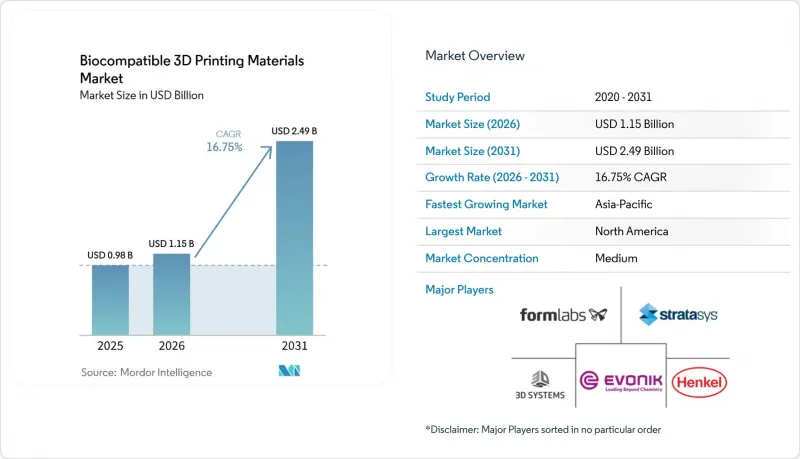
根據 Mordor Intelligence 預測,生物相容性 3D 列印材料的市場規模預計將從 2025 年的 9.8 億美元和 2026 年的 11.5 億美元成長到 2031 年的 24.9 億美元,在 2026 年至 2031 年期間的複合成長率為 16.75%。
本報告按材料類型(聚合物[光敏聚合物等]、金屬、陶瓷等)、形態(粉末、絲狀物等)、技術(槽內光聚合、生物列印等)、應用(植入、組織工程等)、最終用戶(醫院、牙體技術所等)和地區(北美、歐洲等)進行分類。預測值以美元計價。
全球生物相容性3D列印材料市場趨勢與洞察
對病患客製化醫療設備的需求日益成長
生物相容性3D列印材料市場主要由整形外科、顱顏外科和脊椎外科手術驅動,這些手術需要使用傳統製造方法在同等前置作業時間內無法實現的特定形狀。鈦合金,尤其是Ti-6Al-4V,在承重植入中繼續發揮核心作用。其110 GPa的彈性模量比鈷鉻合金和不銹鋼等替代材料更接近皮質骨,從而降低了應力遮蔽的風險。一項2025年的臨床研究也表明,採用積層製造技術製造的多孔Ti-6Al-4V腰椎固定植入在使用過程中提供了良好的初始穩定性和骨骼結合。這提升了能夠將材料的化學特性與預先檢驗的多孔製造參數和相關臨床數據結合的供應商的價值。 Materialise 的生物可吸收聚己內酯氣管和支氣管支架於 2025 年進入美國 FDA 的關鍵性臨床試驗階段。這顯示可吸收聚合物產品距離真正的臨床應用又更近了一步。
數位牙科和椅旁製造的擴展
生物相容性3D列印材料市場也受惠於牙科工作流程的進步,這些進步使得椅旁操作更加便捷,並縮短了以往需要數天的修復週期。這種轉變正在改變材料的包裝和使用方式,因為需求正從集中式實驗室大量生產轉向可控的、可直接用於診所的模式。椅旁系統也提高了材料的消耗頻率,因為材料的消耗是根據就診節奏而非實驗室生產計劃進行的。 Rapid Shape的RS VIVO牙科樹脂產品線於2026年2月獲得FDA批准,鞏固了其作為能夠為義齒和夾板應用提供全面認證工作流程的供應商的地位。在生物相容性3D列印材料市場,這進一步凸顯了符合監管要求的牙科樹脂的重要性,而不僅僅是提供種類繁多的配方。
長期生物相容性和滅菌檢驗週期
在生物相容性3D列印材料市場,供應商在推出受監管應用的新型醫用級配方時,仍面臨漫長的認證週期。當需要進行細胞毒性、致敏性、移植反應、全身毒性和其他評估時,完全符合ISO 10993-1標準可能需要12到18個月。對於擁有完善的法規遵從團隊的大型供應商而言,這種時間負擔尚可承受,但對於致力於新型生物墨水和可生物分解聚合物研發的小規模開發商來說,則是一項挑戰。因此,即使在臨床需求成長速度超過認證能力的領域,產品系列多元化也往往落後。這種限制使得在生物相容性3D列印材料市場中,那些已經擁有完善的文件和檢驗體系的供應商更具優勢。
細分市場分析
截至2025年,聚合物在生物相容性3D列印材料市場中佔比44.31%,而生物墨水和水凝膠預計到2031年將以18.38%的複合年成長率成長。生物相容性3D列印材料產業的這種構成比表明,成熟的聚合物構成了市場基礎,而生物衍生和半生物衍生配方正在推動市場成長。 PEEK和光敏樹脂仍然是牙科、顎顏面外科和整形外科工作流程的核心,因為它們已被納入檢驗的治療方案中。贏創的「VESTAKEEP i4 3DF」作為首款符合ASTM F2026 3D列印標準的植入級PEEK長絲,繼續成為上游工程的關鍵標竿。
隨著臨床項目逐漸接近實際臨床應用,可生物分解聚合物的種類也不斷進步。 Materialise公司所進行的生物可吸收氣管和支氣管支架臨床試驗意義重大,因為它將聚合物的研發從純粹的研究階段推進到正式的FDA核准流程。以鈦和鈦合金為代表的金屬在整形外科和脊椎應用中仍然至關重要,這些應用需要承受長期強度至關重要的負荷。陶瓷在牙科椅旁應用的重要性日益凸顯,而複合材料則繼續應用於助聽器主體和顱顏模型等特定細分市場。因此,即使未來的發展動能轉向生物活性材料,生物相容性3D列印材料市場的收入基礎仍主要依賴成熟的聚合物和金屬。
儘管2025年線材銷售額佔比為38.24%,但預計到2031年,生物墨水的複合年成長率將達到19.52%。生物相容性3D列印材料市場仍高度依賴線材,因為醫用級PEEK材料在整形外科、脊椎和顎顏面領域的應用仍然十分廣泛,FDM和FFF系統的應用基礎依然穩固。贏創的「VESTAKEEP」系列產品充分展現了這種形式的重要性,因為它在一個產品系列中涵蓋了不同的生物植入等級。這種柔軟性使得買家無需更換材料系列即可調整形狀,以適應不同的接觸時間和監管要求。
生物墨水的加速成長源自於其從學術研究階段向系統性臨床前和早期臨床計畫的過渡。在這方面,GelMA及相關水凝膠系統的研究意義重大,已發表的研究表明,這些材料能夠為維持角膜基質細胞和修復角膜等應用創造支持性微環境。這些科學證據支持了「形狀」不再只是「包裝」的概念,而是正在成為生物功能的一部分。儘管生物墨水的臨床應用範圍仍比絲材和液態樹脂窄,但其發展方向已然明確。因此,生物相容性3D列印材料市場將持續專注於提升材料的實用性和細胞支撐能力。
區域分析
到2025年,北美將佔據生物相容性3D列印材料市場36.62%的佔有率,成為目前市場最大的區域參與者。該地區受益於FDA已通過核准的材料和印表機生態系統的高度集中、成熟的醫院即時檢測項目以及臨床採購方和供應商之間的緊密合作。普吉特海灣退伍軍人事務部(VA Puget Sound)的生物列印設施尤其重要,因為它是按照醫院一體化、可直接投入生產的模式建造的,預計將在整個退伍軍人事務部系統中推廣應用。加拿大透過在牙科領域的研究型生物列印和數位化活動做出貢獻,而墨西哥則正在鞏固其作為北美醫療保健供應鏈中鄰近製造地的地位。
預計到2025年,歐洲將佔據相當大的市場佔有率,其特點是監管嚴格、材料科學實力雄厚以及臨床創新基礎穩固。德國、英國和法國引領著該地區的發展,其中德國在工程聚合物和醫用級原料的上游工程方面保持著顯著優勢。 2026年2月,Materialise公司在其CMF產品組合中新增了客製化PEEK植入,並承諾在符合EN ISO 13485認證的生產環境中,於72小時內交貨。法國也因與3D Systems公司合作開發的TISSIUM光聚合神經修復裝置而備受矚目,該裝置於2025年7月成為首個獲得FDA批准的細胞內光聚合植入。
預計到2031年,亞太地區將以19.15%的複合年成長率成長,成為生物相容性3D列印材料市場成長最快的地區。這一成長與生物列印領域投資的增加、牙科行業數位化進程的加速以及人口老化導致整形外科領域需求的擴大密切相關。日本和韓國受惠於高精度製造生態系統,而中國憑藉其規模優勢和政府主導的先進醫療技術舉措,依然佔有重要地位。印度正在發展成為一個注重成本效益的生產中心,生產用於手術導板和骨折固定等應用的線材和顆粒系統。 2025年4月,泰國詩麗吉醫院在臨床環境中成功完成了使用3D列印鈦合金髖關節窩的手術,這表明東南亞的醫療機構正在從可行性檢驗過渡到實際臨床應用。在中東和非洲,海灣合作理事會(GCC)國家的高階需求與其他地區的基礎設施限制之間仍然存在著兩極化的局面。同時,在南美洲,醫用級聚合物和金屬原料的匱乏仍是限制其發展的主要障礙。簡而言之,儘管生物相容性3D列印材料市場正在全球擴張,但其能否被廣泛接受仍然很大程度上取決於當地的檢驗基礎設施和供應鏈的暢通程度。
其他好處:
- Excel格式的市場預測(ME)表
- 3個月的分析師支持
目錄
第1章:引言
- 研究假設和市場定義
- 調查範圍
第2章:調查方法
第3章執行摘要
第4章 市場狀況
- 市場概覽
- 市場促進因素
- 對病患客製化醫療設備的需求日益成長
- 數位牙科和椅旁製造的擴展
- 關於生物相容性材料認證的監管說明
- 加快可消毒列印工作流程的檢驗。
- 即時生產模式的成長
- 贖回壓力使得客製化產品在保證尺寸精準的前提下更具優勢。
- 市場限制因素
- 生物相容性和滅菌性的檢驗週期越來越長。
- 材料跨平台互通性的局限性
- 醫用合格原料高成本
- 印表機、樹脂和後處理步驟之間的製程偏差。
- 供應鏈分析
- 監理情勢
- 技術展望
- 波特五力分析
第5章 市場規模與成長預測
- 依材料類型
- 聚合物
- 光聚合樹脂
- 熱塑性聚合物
- 可生物分解聚合物
- 金屬
- 鈦及鈦合金
- 不銹鋼
- 鈷鉻合金
- 陶瓷
- 氧化鋯
- 氧化鋁
- 其他陶瓷
- 複合材料
- 生物墨水和水凝膠
- 其他材料類型
- 聚合物
- 按形式
- 粉末
- 燈絲
- 液體
- 樹脂
- 生物墨水
- 其他形式
- 透過技術
- 槽內光聚合
- 融合積層製造
- 選擇性雷射燒結
- 多射流建模
- 材料噴射
- 生物列印
- 其他技術
- 透過使用
- 植入和假體
- 原型製作和手術導板
- 組織工程
- 鷹架施工
- 義肢
- 藥物輸送系統
- 手術器械
- 助聽器
- 牙科器械
- 其他用途
- 最終用戶
- 醫院和診所
- 牙體技術所
- 醫療設備製造商
- 契約製造組織
- 其他最終用戶
- 按地區
- 北美洲
- 美國
- 加拿大
- 墨西哥
- 歐洲
- 德國
- 英國
- 法國
- 義大利
- 西班牙
- 其他歐洲國家
- 亞太地區
- 中國
- 日本
- 印度
- 澳洲
- 韓國
- 其他亞太國家
- 中東和非洲
- GCC
- 南非
- 其他中東和非洲國家
- 南美洲
- 巴西
- 阿根廷
- 其他南美國家
- 北美洲
第6章 競爭情勢
- 市場集中度
- 市佔率分析
- 公司簡介
- 3D Biotek, LLC
- 3D Systems, Inc.
- Align Technology, Inc.
- Arkema
- BASF SE
- Carbon, Inc.
- CELLINK AB
- Desktop Metal, Inc.
- DWS Srl
- EOS GmbH
- Evonik Industries AG
- Formlabs Inc.
- Henkel AG and Co. KGaA
- Johnson and Johnson
- Materialise NV
- Prodways Group
- Renishaw plc
- Stratasys Ltd.
第7章 市場機會與未來展望
According to Mordor Intelligence, the biocompatible 3D printing materials market size is projected to expand from USD 0.98 billion in 2025 and USD 1.15 billion in 2026 to USD 2.49 billion by 2031, registering a CAGR of 16.75% between 2026 to 2031.
This report is Segmented by Material Type (Polymers [Photopolymer Resins and More], Metals, Ceramics, and More), Form (Powder, Filament, and More), Technology (Vat Photopolymerization, Bioprinting, and More), Application (Implants, Tissue Engineering, and More), End User (Hospitals, Dental Labs, and More), and Geography (North America, Europe, and More). Forecasts are Provided in Value (USD).
Global Biocompatible 3D Printing Materials Market Trends and Insights
Rising Demand for Patient-Specific Medical Devices
The biocompatible 3D printing materials market is being pulled forward by orthopedic, craniofacial, and spinal procedures that need shapes conventional fabrication cannot match at the same turnaround. Titanium alloy, especially Ti-6Al-4V, remains central in load-bearing implants because its elastic modulus of 110 GPa is closer to cortical bone than cobalt-chrome or stainless steel alternatives, which lowers stress-shielding risk. A 2025 clinical study also showed that porous Ti-6Al-4V lumbar fusion implants produced through additive manufacturing delivered primary stability and favorable bone apposition in use. That is raising the value of suppliers that can pair material chemistry with pre-qualified porous print parameters and supporting clinical data. Materialise's bioresorbable polycaprolactone tracheobronchial splint entered a U.S. FDA pivotal clinical trial in 2025, which shows that resorbable polymer formats are moving closer to active clinical use.
Expansion of Digital Dentistry and Chairside Manufacturing
The biocompatible 3D printing materials market is also gaining from dental workflows that are moving closer to the chairside and reducing multi-day restorative cycles. This shift changes how materials are packaged and used, because demand moves away from centralized laboratory batches and toward controlled, clinic-ready formats. It also lifts material consumption frequency, since chairside systems turn materials over at the pace of appointments rather than lab production schedules. Rapid Shape's RS VIVO dental resin portfolio achieved FDA approval in February 2026, which strengthens the position of suppliers that can offer a full certified workflow across denture and splint applications. In the biocompatible 3D printing materials market, this makes regulatory-ready dental resins more important than simple formulation breadth alone.
Lengthy Biocompatibility and Sterilization Validation Cycles
The biocompatible 3D printing materials market still faces long qualification cycles when a supplier tries to bring a new medical-grade formulation into regulated use. A full ISO 10993-1-compliant evaluation can take 12 to 18 months when cytotoxicity, sensitization, implantation response, systemic toxicity, and other endpoints are required. That time burden is manageable for large suppliers with established regulatory teams, but it is harder for smaller developers working on novel bioinks or biodegradable polymers. The result is slower portfolio diversification, even in areas where clinical demand is moving faster than qualification capacity. This restraint keeps the biocompatible 3D printing materials market tilted toward suppliers that already have documentation depth and validation infrastructure.
Other drivers and restraints analyzed in the detailed report include:
- Regulatory Clarification for Biocompatible Material Qualification
- Faster Validation of Sterilizable Print Workflows
- Limited Cross-Platform Material Interoperability
For complete list of drivers and restraints, kindly check the Table Of Contents.
Segment Analysis
Polymers accounted for 44.31% share of the biocompatible 3D printing materials market size in 2025, while bioinks and hydrogels are projected to grow at an 18.38% CAGR through 2031. In the biocompatible 3D printing materials industry, that split shows a market anchored by established polymers but pulled forward by living and semi-living formulations. PEEK and photopolymer resins remain central across dental, maxillofacial, and orthopedic workflows because they already sit inside validated care pathways. Evonik's VESTAKEEP i4 3DF remains a key upstream reference point as the first ASTM F2026-compliant implant-grade PEEK filament for 3D printing.
Biodegradable polymer formats are advancing as clinical programs move closer to real-world use. Materialise's bioresorbable tracheobronchial splint trial is important because it connects polymer development to a formal FDA pathway rather than a research-only setting. Metals, led by titanium and titanium alloys, remain indispensable in load-bearing orthopedic and spinal applications where long-term strength is non-negotiable. Ceramics are becoming more relevant in chairside dental use, while composites continue to serve targeted niches such as hearing aid shells and craniofacial models. The biocompatible 3D printing materials market therefore keeps its revenue base in proven polymers and metals even as future momentum shifts toward biologically active material classes.
Filament held 38.24% of form revenue in 2025, while bioinks are forecast to expand at a 19.52% CAGR through 2031. The biocompatible 3D printing materials market still leans heavily on filament because the installed base of FDM and FFF systems for medical PEEK remains broad in orthopedic, spinal, and maxillofacial workflows. Evonik's VESTAKEEP range shows why this format stays relevant, because it covers different implantability grades within one product family. That flexibility helps buyers match form factor to contact duration and regulatory need without changing material family.
Bioinks are growing faster because they are moving beyond academic handling and into structured pre-clinical and early clinical programs. Work on GelMA and related hydrogel systems is relevant here, because published research shows these materials can create a supportive microenvironment for stromal keratocyte maintenance and corneal repair applications. That scientific base supports the idea that form is no longer just a packaging issue and is becoming part of biological function. The clinical corridor for bioinks is still narrower than for filament or liquid resins, but the direction of travel is clear. This keeps the biocompatible 3D printing materials market focused on both handling practicality and cell-supportive performance.
Complete Report Scope:
- By Material Type
- Polymers
- Photopolymer Resins
- Thermoplastic Polymers
- Biodegradable Polymers
- Metals
- Titanium and Titanium Alloys
- Stainless Steel
- Cobalt-Chrome Alloys
- Ceramics
- Zirconia
- Alumina
- Other Ceramics
- Composites
- Bioinks and Hydrogels
- Other Material Types
- Polymers
- By Form
- Powder
- Filament
- Liquid
- Resin
- Bioinks
- Other Forms
- By Technology
- Vat Photopolymerization
- Fused Deposition Modeling
- Selective Laser Sintering
- Multi Jet Modeling
- Material Jetting
- Bioprinting
- Other Technologies
- By Application
- Implants and Prosthesis
- Prototyping and Surgical Guides
- Tissue Engineering
- Scaffold Fabrication
- Prosthetics
- Drug Delivery Systems
- Surgical Instruments
- Hearing Aids
- Dental Appliances
- Other Applications
- By End User
- Hospitals and Clinics
- Dental Laboratories
- Medical Device Manufacturers
- Contract Manufacturing Organizations
- Other End Users
- By Geography
- North America
- United States
- Canada
- Mexico
- Europe
- Germany
- United Kingdom
- France
- Italy
- Spain
- Rest of Europe
- Asia-Pacific
- China
- Japan
- India
- Australia
- South Korea
- Rest of Asia-Pacific
- Middle East and Africa
- GCC
- South Africa
- Rest of Middle East and Africa
- South America
- Brazil
- Argentina
- Rest of South America
- North America
Geography Analysis
North America accounted for 36.62% of biocompatible 3D printing materials market share in 2025, giving it the largest regional position in the current market. The region benefits from the deepest concentration of FDA-cleared material-printer ecosystems, mature hospital point-of-care programs, and close interaction between clinical buyers and suppliers. The VA Puget Sound bioprinting facility is especially important because it was built as a hospital-embedded, production-ready model with replication potential across the VA system. Canada contributes through research-linked bioprinting and dental digitalization activity, while Mexico is strengthening its position as a nearby manufacturing base for North American medical supply chains.
Europe held a meaningful share in 2025 and remains defined by regulatory rigor, strong materials science capability, and a dense clinical innovation base. Germany, the UK, and France lead regional development, with Germany holding a major upstream advantage in engineering polymers and medical-grade feedstocks. Materialise added custom-made PEEK implants to its CMF portfolio in February 2026 under EN ISO 13485-certified manufacturing conditions with a 72-hour delivery commitment. France also stands out because TISSIUM's photopolymer nerve repair device, developed with 3D Systems, became the first vat-photopolymerized implant cleared by the FDA in July 2025.
Asia-Pacific is projected to grow at a 19.15% CAGR through 2031, making it the fastest-growing geography in the biocompatible 3D printing materials market. Growth is tied to rising bioprinting investment, faster dental digitization, and a widening base of orthopedic demand across aging populations. Japan and South Korea benefit from high-precision manufacturing ecosystems, while China remains important because of its scale and state-backed activity in advanced medical technologies. India is developing as a cost-focused production base for filament and pellet systems serving surgical guides and fracture fixation use cases. Thailand's Siriraj Hospital showed that Southeast Asian institutions are moving from feasibility work into real clinical deployment when it completed surgery using a point-of-care 3D-printed titanium hip socket in April 2025. The Middle East and Africa remain split between premium GCC demand and infrastructure constraints elsewhere, while South America is still held back mainly by access to qualified medical-grade polymer and metal feedstocks. This means the biocompatible 3D printing materials market is expanding globally, but readiness still depends heavily on local validation infrastructure and supply access.
- 3D Biotek, LLC
- 3D Systems
- Align Technology
- Arkema
- BASF
- Carbon, Inc.
- CELLINK AB
- Desktop Metal
- DWS S.r.l.
- EOS GmbH
- Evonik Industries
- Formlabs Inc.
- Henkel AG and Co. KGaA
- Johnson & Johnson
- Materialise
- Prodways Group
- Renishaw plc
- Stratasys
Additional Benefits:
- The market estimate (ME) sheet in Excel format
- 3 months of analyst support
TABLE OF CONTENTS
1 Introduction
- 1.1 Study Assumptions & Market Definition
- 1.2 Scope of the Study
2 Research Methodology
3 Executive Summary
4 Market Landscape
- 4.1 Market Overview
- 4.2 Market Drivers
- 4.2.1 Rising Demand for Patient-Specific Medical Devices
- 4.2.2 Expansion of Digital Dentistry and Chairside Manufacturing
- 4.2.3 Regulatory Clarification for Biocompatible Material Qualification
- 4.2.4 Faster Validation of Sterilizable Print Workflows
- 4.2.5 Growth in Point-of-Care Production Models
- 4.2.6 Reimbursement Pressure Favoring Lower-Fit-Error Customization
- 4.3 Market Restraints
- 4.3.1 Lengthy Biocompatibility and Sterilization Validation Cycles
- 4.3.2 Limited Cross-Platform Material Interoperability
- 4.3.3 High Cost of Qualified Medical-Grade Feedstocks
- 4.3.4 Process Drift Across Printer, Resin, and Post-Processing Steps
- 4.4 Supply Chain Analysis
- 4.5 Regulatory Landscape
- 4.6 Technological Outlook
- 4.7 Porter's Five Forces Analysis
- 4.7.1 Threat of New Entrants
- 4.7.2 Bargaining Power of Suppliers
- 4.7.3 Bargaining Power of Buyers
- 4.7.4 Threat of Substitutes
- 4.7.5 Intensity of Competitive Rivalry
5 Market Size & Growth Forecasts (Value, USD)
- 5.1 By Material Type
- 5.1.1 Polymers
- 5.1.1.1 Photopolymer Resins
- 5.1.1.2 Thermoplastic Polymers
- 5.1.1.3 Biodegradable Polymers
- 5.1.2 Metals
- 5.1.2.1 Titanium and Titanium Alloys
- 5.1.2.2 Stainless Steel
- 5.1.2.3 Cobalt-Chrome Alloys
- 5.1.3 Ceramics
- 5.1.3.1 Zirconia
- 5.1.3.2 Alumina
- 5.1.3.3 Other Ceramics
- 5.1.4 Composites
- 5.1.5 Bioinks and Hydrogels
- 5.1.6 Other Material Types
- 5.1.1 Polymers
- 5.2 By Form
- 5.2.1 Powder
- 5.2.2 Filament
- 5.2.3 Liquid
- 5.2.4 Resin
- 5.2.5 Bioinks
- 5.2.6 Other Forms
- 5.3 By Technology
- 5.3.1 Vat Photopolymerization
- 5.3.2 Fused Deposition Modeling
- 5.3.3 Selective Laser Sintering
- 5.3.4 Multi Jet Modeling
- 5.3.5 Material Jetting
- 5.3.6 Bioprinting
- 5.3.7 Other Technologies
- 5.4 By Application
- 5.4.1 Implants and Prosthesis
- 5.4.2 Prototyping and Surgical Guides
- 5.4.3 Tissue Engineering
- 5.4.4 Scaffold Fabrication
- 5.4.5 Prosthetics
- 5.4.6 Drug Delivery Systems
- 5.4.7 Surgical Instruments
- 5.4.8 Hearing Aids
- 5.4.9 Dental Appliances
- 5.4.10 Other Applications
- 5.5 By End User
- 5.5.1 Hospitals and Clinics
- 5.5.2 Dental Laboratories
- 5.5.3 Medical Device Manufacturers
- 5.5.4 Contract Manufacturing Organizations
- 5.5.5 Other End Users
- 5.6 By Geography
- 5.6.1 North America
- 5.6.1.1 United States
- 5.6.1.2 Canada
- 5.6.1.3 Mexico
- 5.6.2 Europe
- 5.6.2.1 Germany
- 5.6.2.2 United Kingdom
- 5.6.2.3 France
- 5.6.2.4 Italy
- 5.6.2.5 Spain
- 5.6.2.6 Rest of Europe
- 5.6.3 Asia-Pacific
- 5.6.3.1 China
- 5.6.3.2 Japan
- 5.6.3.3 India
- 5.6.3.4 Australia
- 5.6.3.5 South Korea
- 5.6.3.6 Rest of Asia-Pacific
- 5.6.4 Middle East and Africa
- 5.6.4.1 GCC
- 5.6.4.2 South Africa
- 5.6.4.3 Rest of Middle East and Africa
- 5.6.5 South America
- 5.6.5.1 Brazil
- 5.6.5.2 Argentina
- 5.6.5.3 Rest of South America
- 5.6.1 North America
6 Competitive Landscape
- 6.1 Market Concentration
- 6.2 Market Share Analysis
- 6.3 Company Profiles (includes Global Level Overview, Market Level Overview, Core Segments, Financials as available, Strategic Information, Market Rank/Share, Products and Services, Recent Developments)
- 6.3.1 3D Biotek, LLC
- 6.3.2 3D Systems, Inc.
- 6.3.3 Align Technology, Inc.
- 6.3.4 Arkema
- 6.3.5 BASF SE
- 6.3.6 Carbon, Inc.
- 6.3.7 CELLINK AB
- 6.3.8 Desktop Metal, Inc.
- 6.3.9 DWS S.r.l.
- 6.3.10 EOS GmbH
- 6.3.11 Evonik Industries AG
- 6.3.12 Formlabs Inc.
- 6.3.13 Henkel AG and Co. KGaA
- 6.3.14 Johnson and Johnson
- 6.3.15 Materialise NV
- 6.3.16 Prodways Group
- 6.3.17 Renishaw plc
- 6.3.18 Stratasys Ltd.
7 Market Opportunities & Future Outlook
- 7.1 White-Space and Unmet-Need Assessment

 生物相容性3D列印材料市場:按材料類型、技術相容性、產品形式、應用和最終用戶分類-2026-2032年全球市場預測
 全球生物相容性3D列印材料市場規模、佔有率、趨勢和成長分析報告(2026-2034年)
 2025年生物相容性3D列印材料全球市場報告2026 年至 2032 年生物相容性 3D 列印材料市場(按材料類型、應用、最終用戶產業和地區分類)
 生物相容性 3D 列印材料市場機會、成長動力、產業趨勢分析及 2025 - 2034 年預測
 2030 年生物相容性 3D 列印材料市場預測:按模式、材料類型、技術、應用、最終用戶和地區進行全球分析
 全球生物相容性 3D 列印材料市場:市場規模、佔有率、趨勢分析(按產品、應用和地區)、細分市場預測(2025-2030 年)