


 |
市場調查報告書
商品編碼
2099269
美國現場作業人員技術:市場佔有率分析、行業趨勢和統計數據以及成長預測(2026-2031 年)United States Frontline Worker Technology - Market Share Analysis, Industry Trends & Statistics, Growth Forecasts (2026 - 2031) |
||||||

※ 本網頁內容可能與最新版本有所差異。詳細情況請與我們聯繫。
據 Mordor Intelligence 稱,2025 年美國現場工作人員技術市場價值為 41.2 億美元,預計到 2031 年將從 2026 年的 47.3 億美元成長至 114.2 億美元,預測期(2026-2031 年)的複合年成長率為 19.28%。
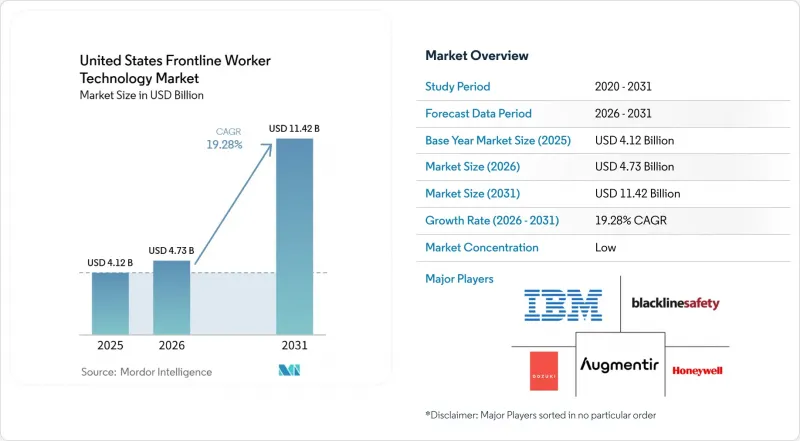
本報告按組件(軟體和服務)、部署方式(雲端等)、組織規模(大型企業和中小企業)、應用領域(員工溝通與互動等)以及最終用戶行業(零售和電子商務、工業製造等)進行細分。市場預測以美元計價。
美國現場工作人員技術市場的趨勢和見解。
對即時現場可視化的需求日益成長
現場工作環境與企業報告系統之間的營運「盲點」仍然是一個重要的成本問題,促使企業將視覺化工具從孤立的試點部署階段推廣到更廣泛的營運階段。斑馬技術公司 (Zebra Technologies) 在 2026 年 6 月報告稱,51% 的美國零售商正在試點使用人工智慧進行庫存最佳化,45% 的零售商正在試點使用人工智慧進行成本最佳化。這兩項工作都依賴從現場流向管理系統的即時數據。這種轉變正在改變業務實踐,因為現在可以將績效與特定地點、班次、任務或事件關聯起來,而無需依賴延遲的每週或每月匯總資料。 2026 年 3 月,Honeywell宣布,在與雪佛龍和道達爾能源的試點營運中,其「Experion Operations Assistant」能夠在事件發生前 5 到 10 分鐘產生警報預測。這表明,早期可視性如何幫助避免停機並使操作員能夠快速回應。因此,買家不再僅僅將視覺化軟體視為在流程故障後產生報告的附加元件,而是將其視為能夠提供直接投資回報的營運管理層。在美國現場工作人員技術市場,這種轉變正在縮短評估週期,因為即使是輕微的延誤也會影響服務水準、工人生產力、庫存準確性或安全性能。
行動優先任務執行的廣泛應用。
對於全美各地的現場工作人員而言,行動裝置正逐漸成為主要的工作流程介面,取代了紙本表格、固定清單和無線指示。現代行動應用程式日益普及的原因在於其支援離線使用、語音輸入、引導式任務路由以及簡化的日常工作流程,從而減輕了那些在辦公桌前工作時間較少的員工的負擔。 2026年1月,Honeywell發布了Performance+ for Guided Work,將語音引導式工作流程工具與分析功能相結合,旨在滿足零售、運輸、物流和醫療保健等行業對更快執行速度和更高現場可視性的需求。微軟發布的《2026年工作趨勢指數》報告顯示,從2025年3月到2026年3月,Microsoft 365生態系統中活躍的AI代理數量增加了15倍,其中製造業的組織採用率高於其他受訪產業。該研究表明,與單獨使用單一工具相比,管理者對實施的態度、允許實驗的企業文化獎勵等組織因素,對AI所報告的影響的解釋力是其兩倍以上。在美國現場工作人員技術市場,這意味著「行動優先」方法的優勢不僅取決於應用程式本身,而且還很大程度上取決於實施設計和操作規範。
與舊有系統進行高階整合的複雜性
整合的高度複雜性仍然是部署中最明顯的限制之一。這是因為許多公司仍在運作的ERP、倉庫管理、製造和營運系統並非為即時資料交換而設計。當需要透過客製化中間件連接新的現場工具時,專案進度往往會延長,內部IT部門的負擔也會加重,並且難以證明整體擁有成本(TCO)的合理性。這個問題在中型企業市場更為嚴重,因為許多公司缺乏專門的整合工程師,即使是基本的系統連接也必須依賴供應商的服務。正是由於這種負擔,美國現場技術市場中「服務」板塊成為了成長最快的細分市場,因為買家通常不僅需要軟體許可,還需要部署、培訓、工作流程設計和託管支援等一攬子服務。因此,混合部署仍然至關重要,因為許多公司在將基於雲端的通訊、分析或指導應用程式整合到其核心系統的同時,仍然將其保留在本地。能夠降低產品本身整合負擔的供應商,在贏得大規模多站點合約和確保長期合約續約方面具有優勢。
細分市場分析
到2025年,軟體銷售額將占美國現場作業人員技術市場83.47%,佔最大的市場。這一領先地位反映了市場正從分散的單一功能工具穩步轉向整合套件,將通訊、任務執行、分析和安全管理整合到一個統一的操作層中。由於過多的應用程式會導致混亂、延遲部署並影響不同地點的數據一致性,買家越來越希望員工使用的應用程式數量更少。在2026年6月的ZONE大會上,Zebra公司將這一問題稱為“應用程式過載”,強調客戶需要更簡潔的現場數位環境,以減少操作摩擦。從實際角度來看,軟體的優勢在於其作為控制層的作用,能夠連接員工、設備、現場活動和企業決策。
預計2026年至2031年間,服務業將以22.36%的複合年成長率成長,成為美國現場工作人員技術市場中成長最快的細分領域。服務業的優勢源自於工作流程配置、系統整合、使用者培訓以及部署後營運支援等實施工作。許多雇主不會單獨購買軟體,因為實施的成功往往取決於流程設計、使用者支援、政策協調以及合約簽訂後的持續最佳化。這一點在跨多個地點的大規模部署中尤其明顯,因為不同地點的員工工作流程、硬體狀況、語言要求和系統準備情況各不相同。因此,對於旨在提高客戶留存率、深化客戶滲透率並實現更好實施效果的供應商而言,持續業務收益變得越來越重要。因此,儘管目前的收入主導來自軟體,但未來的價值佔有率將擴大來自使軟體大規模運作所需的各項服務。
到2025年,基於雲端的採用將佔總營收的82.63%,預計到2031年將以19.84%的複合年成長率成長,繼續在美國現場工作人員技術市場佔據核心地位。這一地位反映了零售商、物流供應商、醫療保健網路以及以現場運營為中心的組織的需求,這些組織需要管理眾多地點並在所有地點之間共用數據。雲端交付減少了為每個倉庫、商店、診所、工廠和服務地點維護獨立本地環境所帶來的基礎設施重複建設。它也非常適合基於訂閱的支出模式,使用戶能夠輕鬆接觸平台並長期管理軟體更新。對於許多買家而言,採用雲端現在是將現場工具擴展到眾多業務地點的最實用方式,而無需在每個地點重建本地IT支援。
隨著許多大型企業在MES、EHR、POS和ERP等核心系統周圍持續添加基於雲端的通訊和分析層,同時保留這些核心系統在本地運行,混合部署仍然至關重要。這種分層方法使企業能夠在不立即替換根深蒂固的業務系統的情況下實現員工工作流程的現代化。總體而言,本地部署的市場佔有率正在下降。然而,在需要更嚴格的本地控制(例如由於員工活動資料、採購規則或安全要求)的環境中,本地部署仍然具有重要意義。微軟的《2026年工作趨勢指數》報告顯示,從2025年3月到2026年3月,Microsoft 365生態系統中活躍的AI代理數量增加了15倍,這顯示下一波自動化浪潮將高度依賴雲端基礎設施。在美國現場工作人員技術產業,部署選擇不再是簡單的「雲端或本地」決策,而是更關注企業如何在不中斷現有營運的情況下快速連接使用者、地點和工作流程。買家越來越傾向於選擇能夠最大限度地減少部署摩擦,同時又能保持對關鍵舊有系統存取的模式。
其他好處:
- Excel格式的市場預測(ME)表
- 3個月的分析師支持
目錄
第1章:引言
- 研究假設和市場定義
- 調查範圍
第2章:調查方法
第3章執行摘要
第4章 市場狀況
- 市場概覽
- 市場促進因素
- 對即時現場可視化的需求日益成長
- 「行動優先」任務執行方式的廣泛應用。
- 在安全至關重要的業務流程中,穿戴式裝置得到了廣泛應用。
- 人工智慧驅動的員工培訓和知識積累
- 跨多個地點的業務運營面臨合規壓力
- 非辦公人員的勞動生產力差距
- 市場限制因素
- 與舊有系統整合的複雜性
- 現場使用者的接受程度和對改變的抗拒情緒
- 對資料隱私和持續監控的擔憂
- 設備耐用性、電池壽命和支援成本方面的限制。
- 產業價值鏈分析
- 宏觀經濟因素對市場的影響
- 監理情勢
- 技術展望
- 波特五力分析
第5章 市場規模與成長預測
- 按組件
- 軟體
- 服務
- 不同的發展
- 基於雲端的
- 混合
- 現場
- 按組織規模
- 大公司
- 小型企業
- 透過使用
- 員工溝通與參與
- 勞動力執行與任務管理
- 人員排班和協調
- 學習與知識應用
- 勞動分析與績效管理
- 安全與合規管理
- 其他用途
- 按最終用戶行業分類
- 零售與電子商務
- 工業製造
- 醫療保健和生命科學
- 運輸/物流
- 飯店業
- 建造
- 政府和公共行政
- 其他行業
第6章 競爭情勢
- 市場集中度
- 策略趨勢
- 市佔率分析
- 公司簡介
- Augmentir, Inc.
- IBM Corporation
- Blackline Safety Corp.
- Dozuki, Inc.
- Honeywell International Inc.
- LumApps
- Tulip Interfaces
- L2L, Inc.
- Microsoft Corporation
- Parsable, Inc.
- Poka Inc.
- PTC Inc.
- QAD Inc.
- RealWear, Inc.
- Salesforce, Inc.
- ServiceNow, Inc.
- Zebra Technologies Corporation
- SAP SE
- Samsara
- WorkJam, Inc.
- Voxware, Inc.
第7章 市場機會與未來展望
According to Mordor Intelligence, the United States frontline worker technology market size was valued at USD 4.12 billion in 2025 and estimated to grow from USD 4.73 billion in 2026 to reach USD 11.42 billion by 2031, at a CAGR of 19.28% during the forecast period (2026-2031).
This report is Segmented by Component (Software, and Services), Deployment Mode (Cloud-Based, and More), Organization Size (Large Enterprises, and Small and Medium Enterprises), Application (Employee Communication and Engagement, and More), and End-User Industry (Retail and E-Commerce, Industrial Manufacturing, and More). The Market Forecasts are Provided in Terms of Value (USD).
United States Frontline Worker Technology Market Trends and Insights
Rising Demand for Real-Time Frontline Visibility
Operational blind spots between frontline work settings and enterprise reporting systems remain a major cost issue, which is pushing companies to move visibility tools from isolated pilots into broader operating use. Zebra Technologies reported in June 2026 that 51% of U.S. retailers were piloting AI for inventory optimization and 45% were piloting it for cost optimization, both of which depend on live data flowing from frontline settings into management systems. This shift is changing management practice because performance can now be linked to a specific site, shift, task, or event instead of relying on delayed weekly or monthly summaries. Honeywell said in March 2026 that Experion Operations Assistant generated alarm predictions 5-10 minutes before incidents during pilot work with Chevron and TotalEnergies, showing how earlier visibility can support avoided downtime and faster operator response. Buyers, therefore, view visibility software as an operating control layer with direct payback rather than as a reporting add-on used after a process failure. In the United States frontline worker technology market, that change is helping compress evaluation cycles in settings where a short delay can affect service levels, worker output, inventory accuracy, or safety performance.
Increasing Adoption of Mobile-First Task Execution
The mobile device is replacing paper forms, static checklists, and radio-based instructions as the main workflow interface for many frontline workers across U.S. operations. Modern mobile applications are gaining traction because they support offline use, voice input, guided task routing, and simple daily workflows that reduce friction for workers who spend little time at a desk. Honeywell launched Performance+ for Guided Work in January 2026, combining voice-directed workflow tools with analytics for retail, transportation, logistics, and healthcare operators that need faster execution and better frontline visibility. Microsoft reported in its 2026 Work Trend Index that active AI agents in the Microsoft 365 ecosystem grew 15x from March 2025 to March 2026, with manufacturing showing deeper deployment per organization than other sectors in the study. The same study said organizational factors such as manager adoption, cultural permission to experiment, and incentives explained more than 2x the reported AI impact compared with individual tool usage alone. For the United States frontline worker technology market, this means the mobile-first advantage depends as much on rollout design and operating discipline as it does on the application itself.
High Integration Complexity with Legacy Systems
High integration complexity remains one of the clearest limits on adoption because many employers still run ERP, warehouse, manufacturing, and operational systems that were not built for real-time exchange. When new frontline tools must connect through custom middleware, project timelines often get longer, internal IT pressure rises, and the total cost of ownership becomes harder to defend. This issue is sharper in the mid-market because many companies do not have dedicated integration engineers and must depend on vendor services for even basic system connectivity. That burden helps explain why services is the fastest-growing component in the United States frontline worker technology market, since buyers often need implementation, training, workflow design, and managed support together with software licenses. Hybrid deployment also remains important for this reason, because many firms keep core systems on-site while layering cloud communication, analytics, or guidance applications around them. Vendors that reduce the integration load inside the product itself are better positioned to secure larger multi-site contracts and renewals over time.
Other drivers and restraints analyzed in the detailed report include:
- AI-Enabled Workforce Guidance and Knowledge Capture
- Expansion of Wearables in Safety-Critical Workflows
- Frontline User Adoption and Change Resistance
For complete list of drivers and restraints, kindly check the Table Of Contents.
Segment Analysis
Software held 83.47% of revenue in 2025, which gave it the largest position in the United States frontline worker technology market share. That lead reflects a steady shift toward unified suites that combine communication, task execution, analytics, and safety management in one operating layer instead of scattered point tools. Buyers increasingly want fewer worker-facing applications because too many apps add confusion, slow adoption, and weaken data consistency across sites. Zebra highlighted this issue as app overload at its June 2026 ZONE conference, pointing to customer demand for simpler frontline digital environments that reduce operating friction. In practical terms, the strength of software comes from its role as the control layer that links workers, devices, site activity, and enterprise decision-making.
Services is projected to expand at 22.36% CAGR from 2026 to 2031, making it the fastest-growing component in the United States frontline worker technology market. The strength of services follows from the implementation work required to configure workflows, connect systems, train users, and support live operations after launch. Many employers are not buying software as a standalone product, because deployment success often depends on process design, user support, policy alignment, and continuing optimization after the contract is signed. This is especially true in large deployments where multi-site rollout creates variation in worker routines, hardware conditions, language needs, and system readiness across locations. As a result, recurring services revenue is becoming more important to vendors that want stronger retention, deeper account penetration, and better deployment outcomes. The component mix is therefore led by software today, but a growing share of future value will come from the services needed to make that software work at scale.
Cloud-based deployment held 82.63% of revenue in 2025 and is projected to grow at 19.84% CAGR through 2031, which keeps it central to the United States frontline worker technology market size. That position reflects the needs of retailers, logistics operators, healthcare networks, and field-intensive organizations that manage many locations and need shared data across all of them. Cloud delivery reduces the infrastructure duplication that would come with maintaining separate local setups for each warehouse, store, clinic, plant, or service branch. It also fits subscription spending models that make platform entry easier and software updates more manageable over time. For many buyers, cloud deployment now represents the most practical way to scale frontline tools across a broad operating footprint without rebuilding local IT support at every site.
Hybrid deployment still has a meaningful role because many large organizations continue to keep core systems such as MES, EHR, POS, or ERP environments on-site while adding cloud communication or analytics layers around them. This layered approach allows companies to modernize worker-facing workflows without forcing immediate replacement of deeply embedded operational systems. On-premises deployment is losing share overall, but it still matters in settings where worker activity data, procurement rules, or security requirements support tighter local control. Microsoft reported in its 2026 Work Trend Index that active AI agents in the Microsoft 365 ecosystem grew 15x from March 2025 to March 2026, reinforcing how strongly the next wave of automation depends on cloud-based infrastructure. Within the United States frontline worker technology industry, deployment choice is now less about a simple cloud versus on-site decision and more about how quickly companies can connect users, sites, and workflows without disrupting existing operations. Buyers are increasingly selecting the model that minimizes rollout friction while preserving access to critical legacy systems.
Complete Report Scope:
- By Component
- Software
- Services
- By Deployment
- Cloud-Based
- Hybrid
- On-Premises
- By Organization Size
- Large Enterprises
- Small and Medium Enterprises
- By Application
- Employee Communication and Engagement
- Workforce Execution and Task Management
- Workforce Scheduling and Coordination
- Learning and Knowledge Enablement
- Workforce Analytics and Performance Management
- Safety and Compliance Management
- Other Applications
- By End-User Industry
- Retail and E-Commerce
- Industrial Manufacturing
- Healthcare and Life Sciences
- Transportation and Logistics
- Hospitality
- Construction
- Government and Public Administration
- Other Industries
List of Companies Covered in this Report:
- Augmentir, Inc.
- IBM Corporation
- Blackline Safety Corp.
- Dozuki, Inc.
- Honeywell International Inc.
- LumApps
- Tulip Interfaces
- L2L, Inc.
- Microsoft Corporation
- Parsable, Inc.
- Poka Inc.
- PTC Inc.
- QAD Inc.
- RealWear, Inc.
- Salesforce, Inc.
- ServiceNow, Inc.
- Zebra Technologies Corporation
- SAP SE
- Samsara
- WorkJam, Inc.
- Voxware, Inc.
Additional Benefits:
- The market estimate (ME) sheet in Excel format
- 3 months of analyst support
TABLE OF CONTENTS
1 INTRODUCTION
- 1.1 Study Assumptions and Market Definition
- 1.2 Scope of the Study
2 RESEARCH METHODOLOGY
3 EXECUTIVE SUMMARY
4 MARKET LANDSCAPE
- 4.1 Market Overview
- 4.2 Market Drivers
- 4.2.1 Rising Demand for Real-Time Frontline Visibility
- 4.2.2 Increasing Adoption of Mobile-First Task Execution
- 4.2.3 Expansion of Wearables in Safety-Critical Workflows
- 4.2.4 AI-Enabled Workforce Guidance and Knowledge Capture
- 4.2.5 Compliance Pressure in Multi-Site Operations
- 4.2.6 Labor Productivity Gap Across Deskless Workforces
- 4.3 Market Restraints
- 4.3.1 High Integration Complexity with Legacy Systems
- 4.3.2 Frontline User Adoption and Change Resistance
- 4.3.3 Data Privacy and Continuous Monitoring Concerns
- 4.3.4 Device Durability, Battery Life, and Support Cost Constraints
- 4.4 Industry Value Chain Analysis
- 4.5 Impact of Macroeconomic Factors on the Market
- 4.6 Regulatory Landscape
- 4.7 Technological Outlook
- 4.8 Porter's Five Forces Analysis
- 4.8.1 Bargaining Power of Buyers
- 4.8.2 Bargaining Power of Suppliers
- 4.8.3 Threat of New Entrants
- 4.8.4 Threat of Substitutes
- 4.8.5 Intensity of Competitive Rivalry
5 MARKET SIZE AND GROWTH FORECASTS (VALUE)
- 5.1 By Component
- 5.1.1 Software
- 5.1.2 Services
- 5.2 By Deployment
- 5.2.1 Cloud-Based
- 5.2.2 Hybrid
- 5.2.3 On-Premises
- 5.3 By Organization Size
- 5.3.1 Large Enterprises
- 5.3.2 Small and Medium Enterprises
- 5.4 By Application
- 5.4.1 Employee Communication and Engagement
- 5.4.2 Workforce Execution and Task Management
- 5.4.3 Workforce Scheduling and Coordination
- 5.4.4 Learning and Knowledge Enablement
- 5.4.5 Workforce Analytics and Performance Management
- 5.4.6 Safety and Compliance Management
- 5.4.7 Other Applications
- 5.5 By End-User Industry
- 5.5.1 Retail and E-Commerce
- 5.5.2 Industrial Manufacturing
- 5.5.3 Healthcare and Life Sciences
- 5.5.4 Transportation and Logistics
- 5.5.5 Hospitality
- 5.5.6 Construction
- 5.5.7 Government and Public Administration
- 5.5.8 Other Industries
6 COMPETITIVE LANDSCAPE
- 6.1 Market Concentration
- 6.2 Strategic Moves
- 6.3 Market Share Analysis
- 6.4 Company Profiles (includes Global Level Overview, Market Level Overview, Core Segments, Financials as available, Strategic Information, Market Rank/Share, Products and Services, Recent Developments)
- 6.4.1 Augmentir, Inc.
- 6.4.2 IBM Corporation
- 6.4.3 Blackline Safety Corp.
- 6.4.4 Dozuki, Inc.
- 6.4.5 Honeywell International Inc.
- 6.4.6 LumApps
- 6.4.7 Tulip Interfaces
- 6.4.8 L2L, Inc.
- 6.4.9 Microsoft Corporation
- 6.4.10 Parsable, Inc.
- 6.4.11 Poka Inc.
- 6.4.12 PTC Inc.
- 6.4.13 QAD Inc.
- 6.4.14 RealWear, Inc.
- 6.4.15 Salesforce, Inc.
- 6.4.16 ServiceNow, Inc.
- 6.4.17 Zebra Technologies Corporation
- 6.4.18 SAP SE
- 6.4.19 Samsara
- 6.4.20 WorkJam, Inc.
- 6.4.21 Voxware, Inc.
7 MARKET OPPORTUNITIES AND FUTURE OUTLOOK
- 7.1 White-Space and Unmet-Need Assessment

 2026年全球數位圖書館市場報告
 時間序列資料庫市場預測至2034年-按部署模式、資料庫類型、資料來源、元件、應用、最終使用者和地區分類的全球分析
 數位發送服務市場:按組件、按組織規模、按行業、按地區分類
 中國現場作業人員技術:市場佔有率分析、產業趨勢與統計及成長預測(2026-2031)印度現場工作人員技術:市場佔有率分析、產業趨勢與統計及成長預測(2026-2031 年)日本現場工作人員技術:市場佔有率分析、產業趨勢與統計及成長預測(2026-2031)法國田間作業人員技術:市場佔有率分析、產業趨勢與統計及成長預測(2026-2031 年)
 雲端解決方案市場:按服務模式、組織規模、部署模式、應用程式和產業分類-2026-2032年全球市場預測亞太地區現場工作人員技術:市場佔有率分析、產業趨勢與統計及成長預測(2026-2031 年)北美現場作業人員技術:市場佔有率分析、產業趨勢與統計及成長預測(2026-2031 年)