


 |
市場調查報告書
商品編碼
2099247
中東和非洲現場工作人員技術:市場佔有率分析、行業趨勢和統計數據以及成長預測(2026-2031 年)Middle East and Africa Frontline Worker Technology - Market Share Analysis, Industry Trends & Statistics, Growth Forecasts (2026 - 2031) |
||||||

※ 本網頁內容可能與最新版本有所差異。詳細情況請與我們聯繫。
根據 Mordor Intelligence 預測,中東和非洲的現場作業人員技術市場規模預計將從 2025 年的 7.1 億美元和 2026 年的 8.4 億美元成長到 2031 年的 25.7 億美元,2026 年至 2031 年的年複合成長率(CAGR)為 25.06%。
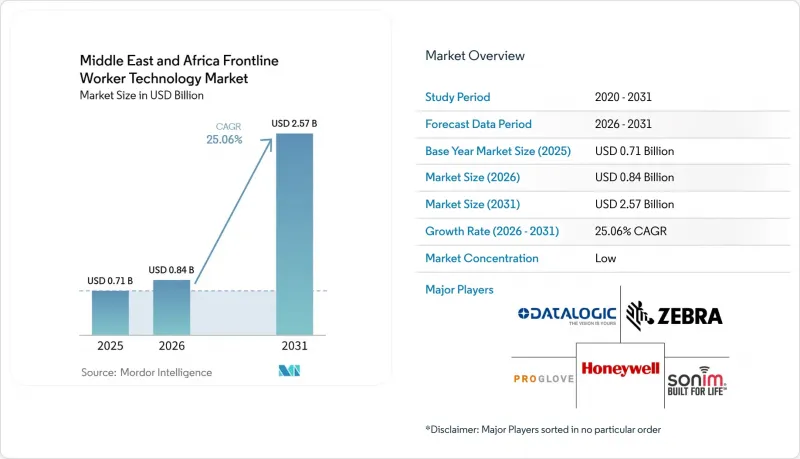
本報告按組件(軟體和服務)、部署方式(雲端、混合、本地部署)、組織規模(大型企業和中小企業)、應用領域(員工溝通與互動等)、最終用戶行業(零售和電子商務等)以及地區進行細分。市場預測以美元計價。
中東和非洲現場作業人員技術市場趨勢和洞察
採用「行動優先」方法實現無辦公桌工作流程的數位化
在中東和非洲,從紙本指令和口頭監督向行動工作流程的轉變仍然是現場作業人員技術市場需求的最大驅動力。根據羅克韋爾自動化2026年的一項調查,沙烏地阿拉伯和阿拉伯聯合大公國98%的製造商認為數位轉型至關重要,40%的員工正在參與技能再培訓項目,高於前一年的30%。這表明數位化正在從核心系統擴展到現場團隊使用的日常操作層面。此外,Mashlek公司在2025年實施SAP Fieldglass系統,用於臨時工管理、服務採購和勞動力管理,這表明受嚴格監管的雇主正在將與現場作業密切相關的勞動力管理流程數位化。因此,能夠快速部署阿拉伯語移動工具並將其部署到眾多分包商地點的供應商,正在中東和非洲的現場作業人員技術市場中佔據更有利的地位。
加強高風險環境下工人安全合規性
在許多高風險環境中,安全合規性是推動市場需求的直接動力,因為現場操作人員現在需要可審計的數位化記錄,而不是手動報告。阿拉伯聯合大公國人力資源和酋長國化部在2025年全球技術展覽會(GITEX Global 2025)上推出了“智慧安全追蹤器”,該追蹤器利用生成式人工智慧來支援工作場所的安全與健康監測。它在公共部門的應用意義重大,因為它提高了受監管行業和公共專案私人雇主的合規標準。類似的壓力也推動了建築、工業和基礎設施領域對安全合規平台的日益關注,因為報告速度和數據品質具有重要的商業性意義。在中東和非洲的現場工作人員技術市場,發展趨勢是將安全工作流程整合到核心營運系統中,而不是將其視為獨立的管理工具。
引入加固型設備會帶來較高的整體擁有成本。
對於小規模買家而言,高效能設備、設備管理、資料通訊套餐、配件和支援等相關成本仍然是一大障礙。在非洲市場,這項挑戰尤其突出,因為許多雇主仍在預算有限且更新周期長的情況下管理其現場移動環境。問題不僅限於初始設備成本;持續的通訊和支援費用也會限制整個員工隊伍的實際採用。雖然供應商正在透過基於 SaaS 的定價和 BYOD(自帶設備)選項來解決這個問題,但這些模式無法完全滿足需要工業級硬體的應用場景。因此,中東和非洲的現場工作人員技術市場仍存在兩極化的局面:一方是資金雄厚的大型企業,另一方則是價格敏感、採用速度較慢的使用者。
細分市場分析
預計到2025年,軟體將在中東和非洲的現場工作人員技術市場佔據77.11%的佔有率,這證實了基於訂閱的授權和SaaS服務仍然是主要的收入來源。這種主導地位反映了無需大量硬體投資即可部署在現有設備上的應用程式的實用價值。在許多現場環境中,買家首先選擇工作流程、通訊和合規性相關的軟體,因為這些工具可以在短時間內帶來實際的營運改善。隨著雇主用行動執行系統取代手動日常任務,這一趨勢確保了軟體在中東和非洲的現場工作人員技術產業中仍然佔據核心地位。
隨著部署和在地化需求的成長,服務業預計將成為成長最快的產業,到2031年複合年成長率將達到26.11%。目前,越來越多的買家需要阿拉伯語配置、多站點部署支援、與薪資核算和EHS(環境、安全和衛生)系統的整合以及部署支援服務。 Firstup在2026年宣布,Forrester的一項研究表明,其員工溝通平台將在三年內實現398%的投資報酬率(ROI)。這表明,供應商為何將分析和託管支援納入其基礎訂閱服務。隨著中東和非洲現場工作人員技術市場的成熟,客戶對可衡量的部署結果和部署後性能的提升提出了更高的要求,因此,服務的豐富性變得日益重要。
預計到2025年,基於雲端的部署方案將佔據69.66%的市場佔有率,成為中東和非洲現場工作人員技術市場中最大的市場佔有率。這反映了市場對更快部署、更輕的基礎設施負擔以及更便捷的分散式團隊更新的需求日益成長。基於雲端的解決方案也非常適合依賴系統連線的工作流程,例如薪資保障和薪資核算,而非孤立的站點層級部署。因此,雲端解決方案正成為中東和非洲現場工作人員技術市場中大多數新計畫的首選。
此外,預計到2031年,雲端運算將以27.44%的複合年成長率保持最高成長率,進一步鞏固其領先地位。同時,混合模式正受到那些需要本地管理敏感員工記錄並滿足特定託管要求的客戶的青睞。 Cority於2024年在沙烏地阿拉伯的Google雲端達曼區域推出了「CorityOne EHS」平台,以滿足本地資料居住要求。這很好地體現了供應商如何調整其基礎設施以滿足本地合規性要求。雖然本地部署模式對於一些公共機構和嚴格控制的環境仍然是一種選擇,但隨著中東和非洲的現場工作人員技術行業向更靈活的交付模式轉變,其作用正在逐漸減弱。
其他好處:
- Excel格式的市場預測(ME)表
- 3個月的分析師支持
目錄
第1章:引言
- 研究假設和市場定義
- 調查範圍
第2章:調查方法
第3章執行摘要
第4章 市場狀況
- 市場概覽
- 市場促進因素
- 採用「行動優先」方法實現無辦公桌工作流程的數位化
- 提高高風險工作環境中的職業安全合規性
- 工業領域企業移動性的擴展
- 即時可視化勞動力狀況和車輛調度擴展
- 在網路連線受限的地區,對支援離線功能的應用程式的需求日益成長。
- 穿戴式和語音控制的免持生產力工具的普及。
- 市場限制因素
- 在穩健的部署環境中,整體擁有成本較高
- 傳統人力資源、環境安全與健康 (EHS) 和現場系統之間的互通性差距。
- 區域城市和偏遠地區數位基礎設施的差異
- 資料主權和設備管治的複雜性
- 宏觀經濟因素對市場的影響
- 產業價值鏈分析
- 科技趨勢
- 監理情勢
- 波特五力分析
第5章 市場規模與成長預測
- 按組件
- 軟體
- 服務
- 不同的發展
- 基於雲端的
- 混合
- 現場
- 按組織規模
- 大公司
- 小型企業
- 透過使用
- 員工溝通與參與
- 勞動力執行與任務管理
- 人員排班和協調
- 學習與知識應用
- 勞動分析與績效管理
- 安全與合規管理
- 其他用途
- 按最終用戶行業分類
- 零售與電子商務
- 工業製造
- 醫療保健和生命科學
- 運輸/物流
- 飯店業
- 建造
- 政府和公共行政
- 其他行業
- 按地區
- 中東
- 沙烏地阿拉伯
- 阿拉伯聯合大公國
- 土耳其
- 其他中東國家
- 非洲
- 南非
- 奈及利亞
- 埃及
- 其他非洲國家
- 中東
第6章 競爭情勢
- 市場集中度
- 策略趨勢
- 市佔率分析
- 公司簡介
- Beekeeper AG
- Firstup, Inc.
- Staffbase GmbH
- WorkJam, Inc.
- Axonify Inc.
- YOOBIC SAS
- Connecteam Ltd.
- Quinyx AB
- LumApps SAS
- Poppulo Limited
- Speakap BV
- Claromentis Limited
- Sociabble SAS
- Happeo Oy
- Blinking Owl Limited
- Flip GmbH
- Simpplr, Inc.
- Workvivo Limited
- Snappii, Inc.
- Connecteer, Inc.
- Eletive AB
- Interaction Ltd.
- Jolt Software, Inc.
- Opterus Inc.
- Mambo.IO Ltd.
第7章 市場機會與未來展望
According to Mordor Intelligence, the Middle East and Africa frontline worker technology market size is projected to expand from USD 0.71 billion in 2025 and USD 0.84 billion in 2026 to USD 2.57 billion by 2031, registering a CAGR of 25.06% between 2026 and 2031.
This report is Segmented by Component (Software, and Services), Deployment (Cloud-Based, Hybrid, and On-Premises), Organization Size (Large Enterprises, and Small and Medium Enterprises), Application (Employee Communication and Engagement, and More), End-User Industry (Retail and E-Commerce, and More), and Geography. The Market Forecasts are Provided in Terms of Value (USD).
Middle East and Africa Frontline Worker Technology Market Trends and Insights
Mobile-First Digitization of Deskless Workflows
The shift from paper instructions and verbal supervision to mobile workflows remains the strongest force behind demand in the Middle East and Africa frontline worker technology market. Rockwell Automation's 2026 survey showed that 98% of manufacturers in Saudi Arabia and the UAE viewed digital transformation as essential, and 40% of employees were in reskilling programs, up from 30% a year earlier. This shows that digitization is moving beyond core systems and into the daily execution layer used by frontline teams. Mashreq's 2025 rollout of SAP Fieldglass across contingent worker management, services procurement, and staffing management also showed that highly regulated employers are digitizing workforce processes that sit close to field operations. As a result, vendors that can deploy mobile tools quickly in Arabic and across many subcontractor locations are in a stronger position in the Middle East and Africa frontline worker technology market.
Rising Worker Safety Compliance in High-Risk Sites
Safety compliance has become a direct demand driver, as site operators now need auditable digital records rather than manual reporting in many high-risk environments. The UAE Ministry of Human Resources and Emiratisation introduced its Smart Safety Tracker at GITEX Global 2025, using generative AI to support occupational health and safety monitoring across work sites. This matters because public-sector adoption raises the compliance standard for private employers that serve regulated sectors or public projects. The same pressure is lifting interest in safety and compliance platforms across construction, industrial, and infrastructure sites where reporting speed and data quality now carry commercial consequences. In the Middle East and Africa frontline worker technology market, this has pushed safety workflows closer to core operating systems rather than keeping them as separate administrative tools.
High Total Cost of Ownership for Ruggedized Deployments
The cost of rugged devices, device management, data plans, accessories, and support remains a real barrier for smaller buyers. This challenge is sharper in African markets where many employers still manage field mobility with tight budgets and long replacement cycles. The issue is not only the upfront device bill, because recurring connectivity and support costs can also limit actual usage across a workforce. Vendors are responding with SaaS pricing and bring-your-own-device options, but those models do not fully solve use cases that require industrial-grade hardware. The Middle East and Africa frontline worker technology market, therefore, continues to split between better-funded enterprise buyers and price-sensitive adopters that move more slowly.
Other drivers and restraints analyzed in the detailed report include:
- Expansion of Ruggedized Enterprise Mobility in Industrial Operations
- Growth of Real-Time Workforce Visibility and Dispatching
- Interoperability Gaps Across Legacy HR, EHS, And Field Systems
For complete list of drivers and restraints, kindly check the Table Of Contents.
Segment Analysis
Software held 77.11% of the Middle East and Africa frontline worker technology market in 2025, confirming that subscription licensing and SaaS delivery remain the main revenue drivers. This lead reflects the practical value of applications that can be deployed onto existing devices without large hardware investment. In many field settings, buyers first choose workflow, communication, and compliance software because these tools deliver visible operational improvements in a short period. That pattern keeps software at the center of the Middle East and Africa frontline worker technology industry as employers replace manual routines with mobile execution systems.
Services are projected to record the fastest growth, with a 26.11% CAGR through 2031, as implementation and localization needs rise. More buyers now need Arabic-language setup, multi-site deployment support, integration with payroll and EHS systems, and managed adoption services. Firstup said in 2026 that a commissioned Forrester study found 398% return on investment over 3 years from its workforce communications platform, which shows why vendors are attaching analytics and managed support to the base subscription. As the Middle East and Africa frontline worker technology market matures, service depth is becoming increasingly important, as customers seek measurable adoption and stronger post-deployment performance.
Cloud-based deployment held a 69.66% share in 2025, making it the largest share of the Middle East and Africa frontline worker technology market. This reflects the need for faster rollout, lower infrastructure burden, and easier updates across distributed workforces. Cloud delivery also fits wage protection and payroll-linked workflows that depend on system connectivity rather than isolated site-level installations. The Middle East and Africa frontline worker technology market has therefore moved toward cloud as the default option for most new projects.
Cloud is also projected to post the fastest CAGR of 27.44% through 2031, indicating its lead is still widening. At the same time, hybrid models are gaining support in accounts that need local control over sensitive workforce records or specific hosting requirements. Cority launched its CorityOne EHS platform in Saudi Arabia on Google Cloud's Dammam region in 2024 to meet local data-residency requirements, demonstrating how vendors are adapting their infrastructure to regional compliance expectations. On-premises models remain in the mix for some public and tightly controlled environments, but their role is narrowing as the Middle East and Africa frontline worker technology industry moves to more flexible delivery models.
Complete Report Scope:
- By Component
- Software
- Services
- By Deployment
- Cloud-Based
- Hybrid
- On-Premises
- By Organization Size
- Large Enterprises
- Small and Medium Enterprises
- By Application
- Employee Communication and Engagement
- Workforce Execution and Task Management
- Workforce Scheduling and Coordination
- Learning and Knowledge Enablement
- Workforce Analytics and Performance Management
- Safety and Compliance Management
- Other Applications
- By End-User Industry
- Retail and E-Commerce
- Industrial Manufacturing
- Healthcare and Life Sciences
- Transportation and Logistics
- Hospitality
- Construction
- Government and Public Administration
- Other Industries
- By Geography
- Middle East
- Saudi Arabia
- United Arab Emirates
- Turkey
- Rest of Middle East
- Africa
- South Africa
- Nigeria
- Egypt
- Rest of Africa
- Middle East
List of Companies Covered in this Report:
- Beekeeper AG
- Firstup, Inc.
- Staffbase GmbH
- WorkJam, Inc.
- Axonify Inc.
- YOOBIC SAS
- Connecteam Ltd.
- Quinyx AB
- LumApps SAS
- Poppulo Limited
- Speakap B.V.
- Claromentis Limited
- Sociabble SAS
- Happeo Oy
- Blinking Owl Limited
- Flip GmbH
- Simpplr, Inc.
- Workvivo Limited
- Snappii, Inc.
- Connecteer, Inc.
- Eletive AB
- Interaction Ltd.
- Jolt Software, Inc.
- Opterus Inc.
- Mambo.IO Ltd.
Additional Benefits:
- The market estimate (ME) sheet in Excel format
- 3 months of analyst support
TABLE OF CONTENTS
1 INTRODUCTION
- 1.1 Study Assumptions and Market Definition
- 1.2 Scope of the Study
2 RESEARCH METHODOLOGY
3 EXECUTIVE SUMMARY
4 MARKET LANDSCAPE
- 4.1 Market Overview
- 4.2 Market Drivers
- 4.2.1 Mobile-First Digitization of Deskless Workflows
- 4.2.2 Rising Worker Safety Compliance in High-Risk Sites
- 4.2.3 Expansion of Ruggedized Enterprise Mobility in Industrial Operations
- 4.2.4 Growth of Real-Time Workforce Visibility and Dispatching
- 4.2.5 Demand for Offline-Capable Applications in Connectivity-Constrained Sites
- 4.2.6 Adoption of Wearable and Voice-Enabled Hands-Free Productivity Tools
- 4.3 Market Restraints
- 4.3.1 High Total Cost of Ownership for Ruggedized Deployments
- 4.3.2 Interoperability Gaps Across Legacy HR, EHS, and Field Systems
- 4.3.3 Uneven Digital Infrastructure Across Secondary Cities and Remote Sites
- 4.3.4 Data Sovereignty and Device Governance Complexity
- 4.4 Impact of Macroeconomic Factors on the Market
- 4.5 Industry Value Chain Analysis
- 4.6 Technology Outlook
- 4.7 Regulatory Landscape
- 4.8 Porter's Five Forces Analysis
- 4.8.1 Threat of New Entrants
- 4.8.2 Bargaining Power of Suppliers
- 4.8.3 Bargaining Power of Buyers
- 4.8.4 Threat of Substitutes
- 4.8.5 Intensity of Competitive Rivalry
5 MARKET SIZE AND GROWTH FORECASTS (VALUE)
- 5.1 By Component
- 5.1.1 Software
- 5.1.2 Services
- 5.2 By Deployment
- 5.2.1 Cloud-Based
- 5.2.2 Hybrid
- 5.2.3 On-Premises
- 5.3 By Organization Size
- 5.3.1 Large Enterprises
- 5.3.2 Small and Medium Enterprises
- 5.4 By Application
- 5.4.1 Employee Communication and Engagement
- 5.4.2 Workforce Execution and Task Management
- 5.4.3 Workforce Scheduling and Coordination
- 5.4.4 Learning and Knowledge Enablement
- 5.4.5 Workforce Analytics and Performance Management
- 5.4.6 Safety and Compliance Management
- 5.4.7 Other Applications
- 5.5 By End-User Industry
- 5.5.1 Retail and E-Commerce
- 5.5.2 Industrial Manufacturing
- 5.5.3 Healthcare and Life Sciences
- 5.5.4 Transportation and Logistics
- 5.5.5 Hospitality
- 5.5.6 Construction
- 5.5.7 Government and Public Administration
- 5.5.8 Other Industries
- 5.6 By Geography
- 5.6.1 Middle East
- 5.6.1.1 Saudi Arabia
- 5.6.1.2 United Arab Emirates
- 5.6.1.3 Turkey
- 5.6.1.4 Rest of Middle East
- 5.6.2 Africa
- 5.6.2.1 South Africa
- 5.6.2.2 Nigeria
- 5.6.2.3 Egypt
- 5.6.2.4 Rest of Africa
- 5.6.1 Middle East
6 COMPETITIVE LANDSCAPE
- 6.1 Market Concentration
- 6.2 Strategic Moves
- 6.3 Market Share Analysis
- 6.4 Company Profiles (includes Global Level Overview, Market Level Overview, Core Segments, Financials as available, Strategic Information, Market Rank/Share, Products and Services, Recent Developments)
- 6.4.1 Beekeeper AG
- 6.4.2 Firstup, Inc.
- 6.4.3 Staffbase GmbH
- 6.4.4 WorkJam, Inc.
- 6.4.5 Axonify Inc.
- 6.4.6 YOOBIC SAS
- 6.4.7 Connecteam Ltd.
- 6.4.8 Quinyx AB
- 6.4.9 LumApps SAS
- 6.4.10 Poppulo Limited
- 6.4.11 Speakap B.V.
- 6.4.12 Claromentis Limited
- 6.4.13 Sociabble SAS
- 6.4.14 Happeo Oy
- 6.4.15 Blinking Owl Limited
- 6.4.16 Flip GmbH
- 6.4.17 Simpplr, Inc.
- 6.4.18 Workvivo Limited
- 6.4.19 Snappii, Inc.
- 6.4.20 Connecteer, Inc.
- 6.4.21 Eletive AB
- 6.4.22 Interaction Ltd.
- 6.4.23 Jolt Software, Inc.
- 6.4.24 Opterus Inc.
- 6.4.25 Mambo.IO Ltd.
7 MARKET OPPORTUNITIES AND FUTURE OUTLOOK
- 7.1 White-Space and Unmet-Need Assessment

 2026年全球數位圖書館市場報告
 時間序列資料庫市場預測至2034年-按部署模式、資料庫類型、資料來源、元件、應用、最終使用者和地區分類的全球分析
 數位發送服務市場:按組件、按組織規模、按行業、按地區分類
 中國現場作業人員技術:市場佔有率分析、產業趨勢與統計及成長預測(2026-2031)印度現場工作人員技術:市場佔有率分析、產業趨勢與統計及成長預測(2026-2031 年)日本現場工作人員技術:市場佔有率分析、產業趨勢與統計及成長預測(2026-2031)法國田間作業人員技術:市場佔有率分析、產業趨勢與統計及成長預測(2026-2031 年)
 雲端解決方案市場:按服務模式、組織規模、部署模式、應用程式和產業分類-2026-2032年全球市場預測亞太地區現場工作人員技術:市場佔有率分析、產業趨勢與統計及成長預測(2026-2031 年)北美現場作業人員技術:市場佔有率分析、產業趨勢與統計及成長預測(2026-2031 年)