


 |
市場調查報告書
商品編碼
2097459
西班牙人工智慧能源管理軟體:市場佔有率分析、行業趨勢和統計數據以及成長預測(2026-2031 年)Spain AI-powered Energy Management Software - Market Share Analysis, Industry Trends & Statistics, Growth Forecasts (2026 - 2031) |
||||||

※ 本網頁內容可能與最新版本有所差異。詳細情況請與我們聯繫。
據 Mordor Intelligence 稱,2025 年西班牙人工智慧能源管理軟體市場價值為 9,310 萬美元,預計到 2031 年將從 2026 年的 1.118 億美元成長至 2.969 億美元,預測期(2026-2031 年)的複合年成長率為 21.57%。
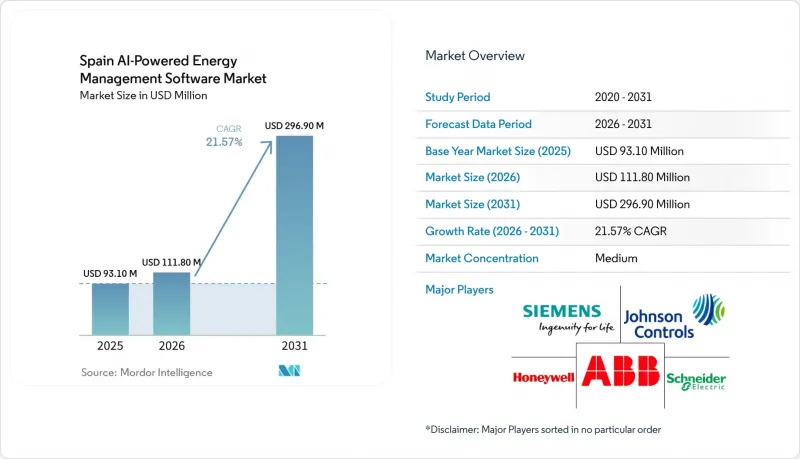
本報告按元件(軟體和服務)、部署模式(雲端、本地部署、混合部署)、應用(例如,能源消耗和需求最佳化、資產性能和預測性維護)以及最終用戶(例如,公共產業、商業建築、工業設施)進行細分。市場預測以美元計價。
西班牙人工智慧能源管理軟體市場的趨勢與洞察
商業和工業設施對即時能源最佳化的需求日益成長。
過去幾年,西班牙商業和工業設施的營運商面臨越來越大的壓力,需要控制能源成本以應對價格波動。這種壓力促使他們更加需要即時監控和自動化控制,因為人工智慧平台無需人工檢查即可檢測尖峰、調整設定並提高日常營運效用。這種方法的價值已在大型設施中得到驗證。例如,Senner 的人工智慧平台已在巴塞隆納會展中心 (Fira de Barcelona) 投入使用,旨在將能耗降低高達 30%。西班牙的人工智慧能源管理軟體市場也受惠於日益成長的需求,即透過軟體而非人工能源監控來管理多種費率方案、尖峰需求罰款和無功功率費用。隨著現場能源決策變得日益複雜,以及屋頂太陽能、熱電聯產和儲能系統在工業設施中的應用,自動化需求不斷成長,這一趨勢變得越發重要。
人工智慧與智慧電網和分散式能源的整合
隨著可再生能源在西班牙經濟中佔比不斷提高,以及對日益複雜的電網管理需求不斷成長,西班牙人工智慧能源管理軟體市場正蓬勃發展。預計到2025年,西班牙可再生能源裝置容量將達到100吉瓦,這將催生對能夠預測、運行儲能系統、靈活管理需求並快速調整分散式資產的軟體的迫切需求。 2025年9月,歐洲投資銀行與Endesa簽署了兩項總額達6.5億歐元(7.02億美元)的貸款協議,用於支持2025年至2027年間智慧電錶、先進變壓器以及電網的全面數位化。這凸顯了西班牙政府對電網智慧化的大力支持。此外,一項利用人工智慧技術支援全國分散式能源(DER)需求聚合和平衡的柔軟性試點計畫正在西班牙的S2F計畫中進行試點,該計畫已獲得生態系統轉型和人口事務部的批准。這些趨勢迫使電力公司向結合即時營運控制和市場導向最佳化的平台轉型,使軟體在西班牙人工智慧驅動的能源管理軟體市場中發揮越來越重要的策略作用。
與傳統OT和IT系統整合的複雜性
西班牙人工智慧能源管理軟體市場面臨的一大挑戰是,電力公司和工業設施廣泛部署了龐大的傳統營運技術(OT)、監控與數據採集(SCADA)和控制系統等底層基礎設施。這些系統並非為與現代應用程式介面(API)和人工智慧(AI)直接整合而設計,通常需要中間件、協定轉換和漫長的檢驗週期。這增加了成本和部署時間,尤其是在擁有多個傳統資產且數位化程度參差不齊的設施中。西班牙戰略能源基礎設施工業網路安全研究所強調了這個問題,反映出西班牙對OT與新型數位層融合所帶來的風險的嚴重擔憂。因此,儘管大型公共產業和跨國公司通常會領先部署,但許多中型工業用戶往往會推遲項目,直到整合風險更容易控制為止。
細分市場分析
預計到2025年,西班牙人工智慧能源管理軟體市場中,軟體部分將佔66.18%的佔有率,且該領域仍將是客戶支出的核心。買家仍然傾向於選擇軟體主導的解決方案,因為這類方案可以將監控、預測、分散式能源資源(DER)協調和報告功能整合到統一的營運層中。這種模式滿足了公用事業公司、工業集團和多站點建築業者的需求,幫助他們提升分散式資產的可視性。與依賴硬體的方案相比,軟體方案還具有更快的功能更新速度和更便捷的擴展性。
在西班牙人工智慧能源管理軟體市場,服務領域仍然是成長最快的細分市場,預計到2031年將以22.61%的複合年成長率成長。隨著許多部署專案需要整合支援、人工智慧模型維護、現場對接以及平台運作後的管理最佳化,對服務的需求正在不斷成長。此外,由於客戶越來越要求供應商對可衡量的節能效果和系統效能承擔責任,基於績效的合約也越來越具吸引力。Schneider Electric於2025年啟動了一項多年舉措,旨在建立下一代基於代理的人工智慧生態系統,用於永續發展和能源管理。該計劃表明,主要供應商正在將其收入重心從軟體授權銷售轉向更長期的服務關係。這種轉變意味著,服務品質的豐富性正成為西班牙人工智慧能源管理軟體市場整體競爭的關鍵因素,其價值遠不止於初始軟體銷售帶來的附加價值。
至2025年,基於雲端的部署方案將佔西班牙人工智慧能源管理軟體市場57.12%的佔有率。這反映了雲端部署方案的規模優勢、較低的初始成本以及便利的遠端管理功能。對於擁有多個設施的營運商而言,雲端工具仍然是一個極具吸引力的選擇,因為它們簡化了更新流程,實現了集中監控,並提供了對全新人工智慧功能的存取。此外,雲端工具與DATADIS等數位資料來源具有高度親和性,外部連線也提升了持續分析的價值。這些優勢使得雲端平台成為商業建築、多站點營運商和中型公共產業公司不可或缺的組成部分。
預計到2031年,混合部署將以22.73%的最高複合年成長率成長,顯示市場正朝著更靈活的架構選項轉變。這種模式對公共產業和工業運營商極具吸引力,他們需要在本地控制敏感的營運數據,同時在增值領域利用雲端分析。西班牙的NIS2強制執行環境和更廣泛的關鍵基礎設施要求正在推動這一趨勢,因為買家既需要性能,也需要本地管治。因此,在西班牙的AI驅動型能源管理軟體市場,能夠支援邊緣+雲端部署(而不僅僅是純雲端部署)的供應商更受青睞。這種轉變意義重大,因為它將重點轉向架構柔軟性、網路安全合規性和應對特定站點合規性的準備工作。
其他好處:
- Excel格式的市場預測(ME)表
- 3個月的分析師支持
目錄
第1章:引言
- 研究假設和市場定義
- 調查範圍
第2章:調查方法
第3章執行摘要
第4章 市場狀況
- 市場概覽
- 市場促進因素
- 商業和工業設施對即時能源最佳化的需求日益成長。
- 人工智慧與智慧電網和分散式能源的整合
- 對自動化需量反應和尖峰負載管理的需求日益成長
- 擴展ESG報表和碳核算工作流程
- 引進邊緣人工智慧技術,實現站點級能源控制和故障檢測
- 由於建築物老化和工業基礎設施老化,維修需求增加。
- 市場限制因素
- 與傳統OT和IT系統整合難度很高。
- 測量層和感測器層的數據品質和互通性存在差距。
- 關鍵能源資產的網路安全和數據主權問題
- 中小型站點負載密度有限,投資報酬率存在不確定性。
- 宏觀經濟因素對市場的影響
- 產業價值鏈分析
- 監理情勢
- 技術展望
- 波特五力分析
第5章 市場規模與成長預測
- 按組件
- 軟體
- 服務
- 部署模式
- 基於雲端的
- 現場
- 混合
- 透過使用
- 最佳化能源消耗和需求
- 資產性能和預測性維護
- 智慧電網與分散式能源(DER)的管理
- 可再生能源預測與整合
- 能源交易、定價和市場訊息
- 最終用戶
- 公用事業
- 商業建築
- 工業設施
- 住宅大樓
第6章 競爭情勢
- 市場集中度
- 策略趨勢
- 市佔率分析
- 公司簡介
- Schneider Electric SE
- Siemens AG
- Honeywell International Inc.
- Johnson Controls International plc
- ABB Ltd.
- IBM Corporation
- C3.ai, Inc.
- Uplight, Inc.
- Kraken Technologies Limited
- AutoGrid Systems, Inc.
- EnergyCAP, LLC
- Enel X Srl
- Emerson Electric Co.
- Itron, Inc.
- GE Vernova Inc.
- Delta Electronics, Inc.
- DEXMA Sensors, SLU
- Smarkia, SL
- Linkener, SL
- Neuro Energy, SL
第7章 市場機會與未來展望
According to Mordor Intelligence, the Spain AI-powered energy management software market size was valued at USD 93.1 million in 2025 and estimated to grow from USD 111.8 million in 2026 to reach USD 296.9 million by 2031, at a CAGR of 21.57% during the forecast period (2026-2031).
This report is Segmented by Component (Software, and Services), Deployment Mode (Cloud-Based, On-Premises, and Hybrid), Application (Energy Consumption and Demand Optimization, Asset Performance and Predictive Maintenance, and More), and End User (Utilities, Commercial Buildings, Industrial Facilities, and More). The Market Forecasts are Provided in Terms of Value (USD).
Spain AI-powered Energy Management Software Market Trends and Insights
Rising Need for Real-Time Energy Optimization in Commercial and Industrial Facilities
Commercial and industrial operators in Spain have remained under pressure to control energy costs following the price disruptions seen over recent years. That pressure is making real-time monitoring and automated control more useful, because AI platforms can detect peaks, adjust setpoints, and improve daily operating efficiency without waiting for manual review. Large venues have already shown the value of this approach, including the deployment of Sener's AI platform at Fira de Barcelona, where the target was to reduce energy use by up to 30%. The Spain AI-powered Energy Management Software Market is also benefiting from the growing need to manage multi-tariff contracts, peak-demand penalties, and reactive power charges through software rather than through manual energy oversight. This is becoming increasingly important as industrial sites add rooftop solar, combined heat and power, and storage, making local energy decisions more complex and strengthening demand for automation.
AI Integration with Smart Grids and Distributed Energy Resources
The Spain AI-powered Energy Management Software Market is gaining traction amid the country's need to manage a more complex, renewable-heavy grid. Spain reached 100 GW of installed renewable capacity in 2025, increasing the need for software that can coordinate forecasting, storage dispatch, flexible demand, and distributed assets at much higher speeds. The European Investment Bank and Endesa signed two loans totaling EUR 650 million (USD 702 million) in September 2025 to support smart meters, advanced transformers, and full grid digitalization during 2025-2027, which confirms strong institutional backing for grid intelligence in Spain. Spain's S2F project, approved by the Ministry for Ecological Transition and the Demographic Challenge, is also testing flexibility pilots that support nationwide AI-enabled demand aggregation and DER balancing. These developments are pushing utilities toward platforms that combine real-time operational control with market-facing optimization, thereby raising the strategic role of software in the Spain AI-powered Energy Management Software Market.
High Integration Complexity With Legacy OT and IT Systems
A major challenge in the Spain AI-powered Energy Management Software Market is the large installed base of older OT, SCADA, and control systems across utilities and industrial sites. These environments were not designed for modern APIs or direct AI integration, so deployments often need middleware, protocol conversion, and long validation cycles. That raises both cost and implementation time, especially for sites with multiple legacy assets and uneven digital readiness. This issue has been highlighted by Spain's industrial cybersecurity laboratory for strategic energy infrastructure, which reflects how seriously the country is treating the risk posed by OT convergence with newer digital layers. The result is that large utilities and multinational operators can often move ahead, while many mid-sized industrial users delay projects until integration risk becomes easier to manage.
Other drivers and restraints analyzed in the detailed report include:
- Increasing Demand for Automated Demand Response and Peak Load Management
- Expansion of ESG Reporting and Carbon Accounting Workflows
- Data Quality and Interoperability Gaps Across Metering and Sensor Layers
For complete list of drivers and restraints, kindly check the Table Of Contents.
Segment Analysis
Software accounted for 66.18% of the Spain AI-powered Energy Management Software Market in 2025, keeping this segment at the center of customer spending. Buyers continue to prefer software-led solutions because they can combine monitoring, forecasting, DER coordination, and reporting into a single operating layer. This model meets the needs of utilities, industrial groups, and multi-site building operators seeking stronger visibility across dispersed assets. It also supports faster feature updates and easier scaling than hardware-dependent approaches.
The Spain AI-powered Energy Management Software Market is still seeing faster growth in services, with this segment projected to expand at a CAGR of 22.61% through 2031. Service demand is rising because many deployments now need integration support, AI model maintenance, site onboarding, and managed optimization after the platform goes live. Outcome-based contracts are also becoming more attractive as customers ask vendors to share responsibility for measured savings and system performance. Schneider Electric's 2025 multi-year initiative to build a next-generation agentic AI ecosystem for sustainability and energy management shows how major suppliers are broadening their revenue focus beyond licenses and into longer service relationships. This shift means service depth is becoming a competitive factor across the Spain AI-powered Energy Management Software Market, not just an add-on to the initial software sale.
Cloud-based deployment held 57.12% of the Spain AI-powered Energy Management Software Market share in 2025, reflecting its scale, lower upfront costs, and easier remote management. Cloud tools remain attractive for operators with multiple facilities because they simplify updates, enable centralized oversight, and provide access to new AI capabilities. They also align well with digital data sources such as DATADIS, where external connectivity improves the value of continuous analytics. These advantages keep cloud platforms important for commercial buildings, multi-site operators, and mid-sized utilities.
Hybrid deployment is projected to record the fastest CAGR of 22.73% through 2031, indicating that the market is moving toward more flexible architectural choices. This model appeals to utilities and industrial operators that need local control over sensitive operational data while still using cloud analytics, where it adds value. Spain's NIS2 enforcement environment and broader critical infrastructure requirements are strengthening that preference, because buyers want both performance and local governance. The Spain AI-powered Energy Management Software Market is, therefore, rewarding vendors that can support edge-plus-cloud deployments rather than a cloud-only approach. That change is important because it shifts the focus to architectural flexibility, cybersecurity fit, and site-specific compliance readiness.
Complete Report Scope:
- By Component
- Software
- Services
- By Deployment Mode
- Cloud-Based
- On-Premises
- Hybrid
- By Application
- Energy Consumption and Demand Optimization
- Asset Performance and Predictive Maintenance
- Smart Grid and Distributed Energy Resource (DER) Management
- Renewable Energy Forecasting and Integration
- Energy Trading, Pricing and Market Intelligence
- By End User
- Utilities
- Commercial Buildings
- Industrial Facilities
- Residential Buildings
List of Companies Covered in this Report:
- Schneider Electric SE
- Siemens AG
- Honeywell International Inc.
- Johnson Controls International plc
- ABB Ltd.
- IBM Corporation
- C3.AI, Inc.
- Uplight, Inc.
- Kraken Technologies Limited
- AutoGrid Systems, Inc.
- EnergyCAP, LLC
- Enel X S.r.l.
- Emerson Electric Co.
- Itron, Inc.
- GE Vernova Inc.
- Delta Electronics, Inc.
- DEXMA Sensors, S.L.U.
- Smarkia, S.L.
- Linkener, S.L.
- Neuro Energy, S.L.
Additional Benefits:
- The market estimate (ME) sheet in Excel format
- 3 months of analyst support
TABLE OF CONTENTS
1 INTRODUCTION
- 1.1 Study Assumptions and Market Definition
- 1.2 Scope of the Study
2 RESEARCH METHODOLOGY
3 EXECUTIVE SUMMARY
4 MARKET LANDSCAPE
- 4.1 Market Overview
- 4.2 Market Drivers
- 4.2.1 Rising Need for Real-Time Energy Optimization in Commercial and Industrial Facilities
- 4.2.2 AI Integration With Smart Grids and Distributed Energy Resources
- 4.2.3 Increasing Demand for Automated Demand Response and Peak Load Management
- 4.2.4 Expansion of ESG Reporting and Carbon Accounting Workflows
- 4.2.5 Edge AI Adoption for Site-Level Energy Control and Fault Detection
- 4.2.6 Retrofit Demand From Aging Building and Industrial Infrastructure
- 4.3 Market Restraints
- 4.3.1 High Integration Complexity With Legacy OT and IT Systems
- 4.3.2 Data Quality and Interoperability Gaps Across Metering and Sensor Layers
- 4.3.3 Cybersecurity and Data Sovereignty Concerns for Critical Energy Assets
- 4.3.4 Payback Uncertainty in Small and Mid-Sized Sites With Limited Load Density
- 4.4 Impact of Macroeconomic Factors on the Market
- 4.5 Industry Value-Chain Analysis
- 4.6 Regulatory Landscape
- 4.7 Technological Outlook
- 4.8 Porter's Five Forces Analysis
- 4.8.1 Bargaining Power of Buyers
- 4.8.2 Bargaining Power of Suppliers
- 4.8.3 Threat of New Entrants
- 4.8.4 Threat of Substitutes
- 4.8.5 Intensity of Competitive Rivalry
5 MARKET SIZE AND GROWTH FORECASTS (VALUE)
- 5.1 By Component
- 5.1.1 Software
- 5.1.2 Services
- 5.2 By Deployment Mode
- 5.2.1 Cloud-Based
- 5.2.2 On-Premises
- 5.2.3 Hybrid
- 5.3 By Application
- 5.3.1 Energy Consumption and Demand Optimization
- 5.3.2 Asset Performance and Predictive Maintenance
- 5.3.3 Smart Grid and Distributed Energy Resource (DER) Management
- 5.3.4 Renewable Energy Forecasting and Integration
- 5.3.5 Energy Trading, Pricing and Market Intelligence
- 5.4 By End User
- 5.4.1 Utilities
- 5.4.2 Commercial Buildings
- 5.4.3 Industrial Facilities
- 5.4.4 Residential Buildings
6 COMPETITIVE LANDSCAPE
- 6.1 Market Concentration
- 6.2 Strategic Moves
- 6.3 Market Share Analysis
- 6.4 Company Profiles (includes Global Level Overview, Market Level Overview, Core Segments, Financials as available, Strategic Information, Market Rank/Share, Products and Services, Recent Developments)
- 6.4.1 Schneider Electric SE
- 6.4.2 Siemens AG
- 6.4.3 Honeywell International Inc.
- 6.4.4 Johnson Controls International plc
- 6.4.5 ABB Ltd.
- 6.4.6 IBM Corporation
- 6.4.7 C3.ai, Inc.
- 6.4.8 Uplight, Inc.
- 6.4.9 Kraken Technologies Limited
- 6.4.10 AutoGrid Systems, Inc.
- 6.4.11 EnergyCAP, LLC
- 6.4.12 Enel X S.r.l.
- 6.4.13 Emerson Electric Co.
- 6.4.14 Itron, Inc.
- 6.4.15 GE Vernova Inc.
- 6.4.16 Delta Electronics, Inc.
- 6.4.17 DEXMA Sensors, S.L.U.
- 6.4.18 Smarkia, S.L.
- 6.4.19 Linkener, S.L.
- 6.4.20 Neuro Energy, S.L.
7 MARKET OPPORTUNITIES AND FUTURE OUTLOOK
- 7.1 White-Space and Unmet-Need Assessment

 2034年人工智慧市場在發電領域的預測-按組件、部署模式、人工智慧技術、電源、應用、企業規模、最終用戶和地區分類的全球分析
 全球能源電力領域人工智慧(AI)市場:機會與策略展望(至2035年)
 中國人工智慧能源管理軟體:市場佔有率分析、產業趨勢與統計及成長預測(2026-2031)中東和非洲人工智慧能源管理軟體:市場佔有率分析、行業趨勢和統計數據以及成長預測(2026-2031 年)中東地區人工智慧能源管理軟體:市場佔有率分析、行業趨勢和統計數據以及成長預測(2026-2031 年)南美洲人工智慧能源管理軟體:市場佔有率分析、行業趨勢和統計數據以及成長預測(2026-2031 年)印度人工智慧能源管理軟體:市場佔有率分析、行業趨勢和統計數據以及成長預測(2026-2031 年)德國人工智慧能源管理軟體:市場佔有率分析、行業趨勢和統計數據以及成長預測(2026-2031 年)新加坡人工智慧能源管理軟體:市場佔有率分析、行業趨勢和統計數據以及成長預測(2026-2031 年)日本人工智慧能源管理軟體:市場佔有率分析、產業趨勢與統計及成長預測(2026-2031)