


 |
市場調查報告書
商品編碼
2099080
銀行、金融服務和保險(BFSI)行業的人才管理:市場佔有率分析、行業趨勢和統計數據以及成長預測(2026-2031 年)Talent Management In BFSI - Market Share Analysis, Industry Trends & Statistics, Growth Forecasts (2026 - 2031) |
||||||

※ 本網頁內容可能與最新版本有所差異。詳細情況請與我們聯繫。
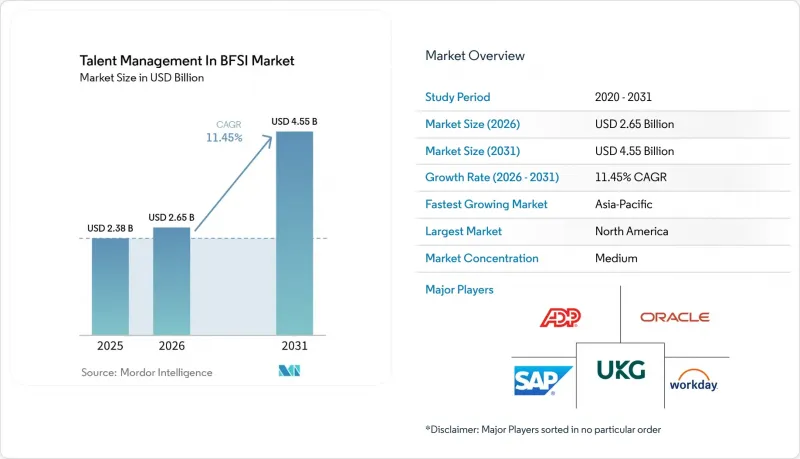
根據 Mordor Intelligence 預測,BFSI 產業的人才管理市場規模預計將在 2025 年達到 23.8 億美元,到 2031 年達到 45.5 億美元,2026 年至 2031 年的複合年成長率為 11.45%。
本報告按元件(軟體和服務[專業服務、支援和維護服務])、應用(效能管理、其他)、部署方式(本地部署、其他)、組織規模(大型企業、中小企業[SME])、最終用戶(銀行、保險公司、其他)和地區進行細分。市場預測以美元計價。
銀行、金融服務和保險 (BFSI) 行業人才管理市場的全球趨勢和洞察
擴大人工智慧驅動的人才分析的應用
到2026年,人工智慧驅動的分析將成為銀行、金融服務和保險(BFSI)人才管理市場最顯著的差異化因素之一,它將使人力資源部門能夠從例行報告轉向持續的人才監控。德勤的研究表明,截至2024年,美國主要金融服務機構中僅有18%的高階主管在其人才管理營運中應用了生成式人工智慧,凸顯了人力資源工作流程中人工智慧應用的巨大空間,而行銷和銷售領域的應用率則高達47%。Accenture的報告指出,實施人工智慧驅動的人力資源專案的領先BFSI機構,其人力資源效率提高了45%,重點技能熟練度提高了30%,內部招聘率提高了40%。隨著這些工具的日趨成熟,銀行和保險公司正在利用它們將績效指標、員工敬業度指標和勞動力市場變化整合到一個統一的視圖中,從而更快地發現員工流失風險並更有效地進行人才規劃。這項轉變意義重大,因為人工智慧和數據相關技術在金融業的應用速度遠超過許多公司招募人才的速度。因此,銀行、金融服務和保險(BFSI)行業的人才管理對技能圖譜、內部轉移工具和基於實證的能力發展工作流程的需求日益成長。隨著BFSI雇主尋求在組織內長期留住稀缺人才,繼任計畫、薪資基準、學習和職位準備追蹤等領域的需求也隨之增加。
「數位優先」招募方式的日益普及
數位化優先的招募模式正在改變銀行、金融服務和保險(BFSI)產業的招募方式,提升招募速度、候選人覆蓋範圍和甄選品質。Accenture的報告顯示,匯豐銀行基於SAP SuccessFactors和Eightfold.ai的AI驅動型人才招募轉型,將營運成本降低了18%,節省了2,850萬美元,並將招募時間縮短了35%。該模式將招募流程從單純的履歷篩選轉變為基於工作流程的評估,在流程早期就融入了行為徵兆、技能傾向和職位匹配度指標。此外,行動優先的招聘負責人能夠觸及中小城市的候選人,這些地區對分店、營運和服務職位的需求正在迅速成長,超出了傳統招聘人員的覆蓋範圍,從而支持企業在主要金融中心之外的業務拓展。沃特斯·克魯維爾指出,到2026年,超過33%的金融服務公司將把「人才短缺」列為採用AI的主要障礙。這表明,招聘效率與各金融機構整體轉型的速度直接相關。
碎片化的傳統人力資源系統
在銀行、金融服務和保險(BFSI)行業,分散的傳統人力資源系統仍然是人才管理中最明顯的結構性障礙,因為它們會損害資料一致性並加劇現代化預算的壓力。 Zararis 的研究表明,大型銀行仍然並行運行多個薪資核算系統,導致數據定義不一致,並增加了處理延遲和錯誤的風險。 Workday 的研究顯示,40% 的金融服務業主管表示存在人力資源資料孤島,65% 的高階主管認為需要更好的技術來整合不同系統的資料。這種分散化會減緩技能映射、薪酬管治、績效可見度和審計準備工作,從而降低即使是最先進的人工智慧解決方案的實際價值。貝恩公司也指出,金融服務業的現代化專案需要在技術、流程和文化方面進行協調轉型,而那些已經整合這些工作的公司,其財務流程的平均工時減少了 22%。資金籌措問題仍然是一個迫切的挑戰。根據 Dunnixer 發布的 2026 年報告,許多金融機構超過 75% 的 IT 預算仍用於過時的系統,導致 BFSI 產業在人才管理新平台方面的投資空間有限。
細分市場分析
截至2025年,軟體將佔據銀行、金融服務和保險(BFSI)行業人才管理市場佔有率的66.41%,但預計到2031年,服務業將以13.92%的複合年成長率(CAGR)實現最高成長。軟體佔據主導地位的原因在於,買家越來越傾向於訂閱式平台,這些平台允許他們持續添加分析、人工智慧代理和合規工具,而無需逐週期地重新部署。雲端交付的普及也使得本地銀行和合作社更容易獲得雲端服務,而這些機構以前無法承擔大規模本地部署環境的成本。服務業成長更快,是因為BFSI產業的部署仍涉及跨多個司法管轄區的複雜遷移、監管合規設定以及營運模式的變更。簡而言之,平台選擇只是BFSI產業人才管理解決方案採購決策的一部分。
此外,人工智慧驅動的招募和績效管理工具的日益普及,要求在更嚴格的管理標準下進行反覆的管治檢查、偏見審查和審計追蹤檢驗,從而提升了支援和維護服務的重要性。 SAP SuccessFactors 在 2026 年上半年的版本週期中引入了強大的工作架構和基於憑證的合規性監控功能,使其在初始軟體部署和長期服務合約方面都更具吸引力。Accenture的研究也發現,採用人工智慧驅動的協作學習模式的銀行掌握技能的速度是依賴獨立培訓的銀行的四倍。這推動了部署過程中對變更支援和工作流程設計的需求成長。這表明,銀行、金融服務和保險 (BFSI) 行業的人才管理與持續的軟體收入和強大的服務層密切相關,而 BFSI 行業的人才管理在很大程度上取決於執行品質和產品廣度。
儘管績效管理預計在2025年將佔據23.14%的市場佔有率,但學習與發展才是銀行、金融服務和保險(BFSI)行業人才管理領域成長最快的領域,預計到2031年將達到12.77%的複合年成長率。隨著基於代理的人工智慧(AI)改變銀行和保險行業的日常運營,學習需求日益成長,迫使雇主以遠超年度培訓計劃的速度更新員工技能。Accenture在2026年報告中指出,透過將學習融入日常工作流程,協作學習模式使金融機構的技能熟練度提高了四倍,員工與人工智慧協作的信心也提高了一倍。這使得學習從單純的輔助活動轉變為支撐生產力和人才持續發展的業務工具。績效管理仍然是最大的應用領域,因為它已在受監管的職位和高度管控的組織中廣泛應用。
隨著供應商逐漸摒棄年度績效考核週期,轉而採用即時貢獻指標和管理者主導的指導,這些工具的使用方式也在改變。 Workday 的「人才管理代理」是基於目前的貢獻資料產生以證據為基礎的績效建議,而 SAP 的「績效代理」則分析績效模式,並提出後續行動建議。繼任計畫的重要性也日益凸顯。 Wolters Kluwer 的報告顯示,預計未來 10 年內將有 40% 的財務顧問退休,而目前超過 25% 的財務顧問尚未制定繼任計畫。銀行、金融服務和保險 (BFSI) 行業人才管理整體可變薪酬規則、內部調動以及更嚴格的文檔要求等方面的變化,正在重塑薪酬管理和人才規劃。
區域分析
到2025年,北美將佔據銀行、金融服務和保險(BFSI)行業人才管理市場佔有率的36.11%。該地區之所以仍保持最大佔有率,是因為大型銀行、保險公司和資產管理公司已經擁有相當可觀的人力資源技術預算,使其能夠比許多其他競爭對手更快地採用人工智慧和分析功能。沃特斯·克魯爾(Walters Cruwer)的報告顯示,美國銀行業目前缺少35萬名數位化人才,隨著人工智慧取代更多常規工作,華爾街銀行未來3-5年內可能會裁員20萬人。在這種情況下,技能再培訓、內部調動和繼任計畫仍然是BFSI產業人才管理的關鍵挑戰。德勤也強調,監管機構持續關注控制職能部門人員配置的合理性,這推動了對能夠更好地整合員工記錄和管治的人力資源系統的持續需求。
亞太地區是銀行、金融服務和保險(BFSI)產業人才管理成長最快的地區,預計到2031年複合年成長率將達到13.09%。該地區正迅速擴張,印度、東南亞、中國、韓國、澳洲和日本的金融機構正以傳統人力資源系統難以跟上的速度增加數位化相關職位。根據People Matters統計,印度的BFSI產業擁有超過2萬家金融機構,員工超過850萬人,但許多公司仍承認,員工的準備程度落後於轉型意願。這種準備程度的差距使得雲端原生、行動優先的平台在BFSI人才管理中具有顯著優勢,這些平台支援技能映射、學習管理和區域特定工作流程。
由於歐洲嚴格的監管以及金融從業人員持續大量集中在英國、德國、法國和北歐國家,歐洲在銀行、金融服務和保險(BFSI)行業的人才管理中佔據著舉足輕重的地位。 WTW指出,英國可變薪酬規則的調整增加了對更完善的薪酬管理工具的需求。同時,德國預計到2025年將有超過42,000個金融相關職缺,這將推動對基於技能的招募和內部調動系統的需求。南美、中東和非洲的規模雖然仍然較小,但隨著當地銀行和金融科技公司採用數位化招募和學習平台來支援員工隊伍擴張和在地化目標,它們的重要性正在日益提升。這凸顯了區域格局的複雜性:北美目前佔據主導地位,亞太地區引領成長速度,而歐洲則承擔BFSI產業人才管理的大部分合規負擔。
其他好處:
- Excel格式的市場預測(ME)表
- 3個月的分析師支持
目錄
第1章:引言
- 研究假設和市場定義
- 調查範圍
第2章:調查方法
第3章執行摘要
第4章 市場狀況
- 市場概覽
- 市場促進因素
- 「數位化優先」招募實踐的擴展
- 勞動力合規性監理壓力不斷加大
- 在新興市場拓展銀行、金融服務和保險業務
- 擴大人工智慧驅動的人才分析的應用
- 對專業技術人才的競爭日益激烈
- 向基於技能的內部轉移框架過渡
- 市場限制因素
- 分散的傳統人力資源系統
- 跨國人才資料流動中的資料隱私問題
- 區域性銀行和保險公司人力資源技術預算的限制
- 人力資源數據標準化面臨的挑戰
- 產業價值鏈分析
- 監理情勢
- 技術展望
- 宏觀經濟因素對市場的影響
- 波特五力分析
第5章 市場規模與成長預測
- 按組件
- 軟體
- 服務
- 專業服務
- 支援和維護服務
- 透過使用
- 績效管理
- 學習與技能發展
- 繼任計劃
- 薪資管理
- 招募和人才獲取
- 人員規劃
- 員工敬業度與職涯發展
- 其他人力資源管理應用
- 不同的發展
- 現場
- 雲
- 按組織規模
- 大公司
- 中小企業
- 最終用戶
- 銀行
- 保險
- 資產管理和投資公司
- 金融科技及其他非銀行金融機構
- 按地區
- 北美洲
- 美國
- 加拿大
- 墨西哥
- 南美洲
- 巴西
- 阿根廷
- 其他南美國家
- 歐洲
- 英國
- 德國
- 法國
- 義大利
- 西班牙
- 俄羅斯
- 其他歐洲國家
- 亞太地區
- 中國
- 印度
- 日本
- 韓國
- 澳洲
- 其他亞太國家
- 中東
- 沙烏地阿拉伯
- 阿拉伯聯合大公國
- 土耳其
- 其他中東國家
- 非洲
- 南非
- 奈及利亞
- 其他非洲國家
- 北美洲
第6章 競爭情勢
- 市場集中度
- 策略趨勢
- 市佔率分析
- 公司簡介
- Workday, Inc.
- SAP SE
- Oracle Corporation
- UKG Inc.
- ADP, Inc.
- Ceridian HCM Holding Inc.
- Cornerstone OnDemand, Inc.
- IBM Corporation
- SumTotal Systems, LLC
- Infor, Inc.
- Talentsoft SAS
- PeopleFluent, Inc.
- Paycom Software, Inc.
- Paylocity Holding Corporation
- BambooHR LLC
- The Sage Group plc
- Zoho Corporation Pvt. Ltd.
- Eightfold AI Inc.
- ClearCompany, Inc.
- Darwinbox Digital Solutions Pvt. Ltd.
第7章 市場機會與未來展望
According to Mordor Intelligence, the talent management in BFSI market size was USD 2.38 billion in 2025 and is forecast to reach USD 4.55 billion by 2031, advancing at a CAGR of 11.45% over 2026-2031.
This report is Segmented by Component (Software, and Services [Professional Services, and Support and Maintenance Services]), Application (Performance Management, and More), Deployment (On-Premise, and More), Organization Size (Large Enterprises, and Small and Medium Enterprises [SMEs]), End User (Banking, Insurance, and More), and Geography. The Market Forecasts are Provided in Terms of Value (USD).
Global Talent Management In BFSI Market Trends and Insights
Rising Adoption of AI-Driven Talent Analytics
AI-driven analytics has become one of the clearest differentiators in the talent management market in BFSI in 2026, enabling HR teams to move from periodic reporting to continuous workforce monitoring. Deloitte found that only 18% of senior executives at large U.S. financial services institutions were implementing generative AI in talent functions in 2024, compared with 47% in marketing and sales, underscoring the significant adoption room in HR workflows. Accenture reported that leading BFSI institutions using AI-supported HR programs achieved 45% gains in HR productivity, a 30% improvement in priority skills proficiency, and a 40% increase in internal fill rates. As these tools mature, banks and insurers are using them to connect performance signals, engagement indicators, and labor market changes into a single view, enabling more immediate flight-risk detection and workforce planning. That shift matters because AI and data roles are expanding inside finance faster than many firms can hire, so the talent management in BFSI market is seeing stronger demand for skills graphs, internal mobility tools, and evidence-based development workflows. The result is greater demand across succession planning, compensation benchmarking, learning, and role-readiness tracking as BFSI employers try to retain scarce talent within the organization for longer.
Growing Digital-First Hiring Practices
Digital-first hiring is changing how the talent management in BFSI market handles recruitment speed, candidate reach, and screening quality. Accenture reported that HSBC's AI-enabled talent acquisition transformation, built on SAP SuccessFactors and Eightfold.ai, reduced operating expenses by 18%, generated USD 28.5 million in savings, and improved time-to-hire by 35%. This model shifts hiring away from resume-only filters and toward workflow-based assessments that can incorporate behavioral signals, skill patterns, and job-fit indicators earlier in the process. It also supports expansion beyond major financial hubs because mobile-first funnels can reach candidates in smaller cities where branch, operations, and service roles are growing faster than traditional recruiter coverage. Wolters Kluwer noted in 2026 that more than 33% of financial services firms ranked talent scarcity as their main barrier to AI deployment, which links hiring effectiveness directly to each institution's broader transformation pace.
Fragmented Legacy HR Systems
Fragmented legacy HR systems remain the clearest structural brake on the talent management in BFSI market because they limit data consistency and consume modernization budgets at the same time. Zalaris found that large banks can still operate across multiple payroll environments, leading to inconsistent data definitions and increased risk of delayed or incorrect processing. Workday found that 40% of senior financial services executives reported siloed HR data, and 65% said they needed better technology to integrate data across separate systems. That fragmentation slows skills mapping, compensation governance, performance visibility, and audit readiness, which weakens the practical value of newer AI layers even when firms buy them. Bain also noted that modernization programs in financial services need coordinated changes across technology, processes, and culture, and that firms that integrated these efforts achieved average labor-time reductions of 22% across financial processes. The funding problem remains real because DUNNIXER reported in 2026 that more than 75% of IT budgets in many financial institutions were still being absorbed by older systems, which leaves less room for new platform investment in the talent management in BFSI market.
Other drivers and restraints analyzed in the detailed report include:
- Increasing Regulatory Pressure on Workforce Compliance
- Expansion of BFSI Operations in Emerging Markets
- Data-Privacy Concerns in Cross-Border Talent Data Flows
For complete list of drivers and restraints, kindly check the Table Of Contents.
Segment Analysis
Software held 66.41% of the talent management in BFSI market share in 2025, while services recorded the fastest 13.92% CAGR through 2031. Software leads because buyers increasingly prefer subscription platforms that keep adding analytics, AI agents, and compliance tools without restarting implementation work every cycle. The spread of cloud delivery has also widened access for regional banks and cooperative institutions that previously could not justify large on-premise setups. Services are growing faster because BFSI deployments still involve complex migration, regulatory configuration, and operating model changes across multiple jurisdictions. That means platform selection is only part of the buying decision in the talent management in BFSI market.
Support and maintenance work is also becoming more important because AI-enabled hiring and performance tools require repeated governance checks, bias reviews, and audit-trail validation under tighter control standards. SAP SuccessFactors introduced enriched job architecture and certificate-based compliance monitoring in its H1 2026 release cycle, which strengthens the case for both initial software adoption and longer service relationships. Accenture also found that banks using co-learning models with AI developed skills 4x faster than those relying on stand-alone training, which expands demand for change support and workflow design around deployments. This keeps the talent management in BFSI market tied to recurring software revenue and a strong services layer, and it also shows how the talent management in BFSI industry depends on execution quality as much as product breadth.
Performance management held a 23.14% share in 2025, while learning and development represented the fastest-growing part of the talent management in BFSI market size, at 12.77% CAGR through 2031. Learning demand is rising because agentic AI is changing daily work in banking and insurance, and forcing employers to refresh skills faster than annual training calendars allow. Accenture reported in 2026 that co-learning models helped financial institutions improve skills proficiency 4x faster and doubled employee confidence in AI collaboration when learning was embedded in daily workflows. That changes learning from a support activity into an operational tool for productivity and workforce continuity. Performance management remains the largest application because it is already embedded across regulated roles and control-heavy organizations.
The application itself is changing as vendors move away from annual review cycles and toward live contribution signals and manager prompts. Workday's Talent Management Agent now drafts evidence-based reviews from current contribution data, while SAP's Performance Agent analyzes performance patterns and recommends next actions. Succession planning is also gaining urgency, as Wolters Kluwer reported that 40% of financial advisors are expected to retire within the next decade and that more than 25% currently lack succession plans. Variable-pay rule changes, internal mobility, and stronger documentation needs across the talent management in BFSI market are reshaping compensation management and workforce planning.
Complete Report Scope:
- By Component
- Software
- Services
- Professional Services
- Support and Maintenance Services
- By Application
- Performance Management
- Learning and Development
- Succession Planning
- Compensation Management
- Recruitment and Talent Acquisition
- Workforce Planning
- Employee Engagement and Career Development
- Other Talent Management Applications
- By Deployment
- On-Premise
- Cloud
- By Organization Size
- Large Enterprises
- Small and Medium Enterprises (SMEs)
- By End User
- Banking
- Insurance
- Wealth Management and Investment Firms
- Fintech and Other Non-Bank Financial Institutions
- By Geography
- North America
- United States
- Canada
- Mexico
- South America
- Brazil
- Argentina
- Rest of South America
- Europe
- United Kingdom
- Germany
- France
- Italy
- Spain
- Russia
- Rest of Europe
- Asia-Pacific
- China
- India
- Japan
- South Korea
- Australia
- Rest of Asia-Pacific
- Middle East
- Saudi Arabia
- United Arab Emirates
- Turkey
- Rest of Middle East
- Africa
- South Africa
- Nigeria
- Rest of Africa
- North America
Geography Analysis
North America held 36.11% of the talent management in BFSI market share in 2025. The region remains the largest because major banks, insurers, and wealth managers already maintain sizable HR technology budgets and can add AI and analytics layers faster than most peers. Wolters Kluwer reported that U.S. banking faces a shortage of 350,000 digital workers and that Wall Street banks could eliminate 200,000 roles over 3 to 5 years as AI absorbs more routine work. That combination keeps reskilling, internal mobility, and succession planning high on the agenda across the talent management in BFSI market. Deloitte also highlighted continued supervisory attention on staffing adequacy in control functions, which supports ongoing demand for better workforce records and governance-linked HR systems.
Asia-Pacific represents the fastest-growing regional slice of the talent management in BFSI market size, at 13.09% CAGR through 2031. The region is expanding quickly because institutions across India, Southeast Asia, China, South Korea, Australia, and Japan are adding digital roles faster than legacy HR systems can absorb them. People Matters reported that India's BFSI sector employs more than 8.5 million people across over 20,000 institutions, while many firms still acknowledge that workforce readiness lags transformation ambition. That readiness gap favors cloud-native and mobile-first platforms that can map skills, manage learning, and support localized workflows across the talent management in BFSI market.
Europe holds a significant share of the talent management in BFSI market because regulation is dense and financial-sector workforces remain broad across the UK, Germany, France, and the Nordics. WTW noted that the UK's variable pay rule changes are increasing the need for stronger compensation management tools, while Germany reported more than 42,000 unfilled finance positions in 2025, which is driving demand for skills-based hiring and internal mobility systems. South America, the Middle East, and Africa remain smaller but are becoming more relevant as local banks and fintech firms adopt digital hiring and learning platforms to support workforce expansion and localization targets. This leaves a broad regional picture, with North America setting the current scale, Asia-Pacific setting the growth pace, and Europe setting much of the compliance burden for the talent management in BFSI market.
- Workday, Inc.
- SAP SE
- Oracle Corporation
- UKG Inc.
- ADP, Inc.
- Ceridian HCM Holding Inc.
- Cornerstone OnDemand, Inc.
- IBM Corporation
- SumTotal Systems, LLC
- Infor, Inc.
- Talentsoft S.A.S.
- PeopleFluent, Inc.
- Paycom Software, Inc.
- Paylocity Holding Corporation
- BambooHR LLC
- The Sage Group plc
- Zoho Corporation Pvt. Ltd.
- Eightfold AI Inc.
- ClearCompany, Inc.
- Darwinbox Digital Solutions Pvt. Ltd.
Additional Benefits:
- The market estimate (ME) sheet in Excel format
- 3 months of analyst support
TABLE OF CONTENTS
1 INTRODUCTION
- 1.1 Study Assumptions and Market Definition
- 1.2 Scope of the Study
2 RESEARCH METHODOLOGY
3 EXECUTIVE SUMMARY
4 MARKET LANDSCAPE
- 4.1 Market Overview
- 4.2 Market Drivers
- 4.2.1 Growing Digital-First Hiring Practices
- 4.2.2 Increasing Regulatory Pressure on Workforce Compliance
- 4.2.3 Expansion of BFSI Operations in Emerging Markets
- 4.2.4 Rising Adoption of AI-Driven Talent Analytics
- 4.2.5 Intensifying Competition for Niche Tech Talent
- 4.2.6 Shift Toward Skills-Based Internal Mobility Frameworks
- 4.3 Market Restraints
- 4.3.1 Fragmented Legacy HR Systems
- 4.3.2 Data-Privacy Concerns in Cross-Border Talent Data Flows
- 4.3.3 Limited HR Tech Budgets at Regional Banks and Insurers
- 4.3.4 Talent Data Standardization Challenges
- 4.4 Industry Value Chain Analysis
- 4.5 Regulatory Landscape
- 4.6 Technological Outlook
- 4.7 Impact of Macroeconomic Factors on the Market
- 4.8 Porter's Five Forces Analysis
- 4.8.1 Threat of New Entrants
- 4.8.2 Bargaining Power of Suppliers
- 4.8.3 Bargaining Power of Buyers
- 4.8.4 Threat of Substitutes
- 4.8.5 Competitive Rivalry
5 MARKET SIZE AND GROWTH FORECASTS (VALUE)
- 5.1 By Component
- 5.1.1 Software
- 5.1.2 Services
- 5.1.2.1 Professional Services
- 5.1.2.2 Support and Maintenance Services
- 5.2 By Application
- 5.2.1 Performance Management
- 5.2.2 Learning and Development
- 5.2.3 Succession Planning
- 5.2.4 Compensation Management
- 5.2.5 Recruitment and Talent Acquisition
- 5.2.6 Workforce Planning
- 5.2.7 Employee Engagement and Career Development
- 5.2.8 Other Talent Management Applications
- 5.3 By Deployment
- 5.3.1 On-Premise
- 5.3.2 Cloud
- 5.4 By Organization Size
- 5.4.1 Large Enterprises
- 5.4.2 Small and Medium Enterprises (SMEs)
- 5.5 By End User
- 5.5.1 Banking
- 5.5.2 Insurance
- 5.5.3 Wealth Management and Investment Firms
- 5.5.4 Fintech and Other Non-Bank Financial Institutions
- 5.6 By Geography
- 5.6.1 North America
- 5.6.1.1 United States
- 5.6.1.2 Canada
- 5.6.1.3 Mexico
- 5.6.2 South America
- 5.6.2.1 Brazil
- 5.6.2.2 Argentina
- 5.6.2.3 Rest of South America
- 5.6.3 Europe
- 5.6.3.1 United Kingdom
- 5.6.3.2 Germany
- 5.6.3.3 France
- 5.6.3.4 Italy
- 5.6.3.5 Spain
- 5.6.3.6 Russia
- 5.6.3.7 Rest of Europe
- 5.6.4 Asia-Pacific
- 5.6.4.1 China
- 5.6.4.2 India
- 5.6.4.3 Japan
- 5.6.4.4 South Korea
- 5.6.4.5 Australia
- 5.6.4.6 Rest of Asia-Pacific
- 5.6.5 Middle East
- 5.6.5.1 Saudi Arabia
- 5.6.5.2 United Arab Emirates
- 5.6.5.3 Turkey
- 5.6.5.4 Rest of Middle East
- 5.6.6 Africa
- 5.6.6.1 South Africa
- 5.6.6.2 Nigeria
- 5.6.6.3 Rest of Africa
- 5.6.1 North America
6 COMPETITIVE LANDSCAPE
- 6.1 Market Concentration
- 6.2 Strategic Moves
- 6.3 Market Share Analysis
- 6.4 Company Profiles (includes Global Level Overview, Market Level Overview, Core Segments, Financials as available, Strategic Information, Market Rank/Share, Products and Services, Recent Developments)
- 6.4.1 Workday, Inc.
- 6.4.2 SAP SE
- 6.4.3 Oracle Corporation
- 6.4.4 UKG Inc.
- 6.4.5 ADP, Inc.
- 6.4.6 Ceridian HCM Holding Inc.
- 6.4.7 Cornerstone OnDemand, Inc.
- 6.4.8 IBM Corporation
- 6.4.9 SumTotal Systems, LLC
- 6.4.10 Infor, Inc.
- 6.4.11 Talentsoft S.A.S.
- 6.4.12 PeopleFluent, Inc.
- 6.4.13 Paycom Software, Inc.
- 6.4.14 Paylocity Holding Corporation
- 6.4.15 BambooHR LLC
- 6.4.16 The Sage Group plc
- 6.4.17 Zoho Corporation Pvt. Ltd.
- 6.4.18 Eightfold AI Inc.
- 6.4.19 ClearCompany, Inc.
- 6.4.20 Darwinbox Digital Solutions Pvt. Ltd.
7 MARKET OPPORTUNITIES AND FUTURE OUTLOOK
- 7.1 White-space and Unmet-need Assessment


