


 |
市場調查報告書
商品編碼
2098560
數位孿生GPU:市場佔有率分析、產業趨勢與統計及成長預測(2026-2031年)Digital Twin GPU - Market Share Analysis, Industry Trends & Statistics, Growth Forecasts (2026 - 2031) |
||||||

※ 本網頁內容可能與最新版本有所差異。詳細情況請與我們聯繫。
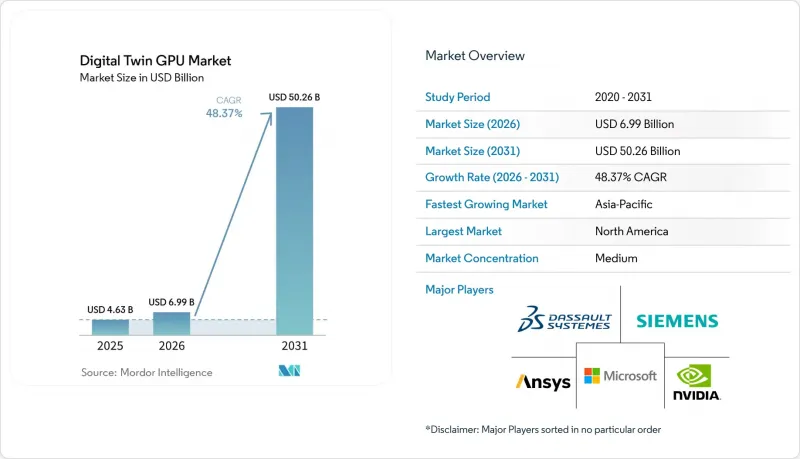
根據 Mordor Intelligence 預測,數位孿生 GPU 的市場規模預計將在 2025 年達到 46.3 億美元,2026 年達到 69.9 億美元,到 2031 年達到 502.6 億美元,2026 年至 2031 年的複合年成長率為 48.37%。
本報告按GPU部署類型(例如工作站GPU)、GPU整合類型(獨立GPU和整合/嵌入式GPU)、部署模式(例如本地部署)、應用領域(例如設計、模擬和工程、即時監控和運行控制)、最終用戶(例如航太和國防)以及地區進行細分。市場預測以美元(USD)計價。
全球數位孿生GPU市場趨勢與洞察
工作負載快速成長,大量運用工業人工智慧和模擬技術
工業人工智慧的普及改變了數位孿生平台的運算模式。這是因為工作負載現在以連續流水線的形式運行,並考慮了物理定律,而不是偶爾進行的批量模擬。 2025年10月,NVIDIA發布了Omniverse DSX Blueprint,旨在協助設計和營運千兆瓦級人工智慧工廠。這表明,數位孿生環境的發展方向是需要比許多工業團隊在早期開發階段預期的大規模的運算資源。 2025年6月,德國推出了一個基於約1萬個GPU的工業人工智慧雲端平台,專門用於歐洲製造業應用,進一步印證了這一點。模擬、機器人和工廠數位孿生—所有這些都與高吞吐量的GPU基礎設施息息相關。這在數位孿生GPU市場意義重大,因為每次模擬運行都會提高合成資料的質量,而更高品質的合成資料又能支援在下一個週期中提升模型效能。因此,一種自我強化的投資模式已經形成:對模擬、人工智慧模型改進以及數位孿生精度的需求,進一步推動了對GPU的需求。這正是數位孿生GPU市場擴張速度遠超簡單硬體更換周期的最直接原因之一。
GPU加速的數位孿生工作流程在製造業的廣泛應用。
製造企業正在將基於GPU的模擬技術整合到日常生產計畫中,使數位孿生從工程支援工具轉變為支撐工廠決策的作業系統。 2026年1月,西門子發布了由NVIDIA Omniverse庫驅動的“數位孿生Composer”,重點展示了具有物理級精度的工廠級數位孿生,可用於生產計畫和設備變更檢驗。同樣在2026年1月,西門子和NVIDIA擴大了在工業AI操作系統領域的合作,承諾在西門子的整個模擬產品組合中實現GPU加速。客戶,尤其是大型工業集團,已經對此表現出了濃厚的興趣。在數位孿生GPU市場,製造業不僅擁有最大的終端用戶佔有率,也是GPU原生模擬工作流程最早的大規模概念驗證領域,這些工作流程未來將擴展到其他產業。這種轉變體現在軟體產品組合正在圍繞GPU原生路徑進行重構,而不是從CPU優先的環境進行調整。這也解釋了為什麼數位孿生 GPU 市場在工廠規劃、吞吐量最佳化和生產線重新設計方案中不斷發展。
配備大容量記憶體和散熱系統的GPU基礎設施高成本。
專為模擬密集型工作負載設計的高記憶體GPU對許多營運商而言仍然價格昂貴,尤其是在必須同時支援渲染、AI推理和即時感測器融合的部署中。成本負擔遠不止晶片本身的價格,因為持續運行數位孿生需要專用的冷卻系統、高頻寬互連和電力基礎設施,而許多設施最初並未預料到這些。 2026年6月,AWS正式發布了配備NVIDIA RTX PRO 4500 Blackwell Server Edition GPU的Amazon EC2 G7執行個體。雖然這項服務展現了顯著的效能提升,但也凸顯了擴展性和清晰的工作負載經濟性對於高階GPU的使用仍然至關重要。溫度控管是數位孿生GPU市場中特別嚴峻的挑戰,因為持續模擬產生的冷卻曲線與短暫突發推理模式截然不同。因此,與擁有現有資料中心容量和靈活雲端預算的大型企業相比,中小型製造商和資產管理公司在採用數位孿生GPU方面面臨更大的挑戰。在租賃、共用池和「即服務」選項更能適應這種工作負載模式之前,成本仍將是數位孿生 GPU 市場的主要障礙。
細分市場分析
到2025年,資料中心GPU將佔該細分市場的47.14%,繼續在數位孿生GPU市場中佔據核心地位,因為規模最大的模擬工作負載仍需要具備大記憶體和高頻寬的集中式基礎設施。這些環境仍然是大規模空氣動力學建模、大型模型訓練、生成式孿生設計和合成資料生成的理想場所。工作站GPU持續被工程師和模擬團隊所利用,他們需要在將模型部署到更廣泛的生產環境之前,利用本地運算能力進行互動式探索、檢驗和視覺化審查。邊緣和嵌入式GPU預計到2031年將以48.99%的複合年成長率成長,這反映了即時資產監控和運行推理功能越來越多地整合到機械、車輛和工廠車間的系統中。因此,數位孿生GPU市場正在演變為一種分層架構,而不是「贏家通吃」的部署模式。
此外,該領域的預算分配正從集中式基礎設施支出轉向分散式營運技術支出,尤其是在工廠和資產密集型設施等對本地決策速度要求極高的場所。在數位孿生GPU產業,這種轉變在汽車、半導體和智慧基礎設施專案中最為明顯,這些專案不僅在企業平台層級評估運算回報,還在機器和資產層面進行評估。 2026年6月,SK Telecom利用NVIDIA Omniverse庫建構了其SK海力士半導體工廠的數位孿生模型。這表明,集中式工廠模擬和分散式資料流在同一架構中處理的趨勢日益成長。雖然資料中心GPU仍然是大型生產環境的核心,但隨著許多營運團隊越來越需要即時、即時的推理和監控,邊緣部署也不斷擴展。這種平衡表明,在整個預測期內,數位孿生GPU市場對集中式和分散式GPU的需求都將保持強勁。
到2025年,獨立GPU將佔據該細分市場75.33%的佔有率,在數位孿生GPU市場中佔據主導地位。這是因為高保真模擬和即時3D渲染仍然依賴記憶體容量和平行處理密度。這些工作負載包括物理密集型模擬、低延遲可視化以及必須在嚴格延遲條件下運行的運行模型。預計到2031年,整合和嵌入式GPU的複合年成長率將達到49.04%,反映出工業邊緣設備、環境適應性模組和專用自動化硬體中GPU功能的應用日益廣泛。在數位孿生GPU市場,這種轉變在那些優先考慮本地資料處理和本地推理的受監管或高度敏感的工業環境中最為明顯。因此,儘管目前獨立GPU仍保持其主導地位,但預計嵌入式GPU的成長動能將在預測期內更加強勁。
該領域的競爭邏輯也取決於軟體的成熟度。這是因為許多仿真庫最初都是針對獨立的GPU架構進行最佳化。 NVIDIA的CUDA-X、PhysicsNeMo和Omniverse庫不斷強化其部署基礎,鞏固了獨立GPU在運行高階數位孿生模型方面的主導地位。同時,ABB Robotics正在開發基於NVIDIA Omniverse的RobotStudio HyperReality,計劃於2026年下半年發布。據報道,該平台虛擬行為與物理行為的相關性高達99%,這意味著嵌入式模擬的精確度將會進一步提升。這對數位孿生GPU產業具有重大意義,因為部署在邊緣的系統不再局限於低保真視覺化或有限的推理任務。隨著內建軟體堆疊的演進,更多的監控和本地最佳化工作負載可以從集中式運算遷移到本地,而不會過度降低模擬的真實性。這為數位孿生 GPU 市場開闢了兩條道路:獨立 GPU 將繼續成為效能的核心,而嵌入式 GPU 將擴展其能夠處理的應用範圍。
區域分析
2025年,北美持續維持領先地位,佔據數位孿生GPU市場36.16%的佔有率。這得歸功於該地區GPU平台開發、超大規模資料中心業者以及豐富的工業軟體供應商資源。美國透過在汽車、航太、半導體和國防等產業的廣泛應用鞏固了這一地位,這些產業模擬頻繁,且計算資源預算充足。加拿大和墨西哥正透過汽車製造網路和供應鏈不斷增強區域影響力,這些網路和供應鏈正穩步將數位孿生工作流程整合到一級供應商層面。 AWS計畫在AWS區域部署超過一百萬個NVIDIA GPU,進一步擴大了這項優勢。最初,部署主要集中在美國關鍵區域,供工業用戶用於突發工作負載。 2026年3月,微軟開放原始碼了Azure實體AI工具鏈,為北美營運商提供了更標準化的途徑,以實現物理上精確的雲端連接孿生模型。
歐洲憑藉其強大的工業基礎和鼓勵眾多營運商採用受控部署模式的法規環境,仍然是數位孿生GPU市場的重要參與者。德國佔據著顯著的市場佔有率,這得益於其於2025年6月發布的工業人工智慧雲端平台,以及西門子將埃爾蘭根工廠作為人工智慧驅動的自適應製造藍圖。英國和法國仍然是次要的成長中心,其需求主要集中在工程服務、航太和國防模擬領域。在全部區域,網路安全和資料居住要求以及純粹的需求都在影響部署的時間和結構。
預計到2031年,亞太地區將以49.07%的複合年成長率成長,成為數位孿生GPU市場成長最快的區域板塊。韓國和台灣半導體晶圓廠的數位轉型、中國、日本和印度的智慧製造項目,以及人工智慧基礎設施投資的持續成長,都在推動市場需求。 2026年6月,SK Telecom和SK Hynix展示了利用NVIDIA Omniverse庫建構的晶圓廠專用數位孿生模型,顯示半導體製造業務正成為該地區運算密集型應用領域之一。同樣在2026年6月,美光科技和MetaAI在NVIDIA Omniverse上推廣了支援模擬的晶圓廠模型,進一步印證了高價值製造環境正在塑造該地區的發展勢頭。中國正透過國內人工智慧基礎設施和工業自動化實現規模化發展,日本則以機器人和精密製造為驅動力,而韓國則以半導體和電池生產為中心。印度正憑藉其 IT主導的整合能力崛起,而南美、中東和非洲則繼續從小規模的基礎擴張,主要基於能源和公共產業的初始需求。
其他好處:
- Excel格式的市場預測(ME)表
- 3個月的分析師支持
目錄
第1章:引言
- 研究假設和市場定義
- 調查範圍
第2章:調查方法
第3章執行摘要
第4章 市場狀況
- 市場概覽
- 市場促進因素
- 工作負載快速成長,大量運用工業人工智慧和模擬技術
- 在製造業中擴大GPU加速數位孿生工作流程的應用。
- 需要加快虛擬性能驗證和設計迭代周期。
- 擴大即時物理渲染和 3D 視覺化的應用。
- 遷移到雲端和混合GPU基礎設施以實現孿生執行
- 互聯資產環境中對邊緣人工智慧推理的需求日益成長
- 市場限制因素
- GPU基礎設施和配備大容量記憶體的散熱系統高成本。
- PLM、CAE、IoT 和孿生平台之間的互通性差距。
- 互聯孿生環境中的網路安全和資料主權問題
- 物理模型校準的專家短缺
- 宏觀經濟因素對市場的影響
- 市場定位分析
- 監理情勢
- 技術展望
- 波特五力分析
- 市場價格分析
- 已部署系統和工作負載遷移分析
- 專利和創新趨勢
第5章 市場規模與成長預測
- GPU部署方法
- 工作站用GPU
- 用於資料中心的GPU
- 邊緣與嵌入式GPU
- GPU整合類型
- 獨立顯示卡
- 整合/嵌入式GPU
- 按部署模式
- 現場
- 雲
- 混合
- 透過使用
- 設計、仿真、工程
- 虛擬性能驗證與工廠規劃
- 預測性維護和資產最佳化
- 即時監控和運行控制
- 機器人與自主系統
- 3D視覺化、渲染與身臨其境型協作
- 最終用戶
- 製造業
- 汽車和運輸業
- 航太/國防
- 能源公用事業
- 石油和天然氣
- 醫療保健和生命科學
- 資訊科技/通訊
- 智慧基礎設施與建築
- 按地區
- 北美洲
- 美國
- 加拿大
- 墨西哥
- 歐洲
- 德國
- 英國
- 法國
- 其他歐洲國家
- 亞太地區
- 中國
- 日本
- 韓國
- 印度
- 其他亞太國家
- 世界其他地區
- 北美洲
第6章 競爭情勢
- 市場集中度
- 策略趨勢
- 市佔率分析
- 公司簡介
- NVIDIA Corporation
- Siemens AG
- Dassault Systemes SE
- Ansys, Inc.
- Microsoft Corporation
- Amazon Web Services, Inc.
- Oracle Corporation
- IBM Corporation
- Autodesk, Inc.
- PTC Inc.
- Hexagon AB
- Bentley Systems, Incorporated
- Altair Engineering Inc.
- Cadence Design Systems, Inc.
- Synopsys, Inc.
- SAP SE
- Rockwell Automation, Inc.
- Schneider Electric SE
- AVEVA Group Limited
- General Electric Company
- Honeywell International Inc.
第7章 市場機會與未來展望
According to Mordor Intelligence, the digital twin GPU market size is projected to be USD 4.63 billion in 2025, USD 6.99 billion in 2026, and reach USD 50.26 billion by 2031, growing at a CAGR of 48.37% from 2026 to 2031.
This report is Segmented by GPU Deployment Type (Workstation GPUs, and More), GPU Integration Type (Discrete GPUs, and Integrated / Embedded GPUs), Deployment Model (On-Premises, and More), Application (Design, Simulation and Engineering, Real-Time Monitoring and Operations Control, and More), End User (Aerospace and Defense, More), and Geography. The Market Forecasts are Provided in Terms of Value (USD).
Global Digital Twin GPU Market Trends and Insights
Rapid Expansion Of Industrial AI And Simulation-Heavy Workloads
Industrial AI deployments have changed the compute profile of digital twin platforms because workloads now run as continuous, physics-aware pipelines instead of occasional batch simulations. NVIDIA introduced the Omniverse DSX Blueprint in October 2025 to support the design and operation of gigawatt-scale AI factories, which showed that digital twin environments are moving into far larger compute footprints than many industrial teams planned for earlier in the cycle. The June 2025 launch of an industrial AI cloud in Germany, built around 10,000 GPUs for European manufacturing use cases, reinforced the same point, with simulation, robotics, and factory digital twins all tied to high-throughput GPU infrastructure. In the digital twin GPU market, that matters because each additional simulation pass improves synthetic data quality, and better synthetic data supports stronger model performance in the next cycle. The result is a self-reinforcing investment pattern in which simulation demand, AI model refinement, and twin fidelity continue to pull GPU demand higher. This is one of the clearest reasons the digital twin GPU market is expanding faster than a simple hardware replacement cycle would suggest.
Rising Adoption Of GPU-Accelerated Digital Twin Workflows In Manufacturing
Manufacturing operators are embedding GPU-backed simulation into day-to-day production planning, which shifts digital twins from engineering support tools into operating systems for factory decisions. Siemens introduced Digital Twin Composer in January 2026 with NVIDIA Omniverse libraries, and the launch highlighted plant-scale twins with physics-level accuracy for production planning and facility change validation. Siemens and NVIDIA also expanded their partnership in January 2026 around an industrial AI operating system, with a commitment to complete GPU acceleration across Siemens' simulation portfolio and with early customer interest already visible across large industrial groups. In the digital twin GPU market, manufacturing does more than contribute the largest end-user share, because it also acts as the earliest large-scale proving ground for GPU-native simulation workflows that later spread into other sectors. This shift is visible in the way software portfolios are being rebuilt around GPU-native paths rather than adapted from CPU-first environments. It also explains why the digital twin GPU market continues to deepen inside factory planning, throughput optimization, and line redesign programs.
High Cost Of High-Memory GPU Infrastructure And Cooling
High-memory GPUs designed for simulation-heavy workloads remain expensive for many operators, especially when those deployments must support rendering, AI inference, and live sensor fusion at the same time. The cost burden extends well beyond the chip, because sustained twin execution also requires specialized cooling, high-bandwidth interconnects, and power infrastructure that many facilities were not designed to carry. AWS made Amazon EC2 G7 instances generally available in June 2026 with NVIDIA RTX PRO 4500 Blackwell Server Edition GPUs, and the offering showed strong performance gains, but it also underlined that high-end GPU access still requires scale and clear workload economics. In the digital twin GPU market, thermal management is a particularly serious barrier because continuous simulation creates a cooling profile that differs from narrower burst inference patterns. Smaller manufacturers and asset operators therefore face a harder adoption path than large enterprises with existing data center capacity or flexible cloud budgets. Until leasing, shared pools, and as-a-service options align better with this workload pattern, cost will remain a meaningful brake on the digital twin GPU market.
Other drivers and restraints analyzed in the detailed report include:
- Need For Faster Virtual Commissioning And Design Iteration Cycles
- Growing Use Of Real-Time Physics-Based Rendering And 3D Visualization
- Interoperability Gaps Across PLM, CAE, IoT, And Twin Platforms
For complete list of drivers and restraints, kindly check the Table Of Contents.
Segment Analysis
Data center GPUs held 47.14% of this segment in 2025, which kept them at the center of the digital twin GPU market size because the largest simulation workloads still require centralized, high-memory, high-bandwidth infrastructure. Those environments remain the preferred location for aerodynamic modeling, large model training, generative twin design, and synthetic data generation at production scale. Workstation GPUs continue to serve engineers and simulation teams that need local compute for interactive exploration, validation, and visual review before a model is moved into broader production environments. Edge and embedded GPUs are projected to expand at a 48.99% CAGR through 2031, which reflects the way real-time asset monitoring and operational inference are moving closer to machines, vehicles, and plant-floor systems. The digital twin GPU market is therefore developing as a layered architecture rather than a winner-take-all deployment pattern.
The same segment is also showing a budget shift from centralized infrastructure spending toward distributed operational technology spending, especially in factories and asset-heavy facilities where local decision speed matters. In the digital twin GPU industry, that shift is most visible in automotive, semiconductor, and smart infrastructure programs that evaluate compute return at the machine or asset level instead of only at the enterprise platform level. SK Telecom applied NVIDIA Omniverse libraries to build digital twins of SK Hynix semiconductor fabs in June 2026, which illustrated how centralized fab simulation and distributed data streams are increasingly being handled in the same architecture. Data center GPUs still anchor the largest production environments, but edge deployments are expanding because many operating teams now want inference and monitoring at the point where conditions change in real time. This balance is likely to keep both centralized and distributed GPU demand active across the digital twin GPU market through the forecast period.
Discrete GPUs accounted for 75.33% of the segment in 2025, which gave them the leading position in the digital twin GPU market size because high-fidelity simulation and live 3D rendering still depend on memory capacity and parallel compute density. Those workloads include physics-heavy simulation, low-latency visualization, and operational models that must run without wide tolerance for delay. Integrated and embedded GPUs are projected to grow at a 49.04% CAGR through 2031, which reflects stronger adoption of GPU capability inside industrial edge devices, ruggedized modules, and purpose-built automation hardware. The digital twin GPU market is seeing this shift most clearly in jurisdictions that are prioritizing local data handling and on-premises inferencing for regulated or sensitive industrial environments. That keeps discrete GPUs dominant today while giving embedded options a stronger growth path through the forecast period.
The competitive logic in this segment also rests on software maturity, because many simulation libraries have been optimized first for discrete GPU architectures. NVIDIA's CUDA-X, PhysicsNeMo, and Omniverse libraries continue to reinforce that installed base, which supports the leading role of discrete GPUs in high-end twin execution. At the same time, ABB Robotics built RobotStudio HyperReality on NVIDIA Omniverse with availability planned for the second half of 2026, and the platform points to stronger embedded simulation fidelity with reported 99% correlation between virtual and physical behavior. In the digital twin GPU industry, that matters because edge-resident systems are no longer limited to low-fidelity visualization or narrow inferencing tasks. As embedded software stacks improve, more monitoring and localized optimization workloads can move away from centralized compute without losing too much realism. This leaves the digital twin GPU market with a dual path in which discrete GPUs retain the performance center while embedded GPUs extend the addressable footprint.
Complete Report Scope:
- By GPU Deployment Type
- Workstation GPUs
- Data Center GPUs
- Edge and Embedded GPUs
- By GPU Integration Type
- Discrete GPUs
- Integrated / Embedded GPUs
- By Deployment Model
- On-Premises
- Cloud
- Hybrid
- By Application
- Design, Simulation and Engineering
- Virtual Commissioning and Factory Planning
- Predictive Maintenance and Asset Optimization
- Real-Time Monitoring and Operations Control
- Robotics and Autonomous Systems
- 3D Visualization, Rendering and Immersive Collaboration
- By End User
- Manufacturing
- Automotive and Transportation
- Aerospace and Defense
- Energy and Utilities
- Oil and Gas
- Healthcare and Life Sciences
- IT and Telecom
- Smart Infrastructure and Buildings
- By Geography
- North America
- United States
- Canada
- Mexico
- Europe
- Germany
- United Kingdom
- France
- Rest of Europe
- Asia-Pacific
- China
- Japan
- South Korea
- India
- Rest of Asia-Pacific
- Rest of the World
- North America
Geography Analysis
North America held 36.16% of the digital twin GPU market size in 2025, which kept it in the lead because the region combines GPU platform development, hyperscaler infrastructure, and a deep base of industrial software vendors. The United States anchors this position through adoption across automotive, aerospace, semiconductor, and defense environments where simulation intensity is high and compute budgets are established. Canada and Mexico support regional depth through automotive manufacturing networks and supply chains that are steadily integrating digital twin workflows at the tier-1 level. AWS expanded this position further through its plan to deploy more than 1 million NVIDIA GPUs across AWS regions, with early concentration in major U.S. regions that industrial users can access for burst workloads. Microsoft also open-sourced its Azure Physical AI Toolchain in March 2026, which gave North American operators a more standardized route to physically accurate cloud-connected twins.
Europe remains a major part of the digital twin GPU market because its industrial base is strong and its regulatory environment is pushing many operators toward controlled deployment models. Germany accounts for a disproportionate share of activity, supported by the industrial AI cloud announced in June 2025 and by Siemens' use of Erlangen as a blueprint for AI-driven adaptive manufacturing. The United Kingdom and France remain secondary growth pockets, with demand linked to engineering services, aerospace, and defense simulation. Across the region, cybersecurity and data residency requirements are shaping the timing and structure of deployments as much as raw demand is shaping them.
Asia-Pacific is projected to advance at a 49.07% CAGR through 2031, which makes it the fastest-growing regional block in the digital twin GPU market. Semiconductor fab digitalization in South Korea and Taiwan, smart manufacturing programs in China, Japan, and India, and a broader wave of AI infrastructure spending are all pushing demand higher. SK Telecom and SK Hynix demonstrated fab-focused digital twins with NVIDIA Omniverse libraries in June 2026, which showed how semiconductor operations are becoming one of the most compute-intensive adopters in the region. Micron and MetAI also advanced simulation-ready fab twins on NVIDIA Omniverse in June 2026, adding more evidence that high-value manufacturing environments are shaping regional momentum. China is scaling through domestic AI infrastructure and industrial automation, Japan is driven by robotics and precision manufacturing, and South Korea is anchored by semiconductor and battery production. India is emerging through IT-led integration capability, while South America and Middle East and Africa are expanding from a smaller base with early demand centered on energy and utilities.
- NVIDIA Corporation
- Siemens AG
- Dassault Systemes SE
- Ansys, Inc.
- Microsoft Corporation
- Amazon Web Services, Inc.
- Oracle Corporation
- IBM Corporation
- Autodesk, Inc.
- PTC Inc.
- Hexagon AB
- Bentley Systems, Incorporated
- Altair Engineering Inc.
- Cadence Design Systems, Inc.
- Synopsys, Inc.
- SAP SE
- Rockwell Automation, Inc.
- Schneider Electric SE
- AVEVA Group Limited
- General Electric Company
- Honeywell International Inc.
Additional Benefits:
- The market estimate (ME) sheet in Excel format
- 3 months of analyst support
TABLE OF CONTENTS
1 INTRODUCTION
- 1.1 Study Assumptions and Market Definition
- 1.2 Scope of the Study
2 RESEARCH METHODOLOGY
3 EXECUTIVE SUMMARY
4 MARKET LANDSCAPE
- 4.1 Market Overview
- 4.2 Market Drivers
- 4.2.1 Rapid Expansion of Industrial AI and Simulation-Heavy Workloads
- 4.2.2 Rising Adoption of GPU-Accelerated Digital Twin Workflows in Manufacturing
- 4.2.3 Need for Faster Virtual Commissioning and Design Iteration Cycles
- 4.2.4 Growing Use of Real-Time Physics-Based Rendering and 3D Visualization
- 4.2.5 Shift Toward Cloud and Hybrid GPU Infrastructure for Twin Execution
- 4.2.6 Rising Demand for Edge AI Inference in Connected Asset Environments
- 4.3 Market Restraints
- 4.3.1 High Cost of High-Memory GPU Infrastructure and Cooling
- 4.3.2 Interoperability Gaps Across PLM, CAE, IoT, and Twin Platforms
- 4.3.3 Cybersecurity and Data Sovereignty Concerns in Connected Twin Environments
- 4.3.4 Shortage of Domain Talent for Physics-Based Model Calibration
- 4.4 Impact of Macroeconomic Factors on the Market
- 4.5 Market Positioning Analysis
- 4.6 Regulatory Landscape
- 4.7 Technological Outlook
- 4.8 Porter's Five Forces Analysis
- 4.8.1 Bargaining Power of Suppliers
- 4.8.2 Bargaining Power of Buyers
- 4.8.3 Threat of New Entrants
- 4.8.4 Threat of Substitutes
- 4.8.5 Intensity of Competitive Rivalry
- 4.9 Market Pricing Analysis
- 4.10 Installed Base and Workload Migration Analysis
- 4.11 Patent and Innovation Landscape
5 MARKET SIZE AND GROWTH FORECASTS (VALUE)
- 5.1 By GPU Deployment Type
- 5.1.1 Workstation GPUs
- 5.1.2 Data Center GPUs
- 5.1.3 Edge and Embedded GPUs
- 5.2 By GPU Integration Type
- 5.2.1 Discrete GPUs
- 5.2.2 Integrated / Embedded GPUs
- 5.3 By Deployment Model
- 5.3.1 On-Premises
- 5.3.2 Cloud
- 5.3.3 Hybrid
- 5.4 By Application
- 5.4.1 Design, Simulation and Engineering
- 5.4.2 Virtual Commissioning and Factory Planning
- 5.4.3 Predictive Maintenance and Asset Optimization
- 5.4.4 Real-Time Monitoring and Operations Control
- 5.4.5 Robotics and Autonomous Systems
- 5.4.6 3D Visualization, Rendering and Immersive Collaboration
- 5.5 By End User
- 5.5.1 Manufacturing
- 5.5.2 Automotive and Transportation
- 5.5.3 Aerospace and Defense
- 5.5.4 Energy and Utilities
- 5.5.5 Oil and Gas
- 5.5.6 Healthcare and Life Sciences
- 5.5.7 IT and Telecom
- 5.5.8 Smart Infrastructure and Buildings
- 5.6 By Geography
- 5.6.1 North America
- 5.6.1.1 United States
- 5.6.1.2 Canada
- 5.6.1.3 Mexico
- 5.6.2 Europe
- 5.6.2.1 Germany
- 5.6.2.2 United Kingdom
- 5.6.2.3 France
- 5.6.2.4 Rest of Europe
- 5.6.3 Asia-Pacific
- 5.6.3.1 China
- 5.6.3.2 Japan
- 5.6.3.3 South Korea
- 5.6.3.4 India
- 5.6.3.5 Rest of Asia-Pacific
- 5.6.4 Rest of the World
- 5.6.1 North America
6 COMPETITIVE LANDSCAPE
- 6.1 Market Concentration
- 6.2 Strategic Moves
- 6.3 Market Share Analysis
- 6.4 Company Profiles (includes Global Level Overview, Market Level Overview, Core Segments, Financials as available, Strategic Information, Market Rank/Share, Products and Services, Recent Developments)
- 6.4.1 NVIDIA Corporation
- 6.4.2 Siemens AG
- 6.4.3 Dassault Systemes SE
- 6.4.4 Ansys, Inc.
- 6.4.5 Microsoft Corporation
- 6.4.6 Amazon Web Services, Inc.
- 6.4.7 Oracle Corporation
- 6.4.8 IBM Corporation
- 6.4.9 Autodesk, Inc.
- 6.4.10 PTC Inc.
- 6.4.11 Hexagon AB
- 6.4.12 Bentley Systems, Incorporated
- 6.4.13 Altair Engineering Inc.
- 6.4.14 Cadence Design Systems, Inc.
- 6.4.15 Synopsys, Inc.
- 6.4.16 SAP SE
- 6.4.17 Rockwell Automation, Inc.
- 6.4.18 Schneider Electric SE
- 6.4.19 AVEVA Group Limited
- 6.4.20 General Electric Company
- 6.4.21 Honeywell International Inc.
7 MARKET OPPORTUNITIES AND FUTURE OUTLOOK
- 7.1 White-Space and Unmet-Need Assessment

 人工智慧加速器市場預測至2034年—按處理器架構、工作負載、外形尺寸、技術、應用、最終用戶和地區分類的全球分析
 全球光子運算市場:按類型、架構、應用、部署和最終用戶分類-市場規模、產業動態、機會分析和預測(2026-2035 年)
 人工智慧加速器:市場佔有率分析、行業趨勢和統計數據、成長預測(2026-2031 年)人工智慧加速器市場:按類型、技術、應用、最終用途、國家和地區分類-全球產業分析、市場規模及佔有率和未來預測(2026-2033)人工智慧加速器晶片市場預測至2034年-全球分析(按晶片類型、處理類型、部署類型、記憶體類型、資料中心類型、技術、應用、產業、最終用戶和地區分類)
 人工智慧加速器市場分析及預測(至2035年):類型、產品、技術、組件、應用、部署、最終用戶、功能、安裝配置
 2026年全球人工智慧加速器市場報告
 人工智慧加速器市場:2026-2032年全球預測(按加速器類型、應用、最終用戶產業、部署類型和組織規模分類)
 TPU vs. GPU:2025 年 AI 加速器市場驚人前景NVIDIA H200 在中國市場的策略展望(2026 年)