


 |
市場調查報告書
商品編碼
2097305
人工智慧加速器:市場佔有率分析、行業趨勢和統計數據、成長預測(2026-2031 年)AI Accelerators - Market Share Analysis, Industry Trends & Statistics, Growth Forecasts (2026 - 2031) |
||||||

※ 本網頁內容可能與最新版本有所差異。詳細情況請與我們聯繫。
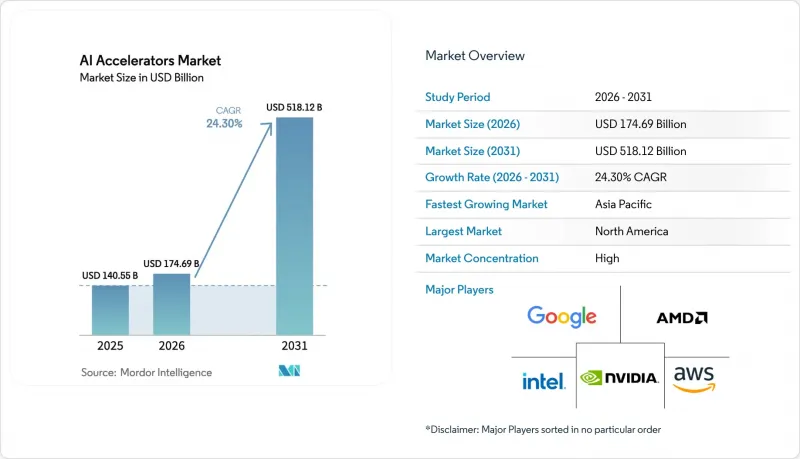
根據 Mordor Intelligence 預測,人工智慧加速器市場規模將從 2025 年的 1,405.5 億美元成長到 2026 年的 1,746.9 億美元,然後在 2031 年達到 5,181.2 億美元,2026 年至 2031 年的複合年成長率為 24.30%。
本報告按處理器類型(GPU、ASIC/TPU、FPGA、CPU/NPU/其他)、處理位置(雲端/資料中心、邊緣/裝置端、本地高效能運算)、功能(訓練、推理)、最終用戶產業(超大規模雲端服務供應商、企業和主機資料中心、汽車OEM廠商和一級供應商、醫療保健和生命科學、其他)以及地區進行細分。市場預測以美元(USD)為單位。
全球人工智慧加速器市場趨勢與洞察
超大規模資料中心對生成式人工智慧運算的爆炸性需求
為了支援模型訓練和全天候推理,超大規模營運商正在每個園區部署數十萬個高效能GPU。產業預測,到2025年,年部署量可能達到650萬至700萬個,電力需求將高達84吉瓦,相當於美國一個州目前的電力負載[CSIS.ORG]。這種持續的需求正推動英偉達資料中心相關營收從2024年的1,100億美元成長到2025年的1,730億美元,進一步凸顯了供應穩定性的重要性,同時也刺激了對先進封裝能力的空前投資。
需要低功耗加速器的邊緣人工智慧設備的激增。
汽車和醫療保健平台對延遲低於 20 毫秒以及嚴格的資料主權合規性要求,推動了設備端推理的發展。預計到 2034 年,汽車 AI 晶片組市場規模將達到 146.8 億美元,年增率達 20%。同時,自開始追蹤以來,美國食品藥物管理局(FDA) 已批准了 950 款 AI醫療設備,2024 年上半年的批准數量增加了 15%。像 Telechips 的 A2X 這樣的新解決方案,在一個整合的系統晶片(SoC) 封裝中實現了 200 TOPS 的運算能力,為實現經濟高效的本地 AI 提供了清晰的路徑。
5奈米以下晶圓供不應求限制了出貨量。
即使該製程的量產規模不斷擴大,對尖端晶圓的需求仍超過供應。台積電預計到2025年下半年,其3nm製程晶圓的月產量將達到12.5萬片,但來自消費性電子產品製造商和資料中心公司的激烈訂單競爭,導致市場呈現賣方市場格局,晶圓價格維持在2.1萬美元左右。替代產能的不足,使得新型人工智慧設計的交付週期延長,資本投入也隨之增加。
細分市場分析
預計到2025年,GPU將佔人工智慧加速器市場收入的59.20%。由於以CUDA為代表的廣泛軟體生態系統,GPU在研發和早期開發階段仍不可或缺。 ASIC人工智慧加速器市場預計將以27.15%的複合年成長率成長,這反映了超大規模資料中心業者驅動的客製化設計在穩態推理中追求能源和成本效益的趨勢。根據供應商藍圖,雲端服務供應商正在增加內部晶片流片,並將晶圓代工廠的生產轉移到自有晶片上。現場可程式閘陣列(FPGA)仍然是一個有吸引力的選擇,尤其是在不斷發展的邊緣工作負載中,其可重構性彌補了峰值吞吐量較低的不足。 CPU/NPU混合架構透過緊密整合主機處理、安全引擎和神經網路內核,滿足了注重成本的消費設備的需求,並為通用晶片供應商拓展了商機。
ASIC晶片的普及正在改變資本配置格局。博通公司預計,到2027年,ASIC市場規模將達到600億至900億美元,其專有的TPU、Tranium和Inferentia晶片將擴大部署到生產群集。因此,儘管GPU在訓練密集型研究領域仍將佔據主導地位,但隨著編譯器成熟度、開放原始碼工具鍊和軟體抽象的進步,推理支出中將有相當大比例轉向ASIC晶片。在由此產生的混合架構環境中,能夠為異質硬體目標提供統一工具鏈的供應商將更具優勢。
預計到2025年,雲端服務和託管設施將佔總支出的74.30%,主要得益於規模經濟和5奈米以下晶圓獲取管道的改善。然而,邊緣運算交付正以26.20%的複合年成長率快速成長,這主要受汽車自動駕駛、醫療診斷以及隱私法規等因素對本地推理需求的推動。人工智慧加速器市場目前正採用一種結合集中式訓練和分散式推理的雙層模型,使應用開發開發人員能夠在降低頻寬負載的同時最大限度地減少延遲。對於必須管理數據並確保確定性延遲的金融服務公司和國家實驗室而言,本地高效能運算(HPC)叢集仍然至關重要。
汽車OEM廠商正在清楚展現邊緣運算領域的轉捩點。繼NVIDIA的Orin和Thor產品藍圖之後,中國汽車製造商正在加強其自主半導體研發項目,而韓國供應商則在調整其封裝藍圖,以滿足汽車級溫度和安全標準。醫療產業也呈現類似的趨勢,影像設備供應商正將AI流程直接整合到掃描儀中,以避免與雲端進行往返通訊,從而提高工作流程效率並保護病患隱私。
區域分析
預計到2025年,北美將佔據人工智慧加速器市場43.50%的佔有率。超大規模雲端公司總部集中於此、創業投資資金與創新法案》(CHIPS Act)等獎勵策略,持續推動該地區的需求與產能集中。對國內晶圓代工廠、先進封裝和高頻寬記憶體組裝的持續投資,可望實現供應鏈多元化並降低地緣政治風險。
亞太地區成長最快,2025年至2031年的複合年成長率將達27.00%。中國電動車製造商正在快速改進其汽車半導體技術,而韓國的產業重組,例如Rebellions和Sapeon的合併,已經打造出一家能夠在光刻和封裝產能方面擁有談判優勢的「國家冠軍」企業。台灣在5奈米以下晶圓生產領域的領先地位依然顯著,但不斷上升的地緣政治風險正使人們越來越關注日本、印度和新加坡等專注於先進記憶體測試和組裝的工廠。
歐洲憑藉嚴格的管理體制和強大的汽車製造業基礎,佔據著雖小但舉足輕重的地位。即將實施的人工智慧法和永續性法規正引導加速器設計朝著透明、節能和全生命週期課責的方向發展。同時,在中東和非洲,基於可再生能源的待開發區資料中心建設正在穩步推進,隨著政策、人才和通訊基礎設施的日趨成熟,這些資料中心將為未來的區域成長奠定基礎。
其他好處:
- Excel格式的市場預測(ME)表
- 3個月的分析師支持
目錄
第1章:引言
- 研究假設和市場定義
- 調查範圍
第2章:調查方法
第3章執行摘要
第4章 市場狀況
- 市場概覽
- 市場促進因素
- 超大規模資料中心對生成式人工智慧運算的需求爆炸性成長。
- 邊緣人工智慧設備的激增需要低功耗加速器
- 晶片技術和先進封裝技術的進步正在擴大記憶體頻寬。
- 政府採用 CHIPS 方法對國內人工智慧半導體製造廠給予優惠。
- HBM3E的供應瓶頸導致設計訂單轉移到其他供應商。
- 開放原始碼SDK 的興起降低了從現有 GPU轉換到新 GPU 的成本。
- 市場限制因素
- 5nm晶圓供不應求限制了出貨量。
- 水冷GPU叢集總擁有成本高
- 高階加速器出口到中國的限制存在不確定性
- 主要託管設施的電網容量限制
- 價值供應鏈分析
- 監理情勢
- 技術展望
- 波特五力模型
第5章 市場規模與成長預測
- 依處理器類型
- GPU
- ASIC/TPU
- FPGA
- CPU/NPU/其他
- 按處理位置
- 雲端/資料中心
- 邊緣/設備端
- 本地高效能運算
- 按功能
- 訓練
- 推理
- 按最終用戶行業分類
- 超大規模雲端服務供應商
- 企業和託管資料中心
- 汽車製造商和一級供應商
- 醫療保健和生命科學
- 金融服務
- 通訊和5G基礎設施
- 其他最終用戶(政府、網路安全、製造業等)
- 按地區
- 北美洲
- 美國
- 加拿大
- 墨西哥
- 南美洲
- 巴西
- 阿根廷
- 智利
- 其他南美國家
- 歐洲
- 德國
- 英國
- 法國
- 義大利
- 西班牙
- 俄羅斯
- 其他歐洲國家
- 亞太地區
- 中國
- 日本
- 韓國
- 印度
- ASEAN
- 澳洲和紐西蘭
- 其他亞太國家
- 中東和非洲
- 中東
- 沙烏地阿拉伯
- UAE
- 土耳其
- 以色列
- 其他中東國家
- 非洲
- 南非
- 奈及利亞
- 埃及
- 其他非洲國家
- 中東
- 北美洲
第6章 競爭情勢
- 市場集中度
- 策略趨勢
- 市佔率分析
- 公司簡介
- NVIDIA Corporation
- Advanced Micro Devices, Inc.(AMD)(Xilinx, Inc.)
- Intel Corporation(Habana Labs Ltd.)
- Google LLC(TPU)
- Amazon Web Services, Inc.(Trainium/Inferentia)
- Qualcomm Incorporated
- Cerebras Systems Inc.
- Graphcore Limited
- SambaNova Systems, Inc.
- Groq, Inc.
- Tenstorrent Inc.
- Mythic, Inc.
- SiFive, Inc.
- Blaize Inc.
- Esperanto Technologies, Inc.
- Hailo Technologies Ltd.
- Neural Magic, Inc.
- Edgecortix Inc.
- T-Head Semiconductor Co., Ltd.(a subsidiary of Alibaba Group)
- Huawei Technologies Co., Ltd.(Ascend)
- Biren Technology Co., Ltd.
- Rebellions Inc.
- CerebrumX Labs Inc.
第7章 市場機會與未來展望
第8章:閒置頻段與未滿足需求的評估
According to Mordor Intelligence, the AI accelerators market size is expected to grow from USD 140.55 billion in 2025 to USD 174.69 billion in 2026 and is forecast to reach USD 518.12 billion by 2031 at 24.30% CAGR over 2026-2031.
This report is Segmented by Processor Type (GPU, ASIC/TPU, FPGA, CPU/NPU/Others), Processing Location (Cloud/Data-center, Edge/On-device, On-Prem HPC), Function (Training, Inference), End-User Industry (Hyperscale Cloud Service Providers, Enterprise & Colocation Data-Centers, Automotive OEMs & Tier-1, Healthcare & Life-Sciences, Others), and Geography. The Market Forecasts are Provided in Terms of Value (USD).
Global AI Accelerators Market Trends and Insights
Explosive Demand for Generative-AI Compute in Hyperscale Data Centers
Hyperscale operators are scaling to hundreds of thousands of high-end GPUs per campus to support both model training and 24-7 inference. Industry forecasts indicate the installed base may reach 6.5-7 million units annually by 2025, lifting power requirements toward 84 GW, or roughly one additional U.S. state's present-day grid load [CSIS.ORG]. Sustained demand has driven NVIDIA's data-center revenue from USD 110 billion in 2024 to an expected USD 173 billion in 2025, reinforcing the importance of supply security and driving unprecedented investment in advanced packaging capacity.
Proliferation of Edge AI Devices Needing Low-Power Accelerators
Automotive and healthcare platforms require sub-20 millisecond latency and stringent data-sovereignty compliance, prompting a shift toward on-device inference. The automotive AI chipset market is projected to reach USD 14.68 billion by 2034, growing at 20% annually, while the U.S. Food and Drug Administration has cleared 950 AI-enabled medical devices since tracking began, up 15% in the first half of 2024. New solutions such as Telechips' A2X deliver 200 TOPS within integrated system-on-chip packages, signaling a clear path toward cost-efficient, localized intelligence.
<5 nm Wafer Shortages Throttling Shipment Volumes
Even after process ramp-ups, leading-edge wafer demand exceeds supply. TSMC's monthly 3 nm output is expected to reach 125,000 wafers in the second half of 2025, yet competing orders from consumer electronics and data-center firms sustain a sellers' market that keeps wafer prices near USD 21,000. Limited alternative capacity prolongs delivery lead-times and raises the capital intensity of new AI designs.
Other drivers and restraints analyzed in the detailed report include:
- Chiplet & Advanced-Packaging Breakthroughs Boosting Memory Bandwidth
- Government CHIPS-Style Incentives for Domestic AI-Silicon Fabs
- Escalating TCO of Liquid-Cooled GPU Clusters
For complete list of drivers and restraints, kindly check the Table Of Contents.
Segment Analysis
GPUs held 59.20% revenue share of the AI accelerators market in 2025. Their broad software ecosystem, epitomized by CUDA, keeps them indispensable for research and early-stage development. The AI accelerators market size for ASICs is projected to expand at a 27.15% CAGR, reflecting bespoke designs by hyperscalers seeking energy and cost efficiency during steady-state inference. Vendor roadmaps show cloud operators increasing internal tape-outs and committing foundry volume to proprietary silicon. Field-programmable gate arrays (FPGAs) remain attractive where reconfigurability offsets lower peak throughput, notably for evolving edge workloads. CPU/NPU hybrids address cost-sensitive consumer devices through tight integration of host processing, security engines, and neural cores, broadening merchant supplier opportunities.
Momentum toward ASICs is reshaping capital allocation. Broadcom anticipates a USD 60-90 billion ASIC opportunity by 2027, and internal TPUs, Tranium, or Inferentia devices increasingly enter production clusters. Continued GPU primacy is therefore expected in training-intensive research, yet a structurally higher share of inference spend will migrate to ASICs as compiler maturity, open-source toolchains, and software abstractions progress. The resulting mixed-architecture environment favors suppliers capable of delivering unified toolchains across heterogeneous hardware targets.
Cloud and colocation facilities accounted for 74.30% of 2025 spending, underpinned by economies of scale and better access to sub-5 nm wafers. Nevertheless, edge delivery is surging at a 26.20% CAGR as automotive autonomy, point-of-care health diagnostics, and privacy regulation require local inference. The AI accelerators market now supports a two-tier model in which centralized training is complemented by distributed inference, enabling application developers to minimize latency while relieving bandwidth stress. On-premises high-performance computing (HPC) clusters retain importance for financial-services firms and national laboratories that must control data and ensure deterministic latency.
Automotive OEMs illustrate the edge inflection. NVIDIA's Orin and Thor product timelines prompted Chinese brands to bolster internal silicon programs, and Korean vendors are aligning packaging roadmaps with vehicle-grade temperature and safety standards. Healthcare follows a similar arc as diagnostic imaging vendors embed AI pipelines directly into scanners, avoiding cloud round-trips that would compromise workflow efficiency or patient privacy.
Complete Report Scope:
- By Processor Type
- GPU
- ASIC / TPU
- FPGA
- CPU / NPU / Others
- By Processing Location
- Cloud / Data-center
- Edge / On-device
- On-prem HPC
- By Function
- Training
- Inference
- By End-User Industry
- Hyperscale Cloud Service Providers
- Enterprise & Colocation Data-centers
- Automotive OEMs & Tier-1s
- Healthcare & Life-sciences
- Financial Services
- Telecom & 5G Infrastructure
- Other End user (Government, Cyber security, Manufacturing among others)
- By Geography
- North America
- United States
- Canada
- Mexico
- South America
- Brazil
- Argentina
- Chile
- Rest of South America
- Europe
- Germany
- United Kingdom
- France
- Italy
- Spain
- Russia
- Rest of Europe
- Asia-Pacific
- China
- Japan
- South Korea
- India
- ASEAN
- Australia & New Zealand
- Rest of Asia-Pacific
- Middle East & Africa
- Middle East
- Saudi Arabia
- UAE
- Turkey
- Israel
- Rest of Middle East
- Africa
- South Africa
- Nigeria
- Egypt
- Rest of Africa
- Middle East
- North America
Geography Analysis
North America captured a 43.50% share of the AI accelerators market in 2025. Concentration of hyperscale cloud headquarters, venture funding depth, and CHIPS Act stimulants continue to channel both demand and fabrication capacity into the region. Ongoing investments in on-shore foundries, advanced packaging, and high-bandwidth-memory assembly are expected to diversify supply chains and mitigate geopolitical exposure.
Asia-Pacific posted the fastest growth, advancing at a 27.00% CAGR between 2025 and 2031. Chinese EV firms rapidly iterate proprietary automotive silicon, while South Korean consolidation-exemplified by the Rebellions-Sapeon merger-creates national champions able to negotiate lithography and packaging capacity. Taiwan's dominance in sub-5 nm wafer output remains critical, though geopolitical risk elevates incentives for Japanese, Indian, and Singaporean facilities specializing in advanced memory test and assembly.
Europe holds a smaller but influential position, guided by stringent regulatory regimes and a robust automotive manufacturing base. The forthcoming AI Act, together with sustainability mandates, is nudging accelerator design toward transparency, energy efficiency, and lifecycle accountability. Meanwhile, Middle East and African countries are commissioning green-field data centers anchored by renewable-energy availability, laying groundwork for future regional growth once policy, skills, and connectivity mature.
- NVIDIA Corporation
- Advanced Micro Devices, Inc. (AMD) (Xilinx, Inc.)
- Intel Corporation (Habana Labs Ltd.)
- Google LLC (TPU)
- Amazon Web Services, Inc. (Trainium/Inferentia)
- Qualcomm Incorporated
- Cerebras Systems Inc.
- Graphcore Limited
- SambaNova Systems, Inc.
- Groq, Inc.
- Tenstorrent Inc.
- Mythic, Inc.
- SiFive, Inc.
- Blaize Inc.
- Esperanto Technologies, Inc.
- Hailo Technologies Ltd.
- Neural Magic, Inc.
- Edgecortix Inc.
- T-Head Semiconductor Co., Ltd. (a subsidiary of Alibaba Group)
- Huawei Technologies Co., Ltd. (Ascend)
- Biren Technology Co., Ltd.
- Rebellions Inc.
- CerebrumX Labs Inc.
Additional Benefits:
- The market estimate (ME) sheet in Excel format
- 3 months of analyst support
TABLE OF CONTENTS
1 INTRODUCTION
- 1.1 Study Assumptions & Market Definition
- 1.2 Scope of the Study
2 RESEARCH METHODOLOGY
3 EXECUTIVE SUMMARY
4 MARKET LANDSCAPE
- 4.1 Market Overview
- 4.2 Market Drivers
- 4.2.1 Explosive demand for generative-AI compute in hyperscale data-centers
- 4.2.2 Proliferation of edge AI devices needing low-power accelerators
- 4.2.3 Chiplet & advanced-packaging breakthroughs boosting memory bandwidth
- 4.2.4 Government CHIPS-style incentives for domestic AI-silicon fabs
- 4.2.5 HBM3E supply bottlenecks redirecting design wins to alternative vendors
- 4.2.6 Rise of open-source SDKs lowering switching costs away from incumbent GPUs
- 4.3 Market Restraints
- 4.3.1 5 nm wafer shortages throttling shipment volumes
- 4.3.2 Escalating TCO of liquid-cooled GPU clusters
- 4.3.3 Export-control uncertainty on high-end accelerators to China
- 4.3.4 Power-grid capacity caps at major colo campuses
- 4.4 Value / Supply-Chain Analysis
- 4.5 Regulatory Landscape
- 4.6 Technological Outlook
- 4.7 Porters Five Forces
- 4.7.1 Threat of New Entrants
- 4.7.2 Bargaining Power of Suppliers
- 4.7.3 Bargaining Power of Buyers
- 4.7.4 Threat of Substitutes
- 4.7.5 Competitive Rivalry
5 MARKET SIZE & GROWTH FORECASTS (VALUE)
- 5.1 By Processor Type
- 5.1.1 GPU
- 5.1.2 ASIC / TPU
- 5.1.3 FPGA
- 5.1.4 CPU / NPU / Others
- 5.2 By Processing Location
- 5.2.1 Cloud / Data-center
- 5.2.2 Edge / On-device
- 5.2.3 On-prem HPC
- 5.3 By Function
- 5.3.1 Training
- 5.3.2 Inference
- 5.4 By End-User Industry
- 5.4.1 Hyperscale Cloud Service Providers
- 5.4.2 Enterprise & Colocation Data-centers
- 5.4.3 Automotive OEMs & Tier-1s
- 5.4.4 Healthcare & Life-sciences
- 5.4.5 Financial Services
- 5.4.6 Telecom & 5G Infrastructure
- 5.4.7 Other End user (Government, Cyber security, Manufacturing among others)
- 5.5 By Geography
- 5.5.1 North America
- 5.5.1.1 United States
- 5.5.1.2 Canada
- 5.5.1.3 Mexico
- 5.5.2 South America
- 5.5.2.1 Brazil
- 5.5.2.2 Argentina
- 5.5.2.3 Chile
- 5.5.2.4 Rest of South America
- 5.5.3 Europe
- 5.5.3.1 Germany
- 5.5.3.2 United Kingdom
- 5.5.3.3 France
- 5.5.3.4 Italy
- 5.5.3.5 Spain
- 5.5.3.6 Russia
- 5.5.3.7 Rest of Europe
- 5.5.4 Asia-Pacific
- 5.5.4.1 China
- 5.5.4.2 Japan
- 5.5.4.3 South Korea
- 5.5.4.4 India
- 5.5.4.5 ASEAN
- 5.5.4.6 Australia & New Zealand
- 5.5.4.7 Rest of Asia-Pacific
- 5.5.5 Middle East & Africa
- 5.5.5.1 Middle East
- 5.5.5.1.1 Saudi Arabia
- 5.5.5.1.2 UAE
- 5.5.5.1.3 Turkey
- 5.5.5.1.4 Israel
- 5.5.5.1.5 Rest of Middle East
- 5.5.5.2 Africa
- 5.5.5.2.1 South Africa
- 5.5.5.2.2 Nigeria
- 5.5.5.2.3 Egypt
- 5.5.5.2.4 Rest of Africa
- 5.5.5.1 Middle East
- 5.5.1 North America
6 COMPETITIVE LANDSCAPE
- 6.1 Market Concentration
- 6.2 Strategic Moves
- 6.3 Market Share Analysis
- 6.4 Company Profiles
- 6.4.1 NVIDIA Corporation
- 6.4.2 Advanced Micro Devices, Inc. (AMD) (Xilinx, Inc.)
- 6.4.3 Intel Corporation (Habana Labs Ltd.)
- 6.4.4 Google LLC (TPU)
- 6.4.5 Amazon Web Services, Inc. (Trainium/Inferentia)
- 6.4.6 Qualcomm Incorporated
- 6.4.7 Cerebras Systems Inc.
- 6.4.8 Graphcore Limited
- 6.4.9 SambaNova Systems, Inc.
- 6.4.10 Groq, Inc.
- 6.4.11 Tenstorrent Inc.
- 6.4.12 Mythic, Inc.
- 6.4.13 SiFive, Inc.
- 6.4.14 Blaize Inc.
- 6.4.15 Esperanto Technologies, Inc.
- 6.4.16 Hailo Technologies Ltd.
- 6.4.17 Neural Magic, Inc.
- 6.4.18 Edgecortix Inc.
- 6.4.19 T-Head Semiconductor Co., Ltd. (a subsidiary of Alibaba Group)
- 6.4.20 Huawei Technologies Co., Ltd. (Ascend)
- 6.4.21 Biren Technology Co., Ltd.
- 6.4.22 Rebellions Inc.
- 6.4.23 CerebrumX Labs Inc.
7 MARKET OPPORTUNITIES & FUTURE OUTLOOK
8 WHITE-SPACE & UNMET-NEED ASSESSMENT

 人工智慧加速器市場預測至2034年—按處理器架構、工作負載、外形尺寸、技術、應用、最終用戶和地區分類的全球分析
 全球光子運算市場:按類型、架構、應用、部署和最終用戶分類-市場規模、產業動態、機會分析和預測(2026-2035 年)
 數位孿生GPU:市場佔有率分析、產業趨勢與統計及成長預測(2026-2031年)人工智慧加速器市場:按類型、技術、應用、最終用途、國家和地區分類-全球產業分析、市場規模及佔有率和未來預測(2026-2033)人工智慧加速器晶片市場預測至2034年-全球分析(按晶片類型、處理類型、部署類型、記憶體類型、資料中心類型、技術、應用、產業、最終用戶和地區分類)
 人工智慧加速器市場分析及預測(至2035年):類型、產品、技術、組件、應用、部署、最終用戶、功能、安裝配置
 2026年全球人工智慧加速器市場報告
 人工智慧加速器市場:2026-2032年全球預測(按加速器類型、應用、最終用戶產業、部署類型和組織規模分類)
 TPU vs. GPU:2025 年 AI 加速器市場驚人前景NVIDIA H200 在中國市場的策略展望(2026 年)