


 |
市場調查報告書
商品編碼
2098548
汽車領域先進DRAM:市佔率分析、產業趨勢與統計及成長預測(2026-2031年)Automotive Advanced DRAM - Market Share Analysis, Industry Trends & Statistics, Growth Forecasts (2026 - 2031) |
||||||

※ 本網頁內容可能與最新版本有所差異。詳細情況請與我們聯繫。
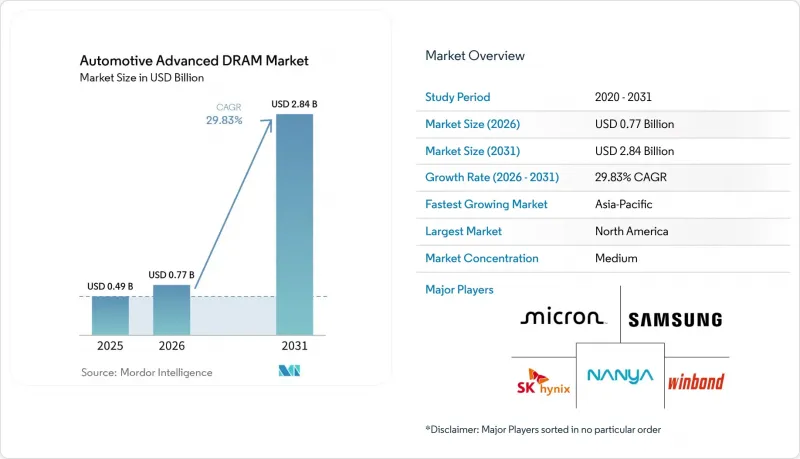
根據 Mordor Intelligence 預測,汽車先進 DRAM 市場規模將從 2025 年的 4.9 億美元成長到 2026 年的 7.7 億美元,然後在 2031 年達到 28.4 億美元,2026 年至 2031 年的複合年成長率為 29.83%。
本報告按記憶體技術(LPDDR5、LPDDR5X、DDR5 SDRAM 等)、記憶體容量(16 GB、24 GB、32 GB、64 GB、96 GB、128 GB 及以上)、應用領域(ADAS 和自動駕駛、數位駕駛座和車載資訊娛樂系統、叢集板和車載顯示器等。市場預測以美元計價。
全球汽車先進DRAM市場趨勢及洞察
ADAS感測器融合的記憶強度
ADAS(進階駕駛輔助系統)工作負載仍是汽車先進DRAM市場短期需求的最大驅動力。這是因為攝影機、雷達和LiDAR系統會產生持續的高速資料流,這些資料流必須能夠即時儲存和處理。美光在其汽車工程研究中指出,L4級及以上自動駕駛系統可能需要超過1TB/s的DRAM頻寬,這凸顯了隨著車輛中感知和推理層的增加,記憶體需求將如何快速成長。這也改變了設計週期,因為記憶體通道數、匯流排寬度和拓樸結構需要在SoC定義階段確定,遠在車輛進入量產階段之前。 JEDEC已確認9600Mbps LPDDR5X已準備好用於汽車應用,但截至2026年中期,GDDR7的汽車認證仍在等待中。這一順序至關重要,因為當前供應商的承諾將與未來幾年內出貨車輛的記憶體架構息息相關。在汽車先進動態隨機存取記憶體 (DRAM) 市場中,供應商在子系統設計階段的影響力比在最終採購階段更大,因為架構在生產開始之前基本上已經確定。
向集中式和基於區域的計算過渡
汽車先進DRAM市場的發展也受到從眾多分散式控制單元轉變為更少集中式分區運算平台的推動。 2025年3月,恩智浦半導體(NXP)發布了S32K5 MCU系列,這是汽車行業首款採用16nm FinFET製程、整合式MRAM的MCU,專為分區SDV架構而設計。這表明供應商已經在開發產品時考慮到了這種系統轉變。該平台支援LPDDR5和LPDDR5X介面,直接擴大了控制器程式中對先進汽車記憶體的潛在需求。隨著這種架構的普及,記憶體決策將從眾多ECU程式轉向更少的Tier 1和網域控制器平台,從而減少設計參與點,同時提高每個參與點的價值。此外,由於曾經分佈在眾多小型電子模組上的功能被單一集中式控制器所取代,每個運算單元的DRAM容量也將增加。在汽車先進DRAM市場,這意味著與傳統的分散式採購模式相比,採用單一平台需要更大、更長期的大量承諾。
晶圓分配短缺主導
汽車級先進DRAM市場最大的供應瓶頸在於先進製程晶圓產能正轉向用於AI加速器的HBM。標普全球汽車洞察(S&P Global Automotive Insights)在2025年12月發布的報告顯示,HBM的產量已佔全球DRAM晶圓產量的約23%,其中三星、美光和SK海力士已將其超過80%的先進製程產能用於HBM。因此,汽車級DRAM的供應正在萎縮。與消費性記憶體相比,汽車級DRAM對溫度、可追溯性和可靠性的要求更為嚴格,難以用標準組件取代。根據同一份標普全球報告,預計2026年汽車級DRAM價格將比2025年的合約價格上漲70%至100%,充分說明了供應情勢的嚴峻程度。而這遠不止是價格問題那麼簡單。從2027年開始,DDR4和LPDDR4的供應量將進一步減少,迫使那些尚未做好平台升級準備的汽車專案進行遷移。在汽車先進DRAM市場,供應穩定性現在幾乎與性能同等重要,因為OEM廠商和一級供應商必須確保未來獲得認證的內存,同時也要為下一代產品進行重新設計。
細分市場分析
憑藉成熟的認證體系、廣泛的供應鏈以及與現有ADAS和駕駛座SoC專案的緊密整合,LPDDR5預計將在2025年佔據汽車高級DRAM市場54.82%的佔有率。這項領先優勢體現了其在頻寬、能源效率和跨多個汽車平臺的成熟相容性之間取得的實際平衡。隨著運算密集型和AI密集型駕駛座專案進入量產階段,LPDDR5X預計將在2026年至2031年間以30.82%的複合年成長率成長,成為記憶體技術領域成長最快的細分市場。三星表示,其12nm製程的汽車級LPDDR5X在256位元匯流排上可實現307.2 GB/s的傳輸速度,滿足同時處理相機、雷達和AI工作負載的控制器的處理容量要求。因此,汽車先進DRAM市場正在經歷兩階段的發展路徑,LPDDR5保持其現有的廣泛部署基礎,而LPDDR5X則作為需要更高頻寬的系統的升級途徑。
DDR5 SDRAM 在需要強大運算效能且能適應各種散熱和功耗特性的汽車平台中繼續發揮著補充作用。而 GDDR6 則面向更專業的應用,尤其適用於圖形密集應用,例如高階 HUD 和擴增實境(AR) 顯示系統,在這些應用中,渲染頻寬比低功耗更為重要。其他 DRAM 和新興的先進 DRAM 類別,雖然目前的生產規模仍然較小,但隨著 JEDEC 宣布將於 2025 年推出 LPDDR6,它們的重要性日益凸顯,因為 LPDDR5X 及更先進 DRAM 的市場藍圖目標將為市場提供清晰的指導。這對汽車先進 DRAM 市場具有重大意義,因為 2028 年以後的車輛設計週期將越來越受到當前關於認證時間和介面準備的決策的影響。包括專注於低密度層的台灣製造商在內的小規模記憶體供應商,在成本、連續性和認證深度比頻寬更重要的領域仍然有發展空間,但市場重心顯然正在向 LPDDR5X 級平台轉移。
截至2025年,32GB級DRAM將佔據高階汽車DRAM市場33.49%的佔有率,這反映了其與目前量產的高階駕駛座控制器和中央運算平台的兼容性。此等級記憶體容量充足,足以應付當今的多螢幕顯示、互聯互通以及適度的ADAS任務,而無需將所有平台都升級到成本最高的容量等級。預計到2031年,128GB及以上容量級別將以31.03%的複合年成長率成長,並有望成為成長最快的容量級別,因為自動駕駛系統需要大規模的內存池。這種成長與控制器整合密切相關,因為中央運算系統整合了先前由多個獨立模組處理的任務。因此,在汽車高級DRAM市場,對記憶體容量的需求正從“滿足平台需求”轉向“為未來的軟體擴展預留空間”,尤其是在旨在支援未來更高級的感測和人工智慧推理的架構中。
16GB 和 24GB 容量的記憶體仍然在量產的車載資訊娛樂系統 (IVI) 和數位儀表叢集應用中佔據重要地位,因為汽車製造商更傾向於穩定、標準化的硬體基準。同時,64GB 和 96GB 容量的記憶體正在 L2+ 和 L3 級快取應用中逐漸普及,這些應用需要更大的記憶體容量來滿足更苛刻的高級駕駛輔助系統 (ADAS) 和駕駛座組合的需求,而無需立即升級到最高容量等級。三星指出,其 12nm 製程的 LPDDR5X 記憶體單晶片容量從 3GB 到 24GB 不等,多晶片擴充技術允許在無需重新設計 SoC 的情況下提高系統整體容量。這種模組化設計在汽車高級 DRAM 市場至關重要,因為它允許供應商根據車輛項目需求自訂記憶體配置,同時保持硬體在多種車型和計算封裝中的複用性。此外,與汽車動作溫度和長期可靠性相關的認證要求正在縮小能夠以量產規模滿足最高容量等級的供應商的選擇範圍,進一步加劇了該類別頂級市場的集中度。
區域分析
2025年,亞太地區佔據了汽車先進DRAM市場56.89%的佔有率,顯著超越其他地區,成為最大的貢獻者。這一地位的取得得益於多種因素的綜合作用,包括強勁的電動車生產、該地區強大的電子製造業基礎以及全球最大DRAM供應商的存在。儘管記憶體供應緊張且原料成本不斷上漲,但中國仍然是該地區的主要需求中心,因為中國汽車製造商持續推進ADAS、AI駕駛座和電動車平台的部署。 2026年1月,韓國SK海力士通過TUV SUD認證,其汽車級LPDDR5X獲得ASIL-D認證,進一步鞏固了韓國在下一代記憶體功能安全應對力領域的領先地位。日本憑藉其一級供應商網路繼續主導認證和整合流程,而台灣在基於LPDDR5X的汽車系統相關的先進封裝和多晶片模組(MCM)組裝仍然發揮著至關重要的作用。
歐洲是成長最快的區域市場,預計到2031年,汽車先進DRAM市場將以30.59%的複合年成長率成長。軟體定義汽車(SDV)專案、高階汽車架構以及對安全性和合規性的高度重視,正在推動該地區的需求成長。 ISO 26262在記憶體認證和系統設計中繼續發揮核心作用,委員會正在進行的下一版本修訂工作表明,其方向是提高半導體層面的安全要求,而不是放鬆監管標準。在此背景下,隨著舊一代記憶體逐漸退出市場,德國和法國的汽車製造商正在加速向LPDDR5和LPDDR5X過渡。此外,與其他許多市場相比,歐洲更傾向於簽訂長期供應契約,這即使在價格波動的情況下,也能為記憶體供應商提供更穩定的需求訊號。
北美仍然是汽車先進DRAM市場的關鍵區域。這主要歸功於美國電動車、高級駕駛輔助系統(ADAS)和軟體定義汽車(SDV)專案對車載計算的高標準要求。該地區的汽車平臺正在推動大規模工作記憶體的應用,用於感測器融合、駕駛座軟體和集中式控制器,從而影響其他地區的設計方向。世界其他地區仍然是最小的區域市場,但隨著聯網汽車功能和電動車產品線擴展到南美、中東和非洲以及東南亞等小規模的市場,需求正在逐步成長。南美仍處於發展週期的早期階段,但進口豪華車和ADAS的早期應用正在催生對比以往車型更高內存容量的明顯需求。
其他好處:
- Excel格式的市場預測(ME)表
- 3個月的分析師支持
目錄
第1章:引言
- 研究假設和市場定義
- 調查範圍
第2章:調查方法
第3章執行摘要
第4章 市場狀況
- 市場概覽
- 市場促進因素
- ADAS感測器融合記憶體負載
- 向集中式和基於區域的計算過渡
- 數位駕駛座和車載人工智慧的廣泛應用。
- 電動車功耗預算:優先選擇低功耗DRAM
- 採用已獲得功能安全認證的LPDDR5。
- 256 位元和 512 位元節點的 SoC 記憶體匯流排協同設計
- 市場限制因素
- 晶圓分配短缺受 HBM主導
- 汽車產業的認證週期很長
- 高密度邊緣排列中的熱降額
- ASIL-D LPDDR5 的替代供應選擇有限。
- 產業供應鏈分析
- 監理情勢
- 技術展望
- 宏觀經濟因素的影響
- 波特五力分析
第5章 市場規模與成長預測
- 透過儲存技術
- LPDDR5
- LPDDR5X
- DDR5 SDRAM
- GDDR6
- 其他/新興先進DRAM
- 按內存密度
- 16 GB
- 24 GB
- 32 GB
- 64 GB
- 96 GB
- 128 GB 或更多
- 透過使用
- ADAS和自動駕駛
- 數位駕駛座和車載資訊娛樂系統
- 儀錶板和抬頭顯示器(HUD)
- 車載資訊服務和連接
- 中央運算、網域控制器、區域控制器
- 車輛類型
- 搭乘用車
- 商用車輛
- 按地區
- 北美洲
- 歐洲
- 亞太地區
- 中國
- 日本
- 韓國
- 台灣
- 其他亞太國家
- 世界其他地區
第6章 競爭情勢
- 市場集中度
- 策略趨勢
- 市佔率分析
- 公司簡介
- Micron Technology, Inc.
- Samsung Electronics Co., Ltd.
- SK hynix Inc.
- Nanya Technology Corporation
- Innodisk Corporation
- ATP Electronics, Inc.
- Apacer Technology Inc.
- Transcend Information, Inc.
- ADATA Technology Co., Ltd./ADATA Industrial
- SMART Modular Technologies, Inc.
- Cervoz Technology Co., Ltd.
- Advantech Co., Ltd.
第7章 市場機會與未來展望
According to Mordor Intelligence, the automotive advanced DRAM market size is expected to grow from USD 0.49 billion in 2025 to USD 0.77 billion in 2026 and is forecast to reach USD 2.84 billion by 2031 at 29.83% CAGR over 2026-2031.
This report is Segmented by Memory Technology (LPDDR5, LPDDR5X, DDR5 SDRAM, and More), Memory Density (16 GB, 24 GB, 32 GB, 64 GB, 96 GB, and 128 GB and Above), Application (ADAS and Automated Driving, Digital Cockpit and IVI, Instrument Cluster and HUD, and More), Vehicle Type (Passenger Cars, and Commercial Vehicles), and Geography. The Market Forecasts are Provided in Terms of Value (USD).
Global Automotive Advanced DRAM Market Trends and Insights
ADAS Sensor-Fusion Memory Intensity
ADAS workloads remain the sharpest near-term demand engine in the automotive advanced DRAM market, as camera, radar, and LiDAR systems generate continuous, high-speed data flows that must be stored and processed without delay. Micron stated in its automotive engineering research that Level 4 and higher autonomous systems can require DRAM bandwidth exceeding 1 TB/s, underscoring how quickly memory demand rises as vehicles add more sensing and inference layers. This also changes the design cycle, because memory channel count, bus width, and topology need to be fixed during SoC definition, well before the vehicle reaches production. JEDEC confirmed that LPDDR5X at 9,600 Mbps is already positioned for automotive use, while automotive certification for GDDR7 remained pending as of mid-2026. That sequencing matters because it ties present supplier commitments to the memory architecture of vehicles that will ship several years from now. In the automotive advanced dynamic random access memory (DRAM) market, this gives suppliers more leverage at the subsystem design stage than at the final procurement stage, since the architecture is largely set before production starts.
Centralized And Zonal Compute Migration
The automotive advanced DRAM market is also being pulled higher by the shift from many distributed control units to fewer centralized and zonal compute platforms. NXP introduced the S32K5 MCU family in March 2025 as the automotive sector's first 16 nm FinFET MCU with embedded MRAM for zonal SDV architectures, which shows how suppliers are already building around this system shift. The platform supports LPDDR5 and LPDDR5X interfaces, which directly widens the addressable demand base for advanced automotive memory in controller programs. As this architecture spreads, memory decisions move upward from many ECU programs to fewer Tier-1 and domain controller platforms, reducing the number of design touchpoints but increasing the value of each. It also raises DRAM content per computing unit because a single centralized controller replaces functions that were once spread across many smaller electronic modules. In the automotive advanced DRAM market, this means that one platform win now carries a larger, longer-term volume commitment than under older distributed procurement models.
HBM-Led Wafer Allocation Squeeze
The strongest supply-side restraint on the automotive advanced DRAM market is the shift of advanced-node wafer capacity toward HBM for AI accelerators. S&P Global Automotive Insights stated in December 2025 that HBM production was already consuming around 23% of global DRAM wafer output, and that Samsung, Micron, and SK Hynix had moved more than 80% of advanced process capacity toward HBM. That leaves less room for automotive-grade DRAM, which has stricter temperature, traceability, and reliability requirements than consumer memory and cannot be easily replaced with standard parts. The same S&P Global source said automotive DRAM prices in 2026 were expected to rise by 70%-100% above 2025 contract levels, indicating how tight the supply position had become. This creates a deeper problem than pricing, because the decline of DDR4 and LPDDR4 availability after 2027 forces migration even for vehicle programs that were not ready to change platforms. In the automotive advanced DRAM market, supply security now matters almost as much as performance, since OEMs and Tier-1 suppliers must secure future-qualified memory while redesigning around newer generations.
Other drivers and restraints analyzed in the detailed report include:
- Digital Cockpit And In-Cabin AI Expansion
- EV Power-Budget Preference For Low-Power DRAM
- Long Automotive Qualification Cycles
For complete list of drivers and restraints, kindly check the Table Of Contents.
Segment Analysis
LPDDR5 held 54.82% of the automotive advanced DRAM market share in 2025, supported by mature qualification coverage, a broader supply base, and close alignment with current ADAS and cockpit SoC programs. That lead reflected a practical balance between bandwidth, power efficiency, and proven automotive readiness across multiple vehicle platforms. LPDDR5X is projected to grow at a 30.82% CAGR from 2026 to 2031, making it the fastest-growing memory technology segment as centralized compute and AI-heavy cockpit programs move into production. Samsung stated that its 12 nm-class automotive LPDDR5X can deliver 307.2 GB/s on a 256-bit bus, which meets the throughput needs of controllers handling camera, radar, and AI workloads simultaneously. The automotive advanced DRAM market is therefore moving along a two-step path, with LPDDR5 maintaining the large installed base and LPDDR5X serving as the upgrade path for higher-bandwidth systems.
DDR5 SDRAM continues to fill a complementary role on vehicle platforms that need strong compute performance and can accommodate different thermal and power profiles. GDDR6 remains more specialized, with its strongest fit in graphics-intensive applications such as advanced HUD and augmented reality display systems, where rendering bandwidth matters more than low power. The others and emerging advanced DRAM category remain small in current production, but they are gaining strategic importance because JEDEC's LPDDR6 publication in 2025 provides the market with a clear post-LPDDR5X roadmap target. That matters for the automotive advanced DRAM market because 2028 and later vehicle design cycles will increasingly be shaped by decisions being made now around qualification timing and interface readiness. Smaller memory suppliers, including Taiwanese houses serving lower-density tiers, still have room where cost, continuity, and qualification depth matter more than peak bandwidth, but the center of gravity is clearly moving toward LPDDR5X-class platforms.
The 32 GB tier accounted for 33.49% of the automotive advanced DRAM market in 2025, underscoring its fit with current premium cockpit controllers and central compute platforms already in production. It offers enough headroom for today's multi-display, connectivity, and moderate ADAS tasks without forcing every platform into the highest-cost density class. The 128 GB and above tier is projected to expand at a 31.03% CAGR through 2031, making it the fastest-growing density band as automated driving stacks require larger pools of memory. That growth is closely tied to controller consolidation, because central compute systems combine tasks that were once handled by many separate modules. The automotive advanced DRAM market is therefore seeing density demand shift from platform adequacy toward future software headroom, especially in architectures meant to support richer sensing and AI inference over time.
The 16 GB and 24 GB tiers remain important in volume IVI and digital cluster applications where automakers prefer stable, standardized hardware baselines. The 64 GB and 96 GB tiers are gaining ground in L2+ and L3 programs, where additional memory is needed for more demanding ADAS and cockpit combinations without moving straight to the top-density class. Samsung noted that its 12 nm-class LPDDR5X is available in capacities from 3 GB to 24 GB per die, and that multi-die scaling can extend total system density without requiring a full SoC redesign. That modularity is important for the automotive advanced DRAM market because it lets suppliers match memory content to vehicle program requirements while preserving hardware reuse across several trims and compute packages. Qualification requirements linked to automotive operating temperature and long-life reliability also narrow the field of suppliers that can serve the highest-density tiers at production scale, supporting continued concentration at the upper end of the category.
Complete Report Scope:
- By Memory Technology
- LPDDR5
- LPDDR5X
- DDR5 SDRAM
- GDDR6
- Others / Emerging Advanced DRAM
- By Memory Density
- 16 GB
- 24 GB
- 32 GB
- 64 GB
- 96 GB
- 128 GB and above
- By Application
- ADAS and Automated Driving
- Digital Cockpit and IVI
- Instrument Cluster and HUD
- Telematics and Connectivity
- Central Compute, Domain and Zonal Controllers
- By Vehicle Type
- Passenger Cars
- Commercial Vehicles
- By Geography
- North America
- Europe
- Asia-Pacific
- China
- Japan
- South Korea
- Taiwan
- Rest of Asia-Pacific
- Rest of the World
Geography Analysis
Asia-Pacific held 56.89% of the automotive advanced DRAM market in 2025, making it the largest regional contributor by a wide margin. That position stems from a combination of strong EV production, deep regional electronics manufacturing, and the presence of the world's largest DRAM suppliers. China remained the main demand center inside the region, because local automakers continued to push ADAS, AI cockpit, and EV platform rollouts despite tighter memory supply and higher input costs. South Korea strengthened its role in January 2026 when SK Hynix completed ASIL-D certification for automotive LPDDR5X through TUV SUD, reinforcing the region's lead in functional safety readiness for next-generation memory. Japan continued to shape qualification and integration cycles through its Tier-1 supplier base, while Taiwan remained important for advanced packaging and multi-chip module assembly tied to LPDDR5X-based automotive systems.
Europe is the fastest-growing regional segment, and the automotive advanced DRAM market size in the region is projected to expand at a 30.59% CAGR through 2031. Software-defined vehicle programs, premium vehicle architectures, and a strong focus on safety and compliance are pushing the region's demand profile. ISO 26262 remained central to memory qualification and system design, and ongoing committee work toward the next edition continued to signal tighter semiconductor-level safety expectations rather than a weaker rule base. That environment is encouraging German and French automakers to move faster on LPDDR5 and LPDDR5X transitions as older memory generations approach end-of-life. Europe is also more willing than many markets to lock in long-term supply agreements, which gives memory suppliers a steadier demand signal even when pricing remains volatile.
North America remained a key region in the automotive advanced DRAM market because U.S.-based EV, ADAS, and software-defined vehicle programs continue to set high baseline expectations for in-vehicle computing. Vehicle platforms in the region have helped normalize larger working-memory footprints for sensor fusion, cockpit software, and centralized controllers, thereby influencing design direction in other geographies. The rest of the world remained the smallest regional segment, but demand is gradually widening as connected vehicle features and EV portfolios spread into South America, the Middle East, Africa, and smaller Southeast Asian markets. South America is still early in the cycle, yet imported premium vehicles and early ADAS adoption are beginning to create a measurable pull for more advanced memory content than earlier vehicle generations required.
- Micron Technology, Inc.
- Samsung Electronics Co., Ltd.
- SK hynix Inc.
- Nanya Technology Corporation
- Innodisk Corporation
- ATP Electronics, Inc.
- Apacer Technology Inc.
- Transcend Information, Inc.
- ADATA Technology Co., Ltd. / ADATA Industrial
- SMART Modular Technologies, Inc.
- Cervoz Technology Co., Ltd.
- Advantech Co., Ltd.
Additional Benefits:
- The market estimate (ME) sheet in Excel format
- 3 months of analyst support
TABLE OF CONTENTS
1 INTRODUCTION
- 1.1 Study Assumptions and Market Definition
- 1.2 Scope of the Study
2 RESEARCH METHODOLOGY
3 EXECUTIVE SUMMARY
4 MARKET LANDSCAPE
- 4.1 Market Overview
- 4.2 Market Drivers
- 4.2.1 ADAS Sensor-Fusion Memory Intensity
- 4.2.2 Centralized and Zonal Compute Migration
- 4.2.3 Digital Cockpit and In-Cabin AI Expansion
- 4.2.4 EV Power-Budget Preference for Low-Power DRAM
- 4.2.5 Functional-Safety-Certified LPDDR5 Adoption
- 4.2.6 SoC Memory-Bus Co-Design Around 256-Bit and 512-Bit Nodes
- 4.3 Market Restraints
- 4.3.1 HBM-Led Wafer Allocation Squeeze
- 4.3.2 Long Automotive Qualification Cycles
- 4.3.3 Thermal Derating in High-Density Edge Placements
- 4.3.4 Limited Second-Source Options for ASIL-D LPDDR5
- 4.4 Industry Supply Chain Analysis
- 4.5 Regulatory Landscape
- 4.6 Technological Outlook
- 4.7 Impact of Macroeconomic Factors
- 4.8 Porter's Five Forces Analysis
- 4.8.1 Bargaining Power of Suppliers
- 4.8.2 Bargaining Power of Buyers
- 4.8.3 Threat of New Entrants
- 4.8.4 Threat of Substitutes
- 4.8.5 Intensity of Competitive Rivalry
5 MARKET SIZE AND GROWTH FORECASTS (VALUE)
- 5.1 By Memory Technology
- 5.1.1 LPDDR5
- 5.1.2 LPDDR5X
- 5.1.3 DDR5 SDRAM
- 5.1.4 GDDR6
- 5.1.5 Others / Emerging Advanced DRAM
- 5.2 By Memory Density
- 5.2.1 16 GB
- 5.2.2 24 GB
- 5.2.3 32 GB
- 5.2.4 64 GB
- 5.2.5 96 GB
- 5.2.6 128 GB and above
- 5.3 By Application
- 5.3.1 ADAS and Automated Driving
- 5.3.2 Digital Cockpit and IVI
- 5.3.3 Instrument Cluster and HUD
- 5.3.4 Telematics and Connectivity
- 5.3.5 Central Compute, Domain and Zonal Controllers
- 5.4 By Vehicle Type
- 5.4.1 Passenger Cars
- 5.4.2 Commercial Vehicles
- 5.5 By Geography
- 5.5.1 North America
- 5.5.2 Europe
- 5.5.3 Asia-Pacific
- 5.5.3.1 China
- 5.5.3.2 Japan
- 5.5.3.3 South Korea
- 5.5.3.4 Taiwan
- 5.5.3.5 Rest of Asia-Pacific
- 5.5.4 Rest of the World
6 COMPETITIVE LANDSCAPE
- 6.1 Market Concentration
- 6.2 Strategic Moves
- 6.3 Market Share Analysis
- 6.4 Company Profiles (includes Global Level Overview, Market Level Overview, Core Segments, Financials as available, Strategic Information, Market Rank/Share, Products and Services, Recent Developments)
- 6.4.1 Micron Technology, Inc.
- 6.4.2 Samsung Electronics Co., Ltd.
- 6.4.3 SK hynix Inc.
- 6.4.4 Nanya Technology Corporation
- 6.4.5 Innodisk Corporation
- 6.4.6 ATP Electronics, Inc.
- 6.4.7 Apacer Technology Inc.
- 6.4.8 Transcend Information, Inc.
- 6.4.9 ADATA Technology Co., Ltd. / ADATA Industrial
- 6.4.10 SMART Modular Technologies, Inc.
- 6.4.11 Cervoz Technology Co., Ltd.
- 6.4.12 Advantech Co., Ltd.
7 MARKET OPPORTUNITIES AND FUTURE OUTLOOK
- 7.1 White-Space and Unmet-Need Assessment

 AI記憶體和先進DRAM市場預測至2034年-按記憶體類型、技術節點、外形尺寸、應用、最終用戶和地區分類的全球分析
 先進DRAM封裝:市場佔有率分析、產業趨勢與統計數據、成長預測(2026-2031年)汽車級LPDDR5 DRAM:市佔率分析、產業趨勢與統計及成長預測(2026-2031年)
 汽車記憶體市場:按記憶體類型、架構、應用和最終用戶分類 - 2026-2032年全球市場預測
 汽車記憶體市場規模、佔有率、趨勢和預測:按產品類型、車輛類型、應用和地區分類,2026-2034年
 汽車記憶體市場-全球產業規模、佔有率、趨勢、機會及預測(依產品、車輛、應用、地區及競爭格局分類),2021-2031年
 基於憶阻器的汽車記憶體市場機會、成長促進因素、產業趨勢分析及預測(2025-2034年)
 全球汽車記憶體市場