


 |
市場調查報告書
商品編碼
2097470
汽車級LPDDR5 DRAM:市佔率分析、產業趨勢與統計及成長預測(2026-2031年)Automotive LPDDR5 DRAM - Market Share Analysis, Industry Trends & Statistics, Growth Forecasts (2026 - 2031) |
||||||

※ 本網頁內容可能與最新版本有所差異。詳細情況請與我們聯繫。
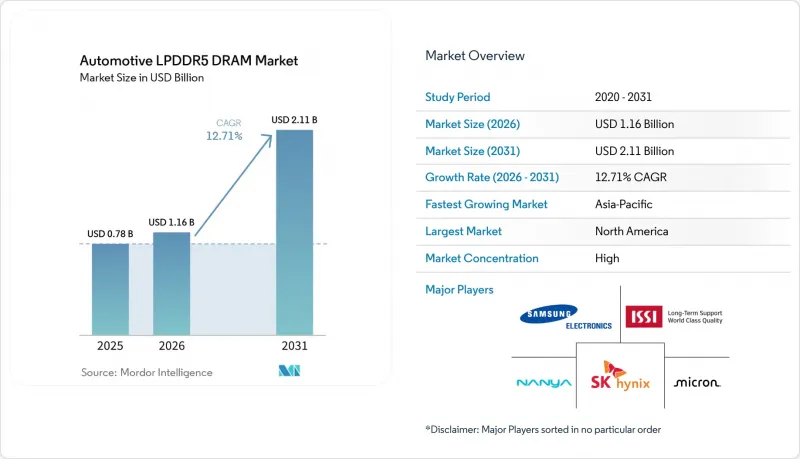
根據 Mordor Intelligence 預測,汽車 LPDDR5 DRAM 市場將從 2025 年的 7.8 億美元成長到 2026 年的 11.6 億美元,然後在 2031 年達到 21.1 億美元,2026 年至 2031 年的複合年成長率為 12.71%。
本報告按AEC-Q100溫度等級(1級(-40°C至+125°C)、2級(-40°C至+105°C)及其他)、應用(例如ADAS和自動駕駛運算)、控制器架構(例如網域控制器)、車輛類型(例如乘用車)和地區進行細分。市場預測以美元(USD)為單位。
全球汽車級LPDDR5 DRAM市場趨勢及洞察
增強ADAS和L2+/L3的運算能力
在汽車級LPDDR5 DRAM市場,記憶體需求成長速度超過了處理器效能提升速度,因為感知、感測器融合和駕駛員決策等工作負載需要高頻寬和大容量工作記憶體池。隨著攝影機、雷達和駕駛監控功能同時執行次數的增加,記憶體子系統不再只是後台組件,而是直接的效能阻礙因素。美光將汽車多模態AI定義為以多GB模型、快速冷啟動和即時推理為核心的工作負載,這正在推動先進運算平台轉型為高效能汽車記憶體。 2025年12月,瑞薩電子展示了一個具體的實際案例:電裝公司將其R-Car V4H ADAS SoC應用於豐田新款RAV4。該平台圍繞著攝影機和雷達融合、駕駛員監控、高級泊車輔助和全景影像功能構建,需要經過認證的工作記憶體。同時,功能安全要求也提高了認證標準的門檻。 ASIL-D級工作負載對錯誤處理、可靠性和熱穩定性的要求比家用電子電器更為嚴格。這就是為什麼 LPDDR5 在汽車 LPDDR5 DRAM 市場中繼續佔據穩固地位,成為新型 ADAS 域控制器和未來自動駕駛運算堆疊的實用記憶體解決方案。
集中式和分區式電子電氣架構
汽車LPDDR5 DRAM市場也正經歷著從眾多獨立ECU向域、區域和集中式運算佈局的轉變。在分散式設計中,記憶體分佈在多個小規模控制器上;而在集中式設計中,大規模的記憶體池被放置在少數幾個高效能節點上,這些節點必須同時管理多個工作負載。這種轉變提高了每輛車記憶體的價值,因為整合並不會降低計算負載;相反,更多的軟體、資料流量和並發處理集中在更少的地方。 JEDEC在汽車AI應用LPDDR記憶體方面的努力凸顯了高速、低功耗記憶體對於支援高運算密集和頻寬汽車系統的重要性,這與這種架構轉變相契合。在2026年國際消費電子展(CES)上,ECARX透過其基於高通驍龍Elite汽車平台的Zenith運算平台重申了這一方向,展示如何將駕駛座和ADAS功能融合到一個整合的硬體堆疊中。隨著這種模式的普及,即使控制器數量減少,汽車 LPDDR5 DRAM 市場中每輛車安裝的 LPDDR5 DRAM 數量仍將繼續增加。
用於人工智慧伺服器的 HBM 分配給汽車 DRAM 的供應帶來了壓力。
汽車級LPDDR5 DRAM市場仍受到根本性分配問題的限制。這是因為汽車產業的需求正在轉向LPDDR5,而更高容量的記憶體則被高利潤的AI相關產品所佔據。隨著產業同時從DDR4過渡到LPDDR5,這個問題變得更加嚴峻。因此,汽車製造商幾乎沒有空間為新的平台週期預留舊記憶體選項。美光解釋說,車載AI應用的複雜性導致記憶體負載不斷增加,並指出汽車行業不斷成長的需求與主要製造商優先考慮其他高階記憶體類別的供應環境發生了衝突。對於汽車製造商和一級供應商而言,這個問題不再僅限於更高的合約價格,因為一旦設計定稿,經過認證的汽車記憶體就無法快速更換。因此,從舊記憶體強制過渡到LPDDR5不僅會影響成本,還會影響生產線的風險,從而對那些已經制定了多年上市計劃的項目造成影響。在經認證的產能大幅擴張之前,汽車 LPDDR5 DRAM 市場將繼續受到配額緊張和採購柔軟性不足的影響。
細分市場分析
到2025年,1級記憶體將佔據汽車LPDDR5 DRAM市場63.08%的佔有率,預計2026年至2031年將以12.98%的複合年成長率成長,成為溫度等級中規模最大、成長最快的類別。這一主導地位反映了新型計算硬體的應用領域,特別是ADAS控制器、區域閘道器和車載中央電腦,這些設備面臨的熱負荷比專用車載電子設備更為嚴峻。 2級記憶體繼續應用於許多傳統的駕駛座和資訊娛樂系統中,這些應用透過HVAC管理系統將周圍環境溫度控制在更嚴格的範圍內,並且在日常駕駛循環中熱負荷相對可預測。 3級記憶體仍然在非關鍵顯示器、基本儀表板和後排區域遠端資訊處理單元中發揮重要作用,但隨著新型車載電子設備向更高性能和更密集的軟體工作負載發展,其應用範圍有所縮小。
在汽車級LPDDR5 DRAM市場,隨著高強度計算將大部分記憶體子系統置於更高溫、更長佔空比的工作環境中,即使是用於駕駛座和車載資訊系統的記憶體也正逐步接近1級標準。 JEDEC針對汽車AI應用LPDDR所做的努力凸顯了高速記憶體和片上補償的重要性,因為在先進的汽車計算中,開關活動和熱應力會同時增加。刷新策略在汽車級LPDDR5 DRAM產業也變得越來越重要,因為設計人員必須在不同的溫度等級下平衡待機功耗、延遲穩定性和安全認證要求。美光的直接鏈路ECC方案表明,更高的頻寬和強大的、以安全為中心的保護功能可以成為1級裝置的核心差異化優勢,而不僅僅是高階設計的可選增強功能。
2025年,數位駕駛座和車載顯示系統將佔汽車LPDDR5 DRAM市場規模的36.52%,而遠端資訊處理、互聯和V2X系統預計將在2026年至2031年間以13.01%的複合年成長率成長。這一細分錶明,由於其目標車型範圍更廣,駕駛座領域在安裝量方面仍然佔據主導地位。另一方面,互聯和V2X的基數較小,但成長迅速。駕駛座領域的優點在於其應用範圍廣泛,涵蓋各個價格區間。這是因為即使是大眾市場車型,與之前的平台相比,也採用了更高解析度的圖形、更快的介面、數位儀表叢集和更多的顯示表面。遠端資訊處理和V2X的快速成長是因為5G連接、安全資料交換、位置資訊和持續連接等所有功能都需要比傳統遠端資訊處理更多的車輛邊緣記憶體。
Springer Nature 的一項關於「V2X(車聯網)通訊」的研究將聯網汽車系統描述為一個平行資料環境,能夠同時處理低延遲通訊、感知、定位和安全等功能,從而解釋了這些模組對工作記憶體需求不斷成長的原因。此外,汽車 LPDDR5 DRAM 市場仍深受 ADAS(高階駕駛輔助系統)和自動駕駛運算需求的影響。這是因為,雖然駕駛座應用在出貨量上領先,但從系統層面來看,這些應用程式對記憶體的需求最高。在汽車 LPDDR5 DRAM 產業,隨著中央運算平台將這些功能進一步整合到共用硬體和整合軟體堆疊中,駕駛座、ADAS 和遠端資訊處理之間的界限將變得更加模糊。這種融合意義重大,因為未來的平台可能會將每個應用程式視為獨立的採購決策,而不是將記憶體作為中央運算架構的一部分進行採購。
區域分析
預計到2025年,亞太地區將佔據汽車LPDDR5 DRAM市場60.97%的佔有率,並在2026年至2031年間以13.66%的複合年成長率成長。該地區擁有數量最多的新能源汽車(NEV)和最強大的記憶體製造基地,因此在供需兩端都保持著持續的影響力。韓國仍然至關重要,其主要供應商持續投資於具有安全認證的汽車記憶體。 SK海力士於2026年1月獲得的ASIL-D認證表明,該認證在全球汽車計畫中的重要性日益凸顯。在中國,電動車和軟體定義汽車的快速普及正在推動需求成長,進而促進集中式運算的早期應用,並提高每輛車LPDDR5的安裝量。日本正透過汽車零件供應商和電子產品製造商之間的緊密合作來深化其供應鏈,這有助於在整個汽車專案週期中進行協調和認證。
儘管北美市場佔有率較小,但它在汽車LPDDR5 DRAM市場仍佔據著重要的戰略地位。這是因為多家美國OEM廠商正在事先佈局,以適應車輛中日益成長的集中式運算和軟體與設備比率。與其他仍以域式佈局為主導的地區相比,這種架構偏好使得北美在產品週期的早期階段就對高密度工作記憶體產生了需求。 2026年2月,瑞薩電子和全球晶圓代工廠擴大了合作,以支持在美國生產下一代汽車半導體。這與該地區加強國內供應鏈韌性和支援汽車晶片本地化的努力相一致。美光科技也強調了汽車多模態人工智慧對記憶體日益成長的需求,這進一步鞏固了北美在塑造未來汽車平臺高性能汽車記憶藍圖的作用。
在歐洲,成長趨勢更為穩定,因為許多汽車製造商在跨平台廣泛採用區域架構成為標準之前,仍繼續採用網域控制器策略。儘管如此,歐盟通用安全法規強制規定的安全功能為新車型項目中與ADAS相關的記憶體需求提供了強力的支援。世界其他地區包括印度等市場。在印度,Mobileye於2026年2月與Mahindra簽訂的合約將為至少六款從2027年起推出的新車型帶來高效能ADAS運算功能。這種區域組成表明,亞太地區主導汽車LPDDR5 DRAM市場,北美是該架構的早期促進者,歐洲是受監管合規主導的採用地區,而新興市場則是下一波高性能運算汽車的浪潮。
其他好處:
- Excel格式的市場預測(ME)表
- 3個月的分析師支持
目錄
第1章:引言
- 研究假設和市場定義
- 調查範圍
第2章:調查方法
第3章執行摘要
第4章 市場狀況
- 市場概覽
- 市場促進因素
- ADAS 與 L2+/L3 階自動駕駛系統運算能力增強
- 集中式和區域式電子電氣架構
- 高階數位駕駛座和多顯示器資訊娛樂系統的發展。
- 電動車和軟體定義汽車平臺的普及
- 採用功能安全認證的工作記憶體
- 車載人工智慧和多模態感測的頻寬需求
- 市場限制因素
- 用於人工智慧伺服器的 HBM 分配給汽車 DRAM 的供應帶來了壓力。
- 汽車產品漫長的認證過程與第二來源週期
- 汽車級LPDDR5記憶體的平均售價(ASP):高級產品產品與消費性記憶體產品的比較
- 高容量模組的散熱、刷新率和功率密度限制
- 產業供應鏈分析
- 監理情勢
- 技術展望
- 宏觀經濟因素的影響
- 波特五力分析
第5章 市場規模與成長預測
- AEC-Q100溫度等級
- 1 級(-40度C 至 +125度C)
- 2 級(-40度C 至 +105度C)
- 3級(-40度C至+85度C)
- 透過使用
- 用於高級駕駛輔助系統和自動駕駛的計算
- 數位駕駛座和車載顯示系統
- 遠端資訊處理、互聯互通和車聯網系統
- 透過控制器架構
- 專用ECU/分散式控制器
- 網域控制器
- 區域控制器
- 車載中央電腦
- 按車輛類別
- 搭乘用車
- 商用車輛
- 按地區
- 北美洲
- 歐洲
- 亞太地區
- 中國
- 日本
- 韓國
- 台灣
- 其他亞太國家
- 世界其他地區
第6章 競爭情勢
- 市場集中度
- 策略趨勢
- 市佔率分析
- 公司簡介
- Micron Technology, Inc.
- Samsung Electronics Co., Ltd.
- SK hynix Inc.
- Nanya Technology Corporation
- Integrated Silicon Solution, Inc.
- ChangXin Memory Technologies, Inc.
- Winbond Electronics Corporation
- Etron Technology, Inc.
- Elite Semiconductor Microelectronics Technology Inc.
- Alliance Memory, Inc.
- Qualcomm Technologies, Inc.
- NVIDIA Corporation
- Renesas Electronics Corporation
- Mobileye Global Inc.
- ECARX Holdings Inc.
第7章 市場機會與未來展望
According to Mordor Intelligence, the automotive LPDDR5 DRAM market size is expected to grow from USD 0.78 billion in 2025 to USD 1.16 billion in 2026 and is forecast to reach USD 2.11 billion by 2031 at 12.71% CAGR over 2026-2031.
This report is Segmented by AEC-Q100 Temperature Grade (Grade 1 (-40 Degree Celsius To +125 Degree Celsius), Grade 2 (-40 Degree Celsius To +105 Degree Celsius), and More), Application (ADAS and Automated Driving Compute, and More), Controller Architecture (Domain Controller, and More), Vehicle Class (Passenger Cars, and More), and Geography. The Market Forecasts are Provided in Terms of Value (USD).
Global Automotive LPDDR5 DRAM Market Trends and Insights
ADAS And Level 2+/3 Compute Expansion
The automotive LPDDR5 DRAM market is seeing memory demand rise faster than processor gains, because perception, sensor fusion, and driving decision workloads require both high bandwidth and large working memory pools. As more camera, radar, and driver monitoring functions run together, the memory subsystem becomes a direct performance constraint instead of a background component. Micron has described in-car multimodal AI as a workload built around multi-gigabyte models, fast cold boot, and real-time inference, which supports the ongoing move to higher-performance automotive memory in advanced compute platforms. Renesas provided a clear production example in December 2025 when Denso selected its R-Car V4H ADAS SoC for Toyota's new RAV4, a platform built around camera-radar fusion, driver monitoring, advanced parking, and panoramic view functions that depend on qualified working memory. Functional safety is raising the qualification bar at the same time, because ASIL-D workloads place stricter demands on error handling, reliability, and thermal consistency than consumer electronics do. This keeps LPDDR5 firmly positioned in the automotive LPDDR5 DRAM market as the practical memory path for new ADAS domain controllers and future autonomous compute stacks.
Centralized And Zonal E/E Architectures
The automotive LPDDR5 DRAM market is also being reshaped by the move away from many separate ECUs and toward domain, zonal, and central compute layouts. In a distributed design, memory is spread across several smaller controllers, but in a centralized design, larger memory pools sit at a few high-performance nodes that must manage multiple workloads at once. That shift raises memory value per vehicle, because consolidation does not reduce compute pressure and instead concentrates more software, more data traffic, and more concurrency into fewer locations. JEDEC's LPDDR memory work for automotive AI applications highlighted the role of high-speed low-power memory in supporting advanced compute and bandwidth-heavy automotive systems, which aligns with this architecture shift. ECARX reinforced the same direction at CES 2026 with its Zenith computing platform built on Qualcomm's Snapdragon Elite automotive platform, showing how cockpit and ADAS functions are being fused into a unified hardware stack. As this model spreads, the automotive LPDDR5 DRAM market will continue to see higher content per vehicle even when controller counts decline.
AI-Server HBM Allocation Crowding Out Automotive DRAM Supply
The automotive LPDDR5 DRAM market remains constrained by a basic allocation problem, because advanced memory capacity is being pulled toward higher-margin AI-linked products at the same time vehicle demand is shifting up to LPDDR5. This matters more now because the industry is moving away from DDR4 and LPDDR4 during the same period, which leaves little room for automakers to hold older memory choices for new platform cycles. Micron has described the growing memory load created by advanced in-car AI applications, and that rising automotive demand is colliding with a supply environment where leading manufacturers are prioritizing other premium memory categories. For automakers and tier 1 suppliers, the issue is no longer limited to higher contract prices, because qualified automotive memory cannot be replaced quickly once a design is frozen. The forced migration from legacy memory to LPDDR5, therefore, carries both cost and line-risk implications for programs already tied to multi-year launch schedules. Until certified capacity expands meaningfully, the automotive LPDDR5 DRAM market will continue to feel the effect of tight allocation and delayed sourcing flexibility.
Other drivers and restraints analyzed in the detailed report include:
- Premium Digital Cockpit And Multi-Display Infotainment Growth
- EV And Software-Defined Vehicle Platform Proliferation
- Long Automotive Qualification And Second-Source Cycles
For complete list of drivers and restraints, kindly check the Table Of Contents.
Segment Analysis
Grade 1 held 63.08% of the automotive LPDDR5 DRAM market share in 2025 and is projected to expand at 12.98% CAGR through 2026-2031, which made it both the largest and fastest-growing temperature class. That leadership reflects where new compute hardware is being deployed, especially in ADAS controllers, zonal gateways, and central vehicle computers that face tougher thermal loads than cabin-only electronics. Grade 2 continued to serve many legacy cockpit and infotainment programs where HVAC management keeps ambient conditions within tighter boundaries and where thermal exposure remains more predictable over daily driving cycles. Grade 3 still mattered for non-critical displays, basic clusters, and rear-zone telematics units, but its addressable role stayed narrower because newer vehicle electronics are moving toward higher performance and denser software workloads.
The automotive LPDDR5 DRAM market is gradually pulling even cockpit and telematics memory toward Grade 1 requirements, because centralized compute places larger portions of the memory subsystem closer to hotter operating environments and longer duty cycles. JEDEC's LPDDR work for automotive AI applications highlighted how higher-speed memory and on-die correction features become more important as switching activity and thermal stress rise together in advanced vehicle compute. Within the automotive LPDDR5 DRAM industry, refresh strategy is also becoming more important, because designers must balance standby power, latency stability, and safety certification demands across different temperature classes. Micron's direct link ECC approach showed how bandwidth uplift and stronger safety-oriented protection can become core differentiators for Grade 1 devices rather than optional enhancements in premium designs.
Digital Cockpit and In-Vehicle Display Systems accounted for 36.52% of the automotive LPDDR5 DRAM market size in 2025, while Telematics, Connectivity, and V2X Systems are projected to expand at 13.01% CAGR through 2026-2031. This split shows that cockpit demand still leads on installed volume because it reaches a much wider vehicle base, while connectivity and V2X are growing from a smaller but faster-moving foundation. The cockpit side benefits from broad adoption across price bands, since even mass-market vehicles now use richer graphics, faster interfaces, digital clusters, and more display surfaces than earlier platforms. Telematics and V2X are scaling faster because 5G-linked communication, secure data exchange, positioning, and continuous connectivity all require more memory at the vehicle edge than legacy telematics did.
Springer Nature's survey of vehicle-to-everything communication described connected vehicle systems as parallel data environments that handle low-latency communication, sensing, positioning, and security at the same time, which explains why working memory requirements are rising in these modules. The automotive LPDDR5 DRAM market also remains heavily influenced by ADAS and automated driving compute, because this application carries the highest memory intensity on a per-system basis even when cockpit programs lead by shipment volume. Within the automotive LPDDR5 DRAM industry, the line between cockpit, ADAS, and telematics is likely to blur further as central compute platforms absorb more of these functions into shared hardware and unified software stacks. That convergence matters because future platforms are likely to buy memory as part of a central compute architecture instead of treating each application as a separate purchasing decision.
Complete Report Scope:
- By AEC-Q100 Temperature Grade
- Grade 1 (-40 Degree Celsius to +125 Degree Celsius)
- Grade 2 (-40 Degree Celsius to +105 Degree Celsius)
- Grade 3 (-40 Degree Celsius to +85 Degree Celsius)
- By Application
- ADAS and Automated Driving Compute
- Digital Cockpit and In-Vehicle Display Systems
- Telematics, Connectivity and V2X Systems
- By Controller Architecture
- Dedicated ECU / Distributed Controller
- Domain Controller
- Zonal Controller
- Central Vehicle Computer
- By Vehicle Class
- Passenger Cars
- Commercial Vehicles
- By Geography
- North America
- Europe
- Asia-Pacific
- China
- Japan
- South Korea
- Taiwan
- Rest of Asia-Pacific
- Rest of the World
Geography Analysis
Asia-Pacific held 60.97% of the automotive LPDDR5 DRAM market share in 2025 and is projected to grow at 13.66% CAGR through 2026-2031. The region combines the largest new energy vehicle base with the deepest memory manufacturing footprint, which keeps both consumption and supply influence centered there. South Korea remains especially important because leading suppliers there continue to invest in safety-qualified automotive memory, and SK hynix's January 2026 ASIL-D certification showed how central that credential has become for global vehicle programs. China adds strong demand momentum through faster EV and software-defined vehicle adoption, which supports earlier uptake of centralized compute and lifts LPDDR5 content per vehicle. Japan adds supply-chain depth through close links between automotive suppliers and electronics manufacturing, which helps with coordination and qualification across long vehicle program cycles.
North America holds a smaller volume share, but it remains strategically important in the automotive LPDDR5 DRAM market because several U.S. OEMs are among the earlier movers toward central vehicle compute and higher software content. That architecture preference creates demand for high-density working memory earlier in the product cycle than in regions that are still more centered on domain-based layouts. Renesas and GlobalFoundries expanded their partnership in February 2026 to support next-generation automotive semiconductor manufacturing in the United States, which aligns with the region's push for stronger domestic supply resilience and more localized automotive chip support. Micron has also emphasized the growing memory demands of in-car multimodal AI, reinforcing North America's role in shaping higher-performance automotive memory roadmaps for future vehicle platforms.
Europe presents a steadier growth profile because many automakers there are still moving through domain-controller strategies before broader zonal transitions become standard on more platforms. Even so, mandatory safety features under the EU's General Safety Regulation keep a durable floor under ADAS-related memory demand across new vehicle programs. Rest of the World includes markets such as India, where Mobileye's February 2026 win with Mahindra will bring high-performance ADAS compute into at least 6 upcoming models from 2027. This regional mix leaves Asia-Pacific in the lead, North America as an early architecture driver, Europe as a compliance-led adopter, and emerging markets as the next wave of compute-rich vehicle launches in the automotive LPDDR5 DRAM market.
- Micron Technology, Inc.
- Samsung Electronics Co., Ltd.
- SK hynix Inc.
- Nanya Technology Corporation
- Integrated Silicon Solution, Inc.
- ChangXin Memory Technologies, Inc.
- Winbond Electronics Corporation
- Etron Technology, Inc.
- Elite Semiconductor Microelectronics Technology Inc.
- Alliance Memory, Inc.
- Qualcomm Technologies, Inc.
- NVIDIA Corporation
- Renesas Electronics Corporation
- Mobileye Global Inc.
- ECARX Holdings Inc.
Additional Benefits:
- The market estimate (ME) sheet in Excel format
- 3 months of analyst support
TABLE OF CONTENTS
1 INTRODUCTION
- 1.1 Study Assumptions and Market Definition
- 1.2 Scope of the Study
2 RESEARCH METHODOLOGY
3 EXECUTIVE SUMMARY
4 MARKET LANDSCAPE
- 4.1 Market Overview
- 4.2 Market Drivers
- 4.2.1 ADAS and Level 2+/3 Compute Expansion
- 4.2.2 Centralized and Zonal E/E Architectures
- 4.2.3 Premium Digital Cockpit and Multi-Display Infotainment Growth
- 4.2.4 EV and Software-Defined Vehicle Platform Proliferation
- 4.2.5 Functional-Safety-Qualified Working Memory Adoption
- 4.2.6 In-Cabin AI and Multimodal Sensing Bandwidth Demand
- 4.3 Market Restraints
- 4.3.1 AI-Server HBM Allocation Crowding Out Automotive DRAM Supply
- 4.3.2 Long Automotive Qualification and Second-Source Cycles
- 4.3.3 Automotive LPDDR5 ASP Premium Versus Consumer-Grade Memory
- 4.3.4 Thermal, Refresh, and Power-Density Limits in High-Capacity Modules
- 4.4 Industry Supply Chain Analysis
- 4.5 Regulatory Landscape
- 4.6 Technological Outlook
- 4.7 Impact of Macroeconomic Factors
- 4.8 Porter's Five Forces Analysis
- 4.8.1 Bargaining Power of Suppliers
- 4.8.2 Bargaining Power of Buyers
- 4.8.3 Threat of New Entrants
- 4.8.4 Threat of Substitutes
- 4.8.5 Intensity of Rivalry
5 MARKET SIZE AND GROWTH FORECASTS (VALUE)
- 5.1 By AEC-Q100 Temperature Grade
- 5.1.1 Grade 1 (-40 Degree Celsius to +125 Degree Celsius)
- 5.1.2 Grade 2 (-40 Degree Celsius to +105 Degree Celsius)
- 5.1.3 Grade 3 (-40 Degree Celsius to +85 Degree Celsius)
- 5.2 By Application
- 5.2.1 ADAS and Automated Driving Compute
- 5.2.2 Digital Cockpit and In-Vehicle Display Systems
- 5.2.3 Telematics, Connectivity and V2X Systems
- 5.3 By Controller Architecture
- 5.3.1 Dedicated ECU / Distributed Controller
- 5.3.2 Domain Controller
- 5.3.3 Zonal Controller
- 5.3.4 Central Vehicle Computer
- 5.4 By Vehicle Class
- 5.4.1 Passenger Cars
- 5.4.2 Commercial Vehicles
- 5.5 By Geography
- 5.5.1 North America
- 5.5.2 Europe
- 5.5.3 Asia-Pacific
- 5.5.3.1 China
- 5.5.3.2 Japan
- 5.5.3.3 South Korea
- 5.5.3.4 Taiwan
- 5.5.3.5 Rest of Asia-Pacific
- 5.5.4 Rest of the World
6 COMPETITIVE LANDSCAPE
- 6.1 Market Concentration
- 6.2 Strategic Moves
- 6.3 Market Share Analysis
- 6.4 Company Profiles (includes Global level Overview, Market level overview, Core Segments, Financials as available, Strategic Information, Market Rank/Share for key companies, Products and Services, and Recent Developments)
- 6.4.1 Micron Technology, Inc.
- 6.4.2 Samsung Electronics Co., Ltd.
- 6.4.3 SK hynix Inc.
- 6.4.4 Nanya Technology Corporation
- 6.4.5 Integrated Silicon Solution, Inc.
- 6.4.6 ChangXin Memory Technologies, Inc.
- 6.4.7 Winbond Electronics Corporation
- 6.4.8 Etron Technology, Inc.
- 6.4.9 Elite Semiconductor Microelectronics Technology Inc.
- 6.4.10 Alliance Memory, Inc.
- 6.4.11 Qualcomm Technologies, Inc.
- 6.4.12 NVIDIA Corporation
- 6.4.13 Renesas Electronics Corporation
- 6.4.14 Mobileye Global Inc.
- 6.4.15 ECARX Holdings Inc.
7 MARKET OPPORTUNITIES AND FUTURE OUTLOOK
- 7.1 White-space and unmet-need assessment

 AI記憶體和先進DRAM市場預測至2034年-按記憶體類型、技術節點、外形尺寸、應用、最終用戶和地區分類的全球分析
 先進DRAM封裝:市場佔有率分析、產業趨勢與統計數據、成長預測(2026-2031年)汽車領域先進DRAM:市佔率分析、產業趨勢與統計及成長預測(2026-2031年)
 汽車記憶體市場:按記憶體類型、架構、應用和最終用戶分類 - 2026-2032年全球市場預測
 汽車記憶體市場規模、佔有率、趨勢和預測:按產品類型、車輛類型、應用和地區分類,2026-2034年
 汽車記憶體市場-全球產業規模、佔有率、趨勢、機會及預測(依產品、車輛、應用、地區及競爭格局分類),2021-2031年
 基於憶阻器的汽車記憶體市場機會、成長促進因素、產業趨勢分析及預測(2025-2034年)
 全球汽車記憶體市場