


 |
市場調查報告書
商品編碼
2098540
人工智慧在網路流量分析的應用:市場佔有率分析、產業趨勢與統計數據以及成長預測(2026-2031 年)AI In Network Traffic Analysis - Market Share Analysis, Industry Trends & Statistics, Growth Forecasts (2026 - 2031) |
||||||

※ 本網頁內容可能與最新版本有所差異。詳細情況請與我們聯繫。
根據 Mordor Intelligence 預測,網路流量分析的 AI 市場規模將從 2025 年的 31.2 億美元成長到 2026 年的 38.2 億美元,然後在 2031 年達到 102.2 億美元,2026 年至 2031 年的複合年成長率為 21.75%。
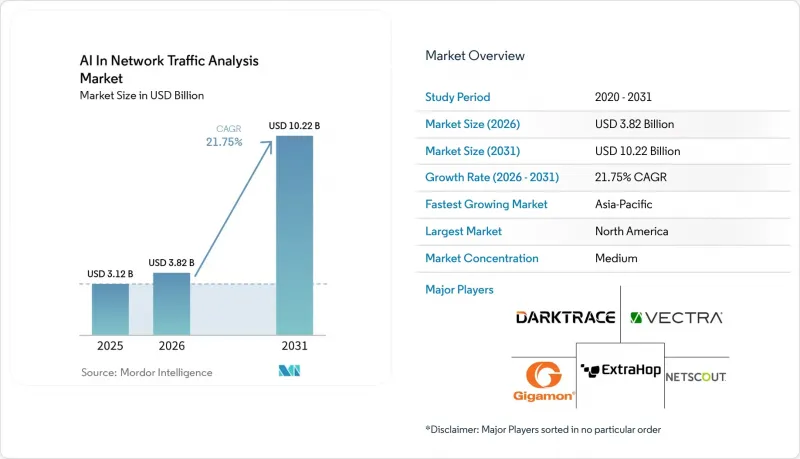
本報告按元件(軟體和服務)、部署方式(雲端、本地部署、混合部署)、企業規模(大型企業等)、網路類型(企業網路、資料中心網路等)、應用程式領域(入侵偵測與防禦等)、最終用戶業(銀行、金融服務和保險等)以及地區進行細分。市場預測以美元計價。
全球網路流量分析中的人工智慧市場趨勢與洞察
企業對即時威脅偵測的需求日益成長
由於安全團隊無法等待數小時來檢驗可疑流量,即時威脅偵測已成為網路流量分析人工智慧市場的短期採購重點。 ExtraHop 發布的 2026 年報告顯示,55% 的受訪者認為人工智慧工具是他們面臨的最大安全風險,這凸顯了這項需求正迅速反映在實際安全預算中。當自主軟體代理程式在內部網路之間通訊時,這個問題會更加嚴重,因為它們的行為可能與正常的機器流量混淆,直到其模式被持續建模。 2026 年 3 月,ExtraHop 發布了“AI Observability”,旨在檢測人工智慧基礎設施、繪製代理通訊模式並即時檢測惡意資料移動。這些功能至關重要,因為它們可以幫助分析人員快速從確認警報過渡到在橫向移動擴散到整個互聯系統之前做出回應。因此,網路流量分析人工智慧市場正從週期性流量檢查轉向持續的行為檢測。
混合雲和多重雲端網路日益複雜
混合雲和多重雲端的無序擴張正在擴大網路流量分析人工智慧市場的盲點,從而提升了能夠跨多個環境追蹤流量的工具的價值。 Gigamon 2025 年的一項調查發現,在人工智慧應用的壓力下,91% 的企業在混合雲端環境中存在高風險的安全漏洞。該調查還發現,47% 的企業已經意識到針對大規模語言模型部署的攻擊增加,這表明網路可見度差距與新的企業工作負載直接相關。泰雷茲在 2025 年報告中發現,55% 的受訪者認為保護雲端環境比保護本地系統更難。泰雷茲還指出,企業平均使用 85 個 SaaS 應用程式,這意味著流量基準必須涵蓋多種不同的模式。因此,網路流量分析人工智慧市場正朝著更廣泛的可觀測性方向發展,涵蓋東西向流量、雲端服務和共用策略層。
在各種交通環境下,誤報率較高
在人工智慧(AI)網路流量分析市場中,誤報仍然是一個實際障礙。這是因為吵雜的警報會佔用分析師有限的時間,並削弱人們對自動偵測的信心。 2025 年發表在《國際電腦科學與工程高級研究期刊》(International Journal of Advanced Research in Computer Science and Engineering)上的一項研究表明,與基於規則的系統相比,AI 驅動的預測分析可以將誤報率降低 40% 以上。雖然這項改善意義重大,但它並不能減輕大量企業流量和多樣化設備環境所帶來的負擔。如果模型是基於過去的行為進行學習的,那麼隨著網路模式因新的 SaaS 工具、容器工作負載或物聯網設備而變化,檢測精度可能會下降。在同時監控 IT、OT 和 IoT 流量的環境中,這個問題尤其突出,因為單一的基準很少能適用於所有資產類別。除非供應商能夠簡化調優流程,否則一些買家可能會推遲部署或在流程中嚴格加入人工審核。
細分市場分析
在網路流量分析人工智慧市場中,服務是成長最快的細分市場,預計從2026年到2031年將以22.84%的複合年成長率成長,其中維運支援是需求的核心。這種成長速度表明,許多買家尋求的是持續的監控、調優和回應支持,而不是一次性的軟體購買。軟體仍是主要產品,佔據61.12%的市場。這是因為網路偵測和回應平台、行為分析引擎以及SIEM整合正成為大多數組織部署大規模檢測的手段。網路流量分析人工智慧市場呈現這種趨勢,是因為對許多團隊而言,購買平台比培養足夠的內部專業知識來正確操作平台要快捷得多。這提升了大規模部署中輔助服務的價值,因為模型調優、策略設定和調查支援都會影響實際效能。
預計到2031年,網路流量分析人工智慧市場中的服務領域將以超過整體市場成長的速度成長,這將推動供應商轉向持續交付模式。 2025年4月,IBM發布了ATOM,該產品可自動進行威脅分類、調查和修復,展示了軟體供應商如何將類似服務的功能整合到其平台中。 2026年2月,Darktrace發布了SECURE AI,該產品將行為監控的範圍擴展到生成式人工智慧工具和自主代理,從而減輕了缺乏專門人工智慧安全專家的內部團隊的負擔。隨著這些模型的成熟,客戶在比較供應商時,將更加重視價值實現的速度、覆蓋範圍和日常運維支持,而不是功能清單。在網路流量分析人工智慧產業,擁有針對醫療保健、金融和工業環境預先配置流量模型的供應商將在以服務為主導的銷售中保持競爭優勢。
到2025年,雲端採用將佔據網路流量分析領域人工智慧市場的54.08%,成為企業買家最主要的採購模式。這一主導地位反映了雲端部署速度快、易於擴展以及感測器覆蓋範圍廣,能夠覆蓋分散式用戶、應用程式和分店等優勢。在網路流量分析人工智慧市場,雲端產品之所以更受歡迎,是因為它能夠比基於設備的更新周期更快地應用軟體更新和改進感測技術。到2031年,混合部署模式將成為成長最快的模式。這是因為大多數大型組織仍然在多個環境中運行敏感系統、傳統工作負載和雲端分析。這種分散運作模式推動了對能夠關聯跨環境活動且不會在邊界造成安全漏洞的平台的需求。
到 2031 年,混合部署模式的成長速度將超過其他模式,而本地基礎設施仍將在國防、政府和受監管的金融領域繼續發揮至關重要的作用。 Cato Networks 於 2026 年 3 月發布了其基於 GPU 的 SASE 平台,表明基於雲端的檢測現在可以處理更苛刻的隨線分析工作負載。這一點意義重大,因為買家在將網路視覺性遷移到基於雲端的控制平面時,不再希望在效能和柔軟性之間做出權衡。網路流量分析的 AI 市場將繼續青睞那些能夠在私有雲、公有雲和混合環境中應用一致行為邏輯的供應商。能夠以同等策略品質支援雲端、本地和主權部署模式的供應商,在複雜的基本客群中可能繼續保持優勢。
區域分析
2025年,北美繼續保持在各區域的領先地位,佔據網路流量分析人工智慧市場佔有率的32.11%。該地區受益於成熟的安全預算、高度集中的供應商以及大型企業對新型檢測模型的快速採用。美國國防部於2025年7月發布的一項指令提高了操作標準,強制要求在所有敏感和非敏感系統(包括運營技術環境)中整合目標級零信任和擴展檢測與響應(XDR)。此類聯邦指南通常會對採購標準產生深遠影響,其影響範圍遠遠超出政府直接使用。網路流量分析人工智慧市場也受益於來自供應商總部、通路深度以及企業安全工具大規模部署基礎的區域支援。
歐洲仍然是至關重要的需求中心,因為企業在需要更嚴格的監控的同時,也需要平衡日益嚴格的隱私保護措施,尤其是在資料包檢測方面。 CERT-FR 發布的《2025 年網路威脅概覽》重點指出,威脅行為者擴大使用人工智慧工具,凸顯了加強歐洲網路行為監控的必要性。這使得基於元資料的分析、加密流量監控和區域特定策略控制始終保持高度關注。雖然南美洲的採用仍處於起步階段,但巴西正在推動區域需求,因為金融和其他受監管服務的數位化進程增加了對更高網路可見度的需求。
預計亞太地區在2026年至2031年間將以23.51%的複合年成長率成長,成為網路流量分析人工智慧市場成長最快的區域市場。這項需求主要受雲端運算擴張、私有5G部署以及分散式數位基礎設施安全保障等因素的推動。供應商正在擴大其區域佈局,以提供低延遲且具有強大本地支援的雲端偵測服務。中東和非洲市場基數小規模,但成長迅速,其中海灣國家推動了企業網路安全支出,而非洲的應用則主要集中在金融服務業。隨著這些區域趨勢的演變,網路流量分析人工智慧市場預計將繼續分化為成熟平台市場、合規主導市場和雲端運算擴張市場。
其他好處:
- Excel格式的市場預測(ME)表
- 3個月的分析師支持
目錄
第1章:引言
- 研究假設和市場定義
- 調查範圍
第2章:調查方法
第3章執行摘要
第4章 市場狀況
- 市場概覽
- 市場促進因素
- 企業對即時威脅偵測。
- 混合雲和多重雲端網路日益複雜
- 擴大零信任與XDR架構的應用
- 擴大對加密流量的監控要求
- 對自動化網路取證和根本原因分析的需求
- 保全行動中針對人工智慧模型漂移管理的需求尚未充分通報。
- 市場限制因素
- 在各種交通環境下,誤報率較高
- 資料隱私和資料包檢查的限制
- 負責人工智慧調優和檢驗的熟練分析師短缺
- 與傳統NDR、SIEM和SOAR堆疊整合時的摩擦
- 產業價值鏈分析
- 監理情勢
- 技術展望
- 波特五力分析
第5章 市場規模與成長預測
- 按組件
- 軟體
- 服務
- 不同的發展
- 雲
- 現場
- 混合
- 按公司規模
- 大公司
- 小型企業
- 依網路類型
- 企業網路
- 資料中心網路
- 雲端網路
- 工業和OT網路
- 透過使用
- 入侵偵測與防禦
- 網路效能監控
- 異常檢測與行為分析
- 威脅狩獵和事件回應
- 網路取證與根本原因分析
- 容量規劃與交通最佳化
- 按最終用戶行業分類
- BFSI
- 醫療保健和生命科學
- IT/通訊
- 零售與電子商務
- 工業製造
- 政府/公共部門
- 其他終端用戶產業
- 按地區
- 北美洲
- 美國
- 加拿大
- 墨西哥
- 南美洲
- 巴西
- 阿根廷
- 其他南美國家
- 歐洲
- 德國
- 英國
- 法國
- 義大利
- 西班牙
- 俄羅斯
- 其他歐洲國家
- 亞太地區
- 中國
- 印度
- 日本
- 韓國
- 澳洲
- 其他亞太國家
- 中東和非洲
- 中東
- 沙烏地阿拉伯
- 阿拉伯聯合大公國
- 其他中東國家
- 非洲
- 南非
- 奈及利亞
- 其他非洲國家
- 中東
- 北美洲
第6章 競爭情勢
- 市場集中度
- 策略趨勢
- 市佔率分析
- 公司簡介
- Darktrace plc
- Vectra AI, Inc.
- ExtraHop Networks, Inc.
- Gigamon Inc.
- NETSCOUT Systems, Inc.
- Arista Networks, Inc.
- Cisco Systems, Inc.
- Palo Alto Networks, Inc.
- Fortinet, Inc.
- IBM Corporation
- Broadcom Inc.
- Juniper Networks, Inc.
- Progress Software Corporation
- Accedian Networks Inc.
- Savvius, Inc.
- Netskope, Inc.
- Observe.AI, Inc.
- Rapid7, Inc.
- Splunk LLC
- Cisco ThousandEyes, Inc.
第7章 市場機會與未來展望
According to Mordor Intelligence, the AI in network traffic analysis market size is expected to grow from USD 3.12 billion in 2025 to USD 3.82 billion in 2026 and is forecast to reach USD 10.22 billion by 2031 at 21.75% CAGR over 2026-2031.
This report is Segmented by Component (Software, and Services), Deployment (Cloud, On-Premises, and Hybrid), Enterprise Size (Large Enterprises, and More), Network Type (Enterprise Networks, Data Center Networks, and More), Application (Intrusion Detection and Prevention, and More), End-User Industry (BFSI, and More), and Geography. The Market Forecasts are Provided in Terms of Value (USD).
Global AI In Network Traffic Analysis Market Trends and Insights
Rising Enterprise Demand for Real-Time Threat Detection
Real-time threat detection has become a near-term buying priority in the AI in network traffic analysis market because security teams cannot wait hours to validate suspicious traffic. ExtraHop reported in 2026 that 55% of respondents viewed AI tools as a top security risk, underscoring how quickly this need has moved into live security budgets. The issue is sharper when autonomous software agents communicate across internal networks, because their behavior can blend into normal machine traffic until patterns are modeled continuously. ExtraHop launched AI Observability in March 2026 to discover AI infrastructure, map agent communication patterns, and detect unauthorized data movement in real time. These capabilities matter because they help analysts move from alert review to action before lateral movement spreads across connected systems. As a result, the AI in network traffic analysis market is shifting toward continuous behavioral inspection rather than periodic traffic review.
Increasing Hybrid and Multi-Cloud Network Complexity
Hybrid and multi-cloud sprawl is widening blind spots in the AI in network traffic analysis market and raising the value of tools that can follow traffic across several environments. Gigamon's 2025 survey found that 91% of organizations made risky security compromises in hybrid cloud environments under pressure to adopt AI. The same survey found that 47% were already seeing more attacks targeting large language model deployments, tying network visibility gaps directly to new enterprise workloads. Thales reported in 2025 that 55% of respondents found cloud environments harder to secure than on-premises systems. Thales also reported that organizations use an average of 85 SaaS applications, which means traffic baselines must cover many distinct patterns. This is why the AI in network traffic analysis market is moving toward broader observability across east-west traffic, cloud services, and shared policy layers.
High False Positive Sensitivity in Diverse Traffic Environments
False positives remain a practical barrier in the AI in network traffic analysis market because noisy alerts consume limited analyst time and weaken trust in automated detection. A 2025 study in the International Journal of Advanced Research in Computer Science and Engineering found that AI-driven predictive analytics cut false positives by more than 40% compared with rule-based systems. That improvement is meaningful, but it does not remove the burden created by high-volume enterprise traffic and mixed device environments. When models are trained on past behavior, detection quality can weaken as new SaaS tools, container workloads, or IoT devices change network patterns. This is especially hard in environments that monitor IT, OT, and IoT traffic together, because a single baseline rarely fits all asset classes. Until vendors make tuning easier, some buyers will slow rollouts or keep human review tightly in the loop.
Other drivers and restraints analyzed in the detailed report include:
- Growing Adoption f Zero Trust and XDR Architectures
- Expansion of Encrypted Traffic Monitoring Requirements
- Data Privacy and Packet Inspection Constraints
For complete list of drivers and restraints, kindly check the Table Of Contents.
Segment Analysis
Services are the fastest-growing component of the AI in network traffic analysis market, with a 22.84% CAGR during 2026-2031, positioning operating support close to the center of demand. That pace shows that many buyers now want ongoing monitoring, tuning, and response help instead of a one-time software purchase. Software remains the main delivery layer with a share of 61.12% because network detection and response platforms, behavioral analytics engines, and SIEM integrations are how most organizations deploy inspection at scale. The AI in network traffic analysis market is moving this way because many teams can buy a platform faster than they can build enough in-house expertise to operate it well. This makes service attachments more valuable in large rollouts where model tuning, policy setting, and investigation support all shape real-world performance.
Services in the AI in network traffic analysis market are projected to outpace headline growth through 2031, nudging vendors toward recurring delivery models. IBM launched ATOM in April 2025 to automate threat triage, investigation, and remediation, demonstrating how software vendors are packaging service-like outcomes within their platforms. Darktrace launched SECURE AI in February 2026 to extend behavioral oversight to generative AI tools and autonomous agents, thereby reducing the burden on internal teams that lack dedicated AI security specialists. As these models mature, customers will compare vendors less on feature lists and more on speed to value, depth of coverage, and day-to-day operational support. In the AI in network traffic analysis industry, providers that preconfigure traffic models for healthcare, finance, and industrial environments should retain an edge in services-led sales.
Cloud deployment accounted for 54.08% of the AI in network traffic analysis market share in 2025, making it the largest delivery model among enterprise buyers. That lead reflects faster rollout, easier scaling, and broader sensor reach across distributed users, applications, and branch locations. The AI in network traffic analysis market is also favoring cloud delivery because software updates and detection improvements can be applied faster than appliance-based refresh cycles. Hybrid deployment is the fastest-growing model through 2031 because most large organizations still split sensitive systems, legacy workloads, and cloud analytics across multiple environments. That split keeps demand high for platforms that can correlate activity across both settings without leaving inspection gaps at the boundary.
Hybrid deployment is growing faster than the other models through 2031, while on-premises infrastructure continues to hold a necessary role in defense, government, and regulated finance. Cato Networks launched a GPU-powered SASE platform in March 2026, which showed that cloud-delivered inspection can now support more demanding inline analysis workloads. This matters because buyers no longer want to trade off performance against flexibility when they move network visibility into cloud-based control planes. The AI in network traffic analysis market should continue rewarding vendors that can apply consistent behavioral logic across private, public, and mixed environments. Vendors that support cloud, on-premises, and sovereign deployment models with the same policy quality are likely to remain stronger in complex accounts.
Complete Report Scope:
- By Component
- Software
- Services
- By Deployment
- Cloud
- On-Premises
- Hybrid
- By Enterprise Size
- Large Enterprises
- Small and Medium Enterprises
- By Network Type
- Enterprise Networks
- Data Center Networks
- Cloud Networks
- Industrial and OT Networks
- By Application
- Intrusion Detection and Prevention
- Network Performance Monitoring
- Anomaly Detection and Behavioral Analytics
- Threat Hunting and Incident Response
- Network Forensics and Root Cause Analysis
- Capacity Planning and Traffic Optimization
- By End-user Industry
- BFSI
- Healthcare and Life Sciences
- Information Technology and Telecom
- Retail and E-commerce
- Industrial Manufacturing
- Government and Public Sector
- Other End-user Industries
- By Geography
- North America
- United States
- Canada
- Mexico
- South America
- Brazil
- Argentina
- Rest of South America
- Europe
- Germany
- United Kingdom
- France
- Italy
- Spain
- Russia
- Rest of Europe
- Asia-Pacific
- China
- India
- Japan
- South Korea
- Australia
- Rest of Asia-Pacific
- Middle East and Africa
- Middle East
- Saudi Arabia
- United Arab Emirates
- Rest of Middle East
- Africa
- South Africa
- Nigeria
- Rest of Africa
- Middle East
- North America
Geography Analysis
North America held 32.11% of the AI in network traffic analysis market share in 2025, maintaining its lead across regions. The region benefits from mature security budgets, high vendor concentration, and quicker adoption of new detection models across large enterprises. The U.S. Department of Defense directive issued in July 2025 raised the operational bar by requiring target-level zero trust and XDR integration across classified and unclassified systems, including OT environments. That kind of federal direction often shapes procurement standards far beyond direct government use. The AI in network traffic analysis market also gains regional support from vendor headquarters, channel depth, and a large installed base of enterprise security tools.
Europe remains an important demand center because enterprises need closer monitoring while balancing tighter privacy expectations around packet inspection. CERT-FR's 2025 cyber threat panorama highlighted the growing use of AI tools by threat actors, underscoring the need for stronger behavioral monitoring across European networks. This keeps interest high in metadata-based analysis, encrypted traffic monitoring, and region-specific policy controls. South America is still earlier in adoption, but Brazil is leading regional demand as digitization in finance and other regulated services raises the need for better network visibility.
Asia-Pacific is projected to expand at a 23.51% CAGR during 2026-2031, making it the fastest-growing regional segment of the AI in network traffic analysis market. Demand is being supported by cloud buildout, private 5G activity, and a wider push to secure distributed digital infrastructure. Vendors are expanding regional delivery capacity to offer cloud-based detection with lower latency and stronger local support. The Middle East and Africa are building from a smaller base, with Gulf countries leading enterprise cybersecurity spending while African adoption is more concentrated in financial services. As these regional patterns evolve, the AI in network traffic analysis market should continue to split into mature platform markets, compliance-led markets, and cloud-expansion markets.
- Darktrace plc
- Vectra AI, Inc.
- ExtraHop Networks, Inc.
- Gigamon Inc.
- NETSCOUT Systems, Inc.
- Arista Networks, Inc.
- Cisco Systems, Inc.
- Palo Alto Networks, Inc.
- Fortinet, Inc.
- IBM Corporation
- Broadcom Inc.
- Juniper Networks, Inc.
- Progress Software Corporation
- Accedian Networks Inc.
- Savvius, Inc.
- Netskope, Inc.
- Observe.AI, Inc.
- Rapid7, Inc.
- Splunk LLC
- Cisco ThousandEyes, Inc.
Additional Benefits:
- The market estimate (ME) sheet in Excel format
- 3 months of analyst support
TABLE OF CONTENTS
1 INTRODUCTION
- 1.1 Study Assumptions and Market Definition
- 1.2 Scope of the Study
2 RESEARCH METHODOLOGY
3 EXECUTIVE SUMMARY
4 MARKET LANDSCAPE
- 4.1 Market Overview
- 4.2 Market Drivers
- 4.2.1 Rising Enterprise Demand for Real-Time Threat Detection
- 4.2.2 Increasing Hybrid And Multi-Cloud Network Complexity
- 4.2.3 Growing Adoption of Zero Trust And XDR Architectures
- 4.2.4 Expansion of Encrypted Traffic Monitoring Requirements
- 4.2.5 Need for Automated Network Forensics and Root-Cause Analysis
- 4.2.6 Under-Reported, AI-Specific Model Drift Management Demand In Security Operations
- 4.3 Market Restraints
- 4.3.1 High False Positive Sensitivity In Diverse Traffic Environments
- 4.3.2 Data Privacy And Packet Inspection Constraints
- 4.3.3 Skilled Analyst Shortage For AI Tuning And Validation
- 4.3.4 Integration Friction With Legacy NDR, SIEM, And SOAR Stacks
- 4.4 Industry Value-Chain Analysis
- 4.5 Regulatory Landscape
- 4.6 Technological Outlook
- 4.7 Porter's Five Forces Analysis
- 4.7.1 Bargaining Power of Buyers
- 4.7.2 Bargaining Power of Suppliers
- 4.7.3 Threat of New Entrants
- 4.7.4 Threat of Substitutes
- 4.7.5 Intensity of Competitive Rivalry
5 MARKET SIZE AND GROWTH FORECASTS (VALUE)
- 5.1 By Component
- 5.1.1 Software
- 5.1.2 Services
- 5.2 By Deployment
- 5.2.1 Cloud
- 5.2.2 On-Premises
- 5.2.3 Hybrid
- 5.3 By Enterprise Size
- 5.3.1 Large Enterprises
- 5.3.2 Small and Medium Enterprises
- 5.4 By Network Type
- 5.4.1 Enterprise Networks
- 5.4.2 Data Center Networks
- 5.4.3 Cloud Networks
- 5.4.4 Industrial and OT Networks
- 5.5 By Application
- 5.5.1 Intrusion Detection and Prevention
- 5.5.2 Network Performance Monitoring
- 5.5.3 Anomaly Detection and Behavioral Analytics
- 5.5.4 Threat Hunting and Incident Response
- 5.5.5 Network Forensics and Root Cause Analysis
- 5.5.6 Capacity Planning and Traffic Optimization
- 5.6 By End-user Industry
- 5.6.1 BFSI
- 5.6.2 Healthcare and Life Sciences
- 5.6.3 Information Technology and Telecom
- 5.6.4 Retail and E-commerce
- 5.6.5 Industrial Manufacturing
- 5.6.6 Government and Public Sector
- 5.6.7 Other End-user Industries
- 5.7 By Geography
- 5.7.1 North America
- 5.7.1.1 United States
- 5.7.1.2 Canada
- 5.7.1.3 Mexico
- 5.7.2 South America
- 5.7.2.1 Brazil
- 5.7.2.2 Argentina
- 5.7.2.3 Rest of South America
- 5.7.3 Europe
- 5.7.3.1 Germany
- 5.7.3.2 United Kingdom
- 5.7.3.3 France
- 5.7.3.4 Italy
- 5.7.3.5 Spain
- 5.7.3.6 Russia
- 5.7.3.7 Rest of Europe
- 5.7.4 Asia-Pacific
- 5.7.4.1 China
- 5.7.4.2 India
- 5.7.4.3 Japan
- 5.7.4.4 South Korea
- 5.7.4.5 Australia
- 5.7.4.6 Rest of Asia-Pacific
- 5.7.5 Middle East and Africa
- 5.7.5.1 Middle East
- 5.7.5.1.1 Saudi Arabia
- 5.7.5.1.2 United Arab Emirates
- 5.7.5.1.3 Rest of Middle East
- 5.7.5.2 Africa
- 5.7.5.2.1 South Africa
- 5.7.5.2.2 Nigeria
- 5.7.5.2.3 Rest of Africa
- 5.7.5.1 Middle East
- 5.7.1 North America
6 COMPETITIVE LANDSCAPE
- 6.1 Market Concentration
- 6.2 Strategic Moves
- 6.3 Market Share Analysis
- 6.4 Company Profiles (includes Global Level Overview, Market Level Overview, Core Segments, Financials as available, Strategic Information, Market Rank/Share, Products and Services, Recent Developments)
- 6.4.1 Darktrace plc
- 6.4.2 Vectra AI, Inc.
- 6.4.3 ExtraHop Networks, Inc.
- 6.4.4 Gigamon Inc.
- 6.4.5 NETSCOUT Systems, Inc.
- 6.4.6 Arista Networks, Inc.
- 6.4.7 Cisco Systems, Inc.
- 6.4.8 Palo Alto Networks, Inc.
- 6.4.9 Fortinet, Inc.
- 6.4.10 IBM Corporation
- 6.4.11 Broadcom Inc.
- 6.4.12 Juniper Networks, Inc.
- 6.4.13 Progress Software Corporation
- 6.4.14 Accedian Networks Inc.
- 6.4.15 Savvius, Inc.
- 6.4.16 Netskope, Inc.
- 6.4.17 Observe.AI, Inc.
- 6.4.18 Rapid7, Inc.
- 6.4.19 Splunk LLC
- 6.4.20 Cisco ThousandEyes, Inc.
7 MARKET OPPORTUNITIES AND FUTURE OUTLOOK
- 7.1 White-Space and Unmet-Need Assessment

 智慧電信流量分析市場預測至2034年-按組件、部署模式、技術、應用、最終用戶和地區分類的全球分析
 組織網路分析(ONA)平台:市場佔有率分析、產業趨勢與統計資料、成長預測(2026-2031)
 2026年全球網路流量分析市場報告2026年全球網路流量分析解決方案市場報告
 2026-2030年全球組織網路分析工具市場
 網路流量分析解決方案市場分析及預測(至2035年):按類型、產品類型、服務、技術、組件、應用、流程、部署類型和最終用戶分類
 網路流量分析解決方案市場 - 全球產業規模、佔有率、趨勢、機會、預測:按部署類型、用戶類型、最終用戶、地區和競爭對手分類,2021-2031 年
 網路流量分析市場規模、佔有率和成長分析(按組件、部署類型、組織規模、最終用戶產業和地區分類)-2026-2033年產業預測網路流量分析市場 - 全球產業規模、佔有率、趨勢、機會和預測,按組件、部署模式、組織規模、最終用戶、地區和競爭格局細分,2020-2030 年預測
 網路流量分析市場機會、成長動力、產業趨勢分析及 2025 - 2034 年預測