


 |
市場調查報告書
商品編碼
2098480
人工智慧超級晶片:市場佔有率分析、產業趨勢與統計及成長預測(2026-2031)AI Superchip - Market Share Analysis, Industry Trends & Statistics, Growth Forecasts (2026 - 2031) |
||||||

※ 本網頁內容可能與最新版本有所差異。詳細情況請與我們聯繫。
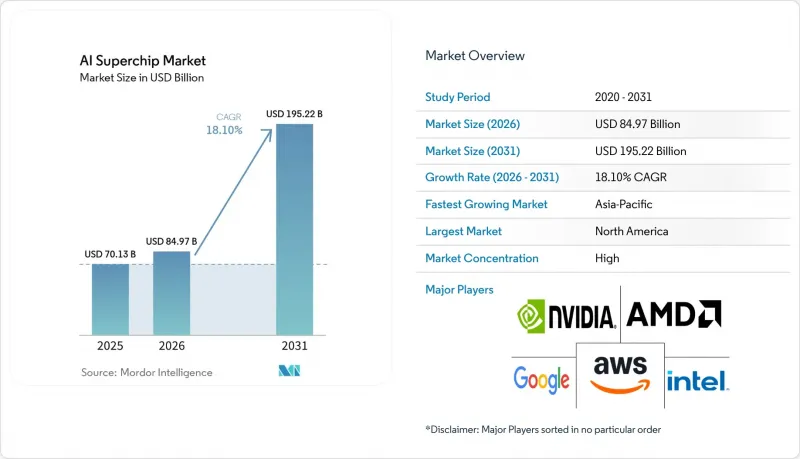
根據 Mordor Intelligence 預測,人工智慧超級晶片市場規模將從 2025 年的 701.3 億美元成長到 2026 年的 849.7 億美元,然後在 2031 年達到 1952.2 億美元,2026 年至 2031 年的複合年成長率為 18.10%。
本報告按功能(訓練與推理)、架構類型(CPU-GPU整合超級晶片、GPU-GPU耦合超級晶片等)、封裝技術(單一系統晶片(SoC)等)、部署模式(雲端、本地部署、邊緣部署)、最終用戶(超大規模雲端供應商、資料中心、企業等)和地區進行細分。市場預測以美元(USD)為單位。
全球人工智慧超級晶片市場趨勢與洞察
用於訓練前沿模型的運算能力的擴展,正在推動矽需求的持續成長。
人工智慧超級晶片市場持續高速成長,這主要得益於尖端模型的訓練。這是因為最新的語言、視覺和多模態系統需要比以往幾代系統更強大的平行運算能力。向「混合專家(MOE)」設計和多階段後訓練的轉變意味著硬體需求不再局限於單一的預訓練階段,而是涵蓋了調優、對齊和評估等多個週期。 2026年1月5日,NVIDIA發布了其「Rubin」平台,每個GPU的NVFP4推理運算能力高達50 petaflops。據該公司稱,與上一代「Blackwell」平台相比,該平台僅需四分之一的GPU即可訓練MOE模型。即使每個模型的計算成本降低,晶片的整體需求也不會降低,因為研究機構通常會建立大規模的系統並進行更多實驗。同樣的趨勢也延續到了生產階段,推理工作負載消耗的計算資源會根據查詢而波動,而不是像傳統推理那樣採用固定的預算。因此,人工智慧超級晶片市場在整個模型生命週期中都出現了需求成長,既支援訓練叢集,也支援大規模推理集群。
HBM 共置和記憶體頻寬擴展正在重塑晶片結構。
現代加速器若要維持高吞吐量,必須將記憶體放置在靠近處理單元的位置,因此高頻寬記憶體已從單純的效能差異化因素演變為人工智慧超級晶片市場的基本設計要求。 2024年12月,JEDEC發布了HBM4標準,目標是2048位元介面和1.5-2 TB/s的單頻寬,從而提高了未來加速器設計的頻寬上限。西門子指出,HBM4也將堆疊容量擴展至64 GB,使設計人員能夠在同一包裝內更好地平衡頻寬、容量和功耗。這種記憶體變革正在改變架構選擇,因為運算模組、中介層和散熱路徑的設計從一開始就必須考慮記憶體的限制。此外,記憶體的可用性與邏輯設計一樣,會影響產品發布的時間,這凸顯了韓國和台灣供應商準備就緒的重要性。因此,產品的成功越來越取決於供應商如何協調記憶體、封裝和系統整合,而不僅僅是處理器吞吐量。
先進封裝技術的產能限制了短期供應。
先進封裝仍然是人工智慧超級晶片市場短期內最大的瓶頸,因為加速器必須經過複雜的組裝流程才能交付,該流程需要將計算晶片和HBM封裝在同一晶片內。即使晶圓供應有所改善,封裝生產線仍需要專用的鍵合機、貼片設備和檢測系統,而這些設備的部署和認證都需要時間。因此,許多供應商仍然受到配額的限制,封裝的可用性已成為與晶片設計和晶圓開片同等重要的商業性籌碼。這種供不應求也加速了市場集中度的上升,因為大型公司比小型競爭對手更容易獲得基板、記憶體和晶圓代工廠的資源。冷卻和互連設計標準的提高進一步增加了高密度貼片的技術難度,導致封裝限制蔓延到機架設計和系統認證。在產能大幅提升之前,交貨時間仍將很大程度上取決於封裝的準備情況以及處理器的需求。
細分市場分析
到2025年,訓練將佔人工智慧超級晶片市場59.32%的佔有率,佔據最大佔有率,因為開發最先進的模型仍然消耗最多的運算資源。這一領先地位反映了大型叢集上訓練的強度,最先進的模型在其漫長的開發週期中可能需要利用數萬個GPU。訓練仍然是核心,因為領先的研究機構不僅擴展模型,還增加了調優和評估階段。這些額外的步驟確保了即使在初始預訓練階段完成後,叢集的使用率仍然很高。據NVIDIA稱,Rubin平台僅需上一代Blackwell平台四分之一的GPU數量即可訓練混合專家(MoE)模型,顯示效率標準正在快速提升。
儘管這些效率提升可能會隨著時間的推移降低訓練所佔的比例,但這並不意味著訓練在絕對支出方面的重要性降低。隨著企業軟體、消費者服務和自動駕駛系統中部署的模型數量不斷增加,預計到2031年,推理市場將以18.49%的複合年成長率成長。因此,人工智慧超級晶片產業並未放棄訓練,而是透過即時推理新增了第二個主要需求來源。推理工作負載在部署過程中也會增加運算資源的使用,因為它們可以為每個提示分配可變的GPU時間,而不是遵循固定的回應路徑。這意味著推理的成長將建立在現有訓練需求的基礎上,而不是取代它。預計人工智慧超級晶片市場將繼續在需要大規模訓練叢集的研究機構和需要快速高效推理集群的企業之間保持平衡。
預計到2025年,整合CPU和GPU的超級晶片將佔據AI超級晶片市場43.76%的最大佔有率。這主要歸功於它們能夠滿足大規模訓練和混合運算環境的需求。這種主導地位建立在「Grace Blackwell」和「Vera Rubin」等平台之上,這些平台透過極高的互連頻寬連接基於Arm架構的CPU和GPU。 CPU和GPU之間的緊密協作提高了資料傳輸效率,並緩解了因跨越不同記憶體域而導致的效能下降。當編配、記憶體存取和加速器執行必須作為整體系統運作時,這種組合尤其重要。這也解釋了為什麼整合平台仍然是大規模AI叢集的首選基礎架構。
隨著超大規模資料中心業者不斷最佳化晶片設計以適應特定工作負載的經濟效益,預計到2031年,基於AI ASIC的超級晶片將以18.81%的複合年成長率(CAGR)實現最高成長。這一趨勢在AI超級晶片產業的推理領域尤其明顯,因為可預測且迭代的工作負載更傾向於客製化晶片設計。 2026年4月,Google發布了用於訓練的TPU 8t和用於推理的TPU 8i,明確區分了不同工作負載的加速器路徑。這一點至關重要,因為買家可以透過控制軟體堆疊和部署模型,更精細地調整成本、功耗和吞吐量。雖然GPU耦合和異質多加速器配置在特定環境中仍然重要,但超大規模環境中客製化ASIC的採用率成長最為強勁。隨著這一構成比的擴大,通用GPU供應商在推理密集型應用場景中將面臨更大的壓力,因為在這些場景中,擁有成本將成為更重要的購買因素。
區域分析
到2025年,北美將佔據人工智慧超級晶片市場55.69%的佔有率,成為全球最大的市場佔有率。這主要歸功於該地區集中了眾多尖端人工智慧實驗室、超大規模資料中心業者中心總部,以及已公佈的規模最大的基礎設施預算。美國仍然是商業加速器設計和客製化晶片策略的中心,該產業的大部分智慧財產權都源自於此。此外,該地區還受益於雲端服務商、晶片設計商、系統整合商和軟體生態系統之間的緊密合作。加拿大正在崛起為支持自主運算計畫的中心,而墨西哥作為近岸製造中心的重要性遠超其作為主要需求來源的地位。這些因素使北美擁有穩固的結構性優勢,即使製造業已轉移到其他地區。
預計到2031年,亞太地區將以19.09%的複合年成長率成長,成為人工智慧(AI)超級晶片市場成長最快的地區。該地區是尖端晶圓代工廠代工、高頻寬記憶體生產和先進封裝技術的核心,直接影響全球供應時效。台灣和韓國仍然至關重要,因為其製造深度和記憶體管理能力將推動先進加速器的部署速度。印度的「印度人工智慧計畫」(IndiaAI Mission)運作2026年初建成一座擁有38,000個GPU的運算設施,並計畫在年底前達到10 萬個GPU,顯示印度本地市場需求正在迅速成長。
到2025年,以德國、英國和法國為首的歐洲將佔據適中的銷售佔有率。 2026年6月,英國政府宣布了一項11億英鎊(約14.1億美元)的“人工智慧硬體計劃”,其中包括為建設國家級人工智慧超級電腦和採購晶片提供資金。這項政策旨在支持國內運算能力的提升,並在高度監管的環境下增強本地部署需求。南美、中東和非洲的銷售額仍然小規模,但政府主導的基礎設施發展計畫正在創造新的機遇,政府主導的數位投資也在增加,尤其是在海灣市場。
其他好處:
- Excel格式的市場預測(ME)表
- 3個月的分析師支持
目錄
第1章:引言
- 研究假設和市場定義
- 調查範圍
第2章:調查方法
第3章執行摘要
第4章 市場狀況
- 市場概覽
- 宏觀經濟因素對市場的影響
- 市場促進因素
- 擴展用於訓練前沿模型的計算資源
- HBM共置與記憶體頻寬擴展
- 基於晶片組的異構整合
- 主權人工智慧基礎設施的開發
- 工業系統中的大規模邊緣推斷
- 多晶片系統中對先進互連技術的需求
- 市場限制因素
- 先進包裝產能受限
- 對最先進加速器的出口限制
- 高密度機架的功率密度和散熱限制
- 提高模型的效率,進而減少對矽的額外需求
- 產業價值鏈分析
- 監理情勢
- 技術展望
- 波特五力分析
第5章 市場規模與成長預測
- 按功能
- 訓練
- 推理
- 以建築學為例
- CPU-GPU整合超級晶片
- GPU-GPU耦合超級晶片
- 基於人工智慧專用積體電路的超級晶片
- 異構多加速器超級晶片
- 生產力
- 單晶片晶片系統(SoC)
- 基於晶片組的SoC
- 系統級封裝 (SiP)
- 多晶片模組(MCM)
- 不同的發展
- 雲
- 現場
- 邊緣
- 最終用戶
- 超大規模雲端供應商
- 資料中心
- 公司
- 政府和國防機構
- 研究和學術機構
- 按地區
- 北美洲
- 美國
- 加拿大
- 墨西哥
- 歐洲
- 德國
- 英國
- 法國
- 義大利
- 其他歐洲國家
- 亞太地區
- 中國
- 日本
- 韓國
- 印度
- 東南亞
- 其他亞太國家
- 南美洲
- 中東和非洲
- 北美洲
第6章 競爭情勢
- 市場集中度
- 策略趨勢
- Market Positioning Analysis
- 公司簡介
- NVIDIA Corporation
- Advanced Micro Devices, Inc.
- Intel Corporation
- Google LLC
- Amazon.com, Inc.
- Microsoft Corporation
- Apple Inc.
- Qualcomm Incorporated
- Broadcom Inc.
- Samsung Electronics Co., Ltd.
- SK hynix Inc.
- Micron Technology, Inc.
- Taiwan Semiconductor Manufacturing Company Limited
- Alchip Technologies
- Arm Holdings plc
- Huawei Technologies Co., Ltd.
- Cerebras Systems Inc.
- Groq, Inc.
- Graphcore Limited
- Tenstorrent Inc.
- Hailo Technologies Ltd.
- SiMa Technologies, Inc.
- SambaNova Systems, Inc.
- Rebellions Inc.
- Marvell Technology, Inc.
第7章 市場機會與未來展望
According to Mordor Intelligence, the AI superchip market size is expected to grow from USD 70.13 billion in 2025 to USD 84.97 billion in 2026 and is forecast to reach USD 195.22 billion by 2031 at 18.10% CAGR over 2026-2031.
This report is Segmented by Function (Training, and Inference), Architecture Type (CPU-GPU Integrated Superchips, GPU-GPU Coupled Superchips, and More), Packaging Technology (Monolithic System-On-Chip (SoC), and More), Deployment (Cloud, On-Premises, and Edge), End-User (Hyperscale Cloud Providers, Data Centers, Enterprises, and More), and Geography. The Market Forecasts are Provided in Terms of Value (USD).
Global AI Superchip Market Trends and Insights
Frontier Model Training Compute Expansion Drives Sustained Silicon Appetite
Frontier model training continues to keep the AI superchip market on a steep spending path because newer language, vision, and multimodal systems require materially more parallel compute than earlier generations. The move toward mixture-of-experts designs and multi-stage post-training has extended hardware demand beyond a single pre-training window and into tuning, alignment, and evaluation cycles. NVIDIA launched the Rubin platform on January 5, 2026, with 50 petaflops of NVFP4 inference compute per GPU, and the company said the platform can train mixture-of-experts models with 4x fewer GPUs than the prior Blackwell generation. Lower compute cost per model does not ease overall chip demand because labs usually respond by targeting larger systems and running more experiments. This same pattern is carried over into deployment, where reasoning workloads consume variable compute per query rather than a fixed inference budget. The result is that the AI superchip market is seeing demand accumulate across the full model lifecycle, which supports both training clusters and high-volume inference fleets.
HBM Co-Location and Memory Bandwidth Scaling Reshapes Chip Architecture
High-bandwidth memory has moved from a performance differentiator to a basic design requirement for the AI superchip market, as modern accelerators cannot sustain throughput without memory close to compute. JEDEC published the HBM4 standard in December 2024 with a 2,048-bit interface and a target of 1.5-2TB/s bandwidth per stack, which raised the ceiling for future accelerator designs. Siemens noted that HBM4 also increases stack capacity to 64GB, giving designers more room to balance bandwidth, capacity, and power within the same package. This memory shift is changing architecture choices because compute blocks, interposers, and thermal paths are now being designed around memory constraints from the start. It also underscores the importance of supplier readiness in South Korea and Taiwan, as memory availability can shape launch timing as strongly as logic design. As a result, product success increasingly depends on how well vendors coordinate memory, packaging, and system integration, rather than on processor throughput alone.
Advanced Packaging Capacity Constraints Cap Near-Term Supply Throughput
Advanced packaging remains the clearest near-term brake on the AI superchip market because accelerators cannot ship without complex assembly that places compute dies and HBM inside the same package. Even when wafer supply improves, packaging lines still need specialized bonders, placement tools, and inspection systems that take time to install and qualify. This keeps many vendors allocation-constrained and makes package availability a commercial lever as important as chip design or wafer starts. The shortage also reinforces concentration because larger firms can secure substrate, memory, and foundry access more easily than smaller rivals. Cooling and interconnect design standards are raising the technical bar for dense deployments, which means packaging constraints now spill into rack design and system qualification as well. Until capacity expands more fully, delivery schedules will continue to depend on packaging readiness as much as on processor demand.
Other drivers and restraints analyzed in the detailed report include:
- Chiplet-Based Heterogeneous Integration Breaks Through The Reticle Ceiling
- Sovereign AI Infrastructure Buildout Diversifies The Demand Base
- Export Controls On Leading-Edge Accelerators Fragment Global Market Access
For complete list of drivers and restraints, kindly check the Table Of Contents.
Segment Analysis
Training held 59.32% of the AI superchip market in 2025, and it represented the largest slice of the market because frontier model development still consumes the most compute. That lead reflected the intensity of large cluster training, where state-of-the-art models can use tens of thousands of GPUs over extended development cycles. Training also remains central because leading labs are not only scaling model size but also adding more stages for tuning and evaluation. These added steps keep cluster usage high even after the initial pretraining phase is complete. NVIDIA said the Rubin platform can train mixture-of-experts models with 4x fewer GPUs than the prior Blackwell generation, demonstrating how quickly the efficiency baseline is advancing.
That efficiency shift may compress training share over time, but it does not reduce the importance of training in absolute spending terms. Inference is forecast to expand at a 18.49% CAGR through 2031 as deployed model counts rise across enterprise software, consumer services, and autonomous systems. The AI superchip industry is therefore not moving away from training; it is adding a second large demand pool through real-time inference. Reasoning workloads also increase compute usage during deployment because they can allocate variable GPU time to each prompt rather than following a fixed response path. This means inference growth adds to existing training demand rather than replacing it. The AI superchip market is likely to remain balanced between labs that need large training clusters and operators that need fast, efficient inference fleets.
CPU-GPU integrated superchips held a 43.76% share in 2025 and accounted for the largest share of the AI superchip market because they meet the needs of large-scale training and mixed-compute environments. Their lead has been built on platforms such as Grace Blackwell and Vera Rubin, which tie Arm-based CPUs and GPUs together with very high interconnect bandwidth. Tighter CPU-GPU coordination improves data movement and reduces the performance loss caused by crossing separate memory domains. That combination is useful when orchestration, memory access, and accelerator execution must work as a single system. It also helps explain why integrated platforms remain the preferred foundation for large AI clusters.
AI ASIC-based superchips are projected to post the fastest CAGR of 18.81% through 2031, as hyperscalers increasingly match silicon to specific workload economics. The AI superchip industry is seeing this most clearly in inference, where predictable, repetitive workloads favor custom chip design. Google introduced TPU 8t for training and TPU 8i for inference in April 2026, which showed a clearer split between workload-specific accelerator paths. This matters because cost, power, and throughput can be tuned more tightly when the buyer controls the software stack and deployment model. GPU-GPU coupled and heterogeneous multi-accelerator setups will remain important in specialized environments, but the strongest growth signal is coming from custom ASIC deployment at hyperscale. As that mix expands, merchant GPU vendors will face greater pressure in inference-heavy use cases, where ownership costs become a stronger buying factor.
Complete Report Scope:
- By Function
- Training
- Inference
- By Architecture Type
- CPU-GPU Integrated Superchips
- GPU-GPU Coupled Superchips
- AI ASIC-Based Superchips
- Heterogeneous Multi-Accelerator Superchips
- By Packaging Technology
- Monolithic System-on-Chip (SoC)
- Chiplet-Based SoC
- System-in-Package (SiP)
- Multi-Chip Module (MCM)
- By Deployment
- Cloud
- On-Premises
- Edge
- By End-User
- Hyperscale Cloud Providers
- Data Centers
- Enterprises
- Government and Defense Organizations
- Research and Academic Institutions
- By Geography
- North America
- United States
- Canada
- Mexico
- Europe
- Germany
- United Kingdom
- France
- Italy
- Rest of Europe
- Asia-Pacific
- China
- Japan
- South Korea
- India
- Southeast Asia
- Rest of Asia-Pacific
- South America
- Middle East and Africa
- North America
Geography Analysis
North America held 55.69% of the AI superchip market in 2025, the largest share, because frontier AI labs, hyperscaler headquarters, and the largest announced infrastructure budgets are concentrated there. The United States remains the center of merchant-accelerator design and custom silicon strategy, which keeps much of the industry's intellectual property anchored there. The region also benefits from close alignment between cloud buyers, chip designers, system builders, and software ecosystems. Canada is emerging as a supporting node for sovereign compute efforts, while Mexico remains more relevant as a nearshore production location than as a major source of demand. These factors keep North America structurally strong even when manufacturing is elsewhere.
Asia-Pacific is projected to expand at a 19.09% CAGR through 2031, making it the fastest-growing geography in the artificial intelligence (AI) superchip market. The region sits at the center of leading-edge foundry work, high-bandwidth memory production, and advanced packaging, which gives it direct influence over global supply timing. Taiwan and South Korea remain critical because manufacturing depth and memory control shape the rollout pace of advanced accelerators. India's IndiaAI Mission operated a compute facility with 38,000 GPUs in early 2026 and targeted 100,000 by year-end, indicating a rapidly rising local demand base.
Europe held a mid-sized share of revenue in 2025, led by Germany, the United Kingdom, and France. The UK government announced a GBP 1.1 billion (USD 1.41 billion) AI Hardware Plan in June 2026, including funding for a national AI supercomputer and chip procurement. That policy direction supports more local compute capacity and reinforces on-premises demand in regulated environments. South America, the Middle East, and Africa remain smaller in terms of revenue, but sovereign infrastructure programs are opening new opportunities, especially in Gulf markets, where state-backed digital investment is rising.
- NVIDIA Corporation
- Advanced Micro Devices, Inc.
- Intel Corporation
- Google LLC
- Amazon.com, Inc.
- Microsoft Corporation
- Apple Inc.
- Qualcomm Incorporated
- Broadcom Inc.
- Samsung Electronics Co., Ltd.
- SK hynix Inc.
- Micron Technology, Inc.
- Taiwan Semiconductor Manufacturing Company Limited
- Alchip Technologies
- Arm Holdings plc
- Huawei Technologies Co., Ltd.
- Cerebras Systems Inc.
- Groq, Inc.
- Graphcore Limited
- Tenstorrent Inc.
- Hailo Technologies Ltd.
- SiMa Technologies, Inc.
- SambaNova Systems, Inc.
- Rebellions Inc.
- Marvell Technology, Inc.
Additional Benefits:
- The market estimate (ME) sheet in Excel format
- 3 months of analyst support
TABLE OF CONTENTS
1 INTRODUCTION
- 1.1 Study Assumptions And Market Definition
- 1.2 Scope Of The Study
2 RESEARCH METHODOLOGY
3 EXECUTIVE SUMMARY
4 MARKET LANDSCAPE
- 4.1 Market Overview
- 4.2 Impact of Macroeconomic Factors On The Market
- 4.3 Market Drivers
- 4.3.1 Frontier Model Training Compute Expansion
- 4.3.2 HBM Co-Location And Memory Bandwidth Scaling
- 4.3.3 Chiplet-Based Heterogeneous Integration
- 4.3.4 Sovereign AI Infrastructure Buildout
- 4.3.5 Edge Inferencing At Scale In Industrial Systems
- 4.3.6 Advanced Interconnect Demand For Multi-Die Systems
- 4.4 Market Restraints
- 4.4.1 Advanced Packaging Capacity Constraints
- 4.4.2 Export Controls On Leading-Edge Accelerators
- 4.4.3 Power Density And Cooling Limits In Dense Racks
- 4.4.4 Model Efficiency Gains That Reduce Incremental Silicon Demand
- 4.5 Industry Value Chain Analysis
- 4.6 Regulatory Landscape
- 4.7 Technological Outlook
- 4.8 Porter's Five Forces Analysis
- 4.8.1 Threat of New Entrants
- 4.8.2 Bargaining Power of Suppliers
- 4.8.3 Bargaining Power of Buyers
- 4.8.4 Threat of Substitutes
- 4.8.5 Intensity of Competitive Rivalry
5 MARKET SIZE AND GROWTH FORECASTS (VALUE)
- 5.1 By Function
- 5.1.1 Training
- 5.1.2 Inference
- 5.2 By Architecture Type
- 5.2.1 CPU-GPU Integrated Superchips
- 5.2.2 GPU-GPU Coupled Superchips
- 5.2.3 AI ASIC-Based Superchips
- 5.2.4 Heterogeneous Multi-Accelerator Superchips
- 5.3 By Packaging Technology
- 5.3.1 Monolithic System-on-Chip (SoC)
- 5.3.2 Chiplet-Based SoC
- 5.3.3 System-in-Package (SiP)
- 5.3.4 Multi-Chip Module (MCM)
- 5.4 By Deployment
- 5.4.1 Cloud
- 5.4.2 On-Premises
- 5.4.3 Edge
- 5.5 By End-User
- 5.5.1 Hyperscale Cloud Providers
- 5.5.2 Data Centers
- 5.5.3 Enterprises
- 5.5.4 Government and Defense Organizations
- 5.5.5 Research and Academic Institutions
- 5.6 By Geography
- 5.6.1 North America
- 5.6.1.1 United States
- 5.6.1.2 Canada
- 5.6.1.3 Mexico
- 5.6.2 Europe
- 5.6.2.1 Germany
- 5.6.2.2 United Kingdom
- 5.6.2.3 France
- 5.6.2.4 Italy
- 5.6.2.5 Rest of Europe
- 5.6.3 Asia-Pacific
- 5.6.3.1 China
- 5.6.3.2 Japan
- 5.6.3.3 South Korea
- 5.6.3.4 India
- 5.6.3.5 Southeast Asia
- 5.6.3.6 Rest of Asia-Pacific
- 5.6.4 South America
- 5.6.5 Middle East and Africa
- 5.6.1 North America
6 COMPETITIVE LANDSCAPE
- 6.1 Market Concentration
- 6.2 Strategic Moves
- 6.3 Market Positioning Analysis
- 6.4 Company Profiles (includes Global Level Overview, Market Level Overview, Core Segments, Financials As Available, Strategic Information, Market Rank/Share, Products And Services, Recent Developments)
- 6.4.1 NVIDIA Corporation
- 6.4.2 Advanced Micro Devices, Inc.
- 6.4.3 Intel Corporation
- 6.4.4 Google LLC
- 6.4.5 Amazon.com, Inc.
- 6.4.6 Microsoft Corporation
- 6.4.7 Apple Inc.
- 6.4.8 Qualcomm Incorporated
- 6.4.9 Broadcom Inc.
- 6.4.10 Samsung Electronics Co., Ltd.
- 6.4.11 SK hynix Inc.
- 6.4.12 Micron Technology, Inc.
- 6.4.13 Taiwan Semiconductor Manufacturing Company Limited
- 6.4.14 Alchip Technologies
- 6.4.15 Arm Holdings plc
- 6.4.16 Huawei Technologies Co., Ltd.
- 6.4.17 Cerebras Systems Inc.
- 6.4.18 Groq, Inc.
- 6.4.19 Graphcore Limited
- 6.4.20 Tenstorrent Inc.
- 6.4.21 Hailo Technologies Ltd.
- 6.4.22 SiMa Technologies, Inc.
- 6.4.23 SambaNova Systems, Inc.
- 6.4.24 Rebellions Inc.
- 6.4.25 Marvell Technology, Inc.
7 MARKET OPPORTUNITIES AND FUTURE OUTLOOK
- 7.1 White-Space and Unmet-Need Assessment

 2026-2030年全球人工智慧語音與影像SoC市場
 用於生成式人工智慧的GPU:市場佔有率分析、行業趨勢和統計數據以及成長預測(2026-2031年)
 中國人工智慧晶片產業(2026):地緣政治風險下的國內生產機會與挑戰
 晶片設計中的人工智慧(AI)市場:按組件、部署模式、應用、最終用戶、技術、國家和地區分類-全球產業分析、市場規模、市場佔有率及2026年至2033年預測
 2026年全球人工智慧(AI)半導體市場報告
 生成式人工智慧硬體材料市場(2026-2036 年)
 工業晶片市場:依產品類型、技術、最終用戶和地區分類
 神經形態計算硬體市場預測至2034年:按技術、應用、最終用戶和地區分類的全球分析人工智慧晶片市場預測至2034年—按晶片類型、功能、技術、應用、最終用戶和地區分類的全球分析2026年全球神經型態硬體市場報告