


 |
市場調查報告書
商品編碼
2099123
用於生成式人工智慧的GPU:市場佔有率分析、行業趨勢和統計數據以及成長預測(2026-2031年)Generative AI GPU - Market Share Analysis, Industry Trends & Statistics, Growth Forecasts (2026 - 2031) |
||||||

※ 本網頁內容可能與最新版本有所差異。詳細情況請與我們聯繫。
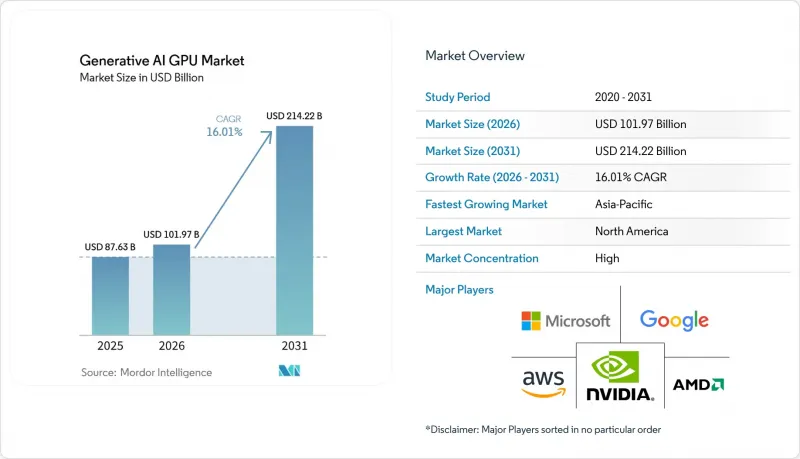
根據 Mordor Intelligence 預測,用於生成式人工智慧的 GPU 市場規模預計將從 2025 年的 876.3 億美元和 2026 年的 1019.7 億美元成長到 2031 年的 2142.2 億美元,2026 年至 2031 年的年複合成長率(CAGR)為 16.01%。
本報告按部署類型(雲端和本地部署)、功能(訓練和推理)、GPU類型(資料中心訓練和推理等)、模型類型(LLM、多模態、圖像/影片、語音/音訊模型等)、最終用戶(雲端服務供應商、企業、政府和研究機構等)以及地區進行細分。市場預測以美元計價。
全球GPU市場趨勢及生成式人工智慧洞察
企業對私有生成式人工智慧訓練叢集的需求日益成長
私有生成式人工智慧基礎架構正逐漸融入企業標準資本規劃,從而在生成式人工智慧GPU市場催生出新的需求流,而這種需求流不再僅僅依賴超大規模資料中心業者資料中心的支出。買家關注的重點在於資料管理、合規性、成本視覺性,以及在託管環境中而非透過第三方處理層微調其專有模型的能力。這項轉變意義重大,因為生成式人工智慧GPU市場如今吸引的不再是短期實驗項目,而是那些希望運作持續性內部工作負載的企業。此外,更高的運轉率帶來更佳的經濟效益,使得企業更容易證明為穩定推理和微調程序分配專用容量的合理性。隨著越來越多的供應商在客戶防火牆內提供託管的私人人工智慧系統,預計生成式人工智慧GPU市場將迎來更廣泛的企業級市場,而並非所有買家都需要建立大規模的內部基礎設施團隊。
增加對超大規模資料中心業者(用於模型訓練和推理基礎設施)的資本投入。
用於生成式人工智慧的GPU市場仍然與超大規模資料中心業者資料中心營運商的資本投資密切相關,因為最大的訓練和服務環境仍然位於雲端平台內。這些公司正在投資多代產品藍圖,而不是短期的更新週期,這使得用於生成式人工智慧的GPU市場比典型的半導體升級模式擁有更清晰的需求前景。如今,這一趨勢已擴展到GPU本身之外,每個運算訂單都成為大規模基礎設施建設的一部分,因為大規模部署還需要網路架構、電力系統和資料中心擴容。 NVIDIA 2026會計年度的業績表明,人工智慧運算和相關基礎設施如今已緊密交織在一起,第四季度資料中心收入達到1,937億美元,資料中心網路收入同比成長263%。 AWS、Google雲端、微軟Azure和Oracle雲端基礎設施對部署Vera Rubin平台的承諾表明,用於生成式人工智慧的GPU市場是由面向未來的容量規劃驅動的,而不是由單一產品週期驅動的。
先進封裝和人類血小板膜供應限制
生成式人工智慧GPU市場的主要供應瓶頸不再局限於晶片設計需求,而是受到封裝加工能力和記憶體可用性的限制。即使預算獲得批准,由於生成式人工智慧GPU市場依賴少數幾家供應商,且這些供應商掌握著複雜的記憶體和封裝工藝,而這些工藝無法在一夜之間實現規模化,因此該市場仍可能面臨訂單延遲。英偉達與SK海力士之間長達數年的記憶體合作關係,凸顯了HBM記憶體對於未來平台部署的重要性。主要記憶體供應商計畫的產能擴張主要針對後續的生產週期,因此短期供應緊張的情況可能會在當前預測期內持續影響供應狀況。因此,儘管預計生成式人工智慧GPU市場將出現強勁的訂單需求,但這種需求轉化為實際銷售的速度可能會低於買家的預期。
細分市場分析
到 2025 年,雲端部署將佔生成式人工智慧 GPU 市場佔有率的 74.19%,在收入方面顯著超越本地部署。這項領先優勢反映了超大規模資料中心業者資料中心營運商透過早期投資 GPU 資料中心以及與大型模型開發商的緊密合作所建立的長期基礎設施優勢。雲端模式之所以依然具有吸引力,是因為它允許買家快速獲得所需容量,而無需承擔硬體、建造和營運的全部前期成本。對於許多組織,尤其是那些仍在檢驗其工作負載模式的組織而言,透過高彈性的雲端基礎設施進入生成式人工智慧 GPU 市場是最便捷的方式。即使成本控制在 2026 年變得更加關鍵,這種准入優勢仍將繼續支撐雲端的主導地位。
本地部署是成長最快的細分市場,預計從2026年到2031年將以16.38%的複合年成長率成長,這表明買家的行為正在轉變。已經完成試驗計畫階段的企業對利用率密度、延遲要求和資料處理需求有了更清晰的了解,這使得部署自有基礎架構的理由更加充分。聯想2026年的分析表明,當擁有50個或更多GPU的叢集中GPU利用率達到75%時,本地系統的成本可以達到與雲端租賃相當的水平,這進一步推動了向專用基礎設施的轉變,以實現穩定的工作負載。用於生成式AI的GPU市場也受益於託管私有AI平台、基於託管的叢集和基於訂閱的服務,這些服務減輕了企業買家的營運負擔。這為生成式AI GPU產業開闢了更多途徑,使其能夠進入高度監管和資料敏感的環境,在這些環境中,長期依賴公共雲端的合理性較低。
預計到2025年,訓練將佔生成式人工智慧GPU市場規模的64.88%,這意味著大部分支出仍集中在建構最先進的模型上。這一佔有率源自於預先訓練大型語言模型、視覺模型和多模態系統極高的運算負載,每次運行都需要大量的GPU時間。因此,生成式人工智慧GPU市場的早期商業化階段是基於以訓練為中心的支出結構,因為模型建構和增強是首要任務。大規模叢集、高效能硬體以及集中採購雲端資源進一步強化了這一趨勢。由於最先進的模型仍然需要性能最高的系統,訓練仍然是收入的主要來源。
推理是成長最快的功能,預計從2026年到2031年將以16.97%的複合年成長率成長,這一成長正在重塑生成式人工智慧GPU市場的營運格局。由於模型會被部署到生產環境並為使用者提供持續服務,因此對推理的需求可能遠遠超出初始訓練週期。此外,隨著使用頻率的提高和硬體攤銷成本的降低,企業正從基於代幣的API使用費轉向自建或專用推理節點。這對生成式人工智慧GPU市場至關重要,因為推理需求在地理上是分散的,而不是集中在少數超大規模資料中心業者中心的園區內。結果是,即使在訓練階段結束後,也能維持較高的總運算需求,同時不斷擴大買家群體。
區域分析
到2025年,北美將佔據生成式人工智慧GPU市場46.74%的佔有率,並繼續保持其作為收入最高的銷售區域的領先地位。該地區受惠於美國集中了許多超大規模資料中心業者資料中心、先進的人工智慧實驗室以及GPU最佳化的資料中心容量。北美地區採購、軟體開發和基礎設施部署緊密結合,這為其生成式人工智慧GPU市場奠定了最強大的商業基礎。主要雲端平台也持續佔據下一代GPU分配的顯著佔有率,進一步鞏固了該地區在訓練和生產推理環境中的主導地位。加拿大正透過其國家人工智慧運算策略建構公共運算層,這與該地區更廣泛的商業性優勢相輔相成。
歐洲仍然是生成式人工智慧GPU市場的重要參與者,其需求受到公共投資以及圍繞數據處理和模型監控的監管壓力的影響。歐盟人工智慧法律的合規要求正在推動對國內部署和本地部署的興趣,尤其是在那些更傾向於嚴格控制資料處理地點的受監管行業。法國已啟動該地區規模最大的國家人工智慧基礎設施發展計畫之一,預計將支援未來的資料中心擴張和GPU採購。英國也正式製定了一項硬體計劃,撥款用於專用晶片採購,作為其廣泛的人工智慧研究資源的一部分,這表明國家級運算能力如今已成為一項明確的政策目標。
亞太地區是成長最快的區域市場,預計2026年至2031年複合年成長率將達到17.36%,在預測期內,其GPU市場規模在生成式人工智慧領域將呈現最快的成長軌跡。這一成長得益於政府主導的人工智慧專案、本地超大規模資料中心業者營運商的投資,以及由於出口限制導致關鍵的美國硬體獲取管道受限,人們對國產替代方案日益成長的興趣。中國的生成式人工智慧GPU市場在不同的政策環境下發展,因為美國的出口限制持續影響採購管道,並推動了本土加速器的發展。這種差異意義重大,因為它在亞太地區形成了兩種截然不同的競爭格局:一種以進口高階系統為中心,另一種則以國產替代方案為中心。南美洲和中東及非洲的生成式人工智慧GPU市場仍處於早期階段,但政府投資和本地資料中心的擴張可能會在預測期後半段進一步提升採購量。
其他好處:
- Excel格式的市場預測(ME)表
- 3個月的分析師支持
目錄
第1章:引言
- 研究假設和市場定義
- 調查範圍
第2章:調查方法
第3章執行摘要
第4章 市場狀況
- 市場概覽
- 市場促進因素
- 企業對私有 GenAI 訓練叢集的需求日益成長
- 增加對超大規模資料中心業者(用於模型學習和推理基礎設施)的資本投入。
- 快速轉向以HBM為主的GPU平台進行大規模模型訓練
- 國家主導的人工智慧專案正在加速該國GPU的採購。
- 在高TDP人工智慧機架中採用水冷技術
- GenAI推理處理:從API使用過渡到內部GPU容量
- 市場限制因素
- 先進封裝和人類血小板膜供應限制
- 高功率密度、冷卻和設備升級相關的成本。
- 出口限制和地緣政治採購限制
- 在推理工作負載中使用自訂ASIC作為替代方案的風險
- 產業價值鏈分析
- 監理情勢
- 技術展望
- 宏觀經濟因素對市場的影響
- 波特五力分析
第5章 市場規模與成長預測
- 依部署類型
- 雲
- 現場
- 按功能
- 訓練
- 推理
- 按GPU類型
- 用於訓練資料中心的GPU
- 用於資料中心推理的GPU
- 邊緣與企業的AI GPU
- 按型號
- 大規模語言模型(LLM)
- 多模態模型
- 影像和影片生成模型
- 語音和音訊模型
- 最終用戶
- 雲端服務供應商
- 公司
- 政府和研究機構
- 人工智慧模型開發公司和人工智慧研究機構
- 按地區
- 北美洲
- 美國
- 加拿大
- 墨西哥
- 歐洲
- 德國
- 英國
- 法國
- 義大利
- 其他歐洲國家
- 亞太地區
- 中國
- 日本
- 韓國
- 印度
- 東南亞
- 其他亞太國家
- 南美洲
- 中東和非洲
- 北美洲
第6章 競爭情勢
- 市場集中度
- 策略趨勢
- Market Positioning Analysis
- 公司簡介
- NVIDIA Corporation
- Advanced Micro Devices, Inc.
- Intel Corporation
- Google LLC
- Amazon Web Services, Inc.
- Microsoft Corporation
- Huawei Technologies Co., Ltd.
- Baidu, Inc.
- Groq, Inc.
- xAI Corp.
- Marvell Technology, Inc.
- Cerebras Systems, Inc.
- Tenstorrent Inc.
- Mistral AI
- Qualcomm Incorporated
- IBM Corporation
- CoreWeave, Inc.
- Oracle Corporation
- Alibaba Group Holding Limited
- Tencent Holdings Limited
- Lambda, Inc.
第7章 市場機會與未來展望
According to Mordor Intelligence, the generative AI GPU market size is projected to expand from USD 87.63 billion in 2025 and USD 101.97 billion in 2026 to USD 214.22 billion by 2031, registering a CAGR of 16.01% between 2026 to 2031.
This report is Segmented by Deployment Type (Cloud, and On-Premise), Function (Training, and Inference), GPU Type (Data Center Training, Inference, and More), Model Type (LLMs, Multimodal, Image/Video, and Speech and Audio Models), End User (Cloud Service Providers, Enterprises, Government and Research Institutions, and More), and Geography. The Market Forecasts are Provided in Terms of Value (USD).
Global Generative AI GPU Market Trends and Insights
Rising Enterprise Demand For Private GenAI Training Clusters
Private generative AI infrastructure is moving into standard enterprise capital planning, and that is giving the generative AI GPU market a demand stream that does not depend only on hyperscaler spending. Buyers are focusing on data control, compliance, cost visibility, and the ability to fine tune proprietary models inside controlled environments rather than through third-party processing layers. This shift matters because the generative AI GPU market is now pulling demand from organizations that intend to run continuous internal workloads instead of short experimental projects. The economics also improve as utilization rises, which makes dedicated capacity easier to justify for stable inference and fine-tuning programs. As more vendors package managed private AI systems behind the customer firewall, the generative AI GPU market is likely to see broader enterprise participation without requiring every buyer to build deep in-house infrastructure teams.
Hyperscaler Capex Expansion For Model Training And Inference Infrastructure
The generative AI GPU market remains closely tied to hyperscaler capital spending because the largest training and serving environments still sit inside cloud platforms. These companies are committing capital across multi-generation roadmaps rather than short replacement cycles, which gives the generative AI GPU market stronger demand visibility than a normal semiconductor upgrade pattern. That pattern now extends beyond the GPU itself because large deployments also require networking fabrics, power systems, and data center expansion, which makes each compute order part of a larger infrastructure build. NVIDIA's fiscal 2026 results show how tightly AI compute and adjacent infrastructure are now linked, with data center revenue reaching USD 193.7 billion and data center networking revenue rising 263% year over year in Q4. The commitment by AWS, Google Cloud, Microsoft Azure, and Oracle Cloud Infrastructure to deploy the Vera Rubin platform shows that the generative AI GPU market is being supported by forward capacity plans rather than one product cycle at a time.
Advanced Packaging And HBM Supply Constraints
The main supply ceiling for the generative AI GPU market is no longer limited to chip design demand; it is now limited to packaging throughput and memory availability. Even when budgets are approved, orders can still face delays because the generative AI GPU market depends on a narrow set of suppliers for advanced memory and packaging steps that cannot be expanded overnight. NVIDIA's multiyear memory partnership with SK Hynix reflects how central HBM access has become to future platform rollouts. Planned capacity additions from major memory suppliers target later production windows, which means short-term tightness is still likely to shape availability through the current forecast period. As a result, the generative AI GPU market can show strong order demand while still converting that demand into revenue more slowly than buyers intend.
Other drivers and restraints analyzed in the detailed report include:
- Rapid Shift To HBM-Heavy GPU Platforms For Large Model Training
- Sovereign AI Programs Accelerating National GPU Procurement
- High Power Density, Cooling, And Facility Upgrade Costs
For complete list of drivers and restraints, kindly check the Table Of Contents.
Segment Analysis
Cloud deployments accounted for 74.19% of the generative AI GPU market in 2025, which kept this model well ahead of on-premise installations by revenue. That lead reflects a long infrastructure advantage built by hyperscalers through earlier GPU data center investment and closer ties to the largest model developers. The cloud model also remains attractive because it lets buyers provision capacity quickly without carrying the full upfront cost of hardware, facility work, and operations. For many organizations, especially those still testing workload patterns, the generative AI GPU market is easiest to access through elastic cloud infrastructure. That access advantage continues to support cloud leadership even as cost discipline becomes a bigger factor in 2026.
On-premise deployments are the fastest-growing segment at 16.38% CAGR through 2026-2031, which shows where the next wave of buyer behavior is shifting. Enterprises that have moved past pilot programs now have better visibility into usage intensity, latency needs, and data handling requirements, so the case for owned capacity is becoming more concrete. Lenovo's 2026 analysis shows that on-premise systems can reach cost parity with cloud rental at 75% GPU utilization across fleets of more than 50 GPUs, which supports the move toward dedicated infrastructure for stable workloads. The generative AI GPU market is also benefiting from managed private AI platforms, colocation-backed clusters, and subscription-style offers that reduce the operational burden on enterprise buyers. This gives the generative AI GPU industry a broader path into regulated and data-sensitive environments where public cloud dependency is harder to justify over time.
Training commanded 64.88% of the generative AI GPU market size in 2025, which shows how much spending is still centered on building frontier models. That share came from the exceptional compute intensity of pre-training large language, vision, and multimodal systems, where each run can consume very large GPU-hour volumes. The early commercial phase of the generative AI GPU market was therefore built on a training-heavy spending mix because the first priority was model creation and capability expansion. Large clusters, premium hardware, and concentrated cloud buying all reinforced that pattern. Training still anchors revenue because the most advanced models continue to require the highest-performance systems available.
Inference is the fastest-growing function at 16.97% CAGR through 2026-2031, and that growth is changing the operating profile of the generative AI GPU market. Once models enter production, they serve users continuously, which means inference demand can last far longer than the original training cycle. Enterprises are also shifting from per-token API spending toward owned or dedicated inference nodes when usage becomes frequent enough to make hardware amortization more attractive. This matters for the generative AI GPU market because inference demand is more geographically distributed than the concentrated training spend inside a small number of hyperscaler campuses. The result is a growth curve that broadens the buyer base while keeping total compute demand elevated after the training phase has already passed.
Complete Report Scope:
- By Deployment Type
- Cloud
- On-Premise
- By Function
- Training
- Inference
- By GPU Type
- Data Center Training GPUs
- Data Center Inference GPUs
- Edge and Enterprise AI GPUs
- By Model Type
- Large Language Models (LLMs)
- Multimodal Models
- Image and Video Generation Models
- Speech and Audio Models
- By End User
- Cloud Service Providers
- Enterprises
- Government and Research Institutions
- AI Model Developers and AI Labs
- By Geography
- North America
- United States
- Canada
- Mexico
- Europe
- Germany
- United Kingdom
- France
- Italy
- Rest of Europe
- Asia-Pacific
- China
- Japan
- South Korea
- India
- Southeast Asia
- Rest of Asia-Pacific
- South America
- Middle East and Africa
- North America
Geography Analysis
North America held 46.74% of the generative AI GPU market in 2025, which kept it as the clear revenue leader by region. The region benefits from the concentration of hyperscaler headquarters, frontier AI labs, and GPU-optimized data center capacity within the United States. That combination gives the generative AI GPU market its deepest commercial base in North America because procurement, software development, and infrastructure deployment are closely linked there. Large cloud platforms also continue to secure a major share of next-generation allocation, which supports the region's lead in both training and production inference environments. Canada adds a public compute layer through its sovereign AI compute strategy, which complements the commercial strength of the broader regional market.
Europe remains important to the generative AI GPU market because demand is shaped by both public investment and regulatory pressure around data handling and model oversight. Compliance requirements under the EU AI Act support interest in domestic and on-premise deployments, especially among regulated sectors that prefer tighter control over where processing occurs. France has made one of the region's largest national AI infrastructure commitments, which is expected to support future data center buildout and GPU procurement. The UK also formalized its hardware plan with funding for specialized chip procurement inside its broader AI research resource, showing that national compute capability is now an explicit policy target.
Asia-Pacific is the fastest-growing regional segment at 17.36% CAGR through 2026-2031, and this gives it the most rapid expansion path within the generative AI GPU market size over the forecast period. Growth is being supported by sovereign AI programs, local hyperscaler investment, and rising interest in domestic alternatives where export restrictions affect access to leading U.S. hardware. The generative AI GPU market in China is developing under a different policy setting because U.S. export controls continue to shape procurement routes and encourage local accelerator development. That divergence matters because it creates separate competitive tracks within Asia-Pacific, one centered on imported premium systems and another centered on domestic substitutes. South America and the Middle East and Africa remain earlier-stage regions in the generative AI GPU market, though sovereign investment and local data center expansion could support stronger procurement volumes later in the forecast period.
- NVIDIA Corporation
- Advanced Micro Devices, Inc.
- Intel Corporation
- Google LLC
- Amazon Web Services, Inc.
- Microsoft Corporation
- Huawei Technologies Co., Ltd.
- Baidu, Inc.
- Groq, Inc.
- xAI Corp.
- Marvell Technology, Inc.
- Cerebras Systems, Inc.
- Tenstorrent Inc.
- Mistral AI
- Qualcomm Incorporated
- IBM Corporation
- CoreWeave, Inc.
- Oracle Corporation
- Alibaba Group Holding Limited
- Tencent Holdings Limited
- Lambda, Inc.
Additional Benefits:
- The market estimate (ME) sheet in Excel format
- 3 months of analyst support
TABLE OF CONTENTS
1 INTRODUCTION
- 1.1 Study Assumptions and Market Definition
- 1.2 Scope of the Study
2 RESEARCH METHODOLOGY
3 EXECUTIVE SUMMARY
4 MARKET LANDSCAPE
- 4.1 Market Overview
- 4.2 Market Drivers
- 4.2.1 Rising Enterprise Demand for Private GenAI Training Clusters
- 4.2.2 Hyperscaler Capex Expansion for Model Training and Inference Infrastructure
- 4.2.3 Rapid Shift to HBM-Heavy GPU Platforms for Large Model Training
- 4.2.4 Sovereign AI Programs Accelerating National GPU Procurement
- 4.2.5 Liquid Cooling Adoption for High-TDP Generative AI Racks
- 4.2.6 GenAI Inferencing Migration From API Consumption to Owned GPU Capacity
- 4.3 Market Restraints
- 4.3.1 Advanced Packaging and HBM Supply Constraints
- 4.3.2 High Power Density, Cooling, and Facility Upgrade Costs
- 4.3.3 Export Controls and Geopolitical Procurement Restrictions
- 4.3.4 Custom ASIC Substitution Risk in Inference Workloads
- 4.4 Industry Value Chain Analysis
- 4.5 Regulatory Landscape
- 4.6 Technological Outlook
- 4.7 Impact of Macroeconomic Factors on the Market
- 4.8 Porter's Five Forces Analysis
- 4.8.1 Threat of New Entrants
- 4.8.2 Bargaining Power of Buyers
- 4.8.3 Bargaining Power of Suppliers
- 4.8.4 Threat of Substitutes
- 4.8.5 Industry Rivalry
5 MARKET SIZE AND GROWTH FORECASTS (VALUE)
- 5.1 By Deployment Type
- 5.1.1 Cloud
- 5.1.2 On-Premise
- 5.2 By Function
- 5.2.1 Training
- 5.2.2 Inference
- 5.3 By GPU Type
- 5.3.1 Data Center Training GPUs
- 5.3.2 Data Center Inference GPUs
- 5.3.3 Edge and Enterprise AI GPUs
- 5.4 By Model Type
- 5.4.1 Large Language Models (LLMs)
- 5.4.2 Multimodal Models
- 5.4.3 Image and Video Generation Models
- 5.4.4 Speech and Audio Models
- 5.5 By End User
- 5.5.1 Cloud Service Providers
- 5.5.2 Enterprises
- 5.5.3 Government and Research Institutions
- 5.5.4 AI Model Developers and AI Labs
- 5.6 By Geography
- 5.6.1 North America
- 5.6.1.1 United States
- 5.6.1.2 Canada
- 5.6.1.3 Mexico
- 5.6.2 Europe
- 5.6.2.1 Germany
- 5.6.2.2 United Kingdom
- 5.6.2.3 France
- 5.6.2.4 Italy
- 5.6.2.5 Rest of Europe
- 5.6.3 Asia-Pacific
- 5.6.3.1 China
- 5.6.3.2 Japan
- 5.6.3.3 South Korea
- 5.6.3.4 India
- 5.6.3.5 Southeast Asia
- 5.6.3.6 Rest of Asia-Pacific
- 5.6.4 South America
- 5.6.5 Middle East and Africa
- 5.6.1 North America
6 COMPETITIVE LANDSCAPE
- 6.1 Market Concentration
- 6.2 Strategic Moves
- 6.3 Market Positioning Analysis
- 6.4 Company Profiles (includes Global Level Overview, Market Level Overview, Core Segments, Financials as available, Strategic Information, Market Rank/Share, Products and Services, Recent Developments)
- 6.4.1 NVIDIA Corporation
- 6.4.2 Advanced Micro Devices, Inc.
- 6.4.3 Intel Corporation
- 6.4.4 Google LLC
- 6.4.5 Amazon Web Services, Inc.
- 6.4.6 Microsoft Corporation
- 6.4.7 Huawei Technologies Co., Ltd.
- 6.4.8 Baidu, Inc.
- 6.4.9 Groq, Inc.
- 6.4.10 xAI Corp.
- 6.4.11 Marvell Technology, Inc.
- 6.4.12 Cerebras Systems, Inc.
- 6.4.13 Tenstorrent Inc.
- 6.4.14 Mistral AI
- 6.4.15 Qualcomm Incorporated
- 6.4.16 IBM Corporation
- 6.4.17 CoreWeave, Inc.
- 6.4.18 Oracle Corporation
- 6.4.19 Alibaba Group Holding Limited
- 6.4.20 Tencent Holdings Limited
- 6.4.21 Lambda, Inc.
7 MARKET OPPORTUNITIES AND FUTURE OUTLOOK
- 7.1 White-Space and Unmet-Need Assessment

 2026年全球人工智慧(AI)半導體市場報告2026年全球人工智慧(AI)推理晶片(IC)市場報告
 終端人工智慧晶片市場報告:趨勢、預測和競爭分析(至2035年)
 全球人工智慧晶片市場規模、佔有率、趨勢和成長分析報告(工業電子領域,2026-2034年)2026年全球資料中心人工智慧(AI)晶片市場報告生成式人工智慧硬體材料市場(2027-2037 年)
 2026-2030年全球人工智慧語音與影像SoC市場
 2035年前工業機器人晶片市場分析和預測 :按類型、產品、技術、組件、應用、最終用戶、功能、安裝類型和解決方案進行分析和預測。工業電子領域的 AI 晶片市場規模、佔有率、成長、全球產業分析、區域趨勢及2026年至2034年預測。
 2026 年至 2035 年 AI 晶片光 I/O 市場的機會、成長促進因素、產業趨勢分析與預測。