


 |
市場調查報告書
商品編碼
2098478
AI驅動的安全分析平台:市場佔有率分析、產業趨勢與統計數據、成長預測(2026-2031年)AI-Augmented Security Analyst Platforms - Market Share Analysis, Industry Trends & Statistics, Growth Forecasts (2026 - 2031) |
||||||

※ 本網頁內容可能與最新版本有所差異。詳細情況請與我們聯繫。
根據 Mordor Intelligence 預測,人工智慧增強型安全分析平台的市場規模預計將從 2025 年的 112 億美元成長到 2026 年的 134 億美元,然後在 2031 年達到 371 億美元,2026 年至 2031 年的複合年成長率為 22.6%。
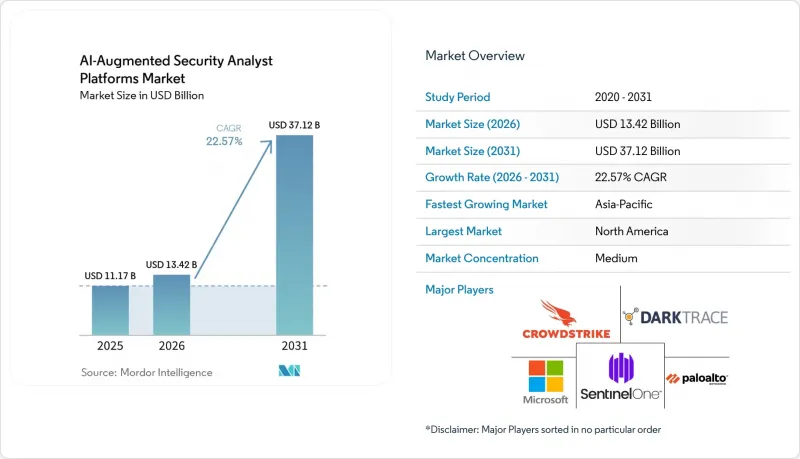
本報告按元件(軟體和服務)、應用程式(威脅偵測和警報管理等)、部署模式(雲端、本地部署、混合部署)、企業規模(大型企業和中小企業)、最終用戶產業(政府和公共機構等)以及地區進行細分。市場預測以價值(美元)表示。
全球人工智慧增強型安全分析平台市場趨勢及洞察
整個混合安全堆疊的警報數量增加。
混合環境中警報數量不斷成長與分析師處理能力之間的直接不匹配,正推動人工智慧增強型安全分析平台市場的發展。如今,安全團隊需要在雲端、本地和營運技術 (OT) 環境中開展工作,遙測資料分散在眾多系統中,人工審核已不再足夠。當攻擊在每一層都留下微弱訊號時,這個問題會更加嚴重,因為這些訊號通常只有與端點、網路、身分和工作負載資料關聯起來才能發揮作用。供應商正透過將安全資訊和事件管理 (SIEM) 以及擴展災難復原 (XDR) 功能整合到統一的營運層來解決這一問題,從而減少因產品孤立和調查路徑分散而造成的延遲。利用人工智慧和安全自動化技術的組織能夠比使用人工方法的組織更快地識別和遏制安全漏洞,速度提升 98 天。此外,每次安全漏洞的平均成本節省高達 220 萬美元,這無疑激發了市場對人工智慧增強型安全分析平台的強勁需求。
經驗豐富的安全分析師長期短缺
人工智慧增強型安全分析平台市場的發展不僅受到人員短缺的驅動,也受到人才短缺的限制。目前的問題在於技能深度不足。許多組織能夠招募員工,但目前缺乏足夠經驗豐富的專業人員來調查所需級別的安全事件。一項2026年的調查顯示,27%的組織將面臨因人才能力缺口而直接導致的安全漏洞,而合規性是推動招募的重要因素。這種人才短缺在高階職位上尤其突出,因為這些職位需要多年的實務經驗,導致招募延遲,並增加了建立成熟的內部保全行動團隊的成本。因此,人工智慧增強型安全分析平台市場正在吸引那些希望初級分析師能夠以更深刻的洞察力和更一致的水平履行職責,並減少對稀缺高級員工依賴的買家。
高風險安全決策模型的可解釋性差距。
當人工智慧 (AI) 建議影響到業務關鍵系統和用戶存取時,AI 增強型安全分析平台市場面臨現實的限制。受監管組織必須根據相關法規做出可解釋、檢驗且合理的決策,這些法規要求對安全措施承擔明確的課責。這使得在隔離措施不當或存取限制可能擾亂生產、合規或客戶服務的領域,難以實現完全自主的回應。歐盟的 AI 法第 12 條進一步提高了這一門檻,強制要求對處理個人資料的高風險系統保留日誌並保證其可追溯性,從而提高了供應商和買家對文件的要求。儘管供應商正努力透過展示調查程序和證據鏈的「基於代理的工作流程」來彌合這一差距,但在可解釋性標準更加完善之前,AI 增強型安全分析平台市場完全自主的普及速度可能仍然緩慢。
細分市場分析
到2025年,軟體將佔據人工智慧增強型安全分析平台市場63.4%的佔有率。這證實了初始購買趨勢仍然集中在平台訂閱和核心產品授權上。人工智慧輔助的安全資訊和事件管理 (SIEM)、擴展資料偵測 (XDR) 以及威脅情報工具仍然是關鍵的商業部署點,因為企業仍然傾向於先購買平台,然後再進行更深層的流程重構。軟體的主導地位反映了買家對這一類別的看法,因為平台覆蓋範圍、遙測整合和調查能力通常比營運支援層更受重視。然而,人工智慧增強型安全分析平台市場不再僅僅由軟體構成;服務的比重正在增加,部署成熟度正成為一項重大挑戰。
預計到2031年,服務業務將以23.7%的複合年成長率成長,成為人工智慧增強型安全分析平台市場中成長最快的細分領域。這一成長速度反映了購買後所需的實際工作,例如調優、劇本開發、模型校準、流程調整和持續最佳化。該報告草案也將這一趨勢與技能深度聯繫起來,因為對許多組織而言,雖然購買先進平臺本身可能很容易,但建立內部營運基礎設施卻十分困難。 2026年3月的一項調查發現,60%的組織認為技能差距(而不僅僅是人員短缺)是網路安全面臨的主要挑戰,這凸顯了對外部部署和託管構成比的需求。因此,人工智慧增強型安全分析平台市場正從初始部署階段轉向以服務主導的營運模式。
到2025年,威脅偵測和警報管理將佔人工智慧增強型安全分析平台市場規模的21.2%,顯示偵測仍是最成熟的應用領域。這種主導地位源於部署基礎的成熟,因為企業在人工智慧輔助檢測工作流程方面的投資時間遠遠超出該類別中的其他任何應用領域。由於警報優先排序和事件關聯分析是許多安全團隊日常運作的核心,因此該細分市場仍然至關重要。同時,人工智慧增強型安全分析平台市場顯然正在加大對工作流程的投資,這些工作流程不僅關注快速回應,也關注預防。
預計到2031年,暴露管理和安全態勢分析將以23.9%的複合年成長率成長,成為人工智慧增強型安全分析平台市場中成長最快的應用領域。這一轉變表明,成熟的買家正在尋求縮小攻擊面,並在漏洞升級為實際安全事件之前識別可利用的漏洞。一家供應商於2026年4月發布了Wayfinder Frontier AI Services,該服務結合了Anthropic的Claude Opus 4.7和資深安全專家,能夠持續發現攻擊面並提供指導性修復。類似的需求模式也適用於事件調查、回應支援、編配和威脅狩獵,尤其是在小規模團隊需要在不增加高級分析師數量的情況下實現更廣泛覆蓋的情況下。整體而言,人工智慧增強型安全分析平台市場的需求正從警報響應擴展到安全態勢、漏洞識別和指導性行動。
區域分析
到2025年,北美將佔據人工智慧增強型安全分析平台市場33.1%的佔有率,成為最大的貢獻地區。該地區受惠於積極的企業安全投資、平台供應商的高度集中,以及網路安全措施不足成本不斷攀升的政策環境。美國仍然是主要的需求中心,因為監管揭露規則、對供應鏈安全的期望以及以國防為導向的合規計劃,都增加了對更強大的營運平台的需求。該地區混合雲和多重雲端環境的集中度也很高,其營運環境與人工智慧增強型安全分析平台市場旨在解決的核心挑戰高度契合。從實際角度來看,北美仍然是最成熟的採購環境,因為安全團隊已經足夠成熟,能夠證明平台整合、人工智慧驅動的故障排查和大規模自動化的合理性。
歐洲仍然是人工智慧增強型安全分析平台的第二大區域市場,其中德國、英國和法國是主要的需求中心。該地區之所以引人注目,是因為安全相關的採購如今深受NIS2、DORA和歐盟人工智慧立法的影響,使得可解釋性、可審計性和主權成為供應商選擇的核心因素。這形成了一種「合規優先」的採購模式,與那些檢測性能仍然是主要標準的市場截然不同。 2026年6月發布的「Sovereign Cortex with T Security」表明,人工智慧增強型安全分析平台市場正在為醫療保健、金融服務、公共部門和關鍵基礎設施買家採用區域特定的部署模式。雖然在南美洲的部署仍處於早期階段,但隨著法律規範與歐洲模式接軌,巴西和阿根廷也表現出了濃厚的興趣。然而,預算和IT成熟度仍然是限制部署速度的因素。
預計到2031年,亞太地區將以24.3%的複合年成長率成長,成為人工智慧增強型安全分析平台市場成長最快的地區。這一成長主要得益於雲端基礎設施的擴張、數位化企業數量的增加以及多個市場政府主導的網路安全法規的加強。印度正處於關鍵轉折點,由於其「數位個人資料保護」框架以及印度儲備銀行於2026年6月發布的建議,金融領域對人工智慧相關網路風險的審查力度加大。韓國和日本正邁向更高階的應用階段,大型企業正大規模建構人工智慧驅動的保全行動能力。在澳大利亞,公共部門和關鍵基礎設施項目與「基本八項」成熟度模型一致,支撐著穩定的升級需求。中東和非洲地區雖然基數較小,但仍在持續成長,尤其是在沙烏地阿拉伯和阿拉伯聯合大公國(阿拉伯聯合大公國),隨著人工智慧安全功能成為更廣泛的數位轉型和國家網路安全戰略的一部分,新的需求正在不斷湧現。
其他好處:
- Excel格式的市場預測(ME)表
- 3個月的分析師支持
目錄
第1章:引言
- 研究假設和市場定義
- 調查範圍
第2章:調查方法
第3章執行摘要
第4章 市場狀況
- 市場概覽
- 市場促進因素
- 整個混合安全體系中的警報數量都在增加。
- 經驗豐富的安全分析師長期短缺
- 企業對人工智慧輔助的分類和調查的需求日益成長。
- SIEM、SOAR、XDR 和 UEBA 工作流程的整合
- 受監管行業在自主解決方案方面的支出增加
- 對低成本、全天候不間斷威脅搜尋的需求日益成長。
- 市場限制因素
- 高風險安全決策模型的可解釋性差距。
- 與傳統安全工具整合的複雜性
- 關於訓練資料的資料主權和隱私限制
- 人工智慧誤報以及對自主行為缺乏信心
- 宏觀經濟因素對市場的影響
- 產業價值鏈分析
- 監理情勢
- 技術展望
- 波特五力分析
第5章 市場規模與成長預測
- 按組件
- 軟體
- AI輔助的SIEM平台
- AI輔助XDR平台
- 人工智慧威脅情報平台
- 其他
- 服務
- 軟體
- 透過使用
- 威脅偵測和警報管理
- 事件調查和根本原因分析
- 支持與編配
- 威脅狩獵
- 暴露管理與安全態勢分析
- 不同的發展
- 雲
- 現場
- 混合
- 按公司規模
- 大公司
- 小型企業
- 按最終用戶行業分類
- 政府/公共行政
- 工業製造
- 零售與電子商務
- 運輸/物流
- 能源公用事業
- 石油和天然氣
- 資訊科技/通訊
- 媒體與娛樂
- 教育和研究機構
- 醫療保健和生命科學
- 銀行、金融服務和保險(BFSI)
- 其他終端用戶產業
- 按地區
- 北美洲
- 美國
- 加拿大
- 墨西哥
- 南美洲
- 巴西
- 阿根廷
- 其他南美國家
- 歐洲
- 德國
- 英國
- 法國
- 義大利
- 西班牙
- 俄羅斯
- 其他歐洲國家
- 亞太地區
- 中國
- 印度
- 日本
- 韓國
- 澳洲
- 其他亞太國家
- 中東和非洲
- 中東
- 沙烏地阿拉伯
- 阿拉伯聯合大公國
- 其他中東國家
- 非洲
- 南非
- 奈及利亞
- 其他非洲國家
- 中東
- 北美洲
第6章 競爭情勢
- 市場集中度
- 策略趨勢
- 市佔率分析
- 公司簡介
- Exabeam
- Securonix, Inc.
- Vectra AI, Inc.
- Darktrace plc
- SentinelOne, Inc.
- Palo Alto Networks, Inc.
- CrowdStrike, Inc.
- IBM Corporation
- Microsoft Corporation
- Cisco Systems, Inc.
- Elastic NV
- Stellar Cyber
- Swimlane, Inc.
- Torq, Inc.
- ReliaQuest, LLC
- Rapid7, Inc.
- Trellix, Inc.
- Anomali
- Armis, Inc.
- Google LLC
第7章 市場機會與未來展望
According to Mordor Intelligence, the AI-augmented security analyst platforms market size is expected to grow from USD 11.2 billion in 2025 to USD 13.4 billion in 2026 and is forecast to reach USD 37.1 billion by 2031 at 22.6% CAGR over 2026-2031.
This report is Segmented by Component (Software, and Services), Application (Threat Detection and Alert Management, and More), Deployment (Cloud, On-Premises, and Hybrid), Enterprise Size (Large Enterprises, and Small and Medium Enterprises), End-User Industry (Government and Public Administration, and More), and Geography. The Market Forecasts are Provided in Terms of Value (USD).
Global AI-Augmented Security Analyst Platforms Market Trends and Insights
Escalating Alert Volumes Across Hybrid Security Stacks
The AI-augmented security analyst platforms market is benefiting from a direct mismatch between the growth in alerts and analysts' capacity in hybrid environments. Security teams now work across cloud, on-premises, and operational technology estates, where telemetry is spread across too many systems for manual review to remain effective. This problem is more serious when attacks leave weak signals at each layer, because those signals often become useful only after correlation across endpoint, network, identity, and workload data. Vendors are responding by bringing SIEM and XDR functions together within unified operating layers, reducing the delays caused by siloed products and separate investigation paths. Organizations that use AI and security automation identify and contain breaches 98 days faster than those using manual methods, while average breach savings reach USD 2.2 million per incident, providing the AI-augmented security analyst platforms market with a clear cost-based demand trigger.
Persistent Shortage of Experienced Security Analysts
The AI-augmented security analyst platforms market is also being lifted by a shortage that is no longer limited to headcount alone. The problem now centers on skill depth: many organizations can hire staff but still cannot find enough experienced people to investigate incidents at the required level. In 2026, research showed that 27% of organizations had experienced breaches tied directly to workforce capability gaps, and that regulatory compliance was a strong hiring driver. The shortage is especially visible in senior roles, where long experience requirements slow hiring and raise the cost of building a mature internal security operations team. That is why the AI-augmented security analyst platforms market is attracting buyers who want junior analysts to work with greater depth, consistency, and less dependence on scarce senior staff.
Model Explainability Gaps in High-Risk Security Decisions
The AI-augmented security analyst platforms market faces a real limit when AI recommendations affect business-critical systems or user access. Regulated organizations need decisions that can be explained, reviewed, and defended in accordance with rules that require clear accountability for security actions. That makes it harder to adopt fully autonomous responses in areas where a wrong isolation action or access block could disrupt production, compliance, or customer service. The EU AI Act raises this bar further by requiring high-risk systems processing personal data to preserve logs and ensure traceability under Article 12, thereby increasing documentation expectations for vendors and buyers. Vendors are trying to narrow the gap with agentic workflows that show investigation steps and evidence chains, but the AI-augmented security analyst platforms market will still see slower adoption of full autonomy until explainability standards become more settled.
Other drivers and restraints analyzed in the detailed report include:
- Rising Enterprise Demand for AI-Assisted Triage and Investigation
- Consolidation of SIEM, SOAR, XDR, and UEBA Workflows
- Integration Complexity With Legacy Security Tooling
For complete list of drivers and restraints, kindly check the Table Of Contents.
Segment Analysis
Software held 63.4% of the AI-augmented security analyst platforms market share in 2025, which confirms that the first buying motion still centers on platform subscriptions and core product licenses. AI-assisted SIEM, XDR, and threat intelligence tools remain the primary commercial entry points because enterprises still prefer buying a platform before committing to deeper process redesign. The software lead also reflects how buyers frame the category, since platform coverage, telemetry integration, and investigation capability are usually evaluated before operational support layers. Even so, the AI-augmented security analyst platforms market is no longer defined solely by software, as services are gaining weight, with deployment maturity as the main challenge.
Services are projected to expand at a 23.7% CAGR through 2031, making it the fastest-growing component of the AI-augmented security analyst platforms market. That pace reflects the practical work needed after purchase, including tuning, playbook development, model calibration, process alignment, and ongoing optimization. The draft also ties this pattern to skills depth because many organizations can buy advanced platforms more easily than they can operationalize them internally. Research reported in March 2026 found that 60% of organizations identified skills gaps, rather than simple headcount shortages, as their main cybersecurity challenge, supporting demand for external implementation and managed support. The result is a component mix where the AI-augmented security analyst platforms market is moving from first-stage adoption toward a more service-led operating model.
Threat Detection and Alert Management accounted for 21.2% of the AI-augmented security analyst platforms market size in 2025, showing that detection remains the most established application area. This lead stems from installed-base maturity, as enterprises have funded AI-assisted detection workflows longer than any other application group in the category. The segment still matters because alert triage and event correlation are the daily operating core of many security teams. At the same time, the AI-augmented security analyst platforms market is showing a clear shift in marginal spending toward prevention-focused workflows rather than only faster reaction.
Exposure Management and Security Posture Analysis is projected to grow at 23.9% CAGR through 2031, making it the fastest-growing application in the AI-augmented security analyst platforms market. That shift shows that mature buyers now want to reduce the attack surface and identify exploitable gaps before they become active incidents. One vendor moved in this direction in April 2026 with Wayfinder Frontier AI Services, which paired Anthropic's Claude Opus 4.7 with senior security experts for continuous attack surface discovery and guided remediation. The same demand pattern supports incident investigation, response assistance, orchestration, and threat hunting, especially where smaller teams need deeper coverage without adding more senior analysts. Overall, application demand in the AI-augmented security analyst platforms market is broadening from alert handling into posture, exposure, and guided action.
Complete Report Scope:
- By Component
- Software
- AI-Assisted SIEM Platforms
- AI-Assisted XDR Platforms
- AI Threat Intelligence Platforms
- Others
- Services
- Software
- By Application
- Threat Detection and Alert Management
- Incident Investigation and Root Cause Analysis
- Response Assistance and Orchestration
- Threat Hunting
- Exposure Management and Security Posture Analysis
- By Deployment
- Cloud
- On-Premises
- Hybrid
- By Enterprise Size
- Large Enterprises
- Small and Medium Enterprises
- By End-user Industry
- Government and Public Administration
- Industrial Manufacturing
- Retail and E-Commerce
- Transportation and Logistics
- Energy and Utilities
- Oil and Gas
- IT and Telecommunication
- Media and Entertainment
- Education and Research Institutions
- Healthcare and Life Sciences
- Banking, Financial Services, and Insurance (BFSI)
- Other End User Industries
- By Geography
- North America
- United States
- Canada
- Mexico
- South America
- Brazil
- Argentina
- Rest of South America
- Europe
- Germany
- United Kingdom
- France
- Italy
- Spain
- Russia
- Rest of Europe
- Asia-Pacific
- China
- India
- Japan
- South Korea
- Australia
- Rest of Asia-Pacific
- Middle East and Africa
- Middle East
- Saudi Arabia
- United Arab Emirates
- Rest of Middle East
- Africa
- South Africa
- Nigeria
- Rest of Africa
- Middle East
- North America
Geography Analysis
North America held 33.1% of the AI-augmented security analyst platforms market share in 2025, which made it the largest regional contributor. The region benefits from deep enterprise security spending, a dense presence of platform vendors, and a policy environment in which the cost of weak cybersecurity controls is rising. The United States remains the main demand center because regulatory disclosure rules, supply chain security expectations, and defense-oriented compliance programs all increase the need for stronger operating platforms. The region also has a high concentration of hybrid multi-cloud environments, and that operating context closely matches the core problem the AI-augmented security analyst platforms market is built to solve. In practical terms, North America remains the most mature buying environment because security teams are already far enough along to justify platform consolidation, AI-assisted triage, and automation at scale.
Europe remains the second-largest regional market for AI-augmented security analyst platforms, with Germany, the United Kingdom, and France as the main demand centers. The region stands out because security purchases are now strongly shaped by the combined effect of NIS2, DORA, and the EU AI Act, which together make explainability, auditability, and sovereignty central to vendor selection. This produces a compliance-first buying pattern that differs from markets where detection performance alone remains the lead criterion. The June 2026 Sovereign Cortex with T Security announcement shows how the AI-augmented security analyst platforms market is adapting with regionalized deployment models for healthcare, financial services, public sector, and critical infrastructure buyers. South America is still earlier in adoption, with Brazil and Argentina showing interest as regulatory ideas begin to move closer to European models, though budgets and IT maturity still limit speed.
Asia-Pacific is forecast to grow at a 24.3% CAGR through 2031, making it the fastest-growing regional band in the AI-augmented security analyst platforms market. Growth is being driven by cloud infrastructure expansion, a rising base of digitally active enterprises, and stronger government-backed cybersecurity mandates across several markets. India is an important trigger point because the Digital Personal Data Protection framework and the Reserve Bank of India's June 2026 advisory are increasing scrutiny of AI-related cyber risk in the financial sector. South Korea and Japan are moving through more advanced adoption paths where large companies are building AI-enabled security operations capabilities at scale. Australia supports steady upgrade demand through public sector and critical infrastructure programs linked to the Essential Eight maturity model. The Middle East and Africa are growing from a smaller base, though Saudi Arabia and the UAE are creating greenfield demand as AI security capabilities become part of broader digital transformation and national cybersecurity agendas.
- Exabeam
- Securonix, Inc.
- Vectra AI, Inc.
- Darktrace plc
- SentinelOne, Inc.
- Palo Alto Networks, Inc.
- CrowdStrike, Inc.
- IBM Corporation
- Microsoft Corporation
- Cisco Systems, Inc.
- Elastic N.V.
- Stellar Cyber
- Swimlane, Inc.
- Torq, Inc.
- ReliaQuest, LLC
- Rapid7, Inc.
- Trellix, Inc.
- Anomali
- Armis, Inc.
- Google LLC
Additional Benefits:
- The market estimate (ME) sheet in Excel format
- 3 months of analyst support
TABLE OF CONTENTS
1 INTRODUCTION
- 1.1 Study Assumptions and Market Definition
- 1.2 Scope of the Study
2 RESEARCH METHODOLOGY
3 EXECUTIVE SUMMARY
4 MARKET LANDSCAPE
- 4.1 Market Overview
- 4.2 Market Drivers
- 4.2.1 Escalating Alert Volumes Across Hybrid Security Stacks
- 4.2.2 Persistent Shortage of Experienced Security Analysts
- 4.2.3 Rising Enterprise Demand for AI-Assisted Triage and Investigation
- 4.2.4 Consolidation of SIEM, SOAR, XDR, and UEBA Workflows
- 4.2.5 Higher Spend on Autonomous Response in Regulated Industries
- 4.2.6 Growing Need for Continuous 24/7 Threat Hunting at Lower Unit Cost
- 4.3 Market Restraints
- 4.3.1 Model Explainability Gaps in High-Risk Security Decisions
- 4.3.2 Integration Complexity With Legacy Security Tooling
- 4.3.3 Data Sovereignty and Privacy Constraints on Training Data
- 4.3.4 Trust Deficit Around AI-Driven False Positives and Autonomous Action
- 4.4 Impact of Macroeconomic Factors on the Market
- 4.5 Industry Value-Chain Analysis
- 4.6 Regulatory Landscape
- 4.7 Technological Outlook
- 4.8 Porter's Five Forces Analysis
- 4.8.1 Bargaining Power of Buyers
- 4.8.2 Bargaining Power of Suppliers
- 4.8.3 Threat of New Entrants
- 4.8.4 Threat of Substitutes
- 4.8.5 Intensity of Competitive Rivalry
5 MARKET SIZE AND GROWTH FORECASTS (VALUE)
- 5.1 By Component
- 5.1.1 Software
- 5.1.1.1 AI-Assisted SIEM Platforms
- 5.1.1.2 AI-Assisted XDR Platforms
- 5.1.1.3 AI Threat Intelligence Platforms
- 5.1.1.4 Others
- 5.1.2 Services
- 5.1.1 Software
- 5.2 By Application
- 5.2.1 Threat Detection and Alert Management
- 5.2.2 Incident Investigation and Root Cause Analysis
- 5.2.3 Response Assistance and Orchestration
- 5.2.4 Threat Hunting
- 5.2.5 Exposure Management and Security Posture Analysis
- 5.3 By Deployment
- 5.3.1 Cloud
- 5.3.2 On-Premises
- 5.3.3 Hybrid
- 5.4 By Enterprise Size
- 5.4.1 Large Enterprises
- 5.4.2 Small and Medium Enterprises
- 5.5 By End-user Industry
- 5.5.1 Government and Public Administration
- 5.5.2 Industrial Manufacturing
- 5.5.3 Retail and E-Commerce
- 5.5.4 Transportation and Logistics
- 5.5.5 Energy and Utilities
- 5.5.6 Oil and Gas
- 5.5.7 IT and Telecommunication
- 5.5.8 Media and Entertainment
- 5.5.9 Education and Research Institutions
- 5.5.10 Healthcare and Life Sciences
- 5.5.11 Banking, Financial Services, and Insurance (BFSI)
- 5.5.12 Other End User Industries
- 5.6 By Geography
- 5.6.1 North America
- 5.6.1.1 United States
- 5.6.1.2 Canada
- 5.6.1.3 Mexico
- 5.6.2 South America
- 5.6.2.1 Brazil
- 5.6.2.2 Argentina
- 5.6.2.3 Rest of South America
- 5.6.3 Europe
- 5.6.3.1 Germany
- 5.6.3.2 United Kingdom
- 5.6.3.3 France
- 5.6.3.4 Italy
- 5.6.3.5 Spain
- 5.6.3.6 Russia
- 5.6.3.7 Rest of Europe
- 5.6.4 Asia-Pacific
- 5.6.4.1 China
- 5.6.4.2 India
- 5.6.4.3 Japan
- 5.6.4.4 South Korea
- 5.6.4.5 Australia
- 5.6.4.6 Rest of Asia-Pacific
- 5.6.5 Middle East and Africa
- 5.6.5.1 Middle East
- 5.6.5.1.1 Saudi Arabia
- 5.6.5.1.2 United Arab Emirates
- 5.6.5.1.3 Rest of Middle East
- 5.6.5.2 Africa
- 5.6.5.2.1 South Africa
- 5.6.5.2.2 Nigeria
- 5.6.5.2.3 Rest of Africa
- 5.6.5.1 Middle East
- 5.6.1 North America
6 COMPETITIVE LANDSCAPE
- 6.1 Market Concentration
- 6.2 Strategic Moves
- 6.3 Market Share Analysis
- 6.4 Company Profiles (includes Global Level Overview, Market Level Overview, Core Segments, Financials as available, Strategic Information, Market Rank/Share, Products and Services, Recent Developments)
- 6.4.1 Exabeam
- 6.4.2 Securonix, Inc.
- 6.4.3 Vectra AI, Inc.
- 6.4.4 Darktrace plc
- 6.4.5 SentinelOne, Inc.
- 6.4.6 Palo Alto Networks, Inc.
- 6.4.7 CrowdStrike, Inc.
- 6.4.8 IBM Corporation
- 6.4.9 Microsoft Corporation
- 6.4.10 Cisco Systems, Inc.
- 6.4.11 Elastic N.V.
- 6.4.12 Stellar Cyber
- 6.4.13 Swimlane, Inc.
- 6.4.14 Torq, Inc.
- 6.4.15 ReliaQuest, LLC
- 6.4.16 Rapid7, Inc.
- 6.4.17 Trellix, Inc.
- 6.4.18 Anomali
- 6.4.19 Armis, Inc.
- 6.4.20 Google LLC
7 MARKET OPPORTUNITIES AND FUTURE OUTLOOK
- 7.1 White-Space and Unmet-Need Assessment

 2026-2034年網路安全人工智慧(AI)全球市場規模、佔有率、趨勢和成長分析報告
 2026年全球能源行為分析市場報告
 生成式人工智慧安全市場預測至2034年-全球分析(按組件、部署模式、安全類型、安全功能、組織規模、最終用戶和地區分類)全球人工智慧(AI)安全市場:機會與戰略展望(至2035年)
 網路安全領域的人工智慧市場:按產品類型、技術、安全類型、部署模式、應用和最終用戶分類——2026-2032年全球市場預測
 對抗性演算法競賽與防禦型人工智慧:市場佔有率分析、產業趨勢與統計數據及成長預測(2026-2031)網路防禦中的生成式人工智慧:市場佔有率分析、產業趨勢與統計數據以及成長預測(2026-2031 年)
 補丁優先級人工智慧市場:按組件、部署方法、企業規模、應用、國家和地區分類 - 全球產業分析、市場規模與佔有率及未來預測(2026-2033 年)2026年全球人工智慧(AI)補丁優先市場報告
 人工智慧安全工具市場分析及預測(至2035年):類型、產品類型、服務、技術、應用、部署模式、最終用戶、功能