


 |
市場調查報告書
商品編碼
2098475
網路防禦中的生成式人工智慧:市場佔有率分析、產業趨勢與統計數據以及成長預測(2026-2031 年)Generative Artificial Intelligence (AI) In Cyber Defense - Market Share Analysis, Industry Trends & Statistics, Growth Forecasts (2026 - 2031) |
||||||

※ 本網頁內容可能與最新版本有所差異。詳細情況請與我們聯繫。
根據 Mordor Intelligence 稱,網路防禦領域生成式人工智慧的市場規模預計將從 2025 年的 164.4 億美元成長到 2026 年的 205.8 億美元,到 2031 年達到 660.5 億美元,預計 2026 年至 2031 年的複合年成長率為 26.27%。
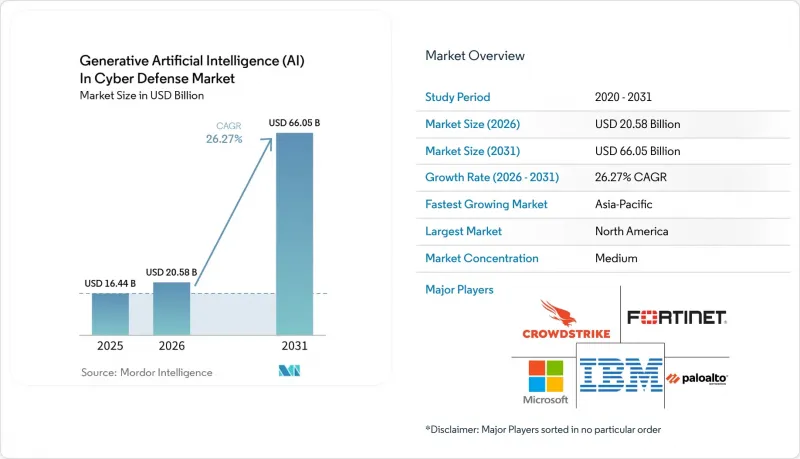
本報告按交付方式(軟體和服務)、應用領域(保全行動和安全營運中心功能增強等)、安全類型(基礎設施安全等)、部署方式(雲端等)、企業規模(大型企業等)、最終用戶產業(石油和天然氣等)以及地區進行細分。市場預測以美元計價。
網路防禦領域生成式人工智慧的全球趨勢與洞察
人工智慧驅動的攻擊數量和速度不斷增加
網路防禦領域的生成式人工智慧市場正受益於人工智慧驅動的網路釣魚、深度造假和自動化偵察的激增,這些攻擊的速度已經超過了人工審核週期。 Zscaler報告稱,基於其網路大規模收集的訊號,該公司在2025年1月至12月期間識別出413,524個人工智慧生成的網路釣魚網站,這表明攻擊者正在迅速將這些宣傳活動產業化。 IBM也報告稱,2025年六分之一的資料外洩事件將是人工智慧驅動的攻擊,其主要目的是擴大網路釣魚和社交工程攻擊的規模,這證實了攻擊性人工智慧已經產生了可衡量的營運影響。英國國家網路安全中心(NCSC)表示,人工智慧幾乎肯定會增加網路攻擊的規模和影響,並指出,尤其是在社交工程中,語法和翻譯錯誤不再是員工可靠的預警訊號。因此,網路防禦領域的生成式人工智慧正朝著以機器速度而非分析師速度運行的偵測、分類和回應引擎方向發展。買家也越來越重視能夠在單一工作流程中追蹤電子郵件、身分、瀏覽器和雲端管道中人工智慧產生的誘人訊息數量的工具。
擴大人工智慧攻擊面,使其涵蓋模型、資料和 API 層。
網路防禦領域生成式人工智慧市場的發展也得益於企業對人工智慧的日益普及。這在提示層、模型行為、訓練資料和連接的API等方面都帶來了新的風險。 OWASP在其「2025年十大大規模語言建模應用」報告中將提示注入列為主要漏洞類型,促使許多企業將人工智慧專用監控視為核心控制機制,而非實驗性附加功能。 CrowdStrike在2025年12月指出,人工智慧提示層和代理互動層是企業中成長最快的攻擊面之一,推動了對專為人工智慧原生工作流程建構的控制措施的需求。隨著每項新的人工智慧應用出現,模型、身分、資料處理歷程和工具呼叫之間的信任邊界都在不斷擴大,降低了傳統基於邊界控制的緩解策略在網路防禦生成式人工智慧領域的有效性。這種轉變促使企業加強對能夠即時觀察模型行為、檢驗提示、監控代理互動和偵測可疑API活動的平台的投資。此外,人工智慧安全的角色已經超越了傳統的網路防禦,包括模型管治和運行時策略的執行。
人工智慧安全檢驗領域缺乏標準化基準
在網路防禦領域的生成式人工智慧市場,由於缺乏被廣泛接受的方法供買家在真實的攻擊環境下比較供應商的效能,企業採用速度仍然緩慢。 NISTIR 8596 仍處於暫定版本,這意味著這個用於確保人工智慧網路安全完整性的最重要公共框架之一尚未最終定稿。 MITRE 的「人工智慧保障概覽」涵蓋了 50 多個框架和 66 項保障要求,顯示儘管該領域存在大量重疊的參考資料,但企業在採購時仍無法放心使用單一的標準基準。 OWASP 的「人工智慧安全檢驗標準」計劃增加了一些有用且檢驗的要求,但它仍然缺乏更成熟的企業安全標準所具備的製度權威性。因此,網路防禦領域的生成式人工智慧仍然過度依賴供應商的演示和案例研究,這可能導致銷售週期過長,並有利於擁有知名品牌的大型成熟企業。此外,這也削弱了買家將人工智慧安全投資與可衡量的保險收益和董事會層面的風險評估結果聯繫起來的能力。
細分市場分析
預計到2025年,軟體將佔據網路防禦領域生成式人工智慧市場62.14%的佔有率,證實了原生人工智慧平台仍是企業買家的主要採購單位。網路防禦領域的生成式人工智慧市場涵蓋了安全助理、人工智慧安全平台、威脅情報工具、安全分析引擎和漏洞管理平台,這些產品目前在安全架構中佔據核心地位。平台捆綁進一步鞏固了這一主導地位。微軟宣布將於2026年4月20日開始分階段推出,將安全助理整合到Microsoft 365 E5中。這將進一步降低其所有用戶採用人工智慧安全解決方案的門檻。同樣在2026年5月,微軟宣布其基於多模型代理的掃描功能在Windows網路堆疊中發現了16個先前未知的漏洞。這表明軟體平台正在從單純的支援轉向直接髮現和檢驗。因此,網路防禦領域生成式人工智慧 (AI) 市場的買家越來越重視將軟體作為控制層,以在單一環境中整合威脅解釋、調查支援和糾正措施指導。
預計到2031年,服務市場將以27.41%的複合年成長率成長,成為網路防禦領域生成式人工智慧市場中成長最快的服務。這一成長主要得益於託管式人工智慧保全行動、對抗性紅隊演練、人工智慧管治支援以及持續監控計劃,而這些服務目前仍是許多企業內部團隊難以獨立完成的。 IBM於2026年6月加入OpenAI的Daybreak Cyber合作夥伴計劃,並在Project Lightwell專案下推出了人工智慧驅動的應用程式保全服務。該項目獲得了IBM和紅帽50億美元的投資支持,顯示服務正在圍繞人工智慧驅動的交付模式進行重組。服務更高的成長率也反映出,許多公司需要協助將其人工智慧平台轉型為可復現的營運模式,並具備審計追蹤、策略控制和可衡量的結果。因此,網路防禦領域的生成式人工智慧正朝著混合模式發展,其中軟體建構平台層,而服務則提供維護其有效性所需的專業知識。
2025年,保全行動和安全營運中心(SOC)的增強將佔網路防禦領域生成式人工智慧(AI)市場20.18%的佔有率,成為目前支出佔比最高的應用領域。這一佔有率反映了在買家能夠將AI部署到更廣泛的用例(例如模擬、內容生成和態勢管理)之前,如何減輕分析師負擔這一緊迫挑戰。 SANS 2025 SOC調查發現,儘管AI的應用已十分普遍,但工作流程的成熟度仍然有限。這解釋了為什麼在網路防禦領域的生成式AI中,SOC增強仍然佔據預算的第一波。威脅情報、安全內容產生和安全自動化仍然是密切相關的附加項目。這是因為,那些一開始就部署SOC輔助系統的組織通常會將AI擴展到事件回應週期中的其他任務。隨著AI驅動的攻擊發展速度過快,靜態劇本難以跟上,對抗性模擬和紅隊活動也獲得了更高的預算優先順序。
預計到2031年,風險暴露管理和安全態勢分析將以27.52%的複合年成長率成長,成為網路防禦領域生成式人工智慧成長最快的應用。這一趨勢表明,成熟的安全團隊正將有限的投資轉向在漏洞被利用之前識別它們,而不是僅僅提升警報審查能力。 2026年4月,SentinelOne推出了Wayfinder Frontier AI服務,將Anthropic的Claude Opus 4.7與攻防專家相結合,實現了對攻擊面的持續發現和優先修復。這正是該應用程式商業化的直接例證。生成式模型現在可以快速連接來自雲端、身分、端點和模型層的訊號,創建出清晰的風險暴露圖,這是傳統人工分析無法實現的。因此,生成式人工智慧在網路防禦中的應用範圍正在從被動的安全輔助擴展到主動的風險量化和人工智慧驅動的安全態勢管理。
區域分析
到2025年,北美將佔據網路防禦領域生成式人工智慧市場33.19%的佔有率,並繼續保持其作為最大區域市場的地位。由於大型企業、聯邦機構和主要供應商集中於同一生態系統,美國將繼續成為需求中心。白宮將於2026年6月發布行政命令,進一步加強對該領域的政策支持,指示聯邦政府支持先進的人工智慧創新和安全,包括設立人工智慧漏洞檢測的津貼計畫。加拿大也將透過在其2025會計年度預算中撥款9.256億加元(約6.621億美元),用於未來五年大規模的主導人工智慧基礎設施建設,從而進一步鞏固該地區的基礎並增加對相關人工智慧安全措施的需求。微軟、CrowdStrike、Palo Alto Networks、SentinelOne、IBM和Google等公司在該地區的佈局進一步增強了其優勢,這些公司持續以高於大多數其他地區的速度發布和擴展商業平台。
儘管歐洲在網路防禦領域的生成式人工智慧(AI)市場仍位居第二,但預計到2031年,亞太地區的複合年成長率將達到28.07%,成為成長最快的地區。歐洲的需求模式深受歐盟《人工智慧法案》的影響,該法案於2026年8月2日生效,其高風險條款直接催生了對監控、日誌和管治工具的需求。德國、英國和法國仍然是該地區的主要驅動力,德國企業正加大對人工智慧驅動的營運技術的保護投入,而英國國家網路安全中心(NCSC)則透過發布威脅評估報告來指導企業採用人工智慧。亞太地區的成長速度更快,這得益於數位轉型、國家主導的網路安全優先事項以及雲端原生技術的成長,這些因素正在擴大中國、印度、日本、韓國和澳洲的目標市場。 2026年2月,NRI Secure Technologies報告稱,日本生成式人工智慧的利用率從2024年的65.3%上升到2025年的83.2%。這表明,隨著目前應用從內部業務流程深入系統級安全實施,未來將出現重大的轉型機會。
南美洲在網路防禦領域,生成式人工智慧(AI)市場持續成長,其中巴西和阿根廷是主要需求中心。巴西在AI應用方面處於領先地位,隨著人們對數位銀行和資料保護的期望日益提高,銀行和數位金融機構正在部署AI驅動的詐欺監控和網路防禦系統。中東和非洲地區的情況則更為複雜。沙烏地阿拉伯和阿拉伯聯合大公國(阿拉伯聯合大公國)正在積極投資AI和網路防禦,而撒哈拉以南非洲大部分地區的AI應用仍處於成熟階段。隨著金融科技的發展、雲端基礎設施的擴展、政府主導的數位化項目以及日益嚴格的合規要求,AI原生安全工具的基礎不斷加深,預計這兩個地區的網路防禦領域生成式AI市場將繼續穩步成長。
其他好處:
- Excel格式的市場預測(ME)表
- 3個月的分析師支持
目錄
第1章:引言
- 研究假設和市場定義
- 調查範圍
第2章:調查方法
第3章執行摘要
第4章 市場狀況
- 市場概覽
- 市場促進因素
- 人工智慧驅動的攻擊數量和速度不斷增加
- 擴大人工智慧在模型層、資料層和 API 層的攻擊面。
- 透過自動化安全營運中心來彌補分析師短缺
- 受監管行業的AI管治和可審計性要求
- 多租戶 GenAI 工作負載對機密運算的需求
- 敵對紅隊活動和模擬需求
- 市場限制因素
- 人工智慧安全檢驗缺乏標準化基準
- 自主安全行動中責任的不確定性
- 與傳統安全堆疊整合的挑戰
- 進階調優工作旨在減少動態人工智慧環境中的誤報
- 宏觀經濟因素對市場的影響
- 產業價值鏈分析
- 監理情勢
- 技術展望
- 波特五力分析
第5章 市場規模與成長預測
- 報價
- 軟體
- 安全副駕駛
- 人工智慧安全平台
- 威脅情報平台
- 安全分析平台
- 漏洞管理平台
- 服務
- 軟體
- 透過使用
- 增強保全行動和安全營運中心 (SOC) 能力
- 威脅情報與威脅分析
- 漏洞管理和風險暴露分析
- 安全內容生成
- 安全自動化和編配
- 敵對模擬和紅隊活動
- 按安全類型
- 基礎設施安全
- 網路安全
- 雲端安全
- 端點安全
- 應用程式安全
- 身分和存取管理
- 資料安全
- 基礎設施安全
- 不同的發展
- 雲
- 現場
- 混合
- 按公司規模
- 大公司
- 小型企業
- 按最終用戶行業分類
- 政府/公共行政
- 工業製造
- 零售與電子商務
- 運輸/物流
- 能源公用事業
- 石油和天然氣
- 資訊科技/通訊
- 媒體與娛樂
- 教育和研究機構
- 醫療保健和生命科學
- 銀行、金融服務和保險(BFSI)
- 按地區
- 北美洲
- 美國
- 加拿大
- 墨西哥
- 南美洲
- 巴西
- 阿根廷
- 其他南美國家
- 歐洲
- 德國
- 英國
- 法國
- 義大利
- 西班牙
- 俄羅斯
- 其他歐洲國家
- 亞太地區
- 中國
- 印度
- 日本
- 韓國
- 澳洲
- 其他亞太國家
- 中東和非洲
- 中東
- 沙烏地阿拉伯
- 阿拉伯聯合大公國
- 其他中東國家
- 非洲
- 南非
- 奈及利亞
- 其他非洲國家
- 中東
- 北美洲
第6章 競爭情勢
- 市場集中度
- 策略趨勢
- 市佔率分析
- 公司簡介
- Microsoft Corporation
- International Business Machines Corporation
- Google LLC
- CrowdStrike, Inc.
- Palo Alto Networks, Inc.
- SentinelOne, Inc.
- Darktrace Holdings Limited
- Fortinet, Inc.
- Zscaler, Inc.
- Trellix
- Check Point Software Technologies Ltd.
- Cisco Systems, Inc.
- Trend Micro Incorporated
- Sophos Limited
- Rapid7, Inc.
- Tenable Holdings, Inc.
- BlackBerry Limited
- Abnormal Security Corporation
- Snyk Limited
- Lakera Inc.
第7章 市場機會與未來展望
According to Mordor Intelligence, the generative artificial intelligence (AI) in Cyber Defense Market size is expected to increase from USD 16.44 billion in 2025 to USD 20.58 billion in 2026 and reach USD 66.05 billion by 2031, growing at a CAGR of 26.27% over 2026-2031.
This report is Segmented by Offering (Software, and Service), Application (Security Operations and SOC Augmentation, and More), Security Type (Infrastructure Security, and More), Deployment (Cloud, and More), Enterprise Size (Large Enterprises, and More), End-User Industry (Oil and Gas, and More), and Geography. The Market Forecasts are Provided in Terms of Value (USD).
Global Generative Artificial Intelligence (AI) In Cyber Defense Market Trends and Insights
Rising AI-Enabled Attack Volume And Speed
The Generative Artificial Intelligence (AI) in Cyber Defense Market is benefiting from a sharp rise in AI-assisted phishing, deepfake impersonation, and automated reconnaissance that outpace human-led review cycles. Zscaler reported 413,524 AI-generated phishing site instances across January to December 2025, based on signals collected at a very large scale across its network, which shows how quickly attackers are industrializing these campaigns. IBM also reported that 1 in 6 breaches in 2025 involved AI-driven attacks, mainly to scale phishing and social engineering, confirming that offensive AI already has a measurable operational impact. The UK National Cyber Security Center stated that AI will almost certainly increase both the volume and impact of cyberattacks, especially in social engineering, where grammar and translation errors are no longer reliable warning signs for employees. The Generative Artificial Intelligence (AI) in Cyber Defense Market is therefore shifting toward detection, triage, and response engines that work at machine speed rather than analyst speed. Buyers are also placing greater value on tools that can track high-volume AI-generated lures across email, identity, browser, and cloud channels in a single workflow.
Expansion of AI Attack Surface Across Model, Data, and API Layers
The Generative Artificial Intelligence (AI) in Cyber Defense Market is also being driven by the spread of enterprise AI deployments, which create new risks across prompt layers, model behavior, training data, and connected APIs. OWASP identified prompt injection as the leading vulnerability class in its 2025 Top 10 for Large Language Model Applications, which pushed many enterprises to treat AI-specific monitoring as a core control rather than an experimental add-on. CrowdStrike stated in December 2025 that the AI prompt and agent interaction layer had become one of the fastest-growing enterprise attack surfaces, which reinforced demand for controls built for AI-native workflows. Each new AI application multiplies the boundaries of trust across models, identities, data lineage, and tool calls, making repurposed perimeter controls less effective in the Generative Artificial Intelligence (AI) in Cyber Defense Market. This change is moving spending toward platforms that can observe model behavior, validate prompts, monitor agent interactions, and flag suspicious API movement in real time. It is also expanding the role of AI security beyond classic cyber defense to include model governance and runtime policy enforcement.
Lack of Standardized Benchmarks for AI Security Validation
The Generative Artificial Intelligence (AI) in Cyber Defense Market still faces slower enterprise adoption because buyers lack a widely accepted way to compare vendor performance under live adversarial conditions. NISTIR 8596 is still in preliminary form, which means one of the most visible public frameworks for AI cybersecurity alignment has not yet reached final status. MITRE's AI Assurance Landscape mapped more than 50 frameworks and 66 assurance needs, which shows that the field has many overlapping references but not one standard benchmark that enterprises can use with confidence in procurement. OWASP's Artificial Intelligence Security Verification Standard effort adds useful testable requirements, but it does not yet carry the same institutional weight as more mature enterprise security standards. The Generative Artificial Intelligence (AI) in Cyber Defense Market, therefore, still relies too heavily on vendor demonstrations and case studies, which can lengthen sales cycles and favor large incumbents with established brands. This also weakens buyers' ability to connect AI security spend with measurable insurance or board-level risk outcomes.
Other drivers and restraints analyzed in the detailed report include:
- Security Operations Center Automation to offset Analyst Shortages
- AI Governance and Auditability Requirements in Regulated Industries
- Liability Uncertainty For Autonomous Security Actions
For complete list of drivers and restraints, kindly check the Table Of Contents.
Segment Analysis
Software held 62.14% of the Generative Artificial Intelligence (AI) in Cyber Defense market in 2025, confirming that AI-native platforms remain the primary procurement unit for enterprise buyers. This part of the Generative Artificial Intelligence (AI) in Cyber Defense Market includes security copilots, AI security platforms, threat intelligence tools, security analytics engines, and vulnerability management platforms that now sit closer to the center of the security stack. Platform bundling is reinforcing that lead, as Microsoft announced that Security Copilot would be included with Microsoft 365 E5 through a phased rollout starting April 20, 2026, lowering the incremental barrier to AI security adoption across its installed base. Microsoft also stated in May 2026 that its multi-model agentic scanning harness discovered 16 previously unknown vulnerabilities in the Windows networking stack, indicating that software platforms are moving from assistance to direct discovery and validation work. As a result, buyers in the Generative Artificial Intelligence (AI) in Cyber Defense industry are increasingly treating software as a control layer that consolidates threat interpretation, investigative support, and remediation guidance across a single environment.
Services are projected to expand at a 27.41% CAGR through 2031, making them the fastest-growing offering in the Generative Artificial Intelligence (AI) in Cyber Defense Market. Growth is coming from managed AI security operations, adversarial red teaming, AI governance support, and continuous monitoring programs that many internal teams still cannot run on their own. IBM entered the OpenAI Daybreak Cyber Partner Program in June 2026 and launched an AI-powered application security service under Project Lightwell, backed by a USD 5 billion commitment from IBM and Red Hat, which shows how services are being rebuilt around AI-enabled delivery. The stronger growth rate for services also reflects the reality that many enterprises need help turning AI platforms into repeatable operating models with audit trails, policy controls, and measurable outcomes. The Generative Artificial Intelligence (AI) in Cyber Defense industry is therefore moving toward a blended model in which software builds the platform layer, while services supply the scarce expertise that keeps it effective.
Security Operations and SOC Augmentation accounted for 20.18% of the Generative Artificial Intelligence (AI) in Cyber Defense Market in 2025, which made it the largest application area by current spending. This share reflects the immediate pressure to reduce analyst overload before buyers expand into broader use cases such as simulation, content generation, and posture management. The SANS 2025 SOC survey found wide AI adoption but limited workflow maturity, which helps explain why SOC augmentation continues to attract first-wave budgets in the Generative Artificial Intelligence (AI) in Cyber Defense Market. Threat intelligence, security content generation, and security automation remain closely linked follow-on purchases, because organizations that start with SOC copilots usually extend AI into adjacent tasks along the incident response cycle. Adversarial simulation and red teaming are also gaining budget priority as AI-assisted attacks change faster than static playbooks can keep pace.
Exposure Management and Security Posture Analysis is projected to expand at a 27.52% CAGR through 2031, making it the fastest-growing application in the Generative Artificial Intelligence (AI) in Cyber Defense Market. That pattern shows that mature security teams are moving marginal investment toward identifying exploitable gaps before they are used, rather than simply adding more alert review capacity. SentinelOne launched Wayfinder Frontier AI Services in April 2026 by pairing Anthropic's Claude Opus 4.7 with offensive and defensive experts for continuous attack surface discovery and prioritized remediation, which is a direct example of how this application is being commercialized. Generative models can now connect cloud, identity, endpoint, and model-layer signals quickly enough to produce clearer exposure maps than manual analysis could previously. The Generative Artificial Intelligence (AI) in Cyber Defense Market is therefore widening from reactive security support into proactive risk quantification and AI-specific posture management.
Complete Report Scope:
- By Offering
- Software
- Security Copilots
- AI Security Platforms
- Threat Intelligence Platforms
- Security Analytics Platforms
- Vulnerability Management Platforms
- Services
- Software
- By Application
- Security Operations and SOC Augmentation
- Threat Intelligence and Threat Analysis
- Vulnerability Management and Exposure Analysis
- Security Content Generation
- Security Automation and Orchestration
- Adversarial Simulation and Red Teaming
- By Security Type
- Infrastructure Security
- Network Security
- Cloud Security
- Endpoint Security
- Application Security
- Identity and Access Management
- Data Security
- Infrastructure Security
- By Deployment
- Cloud
- On-Premises
- Hybrid
- By Enterprise Size
- Large Enterprises
- Small and Medium Enterprises
- By End-user Industry
- Government and Public Administration
- Industrial Manufacturing
- Retail and E-Commerce
- Transportation and Logistics
- Energy and Utilities
- Oil and Gas
- IT and Telecommunication
- Media and Entertainment
- Education and Research Institutions
- Healthcare and Life Sciences
- Banking, Financial Services, and Insurance (BFSI)
- By Geography
- North America
- United States
- Canada
- Mexico
- South America
- Brazil
- Argentina
- Rest of South America
- Europe
- Germany
- United Kingdom
- France
- Italy
- Spain
- Russia
- Rest of Europe
- Asia-Pacific
- China
- India
- Japan
- South Korea
- Australia
- Rest of Asia-Pacific
- Middle East and Africa
- Middle East
- Saudi Arabia
- United Arab Emirates
- Rest of Middle East
- Africa
- South Africa
- Nigeria
- Rest of Africa
- Middle East
- North America
Geography Analysis
North America held 33.19% of the Generative Artificial Intelligence (AI) in Cyber Defense market size in 2025, which kept it as the largest regional segment in the Generative Artificial Intelligence (AI) in Cyber Defense Market. The United States continues to anchor demand because large enterprises, federal agencies, and major vendors are concentrated in the same ecosystem. The White House issued an executive order in June 2026 that directed federal support toward advanced AI innovation and security, including grant pathways for AI vulnerability detection, thereby reinforcing policy backing for this area. Canada also added to the regional base when Budget 2025 allocated CAD 925.6 million, USD 662.1 million, over five years for large-scale sovereign AI infrastructure, which strengthens demand for related AI security controls. The region's strength is further reinforced by the presence of Microsoft, CrowdStrike, Palo Alto Networks, SentinelOne, IBM, and Google, which continue to release and expand commercial platforms faster than in most other geographies.
Europe remains the second-largest regional block in the Generative Artificial Intelligence (AI) in Cyber Defense Market, while Asia-Pacific is projected to record the fastest CAGR at 28.07% through 2031. Europe's demand pattern is strongly shaped by the EU AI Act, whose high-risk provisions became enforceable on August 2, 2026, and created direct demand for monitoring, logging, and governance tools. Germany, the United Kingdom, and France remain the main regional anchors, with German industry investing in AI-powered operational technology protection and the UK National Cyber Security Center guiding enterprise adoption through published threat assessments. Asia-Pacific is expanding faster because digital transformation, state-backed cyber priorities, and cloud-native growth are widening the addressable base across China, India, Japan, South Korea, and Australia. NRI Secure Technologies reported in February 2026 that Japan's generative AI utilization rate rose from 65.3% in 2024 to 83.2% in 2025, suggesting a significant future conversion opportunity as current use deepens from internal work to system-level security deployment.
South America remains an emerging market for Generative Artificial Intelligence (AI) in Cyber Defense, with Brazil and Argentina as the main demand centers. Brazil is the more advanced adopter because banks and digital finance providers are using AI-powered fraud monitoring and cyber defense in response to tighter digital banking and data protection expectations. The Middle East and Africa are more uneven, with Saudi Arabia and the United Arab Emirates investing aggressively in AI and cyber defense, while much of Sub-Saharan Africa remains earlier in its deployment maturity. The Generative Artificial Intelligence (AI) in Cyber Defense Market is still likely to deepen gradually across both regions as fintech growth, cloud buildout, sovereign digital programs, and compliance expectations create a larger base for AI-native security tools.
- Microsoft Corporation
- International Business Machines Corporation
- Google LLC
- CrowdStrike, Inc.
- Palo Alto Networks, Inc.
- SentinelOne, Inc.
- Darktrace Holdings Limited
- Fortinet, Inc.
- Zscaler, Inc.
- Trellix
- Check Point Software Technologies Ltd.
- Cisco Systems, Inc.
- Trend Micro Incorporated
- Sophos Limited
- Rapid7, Inc.
- Tenable Holdings, Inc.
- BlackBerry Limited
- Abnormal Security Corporation
- Snyk Limited
- Lakera Inc.
Additional Benefits:
- The market estimate (ME) sheet in Excel format
- 3 months of analyst support
TABLE OF CONTENTS
1 INTRODUCTION
- 1.1 Study Assumptions and Market Definition
- 1.2 Scope of the Study
2 RESEARCH METHODOLOGY
3 EXECUTIVE SUMMARY
4 MARKET LANDSCAPE
- 4.1 Market Overview
- 4.2 Market Drivers
- 4.2.1 Rising AI-Enabled Attack Volume and Speed
- 4.2.2 Expansion of AI Attack Surface Across Model, Data, and API Layers
- 4.2.3 Security Operations Center Automation to Offset Analyst Shortages
- 4.2.4 AI Governance and Auditability Requirements in Regulated Industries
- 4.2.5 Confidential Computing Demand for Multi-Tenant GenAI Workloads
- 4.2.6 Adversarial Red Teaming and Simulation Demand
- 4.3 Market Restraints
- 4.3.1 Lack of Standardized Benchmarks for AI Security Validation
- 4.3.2 Liability Uncertainty for Autonomous Security Actions
- 4.3.3 Integration Friction With Legacy Security Stacks
- 4.3.4 High Tuning Effort for False Positive Reduction in Dynamic AI Environments
- 4.4 Impact of Macroeconomic Factors on the Market
- 4.5 Industry Value-Chain Analysis
- 4.6 Regulatory Landscape
- 4.7 Technological Outlook
- 4.8 Porter's Five Forces Analysis
- 4.8.1 Bargaining Power of Buyers
- 4.8.2 Bargaining Power of Suppliers
- 4.8.3 Threat of New Entrants
- 4.8.4 Threat of Substitutes
- 4.8.5 Intensity of Competitive Rivalry
5 MARKET SIZE AND GROWTH FORECASTS (VALUE)
- 5.1 By Offering
- 5.1.1 Software
- 5.1.1.1 Security Copilots
- 5.1.1.2 AI Security Platforms
- 5.1.1.3 Threat Intelligence Platforms
- 5.1.1.4 Security Analytics Platforms
- 5.1.1.5 Vulnerability Management Platforms
- 5.1.2 Services
- 5.1.1 Software
- 5.2 By Application
- 5.2.1 Security Operations and SOC Augmentation
- 5.2.2 Threat Intelligence and Threat Analysis
- 5.2.3 Vulnerability Management and Exposure Analysis
- 5.2.4 Security Content Generation
- 5.2.5 Security Automation and Orchestration
- 5.2.6 Adversarial Simulation and Red Teaming
- 5.3 By Security Type
- 5.3.1 Infrastructure Security
- 5.3.1.1 Network Security
- 5.3.1.2 Cloud Security
- 5.3.1.3 Endpoint Security
- 5.3.2 Application Security
- 5.3.3 Identity and Access Management
- 5.3.4 Data Security
- 5.3.1 Infrastructure Security
- 5.4 By Deployment
- 5.4.1 Cloud
- 5.4.2 On-Premises
- 5.4.3 Hybrid
- 5.5 By Enterprise Size
- 5.5.1 Large Enterprises
- 5.5.2 Small and Medium Enterprises
- 5.6 By End-user Industry
- 5.6.1 Government and Public Administration
- 5.6.2 Industrial Manufacturing
- 5.6.3 Retail and E-Commerce
- 5.6.4 Transportation and Logistics
- 5.6.5 Energy and Utilities
- 5.6.6 Oil and Gas
- 5.6.7 IT and Telecommunication
- 5.6.8 Media and Entertainment
- 5.6.9 Education and Research Institutions
- 5.6.10 Healthcare and Life Sciences
- 5.6.11 Banking, Financial Services, and Insurance (BFSI)
- 5.7 By Geography
- 5.7.1 North America
- 5.7.1.1 United States
- 5.7.1.2 Canada
- 5.7.1.3 Mexico
- 5.7.2 South America
- 5.7.2.1 Brazil
- 5.7.2.2 Argentina
- 5.7.2.3 Rest of South America
- 5.7.3 Europe
- 5.7.3.1 Germany
- 5.7.3.2 United Kingdom
- 5.7.3.3 France
- 5.7.3.4 Italy
- 5.7.3.5 Spain
- 5.7.3.6 Russia
- 5.7.3.7 Rest of Europe
- 5.7.4 Asia-Pacific
- 5.7.4.1 China
- 5.7.4.2 India
- 5.7.4.3 Japan
- 5.7.4.4 South Korea
- 5.7.4.5 Australia
- 5.7.4.6 Rest of Asia-Pacific
- 5.7.5 Middle East and Africa
- 5.7.5.1 Middle East
- 5.7.5.1.1 Saudi Arabia
- 5.7.5.1.2 United Arab Emirates
- 5.7.5.1.3 Rest of Middle East
- 5.7.5.2 Africa
- 5.7.5.2.1 South Africa
- 5.7.5.2.2 Nigeria
- 5.7.5.2.3 Rest of Africa
- 5.7.5.1 Middle East
- 5.7.1 North America
6 COMPETITIVE LANDSCAPE
- 6.1 Market Concentration
- 6.2 Strategic Moves
- 6.3 Market Share Analysis
- 6.4 Company Profiles (includes Global Level Overview, Market Level Overview, Core Segments, Financials as available, Strategic Information, Market Rank/Share, Products and Services, Recent Developments)
- 6.4.1 Microsoft Corporation
- 6.4.2 International Business Machines Corporation
- 6.4.3 Google LLC
- 6.4.4 CrowdStrike, Inc.
- 6.4.5 Palo Alto Networks, Inc.
- 6.4.6 SentinelOne, Inc.
- 6.4.7 Darktrace Holdings Limited
- 6.4.8 Fortinet, Inc.
- 6.4.9 Zscaler, Inc.
- 6.4.10 Trellix
- 6.4.11 Check Point Software Technologies Ltd.
- 6.4.12 Cisco Systems, Inc.
- 6.4.13 Trend Micro Incorporated
- 6.4.14 Sophos Limited
- 6.4.15 Rapid7, Inc.
- 6.4.16 Tenable Holdings, Inc.
- 6.4.17 BlackBerry Limited
- 6.4.18 Abnormal Security Corporation
- 6.4.19 Snyk Limited
- 6.4.20 Lakera Inc.
7 MARKET OPPORTUNITIES AND FUTURE OUTLOOK
- 7.1 White-Space and Unmet-Need Assessment

 2026-2034年網路安全人工智慧(AI)全球市場規模、佔有率、趨勢和成長分析報告
 2026年全球能源行為分析市場報告
 生成式人工智慧安全市場預測至2034年-全球分析(按組件、部署模式、安全類型、安全功能、組織規模、最終用戶和地區分類)全球人工智慧(AI)安全市場:機會與戰略展望(至2035年)
 網路安全領域的人工智慧市場:按產品類型、技術、安全類型、部署模式、應用和最終用戶分類——2026-2032年全球市場預測
 AI驅動的安全分析平台:市場佔有率分析、產業趨勢與統計數據、成長預測(2026-2031年)對抗性演算法競賽與防禦型人工智慧:市場佔有率分析、產業趨勢與統計數據及成長預測(2026-2031)
 補丁優先級人工智慧市場:按組件、部署方法、企業規模、應用、國家和地區分類 - 全球產業分析、市場規模與佔有率及未來預測(2026-2033 年)2026年全球人工智慧(AI)補丁優先市場報告
 人工智慧安全工具市場分析及預測(至2035年):類型、產品類型、服務、技術、應用、部署模式、最終用戶、功能