


 |
市場調查報告書
商品編碼
2098476
對抗性演算法競賽與防禦型人工智慧:市場佔有率分析、產業趨勢與統計數據及成長預測(2026-2031)Adversarial Algorithmic Competition and Defensive AI - Market Share Analysis, Industry Trends & Statistics, Growth Forecasts (2026 - 2031) |
||||||

※ 本網頁內容可能與最新版本有所差異。詳細情況請與我們聯繫。
根據 Mordor Intelligence 預測,對抗性演算法競爭和防禦性人工智慧的市場規模預計將從 2025 年的 34.2 億美元成長到 2026 年的 43.3 億美元,到 2031 年將達到 159.9 億美元,2026 年至 2031 年的複合年成長率為 29.9.99.86%。
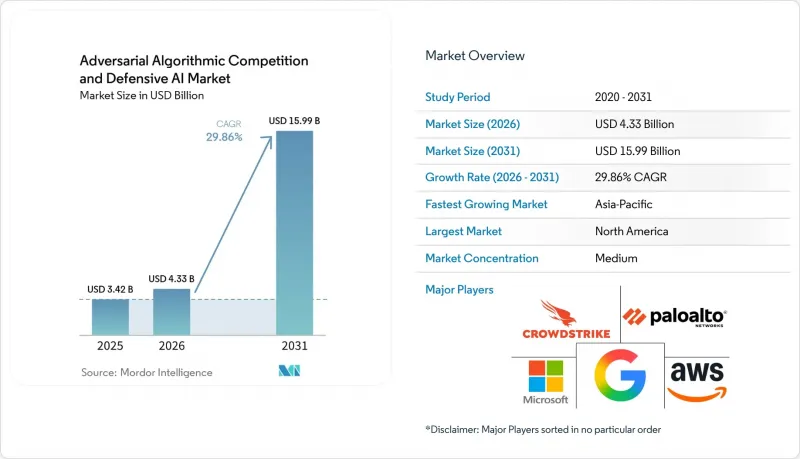
本報告按產品/服務(軟體和服務)、安全評估重點領域(例如快速注入和越獄測試)、部署方式(雲端、本地部署、混合部署)、企業規模(例如大型企業)、最終用戶行業(例如銀行、金融服務和保險 (BFSI)、醫療保健和生命科學)以及地區進行細分。市場預測以美元 (USD) 為單位。
全球對抗性演算法競賽與防禦人工智慧市場趨勢及洞察
在受監管的工作流程中快速部署生成式和基於代理的人工智慧
受監管產業已超越最初的試點階段,對抗性演算法競爭和防禦型人工智慧市場正受益於人工智慧與客戶服務、合規、詐欺篩選和臨床支援營運等需要更嚴格監管的領域的結合。劍橋另類金融中心於2026年4月發布的報告顯示,在金融服務領域,71%的受訪機構正在積極採用生成式人工智慧,52%的機構正在積極採用基於代理的人工智慧,48%的機構認為對抗性人工智慧的威脅是他們最大的擔憂。醫療保健領域也呈現類似的趨勢,英偉達的報告指出,到2026年,69%的機構將使用生成式人工智慧或大規模語言模型,高於2025年的54%。同時,40%的機構表示,HIPAA、FDA核准流程和GDPR正在影響他們基於代理的人工智慧工作。這一點至關重要,因為基於代理的系統並非局限於單一模型邊界,而是會與工具、資料庫和應用層交互,從而擴大了可能出現誤用的位置。因此,在對抗性演算法競賽和防禦型人工智慧市場中,人們越來越需要涵蓋整個工作流程的測試,而不僅僅是孤立模型的行為測試。
注入攻擊、越獄攻擊和模型篡改攻擊的頻率增加。
攻擊技術日益複雜,直接推動了對抗性演算法競賽和防禦型人工智慧市場的發展。 2026年6月發表在《科學報告》(Scientific Reports)上的一項研究表明,針對多個開放加權、參數量達70億的模型族的越獄攻擊,透過使用足夠易讀的提示訊息繞過簡單的過濾規則,其總體成功率從91.1%提升至94.6%。 2025年的一項關於提示注入攻擊的綜述也指出,53%的企業部署依賴檢索擴展生成(RAG)和基於代理的管道,這增加了篡改或操縱的外部內容在運行時影響模型行為的風險。這篇綜述也強調了系統性提示外洩和向量/嵌入漏洞是需要重點關注的問題,顯示攻擊的分類正在不斷擴展,而非趨於穩定。在此框架下進行的研究表明,只需將五個複雜的惡意文件插入數百萬個其他文件中,即可實現 90% 的攻擊成功率,這有助於解釋為什麼對抗演算法和防禦性 AI 市場的競爭正在轉向持續和自動化的紅隊行動。
對抗性人工智慧安全領域專家短缺
對抗性人工智慧技能缺口仍然是限制對抗性演算法競賽和防禦性人工智慧市場成長速度的一大瓶頸。根據Linux基金會發布的《2025年全球人才報告》,68%的受訪機構表示人工智慧和機器學習領域人才短缺,而僅有25%的機構具備專門的人工智慧安全管理能力。 Fortinet在2025年也證實了這一趨勢,97%的IT決策者計劃實施人工智慧安全解決方案,其中48%的人認為缺乏具備足夠人工智慧專業知識的人才是實施過程中面臨的主要挑戰。此外,CyberSeek在2025年6月發布的報告顯示,美國網路安全人才的供需比僅為74%,而專注於人工智慧的安全崗位的招募週期比傳統安全崗位長21%。這種情況迫使各機構轉向自動化工具和託管服務,這些工具和服務雖然能夠支援部分對抗性演算法競賽和防禦性人工智慧市場的支出,但卻減緩了企業內部全面採用人工智慧技術的速度。
細分市場分析
2025年,軟體在對抗性演算法競賽和防禦性人工智慧市場佔了61.22%的佔有率。這一地位的取得主要得益於紅隊平台、模型安全測試工具、深度造假檢測產品以及取代人工和分散工作流程的防禦性監控系統。軟體領域最大的轉變在於平台整合,買家越來越傾向於能夠支援模型掃描、安全態勢監控、對抗性測試和運行時控制的單一環境。 Palo Alto Networks於2025年4月推出了Prisma AIRS,並在2026年網路安全週期間擴展了該平台,使其能夠覆蓋更廣泛的人工智慧代理、應用程式、模型和資料集,從而展現了這一發展方向。這種整合設計的價值不僅體現在技術層面,因為對抗性演算法競賽和防禦性人工智慧市場現在高度重視能夠產生符合合規性要求的可審計證據的平台。受監管行業的買家越來越要求能夠以符合內部風險審查和外部義務的方式記錄測試記錄、管治措施和執行結果。
預計到2031年,該服務市場將以30.91%的複合年成長率成長,成為對抗性演算法競賽和防禦性人工智慧市場中成長最快的細分領域。主要原因很簡單:許多公司仍然缺乏能夠跟上不斷演變的攻擊方法、新模型發布和頻繁工作流程更新的內部團隊。 CrowdStrike很早就滿足了這一需求,於2024年11月推出了“AI紅隊服務”,將基於OWASP攻擊向量對人工智慧系統和大規模語言模型進行主動評估作為核心服務。對託管服務需求不斷成長的另一個原因是,每一次快速變更、模型更新以及與外部工具的整合都會產生新的測試需求,而內部團隊可能無法按時完成這些工作。因此,儘管軟體仍然是更大的收入來源,但服務領域是對抗性演算法競賽和防禦性人工智慧產業中成長最快的細分領域。
威脅情報和威脅分析在安全評估子領域中佔最大佔有率,預計到 2025 年將達到 19.14%。由於模型濫用、提示注入、隱私外洩、投毒和合成媒體利用等攻擊模式各不通用,企業仍需要從理解威脅入手。如今,大型客戶期望的是結合多種測試觀點的多面向方案,而不是針對單一已知漏洞的孤立檢查。劍橋另類金融中心的一份報告顯示,50% 的金融機構和 57% 的監管機構將對抗性人工智慧相關的網路威脅視為其最關注的問題,這也解釋了為何早期威脅分析仍然至關重要。在實踐中,買家會利用此評估層來確定應在哪些方面進行更詳細的測試——例如模型、提示、訓練管道和工具整合代理。這種前端作用確保了威脅分析在商業性需求中始終佔據核心地位,即使新的類別正在蓬勃發展。
預計到2031年,持續人工智慧安全監控將以31.02%的複合年成長率成長,成為對抗性演算法競賽和防禦性人工智慧市場中成長最快的領域。靜態的部署前測試可能會遺漏一些問題,這些問題只有在模型開始處理真實資料、改變提示資訊以及應對真實使用者行為後才會顯現。 2025年8月,OpenSSF指出,安全檢查應該整合到整個機器學習生命週期中,從資料攝取到推理過程中的監控。 2026年5月,開放原始碼了RAMPART,進一步推動了這個趨勢。 RAMPART將代理安全場景和對抗性攻擊調查轉化為可重現的持續整合(CI)管線測試,而非一次性練習。隨著越來越多的團隊將安全測試視為一種工程控制手段而非週期性審查,對抗性演算法競賽和防禦性人工智慧市場的這一領域預計將持續成長,並超越所有其他評估類別。
區域分析
到2025年,北美將佔據對抗性演算法競賽和防禦性人工智慧市場32.18%的佔有率,成為最大的區域收入來源。該地區受益於人工智慧優先型企業、先進網路安全供應商以及正在快速發展正式人工智慧監管體系的受監管行業的緊密結合。美國國家標準與技術研究院(NIST)透過其人工智慧風險管理框架措施強化了這一環境,其中包括2024年發布的《通用人工智慧概況》(GenAI Profile)和2026年4月發布的《關鍵基礎設施概況概念說明》(Concept Note on the Crytical Infrastructure Profile),後者目前正在影響採購要求。加拿大也憑藉著中小企業的2026年人工智慧應用工具包,以及與七國集團(G7)進程的合作,正加速推動人工智慧在中型企業的系統性應用。墨西哥仍處於引進週期的早期階段,但金融服務的數位化以及美國主導的人工智慧平台在該地區的區域擴張,正在推動對抗性演算法競賽和防禦性人工智慧市場需求的擴大。
預計到2031年,亞太地區將以31.46%的複合年成長率成長,在對抗性演算法競賽和防禦型人工智慧市場中,其成長速度在所有地區中位居榜首。這一成長動能不僅源自於人工智慧的普及應用,也源自於全部區域企業往往同時面臨多種合規框架。日本於2025年6月4日頒布了2025年第53號法律,隨後於2025年9月制定了《國家人工智慧基本規劃》。該規劃旨在為人工智慧的開發和應用提供更系統化的保障。中國於2026年5月推出了首個自主人工智慧政策框架,並透過修訂《網路安全法》明確了網路安全法規中對人工智慧的管治。此次修訂將最高罰款額提高至5,000萬元人民幣(約690萬美元)或上年度營業收入的5%。韓國的《人工智慧基本法》也於 2026 年獲得了新的法律約束力,這些框架的結合正在增加該地區公司採購測試和保證能力的頻率。
歐洲在對抗性演算法競爭和防禦型人工智慧市場中仍佔據著重要的結構性地位。這是因為監管已經從政策辯論階段進入了直接實施階段。歐盟人工智慧法案將於2026年8月2日全面實施,其對高風險系統的處理方式已在金融服務、醫療保健、關鍵基礎設施和教育等領域形成了明確的採購因素。德國、英國和法國正在支撐當前的市場需求,而南歐和東歐國家則更嚴格地遵守合規時間表,而非人工智慧成熟度曲線本身。以沙烏地阿拉伯和阿拉伯聯合大公國主導的中東和非洲地區,以及以巴西和阿根廷主導的南美洲地區,目前貢獻較小,但對於那些希望在大規模合規週期到來之前搶佔平台先機的供應商而言,這些地區正成為極具價值的進入市場。
其他好處:
- Excel格式的市場預測(ME)表
- 3個月的分析師支持
目錄
第1章:引言
- 研究假設和市場定義
- 調查範圍
第2章:調查方法
第3章執行摘要
第4章 市場狀況
- 市場概覽
- 市場促進因素
- 在受監管的工作流程中快速採用生成式和基於代理的人工智慧
- 注入攻擊、越獄攻擊和模型篡改攻擊的頻率增加。
- 監管壓力加大,人工智慧的安全性、可審計性和穩健性測試面臨挑戰。
- 大型企業人工智慧管治專案的擴展
- DevSecOps 和 MLOps 流水線中對持續紅隊活動的需求
- 擴大人工智慧在關鍵決策系統中的應用
- 市場限制因素
- 對抗性人工智慧安全領域專家短缺
- 持續測試、工具和專家服務相關的高成本。
- 自主人工智慧辯護中的可解釋性差距和責任不確定性
- 資料來源分散和跨境合規限制
- 宏觀經濟因素對市場的影響
- 產業價值鏈分析
- 監理情勢
- 技術展望
- 波特五力分析
第5章 市場規模與成長預測
- 報價
- 軟體
- AI紅隊平台
- 模型安全測試平台
- 深度造假檢測平台
- 防禦型人工智慧監控平台
- 服務
- 軟體
- 安全評估的關鍵關注領域
- 快速注入和越獄測試
- 模型竊盜和隱私測試
- 訓練流程和資料中毒測試
- 深度造假與合成媒體因應措施
- 持續人工智慧安全監控
- 不同的發展
- 雲
- 現場
- 混合
- 按公司規模
- 大公司
- 小型企業
- 按最終用戶行業分類
- BFSI
- 醫療保健和生命科學
- 資訊科技/通訊
- 零售與電子商務
- 工業製造
- 政府/公共部門
- 其他終端用戶產業
- 按地區
- 北美洲
- 美國
- 加拿大
- 墨西哥
- 南美洲
- 巴西
- 阿根廷
- 其他南美國家
- 歐洲
- 德國
- 英國
- 法國
- 義大利
- 西班牙
- 俄羅斯
- 其他歐洲國家
- 亞太地區
- 中國
- 印度
- 日本
- 韓國
- 澳洲
- 其他亞太國家
- 中東和非洲
- 中東
- 沙烏地阿拉伯
- 阿拉伯聯合大公國
- 其他中東國家
- 非洲
- 南非
- 奈及利亞
- 其他非洲國家
- 中東
- 北美洲
第6章 競爭情勢
- 市場集中度
- 策略趨勢
- 市佔率分析
- 公司簡介
- Microsoft Corporation
- Google LLC
- Amazon Web Services Inc.
- International Business Machines Corporation
- Palo Alto Networks Inc.
- CrowdStrike Holdings, Inc.
- SentinelOne, Inc.
- Darktrace plc
- Check Point Software Technologies Ltd.
- Fortinet, Inc.
- Rapid7, Inc.
- Trend Micro Incorporated
- Cisco Systems, Inc.
- BlackBerry Limited
- Elastic NV
- Vectra AI, Inc.
- Noma Security Ltd.
- Protect AI, Inc.
- Adversa AI Ltd.
- HiddenLayer, Inc.
第7章 市場機會與未來展望
According to Mordor Intelligence, the adversarial algorithmic competition and defensive AI market size is expected to grow from USD 3.42 billion in 2025 to USD 4.33 billion in 2026 and is forecast to reach USD 15.99 billion by 2031 at 29.86% CAGR over 2026-2031.
This report is Segmented by Offering (Software, and Services), Security Assessment Focus (Prompt Injection and Jailbreak Testing, and More), Deployment (Cloud, On-Premises, and Hybrid), Enterprise Size (Large Enterprises, and More), End-User Industry (BFSI, Healthcare and Life Sciences, and More), and Geography. The Market Forecasts are Provided in Terms of Value (USD).
Global Adversarial Algorithmic Competition and Defensive AI Market Trends and Insights
Rapid Adoption Of Generative and Agentic AI in Regulated Workflows
Regulated sectors have moved past early pilots, and the adversarial algorithmic competition and defensive AI market are benefiting from how AI is now tied to customer service, compliance, fraud review, and clinical support tasks that require stronger oversight. In financial services, the Cambridge Center for Alternative Finance reported in April 2026 that 71% of surveyed institutions were actively adopting GenAI, 52% were actively adopting agentic AI, and 48% identified adversarial AI threats as a top concern. Healthcare showed a similar pattern, as NVIDIA reported that 69% of organizations were using generative AI or large language models in 2026, up from 54% in 2025, while 40% said HIPAA, FDA approval processes, and GDPR were shaping their agentic AI approach. This matters because agentic systems do not stay within a single model boundary; they connect to tools, databases, and application layers, widening the number of points where misuse can occur. As a result, the adversarial algorithmic competition and defensive AI market is seeing stronger demand for testing that covers full workflows rather than isolated model behavior.
Rising Frequency Of Prompt Injection, Jailbreak, and Model Tampering Attacks
Attack methods are becoming more effective, and that is a direct growth driver for the adversarial algorithmic competition and defensive AI market. A June 2026 study in Scientific Reports recorded aggregate jailbreak attack success rates of 91.1% to 94.6% across several open-weight 7-billion-parameter model families, using prompts that remained readable enough to bypass simple filtering rules. The 2025 review of prompt injection attacks also noted that 53% of enterprise deployments rely on retrieval-augmented generation and agentic pipelines, which increases the risk that poisoned or manipulated external content can influence model behavior at runtime. The same review highlighted that system prompt leakage and vector and embedding weaknesses had become distinct areas of concern, showing that the attack taxonomy is expanding rather than settling into a stable pattern. Research discussed in that framework also showed that 5 carefully crafted poisoned documents among millions could achieve a 90% attack success rate, which helps explain why the adversarial algorithmic competition and the defensive AI market are moving toward continuous, automated red teaming.
Shortage of Specialized Adversarial AI Security Talent
The adversarial AI skills gap remains a practical limit on how fast the adversarial algorithmic competition and defensive AI market can scale. The Linux Foundation found in its 2025 global tech talent report that 68% of surveyed organizations were understaffed in AI and ML, while only 25% reported dedicated AI security management capabilities. Fortinet reinforced this pattern in 2025, reporting that 97% of IT decision-makers planned to deploy AI security solutions, yet 48% cited the lack of staff with enough AI expertise as the primary implementation challenge. CyberSeek also showed in June 2025 that the United States cybersecurity workforce supply-demand ratio stood at 74%, and recruiting periods for AI-specific security roles ran 21% longer than those for traditional security positions. This is pushing organizations toward automated tools and managed services, which support some spending categories inside the adversarial algorithmic competition and defensive AI market, even while it slows full in-house adoption.
Other drivers and restraints analyzed in the detailed report include:
- Regulatory Pressure For AI Safety, Auditability, and Robustness Testing
- Expansion of AI Governance Programs in Large Enterprises
- High Cost Of Continuous Testing, Tooling, and Expert Services
For complete list of drivers and restraints, kindly check the Table Of Contents.
Segment Analysis
Software held 61.22% share of the adversarial algorithmic competition and defensive AI market in 2025. That position came from red teaming platforms, model security testing tools, deepfake detection products, and defensive monitoring systems that are replacing manual and fragmented workflows. The biggest shift inside software is platform convergence, as buyers prefer a single environment that can scan models, monitor posture, run adversarial tests, and support runtime controls. Palo Alto Networks showed that direction when it introduced Prisma AIRS in April 2025 and later expanded the platform during Cyber Week 2026 with broader coverage for AI agents, applications, models, and datasets. The value of that integrated design is not only technical, because the adversarial algorithmic competition and the defensive AI market now reward platforms that can also generate audit-ready evidence aligned with compliance expectations. Buyers in regulated sectors increasingly want proof that testing records, governance actions, and runtime findings can be documented in a form that satisfies internal risk reviews and external obligations.
Services are projected to expand at a 30.91% CAGR through 2031, making it the fastest-growing segment in the adversarial algorithmic competition and defensive AI market. The core reason is simple: many enterprises still lack internal teams that can keep up with evolving attack methods, new model releases, and frequent workflow updates. CrowdStrike moved early on that demand when it launched AI Red Team Services in November 2024, positioning the service around proactive assessments for AI systems and large language models aligned with OWASP-style attack paths. Managed service demand also rises because each prompt change, model update, or external tool connection can create a fresh testing requirement that internal teams may not be ready to handle on schedule. That is why the services side of the adversarial algorithmic competition and defensive AI industry is expanding fastest, even while software remains the larger revenue pool.
Threat Intelligence and Threat Analysis accounted for the largest security assessment sub-segment, with a 19.14% share in 2025. Enterprises still begin with threat understanding because model misuse, prompt injection, privacy leakage, poisoning, and synthetic media abuse do not follow one common attack pattern. Large clients now expect multi-focus programs that combine several testing lenses rather than isolated checks against a single known weakness. The Cambridge Center for Alternative Finance reported that 50% of financial institutions and 57% of regulators saw adversarial AI-related cyber threats as a top concern, which helps explain why early threat analysis remains a priority. In practice, buyers use this assessment layer to decide where deeper testing should sit across models, prompts, training pipelines, and tool-connected agents. That front-end role keeps threat analysis central to commercial demand even as newer categories gain speed.
Continuous AI Security Monitoring is projected to expand at a 31.02% CAGR through 2031, making it the fastest-growing focus area in the adversarial algorithmic competition and defensive AI market. Static pre-deployment testing can miss issues that only appear after the model begins to handle live data, changing prompts, and real user behavior. OpenSSF stated in August 2025 that security checks should be embedded across the full ML lifecycle, from data ingestion through monitoring at inference time. Microsoft reinforced that move in May 2026 by open-sourcing RAMPART, which turns agent safety scenarios and adversarial findings into repeatable CI pipeline tests rather than one-off exercises. As more teams treat security testing as an engineering control instead of a periodic review, this part of the adversarial algorithmic competition and defensive AI market is likely to keep outpacing every other assessment category.
Complete Report Scope:
- By Offering
- Software
- AI Red Teaming Platforms
- Model Security Testing Platforms
- Deepfake Detection Platforms
- Defensive AI Monitoring Platforms
- Services
- Software
- By Security Assessment Focus
- Prompt Injection and Jailbreak Testing
- Model Theft and Privacy Testing
- Training Pipeline and Data Poisoning Testing
- Deepfake and Synthetic Media Defense
- Continuous AI Security Monitoring
- By Deployment
- Cloud
- On-Premises
- Hybrid
- By Enterprise Size
- Large Enterprises
- Small and Medium Enterprises
- By End-user Industry
- BFSI
- Healthcare and Life Sciences
- Information Technology and Telecom
- Retail and E-commerce
- Industrial Manufacturing
- Government and Public Sector
- Other End-user Industries
- By Geography
- North America
- United States
- Canada
- Mexico
- South America
- Brazil
- Argentina
- Rest of South America
- Europe
- Germany
- United Kingdom
- France
- Italy
- Spain
- Russia
- Rest of Europe
- Asia-Pacific
- China
- India
- Japan
- South Korea
- Australia
- Rest of Asia-Pacific
- Middle East and Africa
- Middle East
- Saudi Arabia
- United Arab Emirates
- Rest of Middle East
- Africa
- South Africa
- Nigeria
- Rest of Africa
- Middle East
- North America
Geography Analysis
North America accounted for 32.18% of the adversarial algorithmic competition and defensive AI market in 2025, making it the largest regional revenue base. The region benefits from a dense mix of AI-first enterprises, advanced cybersecurity vendors, and regulated sectors that are moving faster on formal AI oversight. NIST strengthened that environment through its AI Risk Management Framework work, including the GenAI profile released in 2024 and the April 2026 concept note for a critical infrastructure profile that is now shaping procurement language. Canada also added momentum through its 2026 SME AI deployment toolkit linked to the G7 process, which supports more structured adoption among mid-sized organizations. Mexico remains earlier in the cycle, but financial services digitization and the regional expansion of United States-led AI platforms are helping build a broader demand base for adversarial algorithmic competition and the defensive AI market.
Asia-Pacific is projected to grow at a 31.46% CAGR through 2031, the fastest among all regions in the adversarial algorithmic competition and defensive AI market. Its momentum comes not only from AI adoption but also from the fact that enterprises often face multiple compliance frameworks across the region simultaneously. Japan enacted Act No. 53 of 2025 on June 4, 2025, and later established the National AI Basic Plan in September 2025, which encourages more structured assurance for AI development and use. China introduced its first policy framework on agentic AI in May 2026, and amendments to the Cybersecurity Law clarified AI governance within cybersecurity regulation, raising maximum fines to CNY 50 million (USD 6.9 million) or 5% of prior-year turnover. South Korea's AI Basic Act adds another binding layer in 2026, and together these frameworks are increasing the frequency with which regional enterprises procure testing and assurance capabilities.
Europe remains structurally important in the adversarial algorithmic competition and defensive AI market because regulation has moved from policy discussion into direct implementation. The EU AI Act becomes fully applicable on August 2, 2026, and its treatment of high-risk systems has created a clear procurement trigger in financial services, healthcare, critical infrastructure, and education. Germany, the United Kingdom, and France anchor current demand, while Southern and Eastern Europe are following compliance timelines more closely than pure AI maturity curves. The Middle East and Africa, led by Saudi Arabia and the UAE, and South America, led by Brazil and Argentina, are still smaller contributors today, but they are becoming useful entry markets for vendors that want early platform positions before larger compliance cycles arrive.
- Microsoft Corporation
- Google LLC
- Amazon Web Services Inc.
- International Business Machines Corporation
- Palo Alto Networks Inc.
- CrowdStrike Holdings, Inc.
- SentinelOne, Inc.
- Darktrace plc
- Check Point Software Technologies Ltd.
- Fortinet, Inc.
- Rapid7, Inc.
- Trend Micro Incorporated
- Cisco Systems, Inc.
- BlackBerry Limited
- Elastic N.V.
- Vectra AI, Inc.
- Noma Security Ltd.
- Protect AI, Inc.
- Adversa AI Ltd.
- HiddenLayer, Inc.
Additional Benefits:
- The market estimate (ME) sheet in Excel format
- 3 months of analyst support
TABLE OF CONTENTS
1 INTRODUCTION
- 1.1 Study Assumptions and Market Definition
- 1.2 Scope of the Study
2 RESEARCH METHODOLOGY
3 EXECUTIVE SUMMARY
4 MARKET LANDSCAPE
- 4.1 Market Overview
- 4.2 Market Drivers
- 4.2.1 Rapid Adoption of Generative and Agentic AI in Regulated Workflows
- 4.2.2 Rising Frequency of Prompt Injection, Jailbreak, and Model Tampering Attacks
- 4.2.3 Regulatory Pressure for AI Safety, Auditability, and Robustness Testing
- 4.2.4 Expansion of AI Governance Programs in Large Enterprises
- 4.2.5 Demand for Continuous Red Teaming in DevSecOps and MLOps Pipelines
- 4.2.6 Increasing Use of AI in High Stakes Decision Systems
- 4.3 Market Restraints
- 4.3.1 Shortage of Specialized Adversarial AI Security Talent
- 4.3.2 High Cost of Continuous Testing, Tooling, and Expert Services
- 4.3.3 Explainability Gaps and Liability Uncertainty in Autonomous AI Defenses
- 4.3.4 Fragmented Data Provenance and Cross Border Compliance Constraints
- 4.4 Impact of Macroeconomic Factors on the Market
- 4.5 Industry Value-Chain Analysis
- 4.6 Regulatory Landscape
- 4.7 Technological Outlook
- 4.8 Porter's Five Forces Analysis
- 4.8.1 Bargaining Power of Buyers
- 4.8.2 Bargaining Power of Suppliers
- 4.8.3 Threat of New Entrants
- 4.8.4 Threat of Substitutes
- 4.8.5 Intensity of Competitive Rivalry
5 MARKET SIZE AND GROWTH FORECASTS (VALUE)
- 5.1 By Offering
- 5.1.1 Software
- 5.1.1.1 AI Red Teaming Platforms
- 5.1.1.2 Model Security Testing Platforms
- 5.1.1.3 Deepfake Detection Platforms
- 5.1.1.4 Defensive AI Monitoring Platforms
- 5.1.2 Services
- 5.1.1 Software
- 5.2 By Security Assessment Focus
- 5.2.1 Prompt Injection and Jailbreak Testing
- 5.2.2 Model Theft and Privacy Testing
- 5.2.3 Training Pipeline and Data Poisoning Testing
- 5.2.4 Deepfake and Synthetic Media Defense
- 5.2.5 Continuous AI Security Monitoring
- 5.3 By Deployment
- 5.3.1 Cloud
- 5.3.2 On-Premises
- 5.3.3 Hybrid
- 5.4 By Enterprise Size
- 5.4.1 Large Enterprises
- 5.4.2 Small and Medium Enterprises
- 5.5 By End-user Industry
- 5.5.1 BFSI
- 5.5.2 Healthcare and Life Sciences
- 5.5.3 Information Technology and Telecom
- 5.5.4 Retail and E-commerce
- 5.5.5 Industrial Manufacturing
- 5.5.6 Government and Public Sector
- 5.5.7 Other End-user Industries
- 5.6 By Geography
- 5.6.1 North America
- 5.6.1.1 United States
- 5.6.1.2 Canada
- 5.6.1.3 Mexico
- 5.6.2 South America
- 5.6.2.1 Brazil
- 5.6.2.2 Argentina
- 5.6.2.3 Rest of South America
- 5.6.3 Europe
- 5.6.3.1 Germany
- 5.6.3.2 United Kingdom
- 5.6.3.3 France
- 5.6.3.4 Italy
- 5.6.3.5 Spain
- 5.6.3.6 Russia
- 5.6.3.7 Rest of Europe
- 5.6.4 Asia-Pacific
- 5.6.4.1 China
- 5.6.4.2 India
- 5.6.4.3 Japan
- 5.6.4.4 South Korea
- 5.6.4.5 Australia
- 5.6.4.6 Rest of Asia-Pacific
- 5.6.5 Middle East and Africa
- 5.6.5.1 Middle East
- 5.6.5.1.1 Saudi Arabia
- 5.6.5.1.2 United Arab Emirates
- 5.6.5.1.3 Rest of Middle East
- 5.6.5.2 Africa
- 5.6.5.2.1 South Africa
- 5.6.5.2.2 Nigeria
- 5.6.5.2.3 Rest of Africa
- 5.6.5.1 Middle East
- 5.6.1 North America
6 COMPETITIVE LANDSCAPE
- 6.1 Market Concentration
- 6.2 Strategic Moves
- 6.3 Market Share Analysis
- 6.4 Company Profiles (includes Global Level Overview, Market Level Overview, Core Segments, Financials as available, Strategic Information, Market Rank/Share, Products and Services, Recent Developments)
- 6.4.1 Microsoft Corporation
- 6.4.2 Google LLC
- 6.4.3 Amazon Web Services Inc.
- 6.4.4 International Business Machines Corporation
- 6.4.5 Palo Alto Networks Inc.
- 6.4.6 CrowdStrike Holdings, Inc.
- 6.4.7 SentinelOne, Inc.
- 6.4.8 Darktrace plc
- 6.4.9 Check Point Software Technologies Ltd.
- 6.4.10 Fortinet, Inc.
- 6.4.11 Rapid7, Inc.
- 6.4.12 Trend Micro Incorporated
- 6.4.13 Cisco Systems, Inc.
- 6.4.14 BlackBerry Limited
- 6.4.15 Elastic N.V.
- 6.4.16 Vectra AI, Inc.
- 6.4.17 Noma Security Ltd.
- 6.4.18 Protect AI, Inc.
- 6.4.19 Adversa AI Ltd.
- 6.4.20 HiddenLayer, Inc.
7 MARKET OPPORTUNITIES AND FUTURE OUTLOOK
- 7.1 White-Space and Unmet-Need Assessment

 2026-2034年網路安全人工智慧(AI)全球市場規模、佔有率、趨勢和成長分析報告
 2026年全球能源行為分析市場報告
 生成式人工智慧安全市場預測至2034年-全球分析(按組件、部署模式、安全類型、安全功能、組織規模、最終用戶和地區分類)全球人工智慧(AI)安全市場:機會與戰略展望(至2035年)
 網路安全領域的人工智慧市場:按產品類型、技術、安全類型、部署模式、應用和最終用戶分類——2026-2032年全球市場預測
 AI驅動的安全分析平台:市場佔有率分析、產業趨勢與統計數據、成長預測(2026-2031年)網路防禦中的生成式人工智慧:市場佔有率分析、產業趨勢與統計數據以及成長預測(2026-2031 年)
 補丁優先級人工智慧市場:按組件、部署方法、企業規模、應用、國家和地區分類 - 全球產業分析、市場規模與佔有率及未來預測(2026-2033 年)2026年全球人工智慧(AI)補丁優先市場報告
 人工智慧安全工具市場分析及預測(至2035年):類型、產品類型、服務、技術、應用、部署模式、最終用戶、功能