


 |
市場調查報告書
商品編碼
2097254
DTG印表機:市佔率分析、產業趨勢與統計、成長預測(2025-2030年)DTG Printers - Market Share Analysis, Industry Trends & Statistics, Growth Forecasts (2025 - 2030) |
||||||

※ 本網頁內容可能與最新版本有所差異。詳細情況請與我們聯繫。
根據 Mordor Intelligence 預測,到 2025 年,直接成衣 (DTG) 列印機市場規模將達到 2.1378 億美元,到 2030 年將達到 2.5791 億美元,年複合成長率為 3.87%。
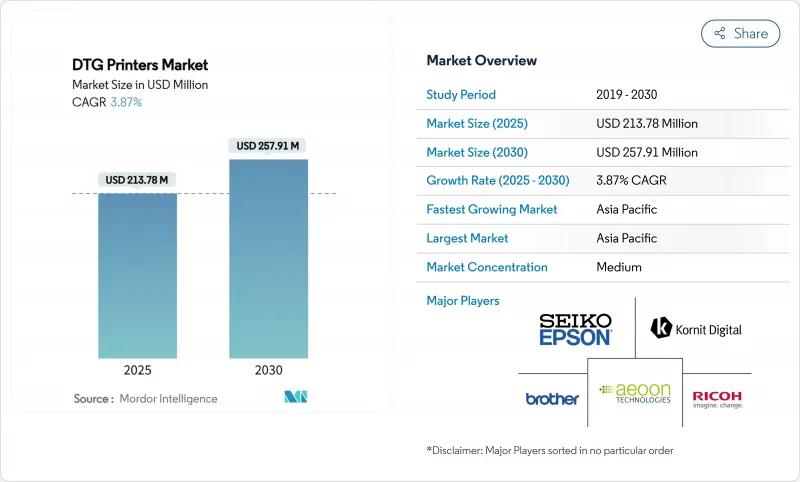
本報告按印表機類型(工業級DTG印表機、桌上型/入門級DTG印表機等)、墨水類型(標準CMYK墨水、CMYK+白色墨水等)、最終用戶(客製化服飾店、大型印刷服務供應商、中小企業等)、應用領域(T卹、運動服、休閒服等)和地區進行細分。市場預測以美元(USD)為單位。
全球DTG列印機市場趨勢與洞察
客製化服飾電子商務的興起
如今,數位市場提供從點擊到出貨的全程自動化個人化服務,亞馬遜的履約演算法將DTG印表機的產能分配給每一筆小訂單。沃爾瑪等零售巨頭正透過Kornit的Apollo平台實現當週補貨,減少庫存積壓,並將DTG印表機市場打造為關鍵基礎設施。 TikTok和Instagram上的社交設計潮流正在蔓延,推動著新型印刷生產,且不再受最低訂購量限制。即時需求數據會反映在生產軟體中,從而完成整個生產週期,消除投機性庫存積壓。隨著消費者對「獨特性」的期望不斷提高,大規模客製化正從追求新奇逐漸走向標準化,進一步加深了對DTG設備的結構性需求。
由於噴嘴密度提高,每次列印成本降低。
壓電列印頭技術的進步增加了噴嘴數量,提高了單一途徑覆蓋率,並減少了墨水浪費。愛普生正透過在日本投資3,400萬美元增加產能來應對這項挑戰。生產線速度的提升使工業用戶能夠以接近網版印刷的價格銷售中等批量產品,從而消除了DTG印表機市場的主要成本障礙。兄弟公司的中期銷售計劃預計工業銷售額將佔總收入的40%,這表明他們對印刷的經濟效益正在接近網版印刷充滿信心。隨著良率的提高(類似半導體製造的學習曲線),單位成本將進一步降低,產品更新周期將加快,小規模企業也將更容易負擔印表機。
高初始資本投入
工業級DTG生產線的成本在10萬至50萬美元之間,外加服務合約費用,這給中小企業(SME)的現金流預算帶來了壓力,而中小企業在2024年的需求量佔比高達38.79%。二手DTG設備的次市場仍然疲軟,導致貸款機構對融資持謹慎態度,並推高了資產風險溢價。 Kornit的「全包式點擊」(All-Inclusive Click)模式將資本支出轉化為每次列印的營運成本,但該模式的推廣應用程式仍處於早期階段。在資金籌措標準穩定之前,設備部署將集中在資金雄厚的服務供應商手中,這將減緩DTG印表機市場的短期成長速度。
細分市場分析
預計到2024年,針對工業用戶的DTG印表機市場規模將達到1.019億美元,佔全球整體銷售額的47.67%。對於營運商而言,這些平台的價值在於其能夠經受多班次輪換的考驗、實現自動化維護以及色彩穩定性校準。這些都是滿足電子商務服務等級協定(SLA)的關鍵特性。實際上,每條工業生產線每小時可生產200至400個點,使列印服務供應商能夠透過可預測的月產量來攤提較高的標價。
目前規模較小的混合式DTG網版印刷系統正以4.93%的複合年成長率快速成長。這類系統滿足了「一站式」生產的需求,利用數位印刷處理約5件的小批量訂單,而網版印刷則用於約5000件的促銷產品。這種設備的柔軟性對越南、孟加拉和墨西哥的契約製造極具吸引力,因為他們需要滿足全球品牌的需求。 Dover公司的Caldera軟體為數位和類比印刷頭提供整合的色彩管理,展現了協同增效的潛力。隨著成本曲線的收緊,混合式系統可望在新用戶中佔據相當大的佔有率,並重塑DTG印表機市場的供應鏈格局。
預計到2024年,採用CMYK四色加白色墨水的DTG印表機市場規模將達到9,280萬美元。受街頭服飾和休閒的推動,深色服飾的需求日益成長,使得白色層對於確保色彩的不透明度至關重要。如今,供應商將脫氣白色墨盒與內建循環迴路捆綁銷售,以抑制沉澱和噴嘴堵塞,從而延長運作。
特種螢光和金屬油墨市場是一個價值1,210萬美元的細分市場,預計將以每年5.04%的速度成長。這些油墨帶來的美學效果使其零售價格更高,抵消了顏料成本的上漲。科慕公司改良的二氧化鈦技術增強了閃光效果的持久性,而杜邦公司則開發了一種黏合劑基質,即使在紫外線照射下也能保持霓虹色的飽和度。訂製運動服、舞蹈服和限量版品牌商品是早期採用者,隨著色彩繽紛的時尚潮流加速發展,預計這些油墨將進一步滲透到整個DTG列印機市場。
區域分析
預計到2024年,亞太地區將佔全球收入的36.23%,並正以4.98%的複合年成長率快速成長,這主要得益於有利的人事費用資本投資比率和上游供應鏈的整合。中國擁有全球大部分服裝代工工廠,國內印表機OEM廠商正以價格具競爭力的中階機型進軍出口市場。越南和泰國政府對智慧工廠維修的補貼進一步推動了DTG技術在區域城市的普及。在印度新建的紡織園區,零排放設施與屋頂太陽能發電結合,DTG技術正成為永續出口區的關鍵技術。
在北美,儘管市場滲透率已相當成熟,但仍有60%的服飾原料依賴進口,這促使支持製造業回流的人士推動在本地建立快速反應中心。各大品牌正利用DTG(直接成衣印花)技術實踐「貼近消費者生產」的概念,加州和德克薩斯州已成為產業叢集的中心。雖然在電商交易高峰期會出現暫時的產能短缺,但這表明,在交貨期限緊迫的情況下,快速的國內印花生產比海外生產更低的單位成本更具優勢。
為了符合歐洲環保法規,DTG的水性油墨可謂恰逢其時。義大利和法國的時尚品牌正在建立微型工廠,以滿足「綠色」標籤檢視標準。德國工程公司正致力於推動自動化設備升級,而嚴格的區域法規也正在加速溶劑型油墨的淘汰。同時,南美洲和中東市場仍在發展中,但巴西和海灣國家可支配收入的成長正在促進當地客製化業務的擴張。政府推出津貼以支持中小企業的資本投資,可望加速這些地區對直噴印花(DTG)設備的採用。
其他好處:
- Excel格式的市場預測(ME)表
- 3個月的分析師支持
目錄
第1章:引言
- 研究假設和市場定義
- 調查範圍
第2章:調查方法
第3章執行摘要
第4章 市場狀況
- 市場概覽
- 市場促進因素
- 客製化服飾電子商務的興起
- 透過提高噴嘴密度,降低每張列印成本。
- 更嚴格的環保法規凸顯了水性顏料墨水的優點。
- 按需微型工廠與ERP系統的整合
- DTG中心在新興市場的擴張
- 線上預處理系統的進展
- 市場限制因素
- 高初始資本投入
- 深色服裝在色彩和透明度方面的局限性
- 對耐用性和耐洗牢度的擔憂
- 壓電印表機頭的供應限制
- 產業價值鏈分析
- 監理情勢
- 技術展望
- 波特五力模型
第5章 市場規模與成長預測
- 依印表機類型
- 工業DTG印表機
- 桌上型/入門級DTG印表機
- 混合式DTG/網版印刷機
- 行動/可攜式DTG單元
- 按墨水類型
- 標準CMYK墨水(適用於淺色服裝)
- CMYK + 白色墨水(用於深色服裝)
- 特種螢光油墨和金屬油墨
- 最終用戶
- 訂製服裝店和中小企業
- 大尺寸列印服務供應商
- 內部品牌團隊
- 時尚品牌的微型工廠
- 透過使用
- T恤
- 運動服和休閒服
- 兒童服裝
- 制服和工作服
- 連帽衫和運動衫
- 按地區
- 北美洲
- 美國
- 加拿大
- 墨西哥
- 南美洲
- 巴西
- 阿根廷
- 其他南美國家
- 歐洲
- 德國
- 英國
- 法國
- 義大利
- 其他歐洲國家
- 亞太地區
- 中國
- 日本
- 韓國
- 印度
- 其他亞太國家
- 中東和非洲
- 中東
- 沙烏地阿拉伯
- 阿拉伯聯合大公國
- 土耳其
- 其他中東國家
- 非洲
- 南非
- 奈及利亞
- 其他非洲地區
- 中東
- 北美洲
第6章 競爭情勢
- 市場集中度
- 策略趨勢
- 市佔率分析
- 公司簡介
- Brother Industries, Ltd.
- Kornit Digital Ltd.
- Seiko Epson Corporation
- Ricoh Company, Ltd.
- Aeoon Technologies GmbH
- Polyprint SA
- Omniprint International, Inc.
- MandR Printing Equipment, Inc.
- Mimaki Engineering Co., Ltd.
- DTG Digital(Pigment.Inc)
- Resolute DTG Ltd.
- Lawson Screen and Digital Products, Inc.
- ROQ International
- Durst Group AG
- ColDesi Inc.
- Guangzhou Belike Digital Inkjet Equipment Co.
- Dongguan EverBright Printing Machinery Co.
- Vastex International Inc.
第7章 市場機會與未來展望
According to Mordor Intelligence, the direct to Garment (DTG) Printers market stands at USD 213.78 million in 2025 and is on course to reach USD 257.91 million by 2030, expanding at a 3.87% CAGR.
This report is Segmented by Printer Type (Industrial DTG Printers, Desktop / Entry-Level DTG Printers, and More), Ink Type (Standard CMYK Inks, CMYK + White Inks, and More), End User (Custom Apparel Shops, Large Print Service Providers, and SMEs and More), Application (T-Shirts, Sportswear and Activewear and More), and Geography. The Market Forecasts are Provided in Terms of Value (USD).
Global DTG Printers Market Trends and Insights
Rise of Customized Apparel E-commerce
Digital marketplaces now deliver automated personalization from click to ship, and Amazon's fulfillment algorithms allocate DTG capacity to match each micro-order. Retail giants such as Walmart achieve same-week replenishment through Kornit's Apollo platform, cutting dead inventory and cementing the DTG Printers market as critical infrastructure. Viral social designs propagate across TikTok and Instagram, stimulating fresh print runs without minimum quantities. The cycle closes when real-time demand data feeds production software, eliminating guess-driven overstock. As consumer expectations for uniqueness harden, mass customization migrates from novelty to baseline, deepening structural demand for DTG equipment.
Declining Cost per Print Through Higher Nozzle Density
Piezo printhead engineering raises nozzle counts, boosting single-pass coverage and shrinking ink waste, a priority Epson is addressing via a USD 34 million capacity expansion in Japan. Increased line speed permits industrial operators to price closer to screen printing for medium-sized runs, eroding a key cost barrier within theDTG Printers market. Brother's mid-term sales plan anticipates a 40% industrial revenue mix, indicating confidence that print economics are reaching parity. As learned curves in semiconductor-style fabrication push yield gains, unit prices fall further, promoting faster refresh cycles and widening accessibility for small shops.
High Upfront Equipment Investment
Industrial DTG lines cost USD 100,000-500,000 plus service contracts, pinching the cash-flow budgets of the very SMEs that generate 38.79% of 2024 demand. Lenders hesitate because secondary markets for used DTG units remain thin, inflating asset-risk premiums. Kornit's All-Inclusive Click model turns capital expense into per-print operating cost, but adoption is early-stage. Until financing norms stabilize, unit placements will cluster with well-capitalized service providers, moderating the DTG Printers market's near-term acceleration.
Other drivers and restraints analyzed in the detailed report include:
- Stricter Eco-compliance Favoring Water-based Pigment Inks
- On-demand Micro-factory Integration with ERP
- Colour/Opacity Limitations on Dark Garments
For complete list of drivers and restraints, kindly check the Table Of Contents.
Segment Analysis
The DTG Printers market size allocated to industrial units stood at USD 101.9 million in 2024, reflecting a 47.67% grip on global revenue. Operators value these platforms for multi-shift durability, automated maintenance, and calibrated color stability, attributes essential for e-commerce SLA compliance. In practice, each industrial line can output 200-400 pieces per hour, letting print-service providers amortize high list prices over predictable monthly volumes.
Hybrid DTG-screen systems, though smaller today, are scaling at a 4.93% CAGR. They answer the "one roof" requirement: digital for 5-piece niche orders and screen heads for 5,000-piece promotional releases. The resulting equipment flexibility appeals to contract factories in Vietnam, Bangladesh, and Mexico that juggle global brand requirements. Dover's Caldera software orchestrates color management across both digital and analog heads, showcasing synergy potential. As cost curves tighten, hybrids may claim an outsize slice of incremental installations, reshaping supply-chain topology inside the DTG Printers market.
The DTG Printers market size tied to CMYK + White inks accounted for USD 92.8 million in 2024. Dark-garment demand, powered by streetwear and athleisure trends, forces white layers for opacity. Vendors now bundle degassed white cartridges with integrated recirculation loops to curb sedimentation and nozzle clogging, extending uptime.
Specialty fluorescent and metallic inks, occupying a niche USD 12.1 million slice, are on track for 5.04% annual growth. Aesthetic effects unlock retail mark-ups that offset higher pigment costs. Chemours' titanium-dioxide enhancements strengthen shimmer permanence, while DuPont develops binder matrices that hold neon chroma under UV exposure. Custom sports jerseys, dancewear, and limited-edition brand drops are early adopters, foreshadowing wider diffusion across the DTG Printers market as color-rich fashion cycles accelerate.
Complete Report Scope:
- By Printer Type
- Industrial DTG Printers
- Desktop / Entry-Level DTG Printers
- Hybrid DTG-Screen Printers
- Mobile/Portable DTG Units
- By Ink Type
- Standard CMYK Inks (for light garments)
- CMYK + White Inks (for dark garments)
- Specialty Fluorescent and Metallic Inks
- By End User
- Custom Apparel Shops and SMEs
- Large Print Service Providers
- In-house Corporate Branding Teams
- Fashion-Brand Micro-Factories
- By Application
- T-Shirts
- Sportswear and Activewear
- Children's Wear
- Uniforms and Workwear
- Hoodies and Sweatshirts
- By Geography
- North America
- United States
- Canada
- Mexico
- South America
- Brazil
- Argentina
- Rest of South America
- Europe
- Germany
- United Kingdom
- France
- Italy
- Rest of Europe
- Asia-Pacific
- China
- Japan
- South Korea
- India
- Rest of Asia-Pacific
- Middle East and Africa
- Middle East
- Saudi Arabia
- United Arab Emirates
- Turkey
- Rest of Middle East and Africa
- Africa
- South Africa
- Nigeria
- Rest of Africa
- Middle East
- North America
Geography Analysis
Asia-Pacific controlled 36.23% revenue in 2024 and is advancing at a 4.98% CAGR, thanks to favorable labor-to-capex ratios and upstream supply integration. China hosts most global contract garment factories, and domestic printer OEMs are entering export lanes with competitively priced mid-range units. Government subsidies for smart-factory retrofits in Vietnam and Thailand are pushing DTG adoption deeper into second-tier cities. India's new textile parks link zero-liquid-discharge facilities and solar rooftops, positioning DTG as a marquee technology for sustainable export zones.
North America shows mature penetration but still imports 60% of blank garments, leaving reshoring advocates to champion local quick-response hubs. Brands leverage DTG to execute "made-near-consumer" slogans, with California and Texas emerging as cluster states. E-commerce volume peaks trigger temporary capacity shortages, demonstrating that domestic print speed can outweigh lower offshore unit costs under tight delivery promises.
Europe's eco-compliance agendas dovetail with DTG's water-based inks. Fashion houses in Italy and France adopt micro-factory nodes to satisfy "green" labeling schemes. Germany's engineering firms contribute automation retrofits, while regional regulatory strictness accelerates solvent phase-outs. Conversely, South America and the Middle East remain nascent; yet rising disposable incomes in Brazil and the Gulf spur localized customization ventures. Grants that bolster SME equipment funding could accelerate Direct to Garment Printers market dispersion across these territories.
- Brother Industries, Ltd.
- Kornit Digital Ltd.
- Seiko Epson Corporation
- Ricoh Company, Ltd.
- Aeoon Technologies GmbH
- Polyprint S.A.
- Omniprint International, Inc.
- MandR Printing Equipment, Inc.
- Mimaki Engineering Co., Ltd.
- DTG Digital (Pigment.Inc)
- Resolute DTG Ltd.
- Lawson Screen and Digital Products, Inc.
- ROQ International
- Durst Group AG
- ColDesi Inc.
- Guangzhou Belike Digital Inkjet Equipment Co.
- Dongguan EverBright Printing Machinery Co.
- Vastex International Inc.
Additional Benefits:
- The market estimate (ME) sheet in Excel format
- 3 months of analyst support
TABLE OF CONTENTS
1 INTRODUCTION
- 1.1 Study Assumptions and Market Definition
- 1.2 Scope of the Study
2 RESEARCH METHODOLOGY
3 EXECUTIVE SUMMARY
4 MARKET LANDSCAPE
- 4.1 Market Overview
- 4.2 Market Drivers
- 4.2.1 Rise of customized apparel e-commerce
- 4.2.2 Declining cost per print through higher nozzle density
- 4.2.3 Stricter eco-compliance favouring water-based pigment inks
- 4.2.4 On-demand micro-factory integration with ERP
- 4.2.5 Expansion of DTG hubs in emerging markets
- 4.2.6 Advancements in inline pre-treatment systems
- 4.3 Market Restraints
- 4.3.1 High upfront equipment investment
- 4.3.2 Colour/opacity limitations on dark garments
- 4.3.3 Durability and wash-fastness concerns
- 4.3.4 Piezo print-head supply constraints
- 4.4 Industry Value Chain Analysis
- 4.5 Regulatory Landscape
- 4.6 Technological Outlook
- 4.7 Porter's Five Forces
- 4.7.1 Threat of New Entrants
- 4.7.2 Bargaining Power of Suppliers
- 4.7.3 Bargaining Power of Buyers
- 4.7.4 Threat of Substitutes
- 4.7.5 Competitive Rivalry
5 MARKET SIZE AND GROWTH FORECASTS (VALUES)
- 5.1 By Printer Type
- 5.1.1 Industrial DTG Printers
- 5.1.2 Desktop / Entry-Level DTG Printers
- 5.1.3 Hybrid DTG-Screen Printers
- 5.1.4 Mobile/Portable DTG Units
- 5.2 By Ink Type
- 5.2.1 Standard CMYK Inks (for light garments)
- 5.2.2 CMYK + White Inks (for dark garments)
- 5.2.3 Specialty Fluorescent and Metallic Inks
- 5.3 By End User
- 5.3.1 Custom Apparel Shops and SMEs
- 5.3.2 Large Print Service Providers
- 5.3.3 In-house Corporate Branding Teams
- 5.3.4 Fashion-Brand Micro-Factories
- 5.4 By Application
- 5.4.1 T-Shirts
- 5.4.2 Sportswear and Activewear
- 5.4.3 Children's Wear
- 5.4.4 Uniforms and Workwear
- 5.4.5 Hoodies and Sweatshirts
- 5.5 By Geography
- 5.5.1 North America
- 5.5.1.1 United States
- 5.5.1.2 Canada
- 5.5.1.3 Mexico
- 5.5.2 South America
- 5.5.2.1 Brazil
- 5.5.2.2 Argentina
- 5.5.2.3 Rest of South America
- 5.5.3 Europe
- 5.5.3.1 Germany
- 5.5.3.2 United Kingdom
- 5.5.3.3 France
- 5.5.3.4 Italy
- 5.5.3.5 Rest of Europe
- 5.5.4 Asia-Pacific
- 5.5.4.1 China
- 5.5.4.2 Japan
- 5.5.4.3 South Korea
- 5.5.4.4 India
- 5.5.4.5 Rest of Asia-Pacific
- 5.5.5 Middle East and Africa
- 5.5.5.1 Middle East
- 5.5.5.1.1 Saudi Arabia
- 5.5.5.1.2 United Arab Emirates
- 5.5.5.1.3 Turkey
- 5.5.5.1.4 Rest of Middle East and Africa
- 5.5.5.2 Africa
- 5.5.5.2.1 South Africa
- 5.5.5.2.2 Nigeria
- 5.5.5.2.3 Rest of Africa
- 5.5.5.1 Middle East
- 5.5.1 North America
6 COMPETITIVE LANDSCAPE
- 6.1 Market Concentration
- 6.2 Strategic Moves
- 6.3 Market Share Analysis
- 6.4 Company Profiles (includes Global level Overview, Market level overview, Core Segments, Financials as available, Strategic Information, Market Rank/Share for key companies, Products and Services, and Recent Developments)
- 6.4.1 Brother Industries, Ltd.
- 6.4.2 Kornit Digital Ltd.
- 6.4.3 Seiko Epson Corporation
- 6.4.4 Ricoh Company, Ltd.
- 6.4.5 Aeoon Technologies GmbH
- 6.4.6 Polyprint S.A.
- 6.4.7 Omniprint International, Inc.
- 6.4.8 MandR Printing Equipment, Inc.
- 6.4.9 Mimaki Engineering Co., Ltd.
- 6.4.10 DTG Digital (Pigment.Inc)
- 6.4.11 Resolute DTG Ltd.
- 6.4.12 Lawson Screen and Digital Products, Inc.
- 6.4.13 ROQ International
- 6.4.14 Durst Group AG
- 6.4.15 ColDesi Inc.
- 6.4.16 Guangzhou Belike Digital Inkjet Equipment Co.
- 6.4.17 Dongguan EverBright Printing Machinery Co.
- 6.4.18 Vastex International Inc.
7 MARKET OPPORTUNITIES AND FUTURE OUTLOOK
- 7.1 White-space and Unmet-Need Assessment

 平板電腦印刷與檢測設備市場:全球市場預測,2026-2032年窄幅柔版印刷機市場:全球市場預測,2026-2032年
 微噴印刷機市場規模、佔有率及成長分析:依產品類型、印刷技術、應用、最終用戶及地區分類-2026-2033年產業預測
 2026-2030年全球印刷設備市場
 瓶子印刷機市場規模、佔有率和成長分析:按印刷技術、自動化程度、適用瓶材、終端用戶產業和地區分類-2026-2033年產業預測
 印刷設備:市場佔有率分析、產業趨勢與統計、成長預測(2026-2031)3D熱壓壓平機市場:依產品類型、操作模式、材料類型、壓制能力、應用和終端用戶產業分類,全球預測,2026-2032年輪轉印刷機市場:材料類型、印刷機類型、速度範圍、應用和最終用途產業分類-全球預測,2026-2032年大幅面印表機(LFP):市場佔有率分析、產業趨勢與統計、成長預測(2026-2031 年)
 2026年全球印刷檢測設備市場報告