


 |
市場調查報告書
商品編碼
2097102
工業塗料:市場佔有率分析、產業趨勢與統計、成長預測(2026-2031)Industrial Coatings - Market Share Analysis, Industry Trends & Statistics, Growth Forecasts (2026 - 2031) |
||||||

※ 本網頁內容可能與最新版本有所差異。詳細情況請與我們聯繫。
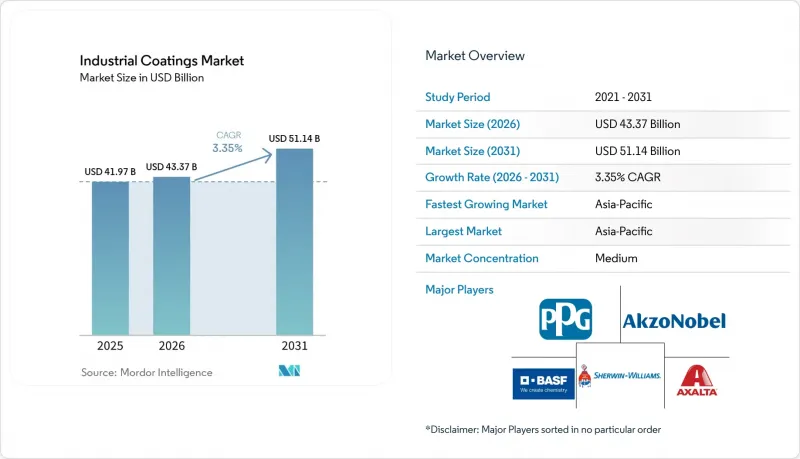
根據 Mordor Intelligence 預測,工業塗料市場規模將從 2025 年的 419.7 億美元成長到 2026 年的 433.7 億美元,然後在 2031 年達到 511.4 億美元,2026 年至 2031 年的複合年成長率為 3.35%。
本報告按樹脂類型(環氧樹脂、聚氨酯、丙烯酸樹脂、聚酯樹脂及其他樹脂)、技術(溶劑型、水性、粉末塗料等)、最終用途行業(通用工業塗料和防護塗料)、基材(金屬和混凝土)以及地區(亞太地區、北美地區、歐洲地區、南美地區、中東和非洲地區)進行細分。市場預測以美元計價。
全球工業塗料市場趨勢與洞察
對老舊油氣資產防護塗層的需求正在激增。
由於維修延誤,北海和墨西哥灣約40%的近海平台運作超過其初始耐腐蝕使用壽命,導致大規模重新塗裝工程。殼牌公司計劃在2025年投資12億美元,用於維修英國的15個平台,採用層級構造玻璃鱗片環氧塗層,將維護週期延長至25年。道達爾能源公司已撥款8億美元用於西非海底管線,這些管線正遭受硫化氫和氯化物的腐蝕。在中東的石化聯合企業中,儲存槽正在塗覆高厚度聚氨酯內襯,以滿足修訂後的API 653完整性要求。數十億美元的訂單正在推動工業塗料市場穩步成長,因為資產所有者優先考慮的是生命週期經濟效益,而不是降低初始成本。由於基礎設施建設屬於資本密集型,且安全至關重要,因此規範變更正在謹慎進行,以確保供應商未來十年的收入前景。
亞太地區的快速工業擴張正在推動對通用工業塗料的需求。
中國2025年1,400億美元的基礎設施獎勵策略已為長江流域的高速鐵路、地鐵擴建和大型鋼橋建設提供資金,所有這些項目都需要多層環氧樹脂或聚氨酯塗層保護。印度的生產連結獎勵計畫計畫已吸引220億美元的新工廠投資,光是在古吉拉突邦和泰米爾納德邦,自動化噴漆室的油漆消耗量就估計達到18萬噸。越南作為製造地轉移目的地正受到關注,該國配備潔淨室的電子工廠指定使用符合IEC 61340標準的防靜電環氧樹脂地板材料。在印度尼西亞,鎳冶煉廠的蓬勃發展催生了對能夠承受600 度C高溫爐環境的矽薄膜的需求。總而言之,該地區每單位製造業增加價值的油漆消耗量高於其他任何地區,這展現了其結構性優勢,並將推動工業塗料市場在整個預測期內持續成長。
加強對溶劑型體系中揮發性有機化合物(VOC)和全氟烷基物質(PFAS)的監管
歐盟擬議的法規要求逐步淘汰化學反應器和半導體製造設備中使用的含氟聚合物薄膜中的全氟烷基和多氟烷基物質,迫使化合物生產商轉向使用較不成熟的矽氧烷和陶瓷基化合物。加州已將其250克/公升的VOC限值擴展至工業維護領域,迫使速乾醇酸樹脂要麼進行成本高昂的化合物改良,要麼退出市場。為因應這些法規,研發和工廠設備升級成本將增加每公升0.30至0.50美元,給不具備全球規模的中型供應商帶來壓力。中國環境部已表示計劃在2027年前使VOC法規與歐盟標準接軌,可能導致中國四分之一的溶劑產能被淘汰。總而言之,這些法規將加速低排放化學品的採用,但同時也會在過渡期內抑制工業塗料市場的整體成長。
細分市場分析
環氧樹脂雖然在高速成長的細分市場中市佔率略有下降,但到2025年仍將佔工業塗料市場規模的30.85%。這主要得益於其在造船、管道和重型結構等領域的應用,這些領域需要對噴砂鋼材具有強烈附著力。丙烯酸乳液在翻新和輕工業領域的佔有率逐漸增加,因為即使直接從桶中取出使用,它們也符合加州250克/公升的VOC(揮發性有機化合物)限值。聚酯樹脂(主要以粉末形式存在)仍然是家用電器機殼和辦公家具的重要材料,目前在歐洲已獲得零排放積分。環氧底漆和聚氨酯面漆的混合配方因其優異的附著力和耐候光澤度而持續成長。 2026年至2031年,聚氨酯的需求量將以5.08%的複合年成長率成長。這是因為航太、風力發電機和高耐久性基礎設施的所有者指定使用雙組分塗料,因為它們具有優異的抗彎曲裂紋性和抗紫外線性能。
供應商正在提高蓖麻油和棕櫚仁多元醇的含量,以提高可再生碳的比例,同時保持機械穩定性。同時,由於即將實施的 PFAS 禁令以及客戶的猶豫不決,導致專案檢驗緩慢,含氟聚合物的出貨量保持穩定。乙烯基酯、醇酸樹脂和酚醛樹脂基化學物質仍僅限於一些小眾的防腐蝕和快乾應用。整體而言,樹脂的多樣化正在緩解原物料價格波動的影響,並有助於擴大目標工業塗料市場,同時又不影響環氧樹脂的可靠性。
儘管溶劑型塗料產品在2025年仍佔銷售額的36.91%,但其成長趨勢正在放緩,因為水性塗料產品已展現出其在防護塗料配方中能夠承受飛濺區浸泡和高達120 度C的溫度循環的能力。粉末塗料在車輪、散熱器、貨架和小曳引機等領域迅速成長,這得益於其97-99%的轉移效率以及有害空氣污染物許可程序的淘汰。由於LED陣列的普及降低了熱負荷和燈管更換頻率,紫外線固化產品線已從利基市場走向主流市場。這些變化共同推動工業塗料市場在維持產量的同時,實現更低的排放、更短的固化時間和更低的能耗。預計到2031年,水性塗料市場將以4.91%的年均成長率成長,因為北美和歐洲的工廠已根據新的VOC法規,從溶劑型醇酸樹脂轉向丙烯酸分散體。
供應商正將數位配色和近紅外線固化添加劑融入其產品線,使代工塗裝商能夠以更少的塗層實現精準的色彩還原。電塗裝仍然是汽車車體的主流技術,但新一代陽離子電電塗裝浴液現在採用生物基助溶劑和無氟界面活性劑。熱噴塗金屬塗料和高固態酚醛環氧樹脂在細分市場中保持強勁的地位,單次噴塗即可形成200μm厚的塗層,從而抵消海外維護成本。隨著監管力道的加大,技術格局將持續向水性塗料和粉末塗料轉變,進一步推動工業塗料市場的永續性。
區域分析
預計到2025年,亞太地區將以51.16%的市場佔有率主導工業塗料市場,並繼續維持4.35%的複合年成長率,這主要得益於中國、印度、越南和印尼在交通運輸、能源和製造業領域的結構性支出。中國雄心勃勃的「2025獎勵策略」正在為大型高速鐵路和長江新橋建設提供資金,這些計畫預計每年將消耗大量的環氧樹脂和聚氨酯。同時,在獎勵政策的推動下,印度的外國直接投資(FDI)舉措正在加速古吉拉突邦和泰米爾納德邦水性塗料生產線的部署。這項進展顯著縮短了汽車車身和消費性電子產品的生產週期,並減少了相關的排放。
在北美和歐洲,由於庫存水準成熟和嚴格的環境法規,成長依然溫和。在美國,工業維護膜揮發性有機化合物(VOC)限量的製定,促使丙烯酸乳化的研發投入增加,並帶動了溶劑蒸氣回收設備投資的需求成長。 2025年,德國引進了紫外線LED塗層生產線,為BMW和福斯汽車的工廠帶來了節能效益。然而,歐盟擬議的PFAS禁令為高性能含氟聚合物產業帶來了不確定性,導致一些化學加工製程的採用有所延遲。
亞洲以外,南美洲、中東和非洲等新興地區蘊藏最大的成長機會。在巴西,高速公路路面翻新工程已開始競標,這些工程將採用適應該國濕潤熱帶氣候的丙烯酸密封劑和聚氨酯面漆。在沙烏地阿拉伯,一項水資源計畫中指定在混凝土水庫中使用環氧改質水泥襯裡,以解決氯化物負荷問題。南非公司舉措已撥款用於沿海鐵路資產的維修,所使用環氧樹脂符合ISO 12944 C5-M標準。同時,奈及利亞丹戈特煉油廠在2024年至2025年的工廠試運行期間使用了保護膜。這些措施不僅使收入來源多元化,還能保護工業塗料市場免受區域性衝擊的影響。
其他好處:
- Excel格式的市場預測(ME)表
- 3個月的分析師支持
目錄
第1章:引言
- 研究假設和市場定義
- 調查範圍
第2章:調查方法
第3章執行摘要
第4章 市場狀況
- 市場概覽
- 市場促進因素
- 對老舊油氣資產防護塗層的需求激增
- 亞太地區的快速工業擴張正在推動對一般工業領域的出口。
- 環保法規正在加速水性塗料和粉末塗料的普及應用。
- OEM廠商推出的UV-LED瞬幹生產線
- 基於數據驅動的預測性維護塗層,內建感測器
- 市場限制因素
- 加強溶劑型產品的VOC和PFAS法規
- 二氧化鈦和環氧樹脂的價格波動
- 全球金屬塗料用細粉狀鋁顏料供不應求
- 價值鏈分析
- 監理展望
- 波特五力模型
第5章 市場規模與成長預測
- 依樹脂類型
- 環氧樹脂
- 聚氨酯
- 丙烯酸纖維
- 聚酯纖維
- 其他樹脂(醇酸樹脂、氟樹脂、乙烯基酯樹脂)
- 透過技術
- 溶劑型
- 水溶液
- 粉末
- 紫外線技術
- 按最終用途行業分類
- 一般工業
- 保護塗層
- 石油和天然氣
- 礦業
- 電力
- 基礎設施
- 其他保護塗層
- 按基礎材料
- 金屬
- 具體的
- 按地區
- 亞太地區
- 中國
- 印度
- 日本
- 韓國
- ASEAN
- 澳洲
- 紐西蘭
- 其他亞太國家
- 北美洲
- 美國
- 加拿大
- 墨西哥
- 歐洲
- 德國
- 英國
- 法國
- 義大利
- 俄羅斯
- 北歐的
- 其他歐洲國家
- 南美洲
- 巴西
- 阿根廷
- 智利
- 其他南美國家
- 中東和非洲
- 沙烏地阿拉伯
- 阿拉伯聯合大公國
- 土耳其
- 南非
- 奈及利亞
- 其他中東和非洲國家
- 亞太地區
第6章 競爭情勢
- 市場集中度
- 策略性舉措(併購、合資、產能擴張)
- 市佔率分析
- 公司簡介
- 3M
- AkzoNobel NV
- Arkema
- Asian Paints
- Axalta Coating Systems
- BASF
- Beckers Group
- Chugoku Marine Paints Ltd.
- Daikin Industries Ltd.
- Hempel A/S
- Henkel AG & Co. KGaA
- Jotun
- Kansai Paint Co., Ltd.
- Nippon Paint Holdings Co., Ltd.
- OC Oerlikon Management AG
- PPG Industries, Inc.
- RPM International Inc.
- Rust-Oleum Corporation
- Sika AG
- The Sherwin-Williams Company
- Tikkurila
- Wacker Chemie AG
第7章 市場機會與未來展望
According to Mordor Intelligence, the industrial coatings market size is expected to grow from USD 41.97 billion in 2025 to USD 43.37 billion in 2026 and is forecast to reach USD 51.14 billion by 2031 at a 3.35% CAGR over 2026-2031.
This report is Segmented by Resin Type (Epoxy, Polyurethane, Acrylic, Polyester, and Other Resins), Technology (Solvent-Borne, Water-Borne, Powder, and More), End-Use Industry (General Industrial and Protective Coatings), Substrate (Metal and Concrete), and Geography (Asia-Pacific, North America, Europe, South America, and Middle East and Africa). Market Forecasts are Provided in Terms of Value (USD).
Global Industrial Coatings Market Trends and Insights
Surge in Protective-Coatings Demand for Aging Oil and Gas Assets
Deferred upkeep left roughly 40% of offshore platforms in the North Sea and Gulf of Mexico running past their original corrosion-protection lifespans, triggering large-scale recoating programs. Shell dedicated USD 1.2 billion in 2025 to upgrade 15 U.K. platforms with three-coat glass-flake epoxies that stretch service intervals to 25 years. TotalEnergies allocated USD 800 million for West African subsea pipelines exposed to hydrogen sulfide and chloride attack. Middle-East petrochemical complexes are simultaneously lining storage tanks with high-build polyurethane to satisfy updated API 653 integrity provisions. This multi-billion-dollar backlog keeps the industrial coatings market on a stable upward track as asset owners now prioritize lifecycle economics over first-cost savings. Because the underlying infrastructure is capital-intensive and safety-critical, specification shifts are deliberate, extending revenue visibility for suppliers through the next decade.
Rapid APAC Industrial Expansion Fueling General-Industrial Volumes
China's 2025 infrastructure stimulus of USD 140 billion funded high-speed rail, metro extensions, and large steel bridges across the Yangtze basin, each requiring multi-layer epoxy or polyurethane defenses. India's production-linked incentive program secured USD 22 billion in fresh factory spending, with automated spray booths in Gujarat and Tamil Nadu alone consuming an estimated 180,000 metric tons of coatings. Vietnam has become a manufacturing relocation hotspot, where cleanroom electronics plants specify anti-static epoxy floors tested to IEC 61340. Indonesia's nickel-smelter boom demands silicone films able to resist 600°C furnace conditions. Taken together, the region applies more kilograms of coating per USD of manufacturing value added than any other geography, illustrating a structural edge that lifts the industrial coatings market throughout the forecast horizon.
Tightening VOC and PFAS Regulations on Solvent-Borne Systems
A draft European Union restriction seeks to phase out per- and polyfluoroalkyl substances in fluoropolymer films used in chemical reactors and semiconductor tools, pushing formulators toward less proven siloxane or ceramic routes. California extended its 250 g/L VOC ceiling to industrial maintenance categories, forcing fast-dry alkyds either into costly reformulations or retirement. Compliance adds USD 0.30-0.50 per liter in R&D and plant retooling, squeezing mid-tier suppliers without global scale. China's environment ministry signaled a plan to harmonize VOC limits with EU norms by 2027, potentially sidelining one-quarter of domestic solvent capacity. Collectively, these curbs temper overall industrial coatings market growth during the transition, even as they accelerate uptake of low-emission chemistries.
Other drivers and restraints analyzed in the detailed report include:
- Environmental Mandates Accelerating Water-Borne and Powder Uptake
- UV-LED Instant-Cure Lines Adopted by OEM Factories
- Titanium-Dioxide and Epoxy-Resin Price Volatility
For complete list of drivers and restraints, kindly check the Table Of Contents.
Segment Analysis
Epoxy, despite sliding marginally in high-growth niches, still accounted for 30.85% of the industrial coatings market size in 2025, supported by marine, pipeline, and heavy-duty structural jobs that require tenacious adhesion on blasted steel. Acrylic emulsions built incremental share in refinish and light-industrial tasks because they comply with California's 250 g/L VOC ceiling straight from the drum. Polyester resins, largely in powder form, stayed essential to appliance shells and office furniture, a segment now capturing zero-emission credits in Europe. Hybrid formulations blending epoxy primers with polyurethane topcoats continue to rise because they marry bond strength with weather-fast gloss. Polyurethane demand climbed at a 5.08% CAGR between 2026 and 2031 as aerospace, wind-turbine, and high-durability infrastructure owners specified two-component films for their superior flex-crack resistance and UV holdout.
Suppliers are widening castor oil or palm kernel polyol content to raise renewable carbon share while maintaining mechanical stability. Fluoropolymer volumes flattened as pending PFAS bans and customer hesitancy slowed project validation. Vinyl ester, alkyd, and novolac chemistries remained confined to niche corrosion or fast-drying roles. Altogether, resin diversification both cushions raw-material shocks and broadens the addressable industrial coatings market without sacrificing core epoxy reliability.
Solvent-borne products captured 36.91% of 2025 revenue; their trajectory tilts down as protective-coatings formulations prove water-borne options can now survive splash-zone immersion and 120°C cycling. Powder coatings grew briskly in wheels, radiators, shelving, and small tractors, buoyed by 97-99% transfer efficiency and elimination of hazardous-air-pollutant permitting. Ultraviolet-curable lines progressed from boutique to mainstream once LED arrays reduced heat load and lamp changeouts. Collectively, these shifts push the industrial coatings market toward lower emissions, shorter cure times, and reduced energy footprints while preserving throughput. Water-borne chemistries advanced 4.91% annually through 2031, lifted by North American and European plant upgrades that swapped solvent alkyds for acrylic dispersions under new VOC laws.
Suppliers are layering digital color-match and near-infrared cure additives into their offerings, letting job shops hit exact shades with fewer coats. Electro-deposition remains dominant for automotive bodies, yet next-gen cationic baths now include bio-based co-solvents and F-free surfactants. Thermal-spray metalizing and high-solid novolac epoxies keep niche footholds where 200-μm films in one pass pay for themselves in offshore upkeep costs. As regulatory scrutiny heightens, the technology mix will continue to tip toward water and powder, reinforcing sustainability narratives that echo across the broader industrial coatings market.
Complete Report Scope:
- By Resin Type
- Epoxy
- Polyurethane
- Acrylic
- Polyester
- Other Resins (Alkyd, Fluoropolymer, and Vinyl Ester)
- By Technology
- Solvent-borne
- Water-borne
- Powder
- UV Technology
- By End-use Industry
- General Industrial
- Protective Coatings
- Oil and Gas
- Mining
- Power
- Infrastructure
- Other Protective Coatings
- By Substrate
- Metal
- Concrete
- By Geography
- Asia-Pacific
- China
- India
- Japan
- South Korea
- ASEAN
- Australia
- New Zealand
- Rest of Asia-Pacific
- North America
- United States
- Canada
- Mexico
- Europe
- Germany
- United Kingdom
- France
- Italy
- Russia
- Nordics
- Rest of Europe
- South America
- Brazil
- Argentina
- Chile
- Rest of South America
- Middle East and Africa
- Saudi Arabia
- United Arab Emirates
- Turkey
- South Africa
- Nigeria
- Rest of Middle-East and Africa
- Asia-Pacific
Geography Analysis
Asia-Pacific dominated the industrial coatings market in 2025 with a 51.16% share and is set to pace forward at a 4.35% CAGR as China, India, Vietnam, and Indonesia underpin structural spending on transport, energy, and manufacturing. China's ambitious 2025 stimulus is channeling funds into high-speed rail spines and new bridges over the Yangtze. These projects are projected to consume significant amounts of epoxy and polyurethane annually. Meanwhile, India's foreign direct investment (FDI) initiative, bolstered by an incentive program, has accelerated the installation of water-borne lines in Gujarat and Tamil Nadu. This advancement has notably reduced both the cycle time and emissions associated with automotive shells and consumer appliances.
In North America and Europe, growth was modest, constrained by mature stock levels and stringent environmental regulations. The U.S. set a VOC limit for industrial maintenance films, leading to increased investments in acrylic-emulsion R&D and heightened capital needs for solvent vapor recovery. In 2025, Germany introduced UV-LED paint lines, achieving energy savings at BMW and Volkswagen facilities. However, the EU's proposal to ban PFAS has cast a shadow of uncertainty over high-performance fluoropolymer sectors, causing delays in some chemical processing rollouts.
Outside of Asia, emerging regions in South America, the Middle East, and Africa present the most significant growth opportunities. Brazil has initiated a tender for highway resurfacing, utilizing acrylic sealers and polyurethane tops tailored for the country's humid tropical cycles. In Saudi Arabia, a water initiative has specified epoxy-modified cementitious linings for concrete reservoirs, addressing chloride loads. South Africa's Transnet has allocated funds for refurbishing coastal rail assets, employing ISO 12944 C5-M epoxies. Concurrently, Nigeria's Dangote refinery utilized protective films during its 2024-25 plant commissioning. Collectively, these endeavors not only diversify revenue streams but also shield the industrial coatings market from regional disruptions.
- 3M
- AkzoNobel N.V.
- Arkema
- Asian Paints
- Axalta Coating Systems
- BASF
- Beckers Group
- Chugoku Marine Paints Ltd.
- Daikin Industries Ltd.
- Hempel A/S
- Henkel AG & Co. KGaA
- Jotun
- Kansai Paint Co., Ltd.
- Nippon Paint Holdings Co., Ltd.
- OC Oerlikon Management AG
- PPG Industries, Inc.
- RPM International Inc.
- Rust-Oleum Corporation
- Sika AG
- The Sherwin-Williams Company
- Tikkurila
- Wacker Chemie AG
Additional Benefits:
- The market estimate (ME) sheet in Excel format
- 3 months of analyst support
TABLE OF CONTENTS
1 Introduction
- 1.1 Study Assumptions & Market Definition
- 1.2 Scope of the Study
2 Research Methodology
3 Executive Summary
4 Market Landscape
- 4.1 Market Overview
- 4.2 Market Drivers
- 4.2.1 Surge in protective-coatings demand for aging oil and gas assets
- 4.2.2 Rapid APAC industrial expansion fueling general-industrial volumes
- 4.2.3 Environmental mandates accelerating water-borne and powder uptake
- 4.2.4 UV-LED instant-cure lines adopted by OEM factories
- 4.2.5 Data-driven predictive-maintenance coatings with embedded sensors
- 4.3 Market Restraints
- 4.3.1 Tightening VOC + PFAS regulations on solvent-borne systems
- 4.3.2 Titanium-dioxide and epoxy-resin price volatility
- 4.3.3 Global shortage of micronized-aluminum pigments for metallic finishes
- 4.4 Value Chain Analysis
- 4.5 Regulatory Outlook
- 4.6 Porter's Five Forces
- 4.6.1 Bargaining Power of Suppliers
- 4.6.2 Bargaining Power of Buyers
- 4.6.3 Threat of New Entrants
- 4.6.4 Threat of Substitutes
- 4.6.5 Degree of Competition
5 Market Size & Growth Forecasts (Value)
- 5.1 By Resin Type
- 5.1.1 Epoxy
- 5.1.2 Polyurethane
- 5.1.3 Acrylic
- 5.1.4 Polyester
- 5.1.5 Other Resins (Alkyd, Fluoropolymer, and Vinyl Ester)
- 5.2 By Technology
- 5.2.1 Solvent-borne
- 5.2.2 Water-borne
- 5.2.3 Powder
- 5.2.4 UV Technology
- 5.3 By End-use Industry
- 5.3.1 General Industrial
- 5.3.2 Protective Coatings
- 5.3.2.1 Oil and Gas
- 5.3.2.2 Mining
- 5.3.2.3 Power
- 5.3.2.4 Infrastructure
- 5.3.2.5 Other Protective Coatings
- 5.4 By Substrate
- 5.4.1 Metal
- 5.4.2 Concrete
- 5.5 By Geography
- 5.5.1 Asia-Pacific
- 5.5.1.1 China
- 5.5.1.2 India
- 5.5.1.3 Japan
- 5.5.1.4 South Korea
- 5.5.1.5 ASEAN
- 5.5.1.6 Australia
- 5.5.1.7 New Zealand
- 5.5.1.8 Rest of Asia-Pacific
- 5.5.2 North America
- 5.5.2.1 United States
- 5.5.2.2 Canada
- 5.5.2.3 Mexico
- 5.5.3 Europe
- 5.5.3.1 Germany
- 5.5.3.2 United Kingdom
- 5.5.3.3 France
- 5.5.3.4 Italy
- 5.5.3.5 Russia
- 5.5.3.6 Nordics
- 5.5.3.7 Rest of Europe
- 5.5.4 South America
- 5.5.4.1 Brazil
- 5.5.4.2 Argentina
- 5.5.4.3 Chile
- 5.5.4.4 Rest of South America
- 5.5.5 Middle East and Africa
- 5.5.5.1 Saudi Arabia
- 5.5.5.2 United Arab Emirates
- 5.5.5.3 Turkey
- 5.5.5.4 South Africa
- 5.5.5.5 Nigeria
- 5.5.5.6 Rest of Middle-East and Africa
- 5.5.1 Asia-Pacific
6 Competitive Landscape
- 6.1 Market Concentration
- 6.2 Strategic Moves (M&A, JVs, Capacity Expansions)
- 6.3 Market Share Analysis
- 6.4 Company Profiles {(includes Global level Overview, Market level overview, Core Segments, Financials as available, Strategic Information, Market Rank/Share for key companies, Products & Services, and Recent Developments)}
- 6.4.1 3M
- 6.4.2 AkzoNobel N.V.
- 6.4.3 Arkema
- 6.4.4 Asian Paints
- 6.4.5 Axalta Coating Systems
- 6.4.6 BASF
- 6.4.7 Beckers Group
- 6.4.8 Chugoku Marine Paints Ltd.
- 6.4.9 Daikin Industries Ltd.
- 6.4.10 Hempel A/S
- 6.4.11 Henkel AG & Co. KGaA
- 6.4.12 Jotun
- 6.4.13 Kansai Paint Co., Ltd.
- 6.4.14 Nippon Paint Holdings Co., Ltd.
- 6.4.15 OC Oerlikon Management AG
- 6.4.16 PPG Industries, Inc.
- 6.4.17 RPM International Inc.
- 6.4.18 Rust-Oleum Corporation
- 6.4.19 Sika AG
- 6.4.20 The Sherwin-Williams Company
- 6.4.21 Tikkurila
- 6.4.22 Wacker Chemie AG
7 Market Opportunities & Future Outlook
- 7.1 Technological Advancements in Coating Formulations
- 7.2 White-space & Unmet-need Assessment

 水性工業防腐蝕塗料市場-全球預測(2026-2032年)
 2026年全球工業塗料市場報告
 印度工業塗料市場:市場佔有率分析、產業趨勢與統計及成長預測(2026-2031)
 全球工業塗料市場:依功能、樹脂類型、技術、終端應用產業及地區分類-預測至2031年工業塗料市場-2026-2032年全球市場預測德國工業塗料:市場佔有率分析、產業趨勢與統計及成長預測(2026-2031)
 全球工業塗料市場規模、佔有率、趨勢和成長分析報告(2026-2034年)
 工業塗料市場-全球產業規模、佔有率、趨勢、機會和預測:按產品、技術、最終用途、地區和競爭格局分類,2021-2031年
 工業塗料市場:按產品、技術、最終用戶和地區分類(2026-2034 年)工業色素市場按應用、顏料類型、顏色和形態分類-全球預測,2026-2032年