


 |
市場調查報告書
商品編碼
2100509
德國工業塗料:市場佔有率分析、產業趨勢與統計及成長預測(2026-2031)Germany Industrial Coatings - Market Share Analysis, Industry Trends & Statistics, Growth Forecasts (2026 - 2031) |
||||||

※ 本網頁內容可能與最新版本有所差異。詳細情況請與我們聯繫。
據 Mordor Intelligence 稱,2025 年德國工業塗料市場價值 10.9 億美元,預計到 2031 年將從 2026 年的 11.3 億美元成長到 13.2 億美元,預測期(2026-2031 年)複合年成長率為 3.22%。
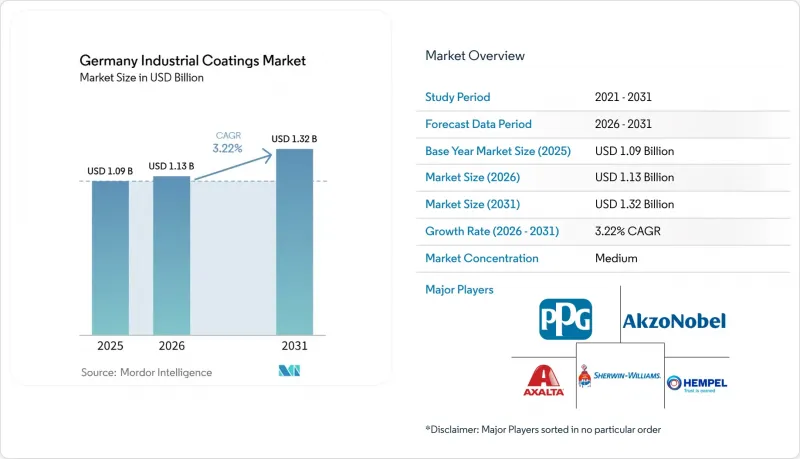
本報告按樹脂類型(環氧樹脂、聚氨酯、丙烯酸樹脂、聚酯樹脂及其他樹脂)、技術(水性、溶劑型、粉末塗料及其他技術)和終端用戶行業(一般工業、防護塗料)進行細分。市場預測以美元計價。
德國工業塗料市場趨勢與洞察
德國製造業對防腐蝕的需求日益成長
由於設備老化和資本投資延遲,德國製造商被迫延長資產使用壽命,導致意外運作成本增加。與傳統塗料相比,專用環氧-聚氨酯混合塗料可將設備壽命延長40-60%,幫助該行業解決估計高達4000億歐元的未處理維護成本。光是化學製造商就佔歐盟產量的四分之一,他們需要能夠承受腐蝕性化學物質侵蝕並符合ISO 12944標準的高膜厚防護系統。因此,保護關鍵機械的需求正在推動德國工業塗料市場實現結構性成長,而非週期性成長。
可再生能源基礎設施塗料的發展勢頭
德國承諾在2030年實現80%的電力來自可再生能源,這一目標正在加速推動對能夠承受離岸風力發電嚴苛環境且使用壽命超過25年的塗料的需求。塗料劣化佔渦輪機維護預算的20%之多,促使操作員指定使用高鋅底漆和具有卓越陰極剝離強度的氟聚合物面漆。太陽能發電廠是另一大驅動力,因為防污和抗紫外線塗層能夠確保70吉瓦裝置容量的太陽能組件持續高效運作。這些需求正在支撐德國工業塗料市場的長期成長。
VOC 和 REACH 法規對化學品實施嚴格的監管。
根據REACH法規,超過2000種物質的使用受到限制,導致每種化學品的研發成本超過100萬歐元,產品核可週期長達四年。大約40%的德國塗料廠需要維修其生產線以符合2024年VOC(揮發性有機化合物)法規標準,預計每個工廠的資本投資將達到200萬至500萬歐元。鉻酸鹽底漆的逐步淘汰給航太和船舶等細分市場帶來了壓力,並降低了德國工業塗料市場的短期銷售量和利潤率潛力。
細分市場分析
預計到2025年,環氧樹脂將佔德國工業塗料市場26.78%的銷售額,這反映了其憑藉強黏合性和成本效益,在保護重型鋼結構方面具有極高的可靠性。因此,環氧樹脂將繼續佔據德國工業塗料市場最大的佔有率。然而,聚氨酯憑藉其柔軟性和耐化學性(在風力發電機葉片和氫氣管道等應用中備受青睞),預計將超越整個行業的成長率,到2031年將保持3.84%的複合年成長率。
在工廠環境和儲槽內襯等領域,環氧樹脂的需求仍然強勁,因為這些應用對抗壓強度和耐化學性要求極高。然而,創新正轉向生物基多元醇,聚氨酯塗料系統也正朝著符合德國循環經濟目標的方向發展。科思創在永續原物料領域投資15億歐元(17.2億美元),顯示研發預算的策略性重新分配可能會在預測期內削弱環氧樹脂的主導地位。
其他好處:
- Excel格式的市場預測(ME)表
- 3個月的分析師支持
目錄
第1章:引言
- 研究假設和市場定義
- 調查範圍
第2章:調查方法
第3章執行摘要
第4章 市場狀況
- 市場概覽
- 市場促進因素
- 德國製造業對防腐蝕的需求日益成長
- 可再生能源基礎設施塗料市場的發展勢頭強勁。
- VOC法規下水性塗料和粉末塗料技術的推廣
- 引入數位配色/現場配色系統
- 氫經濟先導計畫,需要使用與氫氣相容的內襯。
- 市場限制因素
- 關於揮發性有機化合物和REACH法規的嚴格化學品管理規定。
- 原料價格波動(環氧樹脂、溶劑、能源)
- 精密塗層應用領域技術純熟勞工短缺
- 價值鏈分析
- 波特五力模型
第5章 市場規模與成長預測
- 依樹脂類型
- 環氧樹脂
- 聚氨酯
- 丙烯酸纖維
- 聚酯纖維
- 其他樹脂(醇酸樹脂、氟樹脂)
- 透過技術
- 水溶液
- 溶劑型
- 粉末塗裝
- 其他技術(UV/EB固化型和高固態含量型)
- 按最終用戶行業分類
- 一般工業
- 保護塗層
- 石油和天然氣
- 發電
- 基礎設施
- 礦業
- 其他保護塗層
第6章 競爭情勢
- 市場集中度
- 策略趨勢
- 市佔率和排名分析
- 公司簡介
- Akzo Nobel NV
- Axalta Coating Systems
- Beckers Group
- Berger-Seidle GmbH
- DAW SE(Caparol Industrial)
- Hempel A/S
- Hesse Lignal GmbH
- Jotun
- KANSAI HELIOS
- MIPA SE
- PPG Industries Inc.
- RPM International Inc.
- Teknos Deutschland GmbH
- The Sherwin-Williams Company
第7章 市場機會與未來展望
According to Mordor Intelligence, the Germany industrial coatings market size was valued at USD 1.09 billion in 2025 and is estimated to grow from USD 1.13 billion in 2026 to reach USD 1.32 billion by 2031, at a CAGR of 3.22% during the forecast period (2026-2031).
This report is Segmented by Resin Type (Epoxy, Polyurethane, Acrylic, Polyester, Other Resins), Technology (Water-Borne, Solvent-Borne, Powder Coatings, Other Technologies), and End-User Industry (General Industrial, Protective Coatings). The Market Forecasts are Provided in Terms of Value (USD).
Germany Industrial Coatings Market Trends and Insights
Growing Demand for Corrosion-Protection in German Manufacturing
Aging plants and deferred capital expenditures force German manufacturers to extend asset lifecycles, increasing the cost of unplanned downtime. Specialized epoxy-polyurethane hybrids extend equipment life by 40-60% compared with traditional coatings, helping industry address an estimated EUR 400 billion maintenance backlog. Chemical producers alone-responsible for one-quarter of EU output-require high-build protective systems that meet ISO 12944 standards in the face of aggressive chemical exposure. The push to safeguard critical machinery is thus a structural, not cyclical, growth engine for the German industrial coatings market.
Momentum in Renewable-Energy Infrastructure Coatings
Germany's pledge to achieve 80% renewable electricity by 2030 accelerates demand for coatings that can withstand harsh offshore wind environments for 25 years or more. Coating failures account for up to 20% of turbine maintenance budgets, motivating operators to specify zinc-rich primers and fluoropolymer topcoats with superior cathodic-disbondment resistance. Solar farms add further pull-through, as anti-soiling and UV-stable layers ensure sustained module efficiency across 70 GW of installed capacity. These needs underpin long-term growth for the German industrial coatings market.
Stringent VOC and REACH Chemical Restrictions
More than 2,000 substances face usage restrictions under REACH, resulting in research and development costs exceeding EUR 1 million per chemical and extending product approval cycles to four years. Around 40% of German coating plants must retrofit lines to hit 2024 VOC thresholds at capital outlays of EUR 0.5-2 million per site. The phase-out of chromate-based primers squeezes the aerospace and marine niches, trimming near-term volume and margin potential for the German industrial coatings market.
Other drivers and restraints analyzed in the detailed report include:
- Expansion of Water-borne and Powder Tech Under VOC Rules
- Adoption of Digital Color-Matching/On-Site Mixing Systems
- Raw-Material Price Volatility (Epoxy, Solvents, Energy)
For complete list of drivers and restraints, kindly check the Table Of Contents.
Segment Analysis
Epoxy resins accounted for 26.78% of 2025 revenue, reflecting their dependable adhesion and cost efficiency in heavy-duty steel protection. They thus remain the largest slice of the German industrial coatings market. Polyurethane's 3.84% CAGR through 2031, however, outpaces overall sector growth by leveraging flexibility and chemical resilience prized in wind-turbine blades and hydrogen pipelines.
Epoxy demand endures on factory floors and tank linings, where compressive strength and chemical resistance are most critical. Yet, innovation is tilting toward bio-based polyols, aligning polyurethane systems with Germany's circular economy targets. Covestro's EUR 1.5 billion, or USD 1.72 billion, spend on sustainable raw materials exemplifies how strategic research and development reallocations could erode epoxy's dominance over the forecast horizon.
Complete Report Scope:
- By Resin Type
- Epoxy
- Polyurethane
- Acrylic
- Polyester
- Other Resins (Alkyd, Fluoropolymer)
- By Technology
- Water-borne
- Solvent-borne
- Powder Coatings
- Other Technologies (UV-/EB-Cured and High Solids)
- By End-user Industry
- General Industrial
- Protective Coatings
- Oil and Gas
- Power Generation
- Infrastructure
- Mining
- Other Protective Coatings
List of Companies Covered in this Report:
- Akzo Nobel N.V.
- Axalta Coating Systems
- Beckers Group
- Berger-Seidle GmbH
- DAW SE (Caparol Industrial)
- Hempel A/S
- Hesse Lignal GmbH
- Jotun
- KANSAI HELIOS
- MIPA SE
- PPG Industries Inc.
- RPM International Inc.
- Teknos Deutschland GmbH
- The Sherwin-Williams Company
Additional Benefits:
- The market estimate (ME) sheet in Excel format
- 3 months of analyst support
TABLE OF CONTENTS
1 Introduction
- 1.1 Study Assumptions and Market Definition
- 1.2 Scope of the Study
2 Research Methodology
3 Executive Summary
4 Market Landscape
- 4.1 Market Overview
- 4.2 Market Drivers
- 4.2.1 Growing demand for corrosion-protection in German manufacturing
- 4.2.2 Momentum in renewable-energy infrastructure coatings
- 4.2.3 Expansion of water-borne and powder tech under VOC rules
- 4.2.4 Adoption of digital colour-matching/on-site mixing systems
- 4.2.5 Hydrogen-economy pilot projects needing H2-compatible linings
- 4.3 Market Restraints
- 4.3.1 Stringent VOC and REACH chemical restrictions
- 4.3.2 Raw-material price volatility (epoxy, solvents, energy)
- 4.3.3 Skilled labour shortage in precision coating application
- 4.4 Value Chain Analysis
- 4.5 Porter's Five Forces
- 4.5.1 Bargaining Power of Suppliers
- 4.5.2 Bargaining Power of Buyers
- 4.5.3 Threat of New Entrants
- 4.5.4 Threat of Substitute Products
- 4.5.5 Degree of Competition
5 Market Size and Growth Forecasts (Value)
- 5.1 By Resin Type
- 5.1.1 Epoxy
- 5.1.2 Polyurethane
- 5.1.3 Acrylic
- 5.1.4 Polyester
- 5.1.5 Other Resins (Alkyd, Fluoropolymer)
- 5.2 By Technology
- 5.2.1 Water-borne
- 5.2.2 Solvent-borne
- 5.2.3 Powder Coatings
- 5.2.4 Other Technologies (UV-/EB-Cured and High Solids)
- 5.3 By End-user Industry
- 5.3.1 General Industrial
- 5.3.2 Protective Coatings
- 5.3.2.1 Oil and Gas
- 5.3.2.2 Power Generation
- 5.3.2.3 Infrastructure
- 5.3.2.4 Mining
- 5.3.2.5 Other Protective Coatings
6 Competitive Landscape
- 6.1 Market Concentration
- 6.2 Strategic Moves
- 6.3 Market Share/Ranking Analysis
- 6.4 Company Profiles (includes Global level Overview, Market level overview, Core Segments, Financials as available, Strategic Information, Market Rank/Share for key companies, Products and Services, and Recent Developments)
- 6.4.1 Akzo Nobel N.V.
- 6.4.2 Axalta Coating Systems
- 6.4.3 Beckers Group
- 6.4.4 Berger-Seidle GmbH
- 6.4.5 DAW SE (Caparol Industrial)
- 6.4.6 Hempel A/S
- 6.4.7 Hesse Lignal GmbH
- 6.4.8 Jotun
- 6.4.9 KANSAI HELIOS
- 6.4.10 MIPA SE
- 6.4.11 PPG Industries Inc.
- 6.4.12 RPM International Inc.
- 6.4.13 Teknos Deutschland GmbH
- 6.4.14 The Sherwin-Williams Company
7 Market Opportunities and Future Outlook
- 7.1 White-space and Unmet-need Assessment

 水性工業防腐蝕塗料市場-全球預測(2026-2032年)
 2026年全球工業塗料市場報告
 印度工業塗料市場:市場佔有率分析、產業趨勢與統計及成長預測(2026-2031)
 全球工業塗料市場:依功能、樹脂類型、技術、終端應用產業及地區分類-預測至2031年工業塗料市場-2026-2032年全球市場預測
 全球工業塗料市場規模、佔有率、趨勢和成長分析報告(2026-2034年)工業塗料:市場佔有率分析、產業趨勢與統計、成長預測(2026-2031)
 工業塗料市場-全球產業規模、佔有率、趨勢、機會和預測:按產品、技術、最終用途、地區和競爭格局分類,2021-2031年
 工業塗料市場:按產品、技術、最終用戶和地區分類(2026-2034 年)工業色素市場按應用、顏料類型、顏色和形態分類-全球預測,2026-2032年