


 |
市場調查報告書
商品編碼
2073663
行銷機構:市場佔有率分析、產業趨勢與統計、成長預測(2026-2031)Marketing Agencies Market - Market Share Analysis, Industry Trends & Statistics, Growth Forecasts (2026 - 2031) |
||||||

※ 本網頁內容可能與最新版本有所差異。詳細情況請與我們聯繫。
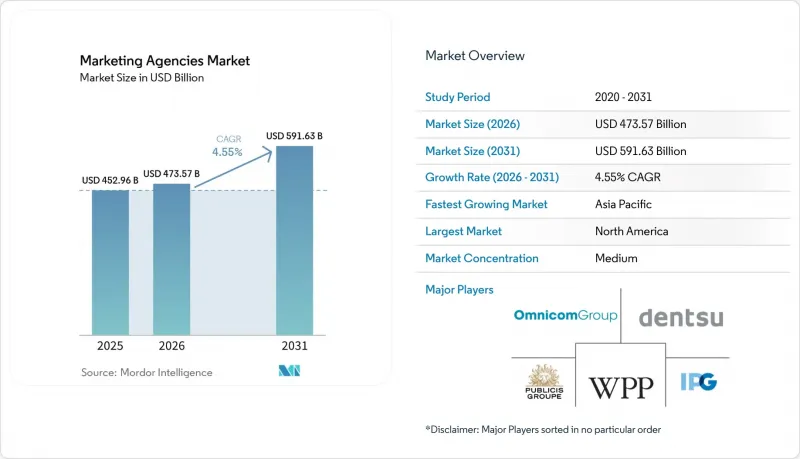
根據 Mordor Intelligence 估計,到 2026 年,行銷代理商市場價值將達到 4,735.7 億美元,高於 2025 年的 4,529.6 億美元,預計到 2031 年將達到 5,916.3 億美元。
預計從 2026 年到 2031 年,其複合年成長率將達到 4.55%。
本報告按服務類型(數位行銷服務、傳統行銷服務、全方位服務代理商)、應用領域(大型企業、中小企業)、最終用戶(金融、保險和證券 (BFSI)、IT 和電信、零售和消費品、公共服務、製造和物流)以及地區(北美及其他地區)進行細分。市場預測以美元 (USD) 為單位。
全球行銷機構市場趨勢與洞察
人工智慧驅動的宣傳活動最佳化
人工智慧 (AI) 正在透過即時演算法重新定義媒體策劃,動態調整跨通路的創新、廣告位和競標,從而最大化廣告支出回報率 (ROAS)。谷歌與 Smartly 的合作清晰地展現了這一轉變。該平台每週產生數十億個創新訊號,能夠自動選擇展示廣告、社群媒體廣告和視訊格式。採用類似系統的代理商報告稱,效率提升幅度達到兩位數,使負責人能夠專注於故事敘述和創新衡量方法。大規模語言模型的快速發展使得在幾分鐘內(而非幾天)創建文案、音訊和動態圖像成為可能。隨著控股集團紛紛建立內部 AI 工作室以避免依賴外部供應商,競爭日益激烈。中期來看,AI 驅動的工作流程與人工工作流程之間的績效差距預計將會擴大,迫使落後的公司進行投資,否則將面臨產品同質化的風險。
引進基於績效的收費系統
以績效為基礎的收費系統將代理商的收入與客戶的業務成果掛鉤,從按小時計費轉向與潛在客戶、增量銷售或品牌提升指標掛鉤的模式。品牌重視此類合約的透明度和課責,能夠證明其有效性的代理商續約率更高。然而,由於實際效果可能達不到預期,代理商面臨更大的財務風險,因此複雜的預測和歸因框架至關重要。電子商務、SaaS 和應用行銷等數據密集型行業正在以最快的速度向這種模式轉型,因為轉換事件的歸因相對容易。行銷分析師表示,基於績效的收費模式在網紅行銷、聯盟行銷和電視直效行銷 (DRT) 中已成為標準做法,並且正在滲透到主流品牌宣傳活動。雖然短期成長主要由北美廣告商推動,但歐洲的採購團隊也擴大試行將基本費用與利潤分成相結合的混合型預付費協議。
財富500強企業內部機構的擴張
目前,82% 的大型廣告主都設有某種形式的內部代理商,這一比例自 2015 年以來幾乎加倍。降低成本、加快反應速度以及接近性第一方數據是推動這項轉變的主要因素。外部合作夥伴擴大承接企劃為基礎和專業化的任務,而非全通路的長期合作契約,這使得傳統廣告公司的收入前景變得不明朗。為了訂單競爭力,控股集團正在客戶辦公室部署跨職能團隊,將策略監督與現場製作結合。在監管嚴格的行業中,混合模式蓬勃發展,外部專業知識能夠有效補充嚴格的合規要求。中期來看,內部團隊和外部團隊之間的界線將變得模糊,能夠靈活利用資源並同時維護品牌管治的廣告公司將更具優勢。
細分市場分析
預計到2025年,數位行銷服務將佔總收入的61.58%,凸顯了品牌對可衡量的全通路互動模式的偏好,這種模式能夠將支出與轉換事件連結起來。雖然這一主導地位構成了行銷機構市場規模的基礎,但全方位服務機構的成長速度最快,複合年成長率高達11.32%,因為客戶要求對其媒體、內容和商務工作流程進行統一管治。整合帶來的優勢在整合資料湖中顯而易見,這些資料湖能夠揭示跨管道歸因並實現全面最佳化。同時,在以印刷品為主的奢侈品產業,傳統行銷服務仍需求強勁,體驗式推廣、贊助諮詢和實體接點能夠提升高階品牌股權。隨著人工智慧驅動的全方位服務模式規模化,純數位行銷機構的市場佔有率可能會趨於穩定。
對預測分析日益成長的需求正在加速向結果導向合約的轉變,這將使那些投資於涵蓋創新可見性、購買路徑和客戶終身價值等指標的專有儀表板的代理商受益。相反,隨著平台開始提供原生最佳化功能,那些僅依賴第三方廣告伺服器的公司正在失去競爭力。領先企業正在透過將技能提升預算轉向機器學習實驗室和低程式碼內容自動化來應對這項挑戰。在整個預測期內,行銷代理商產業預計將進一步融合媒體採購和電商賦能,這將迫使傳統的創新工作室與效果導向代理商合作或合併,以保持其市場地位。
區域分析
北美地區憑藉著強勁的企業支出和成熟的廣告科技基礎設施,預計到2025年將佔全球廣告收入的36.05%。儘管美國客戶優先考慮人工智慧驅動的創新最佳化,但加拿大針對Google的反壟斷訴訟凸顯了監管機構為實現廣告生態系統多元化而採取的舉措。墨西哥快速成長的電子商務市場正吸引著將跨境網紅行銷專案與本地創新工作室結合的網路型廣告公司。歐洲緊隨其後,成為第二大市場,其嚴格的隱私法規(源自GDPR)推動了對無cookie解決方案和第一方資料合作的投資。符合區域ESG(環境、社會和治理)預期標準的廣告公司在以永續發展為重點的宣傳活動的競標中佔據優勢,尤其是在德國和北歐國家。語言多樣性有利於將集中式分析中心與特定國家/地區的創新團隊結合的混合型人才模式。
亞太地區正經歷顯著成長,預計複合年成長率將達到14.24%,這主要得益於以行動端為中心的消費模式、社交電商的蓬勃發展以及中產階級自由裁量權支出的增加。中國行銷人員平均每個品牌需要與12.7家代理商合作,以因應阿里巴巴、騰訊和抖音等平台碎片化的局面。在「數位印度」計畫的推動下,印度中小企業數量激增,推動了對在地化內容和低數據量視訊格式的需求。在東南亞,網紅主導電商正在興起,迫使代理商建構精通當地語言的管治網路。在日本,由於競標調查,代理行業面臨日益嚴格的合規監管,這促使行業加強治理,並受到了全球廣告主的歡迎。在澳洲零售媒體蓬勃發展的背景下,一家美國控股公司收購了一家精品電商顧問公司,這表明跨境併購活動將持續進行。
儘管規模較小,中東和非洲地區也湧現新的機會。主權財富基金正在資助大型企劃,這些項目需要整合行銷,涵蓋旅遊、智慧城市人才招募和文化遺產推廣等領域。在卡達和沙烏地阿拉伯,具備阿拉伯語在地化能力和伊斯蘭金融專業知識的機構在競爭中處於領先地位。拉丁美洲的數位支付革命正在加速巴西、阿根廷和哥倫比亞等國的社交電商宣傳活動,但宏觀經濟的波動性要求合約條款更具彈性。總而言之,這些區域差異進一步凸顯了行銷機構市場對多語言和文化柔軟性服務的需求。
其他好處:
- Excel格式的市場預測(ME)表
- 3個月的分析師支持
目錄
第1章:引言
- 研究假設和市場定義
- 調查範圍
第2章:調查方法
第3章執行摘要
第4章 市場狀況
- 市場概覽
- 市場促進因素
- 人工智慧驅動的宣傳活動最佳化
- 引入基於績效的定價機制
- 不使用 Cookie 的個人化技術
- B2B預算向ABM平台的轉移正在加速。
- 中小企業的自助式廣告入口網站
- 零售媒體網路的傳播
- 市場限制因素
- 財富500強企業內部機構的擴張
- 大型科技公司產品團隊人才流失
- 因資料隱私而產生的宣傳活動合規成本
- 測量標準的變化
- 價值供應鏈分析
- 監理情勢
- 技術展望
- 波特五力模型
第5章 市場規模與成長預測
- 按服務類型
- 數位行銷服務
- 傳統行銷服務
- 全方位服務機構
- 透過使用
- 大公司
- 中小企業
- 最終用戶
- BFSI
- IT/通訊
- 零售和消費品
- 公共服務
- 製造/物流
- 按地區
- 北美洲
- 加拿大
- 美國
- 墨西哥
- 南美洲
- 巴西
- 秘魯
- 智利
- 阿根廷
- 其他南美國家
- 歐洲
- 英國
- 德國
- 法國
- 西班牙
- 義大利
- 比荷盧經濟聯盟(比利時、荷蘭、盧森堡)
- 北歐國家(丹麥、芬蘭、冰島、挪威、瑞典)
- 其他歐洲國家
- 亞太地區
- 印度
- 中國
- 日本
- 澳洲
- 韓國
- 東南亞(新加坡、馬來西亞、泰國、印尼、越南、菲律賓)
- 其他亞太國家
- 中東和非洲
- 阿拉伯聯合大公國
- 沙烏地阿拉伯
- 南非
- 奈及利亞
- 其他中東和非洲國家
- 北美洲
第6章 競爭情勢
- 市場集中度
- 策略趨勢
- 市佔率分析
- 公司簡介
- WPP
- Omnicom Group
- Publicis Groupe
- Interpublic Group
- Dentsu Group
- Accenture Song
- Havas Group
- Deloitte Digital
- Cognizant Interactive
- IBM iX
- Cheil Worldwide
- Hakuhodo DY Holdings
- BBDO
- Ogilvy
- Grey Group
- Saatchi & Saatchi
- R/GA
- VMLY &R
- Leo Burnett
- TBWA Worldwide
第7章 市場機會與未來展望
According to Mordor Intelligence, the marketing agencies market size in 2026 is estimated at USD 473.57 billion, growing from 2025 value of USD 452.96 billion with 2031 projections showing USD 591.63 billion, growing at 4.55% CAGR over 2026-2031.
This report is Segmented by Service Type (Digital Marketing Services, Traditional Marketing Services, Full-Service Agencies), Application (Large Enterprises, Small and Mid-Sized Enterprises), End User (BFSI, IT and Telecom, Retail and Consumer Goods, Public Services, Manufacturing and Logistics), and Geography (North America, and Other). The Market Forecasts are Provided in Terms of Value (USD).
Global Marketing Agencies Market Trends and Insights
AI-driven campaign optimization
Artificial intelligence is redefining media planning as real-time algorithms dynamically vary creative, placement, and bidding across channels to maximize return on ad spend. Google's collaboration with Smartly illustrates this pivot: weekly generation of billions of creative signals enables the platform to automate asset selection for display, social, and video formats. Agencies deploying similar systems report double-digit efficiency gains, freeing strategists to focus on storytelling and measurement innovation. Rapid advances in large language models now allow copy, audio, and motion graphics to be versioned in minutes rather than days. Competitive stakes escalate as holding groups develop in-house AI studios to avoid reliance on external vendors. Over the medium term, performance differentials between AI-enabled and manual workflows are expected to widen, pressuring laggards to invest or risk commoditization.
Performance-based pricing adoption
Outcome-linked fee structures align agency revenue with client business results, replacing labor-hour billing with models tied to lead volume, incremental sales, or brand-lift metrics. Brands value the transparency and accountability of these contracts, leading to higher renewal rates for agencies able to prove impact. However, agencies assume greater financial risk because under-performance directly erodes margins, necessitating sophisticated forecasting and attribution frameworks. Data-rich verticals such as e-commerce, SaaS, and app marketing are quickest to adopt because conversion events are easily attributable. Market observers note that performance fees are already standard in influencer, affiliate, and direct-response television, and they are now moving into mainstream brand campaigns. Short-term growth stems from North American advertisers, yet European procurement teams increasingly pilot hybrid retainers that blend base fees with shared upside.
In-house agency expansion among Fortune 500 companies
Eighty-two percent of large advertisers now operate some form of internal agency, nearly doubling since 2015. Cost savings, faster turnaround, and closer proximity to first-party data motivate this shift. External partners increasingly win project-based or specialist assignments rather than full-funnel retainers, eroding revenue visibility for traditional shops. To defend relevance, holding groups embed cross-functional pods inside client offices, pairing strategic oversight with on-site production. Hybrid models flourish in highly regulated sectors where external expertise complements strict compliance mandates. Over the medium term, the boundary between in-house and external teams blurs, rewarding agencies that can flex resources while maintaining brand governance.
Other drivers and restraints analyzed in the detailed report include:
- Cookieless personalization technologies
- Retail media network proliferation
- Talent attrition to big-tech product teams
For complete list of drivers and restraints, kindly check the Table Of Contents.
Segment Analysis
Digital marketing services retained 61.58% of 2025 revenue, underscoring brands' preference for measurable, omnichannel engagement models that link spend to conversion events. This dominance anchors the marketing agencies' market size baseline, yet full-service agencies exhibit the fastest growth at 11.32% CAGR because clients seek unified governance across media, content, and commerce workflows. Integration advantages manifest in consolidated data lakes that reveal cross-channel attribution, allowing holistic optimization. Meanwhile, traditional marketing services persist in experiential activations, sponsorship consulting, and print-heavy luxury verticals where physical touchpoints carry premium brand equity. The marketing agencies' market share of digital specialists is likely to plateau once AI-augmented full-service models reach scale.
Demand for predictive analytics accelerates migration toward outcome-oriented contracts, benefiting agencies that invest in proprietary dashboards covering creative viewability, path-to-purchase, and lifetime value. Conversely, firms that depend solely on third-party ad servers lose leverage as platforms offer native optimization. Leading groups respond by funneling up-skilling budgets into machine-learning labs and low-code content automation. Over the forecast horizon, the marketing agencies industry expects greater convergence between media buying and commerce enablement, compelling legacy creative boutiques to partner or merge with performance shops to safeguard relevance.
Complete Report Scope:
- By Service Type
- Digital Marketing Services
- Traditional Marketing Services
- Full-Service Agencies
- By Application
- Large Enterprises
- Small and Mid-Sized Enterprises (SMEs)
- By End User
- BFSI
- IT and Telecom
- Retail and Consumer Goods
- Public Services
- Manufacturing and Logistics
- By Geography
- North America
- Canada
- United States
- Mexico
- South America
- Brazil
- Peru
- Chile
- Argentina
- Rest of South America
- Europe
- United Kingdom
- Germany
- France
- Spain
- Italy
- BENELUX (Belgium, Netherlands, Luxembourg)
- NORDICS (Denmark, Finland, Iceland, Norway, Sweden)
- Rest of Europe
- Asia-Pacific
- India
- China
- Japan
- Australia
- South Korea
- South East Asia (Singapore, Malaysia, Thailand, Indonesia, Vietnam, Philippines)
- Rest of Asia-Pacific
- Middle East and Africa
- United Arab Emirates
- Saudi Arabia
- South Africa
- Nigeria
- Rest of Middle East and Africa
- North America
Geography Analysis
North America held 36.05% of global 2025 revenue amid robust enterprise spending and mature ad-tech infrastructure. U.S. clients prioritize AI-enabled creative optimization, while Canada's antitrust action against Google underscores regulatory momentum toward diversified ad ecosystems. Mexico's accelerating e-commerce market attracts network agencies that pair cross-border influencer programs with localized creative studios. Europe follows as the second-largest region, with GDPR-driven privacy rigor catalyzing investment in cookieless solutions and first-party data alliances. Agencies that align with regional ESG expectations win competitive bids for sustainability-focused campaigns, especially within Germany and the Nordic states. Linguistic diversity favors hybrid talent models that combine centralized analytics hubs with country-specific creative pods.
Asia-Pacific stands out with a 14.24% forecast CAGR, propelled by mobile-centric consumption, social commerce proliferation, and rising middle-class discretionary spend. China's marketers employ an average of 12.7 agencies per brand to navigate platform fragmentation across Alibaba, Tencent, and Douyin. India's SME surge under the Digital India program spurs demand for vernacular content and low-data video formats. Southeast Asian markets embrace influencer-driven live-commerce, prompting agencies to cultivate creator networks fluent in local dialects. Japan's agency landscape experiences heightened compliance scrutiny following bid-rigging investigations, forcing governance enhancements that global advertisers view favorably. Australia's retail media boom entices U.S. holding companies to acquire boutique commerce consultancies, signaling ongoing cross-border M&A.
The Middle East and Africa represent smaller but nascent opportunities as sovereign funds finance megaprojects requiring integrated marketing for tourism, smart-city recruitment, and cultural heritage promotion. Agencies with Arabic localization capabilities and Islamic finance expertise position ahead of rivals in Qatar and Saudi Arabia. Latin America's digital-payment revolution accelerates social-commerce campaigns across Brazil, Argentina, and Colombia, although macroeconomic volatility mandates flexible contract terms. Collectively, regional nuances reinforce the marketing agencies market's requirement for multilingual, culturally agile service delivery.
List of Companies Covered in this Report:
- WPP
- Omnicom Group
- Publicis Groupe
- Interpublic Group
- Dentsu Group
- Accenture Song
- Havas Group
- Deloitte Digital
- Cognizant Interactive
- IBM iX
- Cheil Worldwide
- Hakuhodo DY Holdings
- BBDO
- Ogilvy
- Grey Group
- Saatchi & Saatchi
- R/GA
- VMLY&R
- Leo Burnett
- TBWA Worldwide
Additional Benefits:
- The market estimate (ME) sheet in Excel format
- 3 months of analyst support
TABLE OF CONTENTS
1 Introduction
- 1.1 Study Assumptions & Market Definition
- 1.2 Scope of the Study
2 Research Methodology
3 Executive Summary
4 Market Landscape
- 4.1 Market Overview
- 4.2 Market Drivers
- 4.2.1 AI-driven campaign optimization
- 4.2.2 Performance-based pricing adoption
- 4.2.3 Cookieless personalization technologies
- 4.2.4 Accelerated shift of B2B budgets to ABM platforms
- 4.2.5 SME-friendly self-serve ad portals
- 4.2.6 Retail media network proliferation
- 4.3 Market Restraints
- 4.3.1 In-house agency expansion among Fortune 500
- 4.3.2 Talent attrition to big-tech product teams
- 4.3.3 Data-privacy-driven campaign compliance costs
- 4.3.4 Fragmented measurement standards
- 4.4 Value / Supply-Chain Analysis
- 4.5 Regulatory Landscape
- 4.6 Technological Outlook
- 4.7 Porter's Five Forces
- 4.7.1 Threat of New Entrants
- 4.7.2 Bargaining Power of Buyers
- 4.7.3 Bargaining Power of Suppliers
- 4.7.4 Threat of Substitutes
- 4.7.5 Industry Rivalry
5 Market Size & Growth Forecasts
- 5.1 By Service Type
- 5.1.1 Digital Marketing Services
- 5.1.2 Traditional Marketing Services
- 5.1.3 Full-Service Agencies
- 5.2 By Application
- 5.2.1 Large Enterprises
- 5.2.2 Small and Mid-Sized Enterprises (SMEs)
- 5.3 By End User
- 5.3.1 BFSI
- 5.3.2 IT and Telecom
- 5.3.3 Retail and Consumer Goods
- 5.3.4 Public Services
- 5.3.5 Manufacturing and Logistics
- 5.4 By Geography
- 5.4.1 North America
- 5.4.1.1 Canada
- 5.4.1.2 United States
- 5.4.1.3 Mexico
- 5.4.2 South America
- 5.4.2.1 Brazil
- 5.4.2.2 Peru
- 5.4.2.3 Chile
- 5.4.2.4 Argentina
- 5.4.2.5 Rest of South America
- 5.4.3 Europe
- 5.4.3.1 United Kingdom
- 5.4.3.2 Germany
- 5.4.3.3 France
- 5.4.3.4 Spain
- 5.4.3.5 Italy
- 5.4.3.6 BENELUX (Belgium, Netherlands, Luxembourg)
- 5.4.3.7 NORDICS (Denmark, Finland, Iceland, Norway, Sweden)
- 5.4.3.8 Rest of Europe
- 5.4.4 Asia-Pacific
- 5.4.4.1 India
- 5.4.4.2 China
- 5.4.4.3 Japan
- 5.4.4.4 Australia
- 5.4.4.5 South Korea
- 5.4.4.6 South East Asia (Singapore, Malaysia, Thailand, Indonesia, Vietnam, Philippines)
- 5.4.4.7 Rest of Asia-Pacific
- 5.4.5 Middle East and Africa
- 5.4.5.1 United Arab Emirates
- 5.4.5.2 Saudi Arabia
- 5.4.5.3 South Africa
- 5.4.5.4 Nigeria
- 5.4.5.5 Rest of Middle East and Africa
- 5.4.1 North America
6 Competitive Landscape
- 6.1 Market Concentration
- 6.2 Strategic Moves
- 6.3 Market Share Analysis
- 6.4 Company Profiles (includes Global-level Overview, Market-level Overview, Core Segments, Financials as available, Strategic Information, Market Rank/Share for key companies, Products & Services, and Recent Developments)
- 6.4.1 WPP
- 6.4.2 Omnicom Group
- 6.4.3 Publicis Groupe
- 6.4.4 Interpublic Group
- 6.4.5 Dentsu Group
- 6.4.6 Accenture Song
- 6.4.7 Havas Group
- 6.4.8 Deloitte Digital
- 6.4.9 Cognizant Interactive
- 6.4.10 IBM iX
- 6.4.11 Cheil Worldwide
- 6.4.12 Hakuhodo DY Holdings
- 6.4.13 BBDO
- 6.4.14 Ogilvy
- 6.4.15 Grey Group
- 6.4.16 Saatchi & Saatchi
- 6.4.17 R/GA
- 6.4.18 VMLY&R
- 6.4.19 Leo Burnett
- 6.4.20 TBWA Worldwide
7 Market Opportunities & Future Outlook
- 7.1 Generative-AI-enabled hyper-personalized creative studios
- 7.2 Brand commerce integration with live-stream shopping platforms


