


 |
市場調查報告書
商品編碼
2073567
UPVC門窗:市場佔有率分析、產業趨勢與統計、成長預測(2026-2031年)UPVC Doors and Windows - Market Share Analysis, Industry Trends & Statistics, Growth Forecasts (2026 - 2031) |
||||||

※ 本網頁內容可能與最新版本有所差異。詳細情況請與我們聯繫。
據 Mordor Intelligence 稱,2025 年 UPVC 門窗市值為 421.5 億美元,預計到 2031 年將達到 565 億美元,而 2026 年為 442.6 億美元,預測期(2026-2031 年)的複合年成長率為 5.01%。
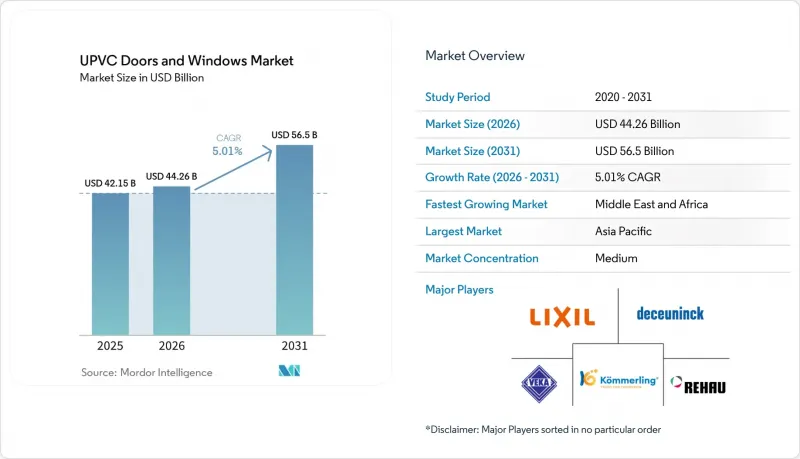
本報告按產品類型(UPVC窗戶、UPVC門)、最終用途領域(住宅、商業等)、設計類型(滑動窗、平開窗、內傾內開窗等)、安裝類型(新建、更換/維修)、配銷通路(經銷商/批發商、廠商直銷)和地區進行細分。市場預測以美元(USD)計價。
全球UPVC門窗市場趨勢與洞察
新建住宅必須遵守的強制性節能標準
全球建築法規正朝著性能標準靠攏,而這些標準只有在多房間建築中使用隔熱性能優異的UPVC型材才能滿足。英國的「未來住宅標準」(Future Homes Standard)將於2025年生效,該標準將窗戶的最高U值降低至1.2 W/m²K,迫使建築商選擇先進的UPVC系統而非普通的雙層玻璃窗框。美國和加拿大的部分地區以及歐盟《建築能源性能指令》(Directory on the Energy Performance of Buildings)的擬議修正案中也正在考慮類似的性能標準。所有這些因素共同作用,將合規預算轉化為對UPVC門窗市場可預測的高利潤需求。能夠檢驗其型材熱模擬數據並儘早獲得認證的供應商將能夠獲得溢價,而未能更新設備的製造商將面臨利潤率下降的壓力,因為監管週期正在縮短。
亞太地區中等收入都市區的房屋維修支出增加。
亞太地區中產階級的快速成長正在改變房屋維修需求的模式。中國、印度和東協五大國家的家庭擴大將收入用於住宅維修,而熱帶地區空調費用高達家庭電費的40%,因此,更換門窗成為提高能源效率的首要任務。 UPVC材質易於維護且防白蟻,深受習慣潮濕氣候的住宅青睞,從而推動了UPVC門窗市場的持續成長。提供專案融資的經銷商成交率不斷提高,凸顯了消費信貸體系在刺激全部區域先前被抑制的房屋翻新需求方面的重要作用。
UPVC價格波動與石油衍生樹脂有關
UPVC樹脂的價格與石油衍生乙烯和氯的投入成本密切相關,因此,每當原油期貨價格飆升時,其價格都會出現超過20%的以季度為基礎波動。持有期貨合約的加工商雖然可以承受部分波動,但仍需將增加的成本轉嫁到價格上,這使得對價格敏感的新興市場的專案預算編制變得困難。這種價格波動削弱了大規模公共競標的競爭力,因為這些招標的價格通常提前9至12個月確定,從而暫時將需求轉向鋁製品,因為鋁製品的合金附加費更加透明。
細分市場分析
到2025年,UPVC窗戶將佔據UPVC門窗市場61.10%的主導佔有率。這一主導地位建立在數十年來UPVC窗戶隔熱性能的不斷提升之上,而這又得益於建築規範的完善以及住宅對各種窗戶類型(包括傾斜窗、平開窗和推拉窗)的熟悉程度。雙層玻璃的普及使得UPVC窗戶的平均售價成長速度超過了擠壓成本的成長速度,從而實現了該細分市場的穩定成長,並使製造商能夠在保持價格優勢(與木包複合複合材料相比)的同時,提高毛利率。在UPVC門窗市場中,隨著三層玻璃被指定用於都市區中層住宅的維修以滿足2025年後的能源標準,預計窗戶細分市場將持續成長。
儘管目前UPVC門銷量仍處於較低水平,但預計到2031年將以6.82%的複合年成長率成長,這主要得益於商業店鋪外立面和住宅庭院對大面積、隔熱性能優異的面板的需求不斷成長。符合EN 1627安全標準的安防玻璃提升了多用戶住宅大廳聚合物門的價值,因為居住者在大廳停留時間更長,對隔音和隔熱性能的要求也更高。門窗製造商正利用跨平台窗型材實現規模經濟,從而降低傳統上與鋁合金系統相關的溢價。隨著北美建築師採用歐式拉門和內傾內開門系統,門的需求正從利基市場轉向主流市場,從而拓寬了UPVC門窗市場的價值層級。
2025年,住宅佔銷售額的68.12%。宣傳宣傳活動和與智慧家庭的捆綁銷售正在推動市場接受度,尤其是在優先考慮低維護成本的首次住宅中。傳統的25年更換週期正在縮短至18-20年,因為消費者將老舊的雙層玻璃窗升級為符合公用事業收費補貼條件的三層玻璃、低輻射鍍膜玻璃。這一趨勢使住宅需求保持強勁,即使在房屋抵押貸款的時期也是如此。在加拿大和斯堪地那維亞等高緯度地區,建築商擴大預裝UPVC窗框,以降低建築物的能耗強度,從而擴大了UPVC門窗市場的基礎。
商業需求雖然絕對值較小,但預期成長速度將更快,複合年成長率 (CAGR) 為 5.74%。推動這一成長的因素包括中東地區和北美地區混合用途高層建築的開發,這些項目需要嚴格的隔熱措施來最佳化暖通空調 (HVAC) 負載。設施管理人員正在重新思考其總體擁有成本 (TCO) 模型,更加重視降低維護成本。 UPVC 具有耐鹽霧和耐空氣污染物的特性,與陽極氧化鋁相比,其生命週期成本優勢高達 30%。這種重新思考正在推動商業買家的結構性轉變,他們正在引領高階功能(例如抗衝擊玻璃、整合式電動百葉窗和智慧門鎖系統)的普及,從而提高每平方英尺的價值密度。
區域分析
預計到2025年,亞太地區將佔據全球44.10%的銷售佔有率,成為UPVC門窗市場的主要驅動力。隨著城市人口向特大城市集中,並制定了雄心勃勃的節能目標,該地區的成長勢頭依然強勁。中國的房屋維修補貼政策以及印度的「總理住房計畫」(Pradhan Mantri Awas Yojana)住宅項目,都促進了未來多年的項目儲備,並擴大了潛在的銷售量。日本和澳洲等成熟市場由於嚴格的建築規範(建議使用低維護成本的門窗),為市場提供了穩定性。區域氣候的多樣性,包括易受颱風侵襲的沿海地區和內陸山區,要求型材具有多功能性,這反過來又促使全球供應商將擠出生產線本地化,並與石化合作夥伴共同開發適用於熱帶氣候的密封材料。
中東和非洲地區預計將以5.67%的複合年成長率實現最高成長,這主要得益於高達3.7兆美元的項目儲備,其中包括政府支持的NEOM、紅海世界以及多個液化天然氣樞紐項目。嚴酷的沙漠高溫和沙塵暴凸顯了粉末塗層鋁材和紫外線穩定型uPVC之間的性能差距,導致酒店業和豪華住宅大樓的規格要求發生變化。該地區政府支持的開發商也致力於實現淨零排放,並推廣使用高隔熱玻璃產品以降低機械冷卻負荷。透過技術轉移協議開展合作的本地擠壓型材製造商可以滿足進口替代需求,並加速uPVC門窗供應鏈的在地化進程。
歐洲市場依然成熟,產量高,其市場走向主要受法規而非單純的建築需求成長所驅動。英國的「未來住宅標準」推動了型材需求的短期激增,而北歐生態標章的合規要求則促進了包括再生材料在內的UPVC產品的採購。德國的《建築節能法》正在推廣三層玻璃窗的使用,儘管住宅開工量持平,但更換週期仍然活躍。北美市場成長更為穩定,主要得益於沿海地區的房屋更換項目以及傾斜旋轉式建築的普及。南美市場規模雖小,但仍有成長空間,巴西的公共住宅計畫納入了能源效率目標,這與UPVC的成本績效特性不謀而合。
其他好處:
- Excel格式的市場預測(ME)表
- 3個月的分析師支持
目錄
第1章:引言
- 研究假設和市場定義
- 調查範圍
第2章:調查方法
第3章執行摘要
第4章 市場狀況
- 市場概覽
- 市場促進因素
- 新建住宅必須遵守的強制性節能標準
- 亞太地區中等收入族群都市區裝修支出增加。
- 疫情後北美地區向在家工作的過渡
- 高抗衝擊性開口的保險福利
- 經銷商導向的AI驅動型大規模客製化平台
- 市場限制因素
- 石油衍生樹脂導致UPVC價格波動
- 高層建築嚴格的消防安全標準
- 從環境、社會及公司治理(ESG)角度來看,人們對含氯聚合物的抗拒情緒日益高漲。
- 廢棄物管理和廢棄UPVC回收利用方面的限制因素
- 產業價值鏈分析
- 波特的五力
- 新進入者的威脅
- 供應商的議價能力
- 買方的議價能力
- 替代品的威脅
- 競爭強度
- 洞察最新市場趨勢與創新
- 近期產業趨勢分析(新產品發布、策略性舉措、投資、合作、合資、業務擴張、併購等)
第5章 市場規模與成長預測
- 依產品類型
- UPVC窗戶
- UPVC門
- 依設計類型
- 滑動
- 平開窗
- 傾斜和旋轉
- 其他(法式、遮陽棚等)
- 按安裝類型
- 新建工程
- 更換/維修
- 最終用戶
- 住宅
- 商業
- 工業和基礎設施
- 透過分銷管道
- 廠商直銷
- 經銷商和分銷商
- 按地區
- 北美洲
- 加拿大
- 美國
- 墨西哥
- 南美洲
- 巴西
- 秘魯
- 智利
- 阿根廷
- 其他南美國家
- 歐洲
- 英國
- 德國
- 法國
- 西班牙
- 義大利
- 比荷盧經濟聯盟(比利時、荷蘭、盧森堡)
- 北歐國家(丹麥、芬蘭、冰島、挪威、瑞典)
- 其他歐洲國家
- 亞太地區
- 印度
- 中國
- 日本
- 澳洲
- 韓國
- 東南亞(新加坡、馬來西亞、泰國、印尼、越南、菲律賓)
- 其他亞太國家
- 中東和非洲
- 阿拉伯聯合大公國
- 沙烏地阿拉伯
- 南非
- 奈及利亞
- 其他中東和非洲國家
- 北美洲
第6章 競爭情勢
- 市場集中度
- 策略趨勢
- 市佔率分析
- 公司簡介
- VEKA AG
- Deceuninck NV
- Rehau Group
- LIXIL Group(Tostem)
- Profine GmbH(Kommerling)
- Andersen Corporation
- JELD-WEN Holding
- PGT Innovations
- Fenesta Building Systems
- NCL VEKA
- LG Hausys
- A-Profiles(Aluplast)
- Eurocell PLC
- YKK AP
- Internorm International
- Schuco International
- AGPL(Ahuja Group)
- Sonipat Polymer
- Kinbon Windows & Doors
- VELFAC(Dovista)
第7章 市場機會與未來展望
According to Mordor Intelligence, the UPVC doors and windows market size was valued at USD 42.15 billion in 2025 and estimated to grow from USD 44.26 billion in 2026 to reach USD 56.5 billion by 2031, at a CAGR of 5.01% during the forecast period (2026-2031).
This report is Segmented by Product Type (UPVC Windows, UPVC Doors), End-Use Sector (Residential, Commercial, and More), Design Type (Sliding, Casement, Tilt-And-Turn, Others), Installation Type (New Construction, Replacement & Renovation), by Distribution Channel (Dealers and Distributors, Direct From the Manufacturers) and Geography. The Market Forecasts are Provided in Terms of Value (USD).
Global UPVC Doors and Windows Market Trends and Insights
Mandatory Energy-efficiency Codes in New-build Housing
Global building regulations are converging on performance benchmarks that can only be met by multi-chambered, thermally-broken UPVC profiles. The United Kingdom's Future Homes Standard, effective 2025, lowers the maximum window U-value to 1.2 W/m2K, a shift that compels builders to select advanced UPVC systems over commodity double-glazed frames. Comparable performance thresholds are being tabled in several United States, Canada, and the European Union's revision of the Energy Performance of Buildings Directive, all of which collectively convert compliance budgets into predictable, high-margin volume for the UPVC doors and windows market. Suppliers that can validate profile thermal simulation data and secure early certification stand to gain price premiums, while fabricators failing to retool face margin compression as code cycles shorten.
Rising Mid-income Urban Renovation Spend in APAC
The demographic surge in the Asia-Pacific's middle class is reshaping renovation demand. Households in China, India, and five major ASEAN economies allocate a rising share of income to existing-home upgrades, and windows top the energy-efficiency priority list because air-conditioning costs account for up to 40% of household electricity bills in tropical regions. UPVC's low-maintenance surfaces and resistance to termite damage resonate with homeowners accustomed to humid climates, creating a durable pull-through for the UPVC doors and windows market. Dealers that bundle project financing see higher close rates, underscoring the importance of consumer credit ecosystems in unlocking deferred renovation demand across APAC.
UPVC Price Volatility Linked to Oil-derived Resin
UPVC resin prices track ethylene and chlorine inputs derived from petroleum, leading to quarterly swings exceeding 20% whenever crude futures spike. Fabricators with forward contracts absorb some volatility yet still pass through cost increments that make project budgeting unpredictable in price-sensitive emerging markets. The volatility dampens bidding competitiveness for large public tenders that lock prices 9-12 months ahead, temporarily steering demand toward aluminum, where alloy surcharges are more transparent.
Other drivers and restraints analyzed in the detailed report include:
- Post-pandemic Home-office Conversions in North America
- Insurance Incentives for High-impact-resistant Fenestration
- Growing ESG Pushback Against Chlorinated Polymers
For complete list of drivers and restraints, kindly check the Table Of Contents.
Segment Analysis
UPVC windows held a commanding 61.10% share of the UPVC doors windows market in 2025, a leadership position rooted in decades of code-driven thermal upgrades and homeowner familiarity with tilt, casement, and sliding variants. Segment revenue climbed steadily as multi-glazed configurations raised average selling prices faster than extrusion costs, allowing fabricators to widen gross margins while preserving price accessibility versus wood-clad composites. The UPVC doors and windows market size for windows is forecast to expand at a steady clip as urban mid-rise housing retrofits specify triple-pane units to meet post-2025 energy benchmarks.
UPVC doors, though smaller in volume, are set for a 6.82% CAGR through 2031, led by commercial storefronts and residential patio expansions that demand large, thermally stable panels. Security glazing compliance with EN 1627 burglar-resistance grades boosted the perceived value of polymer doors in multifamily lobbies, where dwell time of occupants requires higher acoustic and thermal comfort. Door fabricators are cross-leveraging window profile platforms to achieve scale economies, enabling bundled quoting that erodes historical price premiums of competing aluminum systems. As architects in North America adopt European-style lift-and-slide and tilt-and-turn entrance systems, door volumes are converting from niche to mainstream, extending the value ladder within the UPVC doors and windows market.
Residential buyers contributed 68.12% of 2025 sales. Awareness campaigns and smart-home bundling raise acceptance, especially among first-time homeowners value low maintenance.. Long replacement intervals, historically 25 years, are shortening to 18-20 years as consumers trade older double-glazed frames for triple-pane, low-E upgrades eligible for utility rebates. That cadence keeps residential demand resilient, even during mortgage-rate spikes that temporarily suppress housing starts. Builders in high-latitudes Canada and Scandinavia increasingly pre-install UPVC fenestration to lower building energy intensity, extending the baseline for the UPVC doors and windows market.
Commercial demand, although smaller in absolute terms, is projected to grow faster at a 5.74% CAGR. Growth engines include mixed-use high-rise developments in the Middle East and data centers in North America that demand tight thermal envelopes to optimize HVAC loads. Facility managers are recalibrating total-cost-of-ownership models by assigning a higher weight to maintenance savings; UPVC's resistance to salt spray and airborne pollutants delivers lifecycle cost advantages of up to 30% versus anodized aluminum. This recalibration reinforces a structural shift that places commercial buyers at the vanguard of premium feature adoption, impact-graded glass, integrated motorized blinds, and smart-lock-ready door systems, thereby enhancing value density per square foot.
Complete Report Scope:
- By Product Type
- UPVC Windows
- UPVC Doors
- By Design Type
- Sliding
- Casement
- Tilt-and-Turn
- Others (French, Awning, etc.)
- By Installation Type
- New Construction
- Replacement & Renovation
- By End-user
- Residential
- Commercial
- Industrial & Infrastructure
- By Distribution Channel
- Direct from the Manufacturers
- Dealers and Distributors
- By Geography
- North America
- Canada
- United States
- Mexico
- South America
- Brazil
- Peru
- Chile
- Argentina
- Rest of South America
- Europe
- United Kingdom
- Germany
- France
- Spain
- Italy
- BENELUX (Belgium, Netherlands, and Luxembourg)
- NORDICS (Denmark, Finland, Iceland, Norway, and Sweden)
- Rest of Europe
- Asia-Pacific
- India
- China
- Japan
- Australia
- South Korea
- South East Asia (Singapore, Malaysia, Thailand, Indonesia, Vietnam, and Philippines)
- Rest of Asia-Pacific
- Middle East And Africa
- United Arab Emirates
- Saudi Arabia
- South Africa
- Nigeria
- Rest of Middle East And Africa
- North America
Geography Analysis
Asia-Pacific dominated the UPVC doors and windows market with 44.10% revenue share in 2025, and its trajectory remains robust as urban populations concentrate in megacities that pursue aggressive energy-efficiency targets. China's retrofit subsidies and India's Pradhan Mantri Awas Yojana housing mission collectively underpin multi-year project pipelines, amplifying base volumes. Mature markets such as Japan and Australia add stability through stringent building codes that favor low-maintenance fenestration. Regional climatic diversity, typhoon-prone coasts, and alpine interiors demand profile versatility, a requirement that encourages global suppliers to localize extrusion plants and co-develop tropicalized gasket materials with petrochemical partners.
Middle East & Africa is forecast to clock the fastest 5.67% CAGR, riding on a USD 3.7 trillion project pipeline that includes NEOM, Red Sea Global, wealth fund-backed, and multiple LNG hubs. Harsh desert temperatures and dust storms accentuate the performance gap between powder-coated aluminum and UV-stabilized UPVC, prompting specification shifts in hospitality and high-end residential towers. The region's sovereign wealth fund-backed developers also articulate net-zero ambitions, pushing for thermally superior glazing that reduces mechanical cooling loads. Local extruders partnering under technology-transfer agreements can tap import-substitution demand, accelerating the localization of the uPVC doors and windows market supply chain.
Europe remains a volume-dense yet mature territory where regulation, rather than sheer construction growth, dictates market direction. The Future Homes Standard in the United Kingdom creates a near-term spike in profile demand, while Nordic Ecolabel compliance requirements steer procurement toward recycled-content UPVC. Germany's Building Energy Act drives triple-pane adoption, keeping replacement cycles active despite flat housing starts. North America's growth is steadier, fueled by coastal replacement projects and tilt-and-turn migration. South America, though smaller, shows upside as public-sector housing programs in Brazil integrate energy-efficiency targets that align naturally with UPVC's cost-performance profile.
- VEKA AG
- Deceuninck NV
- Rehau Group
- LIXIL Group (Tostem)
- Profine GmbH (Kommerling)
- Andersen Corporation
- JELD-WEN Holding
- PGT Innovations
- Fenesta Building Systems
- NCL VEKA
- LG Hausys
- A-Profiles (Aluplast)
- Eurocell PLC
- YKK AP
- Internorm International
- Schuco International
- AGPL (Ahuja Group)
- Sonipat Polymer
- Kinbon Windows & Doors
- VELFAC (Dovista)
Additional Benefits:
- The market estimate (ME) sheet in Excel format
- 3 months of analyst support
TABLE OF CONTENTS
1 Introduction
- 1.1 Study Assumptions & Market Definition
- 1.2 Scope of the Study
2 Research Methodology
3 Executive Summary
4 Market Landscape
- 4.1 Market Overview
- 4.2 Market Drivers
- 4.2.1 Mandatory Energy-efficiency Codes in New-build Housing
- 4.2.2 Rising Mid-income Urban Renovation Spend in APAC
- 4.2.3 Post-pandemic Home-office Conversions in North America
- 4.2.4 Insurance Incentives for High-impact-resistant Fenestration
- 4.2.5 AI-driven Mass-customisation Platforms for Dealers
- 4.3 Market Restraints
- 4.3.1 UPVC Price Volatility Linked to Oil-derived Resin
- 4.3.2 Stringent Fire-safety Codes in High-rise Construction
- 4.3.3 Growing ESG Pushback Against Chlorinated Polymers
- 4.3.4 Waste-management & Recycling Constraints for End-of-Life UPVC
- 4.4 Industry Value Chain Analysis
- 4.5 Porte's Five Forces
- 4.5.1 Threat of New Entrants
- 4.5.2 Bargaining Power of Suppliers
- 4.5.3 Bargaining Power of Buyers
- 4.5.4 Threat of Substitutes
- 4.5.5 Intensity of Rivalry
- 4.6 Insights into the Latest Trends and Innovations in the Market
- 4.7 Insights on Recent Developments (New Product Launches, Strategic Initiatives, Investments, Partnerships, JVs, Expansion, M&As, etc.) in the Industry
5 Market Size & Growth Forecasts
- 5.1 By Product Type
- 5.1.1 UPVC Windows
- 5.1.2 UPVC Doors
- 5.2 By Design Type
- 5.2.1 Sliding
- 5.2.2 Casement
- 5.2.3 Tilt-and-Turn
- 5.2.4 Others (French, Awning, etc.)
- 5.3 By Installation Type
- 5.3.1 New Construction
- 5.3.2 Replacement & Renovation
- 5.4 By End-user
- 5.4.1 Residential
- 5.4.2 Commercial
- 5.4.3 Industrial & Infrastructure
- 5.5 By Distribution Channel
- 5.5.1 Direct from the Manufacturers
- 5.5.2 Dealers and Distributors
- 5.6 By Geography
- 5.6.1 North America
- 5.6.1.1 Canada
- 5.6.1.2 United States
- 5.6.1.3 Mexico
- 5.6.2 South America
- 5.6.2.1 Brazil
- 5.6.2.2 Peru
- 5.6.2.3 Chile
- 5.6.2.4 Argentina
- 5.6.2.5 Rest of South America
- 5.6.3 Europe
- 5.6.3.1 United Kingdom
- 5.6.3.2 Germany
- 5.6.3.3 France
- 5.6.3.4 Spain
- 5.6.3.5 Italy
- 5.6.3.6 BENELUX (Belgium, Netherlands, and Luxembourg)
- 5.6.3.7 NORDICS (Denmark, Finland, Iceland, Norway, and Sweden)
- 5.6.3.8 Rest of Europe
- 5.6.4 Asia-Pacific
- 5.6.4.1 India
- 5.6.4.2 China
- 5.6.4.3 Japan
- 5.6.4.4 Australia
- 5.6.4.5 South Korea
- 5.6.4.6 South East Asia (Singapore, Malaysia, Thailand, Indonesia, Vietnam, and Philippines)
- 5.6.4.7 Rest of Asia-Pacific
- 5.6.5 Middle East And Africa
- 5.6.5.1 United Arab Emirates
- 5.6.5.2 Saudi Arabia
- 5.6.5.3 South Africa
- 5.6.5.4 Nigeria
- 5.6.5.5 Rest of Middle East And Africa
- 5.6.1 North America
6 Competitive Landscape
- 6.1 Market Concentration
- 6.2 Strategic Moves
- 6.3 Market Share Analysis
- 6.4 Company Profiles (includes Global level Overview, Market level overview, Core Segments, Financials as available, Strategic Information, Market Rank/Share for key companies, Products & Services, and Recent Developments)
- 6.4.1 VEKA AG
- 6.4.2 Deceuninck NV
- 6.4.3 Rehau Group
- 6.4.4 LIXIL Group (Tostem)
- 6.4.5 Profine GmbH (Kommerling)
- 6.4.6 Andersen Corporation
- 6.4.7 JELD-WEN Holding
- 6.4.8 PGT Innovations
- 6.4.9 Fenesta Building Systems
- 6.4.10 NCL VEKA
- 6.4.11 LG Hausys
- 6.4.12 A-Profiles (Aluplast)
- 6.4.13 Eurocell PLC
- 6.4.14 YKK AP
- 6.4.15 Internorm International
- 6.4.16 Schuco International
- 6.4.17 AGPL (Ahuja Group)
- 6.4.18 Sonipat Polymer
- 6.4.19 Kinbon Windows & Doors
- 6.4.20 VELFAC (Dovista)
7 Market Opportunities & Future Outlook
- 7.1 Integration of Smart and Automated Windows
- 7.2 Rising Demand from Asia-Pacific Construction

 2026-2030年全球UPVC門窗市場
 北美UPVC門窗:市場佔有率分析、產業趨勢與統計及成長預測(2026-2031年)印度UPVC門窗:市場佔有率分析、產業趨勢與統計及成長預測(2026-2031年)
 UPVC門窗市場-全球產業規模、佔有率、趨勢、機會和預測:按產品類型、最終用戶、分銷管道、地區和競爭格局分類,2021-2031年
 塑鋼門窗市場規模、佔有率及趨勢分析報告:依產品、應用、地區及細分市場預測(2026-2033 年)
 PVC-U門窗市場:依玻璃類型、產品類型、表面處理、型材腔體、銷售管道、窗戶系統類型、門系統類型、最終用戶、應用領域分類,全球預測(2026-2032)
 全球PVC窗框型材市場規模、佔有率、趨勢及成長分析報告(2026-2034年)
 2026年全球商用聚氯乙烯(PVC)窗型材市場報告住宅用UPVC門窗市場-全球產業規模、佔有率、趨勢、機會及預測(依產品類型、配銷通路、地區及競爭格局分類,2021-2031年預測)
 硬質PVC門窗:全球市佔率及排名、總收入及需求預測(2025-2031年)