


 |
市場調查報告書
商品編碼
2073332
面向銀行、金融服務和保險業的綠色IT軟體:市場佔有率分析、行業趨勢和統計數據以及成長預測(2026-2031年)Green IT Software For BFSI Sector - Market Share Analysis, Industry Trends & Statistics, Growth Forecasts (2026 - 2031) |
||||||

※ 本網頁內容可能與最新版本有所差異。詳細情況請與我們聯繫。
根據 Mordor Intelligence 預測,到 2025 年,BFSI 產業綠色 IT 軟體的市場規模將達到 9.5 億美元,到 2026 年將達到 11.5 億美元,到 2031 年將達到 29.9 億美元。
預計從 2026 年到 2031 年,其複合年成長率將達到 21.06%。
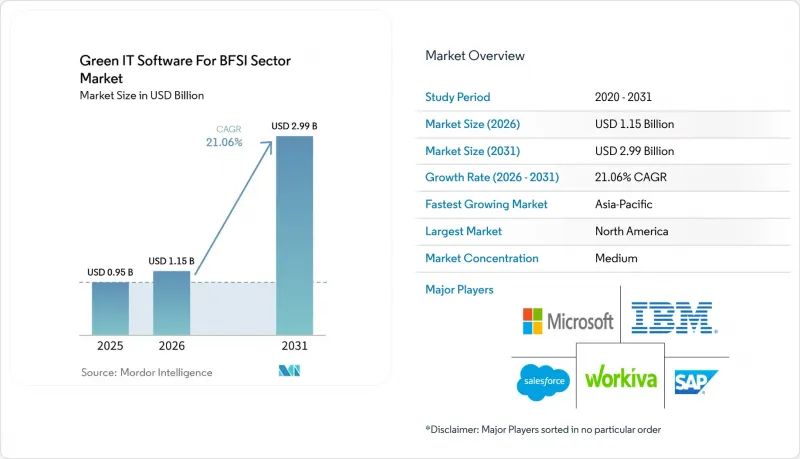
本報告按部署類型(雲端、本地部署、混合部署)、軟體類別(碳管理軟體、永續發展報告和管理軟體、能源和資源最佳化軟體等)、公司規模(大型企業、中小企業)和地區進行細分。市場預測以價值(美元)表示。
全球綠色IT軟體市場趨勢及對銀行、金融服務及保險(BFSI)產業的洞察
銀行、金融服務和保險 (BFSI) 行業的強制性 ESG 資訊揭露和可審計性
由於受監管實體不再能將永續發展報告視為自願性舉措,資訊揭露要求已成為銀行、金融服務和保險(BFSI)行業綠色IT軟體市場最強勁的直接驅動力。歐盟2026年綜合法案在第一階段維持了非營利實體的報告義務,確保了結構化和可審計報告的必要性。然而,後續階段將範圍限制在了規模大規模的公司。日本金融廳也正式強制要求在主要市場上市的大型公司在其年度證券報告中揭露符合日本證券準則(SSBJ)的資訊。這表明,BFSI行業的綠色IT軟體市場是由正式的證券資訊揭露要求而非自願性永續發展報告所支撐的。印度計畫從2025-2026會計年度起將其商業關係準則(BRSR)核心保證義務的覆蓋範圍從前250家公司擴大到前500家公司,並從2026-2027會計年度起擴大到前1000家公司,這將進一步提升持續的市場需求。對於在多個地區運作的機構而言,壓力更大,因為它們必須在同一個報告週期內兼顧財務重要性和區域揭露要求這三重重要性。因此,在面向銀行、金融服務和保險(BFSI)行業的綠色IT軟體市場中,能夠維護單一底層資料模型並產生多個框架輸出而無需每次都重新配置控制的平台正變得越來越有價值。
衡量整個貸款和投資組合中與資金籌措相關的排放。
由於銀行和資產管理公司需要進行遠超自身營運碳足跡的投資組合層面碳核算,因此,衡量整個貸款和投資組合的「精細排放」正成為金融服務業綠色IT軟體市場的核心成長引擎。提交的草案顯示,精細排放可能達到金融機構直接碳足跡的100至700倍,使得第15類數據對許多金融服務業用戶而言比設施能源數據更為重要。隨著PCAF於2025年12月擴展其標準,納入更多資產類別和前瞻性轉型融資指標,傳統的估算方法已不再適用於目前的審查和保證需求。為此,SAP Fioneer於2025年7月發布了其「淨零排放」模組,荷蘭合作銀行已採用該模組在其銀行工作流程中追蹤投資組合、交易對象、資產和單筆貸款層面的氣候績效。這正在改變綠色IT軟體在金融服務業中的角色。與貸款相關的排放數據不再僅用於對外披露,現在還會影響信用評估、資本配置和貸款定價背後的邏輯。隨著這種相關性的增強,BFSI 產業的綠色 IT 軟體市場正在擺脫孤立的報告成本,並逐漸成為風險管理預算。
分散的遺留數據,涵蓋核心銀行系統和風險管理系統。
對於銀行、金融服務和保險(BFSI)產業而言,碎片化的舊有系統架構是綠色IT軟體市場面臨的主要障礙。許多金融機構仍然將貸款、風險和會計數據分散在不相容的平台上,而這些平台的設計並未考慮永續性元元資料。 PCAF的專有數據品質評估框架凸顯了這個問題,因為檢驗的借款人層級資訊對於高品質貸款相關的排放報告至關重要,而許多金融機構仍然依賴粗略的估計值和區域平均值。因此,BFSI產業的綠色IT軟體通常需要耗費大量成本進行資料提取、轉換和管治工作,才能在企業級規模上實現價值。這延長了實施時間,增加了整合成本,並且使得軟體選擇不僅取決於產品功能,還取決於資料就緒程度。對於在多個司法管轄區運作的銀行而言,這個問題更為嚴重,因為區域系統的差異可能會使公司範圍內的整合工作停滯數月甚至數年。因此,在存在許多舊有系統的環境中,BFSI 行業的綠色 IT 軟體市場仍然面臨障礙,當金融機構試圖將風險、財務和永續性記錄整合到單一的管理框架中時,這種趨勢尤其明顯。
細分市場分析
至2025年,雲端採用率將佔BFSI(銀行、金融服務和保險)產業綠色IT軟體市場61.78%的佔有率,成為該產業綠色IT軟體市場按採用模式分類的最大佔有率。這一主導地位反映了BFSI行業綠色IT軟體市場的買家希望在其所有用戶群中反映監管更新、計算方法變更和報告邏輯的變化,而無需等待本地基礎設施升級。雲端交付也減少了版本碎片化,這對於需要在ESRS、PCAF和SSBJ報告週期中保持一致輸出的金融機構至關重要。因此,對於那些將永續性資料日益整合到財務、風險、採購和供應商管理流程中的組織而言,雲端平台正變得越來越有吸引力。這一趨勢不再僅僅關乎基礎設施成本;快速更新、共用控制和輕鬆整合到企業工作流程中所帶來的價值,如今才是主要的驅動力。
對於受嚴格資料居住要求和主權託管法規約束的國有銀行、保險公司和政府相關機構而言,本地部署系統仍然是ESG和永續發展軟體產業的重要組成部分。在這些情況下,敏感的財務和ESG記錄的儲存位置以及在審查和保證流程中如何存取這些記錄是採購決策的關鍵因素。混合部署是成長最快的模式,預計到2031年將以21.32%的複合年成長率成長。這表明,面向銀行、金融服務和保險(BFSI)行業的綠色IT軟體市場並非簡單地從本地部署系統單向遷移到公共雲端。各機構正在建立分散的架構,其中核心財務資料保留在本地,而分析、工作流程自動化和報告輸出則透過雲層完成。 AWS已證明,基於雲端的永續發展報告環境可以透過配置變更而非完全重新實施來適應不斷變化的報告要求,這凸顯了在法規環境中採用混合部署的務實意義。 IBM 的「API優先」策略也推動了這一趨勢。這是因為買家可以將排放計算邏輯添加到現有系統中,而無需即時更換基礎設施。這確保了混合模式在銀行、金融服務和保險 (BFSI) 行業的綠色 IT 軟體市場中繼續發揮至關重要的作用,在這個市場中,可控性、可審計性和數據主權與速度同等重要。因此,採用構成比反映了市場現實,即在尊重監管機構和內部風險管理團隊設定的營運邊界的同時,優先考慮雲端彈性。
區域分析
預計到2025年,北美將佔據41.62%的市場佔有率,成為銀行、金融服務和保險(BFSI)行業綠色IT軟體市場中最大的區域佔有率,並將於2026年繼續保持領先地位。該地區的市場佔有率之所以如此之大,得益於企業早期採用綠色IT軟體、投資者的強大壓力以及各州在將報告和排放管理整合到主流企業系統方面所發揮的作用。加州的SB-253和SB-261法案尤其重要,因為這兩項法案擴大了對在該州開展實質業務活動的大型企業的資訊揭露要求,即使這些企業不符合任何聯邦上市標準。加拿大也透過向受聯邦監管的金融機構提供氣候風險的指導,並促進資本市場更廣泛地採用資訊揭露實踐,從而支持了區域需求。此外,北美BFSI行業綠色IT軟體市場也受益於主要平台供應商的集中,以及該地區作為許多產品在全球部署前進行首次測試的場所的地位。
歐洲在銀行、金融服務和保險(BFSI)營業單位的綠色IT軟體市場中仍然佔據著舉足輕重的地位,即使在綜合性修訂之後,歐洲仍然擁有最完善的正式報告體系。儘管歐盟指令(EU) 2026/470在未來階段縮小了其適用範圍,但它仍然維持著對已在其適用範圍內的實體的審計標準、結構化提交要求和核心一致性的要求。歐洲銀行管理局(EBA)的ESG風險管理指南以及資訊揭露要求,正在銀行業內部創造新的需求層級,從而為歐洲BFSI產業的綠色IT軟體市場形成獨特的採購基礎。此外,隨著監管變化要求平台更新和產品功能深度提升,擔保支援和資料管理成為採購決策的核心要素,歐洲仍然是供應商面臨的一個高要求地區。
預計到2031年,亞太地區將以22.37%的複合年成長率成長,成為銀行、金融服務和保險(BFSI)行業綠色IT軟體市場成長最快的區域板塊。 2026年2月,日本金融廳(FSA)強制要求在年度證券報告中披露符合日本永續發展準則(SSBJ)的信息,為主要上市企業提供了清晰的合規時間表,其中包括氣候變遷報告的關鍵要素。中國主要交易所也在2026年1月修訂了永續發展報告指南,要求指數掛鉤發行人於2026年4月30日前提交2025年度永續發展報告,並滿足更詳細的環境報告要求。印度引入商業關係和社會責任核心(BRSR Core)正在逐步擴大第三方保證義務的範圍,隨著更多上市公司加入這些義務的行列,將支持持續的採購週期。在南美洲,巴西正在透過制定資訊揭露框架以及對跨國公司供應鏈的要求做出貢獻;而在中東,淨零排放承諾和政府資本優先事項的推動,使得永續發展的重要性日益凸顯。在非洲,南非已經建立了綜合報告製度,並且正在保持發展勢頭。這些因素共同作用,使亞太地區成為重要的成長前沿,而更廣泛的新興全部區域也保持活躍,這得益於供應商合規性的推廣、資本市場的預期以及報告規則的逐步規範化。
其他好處:
- Excel格式的市場預測(ME)表
- 3個月的分析師支持
目錄
第1章:引言
- 研究假設和市場定義
- 調查範圍
第2章:調查方法
第3章執行摘要
第4章 市場狀況
- 市場概覽
- 市場促進因素
- 銀行、金融服務和保險 (BFSI) 行業 ESG 資訊的揭露義務和可審計性
- 衡量貸款和投資組合資金籌措相關的排放
- 基於雲端原生技術的永續性資料工作流程自動化
- 利用人工智慧技術擷取和檢驗範圍 3 數據
- ESG、風險與金融平台的整合。
- 最佳化分店、資料中心和工作場所營運中綠色 IT 的成本。
- 市場限制因素
- 分散的遺留數據,涵蓋核心銀行系統和風險管理系統。
- 缺乏具備金融級永續性數據專業知識的人員
- 與核心銀行系統和資料倉儲整合帶來的高昂負擔。
- 跨境雲端服務的資料主權和合規性限制
- 產業價值鏈分析
- 監理情勢
- 技術展望
- 宏觀經濟因素對市場的影響
- 波特五力分析
第5章 市場規模與成長預測
- 部署模式
- 雲
- 現場
- 混合
- 軟體類別
- 碳管理軟體
- 永續發展報告與管理軟體
- 能源和資源最佳化軟體
- 合規和風險管理軟體
- 供應鏈永續性軟體
- 環境、健康與安全軟體
- 按公司規模
- 大公司
- 小型企業
- 按地區
- 北美洲
- 美國
- 加拿大
- 墨西哥
- 南美洲
- 巴西
- 阿根廷
- 智利
- 其他南美國家
- 歐洲
- 德國
- 英國
- 法國
- 義大利
- 西班牙
- 其他歐洲國家
- 亞太地區
- 中國
- 日本
- 印度
- 澳洲
- 韓國
- 新加坡
- 其他亞太國家
- 中東
- 沙烏地阿拉伯
- 阿拉伯聯合大公國
- 土耳其
- 其他中東國家
- 非洲
- 南非
- 埃及
- 其他非洲國家
- 北美洲
第6章 競爭情勢
- 市場集中度
- 策略趨勢
- 市佔率分析
- 公司簡介
- Microsoft Corporation
- IBM Corporation
- SAP SE
- Salesforce, Inc.
- Workiva Inc.
- Persefoni Inc.
- Watershed Technology Inc.
- Novata, Inc.
- EcoVadis SAS
- Diligent Corporation
- Wolters Kluwer NV
- Schneider Electric SE
- Enablon
- Cority Software Inc.
- Sphera Solutions, Inc.
- GreenFi
- SAP Fioneer
- Temenos AG
- Greenly SAS
- Plan A Earth GmbH
- Carbmee GmbH
- Nasdaq, Inc.
- BenchMark Digital Partners LLC
- Measurabl, Inc.
- Intelex Technologies ULC
第7章 市場機會與未來展望
According to Mordor Intelligence, the green IT software for BFSI sector market size is projected to be USD 0.95 billion in 2025, USD 1.15 billion in 2026, and reach USD 2.99 billion by 2031, growing at a CAGR of 21.06% from 2026 to 2031.
This report is Segmented by Deployment Mode (Cloud, On-Premise, and Hybrid), Software Category (Carbon Management Software, Sustainability Reporting and Management Software, Energy and Resource Optimization Software, and More), Enterprise Size (Large Enterprises, and Small and Medium Enterprises), and Geography. The Market Forecasts are Provided in Terms of Value (USD).
Global Green IT Software For BFSI Sector Market Trends and Insights
Mandatory ESG Disclosure and Auditability in BFSI
Mandatory disclosure rules are the strongest immediate driver of the Green IT software for BFSI sector market, as regulated institutions can no longer treat sustainability reporting as a voluntary exercise. The 2026 EU Omnibus kept reporting obligations in place for Wave 1 public-interest entities and preserved the need for structured, audit-ready filings, even while later waves were narrowed to larger companies. Japan's Financial Services Agency also formalized SSBJ-aligned disclosure in annual securities reports for large Prime Market companies, indicating that the Green IT software for BFSI sector market is supported by formal securities filing requirements rather than voluntary sustainability statements. India extended BRSR Core assurance obligations from the top 250 to the top 500 listed companies from FY 2025-26, and planned to move to the top 1,000 from FY 2026-27, adding another layer of recurring implementation demand. The pressure is greater for institutions operating in more than one region because they must address double materiality, financial materiality, and local disclosure variations within a single reporting cycle. That is why the Green IT software for BFSI sector market is increasingly rewarding platforms that maintain a single underlying data model and generate multiple framework outputs without rebuilding controls each time.
Financed Emissions Measurement Across Lending and Investment Books
Financed emissions measurement is becoming a core growth engine for the Green IT software for the BFSI sector market, as banks and asset managers need portfolio-level carbon accounting that extends far beyond their own operational footprint. The supplied draft noted that financed emissions can exceed a financial institution's direct footprint by a factor of 100 to 700, which makes Category 15 data more material than facility energy data for many BFSI users. PCAF expanded its standard in December 2025 to include additional asset classes and forward-looking transition finance metrics, making earlier estimation approaches less suitable for current review and assurance needs. SAP Fioneer responded by launching its Net Zero module in July 2025, and Rabobank adopted it to track climate performance at the portfolio, counterparty, asset, and individual loan levels inside banking workflows. This is changing the role of Green IT software in the BFSI sector, as financed emissions data is no longer used solely for external disclosure; it is now affecting credit assessments, capital allocation, and loan pricing logic. As that link strengthens, the Green IT software for BFSI sector market moves closer to risk management budgets and away from isolated reporting spend.
Fragmented Legacy Data Across Core Banking and Risk Systems
Fragmented legacy system architecture is a meaningful brake on the green IT software for BFSI sector market because many financial institutions still store lending, risk, and accounting data across disconnected platforms that were never designed for sustainability metadata. PCAF's own data quality scoring framework makes the issue clear because higher-quality financed emissions reporting depends on verified borrower-level information, while many institutions still rely on broad estimates and regional averages. The result is that implementation often needs costly extraction, transformation, and governance work before the green IT software for BFSI sector market can deliver value at enterprise scale. This slows time-to-deployment, raises integration costs, and makes software selection depend as much on data readiness as on product capability. The problem is even harder for banks operating in several jurisdictions because local system variations can block enterprise-wide consolidation for years rather than months. That is why the green IT software for BFSI sector market still faces friction in legacy-heavy environments, especially when institutions try to align risk, finance, and sustainability records within a single control framework.
Other drivers and restraints analyzed in the detailed report include:
- Cloud-Native Automation of Sustainability Data Workflows
- AI-Driven Scope 3 Ingestion and Validation
- Limited Availability of Financial-Grade Sustainability Data Talent
For complete list of drivers and restraints, kindly check the Table Of Contents.
Segment Analysis
Cloud deployment held 61.78% of the market in 2025, which gives it the largest share of the Green IT software for BFSI sector market size across deployment models. The leading position reflects how buyers in the Green IT software for BFSI sector market want regulatory updates, calculation changes, and reporting logic to be pushed across the user base without waiting for local infrastructure upgrades. Cloud delivery also reduces version fragmentation, which matters when institutions need consistent outputs across ESRS, PCAF, and SSBJ reporting cycles. This has made cloud platforms more attractive in organizations where sustainability data is moving closer to finance, risk, procurement, and supplier management processes. The preference is not only about infrastructure costs, because the main value now comes from the speed of updates, shared controls, and easier integration into enterprise workflows.
On-premises systems remain relevant in the ESG and sustainability software industry for state-owned banks, insurance providers, and government-adjacent entities that operate under strict data-residency or sovereign-hosting rules. In these cases, the buying decision is shaped by where sensitive financial and ESG records can be stored and how they are accessed during review and assurance. Hybrid deployment is the fastest-growing model and is forecast to expand at a 21.32% CAGR through 2031, which shows that the Green IT software for BFSI sector market is not moving in a simple one-way shift from local systems to public cloud. Institutions are building split architectures in which core financial data remains on-premises, while analytics, workflow automation, and reporting outputs run through cloud layers. AWS has demonstrated that cloud-based sustainability reporting environments can adapt to changing reporting requirements through configuration rather than full reimplementation, which supports the practical case for hybrid adoption in regulated settings. IBM's API-first approach reinforces the same direction because buyers can add emissions logic to existing systems without forcing an immediate infrastructure replacement. This leaves the Green IT software for BFSI sector market with a durable role for hybrid models in sectors where control, auditability, and data sovereignty matter as much as speed. The deployment mix, therefore, reflects a market that values cloud resilience while still respecting operational boundaries set by regulators and internal risk teams.
Complete Report Scope:
- By Deployment Mode
- Cloud
- On-Premise
- Hybrid
- By Software Category
- Carbon Management Software
- Sustainability Reporting and Management Software
- Energy and Resource Optimization Software
- Compliance and Risk Management Software
- Supply Chain Sustainability Software
- Environment, Health, and Safety Software
- By Enterprise Size
- Large Enterprises
- Small and Medium Enterprises
- By Geography
- North America
- United States
- Canada
- Mexico
- South America
- Brazil
- Argentina
- Chile
- Rest of South America
- Europe
- Germany
- United Kingdom
- France
- Italy
- Spain
- Rest of Europe
- Asia-pacific
- China
- Japan
- India
- Australia
- South Korea
- Singapore
- Rest of Asia-pacific
- Middle East
- Saudi Arabia
- United Arab Emirates
- Turkey
- Rest of Middle East
- Africa
- South Africa
- Egypt
- Rest of Africa
- North America
Geography Analysis
North America held 41.62% of the market in 2025, which gave it the largest regional position in the Green IT software for BFSI sector market share and kept it as the leading geography in 2026. The region's scale reflects early enterprise adoption, strong investor pressure, and the role of state-level regulation in pushing reporting and emissions management into mainstream corporate systems. California's SB-253 and SB-261 are particularly important because they extend disclosure obligations across large companies with material operations in the state, even when those firms are not defined by one federal listing route. Canada also supports regional demand by providing climate risk guidance for federally regulated financial institutions and by promoting the broader adoption of disclosure practices in capital markets. The Green IT software for BFSI sector market in North America also benefits from the concentration of large platform vendors and the region's role as the first testing ground for many product launches before wider global rollout.
Europe remains a structurally important part of the Green IT software for BFSI sector market size because the region still has the deepest formal reporting architecture even after the Omnibus revision. Directive (EU) 2026/470 narrowed the mandatory population for later waves, but it kept audit-grade obligations, structured filing requirements, and core alignment expectations in place for entities already inside scope. The EBA's ESG risk management guidelines create an additional demand layer in banking that operates alongside disclosure requirements, which gives the European Green IT software for BFSI sector market a distinct BFSI purchasing base. Europe also remains a demanding region for vendors because regulatory changes force repeated platform updates and keep product depth, assurance support, and data controls at the center of buying decisions.
Asia-Pacific is forecast to expand at a 22.37% CAGR through 2031, making it the fastest-growing regional block in the Green IT software for BFSI sector market. Japan's February 2026 FSA mandate for SSBJ-aligned disclosures in annual securities reports created a clear compliance timetable for large Prime Market companies, including mandatory climate reporting elements. China's major exchanges also updated their sustainability reporting guidance in January 2026, requiring index-linked issuers to submit 2025 sustainability reports by April 30, 2026, and to meet more detailed environmental reporting expectations. India's BRSR Core rollout is extending third-party assurance obligations incrementally, supporting a continuous procurement cycle as more listed companies enter the mandatory scope. South America contributes through Brazil's developing disclosure framework and multinational supply-chain demands, while the Middle East is gaining relevance through net-zero commitments and sovereign capital priorities, and Africa retains momentum, with integrated reporting requirements already established in South Africa. Together, these conditions make Asia-Pacific the main growth frontier while keeping the broader emerging regional set active through supplier compliance transmission, capital market expectations, and the gradual formalization of reporting rules.
- Microsoft Corporation
- IBM Corporation
- SAP SE
- Salesforce, Inc.
- Workiva Inc.
- Persefoni Inc.
- Watershed Technology Inc.
- Novata, Inc.
- EcoVadis SAS
- Diligent Corporation
- Wolters Kluwer N.V.
- Schneider Electric SE
- Enablon
- Cority Software Inc.
- Sphera Solutions, Inc.
- GreenFi
- SAP Fioneer
- Temenos AG
- Greenly SAS
- Plan A Earth GmbH
- Carbmee GmbH
- Nasdaq, Inc.
- BenchMark Digital Partners LLC
- Measurabl, Inc.
- Intelex Technologies ULC
Additional Benefits:
- The market estimate (ME) sheet in Excel format
- 3 months of analyst support
TABLE OF CONTENTS
1 INTRODUCTION
- 1.1 Study Assumptions and Market Definition
- 1.2 Scope of the Study
2 RESEARCH METHODOLOGY
3 EXECUTIVE SUMMARY
4 MARKET LANDSCAPE
- 4.1 Market Overview
- 4.2 Market Drivers
- 4.2.1 Mandatory ESG Disclosure and Auditability in BFSI
- 4.2.2 Financed Emissions Measurement Across Lending and Investment Books
- 4.2.3 Cloud-Native Automation of Sustainability Data Workflows
- 4.2.4 AI-Driven Scope 3 Ingestion and Validation
- 4.2.5 Convergence of ESG, Risk, and Finance Platforms
- 4.2.6 Green IT Cost Optimization For Branch, Data Center, and Workplace Operations
- 4.3 Market Restraints
- 4.3.1 Fragmented Legacy Data Across Core Banking and Risk Systems
- 4.3.2 Limited Availability of Financial-Grade Sustainability Data Talent
- 4.3.3 High Integration Burden With Core Banking and Data Warehouses
- 4.3.4 Data Sovereignty and Cross-Border Cloud Compliance Constraints
- 4.4 Industry Value-Chain Analysis
- 4.5 Regulatory Landscape
- 4.6 Technological Outlook
- 4.7 Impact of Macroeconomic Factors on the Market
- 4.8 Porter's Five Forces Analysis
- 4.8.1 Threat of New Entrants
- 4.8.2 Bargaining Power of Suppliers
- 4.8.3 Bargaining Power of Buyers
- 4.8.4 Threat of Substitutes
- 4.8.5 Competitive Rivalry
5 MARKET SIZE AND GROWTH FORECASTS (VALUE)
- 5.1 By Deployment Mode
- 5.1.1 Cloud
- 5.1.2 On-Premise
- 5.1.3 Hybrid
- 5.2 By Software Category
- 5.2.1 Carbon Management Software
- 5.2.2 Sustainability Reporting and Management Software
- 5.2.3 Energy and Resource Optimization Software
- 5.2.4 Compliance and Risk Management Software
- 5.2.5 Supply Chain Sustainability Software
- 5.2.6 Environment, Health, and Safety Software
- 5.3 By Enterprise Size
- 5.3.1 Large Enterprises
- 5.3.2 Small and Medium Enterprises
- 5.4 By Geography
- 5.4.1 North America
- 5.4.1.1 United States
- 5.4.1.2 Canada
- 5.4.1.3 Mexico
- 5.4.2 South America
- 5.4.2.1 Brazil
- 5.4.2.2 Argentina
- 5.4.2.3 Chile
- 5.4.2.4 Rest of South America
- 5.4.3 Europe
- 5.4.3.1 Germany
- 5.4.3.2 United Kingdom
- 5.4.3.3 France
- 5.4.3.4 Italy
- 5.4.3.5 Spain
- 5.4.3.6 Rest of Europe
- 5.4.4 Asia-pacific
- 5.4.4.1 China
- 5.4.4.2 Japan
- 5.4.4.3 India
- 5.4.4.4 Australia
- 5.4.4.5 South Korea
- 5.4.4.6 Singapore
- 5.4.4.7 Rest of Asia-pacific
- 5.4.5 Middle East
- 5.4.5.1 Saudi Arabia
- 5.4.5.2 United Arab Emirates
- 5.4.5.3 Turkey
- 5.4.5.4 Rest of Middle East
- 5.4.6 Africa
- 5.4.6.1 South Africa
- 5.4.6.2 Egypt
- 5.4.6.3 Rest of Africa
- 5.4.1 North America
6 COMPETITIVE LANDSCAPE
- 6.1 Market Concentration
- 6.2 Strategic Moves
- 6.3 Market Share Analysis
- 6.4 Company Profiles (includes Global Level Overview, Market Level Overview, Core Segments, Financials as available, Strategic Information, Market Rank/Share, Products and Services, Recent Developments)
- 6.4.1 Microsoft Corporation
- 6.4.2 IBM Corporation
- 6.4.3 SAP SE
- 6.4.4 Salesforce, Inc.
- 6.4.5 Workiva Inc.
- 6.4.6 Persefoni Inc.
- 6.4.7 Watershed Technology Inc.
- 6.4.8 Novata, Inc.
- 6.4.9 EcoVadis SAS
- 6.4.10 Diligent Corporation
- 6.4.11 Wolters Kluwer N.V.
- 6.4.12 Schneider Electric SE
- 6.4.13 Enablon
- 6.4.14 Cority Software Inc.
- 6.4.15 Sphera Solutions, Inc.
- 6.4.16 GreenFi
- 6.4.17 SAP Fioneer
- 6.4.18 Temenos AG
- 6.4.19 Greenly SAS
- 6.4.20 Plan A Earth GmbH
- 6.4.21 Carbmee GmbH
- 6.4.22 Nasdaq, Inc.
- 6.4.23 BenchMark Digital Partners LLC
- 6.4.24 Measurabl, Inc.
- 6.4.25 Intelex Technologies ULC
7 MARKET OPPORTUNITIES AND FUTURE OUTLOOK
- 7.1 White Space and Unmet Need Assessment

 東南亞綠色IT軟體和雲端永續性:市場佔有率分析、產業趨勢和統計數據以及成長預測(2026-2031年)碳意識應用開發平台:市場佔有率分析、產業趨勢與統計、成長預測(2026-2031)
 2026年全球雲端永續性市場報告
 雲端永續性市場分析及預測(至 2035 年):按類型、產品類型、服務、技術、組件、應用、部署類型、最終用戶和解決方案分類
 按組織規模、部署模式、組件、服務類型和垂直行業分類的雲端永續性市場 - 全球預測 2026-2032 年
 全球雲端永續市場
 全球雲端永續發展市場規模、佔有率和趨勢分析:按公司規模、解決方案、服務模式、最終用途、地區、前景和預測,2024-2031
 雲端永續發展市場規模、佔有率、趨勢分析報告:按解決方案、按企業規模、按服務模式、按最終用途、按地區、細分市場預測,2024-2030 年