


 |
市場調查報告書
商品編碼
2073115
東南亞綠色IT軟體和雲端永續性:市場佔有率分析、產業趨勢和統計數據以及成長預測(2026-2031年)Southeast Asia Green IT Software and Cloud Sustainability - Market Share Analysis, Industry Trends & Statistics, Growth Forecasts (2026 - 2031) |
||||||

※ 本網頁內容可能與最新版本有所差異。詳細情況請與我們聯繫。
據 Mordor Intelligence 稱,東南亞綠色 IT 軟體、雲端和永續發展市場在 2025 年的價值為 44.6 億美元,預計到 2031 年將達到 129.9 億美元,而 2026 年為 53.3 億美元,預測期(2026-2031 年)的複合年成長率為 19.51%。
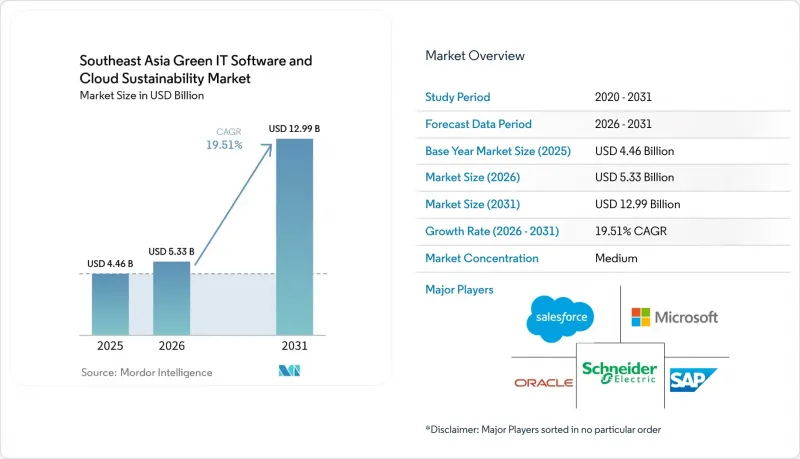
本報告按解決方案(節能基礎設施、永續雲端平台等)、部署模式(雲端部署、本地部署)、組織規模(大型企業、中小企業)、最終用戶(銀行、金融服務、保險等)和地區進行細分。市場預測以美元計價。
東南亞綠色IT軟體和雲端永續性市場的趨勢和洞察。
企業雲端運算的加速現代化
東南亞綠色IT軟體和雲端永續性市場直接受到企業雲端現代化進程的驅動,企業正用能夠在單一環境中管理效能和永續性的平台取代舊有系統。這項替換週期意義重大,因為它促進了企業在重建工作負載而非僅擴展傳統基礎設施時採用綠色軟體和雲端永續性工具。馬來西亞的「數位生態系統加速」獎勵框架將資料中心投資支援與至少採用一項綠色技術掛鉤,確保永續採用標準在有關新數位容量的決策中得到充分體現。一項針對馬來西亞中小企業的2025年調查發現,對結構化IT能力和雲端架構的深入理解能夠提升業務績效,這顯示雲端採用準備不僅是技術問題,也是組織挑戰。這一趨勢正在推動那些能夠提供培訓、架構支援和報告工具等打包服務(而非單獨銷售軟體)的供應商的發展。隨著越來越多的企業擺脫沉沒成本的困擾,預計東南亞雲端永續性市場將繼續加速雲端優先採用的早期採購。
來自跨國企業客戶的壓力,要求其遵守碳排放彙報。
東南亞綠色IT軟體、雲端服務和永續發展市場也受到客戶主導的報告壓力影響。這是因為大規模買家現在期望供應商在正式揭露文件中提供檢驗且可重複使用的碳資料。 Zevero與新加坡大新電氣於2025年7月達成的合作案例表明,與證券交易所相關的氣候變遷資訊揭露要求已開始影響上市公司的軟體選擇。這種需求難以推遲,因為它已融入採購、資金籌措和市場准入決策中,而非一項獨立的永續發展活動。越南的出口製造商更直接感受到這種壓力,因為碳透明度與外部客戶要求和海外貿易條件日益密切相關。新加坡的Gprnt平台於2025年5月推出,獲得了螞蟻國際和三菱日聯銀行462萬美元的種子輪融資。該平台利用政府公用事業收費數據自動產生企業的永續發展指標,從而減輕中小企業的報告負擔。由於大型企業通常將報告要求外包給一級和二級供應商,這種機制正在東南亞綠色資訊技術軟體、雲端和永續發展市場創造更廣泛的買家群體。
從傳統 IT 環境遷移成本高
由於從傳統環境遷移成本高昂,東南亞的綠色IT軟體、雲端運算和永續發展市場持續面臨顯著放緩。許多公司必須先對其核心系統進行現代化改造,才能有效利用先進的永續發展工具。當成本節約落後於初始投資時,遷移專案的核准往往十分困難,而且這種滯後通常會持續數季。 Cogent Business and Management 於2025年發布的一項調查發現,發展中市場機構的雲端遷移經常受到技術、組織和文化障礙的阻礙,這與該地區受監管和資產密集型行業的趨勢相符。對於那些仍依賴定製本地系統、數據環境分散且技術、財務和營運部門職責分類不清的公司而言,這個問題尤其突出。即使買家認知到新工具的合規價值,必要的基礎設施建設工作也可能導致採購決策延遲整個預算週期。因此,在已經進行雲端遷移的地區,東南亞的綠色IT軟體、雲端運算和永續發展市場正在快速成長;而在那些仍然將替換舊有系統作為優先事項的地區,市場成長則有所放緩。
細分市場分析
到2025年,「節能基礎設施」在東南亞綠色IT軟體、雲端和永續發展市場中佔據55.39%的佔有率,成為該地區最大的解決方案類別。這一主導地位反映出,伺服器最佳化、冷卻軟體和工作負載管理等專案作為投資的第一步發揮了重要作用,因為它們比更廣泛的碳平台更容易獲得批准。該細分市場也受益於區域資料中心的擴張,尤其是在新增容量與更嚴格的營運效率要求相關的市場。新加坡的「綠色資料中心藍圖」的目標是至少新增300兆瓦的資料中心容量,其中200兆瓦預留給能夠採用綠色能源的營運商,這帶動了對提升能源效能軟體的強勁需求。事實上,許多買家正是透過這個解決方案類別進入東南亞綠色IT軟體、雲端和永續發展市場,然後再轉向更詳細的報告和碳管理階段。
預計到2031年,碳管理解決方案將以20.56%的複合年成長率成長,成為東南亞綠色IT軟體、雲端和永續發展市場中成長最快的解決方案領域。這項成長需求源自於買家不再只是追求效率提升,他們還要求即時可見性、自動揭露和可審計的排放記錄。這種轉變與上市公司、出口製造商和供應鏈的報告壓力密切相關,這些企業需要加強對其整個營運和合作夥伴範圍的追蹤。此外,資金籌措環境也不斷改善,東協綠色金融催化劑機制已為綠色基礎設施籌集了超過10億美元的聯合融資,為與永續發展相關的數位化支出創造了有利環境。雖然永續雲端平台、綠色軟體工具和資產生命週期管理應用程式的重要性日益凸顯,但隨著東南亞綠色IT軟體、雲端和永續發展市場的日趨成熟,能夠將碳管理與企業工作流程整合的供應商將繼續佔據主導地位。
預計到2025年,基於雲端的解決方案將佔據東南亞綠色IT軟體、雲端和永續發展市場68.47%的佔有率,這表明託管交付模式在全部區域絕對領先地位。這種模式非常適合軟體領域,因為永續發展監測通常需要集中式資料收集、可擴展的分析以及跨多個地點的便利更新。訂閱模式也符合許多買家採購軟體的方式,減少了對大規模本地基礎設施的需求,並縮短了部署時間。因此,雲端優先部署正在成為東南亞綠色IT軟體、雲端和永續發展市場的主導模式,尤其是在那些需要快速部署和靈活的多國報告的行業。隨著越來越多的買家將營運儀錶板與審計要求相結合,雲端交付仍然是大多數新部署的最簡單起點。
同時,在銀行、政府機構和其他高度敏感的環境中,本地部署環境仍然至關重要,因為資料主權和內部控制仍然是技術選擇的關鍵因素。這些部署通常為希望監控能源和碳排放但又不想一次將所有工作負載遷移到公共雲端的公司提供過渡方案。越南於2025年6月簽署的第1121/QD-TTg號決定批准了一項國家雲端運算發展行動計劃,呼籲建置環境友善、安全且高效能的資料中心基礎設施。這確保了無論採用何種遷移路徑,永續性要求始終是優先事項。換句話說,能夠對整個混合環境進行報告的供應商更有可能贏得複雜的、區域規模的交易。未來,東南亞雲端永續性市場可能會更青睞那些能夠在單一報告結構下處理雲端和本地工作負載的供應商,而不是強迫客戶管理不同的工具。
其他好處:
- Excel格式的市場預測(ME)表
- 3個月的分析師支持
目錄
第1章:引言
- 研究假設和市場定義
- 調查範圍
第2章:調查方法
第3章執行摘要
第4章 市場狀況
- 市場概覽
- 市場促進因素
- 加速企業雲端運算現代化
- 來自跨國公司客戶的壓力,要求報告碳排放
- 利用可再生能源採購資料中心
- 綠色軟體工程簡介
- 人工智慧驅動的IT營運能源最佳化
- 政府資助的數位永續發展計劃
- 市場限制因素
- 從傳統 IT 環境遷移成本高
- 綠色軟體標準與衡量指標之間缺乏一致性
- IT、財務和永續發展團隊之間的獎勵不符。
- 缺乏綠色雲和永續性的專業知識
- 產業價值鏈分析
- 監理情勢
- 技術展望
- 宏觀經濟因素對市場的影響
- 波特五力分析
第5章 市場規模與成長預測
- 透過解決方案
- 節能基礎設施
- 永續雲端平台
- 綠色軟體解決方案
- 碳管理解決方案
- 其他解決方案
- 按部署模式
- 基於雲端的
- 現場
- 按組織規模
- 大公司
- 小型企業
- 最終用戶
- IT/通訊
- 銀行業、金融服務業及保險業
- 醫療保健和生命科學
- 製造業
- 政府/公共部門
- 能源公用事業
- 零售與電子商務
- 其他最終用戶
- 按地區
- 新加坡
- 印尼
- 馬來西亞
- 泰國
- 越南
- 菲律賓
- 東南亞其他地區
第6章 競爭情勢
- 市場集中度
- 策略趨勢
- 市佔率分析
- 公司簡介
- Accenture PLC
- Alibaba Cloud Computing Ltd.
- Amazon Web Services, Inc.
- Cisco Systems, Inc.
- Dell Technologies Inc.
- Google LLC
- Hewlett Packard Enterprise Development LP
- IBM Corporation
- Infosys Limited
- Microsoft Corporation
- Oracle Corporation
- Salesforce, Inc.
- SAP SE
- Schneider Electric SE
- ServiceNow, Inc.
- Tencent Cloud Computing(Beijing)Co., Ltd.
- Wipro Limited
- Fujitsu Limited
- Hitachi, Ltd.
- Equinix, Inc.
第7章 市場機會與未來展望
According to Mordor Intelligence, the southeast asia green IT software and Cloud Sustainability Market size was valued at USD 4.46 billion in 2025 and estimated to grow from USD 5.33 billion in 2026 to reach USD 12.99 billion by 2031, at a CAGR of 19.51% during the forecast period (2026-2031).
This report is Segmented by Solution (Energy-Efficient Infrastructure, Sustainable Cloud Platforms, and More), Deployment Model (Cloud-Based, and On-Premises), Organization Size (Large Enterprises, and Small and Medium Enterprises), End User (Banking, Financial Services, and Insurance, and More), and Geography. The Market Forecasts are Provided in Terms of Value (USD).
Southeast Asia Green IT Software and Cloud Sustainability Market Trends and Insights
Accelerated Enterprise Cloud Modernization
The Southeast Asia Green IT Software and Cloud Sustainability Market is receiving direct support from enterprise cloud modernization, as buyers replace legacy systems with platforms that manage performance and sustainability in a single environment. This replacement cycle matters because green software and cloud sustainability tools are easier to adopt when companies rebuild workloads rather than extending legacy infrastructure. Malaysia's Digital Ecosystem Acceleration incentive framework links data center investment support to the adoption of at least 1 green technology, which keeps sustainable deployment criteria close to new digital capacity decisions. A 2025 study on Malaysian SMEs found that structured IT competencies and a better understanding of cloud architecture improved firm performance, indicating that cloud readiness is not only a technical issue but also an organizational one. The same pattern supports vendors that can package training, architecture support, and reporting tools together rather than selling software in isolation. As more firms leave sunk investments behind, the Southeast Asia Cloud Sustainability Market should continue to see faster early-stage buying in cloud-first deployments.
Carbon Reporting Pressure From Multinational Customers
The Southeast Asia Green IT Software and Cloud Sustainability Market is also being shaped by customer-led reporting pressure because large buyers now expect suppliers to provide carbon data that can be reviewed and reused in formal disclosures. Zevero's July 2025 partnership with Tai Sin Electric in Singapore showed how exchange-linked climate disclosure requirements were already influencing software selection at the listed company level. This type of demand is harder to postpone because it sits within procurement, financing, and market access decisions rather than standing apart as a separate sustainability exercise. Vietnam's export manufacturers face this pressure more directly because carbon transparency is increasingly tied to external customer requirements and overseas trade conditions. Singapore's Gprnt platform launched in May 2025 with USD 4.62 million in seed funding from Ant International and MUFG Bank, and it used government utility data to automate the generation of sustainability metrics for businesses, reducing reporting friction for smaller firms. That structure creates a broader buyer base for the Southeast Asia Green Information Technology Software and Cloud Sustainability Market, as large enterprises often pass down reporting expectations to tier-1 and tier-2 suppliers.
High Transition Cost From Legacy IT Environments
The Southeast Asia Green IT Software and Cloud Sustainability Market still faces a real slowdown due to the high cost of migrating from legacy environments, as many firms must modernize core systems before they can use advanced sustainability tools effectively. That spending is hard to approve when migration programs span several quarters and savings accrue later than the initial capital outlay. A 2025 study in Cogent Business and Management found that cloud migration in developing-market institutions is often slowed by technical, organizational, and cultural barriers, which aligns with the pattern seen across regulated and asset-heavy sectors in the region. This problem is strongest in firms that still rely on custom on-premises systems, fragmented data estates, and separate ownership between technology, finance, and operations. Even when buyers accept the compliance value of new tools, the prerequisite infrastructure work can delay procurement decisions by a full budget cycle. As a result, the Southeast Asia Green IT Software and Cloud Sustainability Market grows faster where cloud migration is already underway and more slowly where legacy replacement still dominates the agenda.
Other drivers and restraints analyzed in the detailed report include:
- Renewable-Powered Data Center Procurement
- Green Software Engineering Adoption
- Limited Green Software Standards and Measurement Consistency
For complete list of drivers and restraints, kindly check the Table Of Contents.
Segment Analysis
Energy-Efficient Infrastructure accounted for 55.39% of the Southeast Asia Green IT Software and Cloud Sustainability Market in 2025, making it the largest solution category in the region. This lead reflected its role as the first layer of spending because server optimization, cooling software, and workload management are usually easier to approve than broader carbon platforms. The segment also benefited from regional data center expansion, especially in markets where new capacity is being linked to stricter operating efficiency requirements. Singapore's Green Data Center Roadmap targeted at least 300MW of additional data center capacity and reserved another 200MW for operators that can deploy green energy, which kept demand firm for software that improves energy performance. In practice, many buyers entered the Southeast Asia Green IT Software and Cloud Sustainability Market through this solution category before moving into deeper reporting and carbon management layers.
Carbon Management Solutions is projected to expand at a 20.56% CAGR through 2031, which makes it the fastest-growing solution area in the Southeast Asia Green IT Software and Cloud Sustainability Market. Demand is widening because buyers now want real-time visibility, automated disclosures, and auditable emissions records, not just efficiency gains. This shift is tied to reporting pressure from listed companies, export manufacturers, and supply chains that need better scope tracking across operations and partners. Financing conditions are also improving because the ASEAN Catalytic Green Finance Facility has mobilized more than USD 1 billion in co-financed green infrastructure loans, which supports a broader environment for sustainability-linked digital spending. Sustainable cloud platforms, green software tools, and asset lifecycle applications are also gaining relevance, but vendors that can connect carbon management with enterprise workflows still hold a stronger position as the Southeast Asia Green Information Technology Software and Cloud Sustainability Market matures.
Cloud-Based held 68.47% of the Southeast Asia Green IT Software and Cloud Sustainability Market share in 2025, demonstrating a clear lead in hosted delivery across the region. This format fits the software category because sustainability monitoring often needs centralized data collection, scalable analytics, and easier updates across many sites. It also aligns with how many buyers procure software, since subscription models reduce the need for extensive local infrastructure and shorten deployment timelines. The Southeast Asia Green IT Software and Cloud Sustainability Market has therefore leaned toward cloud-first rollouts in sectors that want faster implementation and more flexible reporting across several countries. As more buyers combine operational dashboards with audit needs, cloud delivery remains the simpler starting point for most new deployments.
On-Premises continued to matter in banking, government, and other sensitive environments where data sovereignty and internal control still shape technology choices. These deployments often act as a bridge for firms that want energy and carbon monitoring without moving all workloads to the public cloud at once. Vietnam's Decision 1121/QD-TTg, signed in June 2025, approved a national action program for cloud computing development and called for green, safe, and high-performance data center infrastructure, ensuring sustainability requirements remain relevant even when migration paths differ. That means vendors able to report across hybrid estates have a better chance of winning complex regional accounts. Over time, the Southeast Asia Cloud Sustainability Market is likely to favor providers that can handle both cloud and on-premises workloads under a single reporting structure, rather than forcing customers to manage separate tools.
Complete Report Scope:
- By Solution
- Energy-Efficient Infrastructure
- Sustainable Cloud Platforms
- Green Software Solutions
- Carbon Management Solutions
- Other Solutions
- By Deployment Model
- Cloud-Based
- On-Premises
- By Organization Size
- Large Enterprises
- Small and Medium Enterprises
- By End User
- Information Technology and Telecom
- Banking, Financial Services, and Insurance
- Healthcare and Life Sciences
- Manufacturing
- Government and Public Sector
- Energy and Utilities
- Retail and E-Commerce
- Other End Users
- By Geography
- Singapore
- Indonesia
- Malaysia
- Thailand
- Vietnam
- Philippines
- Rest of Southeast Asia
List of Companies Covered in this Report:
- Accenture PLC
- Alibaba Cloud Computing Ltd.
- Amazon Web Services, Inc.
- Cisco Systems, Inc.
- Dell Technologies Inc.
- Google LLC
- Hewlett Packard Enterprise Development LP
- IBM Corporation
- Infosys Limited
- Microsoft Corporation
- Oracle Corporation
- Salesforce, Inc.
- SAP SE
- Schneider Electric SE
- ServiceNow, Inc.
- Tencent Cloud Computing (Beijing) Co., Ltd.
- Wipro Limited
- Fujitsu Limited
- Hitachi, Ltd.
- Equinix, Inc.
Additional Benefits:
- The market estimate (ME) sheet in Excel format
- 3 months of analyst support
TABLE OF CONTENTS
1 INTRODUCTION
- 1.1 Study Assumptions and Market Definition
- 1.2 Scope of the Study
2 RESEARCH METHODOLOGY
3 EXECUTIVE SUMMARY
4 MARKET LANDSCAPE
- 4.1 Market Overview
- 4.2 Market Drivers
- 4.2.1 Accelerated Enterprise Cloud Modernization
- 4.2.2 Carbon Reporting Pressure From Multinational Customers
- 4.2.3 Renewable-Powered Data Center Procurement
- 4.2.4 Green Software Engineering Adoption
- 4.2.5 AI-Based Energy Optimization in IT Operations
- 4.2.6 Government-Funded Digital Sustainability Programs
- 4.3 Market Restraints
- 4.3.1 High Transition Cost From Legacy IT Environments
- 4.3.2 Limited Green Software Standards and Measurement Consistency
- 4.3.3 Split Incentives Between IT, Finance, and Sustainability Teams
- 4.3.4 Shortage of Specialized Green Cloud and Sustainability Skills
- 4.4 Industry Value Chain Analysis
- 4.5 Regulatory Landscape
- 4.6 Technological Outlook
- 4.7 Impact of Macroeconomic Factors on the Market
- 4.8 Porter's Five Forces Analysis
- 4.8.1 Threat of New Entrants
- 4.8.2 Bargaining Power of Suppliers
- 4.8.3 Bargaining Power of Buyers
- 4.8.4 Threat of Substitutes
- 4.8.5 Competitive Rivalry
5 MARKET SIZE AND GROWTH FORECASTS (VALUE)
- 5.1 By Solution
- 5.1.1 Energy-Efficient Infrastructure
- 5.1.2 Sustainable Cloud Platforms
- 5.1.3 Green Software Solutions
- 5.1.4 Carbon Management Solutions
- 5.1.5 Other Solutions
- 5.2 By Deployment Model
- 5.2.1 Cloud-Based
- 5.2.2 On-Premises
- 5.3 By Organization Size
- 5.3.1 Large Enterprises
- 5.3.2 Small and Medium Enterprises
- 5.4 By End User
- 5.4.1 Information Technology and Telecom
- 5.4.2 Banking, Financial Services, and Insurance
- 5.4.3 Healthcare and Life Sciences
- 5.4.4 Manufacturing
- 5.4.5 Government and Public Sector
- 5.4.6 Energy and Utilities
- 5.4.7 Retail and E-Commerce
- 5.4.8 Other End Users
- 5.5 By Geography
- 5.5.1 Singapore
- 5.5.2 Indonesia
- 5.5.3 Malaysia
- 5.5.4 Thailand
- 5.5.5 Vietnam
- 5.5.6 Philippines
- 5.5.7 Rest of Southeast Asia
6 COMPETITIVE LANDSCAPE
- 6.1 Market Concentration
- 6.2 Strategic Moves
- 6.3 Market Share Analysis
- 6.4 Company Profiles (includes Global Level Overview, Market Level Overview, Core Segments, Financials as available, Strategic Information, Market Rank/Share, Products and Services, Recent Developments)
- 6.4.1 Accenture PLC
- 6.4.2 Alibaba Cloud Computing Ltd.
- 6.4.3 Amazon Web Services, Inc.
- 6.4.4 Cisco Systems, Inc.
- 6.4.5 Dell Technologies Inc.
- 6.4.6 Google LLC
- 6.4.7 Hewlett Packard Enterprise Development LP
- 6.4.8 IBM Corporation
- 6.4.9 Infosys Limited
- 6.4.10 Microsoft Corporation
- 6.4.11 Oracle Corporation
- 6.4.12 Salesforce, Inc.
- 6.4.13 SAP SE
- 6.4.14 Schneider Electric SE
- 6.4.15 ServiceNow, Inc.
- 6.4.16 Tencent Cloud Computing (Beijing) Co., Ltd.
- 6.4.17 Wipro Limited
- 6.4.18 Fujitsu Limited
- 6.4.19 Hitachi, Ltd.
- 6.4.20 Equinix, Inc.
7 MARKET OPPORTUNITIES AND FUTURE OUTLOOK
- 7.1 White-Space and Unmet-Need Assessment

 面向銀行、金融服務和保險業的綠色IT軟體:市場佔有率分析、行業趨勢和統計數據以及成長預測(2026-2031年)碳意識應用開發平台:市場佔有率分析、產業趨勢與統計、成長預測(2026-2031)
 2026年全球雲端永續性市場報告
 雲端永續性市場分析及預測(至 2035 年):按類型、產品類型、服務、技術、組件、應用、部署類型、最終用戶和解決方案分類
 按組織規模、部署模式、組件、服務類型和垂直行業分類的雲端永續性市場 - 全球預測 2026-2032 年
 全球雲端永續市場
 全球雲端永續發展市場規模、佔有率和趨勢分析:按公司規模、解決方案、服務模式、最終用途、地區、前景和預測,2024-2031
 雲端永續發展市場規模、佔有率、趨勢分析報告:按解決方案、按企業規模、按服務模式、按最終用途、按地區、細分市場預測,2024-2030 年