


 |
市場調查報告書
商品編碼
2073319
銀行、金融服務和保險 (BFSI) 學習管理系統 (LMS):市場佔有率分析、行業趨勢和統計數據以及成長預測 (2026-2031)Learning Management System (LMS) In BFSI - Market Share Analysis, Industry Trends & Statistics, Growth Forecasts (2026 - 2031) |
||||||

※ 本網頁內容可能與最新版本有所差異。詳細情況請與我們聯繫。
據 Mordor Intelligence 稱,BFSI 學習管理系統 (LMS) 市場預計將從 2025 年的 20.1 億美元成長到 2026 年的 21.8 億美元,到 2031 年達到 35.5 億美元,預計 2026 年至 2031 年的複合年成長率為 10.24%。
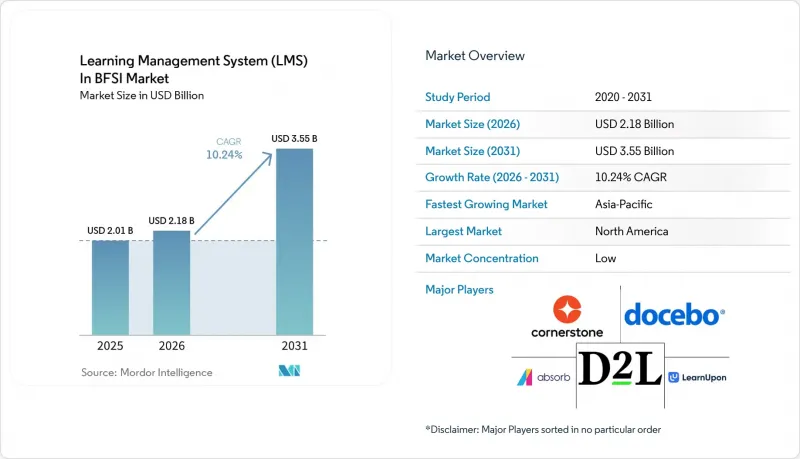
本報告按元件(軟體平台和服務)、部署模式(雲端、本地部署、混合部署)、交付模式(自主學習和遠距學習等)、應用程式(合規和監管培訓、反洗錢/了解你的客戶培訓等)、最終用戶(銀行、保險公司等)和地區進行細分。市場預測以美元計價。
全球銀行、金融服務與保險(BFSI)學習管理系統(LMS)市場趨勢與洞察
在整個銀行、金融服務和保險(BFSI)工作流程中實現監管合規的數位化
隨著監管機構對可審計、基於角色且與結果掛鉤的培訓記錄的要求日益提高,監管合規的數位化已成為銀行、金融服務和保險(BFSI)學習管理系統(LMS)市場的主要採購促進因素。當檢查人員質疑員工是否理解並應用必要的控制措施時,金融機構不能再僅依賴年度結業證書。美國金融業監理局(FINRA)2026年的檢查重點要求公司記錄「公司要素」培訓的適當性,驗證遠端完成情況,并快速反映監管更新,從而提升了具備強大審計功能和工作流程管理能力的系統的價值。歐洲對企業韌性的日益成長的期望也促使金融機構為所有受影響的員工群體維護最新的資訊通訊技術(ICT)風險學習和可驗證的培訓證據。在BFSI LMS市場,將內容完成情況與工作角色、監管規定和審核日期掛鉤的平台正在取代傳統的靜態認證程序。這種轉變意味著培訓預算的分配重點現在放在營運風險和測試應變準備上,而不是隨意的人員規劃。
擴大強制性網路安全和資料隱私培訓的範圍
由於金融機構面臨持續不斷的威脅、隱私義務和韌性要求,網路安全已成為銀行、金融服務和保險(BFSI)產業學習管理系統(LMS)培訓需求的核心。歐洲銀行管理局(EBA)的報告顯示,到2025年3月,82%的歐盟銀行將把網路風險和資料安全列為首要關注點,這表明數位風險的出現速度已經超過了許多傳統的營運重點。在美國,紐約州金融服務部(NYDFS)的第500部分框架強制要求所有受監管營業單位進行年度網路安全培訓,包括社交工程,從而支持持續的企業學習循環。此外,隨著聯邦金融監察委員會(FFIEC)關於網路安全意識提升的指導以及向NIST網路安全框架2.0的過渡,人們越來越期望培訓應該是持續的、有記錄的,而不是一次性的活動。美國貨幣監理署 (OCC) 發布的《2025 年韌性報告》指出,監管人員的培訓內容已涵蓋勒索軟體、分散式帳本技術和人工智慧驅動的欺詐,這表明受監管機構越來越需要達到這些標準。因此,能夠快速更新內容以符合監管發佈時間表的供應商,相比那些基於年度更新周期的平台,正獲得競爭優勢。
將傳統核心系統與人力資源資訊系統整合的複雜性。
舊有系統架構仍然是銀行、金融服務和保險 (BFSI) 學習管理系統 (LMS) 部署面臨的最明顯限制之一。這是因為部署品質仍然依賴跨傳統平台的身份、資料和使用者生命週期的一致性。許多銀行和保險公司同時使用多代人力資源資訊系統 (HRIS)、身份驗證系統和核心系統,而這些系統之間的不一致性會導致註冊資訊缺失、存取問題或合規記錄不完整。雖然使用原生連接器可以在幾週內完成整合,但與傳統本地系統的客製化整合可能需要數月時間,這可能會削弱快速採購決策的價值。 OnCourse Learning 指出,LMS 和 HRIS 整合失敗是自動註冊缺陷和檢查員審計中合規記錄缺失的主要原因,這使得整合深度成為一項業務風險,而不僅僅是技術上的不便。聯準會問責小組 (OIG) 在 2025 年審查報告中也指出了 IT 稽核工具的不一致性。這與金融機構在學習系統無法與其控制環境無縫整合時面臨的更廣泛的管治問題一致。這種限制在亞太和中東及非洲地區更為突出,這些地區本地開發的銀行系統往往缺乏全球學習管理系統供應商所期望的標準化介面。
細分市場分析
到2025年,軟體平台將佔組件細分市場的70%,核心平台層仍是銀行、金融和保險(BFSI)學習管理系統(LMS)市場最大的收入來源。這一主導地位源於培訓模式正從以課堂為中心的傳統模式轉向可擴展的數位化系統轉變,這種轉變遍及分店、業務部門和合規計畫。金融機構之所以優先考慮平台,是因為平台能夠記錄並集中管理審計追蹤,並能根據監管變化進行近乎即時的更新。簡而言之,平臺本身不再是可選項,而是大中型金融機構的基本需求。
預計到2031年,服務業將以11.52%的複合年成長率成長,成為銀行、金融服務和保險(BFSI)市場中,買家在學習管理系統(LMS)方面創造價值最高的領域。金融機構不僅購買軟體許可,還擴大購買實施支援、合規課程設計、在地化和學習營運管理服務。 FINRA的「FLEX」服務清楚地展現了平台基礎設施與合規內容服務的分離,使企業能夠存取預先創建的學習內容,並透過自身環境管理其交付。這種趨勢在中型銀行和保險公司中尤其明顯,這些公司需要快速滿足監管要求,但缺乏內部學習與發展(L&D)資源來設計和維護全面的合規課程。
截至2025年,基於雲端的部署將佔BFSI(銀行、金融服務和保險)學習管理系統(LMS)市場的68.23%,預計到2031年將以11.53%的複合年成長率成長。這反映了能夠在認證高峰期擴展規模、支援行動存取並為合規官提供統一的跨站點報告視圖的系統所具有的營運價值。雲端基礎設施是BFSI市場LMS的首選,因為監管機構和內部控制團隊要求提供證據,證明培訓內容能夠在指南變更時快速部署。雲端系統也與更廣泛的企業軟體堆疊具有更高的相容性,尤其是在金融機構希望將學習資料與人力資源、績效評估和存取管理系統整合時。
對於擁有嚴格內部託管政策的金融機構,尤其是國有銀行和受監管機構而言,本地部署仍然是至關重要的選擇,因為它們需要在國內基礎設施中保存高度敏感的員工記錄。因此,利用雲端交付來確保速度、覆蓋範圍和彈性,同時將學習者資料保留在國內的混合部署方案正日益受到關注。 AWS 的「歐洲主權雲端」舉措證實,受監管的買家現在期望採用能夠感知資料居住的架構,以支援混合和主權雲端採購模式。在銀行、金融服務和保險 (BFSI) 行業的學習管理系統 (LMS) 領域,這可能意味著,長期的贏家將是構建於區域合規要求之上的託管雲端架構,而不是純粹的雲端或純粹的本地部署模式。
區域分析
到2025年,北美將佔銀行、金融服務和保險(BFSI)學習管理系統(LMS)市場佔有率的38.12%,成為最大的區域佔有率。該地區合規性仍然是推動LMS普及的主要因素,因為金融機構在聯邦、自我規範和州三級層級都面臨重疊的培訓要求。紐約州金融服務部第500部分法規要求符合資格的企業每年接受網路安全培訓,從而促進持續學習循環並加強審計文件記錄。美國金融業監理局(FINRA)目前的檢查重點是及時更新培訓內容、遠端完成情況驗證以及「公司要素」計畫的適當性文件記錄,所有這些都將學習基礎設施與監管結構的準備情況緊密聯繫起來。
歐洲是銀行、金融服務和保險(BFSI)學習管理系統(LMS)的主要需求中心。這是因為金融機構必須應對與營運韌性、行為準則、隱私權和國家銀行保密法相關的許多重疊義務。該地區的合規要求催生了資訊通訊技術(ICT)風險、客戶服務、產品管治和數據處理等領域的培訓需求,從而提升了具備強大課程映射和證據管理能力的平台的價值。歐洲的營運韌性要求促使金融機構更頻繁地研究資訊通訊技術風險,不再局限於每年更新的模式。在南美洲,隨著金融機構在分散式分店網路和數位管道中標準化合規計劃,資訊通訊技術風險的重要性也日益凸顯,儘管其應用仍不如北美和歐洲成熟。
預計到2031年,亞太地區將以12.84%的複合年成長率成長,成為銀行、金融服務和保險(BFSI)學習管理系統(LMS)市場成長最快的區域板塊。這一成長主要得益於東協和南亞監理體系的日趨成熟,以及銀行業、金融科技和保險科技業從業人員的快速擴張。新加坡於2025年11月發布的《人工智慧風險管理指南》要求金融機構記錄並確保參與人工智慧開發和部署人員的勝任能力,從而為管治和監督建立清晰的培訓需求週期。在中國,系統性學習正透過正規的學分和認證途徑不斷深化,保險管道的培訓也正透過認證的線上課程逐步製度化。在中東,部署主要集中在沿岸地區的金融中心,這些地區對網路安全和風險管理的強制性培訓要求更為嚴格。而非洲仍處於起步階段,非常適合「行動優先」的部署模式,以支援不斷擴展的數位支付和代理銀行網路。
其他好處:
- Excel格式的市場預測(ME)表
- 3個月的分析師支持
目錄
第1章:引言
- 研究假設和市場定義
- 調查範圍
第2章:調查方法
第3章執行摘要
第4章 市場狀況
- 市場概覽
- 宏觀經濟因素對市場的影響
- 市場促進因素
- 實現整個銀行、金融服務和保險(BFSI)工作流程的監管合規數位化
- 提高網路安全和資料隱私方面的培訓要求
- 數位銀行和保險科技領域對技能發展的需求正在加速成長。
- 分散式辦公團隊中基於雲端的學習採用現狀
- 人工智慧素養和模型風險管治。
- 代理商、仲介、顧問和合作夥伴的擴展企業培訓
- 市場限制因素
- 將傳統核心系統與人力資源資訊系統整合的複雜性。
- 受監管學習工作流程中資料儲存位置和資訊安全的擔憂
- 由於監管變化的不斷循環,導致訓練疲勞。
- 跨多個司法管轄區的規則集和產品分類系統本地化的負擔。
- 產業價值鏈分析
- 監理情勢
- 技術展望
- 波特五力分析
第5章 市場規模與成長預測
- 按組件
- 軟體平台
- 服務
- 部署模式
- 基於雲端的
- 現場
- 混合
- 透過串流媒體模式
- 自主學習與遠距學習
- 講師主導式培訓
- 混合式學習
- 行動微學習
- 透過使用
- 合規和監管培訓
- 反洗錢/了解你的客戶培訓
- 產品培訓
- 流程和操作培訓
- 風險、詐欺和網路安全的培訓
- 客戶教育和合作夥伴支持
- 入職
- 銷售賦能
- 領導力與諮商培訓
- 認證和繼續教育
- 最終用戶
- 銀行
- 保險公司
- 資本市場和資產管理公司
- 金融科技和支付服務供應商
- 信用合作社和合作金融機構
- 非銀行金融機構(NBFC)和貸款機構
- 按地區
- 北美洲
- 美國
- 加拿大
- 墨西哥
- 南美洲
- 巴西
- 阿根廷
- 智利
- 其他南美國家
- 歐洲
- 英國
- 德國
- 法國
- 義大利
- 西班牙
- 其他歐洲國家
- 亞太地區
- 中國
- 日本
- 印度
- 韓國
- 澳洲
- 新加坡
- 其他亞太國家
- 中東
- 沙烏地阿拉伯
- 阿拉伯聯合大公國
- 其他中東國家
- 非洲
- 南非
- 奈及利亞
- 其他非洲國家
- 北美洲
第6章 競爭情勢
- 市場集中度
- 策略趨勢
- 市佔率分析
- 公司簡介。
- Cornerstone OnDemand, Inc.
- Docebo Inc.
- D2L Corporation
- Absorb Software Inc.
- LearnUpon Limited
- 360Learning SA
- Epignosis LLC
- Intellum, Inc.
- Thought Industries, Inc.
- iSpring Solutions, Inc.
- Learning Pool Limited
- Heuristix Digital Technologies Private Limited
- Paradiso Solutions LLC
- Neovation Inc.
- TOVUTI, INC.
- SkyPrep Inc.
- Skillcast Group plc
- LearnWorlds(CY)Ltd
- Schoox, LLC
- DigitalChalk
第7章 市場機會與未來展望
According to Mordor Intelligence, the learning management system (LMS) in the BFSI Market is expected to increase from USD 2.01 billion in 2025 to USD 2.18 billion in 2026, and reach USD 3.55 billion by 2031, growing at a CAGR of 10.24% over 2026-2031.
This report is Segmented by Component (Software Platforms and Services), Deployment Mode (Cloud-Based, On-Premises, and Hybrid), Delivery Mode (Self-Paced and Distance Learning, and More), Application (Compliance and Regulatory Training, AML/KYC Training, and More), End User (Banks, Insurance Firms, and More), and Geography. The Market Forecasts are Provided in Terms of Value (USD).
Global Learning Management System (LMS) In BFSI Market Trends and Insights
Regulatory Compliance Digitization Across BFSI Workflows
Regulatory compliance digitization has become the primary purchase trigger in the LMS market for the BFSI industry, as supervisors now demand auditable, role-based, and outcome-linked training records. Financial institutions can no longer rely on annual completion certificates when examiners ask whether staff understood and applied the required controls. FINRA's 2026 examination priorities require firms to document the adequacy of Firm Element training, verify remote completion, and integrate regulatory updates promptly, which raises the value of systems with strong audit features and workflow discipline. European resilience expectations have also increased pressure on institutions to maintain current ICT risk learning and defensible training evidence across affected staff groups. In the LMS market in BFSI, platforms that map content completion to job roles, regulatory clauses, and review calendars are steadily replacing static certification routines. This shift keeps training budgets tied to operational risk and examination readiness rather than to discretionary HR planning.
Rising Cybersecurity And Data Privacy Training Mandates
Cybersecurity has moved to the center of training demand in the LMS in the BFSI market because institutions now face a constant stream of threats, privacy obligations, and resilience requirements. The European Banking Authority reported that 82% of EU banks identified cyber risk and data security as their primary concern in March 2025, showing how digital risk has overtaken many traditional operational priorities. In the United States, the New York State Department of Financial Services Part 500 framework requires annual cybersecurity training covering social engineering for all covered entities, supporting recurring enterprise learning cycles. The FFIEC's cybersecurity awareness guidance and the move toward NIST Cybersecurity Framework 2.0 have also strengthened the expectation that training be ongoing and documented rather than event-based. The OCC's 2025 resilience report showed that examiner training already includes ransomware, distributed ledger technology, and AI-enabled fraud, signaling that supervised institutions are increasingly expected to meet this standard. Vendors that can update content quickly in line with regulatory publication calendars are therefore gaining an edge over platforms built around annual refresh cycles.
Legacy Core System And HRIS Integration Complexity
Legacy system architecture remains one of the clearest brakes on the LMS in the BFSI market because implementation quality still depends on identity, data, and user lifecycle connections across old platforms. Many banks and insurers operate with several generations of HRIS, authentication, and core systems, and each mismatch can create missing enrollments, access issues, or incomplete compliance records. When native connectors are available, integration can move in weeks, but custom integration with older self-hosted systems can extend implementation timelines into months and undermine the value of fast procurement decisions. OnCourse Learning identified LMS-HRIS integration failures as a leading cause of auto-enrollment gaps and missing compliance records in examiner reviews, making integration depth a business risk rather than a technical inconvenience. The Federal Reserve OIG also pointed to inconsistent IT examination tooling in its 2025 review, which aligns with the broader governance problems institutions face when learning systems do not connect cleanly to control environments. This restraint is sharper in Asia-Pacific and the Middle East and Africa, where locally built banking systems often lack the standardized interfaces expected by global LMS vendors.
Other drivers and restraints analyzed in the detailed report include:
- Accelerating Digital Banking And Insurtech Upskilling Needs
- Cloud-Based Learning Adoption Across Distributed Workforces
- Data Residency And Information Security Concerns In Regulated Learning Workflows
For complete list of drivers and restraints, kindly check the Table Of Contents.
Segment Analysis
Software platforms retained 70% of the component segment in 2025, keeping the core platform layer as the largest revenue base in the LMS market in BFSI. This lead came from the continued shift away from classroom-heavy delivery toward digital systems that can scale across branches, business lines, and compliance programs. Institutions value the platform because it supports audit trails, centralized administration, and near-real-time updates when rules change. That means the platform itself has become a basic requirement for large and mid-sized financial organizations rather than a discretionary tool.
Services are forecast to grow at a 11.52% CAGR through 2031, indicating where buyers are adding the most incremental value around the LMS in the BFSI market. Financial institutions increasingly purchase implementation support, compliance curriculum design, localization, and managed learning operations together with the software license. FINRA's FLEX offering illustrates this split between platform infrastructure and compliance content services because firms can access pre-built learning content while still managing delivery through their own environments. This pattern is strongest among mid-tier banks and insurers that need quick regulatory readiness but lack internal L&D resources to design and maintain a comprehensive compliance curriculum.
Cloud-based deployment accounted for 68.23% of the LMS market in the BFSI market in 2025 and is projected to expand at a 11.53% CAGR through 2031. This position reflects the operational value of systems that can scale during certification peaks, support mobile access, and give compliance leaders a unified reporting view across locations. In the BFSI market, LMSs have favored cloud infrastructure because regulators and internal control teams want evidence that training changes can be distributed quickly when guidance changes. Cloud systems also align better with broader enterprise software stacks, especially when institutions want learning data connected to HR, performance, and access management systems.
On-premises deployments remain relevant for institutions with strict internal hosting policies, especially state-linked banks and regulated entities that retain sensitive employee records within domestic infrastructure. Hybrid deployment is therefore gaining traction because it lets institutions keep learner data in-country while using cloud delivery for speed, reach, and resilience. AWS's European Sovereign Cloud initiative confirms that regulated buyers now expect residency-aware architecture, which supports hybrid and sovereign-ready procurement models. In the LMS in the BFSI industry, this means the long-term winner is less likely to be a pure cloud or pure on-premises model and more likely to be a controlled cloud architecture built around regional compliance needs.
Complete Report Scope:
- By Component
- Software Platforms
- Services
- By Deployment Mode
- Cloud-Based
- On-Premises
- Hybrid
- By Delivery Mode
- Self-Paced and Distance Learning
- Instructor-Led Training
- Blended Learning
- Mobile Microlearning
- By Application
- Compliance and Regulatory Training
- AML/KYC Training
- Product Training
- Process and Operational Training
- Risk, Fraud and Cybersecurity Training
- Customer Education and Partner Enablement
- Onboarding
- Sales Enablement
- Leadership and Advisory Training
- Certification and Continuing Education
- By End User
- Banks
- Insurance Firms
- Capital Markets and Wealth Management Firms
- Fintech and Payment Service Providers
- Credit Unions and Cooperative Financial Institutions
- NBFCs and Lending Institutions
- By Geography
- North America
- United States
- Canada
- Mexico
- South America
- Brazil
- Argentina
- Chile
- Rest of South America
- Europe
- United Kingdom
- Germany
- France
- Italy
- Spain
- Rest of Europe
- Asia-Pacific
- China
- Japan
- India
- South Korea
- Australia
- Singapore
- Rest of Asia-Pacific
- Middle East
- Saudi Arabia
- United Arab Emirates
- Rest of Middle East
- Africa
- South Africa
- Nigeria
- Rest of Africa
- North America
Geography Analysis
North America accounted for 38.12% of the global LMS market in the BFSI market in 2025, making it the largest regional contributor. The region remains the most compliance-driven adoption environment because institutions operate under overlapping federal, self-regulatory, and state training expectations. The New York State Department of Financial Services Part 500 regulation requires covered entities to complete annual cybersecurity training, which supports recurring learning cycles and stronger audit documentation. FINRA's current examination priorities add to this pressure by emphasizing timely training updates, remote completion verification, and documented adequacy of Firm Element programs, all of which keep learning infrastructure tied to supervisory readiness.
Europe is a major demand center for LMSs in the BFSI market because institutions must manage overlapping obligations tied to operational resilience, conduct, privacy, and national banking secrecy rules. The region's compliance stack creates training demand across ICT risk, consumer treatment, product governance, and data handling, which increases the value of platforms with stronger curriculum mapping and evidence controls. European operational resilience requirements have pushed institutions toward more frequent ICT risk learning and away from annual refresh-only models. South America is also becoming more relevant as financial institutions standardize compliance programs across dispersed branch networks and digital channels, even though adoption remains less mature than in North America and Europe.
Asia-Pacific is projected to grow at a 12.84% CAGR through 2031, making it the fastest-expanding regional block in the LMS BFSI market. Growth comes from stronger regulatory maturity in ASEAN and South Asia and from rapid workforce expansion in banking, fintech, and insurtech. Singapore's AI risk management guidelines, published in November 2025, require financial institutions to ensure documented competency among personnel involved in AI development and deployment, thereby creating a clear training demand cycle for governance and oversight. China is also deepening structured learning through formal credit hours and certification pathways, while insurance channel training is being institutionalized through accredited online programs. In the Middle East, adoption is concentrated in Gulf financial centers with stronger cyber and risk training mandates, while Africa remains earlier stage and is better suited to mobile-first deployments that can support expanding digital payments and agent banking networks.
- Cornerstone OnDemand, Inc.
- Docebo Inc.
- D2L Corporation
- Absorb Software Inc.
- LearnUpon Limited
- 360Learning SA
- Epignosis LLC
- Intellum, Inc.
- Thought Industries, Inc.
- iSpring Solutions, Inc.
- Learning Pool Limited
- Heuristix Digital Technologies Private Limited
- Paradiso Solutions LLC
- Neovation Inc.
- TOVUTI, INC.
- SkyPrep Inc.
- Skillcast Group plc
- LearnWorlds (CY) Ltd
- Schoox, LLC
- DigitalChalk
Additional Benefits:
- The market estimate (ME) sheet in Excel format
- 3 months of analyst support
TABLE OF CONTENTS
1 INTRODUCTION
- 1.1 Study Assumptions and Market Definition
- 1.2 Scope of the Study
2 RESEARCH METHODOLOGY
3 EXECUTIVE SUMMARY
4 MARKET LANDSCAPE
- 4.1 Market Overview
- 4.2 Impact of Macroeconomic Factors on the Market
- 4.3 Market Drivers
- 4.3.1 Regulatory Compliance Digitization Across BFSI Workflows
- 4.3.2 Rising Cybersecurity and Data Privacy Training Mandates
- 4.3.3 Accelerating Digital Banking and Insurtech Upskilling Needs
- 4.3.4 Cloud-Based Learning Adoption Across Distributed Workforces
- 4.3.5 AI Literacy and Model Risk Governance Training Demand
- 4.3.6 Extended Enterprise Training for Agents, Brokers, Advisors, and Partners
- 4.4 Market Restraints
- 4.4.1 Legacy Core System and HRIS Integration Complexity
- 4.4.2 Data Residency and Information Security Concerns in Regulated Learning Workflows
- 4.4.3 Training Fatigue From Always-On Regulatory Change Cycles
- 4.4.4 Localization Burden Across Multi-Jurisdiction Rulebooks and Product Taxonomies
- 4.5 Industry Value Chain Analysis
- 4.6 Regulatory Landscape
- 4.7 Technological Outlook
- 4.8 Porter's Five Forces Analysis
- 4.8.1 Bargaining Power of Buyers
- 4.8.2 Bargaining Power of Suppliers
- 4.8.3 Threat of New Entrants
- 4.8.4 Threat of Substitutes
- 4.8.5 Intensity of Competitive Rivalry
5 MARKET SIZE AND GROWTH FORECASTS (VALUE)
- 5.1 By Component
- 5.1.1 Software Platforms
- 5.1.2 Services
- 5.2 By Deployment Mode
- 5.2.1 Cloud-Based
- 5.2.2 On-Premises
- 5.2.3 Hybrid
- 5.3 By Delivery Mode
- 5.3.1 Self-Paced and Distance Learning
- 5.3.2 Instructor-Led Training
- 5.3.3 Blended Learning
- 5.3.4 Mobile Microlearning
- 5.4 By Application
- 5.4.1 Compliance and Regulatory Training
- 5.4.2 AML/KYC Training
- 5.4.3 Product Training
- 5.4.4 Process and Operational Training
- 5.4.5 Risk, Fraud and Cybersecurity Training
- 5.4.6 Customer Education and Partner Enablement
- 5.4.7 Onboarding
- 5.4.8 Sales Enablement
- 5.4.9 Leadership and Advisory Training
- 5.4.10 Certification and Continuing Education
- 5.5 By End User
- 5.5.1 Banks
- 5.5.2 Insurance Firms
- 5.5.3 Capital Markets and Wealth Management Firms
- 5.5.4 Fintech and Payment Service Providers
- 5.5.5 Credit Unions and Cooperative Financial Institutions
- 5.5.6 NBFCs and Lending Institutions
- 5.6 By Geography
- 5.6.1 North America
- 5.6.1.1 United States
- 5.6.1.2 Canada
- 5.6.1.3 Mexico
- 5.6.2 South America
- 5.6.2.1 Brazil
- 5.6.2.2 Argentina
- 5.6.2.3 Chile
- 5.6.2.4 Rest of South America
- 5.6.3 Europe
- 5.6.3.1 United Kingdom
- 5.6.3.2 Germany
- 5.6.3.3 France
- 5.6.3.4 Italy
- 5.6.3.5 Spain
- 5.6.3.6 Rest of Europe
- 5.6.4 Asia-Pacific
- 5.6.4.1 China
- 5.6.4.2 Japan
- 5.6.4.3 India
- 5.6.4.4 South Korea
- 5.6.4.5 Australia
- 5.6.4.6 Singapore
- 5.6.4.7 Rest of Asia-Pacific
- 5.6.5 Middle East
- 5.6.5.1 Saudi Arabia
- 5.6.5.2 United Arab Emirates
- 5.6.5.3 Rest of Middle East
- 5.6.6 Africa
- 5.6.6.1 South Africa
- 5.6.6.2 Nigeria
- 5.6.6.3 Rest of Africa
- 5.6.1 North America
6 COMPETITIVE LANDSCAPE
- 6.1 Market Concentration
- 6.2 Strategic Moves
- 6.3 Market Share Analysis
- 6.4 Company Profiles (includes Global Level Overview, Market Level Overview, Core Segments, Financials as available, Strategic Information, Market Rank/Share, Products and Services, Recent Developments).
- 6.4.1 Cornerstone OnDemand, Inc.
- 6.4.2 Docebo Inc.
- 6.4.3 D2L Corporation
- 6.4.4 Absorb Software Inc.
- 6.4.5 LearnUpon Limited
- 6.4.6 360Learning SA
- 6.4.7 Epignosis LLC
- 6.4.8 Intellum, Inc.
- 6.4.9 Thought Industries, Inc.
- 6.4.10 iSpring Solutions, Inc.
- 6.4.11 Learning Pool Limited
- 6.4.12 Heuristix Digital Technologies Private Limited
- 6.4.13 Paradiso Solutions LLC
- 6.4.14 Neovation Inc.
- 6.4.15 TOVUTI, INC.
- 6.4.16 SkyPrep Inc.
- 6.4.17 Skillcast Group plc
- 6.4.18 LearnWorlds (CY) Ltd
- 6.4.19 Schoox, LLC
- 6.4.20 DigitalChalk
7 MARKET OPPORTUNITIES AND FUTURE OUTLOOK
- 7.1 White-Space and Unmet-Need Assessment

 神經多樣性職場培訓解決方案市場預測至2034年-按解決方案類型、交付方式、目標狀態、組織規模、最終用戶和地區分類的全球分析員工培訓市場預測至2034年-按培訓類型、交付方式、組織規模、產業和地區分類的全球分析
 製造業學習管理系統(LMS):市場佔有率分析、產業趨勢與統計及成長預測(2026-2031)到 2034 年,以神經多樣性為重點的企業培訓專案的市場預測:按培訓類型、交付形式、經營模式、最終用戶和地區進行的全球分析。創新技能學習平台市場預測至2034年-全球分析(按組件、技能類型、交付方式、平台類型、最終用戶和地區分類)
 K-12輔導市場報告:趨勢、預測與競爭分析(至2031年)神經包容性職場平台市場預測至2032年:按平台類型、部署類型、組織規模、最終用戶和地區分類的全球分析
 K-12教育輔導服務:全球市場佔有率和排名、總收入和需求預測(2025-2031年)