


 |
市場調查報告書
商品編碼
2073228
線上服裝:市場佔有率分析、產業趨勢與統計、成長預測(2026-2031)Online Apparel - Market Share Analysis, Industry Trends & Statistics, Growth Forecasts (2026 - 2031) |
||||||

※ 本網頁內容可能與最新版本有所差異。詳細情況請與我們聯繫。
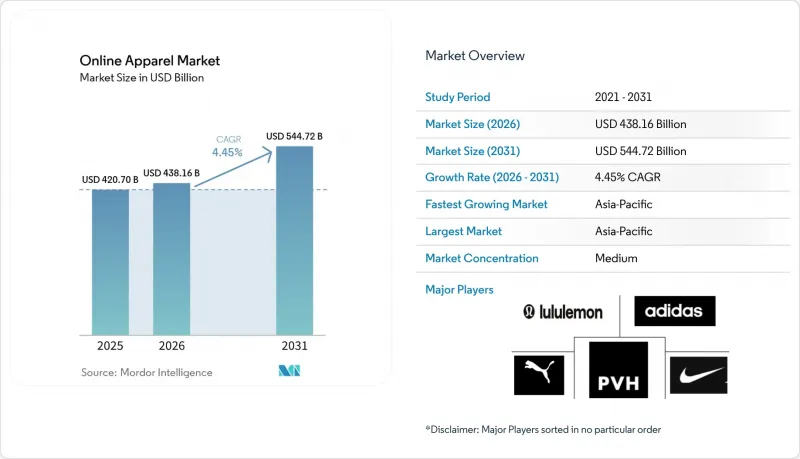
根據 Mordor Intelligence 預測,線上服裝市場規模將從 2025 年的 4,207 億美元和 2026 年的 4,382 億美元成長到 2031 年的 5,447 億美元,2026 年至 2031 年的年複合成長率(CAGR)為 4.5%。
本報告按產品類型(正裝、休閒裝、運動裝等)、最終用戶(男士、女士等)、布料材質(棉、聚酯等)、品類(大眾市場和高階市場)、分銷管道(第三方零售平台和企業自營平台)以及地區(北美、歐洲、亞太等)進行細分。市場預測以美元計價。
全球線上服裝市場趨勢及洞察
社群媒體對時尚潮流的影響日益增強
如今,社交平臺在很大程度上影響著消費者在服裝線上市場尋找服裝、比較搭配以及完成購買的方式。這項轉變意義重大,因為消費者現在可以在同一管道內獲取靈感、查看推薦並完成支付,無需再訪問多個網站。這縮短了購買週期,使得與內容創作者的合作對於那些需要在競爭激烈的時尚領域中快速提升品牌知名度的品牌而言變得至關重要。線上服裝市場趨勢週期的加速以及由此導致的季節性規劃時間的減少,也給商品行銷團隊帶來了壓力。擁有靈活採購管道和快速內容更新能力的品牌,在將用戶關注度轉化為實際轉換方面更具優勢。同時,那些仍依賴經常落後的規劃日曆的品牌,在社群媒體主導、需求瞬息萬變的環境中,顯然處於劣勢。
行動商務和購物應用程式的擴展
目前,線上服裝市場的瀏覽和購買行為正逐漸向行動裝置轉移,尤其是年輕消費者,他們在品牌應用、電商平台應用和短影片平台上花費的時間越來越多。這種轉變有利於那些能夠減少購買摩擦、儲存支付資訊並透過推播通知和個人化資訊流持續引導用戶發現產品的介面。應用程式留存率也變得越來越重要,因為成功的平台並非僅僅排名靠前,而是能夠長期留在用戶主搜尋上。日本的情況就充分體現了這種轉變,預計到2024年,日本服飾電商滲透率將達到23.38%,幾乎是2019年的兩倍。這一趨勢表明,即使在數位市場成熟的國家,隨著用戶習慣向應用主導購物模式轉變,線上滲透率仍有進一步提升的空間。在線上服飾市場,增強行動端用戶參與度也有助於品牌嘗試快速發布新品、動態定價和更精準的產品建議。
仿冒服飾產品損害消費者信任。
仿冒品的氾濫持續削弱消費者對線上服飾市場的信任,因為消費者往往在正品品牌努力創造需求的同一數位環境中發現仿冒品。美國服裝鞋類協會 (AAFA) 於 2025 年舉辦的一場聚焦仿冒品的會議顯示,61% 的仿冒品購買者並非有意為之,而這些無意購買的商品中,52% 是假冒時尚單品。皮尤研究中心的一項調查也發現,17% 的美國成年人在網路上購買仿冒品後未能獲得退款,85% 的人認為網路購物詐騙是一個嚴重的問題。這種損害並非僅限於單次訂單。仿冒品的糟糕體驗會降低復購率,並損害消費者對整個線上服裝市場的信任。歐盟智慧財產局也指出,服裝是全球貿易中查獲仿冒品最多的仿冒品之一。品牌和平台如果大力投資賣家驗證、監控和快速移除,就能更有效保護其轉換率和重購率。
細分市場分析
到2025年,休閒服飾將佔據線上服裝市場38.06%的佔有率,在目前的銷售額方面顯著超越所有其他產品類別。這項領先優勢源自於其廣泛的適用場景。休閒服飾用途廣泛,包括遠距辦公、混合生活方式、旅行和日常穿著,無需專門的衣櫃。其優勢還在於豐富的SKU選擇、頻繁的補貨以及對眾多回頭客而言較低的購買門檻。在線上服裝市場,休閒服飾尤其適合搜尋、篩選和建議工具。這是因為消費者通常會根據款式、價格和顏色瀏覽產品,而不是針對正式場合。即使時尚潮流瞬息萬變,這一細分市場的規模也能對整體銷售額起到穩定作用。
預計2026年至2031年間,運動服飾的複合年成長率將達到6.35%,超過線上服飾市場的整體成長率。這一高成長率得益於運動服與日常服裝界線的日益模糊,使得運動服的需求不再局限於健身房和訓練場所。 Mordor Intelligence預測,到2031年,整個運動服飾市場將持續保持強勁成長,並指出線上管道,尤其是數位優先消費者群體,擁有顯著的成長動能。由於活動主導需求相對較少,且消費者高度重視合身度,正裝的復甦速度較為緩慢。睡衣、家居服和內衣仍然佔據重要地位,因為它們能夠促進重複購買,並且在數位銷售中相對容易實現標準化。在整個線上服裝市場中,與那些嚴重依賴特定場合需求的品牌相比,那些能夠提供休閒裝、運動裝和日常補貨主導產品均衡組合的品牌,更有可能更好地適應市場波動。
2025年,女裝銷售額將佔線上服裝總銷售額的52.33%,成為線上服裝市場最大的終端用戶群體,且優勢顯著。這一規模反映了女裝產品種類更加豐富、瀏覽頻率更高,以及消費者在平價、高階和主導品類中更強烈的參與度。此外,女裝的購買用途也更加多元化,涵蓋了工作服、休閒服、禮服、內衣和休閒等。在線上服裝市場,這種廣泛的產品範圍增加了搜尋和建議的機會,從而提升了購物車金額和復購率。同時,這也為平台和品牌開發促銷活動、忠誠度計畫和內容創作者主導的宣傳活動提供了更廣闊的平台。
預計到2031年,童裝市場將以5.62%的複合年成長率成長,成為終端用戶細分市場中成長前景最為強勁的領域。兒童快速的體型變化以及比成人更頻繁的服裝更新需求,推動了童裝市場的定期更換週期,從而支撐了這一市場需求。 Mordor Intelligence也指出,在網路使用率不斷提高以及各種數位化工具的普及(這些工具能夠有效解決尺寸選擇方面的顧慮)的推動下,童裝市場預計將在2031年之前繼續保持強勁成長。男裝市場也呈現穩定成長態勢,這得益於消費者對休閒和基本款服裝日益成長的興趣,以及便捷的補貨方式,這些因素共同促進了線上購物的發展。在整個線上服飾市場中,那些能夠提供便利購物體驗、精準尺寸指南和快速產品搜尋功能的品牌,正贏得終端用戶的青睞。
區域分析
亞太地區預計到2025年將佔全球線上服飾市場規模的34.81%,並預計到2031年將以6.31%的複合年成長率成長,成為規模最大且成長最快的區域市場。中國憑藉其強大的平台生態系統、對線上時尚購物的高度親和性以及內容主導電商的日益普及,仍然是該地區的核心參與者。印度的線上零售滲透率雖然仍低於中國,但隨著其不斷吸引新的線上服裝用戶,仍有巨大的成長空間。東南亞也推動區域成長,其時尚需求與行動裝置使用、限時搶購和網主導推廣密切相關。在日本,服飾電商滲透率預計到2024年將達到23.38%,這顯示即使在成熟的區域市場,服飾電商仍有成長空間。
到2025年,北美和歐洲將分別成為全球第二和第三大區域叢集,這兩個地區的線上服裝市場都擁有強大的數位基礎設施和更成熟的消費群體。儘管這些市場仍然是重要的收入來源,但由於消費者已經養成線上購物的習慣,其成長速度有所放緩。在消費者期望折扣、快速配送和便利退貨的領域,這些地區的競爭尤其激烈。在歐洲,更嚴格的包裝和合規要求增加了營運壓力,這可能會導致依賴高出貨量的跨境時尚經銷商成本上升。總而言之,這意味著在北美和歐洲的線上服裝市場,客戶維繫、效率提升以及平台和品牌間的市場佔有率轉移,比新進入者帶來的挑戰更為重要。
儘管南美洲和中東及非洲(MEA)地區的當前市場規模較小,但由於平台擴張和主導消費的成長,其線上服飾市場蘊藏著巨大的成長潛力。這些地區許多國家擁有以年輕人為主的數位用戶群體,因此基於應用程式的產品發現功能在服裝行業中尤為重要。預計到2025年,時尚服飾在MEA地區的B2C電子商務銷售額中將佔到25.96%,這表明其在該地區線上需求中已佔據核心地位。此外,南美和MEA地區為區域和本土品牌提供了與全球公司競爭的機會,這些品牌可以透過在地化內容、靈活的支付方式以及快速適應當地時尚潮流來實現這一目標。因此,儘管這兩個地區目前的市場規模落後於成熟的主要地區,但它們代表著線上服裝市場的巨大長期成長潛力。
其他好處:
- Excel格式的市場預測(ME)表
- 3個月的分析師支持
目錄
第1章:引言
- 研究假設和市場定義
- 調查範圍
第2章:調查方法
第3章執行摘要
第4章 市場狀況
- 市場概覽
- 市場促進因素
- 社群媒體對時尚潮流的影響日益增強
- 行動商務和購物應用程式的擴展
- 頻繁的折扣和促銷定價策略
- 方便比較多個品牌的產品
- 我們便捷的退換貨政策鼓勵消費者購買商品。
- 全通路零售模式正變得越來越受歡迎。
- 市場限制因素
- 假冒服裝產品正在損害消費者信任。
- 網上購物時對尺寸和合身度的擔憂
- 消費者對資料隱私和網路安全的擔憂
- 人們越來越關注永續性和包裝廢棄物
- 消費者需求分析
- 監理情勢
- 技術展望
- 波特五力分析
第5章 市場規模與成長預測
- 產品類型
- 正裝
- 休閒裝
- 運動服
- 睡衣/家居服
- 內衣
- 其他產品類型
- 最終用戶
- 男性
- 女士
- 孩子們
- 布料
- 棉布
- 聚酯纖維
- 尼龍
- 丹寧布料
- 其他布料類型
- 類別
- 鱒魚
- 優質的
- 銷售管道
- 第三方零售平台
- 我們自己的平台
- 地區
- 北美洲
- 美國
- 加拿大
- 墨西哥
- 其他北美國家
- 歐洲
- 德國
- 英國
- 義大利
- 法國
- 西班牙
- 荷蘭
- 波蘭
- 比利時
- 瑞典
- 其他歐洲國家
- 亞太地區
- 中國
- 印度
- 日本
- 澳洲
- 印尼
- 韓國
- 泰國
- 新加坡
- 其他亞太國家
- 南美洲
- 巴西
- 阿根廷
- 哥倫比亞
- 智利
- 秘魯
- 其他南美國家
- 中東和非洲
- 南非
- 沙烏地阿拉伯
- 阿拉伯聯合大公國
- 奈及利亞
- 埃及
- 摩洛哥
- 土耳其
- 其他中東和非洲國家
- 北美洲
第6章 競爭情勢
- 市場集中度
- 策略趨勢
- 市佔率分析
- 公司簡介
- VF Corporation
- H&M Group
- Fast Retailing Co., Ltd.
- Nike, Inc.
- Adidas AG
- Roadget Business Pte. Ltd.
- Inditex
- Puma SE
- Kering SA
- LVMH Moet Hennessy Louis Vuitton SE
- PVH Corp.
- Levi Strauss & Co.
- Gap Inc.
- Lululemon Athletica Inc.
- Ralph Lauren Corporation
- American Eagle Outfitters, Inc.
- Hanesbrands Inc.
- Under Armour, Inc.
- Hugo Boss AG
- Columbia Sportswear Company
第7章 市場機會與未來展望
According to Mordor Intelligence, the online apparel market size is projected to expand from USD 420.7 billion in 2025 and USD 438.2 billion in 2026 to USD 544.7 billion by 2031, registering a CAGR of 4.5% between 2026 and 2031.
This report is Segmented by Product Type (Formal Wear, Casual Wear, Sportswear, and More), End-User (Men, Women, and More), Fabric Material (Cotton, Polyester, and More), Category (Mass and Premium), Distribution Channel (Third-Party Retailer Platform and Company-Owned Platform), and Geography (North America, Europe, Asia-Pacific, and More). The Market Forecasts are Provided in Terms of Value (USD).
Global Online Apparel Market Trends and Insights
Growing Influence of Social Media Fashion Trends
Social platforms now shape a large part of how consumers discover clothing, compare looks, and complete purchases in the online apparel market. The shift matters because the same channel can now handle inspiration, recommendation, and checkout without forcing shoppers to move across several sites. That shortens the buying cycle and makes creator partnerships more important for brands that need quick visibility in crowded fashion categories. It also puts pressure on merchandising teams, because trend cycles now move faster and leave less time for seasonal planning in the online apparel market. Brands with flexible sourcing and faster content refresh rates are in a better position to turn rising attention into conversion. Brands that still depend on slower planning calendars face a clear disadvantage when social-led demand shifts within days.
Expansion of Mobile Commerce and Shopping Apps
Mobile devices are now central to browsing and purchasing behavior in the online apparel market, especially where younger shoppers spend more time inside brand apps, marketplace apps, and short-video feeds. This shift favors interfaces that reduce friction, store payment details, and keep product discovery active through push notifications and personalized feeds. It also raises the importance of app retention, because the winning platform is often the one that stays on the customer's home screen rather than the one that ranks highest in search. Japan offers a clear signal of this transition, as apparel e-commerce penetration reached 23.38% in 2024, almost double the 2019 level . That pattern shows how even developed digital markets still have room for deeper online penetration when user habits shift toward app-led buying. In the online apparel market, stronger mobile engagement also helps brands test faster launches, dynamic pricing, and more precise product recommendations.
Counterfeit Apparel Products Reducing Consumer Trust
Counterfeit exposure continues to weaken trust in the online apparel market because shoppers often discover fake products inside the same digital environments where legitimate brands are trying to build demand. A 2025 counterfeit-focused session hosted by the American Apparel & Footwear Association showed that 61% of buyers of fake goods did so unintentionally, and 52% of those unintentional purchases were fake fashion items . Pew Research Center also found that 17% of U.S. adults bought a counterfeit product online and were not refunded, while 85% saw online shopping scams as a significant problem. The damage extends beyond a single order because a poor counterfeit experience can lower repeat buying and reduce trust in the broader online apparel market. The European Union Intellectual Property Office also identified clothing as one of the most frequently seized counterfeit categories in global fake trade flows . Brands and platforms that invest more heavily in seller verification, monitoring, and fast takedowns will be better able to protect conversion and repeat purchase rates.
Other drivers and restraints analyzed in the detailed report include:
- Frequent Discounts and Promotional Pricing Strategies
- Increasing Adoption of Omnichannel Retail Models
- Size and Fit Uncertainties in Online Purchases
For complete list of drivers and restraints, kindly check the Table Of Contents.
Segment Analysis
Casual wear held 38.06% of the online apparel market share in 2025, which kept it firmly ahead of all other product groups in current revenue terms. That lead came from its broad use case, because casual clothing fits remote work, hybrid routines, travel, and everyday wear without requiring high wardrobe specialization. It also benefits from deeper SKU breadth, more frequent replenishment, and a lower decision threshold for many repeat buyers. In the online apparel market, casual wear works especially well with search, filtering, and recommendation tools because consumers often browse by style, price, and color rather than by a formal occasion. The size of this segment gives it a stabilizing effect on overall revenue, even when fashion cycles shift quickly.
Sportswear is forecast to grow at a 6.35% CAGR from 2026 to 2031, which places it ahead of the overall growth pace of the online apparel market. That premium is supported by rising overlap between performance wear and everyday style, which keeps the category relevant beyond gym or training use. Mordor Intelligence also noted that the broader sports apparel space is expected to grow strongly through 2031, with online channels showing particularly strong traction among digital-first consumers. Formal wear is recovering more gradually, because event-led demand tends to be less frequent and more fit-sensitive. Nightwear, loungewear, and intimate apparel remain important because they attract repeat buying and can be easier to standardize in digital selling. Across the online apparel market, brands with a balanced mix of casual, sports, and replenishment-driven items are likely to manage volatility better than brands that depend heavily on occasion-led demand.
Women held 52.33% of revenue in 2025, which made this the largest end-user group in the online apparel market by a wide margin. That scale reflects wider assortment depth, higher browsing frequency, and stronger engagement across value, premium, and trend-driven categories. Women's apparel also benefits from more varied purchase missions, including workwear, casualwear, occasionwear, intimate apparel, and athleisure. In the online apparel market, this range creates more search and recommendation opportunities, which support basket building and repeat visits. It also gives platforms and brands a broader base for promotions, loyalty programs, and creator-led campaigns.
Children's apparel is forecast to expand at a 5.62% CAGR through 2031, which gives it the strongest growth outlook within end-user segmentation. The demand pattern is supported by recurring replacement cycles, because children outgrow sizes quickly and require more frequent wardrobe updates than adults. Mordor Intelligence also highlighted that the children's wear segment is expected to post strong growth through 2031, supported by rising online adoption and digital tools that can ease fit-related hesitation. Men's apparel continues to advance steadily, with online adoption helped by growing interest in athleisure, basics, and easier replenishment purchases. Across the online apparel market, the end-user mix increasingly rewards brands that can combine convenience with strong size guidance and quick product discovery.
Complete Report Scope:
- Product Type
- Formal Wear
- Casual Wear
- Sportswear
- Nightwear/Loungewear
- Intimate
- Other Product Types
- End-User
- Men
- Women
- Children
- Fabric Material
- Cotton
- Polyester
- Nylon
- Denim
- Other Fabric Types
- Category
- Mass
- Premium
- Distribution Channel
- Third-Party Retailer Platform
- Company-Owned Platform
- Geography
- North America
- United States
- Canada
- Mexico
- Rest of North America
- Europe
- Germany
- United Kingdom
- Italy
- France
- Spain
- Netherlands
- Poland
- Belgium
- Sweden
- Rest of Europe
- Asia-Pacific
- China
- India
- Japan
- Australia
- Indonesia
- South Korea
- Thailand
- Singapore
- Rest of Asia-Pacific
- South America
- Brazil
- Argentina
- Colombia
- Chile
- Peru
- Rest of South America
- Middle East and Africa
- South Africa
- Saudi Arabia
- United Arab Emirates
- Nigeria
- Egypt
- Morocco
- Turkey
- Rest of Middle East and Africa
- North America
Geography Analysis
Asia-Pacific accounted for 34.81% share of the online apparel market size in 2025, and it is projected to grow at a 6.31% CAGR through 2031, which makes it both the largest and fastest-growing regional block. China remains the anchor within this region because of its deep platform ecosystem, high comfort with digital fashion buying, and the growing role of content-led commerce. India adds another layer of expansion potential because digital retail penetration is still lower than in China, which leaves more room for first-time online apparel adoption. Southeast Asia also supports regional growth, with fashion demand tied closely to mobile usage, flash sales, and influencer-driven discovery. Japan shows that even mature regional markets still have runway, as apparel e-commerce penetration reached 23.38% in 2024.
North America and Europe formed the second and third largest regional clusters in 2025, and both parts of the online apparel market are marked by strong digital infrastructure and a more mature buying base. These markets still deliver large revenue pools, but growth is more measured because digital shopping habits are already well established. Competition in these regions is intense, especially where discounting, fast delivery expectations, and easy returns have become standard customer assumptions. Europe also faces added operating pressure from tighter packaging and compliance requirements, which can raise cost for cross-border fashion sellers that depend on high shipment volume. In practical terms, this means the online apparel market in North America and Europe is less about first-time digital migration and more about retention, efficiency, and share shifts between platforms and brands.
South America and MEA are smaller in current value, but they offer more open runway for platform expansion and mobile-led wallet growth in the online apparel market. These regions benefit from a younger digital user base in many countries, and that often makes app-first discovery especially important for apparel. In MEA, fashion and apparel represented 25.96% of B2C e-commerce product revenue in 2025, which shows how central this category already is to regional online demand. South America and MEA also give regional and local brands room to compete with global players through localized content, payment flexibility, and faster adaptation to local style cues. That makes both regions important long-term opportunity zones for the online apparel market, even if their present scale still trails the larger established regions.
- VF Corporation
- H&M Group
- Fast Retailing Co., Ltd.
- Nike, Inc.
- Adidas AG
- Roadget Business Pte. Ltd.
- Inditex
- Puma SE
- Kering SA
- LVMH Moet Hennessy Louis Vuitton SE
- PVH Corp.
- Levi Strauss & Co.
- Gap Inc.
- Lululemon Athletica Inc.
- Ralph Lauren Corporation
- American Eagle Outfitters, Inc.
- Hanesbrands Inc.
- Under Armour, Inc.
- Hugo Boss AG
- Columbia Sportswear Company
Additional Benefits:
- The market estimate (ME) sheet in Excel format
- 3 months of analyst support
TABLE OF CONTENTS
1 INTRODUCTION
- 1.1 Study Assumptions and Market Definition
- 1.2 Scope of the Study
2 RESEARCH METHODOLOGY
3 EXECUTIVE SUMMARY
4 MARKET LANDSCAPE
- 4.1 Market Overview
- 4.2 Market Drivers
- 4.2.1 Growing influence of social media fashion trends
- 4.2.2 Expansion of mobile commerce and shopping apps
- 4.2.3 Frequent discounts and promotional pricing strategies
- 4.2.4 Easy product comparison across multiple brands
- 4.2.5 Convenient return and exchange policies boosting purchases
- 4.2.6 Increasing adoption of omnichannel retail models
- 4.3 Market Restraints
- 4.3.1 Counterfeit apparel products reducing consumer trust
- 4.3.2 Size and fit uncertainties in online purchases
- 4.3.3 Data privacy and cybersecurity concerns among shoppers
- 4.3.4 Growing concerns over sustainability and packaging waste
- 4.4 Consumer Demand Analysis
- 4.5 Regulatory Landscape
- 4.6 Technological outlook
- 4.7 Porter's Five Forces Analysis
- 4.7.1 Bargaining Power of Suppliers
- 4.7.2 Bargaining Power of Buyers
- 4.7.3 Threat of New Entrants
- 4.7.4 Threat of Substitutes
- 4.7.5 Degree of Competition
5 MARKET SIZE AND GROWTH FORECASTS (VALUE)
- 5.1 Product Type
- 5.1.1 Formal Wear
- 5.1.2 Casual Wear
- 5.1.3 Sportswear
- 5.1.4 Nightwear/Loungewear
- 5.1.5 Intimate
- 5.1.6 Other Product Types
- 5.2 End-User
- 5.2.1 Men
- 5.2.2 Women
- 5.2.3 Children
- 5.3 Fabric Material
- 5.3.1 Cotton
- 5.3.2 Polyester
- 5.3.3 Nylon
- 5.3.4 Denim
- 5.3.5 Other Fabric Types
- 5.4 Category
- 5.4.1 Mass
- 5.4.2 Premium
- 5.5 Distribution Channel
- 5.5.1 Third-Party Retailer Platform
- 5.5.2 Company-Owned Platform
- 5.6 Geography
- 5.6.1 North America
- 5.6.1.1 United States
- 5.6.1.2 Canada
- 5.6.1.3 Mexico
- 5.6.1.4 Rest of North America
- 5.6.2 Europe
- 5.6.2.1 Germany
- 5.6.2.2 United Kingdom
- 5.6.2.3 Italy
- 5.6.2.4 France
- 5.6.2.5 Spain
- 5.6.2.6 Netherlands
- 5.6.2.7 Poland
- 5.6.2.8 Belgium
- 5.6.2.9 Sweden
- 5.6.2.10 Rest of Europe
- 5.6.3 Asia-Pacific
- 5.6.3.1 China
- 5.6.3.2 India
- 5.6.3.3 Japan
- 5.6.3.4 Australia
- 5.6.3.5 Indonesia
- 5.6.3.6 South Korea
- 5.6.3.7 Thailand
- 5.6.3.8 Singapore
- 5.6.3.9 Rest of Asia-Pacific
- 5.6.4 South America
- 5.6.4.1 Brazil
- 5.6.4.2 Argentina
- 5.6.4.3 Colombia
- 5.6.4.4 Chile
- 5.6.4.5 Peru
- 5.6.4.6 Rest of South America
- 5.6.5 Middle East and Africa
- 5.6.5.1 South Africa
- 5.6.5.2 Saudi Arabia
- 5.6.5.3 United Arab Emirates
- 5.6.5.4 Nigeria
- 5.6.5.5 Egypt
- 5.6.5.6 Morocco
- 5.6.5.7 Turkey
- 5.6.5.8 Rest of Middle East and Africa
- 5.6.1 North America
6 COMPETITIVE LANDSCAPE
- 6.1 Market Concentration
- 6.2 Strategic Moves
- 6.3 Market Share Analysis
- 6.4 Company Profiles (includes Global level Overview, Market level overview, Core Segments, Financials as available, Strategic Information, Market Rank/Share for key companies, Products and Services, and Recent Developments)
- 6.4.1 VF Corporation
- 6.4.2 H&M Group
- 6.4.3 Fast Retailing Co., Ltd.
- 6.4.4 Nike, Inc.
- 6.4.5 Adidas AG
- 6.4.6 Roadget Business Pte. Ltd.
- 6.4.7 Inditex
- 6.4.8 Puma SE
- 6.4.9 Kering SA
- 6.4.10 LVMH Moet Hennessy Louis Vuitton SE
- 6.4.11 PVH Corp.
- 6.4.12 Levi Strauss & Co.
- 6.4.13 Gap Inc.
- 6.4.14 Lululemon Athletica Inc.
- 6.4.15 Ralph Lauren Corporation
- 6.4.16 American Eagle Outfitters, Inc.
- 6.4.17 Hanesbrands Inc.
- 6.4.18 Under Armour, Inc.
- 6.4.19 Hugo Boss AG
- 6.4.20 Columbia Sportswear Company
7 MARKET OPPORTUNITIES AND FUTURE OUTLOOK

 2026-2030年全球線上鞋類市場
 電子商務服飾市場-2026-2032年全球市場預測線上時尚零售市場:2026-2032年全球市場預測(依產品類別、性別、銷售管道和經營模式)
 歐洲電子商務服裝:市場佔有率分析、產業趨勢與統計、成長預測(2026-2031)電子商務服裝:市場佔有率分析、產業趨勢與統計、成長預測(2026-2031)
 日本時尚電商市場:依產品類型、最終用戶、價格範圍和分銷管道分類
 2026年全球線上服裝鞋類市場報告2026年全球時尚電商市場報告2026年全球線上時尚零售市場報告
 全球電子商務服裝市場規模、佔有率、趨勢和成長分析報告(2026-2034)