


 |
市場調查報告書
商品編碼
2072900
電子商務服裝:市場佔有率分析、產業趨勢與統計、成長預測(2026-2031)E Commerce Apparel - Market Share Analysis, Industry Trends & Statistics, Growth Forecasts (2026 - 2031) |
||||||

※ 本網頁內容可能與最新版本有所差異。詳細情況請與我們聯繫。
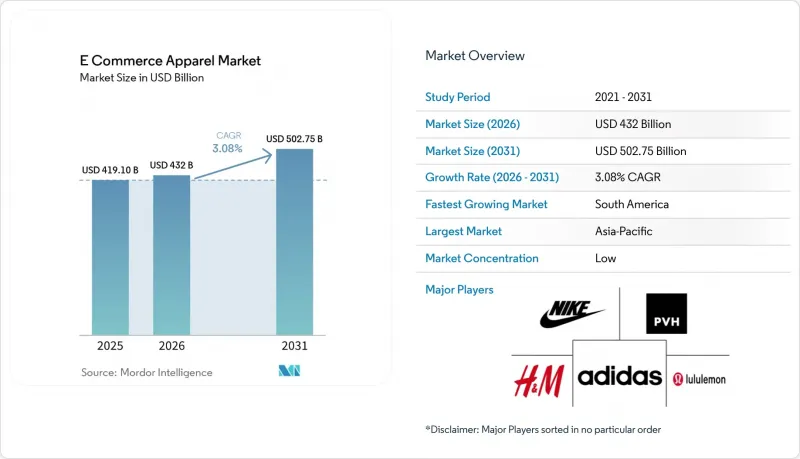
根據 Mordor Intelligence 預測,電子商務服飾市場規模將從 2025 年的 4,191 億美元成長到 2026 年的 4,320 億美元,到 2031 年達到 5,027.5 億美元,2026 年至 2031 年的複合年成長率為 3.08%。
本報告按產品類型(正裝、休閒裝等)、最終用戶(男士、女士、兒童)、布料材質(棉、聚酯等)、類別(大眾市場和高階市場)、平台類型(第三方平台和自有平台)以及地區(北美、歐洲、亞太、南美、中東和非洲)進行細分。市場預測以美元計價。
全球電子商務服飾市場趨勢及洞察
網路和智慧型手機普及率不斷提高
網路和智慧型手機的日益普及增強了數位連接性,使更多消費者能夠更方便地存取網路購物平台。智慧型手機的普及對服裝購買行為產生了顯著影響,用戶可以透過行動應用程式和網站隨時隨地瀏覽時尚系列、比較產品、獲取個人化推薦並完成交易。根據國際電信聯盟(ITU)預測,到2025年,全球10歲以上族群中將有82%擁有行動電話。 「普及率」超過95%,顯示全球範圍內取得數位設備變得越來越容易。智慧型手機用戶群的不斷擴大正在推動行動商務的發展,使服裝零售商能夠透過數位行銷、社交商務和基於應用程式的購物平台觸及更廣泛的客戶群。
數位支付解決方案的廣泛應用
數位支付解決方案的日益普及,使得網路購物體驗更加快速、安全和便捷,從而推動了服裝行業電子商務市場的發展。數位錢包、信用卡和簽帳金融卡、即時支付系統以及「先買後付 (BNPL)」服務等支付技術的進步,正在簡化線上交易流程,並增強消費者透過數位平台購買服裝的信心。根據國際清算銀行 (BIS) 統計,全球無現金交易額已達 1.9,768 兆美元,顯示支付方式正顯著轉向數位化和非接觸式支付。隨著安全付款閘道、一鍵支付選項、詐欺防範系統和彈性支付方式的普及,交易門檻正在降低,購買完成率也不斷提高。
消費者關注尺寸和合身度問題
尺寸和合身度問題仍然是電商服裝市場面臨的一大挑戰。由於消費者無法在購買前試穿,他們常常猶豫不決或對購買失去信心。品牌尺寸標準差異、體型差異以及服裝尺寸不一致等因素,都使得消費者難以在線上選擇合適的尺寸。這個問題導致退換貨增加、顧客不滿,最終增加服裝零售商的營運複雜性。此外,布料觸感和舒適度,以及實體與線上展示的差異也會影響消費者的購買決策。頻繁的尺寸問題退貨會增加逆向物流、庫存管理和產品處理的成本。
細分市場分析
到2025年,休閒服飾將佔據38.23%的市場佔有率(按產品類型分類)。這主要歸功於消費者對舒適、百搭且適合日常穿著的服裝日益成長的偏好,這些服裝也符合不斷變化的時尚和生活方式趨勢。人們對輕鬆著裝的追求提升了對兼具功能性和美觀性的服裝的需求,使得休閒服飾成為日常穿著、社交活動、休閒以及靈活辦公環境的熱門之選。便利的線上平台進一步推動了休閒服飾的流行,消費者可以透過線上平台輕鬆瀏覽各種款式、版型、顏色和設計,並進行便利的比較和個人化的購物體驗。此外,消費者對數位時尚趨勢的日益關注、從社交媒體獲得的穿搭靈感以及消費偏好的頻繁變化,都促使他們定期購買服飾,並縮短了衣櫥更新周期。
運動服飾是成長最快的產品類型,預計2026年至2031年將以4.11%的複合年成長率成長。這一成長歸功於健身、健康和積極的生活方式日益融入消費者的日常生活。人們參與運動、運動和休閒活動的增加顯著提升了對兼具功能性和舒適性的服裝的需求,這些服裝不僅適合運動,也適合日常穿著。根據美國勞工統計局的數據顯示,到2024年,約94.2%的美國男性將參與運動或休閒活動,反映出消費者對積極生活方式的強烈偏好,並進一步推動了運動服飾的普及。此外,兼具功能性、舒適性和時尚感的「休閒風」日益流行,也使得運動服飾的用途超越了傳統的健身的範疇。
到2025年,女性將佔終端用戶市場的54.53%,這主要得益於線上時尚平台的普及以及消費者對適合各種場合和偏好的多樣化服裝風格的強勁需求。數位購物管道的蓬勃發展使消費者能夠接觸到豐富的商品系列,包括日常穿著、商務裝、特定場合的服裝以及潮流服飾,從而刺激了頻繁的購買行為。社交媒體、數位時尚內容、名流潮流以及個人化造型提案的影響進一步推動了時尚發現,並促進了線上服裝購買。此外,豐富的商品種類、尺寸齊全、個人化推薦、顧客評價以及便利的退貨政策等功能增強了消費者的購物信心,並促進了線上購物的使用。
預計2026年至2031年間,童裝市場將以3.59%的複合年成長率成長,成為成長最快的終端用戶類別。這項成長主要得益於消費者對透過數位購物平台便捷獲取各類童裝的需求不斷成長。隨著兒童成長,他們的服裝需求不斷變化,季節性需求以及不斷變化的時尚偏好也推動了消費者透過線上管道購買童裝的比例上升。豐富的童裝系列,涵蓋日常穿著、特殊場合服裝、校服以及特定活動服裝,能夠滿足不同年齡層和需求的消費者。此外,尺寸指南、產品推薦、用戶評價、便利的比價工具以及簡化的退貨流程等增強的網路購物功能,也進一步提升了消費者在線購買童裝的信心。
區域分析
到2025年,亞太地區將佔全球電商服裝銷售額的37.55%。這主要得益於數位購物生態系統的快速發展、行動商務的高滲透率以及消費者與線上時尚平台日益成長的互動。廣泛的網路普及、先進的數位支付系統以及消費者對便利服裝購物體驗的日益成長的偏好,共同支撐了亞太地區強大的市場地位。根據中華人民共和國國務院預測,到2025年底,中國網路用戶數量將達到11.2億,凸顯了龐大的數位消費群正在推動線上零售的成長。豐富多元的時尚系列、社群電商的融合、網紅主導的產品發現以及建議、直播購物等科技驅動的購物功能,進一步鞏固了亞太地區在電商服飾市場的主導地位。
預計南美洲將成為成長最快的地區,2026年至2031年的複合年成長率將達到5.11%。這一成長主要得益於數位技術的日益普及、線上零售基礎設施的擴張以及消費者對便捷服裝購買管道的日益偏好。行動購物平台的改進、安全的支付系統、物流能力和配送網路的完善,提高了購物的便利性,並鼓勵更多消費者轉向線上購買時尚產品。社群媒體和數位推廣的影響力日益增強,以及潮流主導的時尚消費趨勢,進一步加速了服飾電商平台的普及,使南美洲在預測期內成為成長最快的區域市場。
北美和歐洲是成熟且具有重要戰略意義的市場,人工智慧驅動的個人化、全通路零售策略和高階數位購物體驗正日益成為推動市場發展的動力。虛擬試穿解決方案、預測性建議和數據驅動的客戶參與工具等先進技術正在提升線上服裝的轉換率並增強消費者忠誠度。中東和非洲(MEA)地區正憑藉數位轉型的進步、行動商務的廣泛應用、物流基礎設施的完善以及線上時尚平台的日益普及而蓬勃發展。預計更完善的支付解決方案、更便利的服飾產品取得管道以及消費者偏好向數位化優先購物體驗的轉變,將進一步推動這些新興市場服飾電商的持續成長。
其他好處:
- Excel格式的市場預測(ME)表
- 3個月的分析師支持
目錄
第1章:引言
- 研究假設和市場定義
- 調查範圍
第2章:調查方法
第3章執行摘要
第4章 市場狀況
- 市場概覽
- 市場促進因素
- 網路和智慧型手機普及率不斷提高
- 數位支付解決方案的廣泛應用
- 虛擬試穿與擴增實境(AR)技術的發展
- 社群媒體平台的影響以及名人效應
- 對快時尚和頻繁款式更新的需求
- 直接面對消費者 (DTC) 品牌的成長
- 市場限制因素
- 消費者關注尺寸和合身度問題
- 大量退換貨帶來的挑戰。
- 對產品品質和真實性的擔憂
- 資料隱私和網路安全問題
- 消費行為分析
- 監理情勢
- 技術展望
- 波特五力分析
第5章 市場規模與成長預測
- 依產品類型
- 正裝
- 休閒裝
- 運動服
- 睡衣
- 內衣和家居服
- 其他產品類型
- 最終用戶
- 男性
- 女士
- 孩子們
- 按織物材料
- 棉布
- 聚酯纖維
- 尼龍
- 丹寧布料
- 其他布料類型
- 按類別
- 大規模生產
- 優質的
- 依平台類型
- 第三方市場
- 我們自己的平台
- 按地區
- 北美洲
- 美國
- 加拿大
- 墨西哥
- 其他北美國家
- 歐洲
- 德國
- 英國
- 義大利
- 法國
- 西班牙
- 荷蘭
- 波蘭
- 比利時
- 瑞典
- 其他歐洲國家
- 亞太地區
- 中國
- 印度
- 日本
- 澳洲
- 印尼
- 韓國
- 泰國
- 新加坡
- 其他亞太國家
- 南美洲
- 巴西
- 阿根廷
- 哥倫比亞
- 智利
- 秘魯
- 其他南美國家
- 中東和非洲
- 南非
- 沙烏地阿拉伯
- 阿拉伯聯合大公國
- 奈及利亞
- 埃及
- 摩洛哥
- 土耳其
- 其他中東和非洲國家
- 北美洲
第6章 競爭情勢
- 市場集中度
- 策略趨勢
- 市佔率分析
- 公司簡介
- Nike, Inc.
- Adidas AG
- H & M Hennes & Mauritz AB
- Inditex, SA
- Lululemon Athletica Inc.
- PVH Corp.
- VF Corporation
- Gap Inc.
- Ralph Lauren Corporation
- Under Armour, Inc.
- ASICS Corporation
- Puma SE
- Levi Strauss and Co.
- Hanesbrands Inc.
- Gildan Activewear Inc.
- Fast Retailing Co., Ltd.
- Kering SA
- Burberry Group plc
- Moncler SpA
- Tapestry, Inc.
第7章 市場機會與未來展望
According to Mordor Intelligence, the e-Commerce apparel market is projected to grow from USD 419.10 billion in 2025 to USD 432 billion in 2026, with an anticipated value of USD 502.75 billion by 2031, registering a CAGR of 3.08% during the period 2026-2031.
This report is Segmented by Product Type (Formal Wear, Casual Wear, and More), End User (Men, Women, and Children), Fabric Material (Cotton, Polyester, and More), Category (Mass and Premium), Platform Type (Third-Party Marketplace and Company-Owned Platform) and Geography (North America, Europe, Asia-Pacific, South America, Middle East and Africa). The Market Forecasts are Provided in Terms of Value (USD).
Global E Commerce Apparel Market Trends and Insights
Rising internet and smartphone penetration
Increasing internet and smartphone penetration is enhancing digital connectivity, enabling more consumers to access online shopping platforms with ease. The widespread use of smartphones has significantly influenced apparel purchasing behavior by allowing users to browse fashion collections, compare products, receive personalized recommendations, and complete transactions through mobile applications and websites at any time. According to the International Telecommunication Union (ITU), in 2025, 82% of individuals aged 10 years or older globally owned a mobile phone . Universal ownership, defined as a penetration rate exceeding 95%, highlights the growing accessibility of digital devices worldwide. The expanding base of smartphone users is driving the adoption of mobile commerce, allowing apparel retailers to reach a broader audience through digital marketing, social commerce, and app-based shopping platforms.
Increasing adoption of digital payment solutions
The growing adoption of digital payment solutions is driving the expansion of the e-commerce apparel market by enabling faster, safer, and more convenient online shopping experiences. The development of payment technologies, such as digital wallets, credit and debit cards, instant payment systems, and buy-now-pay-later (BNPL) services, has streamlined online transactions and enhanced consumer trust in purchasing apparel through digital platforms. According to the Bank for International Settlements (BIS), global cashless transactions reached 1,976.8 billion, underscoring the shift toward digital and contactless payment methods. The increasing availability of secure payment gateways, one-click checkout options, fraud protection systems, and flexible payment alternatives is reducing transaction barriers and boosting purchase completion rates.
Size and fit uncertainty among consumers
Size and fit uncertainty remains a significant challenge for the e-commerce apparel market. The inability of consumers to physically try on products before purchase often leads to hesitation and diminished confidence. Factors such as varying sizing standards across brands, differences in body shapes, and inconsistencies in garment measurements make it difficult for shoppers to choose the correct fit online. This issue contributes to higher rates of product returns, exchanges, and customer dissatisfaction, thereby increasing operational complexities for apparel retailers. Furthermore, concerns about fabric feel, comfort, and discrepancies between the actual product and its online representation also impact purchasing decisions. Frequent returns due to sizing issues add to costs related to reverse logistics, inventory management, and product handling.
Other drivers and restraints analyzed in the detailed report include:
- Growth of virtual try-on and augmented reality (AR) technologies
- Influence of social media platforms and celebrity endorsements
- High product return and exchange challenges
For complete list of drivers and restraints, kindly check the Table Of Contents.
Segment Analysis
Casual wear accounted for a 38.23% share of the product-type market in 2025, driven by increasing consumer preference for comfortable, versatile, and everyday apparel that aligns with evolving fashion and lifestyle trends. The shift toward relaxed dressing styles has fueled demand for clothing that combines functionality with aesthetic appeal, making casual apparel a popular choice for daily use, social activities, leisure, and flexible working environments. The convenience of online platforms has further supported adoption by offering consumers access to a wide range of styles, fits, colors, and designs, enabling easy comparison and personalized shopping experiences. Additionally, growing exposure to digital fashion trends, social media-driven styling inspiration, and frequent changes in consumer preferences have encouraged regular apparel purchases and faster wardrobe refresh cycles.
Sportswear is the fastest-growing product type, with a CAGR of 4.11% projected for 2026-2031. This growth is driven by the increasing integration of fitness, wellness, and active lifestyles into consumers' daily routines. Rising participation in sports, exercise, and recreational activities has significantly increased demand for performance-oriented and comfortable apparel suitable for both athletic and everyday use. According to the Bureau of Labor Statistics, in 2024, approximately 94.2% of men in the United States engaged in sports and leisure activities, reflecting a strong consumer inclination toward active lifestyles and supporting greater adoption of sportswear . Furthermore, the growing popularity of athleisure trends, where consumers seek clothing that combines functionality, comfort, and style, has expanded sportswear usage beyond traditional fitness purposes.
In 2025, women accounted for 54.53% of the end-user market, driven by increased engagement with online fashion platforms and strong demand for a wide variety of apparel styles catering to different occasions and preferences. The growing adoption of digital shopping channels has provided consumers with access to extensive collections, including everyday clothing, professional attire, occasion wear, and trend-focused fashion, fostering frequent purchasing behavior. Social media influence, digital fashion content, celebrity trends, and personalized styling recommendations have further supported fashion discovery and boosted online apparel purchases. Additionally, features such as broader product selections, inclusive sizing, customized recommendations, customer reviews, and convenient return policies have enhanced shopping confidence and encouraged online adoption.
The children's segment is expected to be the fastest-growing end-user category, with a projected CAGR of 3.59% during 2026-2031. This growth is attributed to the rising demand for convenient access to a wide range of children's apparel through digital shopping platforms. Frequent changes in children's clothing needs due to growth, seasonal requirements, and evolving style preferences are driving increased apparel purchases via online channels. The availability of diverse collections, including everyday wear, occasion wear, school-related clothing, and activity-specific apparel, enables consumers to find suitable products for various age groups and needs. Enhanced online shopping features, such as size guides, product recommendations, customer reviews, easy comparison tools, and simplified return processes, are further boosting consumer confidence in purchasing children's apparel online.
Complete Report Scope:
- By Product Type
- Formal Wear
- Casual Wear
- Sportswear
- Nightwear
- Intimate and Loungewear
- Other Product Types
- By End User
- Men
- Women
- Children
- By Fabric Material
- Cotton
- Polyester
- Nylon
- Denim
- Other Fabric Types
- By Category
- Mass
- Premium
- By Platform Type
- Third-Party Marketplace
- Company-owned Platform
- By Geography
- North America
- United States
- Canada
- Mexico
- Rest of North America
- Europe
- Germany
- United Kingdom
- Italy
- France
- Spain
- Netherlands
- Poland
- Belgium
- Sweden
- Rest of Europe
- Asia-Pacific
- China
- India
- Japan
- Australia
- Indonesia
- South Korea
- Thailand
- Singapore
- Rest of Asia-Pacific
- South America
- Brazil
- Argentina
- Colombia
- Chile
- Peru
- Rest of South America
- Middle East and Africa
- South Africa
- Saudi Arabia
- United Arab Emirates
- Nigeria
- Egypt
- Morocco
- Turkey
- Rest of Middle East and Africa
- North America
Geography Analysis
Asia-Pacific accounted for a 37.55% share of global e-commerce apparel revenues in 2025, driven by the rapid growth of digital shopping ecosystems, high mobile commerce adoption, and increasing consumer engagement with online fashion platforms. This strong market position is supported by widespread internet accessibility, advanced digital payment systems, and a growing preference for convenient apparel shopping experiences. According to the State Council of the People's Republic of China, China had 1.12 billion internet users by the end of 2025, underscoring the significant digital consumer base fueling online retail growth . The availability of diverse fashion collections, integration of social commerce, influencer-driven product discovery, and technology-enabled shopping features such as personalized recommendations and livestream shopping further reinforce Asia-Pacific's leadership in the e-commerce apparel market.
South America is projected to be the fastest-growing region, with a CAGR of 5.11% during 2026-2031. This growth is supported by increasing digital adoption, expanding online retail infrastructure, and a rising consumer preference for convenient apparel purchasing channels. Enhancements in mobile shopping platforms, secure payment systems, logistics capabilities, and delivery networks are improving accessibility and encouraging more consumers to transition to online fashion purchases. The growing influence of social media, digital promotions, and trend-driven fashion consumption is further accelerating the adoption of e-commerce apparel platforms, positioning South America as the fastest-expanding regional market during the forecast period.
North America and Europe represent mature yet strategically significant markets, where growth is increasingly driven by AI-powered personalization, omnichannel retail strategies, and premium digital shopping experiences. Advanced technologies such as virtual fitting solutions, predictive recommendations, and data-driven customer engagement tools are enhancing online apparel conversion rates and fostering consumer loyalty. The Middle East and Africa (MEA) region is gaining traction through rising digital transformation, increasing mobile commerce adoption, improved logistics infrastructure, and the growing presence of online fashion platforms. Enhanced payment solutions, broader apparel accessibility, and evolving consumer preferences for digital-first shopping experiences are expected to support the continued growth of e-commerce apparel in these emerging markets.
- Nike, Inc.
- Adidas AG
- H & M Hennes & Mauritz AB
- Inditex, S.A.
- Lululemon Athletica Inc.
- PVH Corp.
- VF Corporation
- Gap Inc.
- Ralph Lauren Corporation
- Under Armour, Inc.
- ASICS Corporation
- Puma SE
- Levi Strauss and Co.
- Hanesbrands Inc.
- Gildan Activewear Inc.
- Fast Retailing Co., Ltd.
- Kering S.A.
- Burberry Group plc
- Moncler S.p.A.
- Tapestry, Inc.
Additional Benefits:
- The market estimate (ME) sheet in Excel format
- 3 months of analyst support
TABLE OF CONTENTS
1 INTRODUCTION
- 1.1 Study Assumptions and Market Definition
- 1.2 Scope of the Study
2 RESEARCH METHODOLOGY
3 EXECUTIVE SUMMARY
4 MARKET LANDSCAPE
- 4.1 Market Overview
- 4.2 Market Drivers
- 4.2.1 Rising internet and smartphone penetration
- 4.2.2 Increasing adoption of digital payment solutions
- 4.2.3 Growth of virtual try-on and augmented reality (AR) technologies
- 4.2.4 Influence of social media platforms and celebrity endorsements
- 4.2.5 Demand for fast fashion and frequent style updates
- 4.2.6 Direct-to-consumer (DTC) brand growth
- 4.3 Market Restraints
- 4.3.1 Size and fit uncertainty among consumers
- 4.3.2 High product return and exchange challenges
- 4.3.3 Concerns regarding product quality and authenticity
- 4.3.4 Data privacy and cybersecurity concerns
- 4.4 Consumer Behavior Analysis
- 4.5 Regulatory Landscape
- 4.6 Technological Outlook
- 4.7 Porter's Five Forces Analysis
- 4.7.1 Threat of New Entrants
- 4.7.2 Bargaining Power of Buyers
- 4.7.3 Bargaining Power of Suppliers
- 4.7.4 Threat of Substitutes
- 4.7.5 Intensity of Competitive Rivalry
5 MARKET SIZE AND GROWTH FORECASTS (VALUE)
- 5.1 By Product Type
- 5.1.1 Formal Wear
- 5.1.2 Casual Wear
- 5.1.3 Sportswear
- 5.1.4 Nightwear
- 5.1.5 Intimate and Loungewear
- 5.1.6 Other Product Types
- 5.2 By End User
- 5.2.1 Men
- 5.2.2 Women
- 5.2.3 Children
- 5.3 By Fabric Material
- 5.3.1 Cotton
- 5.3.2 Polyester
- 5.3.3 Nylon
- 5.3.4 Denim
- 5.3.5 Other Fabric Types
- 5.4 By Category
- 5.4.1 Mass
- 5.4.2 Premium
- 5.5 By Platform Type
- 5.5.1 Third-Party Marketplace
- 5.5.2 Company-owned Platform
- 5.6 By Geography
- 5.6.1 North America
- 5.6.1.1 United States
- 5.6.1.2 Canada
- 5.6.1.3 Mexico
- 5.6.1.4 Rest of North America
- 5.6.2 Europe
- 5.6.2.1 Germany
- 5.6.2.2 United Kingdom
- 5.6.2.3 Italy
- 5.6.2.4 France
- 5.6.2.5 Spain
- 5.6.2.6 Netherlands
- 5.6.2.7 Poland
- 5.6.2.8 Belgium
- 5.6.2.9 Sweden
- 5.6.2.10 Rest of Europe
- 5.6.3 Asia-Pacific
- 5.6.3.1 China
- 5.6.3.2 India
- 5.6.3.3 Japan
- 5.6.3.4 Australia
- 5.6.3.5 Indonesia
- 5.6.3.6 South Korea
- 5.6.3.7 Thailand
- 5.6.3.8 Singapore
- 5.6.3.9 Rest of Asia-Pacific
- 5.6.4 South America
- 5.6.4.1 Brazil
- 5.6.4.2 Argentina
- 5.6.4.3 Colombia
- 5.6.4.4 Chile
- 5.6.4.5 Peru
- 5.6.4.6 Rest of South America
- 5.6.5 Middle East and Africa
- 5.6.5.1 South Africa
- 5.6.5.2 Saudi Arabia
- 5.6.5.3 United Arab Emirates
- 5.6.5.4 Nigeria
- 5.6.5.5 Egypt
- 5.6.5.6 Morocco
- 5.6.5.7 Turkey
- 5.6.5.8 Rest of Middle East and Africa
- 5.6.1 North America
6 COMPETITIVE LANDSCAPE
- 6.1 Market Concentration
- 6.2 Strategic Moves
- 6.3 Market Share Analysis
- 6.4 Company Profiles (includes Global level Overview, Market level overview, Core Segments, Financials as available, Strategic Information, Market Rank/Share for key companies, Products and Services, and Recent Developments)
- 6.4.1 Nike, Inc.
- 6.4.2 Adidas AG
- 6.4.3 H & M Hennes & Mauritz AB
- 6.4.4 Inditex, S.A.
- 6.4.5 Lululemon Athletica Inc.
- 6.4.6 PVH Corp.
- 6.4.7 VF Corporation
- 6.4.8 Gap Inc.
- 6.4.9 Ralph Lauren Corporation
- 6.4.10 Under Armour, Inc.
- 6.4.11 ASICS Corporation
- 6.4.12 Puma SE
- 6.4.13 Levi Strauss and Co.
- 6.4.14 Hanesbrands Inc.
- 6.4.15 Gildan Activewear Inc.
- 6.4.16 Fast Retailing Co., Ltd.
- 6.4.17 Kering S.A.
- 6.4.18 Burberry Group plc
- 6.4.19 Moncler S.p.A.
- 6.4.20 Tapestry, Inc.
7 MARKET OPPORTUNITIES AND FUTURE OUTLOOK

 2026-2030年全球線上鞋類市場
 電子商務服飾市場-2026-2032年全球市場預測線上時尚零售市場:2026-2032年全球市場預測(依產品類別、性別、銷售管道和經營模式)
 歐洲電子商務服裝:市場佔有率分析、產業趨勢與統計、成長預測(2026-2031)線上服裝:市場佔有率分析、產業趨勢與統計、成長預測(2026-2031)
 日本時尚電商市場:依產品類型、最終用戶、價格範圍和分銷管道分類
 2026年全球線上服裝鞋類市場報告2026年全球時尚電商市場報告2026年全球線上時尚零售市場報告
 全球電子商務服裝市場規模、佔有率、趨勢和成長分析報告(2026-2034)