


 |
市場調查報告書
商品編碼
2073143
工業網路交換器:市場佔有率分析、產業趨勢與統計、成長預測(2026-2031)Industrial Network Switch - Market Share Analysis, Industry Trends & Statistics, Growth Forecasts (2026 - 2031) |
||||||

※ 本網頁內容可能與最新版本有所差異。詳細情況請與我們聯繫。
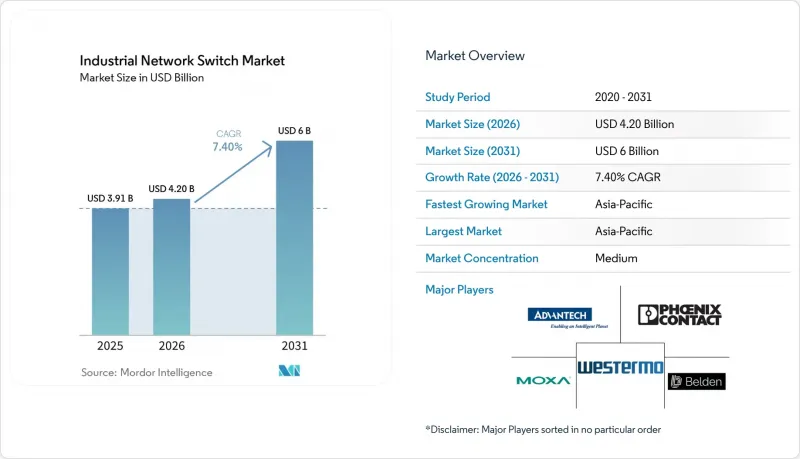
根據 Mordor Intelligence 預測,工業網路交換器市場預計將從 2025 年的 39.1 億美元成長到 2026 年的 42 億美元,到 2031 年達到 60 億美元,2026 年至 2031 年的複合年成長率預計為 7.4%。
本報告按類型(網管型交換器、非網管型交換器、智慧型/Web管理型交換器)、連接埠數量(2-8連接埠、9-16連接埠、17-24連接埠、25-48連接埠及其他)、連接埠速度(100Mbps快速乙太網路及其他)、PoE功能(PoE交換器和非PoE)、產業分類機和非PoE)、產業分類機和非PoE)、產業分類機和非PoE)、產業分類機和非PoE)、產業分類機和非PoE)、產業分類機(PoE交換機和非PoE)、產業分類機。市場預測以美元(USD)為單位。
全球工業網路交換器市場趨勢與洞察
工業4.0推動自動化快速發展
工廠營運商正在將傳統的現場匯流排孤島改造為支援數位雙胞胎、人工智慧驅動的缺陷檢測和封閉回路型品管的整合乙太網路架構。思科2026年的一項調查發現,61%的製造商已在現場部署了人工智慧,97%的製造商預計連接密度將會增加,這凸顯了對可管理交換器連接埠日益成長的需求。西門子在印尼的一條試點生產線上遷移到軟體定義生產單元後,生產率提高了49%。汽車組裝正在將以乙太網路為基礎的運動控制標準化,加快交換器更新周期,並將存取層頻寬從快速乙太網路提升至Gigabit。因此,工業網路交換器市場正受益於所有新的邊緣人工智慧工作負載,這些工作負載推動了更快的連接埠和確定性的流量調度。捆綁NETCONF介面和VLAN模板的供應商正在幫助工廠管理員克服配置複雜性,並將試運行時間縮短高達30%。
確定性乙太網路的時間敏感網路技術的快速普及
透過結合 IEEE 802.1AS 的時間同步、802.1Qbv 的時間感知整形以及 802.1Qbu 的幀搶佔,乙太網路可以實現現場匯流排級別的確定性,這對於封閉回路型運動和安全單元至關重要。 IEC/IEEE 60802 標準於 2024 年發布,定義了工業級 TSN 規範,要求抖動低於微秒。 2025 年,法國電網營運商 RTE 在一個 400 kV 變電站檢驗了多廠商 TSN 的互通性,證明了其營運商級的穩健性。汽車乙太網路委員會也批准了 TSN 調度,用於同時傳輸攝影機、雷射雷達和無線更新串流。因此,工業網路交換器市場對在單一硬體平台上同時相容 TSN 和傳統工業協議的設備訂單激增。採用基於 IEEE 1588 的時鐘恢復和熱備用路徑的供應商正在獲得相對於低階新進入者的技術競爭優勢。
營運技術 (OT) 網路中的網路安全漏洞
在融合IT和OT的拓樸結構中,傳統的PLC和HMI容易受到勒索軟體的攻擊,這些軟體會利用未修補的韌體和預設憑證。 2025年,美國網路安全與基礎設施安全局(CISA)發布了47份安全公告,旨在解決交換器中存在的可遠端執行程式碼的漏洞。到2026年初,只有不到30%的已部署工業交換器能夠達到IEC 62443-4-2安全等級。根據Dragos的報告,68%的工業企業在2025年至少會遭遇一次網路安全事件,其中42%的案例中,乙太網路設備是最初的攻擊入口點。菲尼克斯電氣(Phoenix Contact)的FL Switch 2000於2025年12月獲得了IEC 62443-4-2認證,這表明合規是可以實現的,但成本高昂。未隔離網路的保險成本不斷上漲,進一步阻礙了企業短期內的採購決策。
細分市場分析
到2025年,管理型交換器將佔工業網路交換器市場的65.8%,預計到2031年將以10.3%的複合年成長率成長,因為VLAN分段、QoS隊列和遠端診斷在工業4.0生產領域變得至關重要。部署數位化變電站的電力公司要求容錯移轉小於10毫秒,而非管理型交換器無法滿足此要求。智慧型和Web管理型交換器透過提供瀏覽器圖形使用者介面(GUI)而非複雜的命令列介面(CLI),在小規模工廠中越來越受歡迎。目前,擁有網路安全認證的管理型交換器價格高出25%至40%,但對於關鍵基礎設施的買家而言,合規性是不可妥協的要求。
相較之下,非管理型交換器在單機獨立部署的環境中仍然可行,但當需要對安全相關流量進行確定性優先排序時,它們便麵臨挑戰。因此,廠商正在投資韌體升級功能,以便客戶日後啟用管理功能,從而確保入門級硬體的未來相容性。隨著工業網路交換器市場的日趨成熟,分析師預測,到2020年代中期,管理型交換器將佔據超過70%的市場佔有率,進一步加速向集中編配、API驅動的網路架構轉型。
到2025年,2埠至8埠交換器將佔據35.6%的市場佔有率,為緊湊型機器單元提供支援。同時,隨著汽車、電子和半導體製造廠將邊緣機櫃整合到聚合機架中的趨勢持續發展,預計到2031年,48埠及以上交換器的複合年成長率將達到9.3%。汽車生產線正在部署48埠Gigabit存取模組,提供10G上行鏈路,以處理每秒數千幀的視覺資料。雖然更高的連接埠密度降低了每個連接埠的成本,但除非採用冗餘電源和熱插拔風扇托架,否則可能會引入單點故障。
因此,在控制室中,配備模組化電源倉的堅固耐用的19吋底盤正在取代DIN導軌式機殼。此外,供應商正在推廣軟體定義配置,使工程師無需手動跳線即可重複使用未使用的連接埠。隨著虛擬化的日益普及,擁有48個以上連接埠的工業網路交換器市場預計將穩定成長,尤其是在旨在減少佈線的現有工廠(棕地改造)中。
區域分析
預計到2025年,亞太地區將佔工業網路交換器市場37.2%的佔有率,並在2031年之前以9.7%的複合年成長率持續成長。中國的「中國製造2025」計畫、印度的「生產連結獎勵計畫(PLI)」以及東南亞的智慧工廠津貼正在共同推動這項多年資本投資週期。西門子指出,印尼的一個試點計畫實現了49%的生產效率提升,並預計到2030年,工廠自動化的支出可能達到1,258.4億美元。日本和韓國的半導體工廠需要TSN交換機來實現5奈米微影術的同步,而印度的太陽能發電園區正在部署符合IEC 61850標準的設備,以彌補可再生能源的間歇性問題。儘管台灣和中國大陸的本土供應商在價格上具有競爭力,但一級汽車和航太OEM廠商仍傾向於選擇能夠提供全天候支援的全球供應商。
在北美,該地區正受益於總額達527億美元的《晶片與科學法案》(CHIPS and Science Act),該法案保障了英特爾位於亞利桑那州的晶圓廠(200億美元)、台積電位於鳳凰城的園區(400億美元)、美光位於紐約的生產線(200億美元)以及三星投資億美元的工廠投資(德克薩斯州億美元的工廠(200億美元)。每個晶圓廠都採用支援TSN技術的10G和100G互連架構,以同步微影術、測量和自動化物料搬運。美國和加拿大的電力公司正在對變電站進行現代化改造,以符合北美電力可靠性公司(NERC)的持續改進計劃(CIP),這加速了對符合IEC 62443標準的交換機的需求。墨西哥的近岸外包浪潮進一步擴大了區域銷售,因為其汽車叢集正在效仿美國的生產線架構。
歐洲市場受智慧電網部署、車輛電氣化和NIS2網路安全法規的驅動。 RTE在其整個400千伏站點部署的多供應商TSN系統已證明商業性可行性,並為其他電網營運商樹立了先例。德國汽車製造商目前正在採用乙太網路骨幹網路來管理攝影機和雷射雷達的資料流,從而推動了對低延遲交換器的本地需求。歐盟的「數位十年」計畫旨在2030年實現80%的企業雲端和巨量資料應用,這促使製造商將現場匯流排網路升級為乙太網路架構。
其他好處:
- Excel格式的市場預測(ME)表
- 3個月的分析師支持
目錄
第1章:引言
- 研究假設和市場定義
- 調查範圍
第2章:調查方法
第3章執行摘要
第4章 市場狀況
- 市場概覽
- 市場促進因素
- 工業4.0推動自動化快速發展
- 確定性乙太網路中時間敏感網路的快速普及
- 擴大工業PoE攝影機和感測器的應用
- 智慧電網和數位化變電站的擴展
- 惡劣環境下邊緣運算的要求
- 政府主導
- 市場限制因素
- 營運技術 (OT) 網路中的網路安全漏洞
- 工業網路工程師短缺
- 工業半導體供應鏈的波動性
- 與商用級交換器相比,總擁有成本較高。
- 產業供應鏈分析
- 監理情勢
- 技術展望
- 宏觀經濟因素對市場的影響
- 波特五力分析
第5章 市場規模與成長預測
- 按開關類型
- 管理型交換機
- 非管理型交換機
- 智慧型/Web管理型交換機
- 按連接埠數量
- 2-8個端口
- 9-16個端口
- 17-24個端口
- 25-48個端口
- 48 個或更多端口
- 連接埠速度
- Fast Ethernet(100 Mbps)
- Gigabit乙太網路(1G)
- 10Gigabit乙太網路(10G)
- 超過 10G(25G/40G/100G)
- 按 PoE 容量
- PoE交換機
- 非PoE交換機
- 按行業分類
- 製造業
- 能源和電力(電力公司/智慧電網)
- 石油和天然氣
- 交通運輸(鐵路、港口和智慧型運輸系統)
- 車
- 航太/國防
- 採礦和金屬
- 其他工業部門
- 按地區
- 北美洲
- 南美洲
- 歐洲
- 亞太地區
- 中東
- 非洲
第6章 競爭情勢
- 市場集中度
- 策略趨勢
- 市佔率分析
- 公司簡介
- Moxa Inc.
- Advantech Co., Ltd.
- Belden Inc.
- Phoenix Contact GmbH & Co. KG
- Antaira Technologies, LLC
- Westermo Network Technologies AB
- Beijer Electronics Group AB
- Hirschmann Automation and Control GmbH
- Red Lion Controls, Inc.
- RuggedCom Inc.
- PLANET Technology Corporation
- TRENDnet, Inc.
- Allied Telesis Holdings KK
- Lantronix, Inc.
- ORing Industrial Networking Corporation
- Korenix Technology Co., Ltd.
- EtherWAN Systems, Inc.
- Weidmuller Interface GmbH & Co. KG
- Patton Electronics Co.
- Siemens AG
第7章 市場機會與未來展望
According to Mordor Intelligence, the industrial network switch market size is expected to increase from USD 3.91 billion in 2025 to USD 4.20 billion in 2026 and reach USD 6.00 billion by 2031, growing at a CAGR of 7.4% over 2026-2031.
This report is Segmented by Type (Managed Switches, Unmanaged Switches, and Smart/Web-Managed Switches), Port Count (2-8 Ports, 9-16 Ports, 17-24 Ports, 25-48 Ports, and More), Port Speed (Fast Ethernet 100 Mbps, and More), Poe Capability (PoE Switches, and Non-PoE Switches), Industry Vertical (Manufacturing, and More), and Geography. The Market Forecasts are Provided in Terms of Value (USD).
Global Industrial Network Switch Market Trends and Insights
Surge in Industry 4.0 Automation
Factory operators are converting legacy fieldbus islands into unified Ethernet fabrics that support digital twins, AI-driven defect detection, and closed-loop quality control. A 2026 Cisco survey found that 61% of manufacturers are already deploying artificial intelligence on the shop floor and 97% anticipate higher connectivity density, underscoring rising demand for managed switch ports.Siemens observed productivity gains of 49% in Indonesian pilot lines after migrating to software-defined production cells. Automotive assemblers are standardizing on Ethernet-based motion control, which accelerates switch refresh cycles and lifts access-layer bandwidth from Fast Ethernet to 10 Gigabit. The industrial network switch market therefore benefits from every new edge AI workload that pushes ports toward higher speeds and deterministic traffic scheduling. Vendors that bundle NETCONF interfaces and VLAN templates help plant managers overcome configuration complexity, shortening commissioning windows by up to 30%.
Rapid Adoption of Time-Sensitive Networking for Deterministic Ethernet
IEEE 802.1AS time synchronization, 802.1Qbv time-aware shaping, and 802.1Qbu frame pre-emption together let Ethernet match fieldbus-level determinism, a prerequisite for closed-loop motion and safety cells. IEC/IEEE 60802 published in 2024 codified industrial TSN profiles that require sub-microsecond jitter. France's grid operator RTE validated multi-vendor TSN interoperability across 400 kV substations in 2025, demonstrating carrier-grade robustness. Automotive Ethernet committees have also ratified TSN scheduling to carry camera, LiDAR, and over-the-air update streams simultaneously. Consequently, the industrial network switch market sees surging orders for devices that certify to both TSN and legacy industrial protocols on a single hardware platform. Suppliers that embed IEEE 1588-based clock recovery and hot-standby paths secure a technical moat against low-end entrants.
Cybersecurity Vulnerabilities in Operational Technology Networks
Converged IT-OT topologies expose legacy PLCs and HMIs to ransomware that exploits unpatched firmware and default credentials. CISA issued 47 advisories in 2025 addressing switch vulnerabilities that allowed remote code execution. Less than 30% of installed industrial switches meet IEC 62443-4-2 security levels as of early 2026. Dragos reported that 68% of industrial organizations logged at least one cyber incident in 2025, with Ethernet devices as the initial access vector in 42% of cases. Phoenix Contact's FL Switch 2000 achieved IEC 62443-4-2 certification in December 2025, proving compliance is feasible but costly. Rising insurance premiums for non-segmented networks further restrain short-run purchasing decisions.
Other drivers and restraints analyzed in the detailed report include:
- Growing Deployment of Industrial PoE Cameras and Sensors
- Expansion of Smart Grids and Digital Substations
- Shortage of Industrial Networking Skill Sets
For complete list of drivers and restraints, kindly check the Table Of Contents.
Segment Analysis
Managed switches captured 65.8% of the industrial network switch market in 2025 and are forecast to deliver a 10.3% CAGR through 2031, as VLAN segmentation, QoS queuing, and remote diagnostics become essential in Industry 4.0 production zones. Utilities deploying digital substations demand sub-10-millisecond failover, which unmanaged models cannot provide. Smart or web-managed variants appeal to small plants by offering browser GUIs without the full CLI complexity. Cybersecurity-certified managed switches now command 25-40% price premiums, yet critical-infrastructure buyers consider compliance non-negotiable.
In contrast, unmanaged switches remain viable for single-machine islands but face headwinds where safety traffic needs deterministic prioritization. Vendors are therefore investing in firmware upgradability that lets customers unlock management features later, future-proofing entry-level hardware. As the industrial network switch market matures, analysts expect the managed tier to exceed 70% share by mid-decade, reinforcing the shift toward centrally orchestrated, API-driven fabrics.
The 2-8-port class held 35.6% share in 2025, serving compact machine cells, while switches above 48 ports are projected to post a 9.3% CAGR through 2031 as automotive, electronics, and semiconductor fabs consolidate edge cabinets into aggregation-layer racks. Automotive lines deploy 48-port Gigabit access blocks feeding 10 G uplinks to handle thousands of vision frames per second. High port density trims per-port costs, yet it introduces single points of failure unless redundant PSUs and hot-swap fan trays are adopted.
Ruggedized 19-inch chassis with modular PSU bays are therefore supplanting DIN-rail boxes in control rooms. Vendors also push software-defined provisioning so engineers can repurpose idle ports without manual patching. As virtualization spreads, the industrial network switch market size for the above-48-port bracket is set to climb steadily, particularly inside brownfield plants seeking cable reduction.
Complete Report Scope:
- By Switch Type
- Managed Switches
- Unmanaged Switches
- Smart / Web-Managed Switches
- By Port Count
- 2-8 Ports
- 9-16 Ports
- 17-24 Ports
- 25-48 Ports
- Above 48 Ports
- By Port Speed
- Fast Ethernet (100 Mbps)
- Gigabit Ethernet (1G)
- 10 Gigabit Ethernet (10G)
- Above 10G (25G / 40G / 100G)
- By PoE Capability
- PoE Switches
- Non-PoE Switches
- By Industry Vertical
- Manufacturing
- Energy and Power (Electric Utilities / Smart Grid)
- Oil and Gas
- Transportation (Rail, Ports, Intelligent Transport Systems)
- Automotive
- Aerospace and Defense
- Mining and Metals
- Others Industry Verticals
- By Geography
- North America
- South America
- Europe
- Asia-Pacific
- Middle East
- Africa
Geography Analysis
Asia-Pacific commanded 37.2% of the industrial network switch market in 2025 and is forecast to expand at a 9.7% CAGR through 2031. China's Made in China 2025 plan, India's Production-Linked Incentives, and Southeast Asian smart-factory grants jointly sustain multi-year capex cycles. Siemens estimated factory-automation outlays could climb to USD 125.84 billion by 2030, citing 49% productivity gains in Indonesian pilots. Japanese and South Korean fabs require TSN switches for 5 nm lithography sync, while India's solar parks install IEC 61850 gear to balance renewable intermittency. Domestic Taiwanese and Chinese vendors undercut incumbents on price, but Tier-1 automotive and aerospace OEMs still prefer global suppliers with 24-hour support.
North America benefits from the USD 52.7 billion CHIPS and Science Act, which underwrites Intel's USD 20 billion Arizona fabs, TSMC's USD 40 billion Phoenix campus, Micron's USD 20 billion New York line, and Samsung's USD 17 billion Texas facility. Each fab specifies TSN-capable 10 G and 100 G fabrics to synchronize lithography, metrology, and automated material handling. Utilities across the United States and Canada modernize substations to meet NERC CIP, which accelerates demand for IEC 62443-compliant switches. Mexico's nearshoring wave further expands regional sales as automotive clusters replicate U.S. line architectures.
Europe's market hinges on smart-grid roll-outs, automotive electrification, and NIS2 cybersecurity rules. RTE's multi-vendor TSN deployment across 400 kV sites validated commercial viability and sets a precedent for other grid operators. German automakers now embed Ethernet backbones to manage camera and LiDAR streams, lifting local demand for low-latency switches. The EU Digital Decade targets 80% enterprise cloud and big-data adoption by 2030, nudging manufacturers to upgrade legacy fieldbus networks to Ethernet fabrics.
- Moxa Inc.
- Advantech Co., Ltd.
- Belden Inc.
- Phoenix Contact GmbH & Co. KG
- Antaira Technologies, LLC
- Westermo Network Technologies AB
- Beijer Electronics Group AB
- Hirschmann Automation and Control GmbH
- Red Lion Controls, Inc.
- RuggedCom Inc.
- PLANET Technology Corporation
- TRENDnet, Inc.
- Allied Telesis Holdings K.K.
- Lantronix, Inc.
- ORing Industrial Networking Corporation
- Korenix Technology Co., Ltd.
- EtherWAN Systems, Inc.
- Weidmuller Interface GmbH & Co. KG
- Patton Electronics Co.
- Siemens AG
Additional Benefits:
- The market estimate (ME) sheet in Excel format
- 3 months of analyst support
TABLE OF CONTENTS
1 INTRODUCTION
- 1.1 Study Assumptions and Market Definition
- 1.2 Scope of the Study
2 RESEARCH METHODOLOGY
3 EXECUTIVE SUMMARY
4 MARKET LANDSCAPE
- 4.1 Market Overview
- 4.2 Market Drivers
- 4.2.1 Surge in Industry 4.0 Automation
- 4.2.2 Rapid Adoption of Time-Sensitive Networking for Deterministic Ethernet
- 4.2.3 Growing Deployment of Industrial PoE Cameras and Sensors
- 4.2.4 Expansion of Smart Grids and Digital Substations
- 4.2.5 Edge Computing Requirements in Harsh Environments
- 4.2.6 Government-Led Reshoring of Critical Manufacturing
- 4.3 Market Restraints
- 4.3.1 Cybersecurity Vulnerabilities in Operational Technology Networks
- 4.3.2 Shortage of Industrial Networking Skill Sets
- 4.3.3 Volatility in Industrial Semiconductor Supply Chains
- 4.3.4 Higher Total Cost of Ownership versus Commercial-Grade Switches
- 4.4 Industry Supply-Chain Analysis
- 4.5 Regulatory Landscape
- 4.6 Technological Outlook
- 4.7 Impact of Macroeconomic Factors on the Market
- 4.8 Porter's Five Forces Analysis
- 4.8.1 Bargaining Power of Suppliers
- 4.8.2 Bargaining Power of Buyers
- 4.8.3 Threat of New Entrants
- 4.8.4 Threat of Substitutes
- 4.8.5 Competitive Rivalry
5 MARKET SIZE AND GROWTH FORECASTS (VALUE)
- 5.1 By Switch Type
- 5.1.1 Managed Switches
- 5.1.2 Unmanaged Switches
- 5.1.3 Smart / Web-Managed Switches
- 5.2 By Port Count
- 5.2.1 2-8 Ports
- 5.2.2 9-16 Ports
- 5.2.3 17-24 Ports
- 5.2.4 25-48 Ports
- 5.2.5 Above 48 Ports
- 5.3 By Port Speed
- 5.3.1 Fast Ethernet (100 Mbps)
- 5.3.2 Gigabit Ethernet (1G)
- 5.3.3 10 Gigabit Ethernet (10G)
- 5.3.4 Above 10G (25G / 40G / 100G)
- 5.4 By PoE Capability
- 5.4.1 PoE Switches
- 5.4.2 Non-PoE Switches
- 5.5 By Industry Vertical
- 5.5.1 Manufacturing
- 5.5.2 Energy and Power (Electric Utilities / Smart Grid)
- 5.5.3 Oil and Gas
- 5.5.4 Transportation (Rail, Ports, Intelligent Transport Systems)
- 5.5.5 Automotive
- 5.5.6 Aerospace and Defense
- 5.5.7 Mining and Metals
- 5.5.8 Others Industry Verticals
- 5.6 By Geography
- 5.6.1 North America
- 5.6.2 South America
- 5.6.3 Europe
- 5.6.4 Asia-Pacific
- 5.6.5 Middle East
- 5.6.6 Africa
6 COMPETITIVE LANDSCAPE
- 6.1 Market Concentration
- 6.2 Strategic Moves
- 6.3 Market Share Analysis
- 6.4 Company Profiles (includes Global Level Overview, Market Level Overview, Core Segments, Financials as available, Strategic Information, Market Rank/Share, Products and Services, Recent Developments)
- 6.4.1 Moxa Inc.
- 6.4.2 Advantech Co., Ltd.
- 6.4.3 Belden Inc.
- 6.4.4 Phoenix Contact GmbH & Co. KG
- 6.4.5 Antaira Technologies, LLC
- 6.4.6 Westermo Network Technologies AB
- 6.4.7 Beijer Electronics Group AB
- 6.4.8 Hirschmann Automation and Control GmbH
- 6.4.9 Red Lion Controls, Inc.
- 6.4.10 RuggedCom Inc.
- 6.4.11 PLANET Technology Corporation
- 6.4.12 TRENDnet, Inc.
- 6.4.13 Allied Telesis Holdings K.K.
- 6.4.14 Lantronix, Inc.
- 6.4.15 ORing Industrial Networking Corporation
- 6.4.16 Korenix Technology Co., Ltd.
- 6.4.17 EtherWAN Systems, Inc.
- 6.4.18 Weidmuller Interface GmbH & Co. KG
- 6.4.19 Patton Electronics Co.
- 6.4.20 Siemens AG
7 MARKET OPPORTUNITIES AND FUTURE OUTLOOK
- 7.1 White-Space and Unmet-Need Assessment

 2026年全球開放式去程傳輸開關市場報告
 網路交換器市場 - 全球預測,2026-2032年
 網路交換器市場:市場洞察、競爭格局及市場預測(2033 年)
 網路交換器:市場佔有率分析、產業趨勢與統計、成長預測(2026-2031)開放式網路交換器:市場佔有率分析、產業趨勢與統計資料、成長預測(2026-2031 年)環境適應性網路交換器:市場佔有率分析、產業趨勢與統計及成長預測(2026-2031 年)
 網路交換器市場:按交換器類型、應用和地區分類2026年全球網路交換器市場報告
 網路交換器市場:2025-2029 年全球市場
 2030 年網路交換器市場預測:按交換器類型、交換容量、連接埠速度、企業規模、最終用戶和地區進行的全球分析