


 |
市場調查報告書
商品編碼
2073141
網路交換器:市場佔有率分析、產業趨勢與統計、成長預測(2026-2031)Network Switch - Market Share Analysis, Industry Trends & Statistics, Growth Forecasts (2026 - 2031) |
||||||

※ 本網頁內容可能與最新版本有所差異。詳細情況請與我們聯繫。
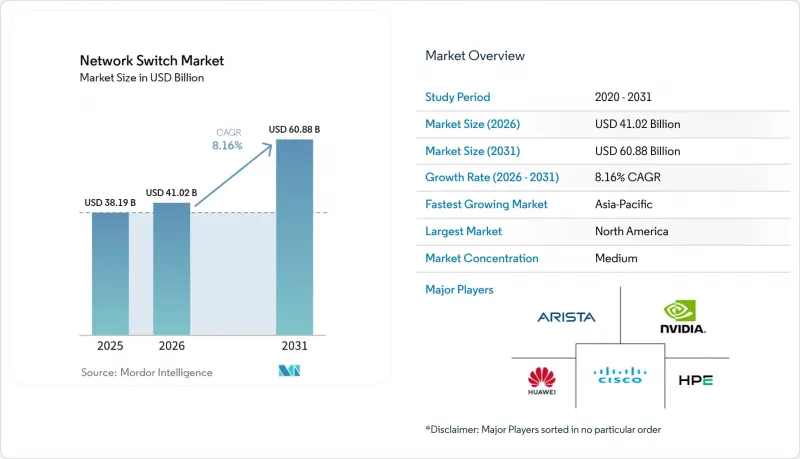
根據 Mordor Intelligence 預測,網路交換器市場規模將從 2025 年的 381.9 億美元和 2026 年的 410.2 億美元成長到 2031 年的 608.8 億美元,2026 年至 2031 年的年複合成長率(CAGR)為 8.16%。
本報告按交換器類型(固定配置交換器和模組化交換器)、連接埠速度(1 GbE 或更低、2.5/5 GbE 多千兆、10 GbE 及其他)、供電供給能力(非 PoE 交換器、支援 PoE 的交換器)、最終用戶(雲端和資料中心供應商、企業、電信服務供應商及其他)以及地區進行細分。市場預測以美元 (USD) 為單位。
全球網路交換器市場趨勢及洞察
超大規模資料中心擴建
超大規模資料中心營運商持續新增15-20吉瓦的容量,但變壓器短缺導致新建設仍需等待監管機構批准,迫使營運商過度配置現有機房網路基礎設施,以提高每瓦運算密度。 GPU數量的不斷成長需要無阻塞的800GbE網路架構,這正在遏制多年來持續的單埠收入下滑趨勢。 NVIDIA的Spectrum-X晶片結合Spectrum-4交換器和先進的擁塞控制軟體,在xAI Colossus超級電腦上實現了95%的網路吞吐量。因此,缺乏專用AI遙測功能的通用晶片供應商可能會失去在主幹網路層的設計採用機會。
遷移到更快的端口
隨著運行大規模語言模型推理的組織機構將骨幹網路遷移到 100 GbE 以上,預計到 2025 年,全球 800 GbE光學模組的出貨量將增加 60%。 Arista 的 7700R5 在單一框架單位中整合了 32 個 800 GbE 端口,使雲端服務供應商能夠將三層網路架構整合為兩層,並將延遲降低 30%。 NVIDIA 的共封裝光模組無需進行電光轉換,預計將每Terabit的能耗降低 40%。傳統的網路作業系統假定鏈路速率是對稱的,這導致軟體複雜性不斷增加,並促使人們越來越需要基於意圖的自動化解決方案來抽象化混合鏈路速率。
來自白盒ODM交換器的價格壓力
透過將 SONiC 整合到 Edgecore 和 Celestica 的裸機交換器中,超大規模資料中心業者實現了 20-30% 的成本節約,並在 2025 年 11 月發布的版本中增加了對 800 GbE 的支援。微軟、Meta 和Google已經經營超過一百萬台白盒設備,這給品牌供應商的毛利率帶來了壓力。 Juniper 在 2025 年被惠普企業收購,旨在將 AI 原生軟體與伺服器捆綁銷售,以對抗產品同質化。隨著 SONiC 的功能日趨成熟,並包含基於角色的存取控制等企業級功能,它也可能疏遠中型客戶,從而壓縮高級產品的潛在收入。
細分市場分析
2025年,固定配置交換器將佔據網路交換器市場71.45%的佔有率。這是因為企業持續優先考慮產品的簡易性、易於部署和降低初始資本投入。其即插即用的特性以及對專業管理知識的低要求,使其在工作負載可預測的園區網路和分店環境中尤為具有吸引力。同時,隨著通訊業者越來越重視長期投資保護和可擴展性,模組化交換機預計將以9.62%的複合年成長率成長。諸如Arista Networks的“7800R4”等平台允許客戶逐步添加400 GbE和800 GbE線路卡,從而無需昂貴的整體更換即可實現容量升級。
在人工智慧主導的資料中心環境中,情況截然不同,頻寬需求呈指數級成長,對更靈活架構的需求也日益迫切。針對這種情況,NVIDIA 公司的 Spectrum-X 參考架構強調採用模組化脊交換機,以高效支援未來的擴展和東西向流量的擴張。固定配置交換器由於其成本效益和緊湊的設計,在機架頂部 (ToR) 部署中仍然佔據主導地位,尤其是在標準化機架環境中。
至2025年,傳統的1GbE及以下連接埠(主要面向園區終端)將佔網路交換器市場規模的32.40%。 400GbE及以上連接埠的複合年成長率(CAGR)為10.61%,比整體網路交換器市場高出245個基點。同時,受超大規模和人工智慧帶來的頻寬需求成長的推動,400GbE及以上連接埠的複合年成長率(CAGR)也同樣為10.61%,比整體市場高出245個基點。光收發器成本的降低使得向更高速度的過渡更加經濟實惠,也提高了企業採用下一代交換架構的意願。
在 WiFi 7 更新週期中,多Gigabit2.5/5 GbE 上行鏈路正變得越來越普及。這一周期需要高吞吐量和低延遲來支援高密度設備環境和進階應用。思科系統公司的 Catalyst 9000X 等平台體現了這一趨勢,它整合了 400 GbE 上行鏈路和 48 個多GigabitPoE++ 端口,以滿足不斷發展的企業接入需求。在晶片層面,博通公司的 Tomahawk 6 等創新技術在保持與傳統 400 GbE 晶片相當的功耗範圍的同時,可提供 800 GbE 的性能。這加速了速度較慢的交換層的淘汰,迫使企業遷移到更高容量的網路基礎架構。
區域分析
2025年,北美地區繼續佔據全球整體的36.88%,這主要得益於424.5億美元的BEAD計劃,該計劃支持維吉尼亞、奧勒岡州和德克薩斯州的超大規模資料中心擴建,以及鄰近節點的光纖聚合交換。聯邦政府的獎勵正在推動私人投資,雲端服務供應商將邊緣設施建在獲得資助的光纖線路附近,以降低內容傳送延遲。加拿大也出現了類似的趨勢,儘管規模較小,主要透過省級寬頻津貼來實現。
亞太地區是成長最快的地區,複合年成長率達9.72%。印度計畫投資300億至360億美元,旨在將其通訊塔的光纖滲透率提升至近70%,刺激城域環網對聚合交換器的需求。在中國,隨著政策性銀行向必須在國內維護訓練資料的AI新創公司提供低利率貸款,內陸省份的資料中心建設正在加速推進。在日本和韓國,時間敏感網路(TSN)正被應用於機器人領域,而私有5G園區則需要確定性乙太網路架構。
在歐洲,由於生態設計指令要求對專用積體電路(ASIC)進行成本高昂的重新設計以達到二級能源效率目標,成長速度正在放緩。德國和荷蘭優先考慮節水冷卻解決方案,並增加了採購標準,優先選擇採用浸沒式冷卻器箱的底盤。南歐的通訊業者正專注於農村寬頻建設,但宏觀經濟逆風抑制了資本密集度。在中東,沙烏地阿拉伯和阿拉伯聯合大公國正在建造以人工智慧為核心的園區,並配備800GbE骨幹網路;而在非洲,行動回程回傳網路正在升級到4G和早期5G,但受到電網不可靠和光纖線路有限的限制。
其他好處:
- Excel格式的市場預測(ME)表
- 3個月的分析師支持
目錄
第1章:引言
- 研究假設和市場定義
- 調查範圍
第2章:調查方法
第3章執行摘要
第4章 市場狀況
- 市場概覽
- 市場促進因素
- 超大規模資料中心的擴張
- 遷移到更快的端口
- 雲端管理網路平台的普及
- 政府寬頻刺激資金
- AI最佳化乙太網路架構整合
- 私有5G園區網路的興起需要TSN
- 市場限制因素
- 來自白盒ODM交換器的價格壓力
- 半導體供應鏈的波動性
- 能源效率法規導致設計複雜性增加。
- 高速光交換技術技能缺口
- 產業價值鏈分析
- 監理情勢
- 技術展望
- 宏觀經濟因素對市場的影響
- 波特五力分析
第5章 市場規模與成長預測
- 按開關類型
- 固定配置交換機
- 模組化開關
- 連接埠速度
- 1 GbE 或更低
- 2.5/5 GbE 多千兆以太網
- 10 GbE
- 25/40 GbE
- 100 GbE
- 400 GbE 或更高
- 按功率容量
- 非PoE交換機
- 支援 PoE 的交換機
- 最終用戶
- 雲端和資料中心供應商
- 企業(商業辦公大樓和園區)
- 電信服務供應商
- 政府/國防
- 其他最終用戶
- 按地區
- 北美洲
- 美國
- 加拿大
- 墨西哥
- 南美洲
- 巴西
- 阿根廷
- 其他南美國家
- 歐洲
- 德國
- 英國
- 法國
- 義大利
- 俄羅斯
- 西班牙
- 其他歐洲國家
- 亞太地區
- 中國
- 日本
- 印度
- 韓國
- 澳洲和紐西蘭
- 其他亞太國家
- 中東
- 沙烏地阿拉伯
- 阿拉伯聯合大公國
- 土耳其
- 其他中東國家
- 非洲
- 南非
- 奈及利亞
- 其他非洲國家
- 北美洲
第6章 競爭情勢
- 市場集中度
- 策略趨勢
- 市佔率分析
- 公司簡介
- Cisco Systems, Inc.
- Arista Networks, Inc.
- NVIDIA Corporation
- Extreme Networks, Inc.
- Hewlett Packard Enterprise Development LP
- Huawei Technologies Co., Ltd.
- Juniper Networks, Inc.
- Dell Technologies Inc.
- Broadcom Inc.
- D-Link Corporation
- NETGEAR, Inc.
- Ubiquiti Inc.
- Allied Telesis Holdings KK
- Edgecore Networks Corporation
- Ruijie Networks Co., Ltd.
- Shandong New H3C Technologies Co., Ltd.
- Zyxel Communications Corporation
- Celestica Inc.
- Buffalo, Inc.
- QNAP Systems, Inc.
第7章 市場機會與未來展望
According to Mordor Intelligence, the network switch market size is projected to expand from USD 38.19 billion in 2025 and USD 41.02 billion in 2026 to USD 60.88 billion by 2031, registering a CAGR of 8.16% between 2026 to 2031.
This report is Segmented by Switch Type (Fixed Configuration Switches, and Modular Switches), Port Speed (1 GbE and Below, 2. 5/5 GbE Multi-Gig, 10 GbE, and More), Power Capability (Non-PoE Switches, and PoE-Capable Switches), End-User (Cloud and Data Center Providers, Enterprise, Telecommunication Service Providers, and More), and Geography. The Market Forecasts are Provided in Terms of Value (USD).
Global Network Switch Market Trends and Insights
Hyperscale Data Center Expansion
Hyperscale operators continue to add 15-20 GW of capacity, yet transformer shortages keep new builds in regulatory queues, prompting operators to over-provision networking in existing halls to raise compute density per watt. Rising GPU counts require non-blocking 800 GbE fabrics, reversing the multi-year decline in revenue per port. NVIDIA's Spectrum-X reached 95% network throughput in the xAI Colossus supercomputer by pairing Spectrum-4 switches with advanced congestion-control software. As a result, merchant-silicon vendors that lack AI-specific telemetry risk design-win losses at the spine layer.
Migration to Higher Port Speeds
Global shipments of 800 GbE optical modules grew 60% in 2025 as organizations running large-language-model inference moved beyond 100 GbE backbones. Arista's 7700R5 packs 32 800 GbE ports in one rack unit, enabling cloud operators to collapse three-tier fabrics into two tiers and cut latency by 30%. Co-packaged optics introduced by NVIDIA eliminate electrical-optical conversion and may cut energy per terabit by 40%. Software complexity rises because legacy network operating systems assume symmetrical speeds, pushing demand for intent-based automation that abstracts mixed link rates.
Price Pressure from White-Box ODM Switches
Hyperscalers save 20-30% by loading SONiC on bare-metal switches from Edgecore or Celestica, and the November 2025 release added 800 GbE support. Microsoft, Meta, and Google already run more than one million white-box devices, eroding gross margins for branded vendors. Juniper's 2025 sale to Hewlett Packard Enterprise aimed to bundle AI-native software with servers to combat commoditization. As SONiC matures with enterprise features like role-based access control, mid-market customers may also defect, compressing addressable revenue for premium products.
Other drivers and restraints analyzed in the detailed report include:
- Integration of AI-Optimized Ethernet Fabrics
- Proliferation of Cloud-Managed Networking Platforms
- Semiconductor Supply-Chain Volatility
For complete list of drivers and restraints, kindly check the Table Of Contents.
Segment Analysis
Fixed configuration switches held 71.45% of the network switch market share in 2025, as enterprises continue to prioritize simplicity, ease of deployment, and lower upfront capital expenditure. Their plug-and-play nature and reduced need for specialized management expertise make them especially attractive for campus and branch environments with predictable workloads. Modular switches, however, are projected to expand at a 9.62% CAGR as operators increasingly focus on long-term investment protection and scalability. Platforms such as the 7800R4 from Arista Networks allow customers to incrementally add 400 GbE and 800 GbE line cards, enabling capacity upgrades without costly forklift replacements.
The calculus shifts significantly in AI-driven data center environments, where bandwidth demands grow exponentially, requiring more flexible architectures. In such scenarios, NVIDIA Corporation's Spectrum-X reference architecture emphasizes modular spine switches to efficiently support future scaling and east-west traffic expansion. Fixed-configuration switches still dominate top-of-rack deployments due to their cost efficiency and compact design, particularly in standardized rack environments.
Legacy 1 GbE-and-below accounted for 32.40% of the network switch market size in 2025, tied to campus endpoints. Ports rated 400 GbE and above are growing at a 10.61% CAGR, outpacing the network switch market by 245 basis points. Meanwhile, ports rated 400 GbE and above are expanding at a 10.61% CAGR, outpacing the overall market by 245 basis points, driven by hyperscale and AI-driven bandwidth requirements. The declining cost of optical transceivers has made the transition to higher speeds significantly more economical, accelerating enterprise willingness to adopt next-generation switching architectures.
Multi-gig 2.5/5 GbE uplinks are gaining traction in the WiFi 7 refresh cycle, where higher throughput and low latency are essential for supporting dense device environments and advanced applications. This trend is reflected in platforms like the Catalyst 9000X from Cisco Systems, Inc., which integrates 400 GbE uplinks alongside 48 multi-gig PoE++ ports to address evolving enterprise access needs. At the silicon level, innovations such as the Tomahawk 6 from Broadcom Inc. enable 800 GbE performance while maintaining power envelopes similar to those of earlier 400 GbE chips, thereby accelerating the obsolescence of slower switching tiers and pushing enterprises toward higher-capacity network infrastructure.
Complete Report Scope:
- By Switch Type
- Fixed Configuration Switches
- Modular Switches
- By Port Speed
- 1 GbE and Below
- 2.5/5 GbE Multi-Gig
- 10 GbE
- 25/40 GbE
- 100 GbE
- 400 GbE and Above
- By Power Capability
- Non-PoE Switches
- PoE-Capable Switches
- By End-User
- Cloud and Data Center Providers
- Enterprise (Commercial Offices & Campuses)
- Telecommunication Service Providers
- Government and Defense
- Other End Users
- By Geography
- North America
- United States
- Canada
- Mexico
- South America
- Brazil
- Argentina
- Rest of South America
- Europe
- Germany
- United Kingdom
- France
- Italy
- Russia
- Spain
- Rest of Europe
- Asia-Pacific
- China
- Japan
- India
- South Korea
- Australia and New Zealand
- Rest of Asia-Pacific
- Middle East
- Saudi Arabia
- United Arab Emirates
- Turkey
- Rest of Middle East
- Africa
- South Africa
- Nigeria
- Rest of Africa
- North America
Geography Analysis
North America maintained 36.88% of global revenue in 2025, lifted by hyperscale footprints in Virginia, Oregon, and Texas, and by the USD 42.45 billion BEAD program that underwrites fiber aggregation switches at neighborhood nodes. Federal incentives amplify private spending as cloud operators co-locate edge facilities near funded fiber routes to lower content-delivery latency. Canada follows similar patterns through provincial broadband grants, albeit at smaller scale.
Asia-Pacific is the fastest-growing region at a 9.72% CAGR. India's planned USD 30-36 billion investment aims to lift tower fiberization toward 70%, triggering demand for aggregation switches in metro rings. China accelerates data-center construction in inland provinces as policy banks extend low-rate loans to AI start-ups that must keep their training data within national borders. Japan and South Korea deploy Time-Sensitive Networking for robotics, requiring deterministic Ethernet fabrics in private 5G campuses.
Europe is growing more slowly as the EcoDesign Directive forces costly ASIC redesigns to meet Tier 2 energy-efficiency targets. Germany and the Netherlands prioritize water-efficient cooling solutions, adding purchasing criteria that favor vendors with immersion-ready chassis. Southern European carriers focus on rural broadband, but macroeconomic headwinds curb capital intensity. In the Middle East, Saudi Arabia and the United Arab Emirates build AI-focused campuses with 800 GbE spines, while Africa upgrades mobile backhaul to 4G and early 5G, held back by unreliable grids and limited fiber.
- Cisco Systems, Inc.
- Arista Networks, Inc.
- NVIDIA Corporation
- Extreme Networks, Inc.
- Hewlett Packard Enterprise Development LP
- Huawei Technologies Co., Ltd.
- Juniper Networks, Inc.
- Dell Technologies Inc.
- Broadcom Inc.
- D-Link Corporation
- NETGEAR, Inc.
- Ubiquiti Inc.
- Allied Telesis Holdings K.K.
- Edgecore Networks Corporation
- Ruijie Networks Co., Ltd.
- Shandong New H3C Technologies Co., Ltd.
- Zyxel Communications Corporation
- Celestica Inc.
- Buffalo, Inc.
- QNAP Systems, Inc.
Additional Benefits:
- The market estimate (ME) sheet in Excel format
- 3 months of analyst support
TABLE OF CONTENTS
1 INTRODUCTION
- 1.1 Study Assumptions and Market Definition
- 1.2 Scope of the Study
2 RESEARCH METHODOLOGY
3 EXECUTIVE SUMMARY
4 MARKET LANDSCAPE
- 4.1 Market Overview
- 4.2 Market Drivers
- 4.2.1 Hyperscale Data Center Expansion
- 4.2.2 Migration to Higher Port Speeds
- 4.2.3 Proliferation of Cloud-Managed Networking Platforms
- 4.2.4 Government Broadband Stimulus Funds
- 4.2.5 Integration of AI-Optimized Ethernet Fabrics
- 4.2.6 Rise of Private 5 G Campus Networks Requiring TSN
- 4.3 Market Restraints
- 4.3.1 Price Pressure from White-Box ODM Switches
- 4.3.2 Semiconductor Supply-Chain Volatility
- 4.3.3 Energy-Efficiency Regulations Raising Design Complexity
- 4.3.4 Skills Gap in High-Speed Optical Switching Technologies
- 4.4 Industry Value Chain Analysis
- 4.5 Regulatory Landscape
- 4.6 Technological Outlook
- 4.7 Impact of Macroeconomic Factors on the Market
- 4.8 Porter's Five Forces Analysis
- 4.8.1 Threat of New Entrants
- 4.8.2 Bargaining Power of Suppliers
- 4.8.3 Bargaining Power of Buyers
- 4.8.4 Threat of Substitutes
- 4.8.5 Intensity of Competitive Rivalry
5 MARKET SIZE AND GROWTH FORECASTS (VALUE)
- 5.1 By Switch Type
- 5.1.1 Fixed Configuration Switches
- 5.1.2 Modular Switches
- 5.2 By Port Speed
- 5.2.1 1 GbE and Below
- 5.2.2 2.5/5 GbE Multi-Gig
- 5.2.3 10 GbE
- 5.2.4 25/40 GbE
- 5.2.5 100 GbE
- 5.2.6 400 GbE and Above
- 5.3 By Power Capability
- 5.3.1 Non-PoE Switches
- 5.3.2 PoE-Capable Switches
- 5.4 By End-User
- 5.4.1 Cloud and Data Center Providers
- 5.4.2 Enterprise (Commercial Offices & Campuses)
- 5.4.3 Telecommunication Service Providers
- 5.4.4 Government and Defense
- 5.4.5 Other End Users
- 5.5 By Geography
- 5.5.1 North America
- 5.5.1.1 United States
- 5.5.1.2 Canada
- 5.5.1.3 Mexico
- 5.5.2 South America
- 5.5.2.1 Brazil
- 5.5.2.2 Argentina
- 5.5.2.3 Rest of South America
- 5.5.3 Europe
- 5.5.3.1 Germany
- 5.5.3.2 United Kingdom
- 5.5.3.3 France
- 5.5.3.4 Italy
- 5.5.3.5 Russia
- 5.5.3.6 Spain
- 5.5.3.7 Rest of Europe
- 5.5.4 Asia-Pacific
- 5.5.4.1 China
- 5.5.4.2 Japan
- 5.5.4.3 India
- 5.5.4.4 South Korea
- 5.5.4.5 Australia and New Zealand
- 5.5.4.6 Rest of Asia-Pacific
- 5.5.5 Middle East
- 5.5.5.1 Saudi Arabia
- 5.5.5.2 United Arab Emirates
- 5.5.5.3 Turkey
- 5.5.5.4 Rest of Middle East
- 5.5.6 Africa
- 5.5.6.1 South Africa
- 5.5.6.2 Nigeria
- 5.5.6.3 Rest of Africa
- 5.5.1 North America
6 COMPETITIVE LANDSCAPE
- 6.1 Market Concentration
- 6.2 Strategic Moves
- 6.3 Market Share Analysis
- 6.4 Company Profiles (includes Global Level Overview, Market Level Overview, Core Segments, Financials as available, Strategic Information, Market Rank/Share, Products and Services, Recent Developments)
- 6.4.1 Cisco Systems, Inc.
- 6.4.2 Arista Networks, Inc.
- 6.4.3 NVIDIA Corporation
- 6.4.4 Extreme Networks, Inc.
- 6.4.5 Hewlett Packard Enterprise Development LP
- 6.4.6 Huawei Technologies Co., Ltd.
- 6.4.7 Juniper Networks, Inc.
- 6.4.8 Dell Technologies Inc.
- 6.4.9 Broadcom Inc.
- 6.4.10 D-Link Corporation
- 6.4.11 NETGEAR, Inc.
- 6.4.12 Ubiquiti Inc.
- 6.4.13 Allied Telesis Holdings K.K.
- 6.4.14 Edgecore Networks Corporation
- 6.4.15 Ruijie Networks Co., Ltd.
- 6.4.16 Shandong New H3C Technologies Co., Ltd.
- 6.4.17 Zyxel Communications Corporation
- 6.4.18 Celestica Inc.
- 6.4.19 Buffalo, Inc.
- 6.4.20 QNAP Systems, Inc.
7 MARKET OPPORTUNITIES AND FUTURE OUTLOOK
- 7.1 White-Space and Unmet-Need Assessment

 2026年全球開放式去程傳輸開關市場報告
 網路交換器市場 - 全球預測,2026-2032年
 網路交換器市場:市場洞察、競爭格局及市場預測(2033 年)
 工業網路交換器:市場佔有率分析、產業趨勢與統計、成長預測(2026-2031)開放式網路交換器:市場佔有率分析、產業趨勢與統計資料、成長預測(2026-2031 年)環境適應性網路交換器:市場佔有率分析、產業趨勢與統計及成長預測(2026-2031 年)
 網路交換器市場:按交換器類型、應用和地區分類2026年全球網路交換器市場報告
 網路交換器市場:2025-2029 年全球市場
 2030 年網路交換器市場預測:按交換器類型、交換容量、連接埠速度、企業規模、最終用戶和地區進行的全球分析