


 |
市場調查報告書
商品編碼
2073120
開放式網路交換器:市場佔有率分析、產業趨勢與統計資料、成長預測(2026-2031 年)Open Networking Switch - Market Share Analysis, Industry Trends & Statistics, Growth Forecasts (2026 - 2031) |
||||||

※ 本網頁內容可能與最新版本有所差異。詳細情況請與我們聯繫。
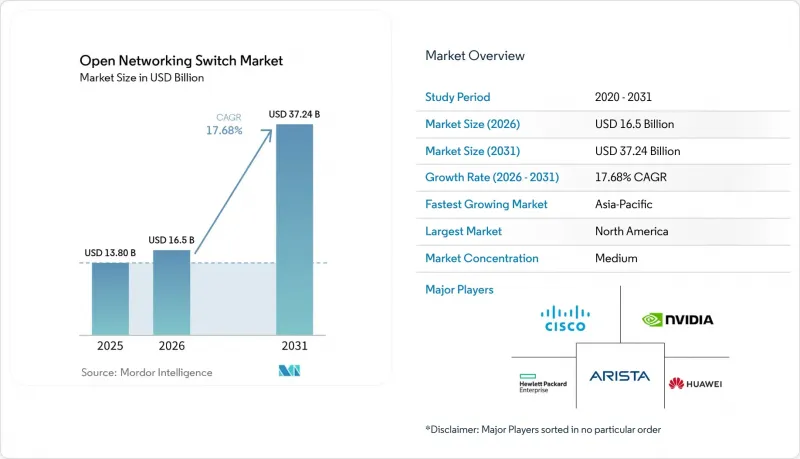
根據 Mordor Intelligence 預測,開放式網路交換器市場規模將從 2025 年的 138 億美元和 2026 年的 165 億美元成長到 2031 年的 372.4 億美元,2026 年至 2031 年的複合年成長率為 17.68%。
本報告按連接埠速度(1 GbE 或更低、10–25 GbE 及其他)、外形尺寸(固定配置、模組化底盤及其他)、最終用戶(超大規模雲端供應商、通訊業者及其他)、網路作業系統(專有商用 NOS、基於 SONiC 的 NOS 及其他)和地區進行細分。市場預測以美元 (USD) 為單位。
全球開放式網路交換器市場趨勢與洞察
面向 GenAI叢集的超大規模資料中心業者基礎設施擴展
生成式人工智慧訓練工作負載正在重塑資料中心網路設計,推動了對支援GPU間全連接通訊且無延遲瓶頸的交換器的需求。 2025年的大規模部署將使用數十萬個人工智慧加速器,每個加速器都需要雙800GbE上行鏈路,以在超過16,000個節點的叢集中維持亞毫秒級的聚合通訊。這種轉變有利於採用高基數脊交換器的非阻塞Clos拓撲結構,從而透過使用白盒硬體和解耦作業系統實現更有效率的橫向擴展。 2026年的平行部署將擴展到10萬個透過基於SONiC的交換器互連的人工智慧晶片,從而縮短硬體更新周期。由此帶來的資本密集度增加正在推動市場集中化,使超大規模資料中心業者能夠攤銷基礎設施成本,而小規模供應商則面臨利潤率下降以及退出人工智慧基礎設施業務的風險。
400G 和 800G 連接埠的部署迅速增加
從 100 GbE 到 400 GbE 和 800 GbE 乙太網路的過渡,代表了資料中心歷史上最快的連接埠速度升級週期,將部署時間從七年縮短至近三年。 IEEE 802.3df-2024 標準建立了 400 Gbps 和 800 Gbps 層之間的互通性,加速了多廠商生態系統的成熟。新型交換器晶片在單一先進節點晶片上整合了多達 64 個 800 GbE 端口,將每個端口的功耗從傳統 400 GbE 設計的 12 瓦降低至約 8.5 瓦。此平行晶片平台可提供 51.2 Tbps 的吞吐量,目標部署在超大規模資料中心業者資料中心通訊業者覆蓋範圍有限的營運商邊緣環境中。 800 GbE 的經濟可行性取決於光學模組的價格能否從 2025 年的 3,500 美元降至 2028 年的 1,500 美元以下,從而實現總成本的持平。
乙太網路PHY的功率密度瓶頸超過1.6T
物理層訊號傳輸速率超過 1.6 Tbps 時,散熱能力受到限制,傳統風冷無法滿足需求,迫使架構調整,增加系統複雜性和成本。根據正在製定的 200 Gbps 至 1.6 Tbps 新標準,電控 SerDes 的功耗呈非線性成長,目前每個 800 GbE 連接埠的功耗已達到約 18 瓦,預計在 1.6 Tbps 速率下,若不光學整合,功耗將超過 35 瓦。早期部署的液冷交換系統已證明其單板散熱能力超過 1.8 千瓦,但需要冷卻水基礎設施,而目前只有不到 15% 的資料中心具備此基礎設施,限制了其短期擴充性。
共封裝光學模組透過省去電重定時器,可將功耗降低近70%,從而提高結構效率,但製造流程的限制仍是一大障礙。先進光學模組封裝的良率低於60%,這意味著在2028年之前,它們在成本上無法與插入式光學模組競爭。這一瓶頸在需要高光電配置的AI交換架構中特別突出,例如64個800 GbE端口或32個1.6 Tbps端口。因此,通訊業者可能會推遲下一代升級,將其400 GbE平台的生命週期延長18-24個月,同時等待溫度控管和生產良率的改善。
細分市場分析
到2025年,200-400 GbE頻寬將佔開放式網路交換器市場的49.62%。這反映了受雲端原生和人工智慧工作負載推動的資料中心流量成長所驅動的,傳統100 GbE頻寬的快速轉型。由於光學模組模組和交換晶片在成本、能源效率和生態系統成熟度方面實現了良好的平衡,該頻寬將繼續成為銷售的主要驅動力。然而,受GPU叢集對低於250奈秒的脊延遲以及高Radix無阻塞架構的需求驅動,預計800 GbE以上的頻寬將以24.62%的複合年成長率成長。大規模部署表明,Radix64架構是維持東西向流量而不因過載而導致效能下降的最佳拓撲結構。
800 GbE部署的經濟轉折點與光學模組的成本趨勢和能源效率提升密切相關。整合至下一代交換器矽晶中的共封裝光學模組架構,可將單埠功耗從8.5 W降低至約5.2 W,同時在標準散熱設計框架內實現高密度64埠800 GbE配置。這些改進還釋放了面板容量,從而提高了機架級吞吐量密度。然而,要實現廣泛應用,光學模組價格能否降至1,500美元以下。這是與即插即用型替代方案實現總體成本持平,並支援大規模企業級和超大規模引進週期的必要閾值。
到 2025 年,固定配置交換器將佔總銷售額的 57.39%。這反映了它們的成本效益、易於部署以及對主流雲端和企業工作負載的適用性。然而,隨著基礎設施需求轉向高密度、低延遲的 GPU 互連,AI Fabric 設備正以 22.34% 的複合年成長率快速成長。諸如 NVLink over Ethernet 等新規範需要 102.4 Tbps 的 Radix 64 脊架構,這超出了 1RU 固定系統的物理和散熱極限。早期 1.6 Tbps 水冷原型機的單板散熱量約為 1.8 kW,凸顯了傳統風冷模組化底盤設計在下一代 AI 環境中將面臨擴展性限制的原因。
解耦式模組化產品定位為混合模式,兼具底盤級柔軟性和白盒成本結構。該平台基於先進的路由晶片,可提供高達 14.4 Tbps 的吞吐量,滿足優先考慮 15 年長生命週期基礎設施的中型通訊業者的需求。這種方法允許在插槽層級進行增量升級,同時保持與開放式網路作業系統的相容性。儘管競爭日益激烈,但由於供應商供應有限和高效能要求,AI Fabric 交換器的毛利率預計在短期內仍將保持在 40% 左右,不過標準化工作未來可能會導致價格壓力增加。
區域分析
預計到2025年,北美將佔全球收入的41.34%,這主要得益於維吉尼亞、奧勒岡州和德克薩斯州等關鍵資料中心樞紐的超大規模資料中心業者資料中心營運商的集中佈局。該地區受益於縮短至24個月的基礎設施更新周期以及800 GbE的早期應用,從而能夠快速擴展人工智慧和雲端工作負載。儘管組件成本不斷上漲,但高密度人工智慧架構的部署仍然支撐著市場需求,因為營運商優先考慮效能和延遲,而非短期成本效益。這一趨勢正在鞏固北美的結構性領先地位,超超大規模資料中心業者主導技術轉型,影響供應商的藍圖,並在全球同行之前加速了下一代交換架構的商業化進程。
預計到2031年,亞太地區將以18.32%的複合年成長率成長,主要得益於人工智慧基礎設施領域的大規模投資和超大規模部署。部署規模正擴展到多達10萬個加速器組成的集群,這些加速器透過基於SONiC的交換器互連,這表明解耦網路模型的採用率正在激增。中國和印度政府主導的供應鏈本地化可望促進國內ASIC晶片的研發,並降低對現有半導體供應商的依賴。這種區域性轉變將增強區域生態系統,同時也將為現有供應商帶來競爭壓力,尤其是在主權雲端計畫和資料本地化要求持續影響基礎設施投資策略的情況下。
歐洲面臨能源成本飆升和監管複雜性帶來的結構性限制,與北美和亞太地區相比,超大規模部署受到限制。然而,通訊業者的5G傳輸網路部署正在推動對開放式網路解決方案的穩定需求,部分抵消了企業市場的放緩。中東和非洲仍處於起步階段,主要得益於一些國家超大規模資料中心業者的進入,但企業主導有限。在南美洲,巴西出現了區域成長,對延遲敏感的金融科技工作負載推動了對高速交換的需求,但更廣泛的區域擴張取決於宏觀經濟穩定性和基礎設施投資能力。
其他好處:
- Excel格式的市場預測(ME)表
- 3個月的分析師支持
目錄
第1章:引言
- 研究假設和市場定義
- 調查範圍
第2章:調查方法
第3章執行摘要
第4章 市場狀況
- 市場概覽
- 市場促進因素
- 面向生成式人工智慧叢集的超大規模資料中心業者基礎架構擴展
- 400G 和 800G 連接埠的部署正在迅速增加。
- 加速採用軟硬體解耦架構
- 開放原始碼作業系統(SONiC、Open-NOS)的成熟度
- 制定廠商中立的晶片藍圖,以實現多廠商生態系統
- 下一代交換器中的高效能晶片和液冷技術
- 市場限制因素
- 乙太網路PHY的功率密度瓶頸超過1.6T
- 碎片化的網路作業系統認證和支援生態系統
- 單一供應商主導ASIC市場對供應鏈的影響。
- 增強開放式網路協定堆疊安全性的挑戰
- 產業價值鏈分析
- 監理情勢
- 技術展望
- 宏觀經濟因素對市場的影響
- 波特五力分析
第5章 市場規模與成長預測
- 連接埠速度
- 1 GbE 或更低
- 10~25 GbE
- 40~100 GbE
- 200~400 GbE
- 800 GbE 或更高
- 按外形規格
- 固定配置交換機
- 模組化底盤開關
- 去中心化模組化平台
- 高密度人工智慧結構開關
- 最終用戶
- 超大規模雲端供應商
- 通訊業者
- 大公司
- 小型企業
- 政府/公共部門
- 網路作業系統
- 專有商業NOS
- 基於SONiC的NOS
- Cumulus Linux 系統
- P4 可程式設計/SDN 網路作業系統
- 自主研發的NOS
- 按地區
- 北美洲
- 美國
- 加拿大
- 墨西哥
- 南美洲
- 巴西
- 阿根廷
- 其他南美國家
- 歐洲
- 英國
- 德國
- 法國
- 義大利
- 西班牙
- 俄羅斯
- 其他歐洲國家
- 亞太地區
- 中國
- 日本
- 印度
- 韓國
- 澳洲
- 新加坡
- 其他亞太國家
- 中東
- 沙烏地阿拉伯
- 阿拉伯聯合大公國
- 以色列
- 土耳其
- 其他中東國家
- 非洲
- 南非
- 奈及利亞
- 肯亞
- 埃及
- 其他非洲國家
- 北美洲
第6章 競爭情勢
- 市場集中度
- 策略趨勢
- 市佔率分析
- 公司簡介
- Edgecore Networks Corporation
- Accton Technology Corporation
- Quanta Cloud Technology LLC
- Celestica Inc.
- Delta Electronics, Inc.
- Alpha Networks Inc.
- Super Micro Computer, Inc.
- UfiSpace Co., Ltd.
- Foxconn Interconnect Technology Limited
- Inventec Corporation
- Lanner Electronics Inc.
- Wistron NeWeb Corporation
- Advantech Co., Ltd.
- Flex Ltd.
- Fiberhome Telecommunication Technologies Co., Ltd.
- Ruijie Networks Co., Ltd.
- NoviFlow Inc.
- Netberg Ltd.
- Penguin Computing, Inc.
第7章 市場機會與未來展望
According to Mordor Intelligence, the open networking switch market size is projected to expand from USD 13.8 billion in 2025 and USD 16.5 billion in 2026 to USD 37.24 billion by 2031, registering a CAGR of 17.68% between 2026 and 2031.
This report is Segmented by Port Speed (1 GbE and Below, 10 To 25 GbE, and More), Form Factor (Fixed Configuration, Modular Chassis, and More), End-User (Hyperscale Cloud Providers, Telecommunications Operators, and More), Network Operating System (Proprietary Commercial NOS, SONiC-Based NOS, and More), and Geography. The Market Forecasts are Provided in Terms of Value (USD).
Global Open Networking Switch Market Trends and Insights
Hyperscaler Build-outs for GenAI Clusters
Generative AI training workloads are reshaping data center network design, increasing demand for switches that support all-to-all GPU communication without latency bottlenecks. Large-scale deployments in 2025 used hundreds of thousands of AI accelerators, each requiring dual 800 GbE uplinks to sustain sub-millisecond collective communication across clusters with more than 16,000 nodes. This shift favors non-blocking Clos topologies with high-radix spine switches, which scale more efficiently using white-box hardware and disaggregated operating systems. Parallel deployments in 2026 scaled toward 100,000 AI chips interconnected via SONiC-based switches, enabling faster hardware refresh cycles. The resulting capital intensity is driving market concentration, as hyperscalers amortize infrastructure costs, while smaller providers face margin compression or potential exit from AI infrastructure.
Surge in 400G and 800G Port Deployments
The transition from 100 GbE to 400 GbE and 800 GbE Ethernet marks the fastest port-speed upgrade cycle in data center history, compressing adoption timelines from 7 years to nearly 3 years. The IEEE 802.3df-2024 standard established interoperability for 400 Gbps and 800 Gbps layers, accelerating the maturity of the multi-vendor ecosystem. New switch silicon integrates up to 64 800 GbE ports on a single advanced-node die, reducing per-port power consumption to roughly 8.5 watts, down from 12 watts in prior 400 GbE designs. Parallel silicon platforms delivering 51.2 Tbps throughput are targeting telco edge deployments where hyperscaler-focused vendors have limited presence. The economic viability of 800 GbE depends on optics pricing declining from USD 3,500 in 2025 to below USD 1,500 by 2028 to reach total cost parity.
Ethernet PHY Power Density Bottlenecks above 1.6 T
Physical-layer signaling at 1.6 Tbps and beyond is constrained by thermal dissipation limits that conventional air cooling cannot address, forcing architectural changes that increase system complexity and cost. Emerging standards under development for 200 Gbps to 1.6 Tbps reveal that electrical SerDes power consumption scales non-linearly, already reaching about 18 watts per 800 GbE port and projected to exceed 35 watts at 1.6 Tbps without optical integration. Early deployments of liquid-cooled switch systems demonstrate the ability to dissipate over 1.8 kilowatts per board, but require chilled-water infrastructure that is available in fewer than 15% of current data centers, limiting near-term scalability.
Co-packaged optics offer a structural efficiency gain by reducing optical module power consumption by nearly 70% through the elimination of electrical retimers, but manufacturing constraints remain a barrier. Advanced photonics packaging yields are below 60%, preventing cost competitiveness with pluggable optics before 2028. This bottleneck is most acute in AI fabric switches, where high-density configurations such as 64 ports of 800 GbE or 32 ports of 1.6 Tbps are required. As a result, operators may delay next-generation upgrades, extending the lifecycle of 400 GbE platforms by 18 to 24 months while awaiting improvements in thermal management and production yields.
Other drivers and restraints analyzed in the detailed report include:
- Accelerated Adoption of Disaggregated Hardware-Software Architectures
- Open-Source NOS Maturity (SONiC, Open-NOS)
- Fragmented NOS Certification and Support Ecosystem
For complete list of drivers and restraints, kindly check the Table Of Contents.
Segment Analysis
The 200 to 400 GbE tier accounted for 49.62% of the open networking switch market in 2025, reflecting rapid migration from legacy 100 GbE as data center traffic intensified with cloud-native and AI workloads. This band remains the volume anchor due to balanced cost, power efficiency, and ecosystem maturity across optics and switching silicon. However, the 800 GbE and above tier is projected to grow at a 24.62% CAGR, driven by GPU clusters requiring sub-250 ns spine latency and high-radix, non-blocking architectures. Large-scale deployments have validated radix-64 fabrics as the preferred topology for sustaining east-west traffic without oversubscription penalties.
The economic inflection point for 800 GbE adoption is closely linked to the trajectories of optics costs and power-efficiency improvements. Co-packaged optics architectures integrated into next-generation switch silicon reduce per-port power consumption from 8.5 W to approximately 5.2 W, while enabling dense 64-port 800 GbE configurations within standard thermal envelopes. These gains also free faceplate capacity, improving rack-level throughput density. However, widespread adoption depends on optical module pricing declining below USD 1,500 by 2028, a threshold required to achieve total cost parity with pluggable alternatives and unlock large-scale enterprise and hyperscale deployment cycles.
Fixed configuration switches accounted for 57.39% of revenue in 2025, reflecting their cost efficiency, ease of deployment, and suitability for mainstream cloud and enterprise workloads. However, AI fabric appliances are expanding at a 22.34% CAGR as infrastructure requirements shift toward high-density, low-latency GPU interconnects. Emerging specifications such as NVLink-over-Ethernet require 102.4 Tbps radix-64 spine architectures that exceed the physical and thermal limits of 1RU fixed systems. Early 1.6 Tbps liquid-cooled prototypes demonstrate heat dissipation levels near 1.8 kW per board, underscoring why traditional air-cooled modular chassis designs face scaling constraints in next-generation AI environments.
The disaggregated modular segment is positioning itself as a hybrid model, combining chassis-level flexibility with white-box cost structures. Platforms built on advanced routing silicon deliver up to 14.4 Tbps throughput, addressing mid-tier telecom operators that prioritize long lifecycle infrastructure spanning 15 years. This approach enables incremental slot-level upgrades while maintaining compatibility with open networking operating systems. Despite increasing competition, AI fabric switches are expected to sustain gross margins near 40% in the near term due to limited supplier availability and high performance requirements, although standardization initiatives are likely to compress pricing over time.
Complete Report Scope:
- By Port Speed
- 1 GbE and Below
- 10-25 GbE
- 40-100 GbE
- 200-400 GbE
- 800 GbE and Above
- By Form Factor
- Fixed Configuration Switches
- Modular Chassis Switches
- Disaggregated Modular Platforms
- High-Density AI Fabric Switches
- By End-User
- Hyperscale Cloud Providers
- Telecommunications Operators
- Large Enterprises
- Small and Medium Enterprises
- Government and Public Sector
- By Network Operating System
- Proprietary Commercial NOS
- SONiC-based NOS
- Cumulus Linux-based NOS
- P4-Programmable / SDN NOS
- In-house Developed NOS
- By Geography
- North America
- United States
- Canada
- Mexico
- South America
- Brazil
- Argentina
- Rest of South America
- Europe
- United Kingdom
- Germany
- France
- Italy
- Spain
- Russia
- Rest of Europe
- Asia-Pacific
- China
- Japan
- India
- South Korea
- Australia
- Singapore
- Rest of Asia-Pacific
- Middle East
- Saudi Arabia
- United Arab Emirates
- Israel
- Turkey
- Rest of Middle East
- Africa
- South Africa
- Nigeria
- Kenya
- Egypt
- Rest of Africa
- North America
Geography Analysis
North America accounted for 41.34% of 2025 revenue, driven by hyperscaler concentration in major data center hubs across Virginia, Oregon, and Texas. The region benefits from accelerated 24-month infrastructure refresh cycles and early adoption of 800 GbE, enabling rapid scaling of AI and cloud workloads. High-density AI fabric deployments sustain demand despite component cost inflation, as operators prioritize performance and latency over near-term cost efficiency. This dynamic reinforces North America's structural leadership, with hyperscalers dictating technology transitions, influencing vendor roadmaps, and accelerating the commercialization of next-generation switching architectures ahead of global peers.
Asia-Pacific is projected to grow at an 18.32% CAGR through 2031, supported by large-scale investments in AI-ready infrastructure and hyperscale expansion. Deployments are scaling toward clusters of up to 100,000 accelerators interconnected via SONiC-based switches, indicating strong adoption of disaggregated networking models. Government-led supply chain localization in China and India is expected to stimulate domestic ASIC development, potentially reducing dependence on incumbent silicon providers. This regional shift introduces competitive pressure on established suppliers while strengthening local ecosystems, particularly as sovereign cloud initiatives and data localization requirements continue to influence infrastructure investment strategies.
Europe faces structural constraints from elevated energy costs and regulatory complexity, limiting hyperscale expansion relative to North America and Asia-Pacific. However, telecom-driven deployments in 5G transport networks provide stable demand for open networking solutions, partially offsetting enterprise slowdown. The Middle East and Africa remain early-stage markets, primarily driven by hyperscaler entry points in select countries, with limited enterprise adoption. South America shows localized growth in Brazil, where latency-sensitive fintech workloads are driving demand for higher-speed switching, though broader regional expansion remains contingent on macroeconomic stability and infrastructure investment capacity.
- Edgecore Networks Corporation
- Accton Technology Corporation
- Quanta Cloud Technology LLC
- Celestica Inc.
- Delta Electronics, Inc.
- Alpha Networks Inc.
- Super Micro Computer, Inc.
- UfiSpace Co., Ltd.
- Foxconn Interconnect Technology Limited
- Inventec Corporation
- Lanner Electronics Inc.
- Wistron NeWeb Corporation
- Advantech Co., Ltd.
- Flex Ltd.
- Fiberhome Telecommunication Technologies Co., Ltd.
- Ruijie Networks Co., Ltd.
- NoviFlow Inc.
- Netberg Ltd.
- Penguin Computing, Inc.
Additional Benefits:
- The market estimate (ME) sheet in Excel format
- 3 months of analyst support
TABLE OF CONTENTS
1 INTRODUCTION
- 1.1 Study Assumptions and Market Definition
- 1.2 Scope of the Study
2 RESEARCH METHODOLOGY
3 EXECUTIVE SUMMARY
4 MARKET LANDSCAPE
- 4.1 Market Overview
- 4.2 Market Drivers
- 4.2.1 Hyperscaler Build-outs for GenAI Clusters
- 4.2.2 Surge in 400G and 800G Port Deployments
- 4.2.3 Accelerated Adoption of Disaggregated Hardware-Software Architectures
- 4.2.4 Open-Source NOS Maturity (SONiC, Open-NOS)
- 4.2.5 Vendor-Neutral Silicon Road-maps Enabling Multi-Vendor Ecosystems
- 4.2.6 Energy-Efficient Chiplets and Liquid-Cooling in Next-Gen Switches
- 4.3 Market Restraints
- 4.3.1 Ethernet PHY Power Density Bottlenecks above 1.6 T
- 4.3.2 Fragmented NOS Certification and Support Ecosystem
- 4.3.3 Supply-Chain Exposure to Single-Vendor ASIC Dominance
- 4.3.4 Security Hardening Gaps in Open Networking Stacks
- 4.4 Industry Value -Chain Analysis
- 4.5 Regulatory Landscape
- 4.6 Technological Outlook
- 4.7 Impact of Macroeconomic Factors on the Market
- 4.8 Porters Five Forces Analysis
- 4.8.1 Bargaining Power of Suppliers
- 4.8.2 Bargaining Power of Buyers
- 4.8.3 Threat of New Entrants
- 4.8.4 Threat of Substitutes
- 4.8.5 Intensity of Competitive Rivalry
5 MARKET SIZE AND GROWTH FORECASTS (VALUE)
- 5.1 By Port Speed
- 5.1.1 1 GbE and Below
- 5.1.2 10-25 GbE
- 5.1.3 40-100 GbE
- 5.1.4 200-400 GbE
- 5.1.5 800 GbE and Above
- 5.2 By Form Factor
- 5.2.1 Fixed Configuration Switches
- 5.2.2 Modular Chassis Switches
- 5.2.3 Disaggregated Modular Platforms
- 5.2.4 High-Density AI Fabric Switches
- 5.3 By End-User
- 5.3.1 Hyperscale Cloud Providers
- 5.3.2 Telecommunications Operators
- 5.3.3 Large Enterprises
- 5.3.4 Small and Medium Enterprises
- 5.3.5 Government and Public Sector
- 5.4 By Network Operating System
- 5.4.1 Proprietary Commercial NOS
- 5.4.2 SONiC-based NOS
- 5.4.3 Cumulus Linux-based NOS
- 5.4.4 P4-Programmable / SDN NOS
- 5.4.5 In-house Developed NOS
- 5.5 By Geography
- 5.5.1 North America
- 5.5.1.1 United States
- 5.5.1.2 Canada
- 5.5.1.3 Mexico
- 5.5.2 South America
- 5.5.2.1 Brazil
- 5.5.2.2 Argentina
- 5.5.2.3 Rest of South America
- 5.5.3 Europe
- 5.5.3.1 United Kingdom
- 5.5.3.2 Germany
- 5.5.3.3 France
- 5.5.3.4 Italy
- 5.5.3.5 Spain
- 5.5.3.6 Russia
- 5.5.3.7 Rest of Europe
- 5.5.4 Asia-Pacific
- 5.5.4.1 China
- 5.5.4.2 Japan
- 5.5.4.3 India
- 5.5.4.4 South Korea
- 5.5.4.5 Australia
- 5.5.4.6 Singapore
- 5.5.4.7 Rest of Asia-Pacific
- 5.5.5 Middle East
- 5.5.5.1 Saudi Arabia
- 5.5.5.2 United Arab Emirates
- 5.5.5.3 Israel
- 5.5.5.4 Turkey
- 5.5.5.5 Rest of Middle East
- 5.5.6 Africa
- 5.5.6.1 South Africa
- 5.5.6.2 Nigeria
- 5.5.6.3 Kenya
- 5.5.6.4 Egypt
- 5.5.6.5 Rest of Africa
- 5.5.1 North America
6 COMPETITIVE LANDSCAPE
- 6.1 Market Concentration
- 6.2 Strategic Moves
- 6.3 Market Share Analysis
- 6.4 Company Profiles (includes Global Level Overview, Market Level Overview, Core Segments, Financials as available, Strategic Information, Market Rank/Share, Products and Services, Recent Developments)
- 6.4.1 Edgecore Networks Corporation
- 6.4.2 Accton Technology Corporation
- 6.4.3 Quanta Cloud Technology LLC
- 6.4.4 Celestica Inc.
- 6.4.5 Delta Electronics, Inc.
- 6.4.6 Alpha Networks Inc.
- 6.4.7 Super Micro Computer, Inc.
- 6.4.8 UfiSpace Co., Ltd.
- 6.4.9 Foxconn Interconnect Technology Limited
- 6.4.10 Inventec Corporation
- 6.4.11 Lanner Electronics Inc.
- 6.4.12 Wistron NeWeb Corporation
- 6.4.13 Advantech Co., Ltd.
- 6.4.14 Flex Ltd.
- 6.4.15 Fiberhome Telecommunication Technologies Co., Ltd.
- 6.4.16 Ruijie Networks Co., Ltd.
- 6.4.17 NoviFlow Inc.
- 6.4.18 Netberg Ltd.
- 6.4.19 Penguin Computing, Inc.
7 MARKET OPPORTUNITIES AND FUTURE OUTLOOK
- 7.1 White-Space and Unmet-Need Assessment

 2026年全球開放式去程傳輸開關市場報告
 網路交換器市場 - 全球預測,2026-2032年
 網路交換器市場:市場洞察、競爭格局及市場預測(2033 年)
 工業網路交換器:市場佔有率分析、產業趨勢與統計、成長預測(2026-2031)網路交換器:市場佔有率分析、產業趨勢與統計、成長預測(2026-2031)環境適應性網路交換器:市場佔有率分析、產業趨勢與統計及成長預測(2026-2031 年)
 網路交換器市場:按交換器類型、應用和地區分類2026年全球網路交換器市場報告
 網路交換器市場:2025-2029 年全球市場
 2030 年網路交換器市場預測:按交換器類型、交換容量、連接埠速度、企業規模、最終用戶和地區進行的全球分析